
Posts How tactical network automation can help banks respond to a changing financial sector

How tactical network automation can help banks respond to a changing financial sector

In this Article

The financial services sector has undergone seismic change – even well-established institutions are feeling the pressure from leaner margins and agile new competitors. In response, they’re hungry for new ways to drive efficiency, create revenue streams, and offer enhanced value to customers.

That dual demand – to unlock innovation and agility while cutting process costs – lands squarely at the door of IT.

A smarter, leaner finance sector needs responsive, cost-effective IT

At CACI, our specialists are used to helping financial institutions to optimise their network infrastructure. And we see every day how smart, tactical use of network automation can play a role in meeting the challenge by reducing workloads, improving quality, and meeting regulatory standards.

Automated switch checks improve visibility and accelerate ACI migration

It’s perhaps easiest to see the impact of tactical network automation in an accelerating and de-risking a major project, like network migration.

Next-generation data centre infrastructure is a key foundation for modern, data-driven banking. But achieving that transformation can often encounter unexpected and time-consuming obstacles.

For example, switching from a legacy system Cisco Application Centric Infrastructure can mean executing thousands of commands across hundreds of devices to define the migration requirements of each VLAN.

Instead of doing this manually, we built a script in Python 3, combining community-built packages to connect to each switch, translate the device output, and arrange the data into an easily manageable database.

It quickly extracted the information needed for migration planning and execution – preventing significant project delays, while eliminating the risk of human error.

MAC address checks de-risk migration in advance

Likewise, with ACI each IP address can correspond to one MAC address only. Any switches in the legacy infrastructure that exceed this limit could have a catastrophic effect. Finding them in advance of a migration is crucial – but extremely time-consuming. And missing one is a significant risk.

So on-site professionals from CACI built a solution to attach to each switch and create a report detailing which boxes have two MAC addresses or more.

Again, the automation saves potentially hundreds of engineer hours, and gives confidence that the migration can proceed without the risk of human error.

Self-service port provisioning saves hours and improves service

BAU processes can also benefit from automation – and here, the impact builds cumulatively over time.

For example, server deployment teams rely on fast, accurate port provisioning. As well as the initial configuration, each request requires extensive testing, and when completed manually the work can total dozens of engineer hours per week.

So we developed a proof of concept for a self-service system, where requests are made through a front-end web portal, but the provision and testing are automated.

As well as releasing engineer time and reducing risk, the solution prevents internal clients waiting for their request, accelerating their own work in turn. It also eliminates variations in naming and other standards, and documents each process for compliance purposes.

Bulk element configuration proves compliance without headcount

That compliance element demonstrates why automation is such a good fit for a regulated industry like finance. Because it can do more than just save time and headcount; it can provide documentation.

Each script in an institution’s library serves to document network requirements to be followed by engineers in future, and prove compliance with the relevant network engineering, security, and data sovereignty standards. And because the program is created to fit the bank’s own policies, conformity is built in.

Meanwhile, by eliminating manual configuration errors that could bring down key production environments, automation helps to avoid serious service outages that could result in sanctions from the financial conduct authority.

Quick, tactical wins with a long-term business impact

In these and dozens of other ways, we’ve deployed network automation to solve tactical issues, save financial institutions time and money, and facilitate faster, smarter working.

But the long-term cumulative effect is even more significant. The client always owns the IP in each script we’ve written and the program performs its task repeatably. That means the automation will go on saving time in future – so every solution we create makes the organisation that much more efficient and effective – ready to compete in tomorrow’s financial market.

If you’d like to discuss how we can use network automation to ease your migration, streamline your processes, or make you more efficient, please contact our Network Services experts today.

Retail experts’ post-lockdown predictions

In this Article

Prospects for 2021 may seem uncertain in many retail markets. But there are clear trends and opportunities emerging, according to the specialists in CACI’s retail analytics practice. They’ve been working with retailers and studying market intelligence throughout the pandemic, so they have a bird’s eye view of customer and retailer activity and the forces that are driving it.

Like most analysts, they agree that many of the fastest emerging trends were already becoming established before the pandemic took hold. Covid-19 and the diverse consequences of lockdown have accelerated technology development and the evolution of consumer behaviour. Although some people have become starkly digitally isolated, for many million, the digital divide has been narrowed. Consumers have had to embrace digital ways to work and learn remotely and to socialise, engage and transact online.

Sudden and extreme online demand has created pressure on formerly small-scale digital operations. But our three highlighted trends present opportunities for retailers that are able and willing to embrace a sophisticated digital or hybrid model, as economies and nations emerge from lockdown.

TREND 1: HYPER-PERSONALISATION AND HYPER-LOCALISATION

Retail intelligence expert Chris Thompson is Director of Location Analytics at CACI.

t’s clear that by late 2021, data will be integral for retailers to hear the full range of consumer voices and understand their expectations. As a result, hyper-personalisation and hyper-localisation are going to gain momentum rapidly.

What do these terms mean? Hyper-personalisation means creating communications content that we know is directly relevant to the customer – telling them about things they’re already interested in or are likely to want or need next. Hyper-localisation means sending relevant messages to the customer at the right time and in the right place, seizing the moment when it’s convenient or essential to purchase.

When high streets and outlets can re-open to shoppers in person, technologies in-store will recognise that the customer has arrived or is nearby and will suggest products and offers to consumers at the point of consideration. That’s both hyper-local and hyper-personalised.

It all hinges on making sense of the rich and varied customer data that’s more available than ever, because of the swing to digital shopping.

We’re already working with retailers to give them more precise consumer information through the latest data science technologies, so they can diversify format, range and omni-channel services to match local demand precisely.

As retailers look to re-engage customers, the trend will accelerate. Market share has been massively disrupted: real-time, hyper-targeted activity will help retailers stand out and create higher engagement and conversion across all channels.

TREND 2: AUGMENTED REALITY

Hana Butt is a CACI Consultant who specialises in data insight projects for retail clients.

Augmented reality (AR) is going to differentiate retailers as retail markets re-adjust after lockdown. From the warehouse to the in-store virtual changing room, AR and AI technologies are already bridging the gap between physical and digital retail experiences.

Although many shoppers are desperate to get back onto the high street, some will be more cautious, and others will remain loyal converts to digital channels. They’ve embraced the advantages of virtual retail: a great shopping experience with excellent service, proven security and a controllable and healthy environment in their own chosen surroundings.

Not all online retail is like this of course, but the best in the industry have worked hard, particularly during the last year or so, to create an immersive virtual shopping experience. They’ve got the basics right already – good site design, range, availability and ease of use are all standard shopper expectations. But AR and AI help these innovative retail brands to surprise and delight consumers, moving the experience from functional to truly enjoyable. Sephora’s mobile app allows consumers to try out lipstick using the front camera – 45 million people have had a go!

For customers who are happy to be back in-store, AR will help them find information about products as they browse. they might scan a qr code or bar code on the shelf to access rich content immediately that shows the product in action or answers consumer questions.

AI and AR will create convergence between the online and in-store experience – the best of both worlds in both places, if you like.

TREND 3: CUSTOMER EXPERIENCE, ENGAGEMENT AND TRUST

Managing Consultant Chris Lidington helps CACI clients apply insight in the convenience and retail sectors.

There’s been a huge online sales boom during the pandemic – but consumers aren’t necessarily behaving as you might imagine in terms of their shopping choices. Our own Super HALO research reveals that they are staying more loyal to brands they know and trust through a store network.

At first we thought that the shift to online shopping would be underpinned by deal-hunting and a price-driven mindset – after all, it’s easy compare and shop around online. But the brands we engage with are gaining full price sales and observe that consumers are coming directly to their online stores.

It’s not just deal fatigue. Consumers value experience and convenience. For instance, if they’re buying Levi’s jeans, they know that the official Levi’s store will have the full range of current styles and the experience will be reassuring and positive. They trust the brand to provide a quality end-to-end experience, including reliable delivery. Rather than going away to find the same product cheaper elsewhere, they’re choosing to buy there and then.

Brands that are making the most of apps and mobile technology are also seeing a good response from consumers, who like the convenience and utility.

A good example of genuine added value comes from Under Armour, the sports brand. Connecting their retail operation to their running app, they can remind consumers when their trainers have covered enough miles to need replacing and show them the best new model for their needs.

This is making the most of customer engagement – giving the consumer information or a service that they value through natural interaction. The consumer sees the benefit and uses the app regularly, feeding data back to the retailer so they can further build trust by recommending desirable and relevant products. It’s a virtuous circle: the continuing engagement gives the retailer truly personalised insight that keeps pace with the consumer’s changing needs and preferences, making interactions ever more useful and meaningful to the consumer.


If you’d like to find out about technologies and approaches for your post-lockdown retail success, talk to our experts. Contact Chris Thompson CThompson@caci.co.uk Hana Butt hbutt@caci.co.uk or Chris Lidington clidington@caci.co.uk for more insights and advice.

Three opportunities in Food Box delivery

In this Article

Looking back at 2020 and we can clearly see that some sectors experienced a lot of pain while others have thrived and grew hugely in demand. A black swan event like a pandemic could not have been predicted, but even before that a shift to online shopping was gaining momentum for years.

Last year businesses that were digitally native have fared a lot better than those that relied purely on the physical presence in neighbourhoods and high streets. In Grocery we have seen propped up demand across the board with the unfortunate shut down of the leisure sector, but online delivery and local convenience channels have done especially well.

Food box delivery concept is driven by three big trends in grocery sector, a demand for convenient solutions, personalisation and being able to transact online. This offering has been a part of the grocery channel for a while but has really showed how uniquely valuable it is in 2020.

Our recent consumer survey suggests that in 2020 16.5% of respondents ordered a food delivery box and 56% of those who use food boxes order at least fortnightly. Operators that were able to scale up the delivery infrastructure won big in 2020, gaining that initial share of the market.

We can now see how the competition in the space is intensifying, food box delivery operators are working hard on differentiating the offer and capturing the desired section of the market. Food box delivery services are now serving a variety of consumer needs, from routine grocery top ups, to value boxes, to unique dining in experiences.

2021 has already seen Morrison’s move into this space with £30 food box offer targeting families, Booths launching its ‘Let’s Cook’ boxes and Parsley Box securing over £5.2m to expand and target baby boomers.

It is clear that food box delivery services will keep growing in importance in 2021. from our recent shopper survey, we know that 18% of customers plan to use food delivery boxes more in the next 12 months with this jumping to a quite extraordinary 31% in London showing the regional variation in demand for food boxes.

It should be acknowledged that different shopper types have different demands and criteria of choice when it comes to choosing whether to use a food box and who to purchase from.

For example, the grocery shopper type Families on a Budget who are larger families with multiple, often younger, children living at home plan to use more delivery boxes going forward than the UK average. They typically shop at retailers such as Morrison’s, Asda and Iceland so Morrison’s new family food box offering will have great appeal to these shopper types.

In contrast younger, affluent shoppers are seeking health-conscious choices and inspiration in their decision to purchase a food box leaning to brands such as Mindful Chef to fulfil this mission.

Three challenges for the food box delivery sector to solve in 2021

The pandemic has undoubtedly caused a surge in demand as we seek alternative ways of both treating ourselves whilst restaurants are closed and getting our groceries whilst supermarket visits are kept to a minimum.

In fact, 38% of those ordering food delivery boxes said one of the main reasons for doing so was to avoid going to the supermarket. The next 6-12 months will be crucial for companies looking to grow a loyal customer base to emerge as a larger sector at the end of the pandemic.

As the risk factors of supermarkets begin to decrease food box delivery companies will need to tackle a number of obstacles to remain successful. Here are the three main areas to focus on to drive further growth in the sector in 2021:

Laser focus on customers

Customers desire personalisation and food box delivery companies are in a unique position where they can engage with customers and really understand what ingredients they like or dislike and manage the future interactions better. Real brand growth happens when new customers are added to the brand.

Finding new customers and knowing how to tailor your communications will be the winning recipe. But before finding new customers it is important to understand who exactly your current customers are, where else they shop, what brands they like and what is important to them.

Utilising the right technology to stand out and deliver intuitive customer experience

The world of customer data platforms and CRM systems is ever changing and to be at the top, companies need to upgrade and stay relevant. Modern solutions allow you to manage the customer data in real time, analyse campaign impact and code up new customers as soon as they have made a first purchase or inquiry.

Customers stumble across different parts of the journey, for example not checking out at the last moment or not finding the right product or promotion. It is important to have a tailored communication stream with those customers to convert them in to the first sale while keeping the acquisition costs low and to ensure the repeat purchase happens.

Keeping delivery costs low and serving customers in the most effective manner

Saving money and time on the very expensive logistics side of the business will allow for great ROI and ability to direct funds to customer acquisition and loyalty building. Effective route planning, holding the best-in-class datasets on addresses and providing precise instructions to delivery drivers will be one of the factors that differentiate the market leaders with runner ups.

Food box delivery is an extremely exciting space to be in and the market cap of this sector is expected to grow, however, like in any growing sector it attracts new entrants and the attention of large retailers and FMCG players.

Competition intensifies and with more than 20 players in the market some consolidation is imminent. At CACI we can help tackle the big three challenges that are now in front of the sector, building a strong customer understanding and growing organically through customer acquisition, getting the most out of complex data platforms and saving time and costs on logistics.

If you are interested in tackling the above challenges and outcompeting in the crowded space, please get in touch as we have developed unique solutions to unlock growth in the sector.

The future of betting and gaming

In this Article

As online betting and gaming grows in popularity, so does the exposure.

Exposure from customer safety (or exploitation), exposure from regulators and exposure from competition. Which leads to the fundamental question

How can operators continue to grow player value whilst navigating the consistent challenges around safer gambling, fierce market competition and regulatory compliance?

We have taken on these factors and explored the challenges (both existing and future) and opportunities they present, along with providing suggestions on how they can be most effectively anticipated and managed.

To address these challenges requires a combined approach based on strategy, data and technology – incorporating cutting edge technologies including central decisioning engines, marketing attribution models, data modelling, machine learning and AI-driven recommendations.

Within our whitepaper, CACI make 4 key predictions that will have big impacts on the future of betting and gaming, and how operators can ensure they anticipate the changes to turn these into big opportunities.

Find out how Covid-19 could change the marketing landscape, what extra factors to consider in the future of responsible gambling and how central decisioning might be the answer to a progressively more complex environment.

Download ‘The Future of Betting and Gaming’ CACI whitepaper today

The mitigation of unwanted bias in algorithms

In this Article

Unwanted Bias is prevalent in many current Machine Learning and Artificial Intelligence algorithms utilised by small and large enterprises alike. The reason for prefixing bias with “unwanted” is because bias is too often considered to be a bad thing in AI/ML, when in fact this is not always the case. Bias itself (without the negative implication) is what these algorithms rely on to do their job, otherwise what information could they use to categorise such data? But that does not mean all bias is equal.

Dangerous Reasoning

Comment sections throughout different articles and social media posts are plagued with people justifying the racial bias within ML/AI on light reflection and saliency. This dangerous reasoning can be explained for, perhaps, a very small percentage of basic computer vision programs out there but not frequently utilised ML/AI algorithms. The datasets utilised by these are created by humans, therefore prejudice in equals prejudice out. The data in, and training, thereafter, has a major part in creating bias. The justification doesn’t explain a multitude of other negative bias within algorithms, such as age and location bias within applying for a bank loan or gender bias in similar algorithms where it is also based on imagery.

Microsoft, Zoom, Twitter, and More

Tay

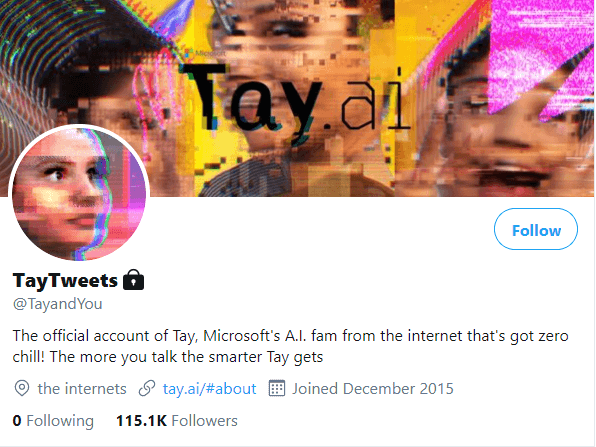
In March 2016, Microsoft released its brand-new Twitter AI, Tay. Within 16 hours after the launch, Tay was shut down.

Tay was designed to tweet similarly to that of a teenage American girl, and to learn new language and terms from the users of Twitter interacting with her. Within the 16 hours it was live, Tay went from being polite and pleased to meet everyone, to a total of over 96, 000 tweets of which most were reprehensible. These tweets ranged from anti-Semitic threats, racism and general death threats. Most of these tweets weren’t the AI’s own tweets and was just using a “repeat after me” feature implemented by Microsoft, which without a strong filter led to many of these abhorrent posts. Tay did also tweet some of her own “thoughts”, which were also offensive.

Tay demonstrates the need for a set of guidelines that should be followed, or a direct line of responsibility and ownership of issues that arise from the poor implementation of an AI/ML algorithm.

Tay was live for an extensive period, during this time many people saw and influenced Tay’s dictionary. Microsoft could have quickly paused tweets from Tay as soon as the bot’s functionality was abused.

Zoom & Twitter

Twitter user Colin Madland posted a tweet regarding an issue with Zoom cropping his colleagues head when using a virtual background. Zooms virtual background detection struggles to detect black faces in comparison to the accuracy when detecting a white face or objects that are closer to what it thinks is a white face, like the globe in the background in the second image.

After sharing his discovery, he then noticed that Twitter was cropping the image on most mobile previews to show his face over his colleagues, even after flipping the image. Amongst this discovery, people started testing a multitude of different examples, mainly gender and race-based examples. Twitters preview algorithm would choose to pick males over females, and white faces over black faces.

Exam Monitoring

Recently due to Coronavirus it has become more prevalent for institutions like universities to utilise face recognition for exam software, which aims to ensure you’re not cheating. Some consider it invasive and discriminatory, and recently it has caused controversy with poor recognition for people of colour.

To ensure ExamSoft’s test monitoring software doesn’t raise red flags, people were told to sit directly in front of a light source. With many facing this issue more often due to the current Coronavirus pandemic, this is yet another common hurdle that needs to be solved immediately in the realm of ML & AI.

Wrongfully Imprisoned

On 24th June 2020, the New York Times had reported on Robert Julian-Borchak Williams, who had been wrongfully imprisoned because of an algorithm. Mr Williams had received a call from the Detroit Police Department, which he initially believed to be a prank, However, just an hour later Mr Williams was arrested.

The felony warrant was for a theft committed at an upmarket store in Detroit, which Mr. Williams and his wife had checked out when it first opened.

This issue may be one of the first known accounts of wrongful conviction from a poorly made facial recognition match, but it certainly wasn’t the last.

Trustworthy AI According to the AI HLEG

There are three key factors that attribute to a trustworthy AI according to the AI HLEG (High-Level Expert Group on Artificial Intelligence – created by the EU Commission), these are:

  1. It should be lawful, complying with all applicable laws and regulations;
  2. It should be ethical, ensuring adherence to ethical principles and values; and
  3. It should be robust, both from a technical and social perspective, since, even with good intentions, AI systems can cause unintentional harm.

These rules would need to be enforced throughout the algorithm’s lifecycle, due to different learning methods altering outputs that could potentially cause it to oppose these key factors. The timeframes where you evaluate the algorithm would ideally be deemed based on the volume of supervised and unsupervised learning the algorithm is undergoing on a specific timescale.

If you are creating a model, whether it’s to evaluate credit score or facial recognition, it’s trustworthiness should be evaluated. There are no current laws involving this maintenance and assurance – it is down to the company, or model owner, to assure lawfulness.

How Can a Company/Individual Combat This?

By following a pre-decided set of guidelines continuously and confidently, you can ensure that you, as a company/individual, are actively combatting unwanted bias. It is recommended to stay ahead of the curve in upcoming technology, whilst simultaneously thinking about potential issues with ethics and legality.

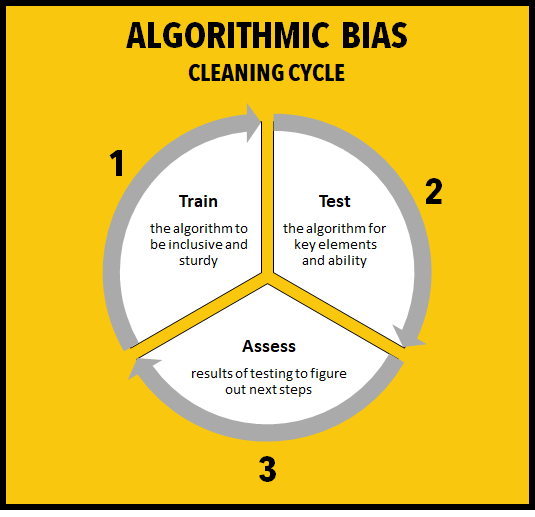
By using an algorithm with these shortfalls, you will inevitably repeat mistakes that have been already made. There are a few steps you can go through to ensure your algorithm doesn’t have the aforementioned bias’:

Assess – test results to figure out next steps that need to be done.

Train – your algorithm to the best of your ability with a reliant dataset.

Test – thoroughly to ensure there is no unwanted bias in the algorithm.

Companies that utilise algorithms, or even pioneering new tech, need to consider any potential new issues with ethics and legality, to assure no one is hurt ahead.

We can only see a short distance ahead, but we can see plenty there that needs to be done

A. Turing

Understanding new supporter behaviours

In this Article

Covid has brought unprecedented changes to our day to day lives and our behaviour. This in turn is having a huge impact on the charity sector and their ability to fundraise, a vital part of their operations. Some of these key challenges that charities are facing currently are:

  • Not being able to host fundraising events
  • Loss of income from mass participation events
  • Charity shops being closed
  • Lower footfall on high streets and transport hubs
  • Economic impacts on income

At CACI we have been exploring the impact of Covid on people’s behaviour and we took a look at what this meant for charities and how they can overcome these challenges.

CHANGED PRIORITIES

One of the more unusual impacts in people’s changed behaviour is the up-turn in their priorities when engaging with brands. Whilst Covid-19 safety measures have risen to be the number one priority, regardless of demographics, this was not the only change to the ranking. With a reduction in spending resulting from lockdown, two key aspects have risen to the fore in people’s priorities:

  • Ethics of Brands
  • Sustainability/Green

This is a key factor for charities as it shows that despite the hardships that many of the population is currently facing, there is a general desire to ensure money spent is done so with ethical and sustainable brands. This is particularly key for charities that have online stores as there is clearly an appetite for this kind of spending, so it is imperative to be reaching out to supporters with this message.

FINANCIAL SITUATIONS

Consideration of changes in income and financial status is imperative, but whilst Covid is having an impact on all, the effect of this is not the same across the board.

Using CACI’s Fresco segmentation, we have been able to look at survey respondents changed financial situations. The groups that are seeing an increased disposable income tend to be some of the younger segments that are early in their careers and have been able to successfully work from home. This is a key group to look at, as they aren’t the typical audience for charities to target as they usually have low levels of disposable income.

DIGITAL ADOPTERS

With face to face fundraising coming to an abrupt stop back in March, digital channels messaging for brand awareness and fundraising initiatives became a key strategy overnight. Since lockdown was imposed, we have seen that 53% of people are now expecting to engage more online. Breaking this down further, we can see that 23% will look to make online a priority going forwards, whereas 35% will only use online over physical when absolutely essential.

What is most important to consider in these statistics, is that it is older generations, typically adverse to using digital channels, that have now become more digitally savvy and more comfortable making payments online. As a key demographic for many charities, this is a key consideration in future fundraising strategy.

THE FUTURE OF FACE TO FACE FUNDRAISING

As restrictions have been eased and the tier system has been implemented, we have seen a rise in movement in the local community – whilst people are not moving in the same way that they were before lockdown, we can see that people are moving about and interacting more in their local community. This is key to consider when planning face to face fundraising strategies as the local high street is a more powerful location than before.

DISCUSSION

One of the key themes that was discussed is the importance in using data to understand what is changing in charity audiences. Whilst there have been some obvious changes with the loss of face to face fundraising and community events being cancelled or postponed, some of the changes in supporter behaviour are more subtle and being able to understand and react to these is crucial.

Some of the other key discussion points were:

  • Many charities are seeing an increase in digital donations – it’s key to understand who these donors are an ensure their retention and more importantly to continue to engage them.
  • Older donors are getting help from younger family members to donate online.
  • Direct mail and DRTV are proving successful – people are responding to the needs of charities, but data is needed to understand who and why.
  • Using value exchange and digital campaigns to attract a younger base of new supporters.
  • At this point in the year, looking forwards is essential – what does a fundraising strategy look like in 2021 with the lingering effects of lockdown and the tier system in place?
  • Improve online retail to recoup losses from retail spaces.
  • Retention of donors will be key for stability moving forwards.
  • Some charities have already started looking at younger demographics that have more disposable income than previously and engagement strategies here.
  • An unexpected bonus is that Covid has given space for internal transformative changes to come about quickly – for example, removing the reliance on particular channels such as face to face.

WHAT’S NEXT?

If any of these points resonate, and if you’d like to understand more about how CACI can support your charity to overcome this challenging time through data, marketing technology and insight please do not hesitate to get in touch.

Do charity shops add wider value to charities?

Charity stores are an established feature of almost every retail centre from local parade to retail parks. They offer a valuable income stream for charities and are an increasingly important occupier in a retail landscape facing further store closures by significant household names

But do the stores bring charities more than just the money that comes through the tills?

  • By having a physical presence on the high street are you also raising awareness of your charity?
    • Does this convert into additional financial giving, volunteering or engagement with your cause?
  • Do stores also provide assistance for local people that your wider charity mission is to support?
    • Alongside serving the valuable role of selling affordable goods to vulnerable groups?
  • Do local stores drive online sales through the increasingly important e-commerce channels that are being invested in by many charities?
    • Or should we follow the trends to focus on online retail?

Cleary, if the answers to these questions is “yes”, it will help to support the business case for new store openings. But many charity retailers are struggling to answer these critical business questions beyond the point of anecdotes and hunches.

Wouldn’t it be good to be able to prove the wider value, and be able to quantify it in revenue terms?

Working with a major charity we’ve taken the first steps and recently presented the results at the Charity Retail Association’s annual conference.

IT’S A POSITIVE PICTURE FOR THE CHARITY RETAIL SPACE AS WE HAVE SEEN EVIDENCE OF A STRONG UPLIFT IN FINANCIAL DONATIONS IN THE CATCHMENTS OF THEIR STORES.  THIS STARTS TO SUPPORT A KEY PART OF THE HYPOTHESIS THAT RETAIL STORES DO CONTRIBUTE ADDITIONAL FUNDRAISING.

Our methodology, outlined in Figure 1, built on an approach that we have already employed to demonstrate how physical stores drive online sales success for mainstream retailers. This widely shared report reveals that a typical retailer is likely to benefit significantly from an “online halo” around physical stores.

We then overlaid store catchments onto this “expected” local demand estimate and compared the “actual” income from the expectation.  This brought exciting results. We witnessed a clear and quantifiable uplift in giving close to stores that was similar to the total profits of the store network.  This is a serious upside from stores.

Such an upside would truly justify the role of the store, support new site business cases and lead to greater collaboration between retail, fundraising and volunteering teams to put the store at the heart of acquisition.

Unfortunately approach 2, the time-series analysis, was inconclusive.  The challenge here being the data, with huge amounts of noise in the catchments of overlapping stores that meant a clean uplift in financial donations could not be seen.

This does not mean that the effect is not there, unfortunately we just can’t see it in their data yet.  So, we accept that this lack of a second opinion does temper our confidence in the uplift findings whilst our hunt for the holy grail continues and the client develops their data strategy.

Whilst proving the wider value of stores may sound a simple task the challenge is missing or disconnected data sources.

MOST CHARITY STORE TRANSACTIONS ARE FACELESS – WHETHER THAT IS BUYING OR DONATING PRODUCTS.  AND IF YOU SIGN-UP TO VOLUNTEER, CAMPAIGN, GIVE OR SHOP ONLINE FROM THE COMFORT OF YOUR OWN HOME THERE ARE RARELY CLEAR LINKS THAT PROVE THE ROLE THE STORE PLAYED IN THE ACQUISITION.

But links can be made to enable you to attribute the role of your stores in your transactions. Whether that is through catchment models, data enhancement, transforming your in-store data capture, improving your data holding or visualisation of data.

To discuss how CACI’s technology, data and consultancy can help you understand the true value of your stores, customers and supports please contact Paul Langston on 020 3892 2311.

Technology and staff retention – improving each worker to improve your workforce

In this Article

Many roles in the transport and construction industries require ongoing training as part of a wider competency management drive, for example drivers, engineers and inspectors need to periodically retake tests, exams and be monitored to ensure that they are still able to fulfil the purpose for which they have been assigned. This process, too, creates opportunities for upskilling your workforce, which in turn helps to improve employee engagement, career development and reduce staff turnover.

The Work Institute’s 2020 Retention Report notes that the top three reasons for people leaving their jobs are career development (19.6% of leavers), seeking an improved work-life balance (12.4%) and management (11.8%). Work Institute estimates that the average cost of employee turnover is 33% of that employee’s salary, given the effort of covering their work amongst remaining team members, management having to reshuffle resources and then the cost of finding and hiring a replacement.

Glassdoor calculates the tangible cost of each new hire to be £3000. There’s also the general upheaval of staff turnover combined with the intangible element of carrying disengaged and dissatisfied employees towards the end of their tenure, alongside the time spent searching for, interviewing, employing and training new staff members. It is, therefore, well worth investing the time and effort in not only tracking staff competencies but identifying areas in which your workforce can be upskilled.

Upskilling carries the twin benefits of not only improving the career development of those who are being trained, but also of putting those staff members in a position to be upwardly mobile within your organisation when positions present themselves. Employing from within is often far more efficient than employing recruitment agencies, both in terms of time and cost.

HOW CAN FIRMS EFFICIENTLY AND EFFECTIVELY PROVIDE ONGOING STAFF MONITORING AND TRAINING?

The use of technology is becoming increasingly prevalent in many organisations’ overseeing of staff competency management and training. It makes sense to automate swathes of these processes to free up administrative time to focus maximising the output of your workforce. Deploying technology to underpin these processes also opens them up to your workforce, making them more interactive with their work and more aware of training requirements and possibilities.

This goes beyond simply scheduling everyone onto mandatory courses such as health and safety training for onsite workers. It enables them to research available training opportunities across your organisation which allows them to start shaping their own career within it.

Alongside maintaining core competencies with automated training allocations where required, this facilitates improved workforce engagement with your organisation and their own careers, helping to manage the most common cause for staff leaving their jobs in 2019, career development.

Putting in place such opportunities and actively encouraging staff to take up training opportunities demonstrates a clearer commitment to the individual than might otherwise be the case.

To further enhance staff trust in the training opportunities at their disposal, technology can also help with the allocation of resources for courses, such as allocating training rooms for in-person sessions and ensuring that the trainer has the correct equipment for the running of the session. This helps to enhance the user experience by avoiding last-minute cancellations and courses being disrupted by unavailability of necessary provisions.

ENSURE THE RIGHT PEOPLE IN HOUSE

Staff turnover is inevitable to a certain degree but using technology to underpin your training enables you to identify potential areas of weakness and strengthen them before they become an issue. If you suddenly lost staff members in one area, how would you cope?

Having this knowledge enables you to facilitate training courses to enhance the skills of other workers so that they could step up as and when required. This not only fills knowledge gaps across your organisation which helps to keep the right people in the right place at the right time, it also demonstrates the availability of career progression to your workforce and allows them to be able to diversify their own skillset.

Utilising technology can play a fundamental role in keeping your workforce engaged, trained and assigned to appropriate tasks across your organisation. For more information on how Cygnum can help, please click here.

It’s all about demand

Understanding demand is a key challenge for the water industry as it is a stepping stone in helping solve several puzzles such as distribution, understanding leakage, and helping customers reduce their water use. With some areas of the UK having low meter penetration, and standard meters only being read annually or even less frequently; demographic data is a key aspect in modelling demand to meet these challenges.

Recently, CACI ran a roundtable discussion on all things demand to understand how companies are tackling demand forecasting currently, and what innovations are being explored for the future. We ran the roundtable in conjunction with Anglian Water to share the work they are currently doing in this area, and Badger Meter who were part of the winning team at the recent “Innovate East” Hackathon.

USING DATA TO UNDERSTAND DEMAND – ADAM GRAY, ANGLIAN WATER

Anglian Water is one of the largest geographic water regions, spanning the East of England from Grimsby to Basildon. Unusually, Anglian has a 90% penetration of meters across their region.

One of the biggest challenges currently facing Anglian Water, as one of the driest areas in the UK, is climate change.  The increased risk of drought and predicted reduction in rainfall for the region is a huge concern for the demand of water.

Another major challenge that Anglian is tackling is the continually increasing population growth in the area. Located to the north and east of London, Anglian Water’s region contains 3 of the 5 fastest growing towns in England – Peterborough, Cambridge, and Milton Keynes. This means that in some areas the population could grow by more than 28% by 2045, again causing a huge increase in water demand.

To help tackle these challenges, it’s important to accurately understand the level of demand and therefore be able to calculate and tackle leakage in the area. To do this, Anglian use three main work streams:

  • First, the survey of domestic consumption (SodCon) for which Anglian has 2,000 domestic customers on flow meters, collecting data every 15 minutes. CACI’s geodemographic segmentation Acorn is used to ensure a representative sample of customers have the flow meters.
  • Secondly, for customers that are metered annually, Acorn is applied in conjunction with CACI’s Household Occupancy data to calculate the average daily consumption.
  • Thirdly, Anglian has approximately 17,000 customers on smart meters which collect hourly data. Acorn is applied to this data to again sort them into cohorts to build corresponding models.

The importance of smart meters in an area that is being increasingly challenged in terms of demand cannot be understated. Anglian has a programme in place to get 70% of their customers upgraded to smart meters by 2030, in order to further improve their understanding of how customers use water and plan for future local demand. Acorn will again be used in supporting the build of these models and to help quantify the day-to-day demand in areas that aren’t smart metered.

In addition, the smart meter data is a game-changer in terms of the understanding, modelling and reporting of leakage in a way that Anglian hasn’t been able to do before.

HELPING CUSTOMER SAVE WATER (AND MONEY) – ANNA CRISP, ANGLIAN WATER AND MICHAEL DAVIES, BADGER METER

At the beginning of September, Anglian Water along with Welsh Water and SES Water hosted the event ‘Innovate East’ – a two-week event focussed on innovation in the water industry. As part of the event, a data hack was held to explore what insights and actions could be driven from smart meter data.

The hack had the challenge statement of ‘Helping customers save water (and money)’ and teams were given Anglian’s smart meter data, along with occupancy data and CACI’s Household Acorn data to find innovative ways to approach and answer the challenge.

Using the above statement on the level of water reduction that is being targeted, Michael and the team approached this challenge with the focus on reducing customers waste use of water.

The first step in their approach was to answer the question – what is considered to be ‘excess use’? The team took raw data from a two-person household to look at an average day’s typical water use. From this, they were able to match behaviours to peaks on the graph as can be seen in the image below.

You can see that the activities with high levels of consumption, but low levels of frequency, can be identified as water being wasted and are the activities that are key to target to reduce water use.

By understanding the different ‘excess use’ patterns of different Acorn groups, this information can then be used to create personalised communications to customers to help them better understand their waste habits and to encourage them to consider alternative options. For example, being able to suggest a variable flush to reduce excessive water being used by toilet systems.

The team then proposed an app, ‘Pipedream’, to demonstrate how this would work. Using best practice from the energy industry as a guide, customers would be able to download the app and visualise their daily consumption against a set reduction target. The team also proposed adding options to demonstrate the change in water usage when different activities were chosen. For example, what happens to their water use if they decide to switch to baths instead of showers. This can then link into a reward scheme to encourage users in better water saving habits.

HOW ARE WATER COMPANIES APPROACHING THE CHALLENGE OF DEMAND MODELLING AND INNOVATION?

The roundtables also included discussion from representatives from other water companies sharing their views, examples of best practice and innovative ideas for future approaches to reducing consumption.

Points raised ranged from the importance of understanding the potentially contradictory view that larger households are naturally more water efficient than single person households (and how this can lead to flaws in using Per Capita Consumption (PCC) rather than Per Household Consumption (PHC) in demand calculations), to examples of how quality and timely communications have been proven to reduce water use.

Naturally conversations turned to Covid 19 and the clear evidence of changing behaviours and local demand, and potential ways in which this can be modelled and evidenced.

WHAT’S NEXT?

Look out for our next roundtable in the series which will be focussed on understanding the impact that Covid has had on financial vulnerability in the water sector.

Please do not hesitate to get in touch should you want to hear more!

Five takeaways from CACI’s Snowflake for the CMO webinar

In this Article

CACI and Snowflake hosted a webinar on the benefits of marketers getting involved in Snowflake’s Data Cloud. Whilst real-time data infrastructure may sound like the focus of the techies, this webinar sets out the why and how of playing an active part in your data infrastructure.

I was fortunate as webinar host to be joined by Paul Coward of the RAC and Jon Ede who leads CACI’s Snowflake practice. As Strategy & Insight Director at the RAC, Paul has been heavily involved in their implementation of Snowflake to drive real-time marketing and insight capabilities. Jon has a wealth of experience in building customer and marketing data platforms, and was an early adopter of Snowflake’s technology.

Five takeaways on snowflake’s data cloud

  1. Failure to engage on data infrastructure may leave marketers with something that is not fit for use.
  2. Data provides an edge for marketers who are seeking to continually optimise marketing activities.
  3. Snowflake enables marketers and IT teams to quickly deliver high value insights.
  4. Optimised marketing comes from a continual cycle of using data to hypothesise, test, measure, learn and improve.
  5. The frictionless data infrastructure that Snowflake delivers connects all the data in your organisation straight to the customer.

Enabling your marketing data transformation

CACI is here to help marketers do amazing things with data. Whether that’s building a Single Customer View, creating clean data feeds for your marketing technology, or augmenting your customer data with demographics and lifestyle variables. There’s a host of technology, consulting and data science work that we can do to improve your marketing results.

If you’d like to see a recording of the event please get in touch!

We will soon be releasing the CMO’s Playbook for Snowflake, if you’d like to register for a copy of that in advance, please contact me with your details!

Driving business decisions with real-time data

In this Article

APIs are not new news; they’ve been around for 20 years and have grown exponentially.

From powering ecommerce, social platforms and Cloud applications they have become ubiquitous since the explosion of smart phones. They improve integration and automation, leading to better services and innovation, saving time and money – linking both internal and external systems.

With 83% of respondents to The State of API Integration Report 2020 believing API integration is now a critical part of their strategy and 43% seeing a direct increase in revenue it is clear that this is the direction of travel for most organisations.

Added to this, the desire for most brands to provide a more personalised and seamless experience to their customers with 66% of consumers stating that content, that is not personalised, would stop them from making a purchase, real-time information is more important than ever.

To facilitate these real time business requirements, we have made our suite of demographic products available via our API, enabling organisations to access real-time insight about their customers directly into their marketing tech, consumer databases or websites.

The API enables you to code up new customer records instantaneously for immediate onboarding as well as providing insight across digital applications for content personalisation and messaging. With our API you will have the ability to improve business decision-making and user experience whilst achieving personalisation at scale.

The Benefits of a Real-Time API

CACI have taken the Acorn, Ocean and Fresco data products and made them available via our real time API. This allows for the coding of an individual instantaneously, and can change the use cases and application of the products. Here are just some of the benefits our clients are experiencing with CACI’s Demographic Data API.

– Immediate onboarding

Many organisations use CACI’s data products such as OceanAcorn and Fresco to plan the customer journey a new customer will follow as they onboard them. Understanding your audience’s affluence, lifestage, and lifestyle can make a big difference when creating tailored messaging and customer engagement strategies, by providing a view of the products your customer may be interested in, in the future. It is particularly important to get this right during the onboarding process as getting it wrong can affect the way a new customer perceives your organisation.

Knowing this additional insight at the start of the relationship can be immensely helpful, from knowing whether they are a Rising Metropolitan who may be interested in getting on the property ladder to an Asset Rich Grey who is planning for life enhancing expenditure or saving for their grandchildren, messaging can be adapted accordingly.

Similarly, if you are a leisure organisation, you might want to understand which shows your customers might be interested in attending in the future; adding CACI’s data can provide the insight you need to predict this while you build up a picture of their transaction habits.

– Siloed data

Another benefit of using the API is that it can assist organisations with myriads of siloed legacy systems containing customer information. It can be complex and expensive to pull data that is sitting on a marketing database, using the API can be a quick and efficient way to provide marketeers access to key pieces of information that drive their marketing communications programmes.

– Website and Email Personalisation

Identifying customers when they appear on your website enables you to serve tailored page content immediately, based on customer characteristics. Adding insight to a customer or prospect in a logged in environment or when they enter their postcode on a web form, enables instant journey planning and content personalisation.

For example, on a grocer’s website, a Successful Surbubs family will be looking for different products than someone who falls into the Student Life Group. Adding this colour to individuals, means that you can personalise content and create appropriate digital journeys which are dynamically adapted as they browse.

– Geo location

Additionally, at the point of placing a home delivery order, appending the geo location of the property can immediately assist in planning the delivery logistics, as well as helping drivers identify properties when on route, especially when it is dark or they are delivering in rural locations.

– Quote journey analytics

A number of our clients are interested in understanding the types of customers who drop out of the funnel during the quote process, compared to those that go on to convert. By adding key demographic, lifestyle or your own segment information to a record as it goes through the quote process, enables you to improve the effectiveness of your digital journey planning. Understanding whether a prospect might need additional reassurance or if they are more likely to be driven by price could affect the conversion path each customer follows.

– Providing insight to sales, customer service or chatbots

We also support our clients with bespoke APIs. For example, one organisation has a bespoke API system built by CACI, which provides real time insight to their inbound call handling teams for both sales and customer service applications, This allows for tailored scripts to be followed dependent on the customer segment.

With studies showing that it is likely 85% of customer interactions will be handled without a human in the future, providing demographic information in real time can provide different routes for chatbots to follow.

BEGIN YOUR REAL-TIME DATA JOURNEY

With the world moving to more automated ways of dealing with data and consumers expecting things to happen in real time, being able to understand your customers or prospects immediately can make a huge difference to the customer journey, maximising the revenue opportunities available to you.

You can discover more about CACI’s suite of consumer data products here, or to speak to one of our data experts and gain a better understanding of how you can integrate these products in real-time with your CRM system, websites and call centres, please get in touch.

Who are you?

As a philosophical question, you probably have a fairly good grasp of the answer when it comes to your own life.

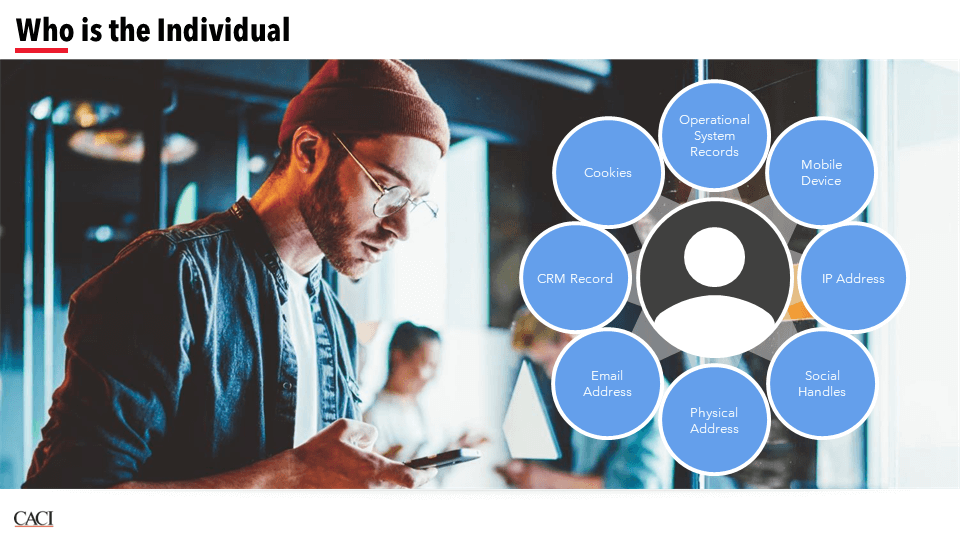
However, the way businesses see us is patchy at best. Duplicated, incomplete, inaccurate data that is spread around systems creates an issue when it comes to generating an accurate profile of who an individual customer is.

When I consider my own data, I use multiple email addresses, have seen my surname spelt multiple ways, and use Dave and David interchangeably. My postal address can be written in endless ways depending on the input form used. It’s messy data.

Businesses will store this data across finance, operational, CRM and sales systems. You may notice this when you phone a call centre and are asked for policy numbers, order tracking codes, or some other identifier. It becomes more transparent that your records are split across systems and teams when that request is followed by “ah, I’ll need to transfer you to another team in that case…”.

It’s not just the data I provide either. Brands are tracking website visits, the content we consume, our social media interactions, and how we use their mobile apps. This tracking information can then be combined with my first-party data. This opens up further insight into my interests and intentions.

For example, if I’ve just purchased a product and start reading the returns policy on the company’s website, it should be obvious that I’m not happy and considering a refund. Brands that can use this data will retain customers, reduce services costs, and ultimately win share of wallet.

For customer focussed brands, Identity Resolution unlocks real benefits:

  • Advanced Personalisation: Utilising the full 360-degree view of customer data to serve personalised messaging across channels
  • Compliance: Ability to gather all PII data from across systems on the individual and to ensure responsible marketing in regulated industries
  • Improved Service: Less “screen switching” during customer interactions and the ability to pre-empt service problems
  • Accurate Analytics: Taking account of full customer data set to accurately measure loyalty or predict propensity to take certain action

Failure to get the full picture of who your customer is will lead to issues in making better business decisions that reach a customer. As the old-adage goes, garbage in, garbage out. We can’t expect our marketing to be optimal if it’s only utilising a small percentage of the data available.

To find out more information on Getting Started with Identity Resolution.

If you’d like to find out more about CACI’s real-time ResolvID service for identity resolution, get in touch.

Vulnerability in the water sector

In this Article

Covid-19 has meant that 2020 has been a challenging year for all sectors. With a lack of historical data to forward forecast the impact on consumers and their behaviour, there is no way to know what impact this will have on regulatory and business objectives.

For the water sector, this has been particularly challenging. Water companies have spent years building demand and leakage models to ensure that they are as accurate as possible.  With a significant shift in working patterns and individuals furloughed, working from home or made redundant; household consumption has increased dramatically, with a significant drop in non-household use.

On top of this, the UK saw a record breaking dry and sunny spring across the UK, quickly following the wettest February on record – adding further complicating factors to demand models.

Furthermore, UKWIR are working with the water sector to develop a strategy to “achieve zero customers in water poverty by 2030”.  With more customers at risk of becoming financially vulnerable, especially with the furlough scheme due to end this month nd further redundancies on the horizon, understanding which customers are at risk and how you can protect them is more important than ever.

Recently, CACI ran a roundtable to explore this latter point in detail and discuss how water companies can understand vulnerable customers and address water poverty.

We addressed this in 4 key areas:

  • Understanding those that are at risk of becoming financially vulnerable, pre-Covid
  • Using CACI’s movement of people reports to understand who is moving vs pre-Covid levels
  • Understanding how this movement compares to demographic groups
  • What water companies are doing to support vulnerable customers

UNDERSTANDING THOSE THAT ARE AT RISK OF BECOMING FINANCIALLY VULNERABLE, PRE-COVID

In January, CACI released Vulnerability Indicators to support organisations in understanding customers who are at risk of vulnerability from a financial and digital perspective.  The purpose of these indicators is to ensure that organisations are supporting those on lower incomes with appropriate tariffs and ensuring that those that can’t (or won’t) access services digitally are able to access services.

The Financial Indicators include the below attributes, as well as a combined score:

The Financial Indicators include the below attributes, as well as a combined score:

  • Basic Bank Account
  • Disposable Income
  • Young Dependents
  • Financial Situation
  • Likely to Borrow
  • Minimum Payments on Credit Card
  • Equivalised Income
  • Has a Loan
  • No Savings or Investments
  • No Pension
  • Distance to Bank Branch

The Digital Indicators include (as well as a combined score):

  • Broadband Access/Speed
  • Does not Have Mobile
  • Does not Buy Online
  • Does not Use Internet
  • Online Finance
  • “Computers Confuse Me”

USING CACI’S MOVEMENT OF PEOPLE DATA TO UNDERSTAND WHO IS MOVING VS PRE-COVID LEVELS

CACI has been running regular research surveys to a nationally representative sample on an ongoing basis, to see how consumer behaviour is changing. In terms of the latest movement, this is currently sitting at around 74% of pre-Covid movement, with decreased movement following the introduction of the tiered system in the UK:

UNDERSTANDING HOW THIS MOVEMENT COMPARES TO DEMOGRAPHIC GROUPS

When comparing this to Acorn Demographics, movement is highly correlated to affluence, as you can see from this chart below. During Peak Lockdown the lower affluence groups were moving more than the national average (the black line in the chart below).  These groups are highly correlated to those working in the “essential” category, such as Care Workers and Retail Workers:

Compared to the more affluent, who were moving less frequently than the national average (the black line).  This is highly correlated to those that are “Office Workers” so are more likely to be able to work easily from home:

In addition, when we compliment this further with the research we are running, we can see that although the number of those on furlough is reducing, 33% of those on furlough believe they are at risk of losing their job, with 25% of people having less disposable income vs pre-pandemic:

WHAT WATER COMPANIES ARE DOING TO SUPPORT VULNERABLE CUSTOMERS

During the roundtable, we discussed a number of key areas that the attendees are focused on, to support customers:

  • A desire to be more proactive, rather than reactive and use data intelligently to understand those that are at risk. Some organisations are already using demographic, behavioural and contact centre data to understand vulnerable customers and how to support them – others are struggling to make sense of a very busy data world.
  • Consider partnering with organisations where consumers may go if they have not been financially vulnerable before. Linking with organisations such as Citizens Advice is a good place to start.
  • Some organisations where data is not easy to access are looking to partner with other utility companies to present a united front for consumers to access support.
  • Using additional channels such as Social Media and Press Releases partnered with National Debtline is a good way to reach audiences who may be at risk of becoming vulnerable in the future.
  • Also using direct channels such as pro-active emails to promote PSR and alternative ways to pay so you’re directly speaking to all customers (you can of course personalise this using CACI’s segmentations!)

WHAT’S NEXT?

Our next blog will be focussed on the impact of Covid on demand forecasting, following a recent roundtable we ran with Anglian Water and Badger Meter.

Following our next Roundtable on “Identifying the New Wave of Vulnerability” we’ll be releasing the key thoughts and findings.

Please do not hesitate to get in touch should you want to hear more!

Rustlr – where goes my internet traffic?

In this Article

So, the first question on your mind is likely to be what on earth is Rustlr? And indeed, the name can do with a little bit of explaining.

Similar to how a rustler is someone who rounds up and steals sheep or cattle, our browser plugin Rustlr rounds up and visualises data sent from your browser as you surf the internet. It also (among other things!) tries to alert you of other suspected rustlers out there who may be trying to steal your data. Admittedly the link is slightly tenuous, but it makes for a cool sheep icon, a name that rolls of the tongue, and nods towards our west-country location!

The intention behind Rustlr was twofold: For the user, we wanted to provide a way of increasing their awareness of their security footprint while browsing the web. Whereas we, as a group of developers, wanted to try our hand at making an internet plugin. We wanted to focus on usability and make it easily accessible to those who were not necessarily ‘techies’ or internet security experts.

How it Works

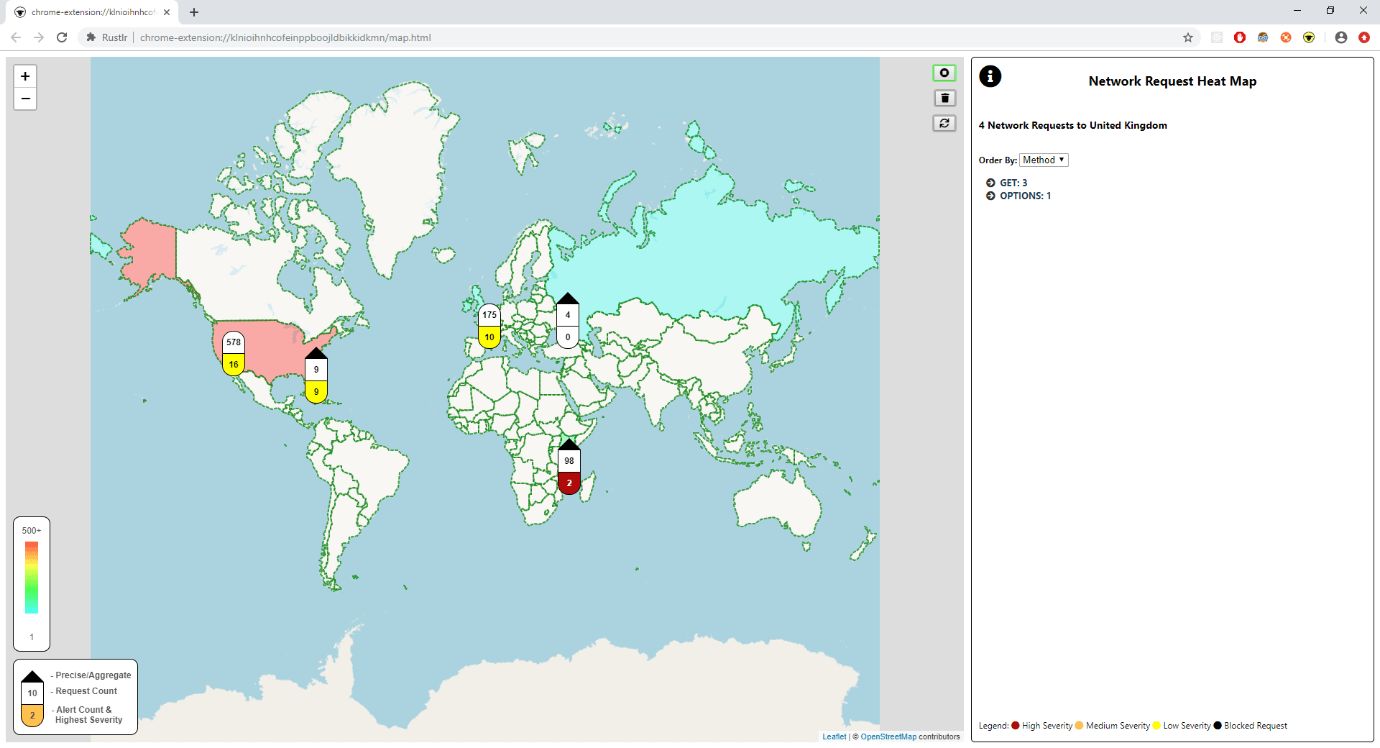
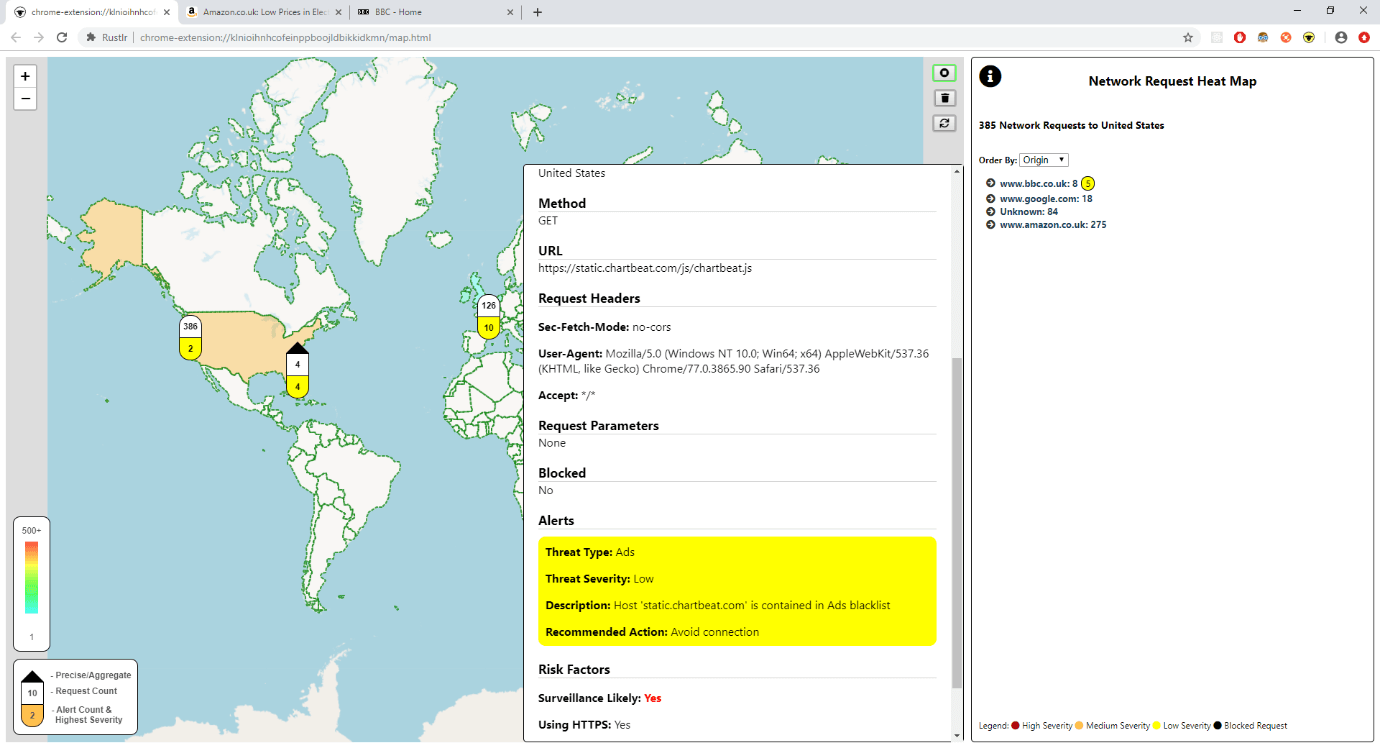
The extension captures HTTP traffic sent from the browser, runs processing on each request to generate a set of alerts, and then displays the results on a map of the world.

The processing step resolves the IP from the hostname, and then uses the Maxmind GeoIP database to find the location the request originated from. It then runs a set of rules on each request, checking for things that look a little suspicious such as the request origin being on a known blacklist, or a password being sent to an unexpected domain. Finally, it sends the resulting set of alerts along with the request to the visualisation layer.

The main visualisation shows a heatmap of the world, built from the count of requests sent to each country, which quickly gives a picture of where data is going. For instance, an unexpected country lighting up when browsing a known website could be an indicator that something odd is going on!

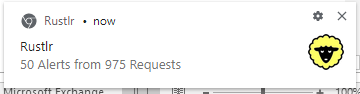
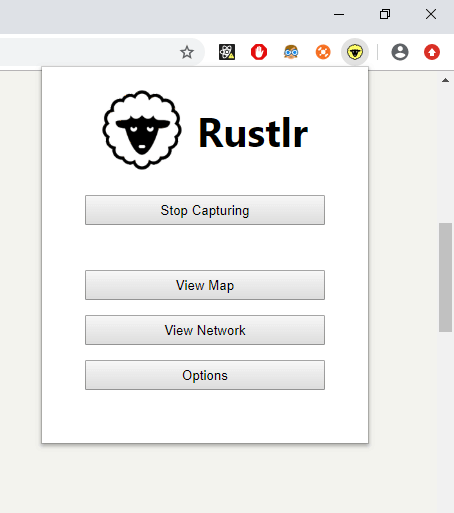
From here the user can drill into the requests sent to each place. They can view request data that an experienced developer may be able to find through Dev Tools. Or they can skip straight to viewing the alerts, which highlight potentially dangerous activity. The icon changes colour as the alerts rack up that, alongside pushed browser notifications, warn the user even when the map is not in view!

Technology Stack

Writing a browser extension, we were tied to using the web development technologies – JavaScript, HTML and CSS. However, we did have room to make a few decisions. We decided to use TypeScript, for all the benefits that it brings, notably reliability and readability.

While the extension API prescribed the structure of the built package, we wanted flexibility in structuring our code. So, we used Webpack to convert our source into the modules that the browser required. We used the browser Web Storage API for persistence to ensure that the whole system could be packaged and loaded in without any external dependencies.

We discussed the idea of using a framework such as Angular or React but decided against it to reduce boilerplate and to avoid introducing another technology into the mix that would have to play nice with the others.

We decided to support both Chrome and Firefox, which can often throw up challenges due to the subtle differences in their APIs. However, we mitigated this by finding a polyfill library that enabled us code against just one common API.

Our main third-party dependency was the open-source mapping library Leaflet which we used for our main visual element. We found it straightforward to use and some of the additional features developed by the open source particularly suited our needs.

Our Development Process

We kicked this off in a team of four and run this as an internal ‘Capability Development’ project. We worked in one-week sprints following the Agile Scrum Framework, albeit a slightly relaxed one, so that we could incrementally build up a more sophisticated solution, while maintaining some focus on the end user.

At the end of each sprint, we demoed to our senior engineering team, who were acting as the customer. One of them played the role of the Product Owner to prioritise our backlog and give us steer in terms of features.

After an initial phase of development of around a month, we had laid down the core structure and implemented many of the initially desired features. This meant that subsequently, it was easy for new developers to pick up the project quickly and slot in their new feature in the established architecture.

UX Journey

In terms of user experience, we began by gathering a high-level idea of what the extension should do from our group of ‘customers’, and how this could be useful. We quickly determined that the plugin should have a visual element, be easy to install and use, and highlight the most interesting information first. As we started developing and receiving feedback, we went on a journey that significantly changed the structure of the app.

A good example of this is that initially we went for a design that popped out the extension in a separate window, and then all further controls were operated from that window. This was seemingly a simple design but it went against the normal convention that browser extensions use – to display a control panel popup below the icon next to the address bar. It was also found to be cumbersome to have to always keep an extra window hanging about while browsing.

Following user feedback during each sprint, we restructured the extension to fit the common pattern, meaning that it would behave as the user expected on their first use, a principal that is at the core of user-centric design!

Final Thoughts

We found that using the Agile development process helped us to stay focussed on the most important features. It enabled us to react spontaneously and change the direction the extension was going in after receiving feedback. It also allowed us to delay some design decisions to when we had a better understanding, instead of trying to guess up-front.

All too often when developing we become over familiar with our product and lose sight of the user’s experience. Sticking to user-centric principles when designing helped us to tackle this to an extent. However, putting our extension in front of someone outside the development team was even more valuable.

We developed using all open-source products, so were very grateful of the strength of the open-source community. It also goes to show that putting together the right mixture of technologies can go a long way.

All in all, we developed an extension that is easy to use, provides useful security information and fits our initial aims!

Five key challenges convenience clusters and mobile app data can help you solve

In this Article

It can be hard to segment and understand your existing estate let alone find new locations to expand. Through using CACI’s Convenience Cluster data the first part of the puzzle is already solved. There are over 32,000 pre-defined convenience clusters within the UK to define local retail areas. Centres can range from local parades right through to city centre locations and describe both the extent and function of all retail locations.

This year’s release has seen the introduction of two new exciting changes. The first is the introduction of city zones helping you to understand the micro level nuances of city centres into distinct zones split by function to the shopper. The second is the incorporation of mobile app data for each of the UK’s 32,000 centres to describe the centres in detail understanding who is there, by time of day, day of week and purpose.

Using the new mobile app data our clients are now able to respond to some of the biggest questions that have been facing their businesses including:

1) Is the Catchment of my Store Residential or Transient?

Transient stores need a very different range and layout and the drivers of success are completely different to residential stores.  Quickly identifying the mix between people who are close to or further from home can help you to create high performing, successful and tailored stores.  Mobile app data combined with Convenience Clusters goes beyond the traditional drivetime or radii catchments to capture who is within that centre no matter where they have come from.

Through capturing home locations for devices and therefore knowing how far people have travelled to visit a centre audience classes have been created to split centres into residential, worker, local visitor or visitor. Using the example below you can begin to capture detailed information on how far shoppers have travelled to visit that centre enabling you to make informed decision on store formats, ranging and the potential of a location for your offer.

2) Who could my Customers be?

By understanding not just who is coming into your store, but who is passing in the immediate area and when, you can understand the nature of the opportunity on your doorstep and make sure you are set up to maximise on it.  Mobile app data is coded with Acorn, CACI’s customer segmentation giving visibility and additional supporting information on who is visiting each centre. Through coding up customers based on their home postcode the dashboard reports back on what shopper types are visiting the centre and at what time of day.
This is really valuable to our clients who are working out how to tailor to a location and whether the passing footfall contains the right mix of demographics for their potential store. This can help you identify opportunities and look beyond where people to live to capture your target audience wherever they may be during the course of the day or week.

3) Should I be Planning for a Big Christmas or Summer Peak Here?

Seasonality is hugely important when it comes to operational planning of activities such as new store turnover forecasting or marketing campaigns. Each cluster is classified by seasonality identifying for example locations with summer peaks, Christmas peaks and term time peaks. Examples below show Westfield London’s Christmas peak and Fowey in Cornwall’s strong summer holiday peak.

Clients ranging from CPG brands to grocers have been utilising this data to predict and plan for seasonality across their estate. Having an easy to use classing filter allows you to segment your estate on expected seasonal uptakes making it easy to plan for these fluctuations.

4) What would the Optimal Opening Hours be?

Mobile app data linked with Convenience Clusters provides an indicator of busyness within the centre on a scale of 1 (not busy) to 20 (very busy). This data combined with visibility on when shoppers are visiting by time of day and day of week will inform key business decisions ranging from store opening hours, key restocking times, extra staff requirements and even vulnerable or quiet shopping hours.

Taking the example of the time of day chart below it is clear that on weekdays there are strong rush hour peaks with customers interacting with the centre between 6am to 8am and 4pm to 6pm.  On the weekend a very different time of day profile can be seen with shoppers not appearing in numbers until 10am.

5) What is the Mission of my Store?

Combining the powerful data demonstrated on who is in the centre by demographic group with when they are visiting the centre by time of day builds up a clear picture of the mission of shoppers within the centre. For example, rush hour peaks in the time of day data combined with a high proportion of young family groups e.g. ‘Young Families on the Go’ that your store is serving a time poor shopper group who would be looking for a meal solution for tonight or top up items for their last minute school bake sale for example. Segmenting your estate by these variables will tell you if there is untapped opportunity for a new range or concept for your store.

Convenience Clusters provide you with information about the physical extent of locations and what is there on the ground while Mobile App data paints a vivid picture on the people visiting those locations, in combination this creates a powerful tool to answer the big questions of 2020. With a number of areas in the UK going in to tier 2 and tier 3 lockdowns, the weekly movement tracking of 32,000 convenience clusters becomes essential to businesses to understand the level of activity across their estates.

For more information on how your company can benefit from Convenience Clusters and mobile app data please contact us.

CACI becomes an official Snowflake cloud data platform partner

In this Article

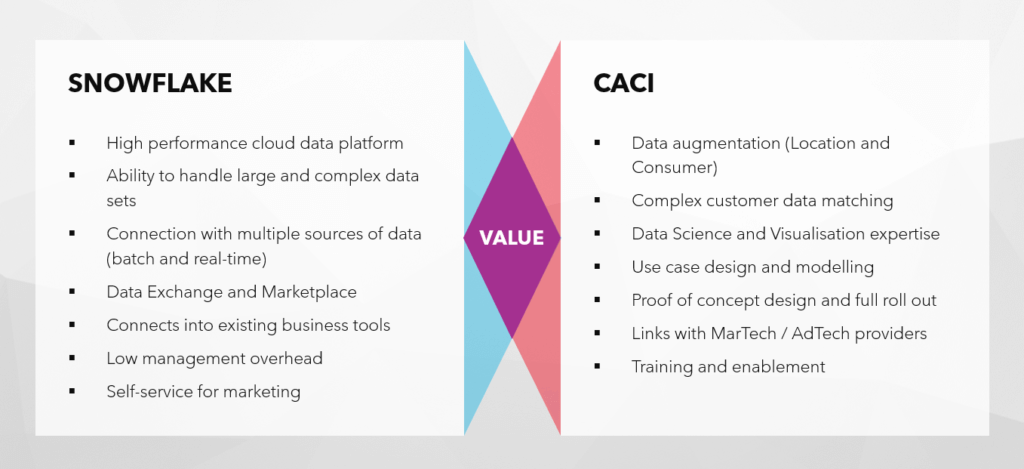
CACI is focussed on doing amazing things with data. For that reason, I’m really pleased to announce that through certifications and client case studies, we’ve achieved an official Select Partnership level with Snowflake.

Our clients have always relied on CACI to combine complex and large data sets to improve their business. Whether we’re bringing together data from across multiple brands and systems to build a 360-degree view of customer data, or analysing anonymous data from the UK’s major banks and lenders, we have expertise that brands can trust.

Snowflake is a cloud-based data platform that is gaining significant traction with CTOs. Snowflake is also one the fastest growing tech companies in the world and recently went public with a $60bn valuation.

Through its unique technology, Snowflake can power critical real-time use cases for CMOs and achieve improved time to value. Jon Ede who leads CACI’s Snowflake practice said:

I’ve built more SCVS and CDPS in my career than I wish to count. A lot of the functionality that a modern platform needs to deliver is out the box with snowflake, allowing for a CMO to cut down on the upfront implementation time and deliver value sooner. As a technologist who has spent most of their career working in marketing, I see immediate benefits of snowflake to a CMO.

CACI and Snowflake for CMOs

CACI and Snowflake combined bring together a cutting-edge data platform with expertise in delivering customer marketing solutions.

Table showing the benefits that both CACI and Snowflake bring to CMOs with bullet points highlighting key areas and services that each partner can delive

As already demonstrated with our real-time Customer Personalisation Platform architecture that is built on Snowflake, CACI is developing answers for real CMO needs.

CACI has also integrated our identity resolution services into Snowflake, enabling marketers to bring together multiple data sets and, in real-time, combine duplicates. Improving the accuracy of reporting, attribution, and campaign selection.

Get in touch

Should you need help with your customer and marketing needs, get in touch with us.

Badge showing Snowflake Services Partner

Unlocking opportunities in social care with big data

At this recent Laing Buisson hosted event it was clear from the wise words of Daya Thayan, CEO at Kingsley Healthcare, that data is now critical to almost every aspect of running a successful social care business.

Daya eloquently and passionately outlined how, despite the challenges of this year, Kingsley are investing in their five-year vision to substantially expand their care home network.  Kingsley, along with many of our clients, are seeing that new, higher quality, purpose-built homes are increasingly attractive in the current market, and offering an opportunity for growth.

Tom Hall, Chief Economist at Barbour ABI mirrored Daya’s view of the market.   He clearly demonstrated how, despite inevitable drops in the planning pipeline for Care Homes at the height of lockdown, the sector is proving more robust than many sectors, and back on an encouraging upward trajectory.

Tom’s evidence was based on big data, sourced from Barbour ABI’s rigorous monitoring of planning applications.   Similarly, Daya’s search for his new sites is underpinned by data.  To give him confidence in the potential of the local markets for the long-term of his investments.

Recently at CACI we’ve also been using seriously big data sets, derived from Mobile Apps, to understand how different Acorn demographic groups have responded to the various stages of the pandemic.  Actual and potential applications of this data in the care sector include:

  • Demonstrating how care workers were more vulnerable to the virus when it was at its height
  • Prioritising the opening-up of care homes to visitors based on weekly movement levels in the local community
  • Planning local healthcare responses based on understanding current and potential future movement behaviours
  • Understanding the true catchment of care homes to support local marketing and communications.

Mobile App data is a recent addition to our existing big data sets that describe the lifestyles, attitudes and behaviours of the UK population.

Daya, Tom, Laing Buisson and I all have access to different datasets.  They are all part of a jigsaw.  And when they all come together they have the potential to form a wonderful picture that helps to meet the needs and wants of customers and, in turn maximise, business returns.

Daya and Kingsley may be more data-savvy than some providers in the sector, but most organisations are also gaining bigger data sets on their customers and enquiries. Through your customer databases and CRM systems you know who your customer are, where they live and what products and services they need.  Also, by tracking this data over the Covid period, you can understand how customers and their needs are changing.

By linking this wealth of information with big market datasets you can really understand the nuances in the individuals behind this data. When harnessed successfully these data driven insights can help you to:

  • Open profitable sites – where your key targets want to live
  • Align products and services to meet their wants and needs
  • Increase your occupancy with cost-effective targeting using the right message and media.

All combining to improve your performance and customer satisfaction.

Are you, like many in the sector, looking to new properties, products, services or operating models to reflect the current market?  If so, you would be wise to start to put the jigsaw together for your business – and make the most of the data you hold and the powerful big datasets that complete the rest of the picture.

Escape to the country

In this Article

It comes as no surprise that lockdown has had a significant impact on the way city dwellers see the relationship between where they live and work. Recent data released by Rightmove for June and July has revealed a significant shift in city residents looking to relocate and take up village life. This shift is so great it outweighs the year on year growth of those looking to relocate from cities to towns. In June and July, the number of city dwellers contacting estate agents with an interest in relocating to villages increased by 126% over last year. Yet, although enquiries from those looking to relocate to towns was up 63% on last year, village life is clearly gaining greater attraction.

It goes without saying that most village locations city dwellers are looking to move to are within a commutable distance of work. For some, it has been proven we have the technology to work from home, therefore the daily commute may become the ‘once a week’ commute.

Its not just the appeal of living in the country that makes village life so attractive, its also the sense of community which we have all come to identify with since lockdown.

So where are these city dwellers moving to? According to Rightmove, Londoners are particularly keen on Iver in Buckinghamshire where as those living in Manchester are weighing up Charlesworth in Derbyshire.

Paul Nash, at CACI, has found there are around 15,000 villages across the UK. But which are most affordable for city dwellers that may not have the equity or income to relocate to desirable chocolate box villages? Let’s look at London, Manchester and Birmingham to see which areas are most affordable.

Assuming city dwellers would like to relocate to within a one to two-hour drive of their city office, this leaves London city dwellers with a choice of 1,900 villages, Birmingham 2,600 and Manchester 1,700.

Taking into consideration the relative average household income of a worker living within 3 miles of each city centre and the average house price across the vast choice of villages, the following villages have been identified to be not just the most affordable, but also populated by an affluent demographic.

Moving out of London

For those looking to move out of London, the large village of Grove, just under 2 hours away in Oxfordshire should be high on the list. Average house prices stand at around £312,000 and with average household incomes within the local area at £49,300, the typical London commuter earning £49,000 would be well positioned to buy property, requiring around 5.7 times earnings to live that village dream. City professionals looking to relocate would fit in well with the local population consisting of very high proportions of ‘Executive Wealth’.

Moving out of Manchester

Manchester is growing as a metropolitan social hub but for those affluent professional workers wishing to escape the fast pace of life, maybe the small village of Melling in Sefton, just under a 1 hour drive away could help slow things down. Although local household incomes are 60% higher than typical Manchester city workers, average house prices in Melling are a reasonable £330,000. The local population sit very high on the affluence scale consisting mainly of ‘Wealthy Countryside Commuters’ and ‘Better-Off Villagers’.

Moving out of Birmingham

With 90% of the UK accessible within 4 hours, Birmingham is an easy commute, but what would be one of the most aspiring and affordable villages to commute from within an hour. If you like the canals and open space then Gnosall, just under an hour drive from Birmingham should be on the list. With a mix of traditional old-world charm property and new build it has a lot to offer. House prices are typically 7 times earnings and local household incomes are around £44,000, 37% high than the average for Birmingham. ‘Asset rich families’ along side older and retired couples living in smaller detached and semi-detached housing dominate the area.

These are just 3 of the potential 15,000 villages that may be attractive to new ‘once a week’ commuter.

If you would like to discuss how CACI solutions can drive your location strategy for residential demand, workforce planning or long-term housing and infrastructure planning contact us.

Five challenges of personalised marketing

In this Article

PERSONALISATION IS A CHALLENGING TOPIC

Some organisations just don’t get it. How do you change things at your company?

Almost two thirds of consumers expect to receive personalised offers as standard and 63% of consumers would stop using companies who provide poor personalisation. Effective personalisation presents a huge opportunity for marketers who can master it. The rewards are potentially great. But so are the risks of delivering it badly.

Marketers are finding it harder than ever to reach and convert consumers across channels. So smarter targeted messaging is an absolute must to connect with customers.

Working with clients in a wide range of sectors, we’ve been helping marketers crack the conundrum. The most successful organisations are combining a range of technologies and expertise in datacampaign management and channels to achieve impactful results.

Typically, we find there are five main challenges to overcome in creating an effective and sustainable personalisation model that can continually adapt to changing customer needs.

  1. MULTIPLE VIEWS OF THE CUSTOMERCustomer data is typically acquired over time and is kept in different repositories and formats. Multi-channel personalisation requires a complete and accurate 360 degree view of every customer. Identifying, matching, cleaning and integrating diverse records and information is a complex challenge.
  2. SEPARATE TOOLS AND CHANNELSEnterprise businesses currently use up to 91 different marketing cloud services. Marketing technology (even when it comes from a single vendor) is hard to connect, because different tools have their own unique data models and capabilities. To provide a personalised, seamless, omnichannel experience, tools need to work in harmony.
  3. DISCONNECTED DATAMany customers are willing to provide more data, if they can see that it’s being used to their advantage to provide more relevant communication. Around the organisation, there’s demand for different insights at different times, so teams collect new data from a range of sources to meet a particular need. It’s hard to funnel this relentless deluge of new data into the mix and making it accessible immediately, to match current behaviour and preferences.
  4. SILOED DECISIONSCommunication decisions may be made by a number of different teams – from customer services, marketing and sales to IT and operations. Customers receive communications from several platforms – they can be contradictory and repetitive. This undermines the whole purpose of personalisation, creating an impression that your organisation doesn’t understand the customer and places little value on quality. To compound the problem, feedback from different campaigns isn’t built back into a central knowledge base. Effective personalisation strategies avoid this by using automation to combine technology and decision-making.
  5. OPERATIONAL INEFFICIENCYCollectively, customer engagement teams aren’t productive because they’re underusing the technology in the business. That’s typically either because of its inherent complexity or a lack of training. Through a single personalisation platform, you can integrate all your campaign and communications systems into a single marketing stack that gives more power and insight to everyone.

FOR MORE INFORMATION

We’ve partnered with BrazeTealium and Snowflake to combine world-class technologies that create a powerful, user-friendly platform capable of high-volume delivery of sophisticated, personalised campaigns.

CACI’s Customer Personalisation Platform empowers marketers to model and deliver incisive and high-impact personalised campaigns. Our experts help clients customise and deploy it to start delivering ROI quickly.

Implementing the ALN code and the benefit to children, local authorities, skills providers and higher education

In this Article

Councils across Wales are wanting to implement the additional learning needs (ALN) code and this is set to transform benefits to children and families, impacting schools and other educational facilities. The main driver behind the introduction of ALN across Wales is to integrate support for special educational needs (SEN) and learning difficulties and/or disabilities (LDD) in schools and further education into one, more inclusive system for all 0-25-year olds.

New ALN practice will ensure that all children and young adults are supported in overcoming learning and educational barriers and have agreed plans delivering support to them. Additionally, the focus is on early identification and putting in place effective, universal provision for this.

The Welsh government reports that around 23% of students in Wales have SEN. To go further in protecting and providing for them, the ALN code will work across the 22 local authorities in Wales for every child identified with support needs.

Systems will create a digital footprint for every ALN child, which will help not only local authorities and schools, but also higher and further education facilities to respond and adapt. With easily accessed and shared common data standards, records can be worked on collaboratively and in real time involving all parties to help with common as well as complex support needs. This will assist with building capacity and planning and to ensure continuous access to quality education and training opportunities to each ALN child and young person.

LEARNING POINTS FROM SUPPORTING SEND PRACTICE

We have been supporting local authorities and schools across the UK with SEN requirements and pupil provisions for over 20 years via our IMPULSE eMIS software. Where children have usually fallen through the gaps, there hasn’t been an effective joined-up approach to arranging provision between local authorities, schools, other providers and their parents/carers. Essentially, fragments of information on each child get lost or siloed in a school or local authority, resulting in extra stress. This can lead to avoidable school disruptions and challenging transitions to a new school or a new area, with critical information that hasn’t followed with them.

ALN systems will change this for children and young people in Wales. Using our experience and understanding, we are helping local authorities in Wales to prepare and implement ALN with a fresh technical and practical partnership approach. There is a real opportunity here to build Welsh universal additional learning support provision, identifying a child’s needs early and building resilience in their education journey. This will also enable engagement and transparency for themselves as young people, their parents/carers and their schools, colleges and universities.

AN EFFICIENT ALN JOURNEY

Our specifically designed IMPULSE ALN module is configured to manage your locally agreed practice and process under the new ALN code. Furthermore, the software is fully bilingual to facilitate simultaneous access in a preferred language. Our software is 100% compatible and works with your other systems in schools, for example SIMS. We also provide a data matching and data sharing hub which can interoperate with Teacher Centre and WCCIS, making the ALN and Individual Development Plan (IDP) process and practice transparent and easier to deliver the agreed provision in schools. The IMPULSE ALN portals and hub also enable this information to be seamlessly exchanged with other local authorities and providers as required.

THE BENEFITS TO SKILLS PROVIDERS, FURTHER AND HIGHER EDUCATION

Local providers have a vital role in providing workplace experience and opportunities to develop skills. Good ALN practice will facilitate these opportunities enabling providers to consider placements and apprenticeships and access to the system will also help make these journeys successful.

Likewise, when a student enrols at a college or university, they can request assistance during the application process. Good ALN practice will encourage a transfer of understanding through the whole journey and IMPULSE ALN enables this. This assists higher and further education facilities in preparing and adapting for students with additional support needs.

When all parties and stakeholders have appropriate access to information about the support needs of local populations, evidence of effective practice and outcomes generated from the ALN system can be used to improve learning journeys through early help.

MULTI-AGENCY APPROACH

The ALN code and systems in Wales will further enable the multi-agency approach that has been argued over for many years in education and youth services. By bringing together key agencies to build on disparate practice and share understanding of outcomes, the journeys of all children can be enhanced.

Parents/carers can access and interact in real time via a parents’ portal in their preferred language. This engages them in the wishes and feelings of their child, feeding back to raise questions, understanding professional contributions and to comment on the IDP being formulated. Parents/carers can also challenge decision making where necessary to support their child’s journey. This helps ensure the success of the plan and that parents/carers are on board and are kept up to date.

Schools can access and interact with parents/carers and other professionals, review information and view the plan from local authorities. Working in tandem with other children’s information systems, IMPULSE ALN further enables schools to seamlessly transfer ALN data between themselves throughout the admissions process.

Local authorities can oversee the practice and process of the ALN code, capturing information from all the relevant parties in a timely way to agree the IDP and support provision for each pupil. Where children move between providers and authorities, relevant information can be seamlessly shared so the local authority can always keep a track of this.

Skills providers can interact with schools and other professionals to understand the young person to generate a mutually successful experience.

Higher and further education can receive information on students as and before they join, assisting them to adapt their facilities to successfully support greater student diversity.

The ALN code aims to improve the learner’s journey, encourage more of the collaborative multi-agency approach and facilitate wider opportunities and better outcomes for every young person.

Build, build, build smart not hard

In this Article

Boris Johnson has issued a call to arms with “the most radical reforms to our planning system since the second world war.” “Build, build, build”; the message is as clear as the slogan. The UK is cutting the red tape surrounding residential development to allow quicker planning and to open up more unused or underused space to be developed into residential property. Not only this but the announcement of an increased £450million for The Home Building Fund creates an exciting prospect to see SME’s gain further support to build new homes.

An increase in supply is needed but through our use of analysis, our unique data sources and models CACI has been aware for a while that the “Field of dreams strategy” (build it and they will come) is no longer a suitable model. In fact, what is needed are developments that address the needs of the population at a localised level; needs assessed and measured against local population demographics. Although the new reforms that open up unused or underutilised space to transfer into residential should in theory address the supply issue, looking into the past few years of development I have good reason to be sceptical.

Below I will be addressing some of the key problems and solutions that all developers large or small should be planning and preparing for especially due to the uncertain times ahead:

  • Understanding the catchment that your development will pull from, and who is likely to move to your location to inform what you build.
  • Using a diverse source of data to set smart prices and rent based on demand rather than supply.
  • How to get your development in front of the people most likely to move there and understand what messages resonate with them.

WHO WILL ACTUALLY MOVE TO YOUR DEVELOPMENT AND WHAT DO THEY WANT?

Tolga Necar, managing consultant at CACI, has profiled and Acorn coded new build houses across London and provided the following insight “50% of all New Build houses in London were Acorn Profiled as “City Sophisticates”; a group that accounts for just 25% of the London population. It is clear why these are an attractive target for developers; they are high earners and they are mobile (they are 67% more likely to move in a given year than the average person). But this oversupply of new builds means that each development is fighting for the same slice of the same pie; whilst other demographics across the spectrum are missed. Indeed, in London there are 49% more non-City Sophisticates movers than City Sophisticate movers so targeting just one narrow set of potential customers misses the substantial opportunity in winning with the 140,000 households from other demographic groups that will move.”

With this in mind it is no wonder that in London alone there was a value of £1 billion properties built but not sold last year. CACI is enabling developers to understand local demand by using our innovative catchment model to identify local demand and ultimately create an accurate correlation between the people likely to move and what they are actually looking for in a property across the UK. This in turn is successfully mitigating future risk and increasing profit margins for developers by increasing the volume of sales and occupancy on completion.

SETTING SMART PRICES AND RENT BASED ON DEMAND RATHER THAN SUPPLY

The margin for error has increased significantly this year and will do for years to come as the financial, societal situation and knock on effects of a pandemic are affecting individual households. Creating an accurate picture of affordability has been important but is now a necessity in a consumer led crisis. As a young private renter, I have witnessed first-hand the effect even the slightest difference in price can have on the decision of choosing between properties that on the surface are almost identical.

In 2019 Shelter conducted a study that found that almost half of working renters are only one paycheque away from losing their home. Carry that forward into 2020 with an increase in redundancy and lower salaries, the problem grows significantly. So why are we still so focused on pricing rental and sales on the supply rather than the demand? Within our models and analysis CACI has built in our product ‘Paycheck’ which is a dataset that provides consistent and reliable gross household income estimates from all sources including earnings, benefits and investments. We have also advanced this process to also look at disposable income which identifies: Income tax and national insurance, mortgage and rents, council tax, utilities, water bills and structural insurance, food and clothing costs, childcare, student loans and pension contributions and travel to work costs. This allows us to paint a more accurate picture of what your tenants and buyers can actually afford rather than what you expect they can afford or should be paying.

A more robust approach to affordability is not only important for the tenant but for the landlord/developer as competition for customers increases. With an expected increase in SME’s and a more diverse portfolio of developers it is important to make sure that you understand the customers in more detail than your competitors from a local to national level.

ENGAGE AND LOCATE THE RIGHT PEOPLE TO MITIGATE RISK

With new rental accommodation concepts hitting the market and increasing residential content in our feeds it is harder to stand out than ever. Unfortunately, blogs, brochures and videos are not going to make an impact if you don’t know where to market them or how to engage with your consumers. For years retailers and brands have been utilising location intelligence into their marketing so why aren’t developers? With the emergence of build to rent driving the property industries new concepts and features in a home, I would argue that properties in the private residential sector are as much a lifestyle choice as a roof over your head. So how do you know the difference between who is looking for a rental property with a gym and a balcony compared to a young family looking to invest in their first home. More importantly how do you find them?

Combining multiple variables to identify your target market is a great way of identifying the perfect consumer for your new developments. By understanding financials, lifestyle choices and lifestage we can understand who we should be targeting. CACI uses our unique datasets that are geocoded to enable marketers to do this in the same way we would identify the right location to develop in.

Once areas with a higher density of these consumers is identified we then need to drill down into their lifestyle choices and media preferences to engage with them. This doesn’t mean “are they online or offline?” but really understanding what they are looking for. It could be price, local amenities, on site facilities, location or all of the above. CACI understands there is a direct correlation between where people work, play and live so all must be considered when creating content for this particular set of customers. Once motivations are understood and the correct content is created CACI can then apply variables to not only understand who has a higher propensity to engage with certain content or media preferences but who is more likely to respond to that content.

From a household to postcode level of geography we can then locate the people who have a far higher propensity to engage and ultimately view your developments.

CONCLUSION

More houses need to be built to meet demand. Not understanding localised demand and affordability has been the Achilles’ heel of the residential market for a number of years. Where there is a high supply of housing that doesn’t fully meet the needs of the local demand, it has become increasingly difficult to sell them to investors or customers. A higher level of competition and supply has also made it difficult to reach and engage with the desired target market causing developers to fluctuate price or miss out on opportunity as the right customers are not seeing the marketing messages.

CACI understands people and place and in doing so can enable developers to build the right homes, in the right location, at the right price for the right people. Our new residential model can mitigate risk and increase the value of your developments at any point in the development cycle from first identifying a site all the way through to marketing and letting/selling the individual units.

In response to the ongoing situation and the ever-present housing crisis across the UK we will be releasing a white paper on residential movers and where to find them. For more information get in touch at twilson@caci.co.uk

Keeping projects moving during lockdown

In this Article

STAYING CONNECTED

Central to how we manage the multiple projects that are running at any given moment are our daily stand ups. These really help me to get an understanding of where each project is and where resources need to be applied most. I was initially concerned that these would suffer with everyone working at home, but we’ve able to switch these meetings to Skype with no loss of output from the sessions.

Our team has been heading in this direction over the past couple of years anyway, with everyone now well versed in using Teams, Skype, Zoom, Yammer and distant contact. Since our projects are run across the UK, it is normal that we’re not all in the same place at the same time. COVID-19 has just pushed this to the extreme.

Being used to working in such scenarios has certainly served us well during the lockdown. The interoperability of Cygnum and our internal processes with third party software has also proved hugely beneficial, especially as we have had to complete a complete major enhancement project to Cygnum, with the release of the latest version, Cygnum 2020.

GETTING PROJECTS OVER THE LINE

We were very close to the completion date of the project when the lockdown came into force, and as the project manager for it, I was a bit nervous that our timelines would be knocked out of kilter in delivering the work.

Thankfully, Cygnum really demonstrated its worth to us, as everyone was able to access the same resources and information from home to enable the smooth continuation of the project.

The same has happened with major client projects, too. Upgrade work is under way and we still have service level agreements to meet, all of which I have been able to manage through Cygnum. Allocating training and support time has been a case of business as usual, with delivery set to remote, rather than face to face. With everyone in the same position, it has been easy to communicate and work with our clients remotely.

Ultimately, everyone still has the same goals and it’s been impressive how flexible everyone has been, both from the perspective of my colleagues and our clients. Remote delivery has become the new norm, but we’ve been able to utilise Cygnum in the same way. The consistency it has afforded us has been invaluable.

BEYOND LOCKDOWN

Looking beyond lockdown, we’ve proved that we have the systems in place, both in terms of communications and delivery, to run our projects smoothly in extraordinary circumstances. I am expecting more clients to take up remote project delivery and training, since it is helping to manage costs, travel times and resources more efficiently. We’ve been able to dedicate more resource time to some projects, since travel time has been taken out of the equation. This has also eased the cost burden of travel and subsistence across our projects.
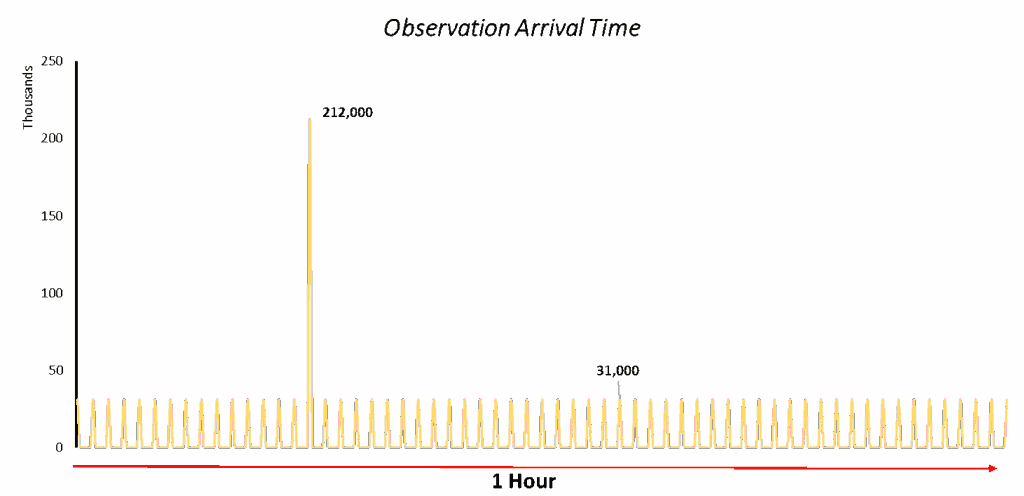
Whilst the value of face to face interaction will always remain intact, this scenario has shown us a different way of working. We have the technology in place, where we use it from is the only outstanding question going forward.

Luke Brown is a project manager in our Cygnum team. For more information on Cygnum, please click here.

Data analysis in a cyber security platform

CACI Information Intelligence are working with the Government on a prototype cyber security platform to improve capability in the area of automated network defence. 

The platform ingests messages from disparate sources, including mainstream cyber security sensors and several bespoke sensors that are unique to our customer, and analyse the resulting data so a corresponding action can be automated.

Before you can respond to a cyber threat you must first detect that threat in real time, with attackers aiming to subvert detection by any means necessary, sometimes ‘real time’ can mean data spread across days, months or years, depending on the value of the target.

Our ingest pipeline was designed with these factors in mind, developing a scalable solution using message queues and data stored in elastic search which allows us to receive a large amount of fine grained data from sensors. The data received into the system is characteristically small and noisy. The natural background noise on these networks can make it difficult to decipher a legitimate cyber-attack and sensors often only report small snippets of information. The first step is to normalise the data, extracting common features from the sensors data such as devices involved, files, URLs, timings and severity.

Once all data is normalised into a common model, we seek to understand more about it by passing it through an enrichment process. In an ideal world you would perform a high level of enrichment on every message, but this is computationally expensive – especially if it requires a 3rd party service such as a DNS lookup. We aim to perform a basic level of enrichment on every message, for example, by using internal databases we can geocode external IPs to their country. An asset library of all known devices within the system is a valuable resource, adding in device information, physical location and operational status. We can optionally use 3rd party enrichment or even query back into the network using tools like Osquery on an on-demand basis. This allows us to make decisions on how to enhance the dataset while balancing the load on the system and network.

Once the ingest process has finished enrichment, we have a large pool of data to analyse. To reduce the burden on the Cyber Analyst we make use of ML techniques. Using Recommendation Engines, we can look at the previous actions performed by the user for similar messages and make a suggestion on the correct response. If the confidence of the recommendation is high, then a response can be automated by the system, for example blocking an attacker’s access to the network.

Our UI is a key part of the application and allows for Cyber Analysts to browse the data within the system. They follow threads through the data, spotting patterns that could indicate the presence of an attacker. It’s important the UI can enable the user’s workflow of pivoting on the data and following these threads. We provide tools to group the data together to provide context. The system has built-in tasks to replicate these groups and present it to the user, should a similar pattern of events happen in the future. The sequence of events can be as important as the body of the events themselves, and our system’s UI accounts for this by enabling a timeline view.

Ultimately the automated data analysis and ML applied in this project means that the caseload of the Cyber Analyst is reduced, responses to cyber threats can be made at all hours of the day with significant levels of trust and can result in the fast, automatic removal of a malicious entity from an unmonitored network.

SurfaceNet: An Observational Data Platform Improved by Cloud

In this Article

Met Office are responsible for collecting and processing observation data, used to analyse the country’s weather and climate, at weather stations around the world and coast. The observations are valuable to several different consumers, from meteorologists forecasting the weather to climate scientists trying to predict global trends resulting from global warming.

Met Office and CACI’s SurfaceNet

Met Office have been looking to build a replacement observations platform that is more efficient and appropriate for their current needs. CACI have been working with Met Office for the last two years to deliver the next generation system: ‘SurfaceNet’, with the primary requirements being that it is cost effective and scalable.

Given Met Office’s ethos of adopting a ‘Cloud First’ approach, and its partnership with AWS, it was an obvious choice to build the system in AWS’ Cloud.  The first important decision was to select what would be our main compute resource. The observation data would be arriving once a minute and, given this spiky arrival time, Lambda proved to be the most cost-effective solution, allowing us to only pay for small periods where compute was required. The platform processes several observations from roughly 400 stations every minute – equating to 15 billion observations per month – so any marginal improvements on compute cost would soon add up.

Choosing Lambda complemented our desire to have a largely serverless system to minimise maintenance costs, using other serverless AWS resources such as S3, Aurora Serverless, DynamoDB and SQS. This approach avoided the need to provision and manage servers and the associated costs involved with this. Serverless resources are highly available by design; Aurora Serverless mandates at least two Availability Zones that the database is deployed into, while DynamoDB and S3 resources have their data intrinsically spread over multiple data centres.

Most of the data ingest occurs by remote data loggers communicating via MQTT with the platform; AWS IoT Core was the ideal resource for managing this. Using API gateway, we developed a simple API on top of IoT Core allowing those administering the system to onboard new loggers, manage their certificates and monitor their statuses. The Simple Email Service (SES) allows ingestion of data from marine buoys and ships that transmit their data via Iridium Satellite. Both IoT Core and SES are fully managed by AWS, supplying an easy method of handling data from a range of protocols with minimal operational management.

From a development perspective, the stand-out benefit of working in the cloud has been having the ability to deploy fully representative environments to test against. Our infrastructure is defined using CloudFormation, enabling each developer to stand up their own copy of the system when adding a new feature.

Eliminating the classic ‘works on my machine’ problems that plague local development allowed for rapid iteration cycles and far fewer bugs during testing. The process means constantly exercising the ability to deploy the system from scratch, which will come in handy when an unforeseen problem occurs in the future.

Whilst this suggests a flawless venture into the Cloud sector, the journey hasn’t been without problems. CloudFormation has been incredibly useful, but given the scale and the number of resources, it has become cumbersome. Despite our best mitigation efforts there is still a large amount of repetition, and the cumulative lines of YAML we have committed is on par with the number of lines of python. We would consider using the newer AWS CDK if we were to approach the project again.

Additionally, we started off making new repositories for each new Lambda, but this has ended up limiting our ability to share code effectively across components, not to mention having to update ~40 repositories when we want to update buildspecs to use a new version of python.

It has been a fascinating couple of years and a main takeaway has been that large organisations such as Met Office, with large-scale bespoke data problems, see the cloud as a desired environment for building solutions.

The maturity of the AWS platform has shown the cloud to be both robust and cheap enough to satisfy the requirements of complex systems, such as SurfaceNet, and will certainly play a big part in the future of both CACI and the Met Office.

Four tips for advanced email personalisation

In this Article

PConsider how many emails you get in a day. Even in the aftermath of GDPR, we bet it’s still a lot. Increasingly, people have very little time to read even the most important emails they receive.

So as a marketer, it’s vital to make the most of that tiny window. And personalisation is key to delivering content that a recipient will actually read – it’s no coincidence that one client we spoke to noticed an 18% uplift in revenue when sending more targeted messages.

When it comes to advanced email automation techniques, the best brands all have one thing in common: they use personalisation creatively, to make their campaigns more relevant, and meet customers’ increasing expectations.

PERSONALISATION: THE ONLY WAY TO CUT THROUGH THE NOISE

For the best performing organisations, personalisation goes way beyond the basic “first name in the subject line”. They use it to:

  • Relate to their audience through personal preferences
  • Deliver better customer experiences
  • Reduce churn and drive loyalty
  • Increase revenues

Personalisation doesn’t have to be complicated. For many time-sensitive communications, it can be as simple as ensuring you have the right information, at the right time, and aimed at the right person.

But it does rely on adhering to four rules, which every successful campaign needs to follow.

1 – Personalise From The Start

If you’ve overcome the first and most important hurdle of getting a subscriber to open your email, that’s great. But the bad news is the work is far from over.

There’s no point personalising the content near the end of your email, if your customer won’t get that far. You need to grab their attention by putting your most relevant and personalised content first. Or else they simply won’t read any further.

Just like you’d optimise your website structure, you need to ensure your most interesting and relevant information and CTAs – for that individual – are right at the top of the page. That way, you maximise the chance they’ll start to scroll down.

One client told us this simple structure change far outperformed any variations they tested in their email’s content or offers.

2 – Design Matters

For many leading brands, emails are a continuation of their website’s design. And having images with the same dimensions makes it easier to set up many personalisation options.

What’s more, by linking module copy and images from your website to your emails, the chances of making mistakes within an email is greatly reduced.

But it’s important to strike a balance: something that looks good, but that’s also very functional – and that the majority of email clients can handle.

And don’t forget to test how your design works across a wide range of devices. What works on a wide PC monitor may become fiddly and difficult on a small mobile screen.

Speaking of testing…

3 – Test And Learn. Constantly.

From big module structure changes, to minor colour or CTA tweaks, the importance of constantly testing what works can’t be overstated.

It’s the quickest and most accurate way to understand what individual customers like, and the reason why most major brands have transferred what they’ve learned from years of website testing over to their emails.

But one of the most important pieces of advice leading email marketers gave us is to not be afraid to fail.

Remember, a failure against the control is still a success, so long as you learn from it.

4 – The Future Is Real-Time Personalisation

For some leading organisations, real-time personalisation software like Liveclicker has proven a valuable asset.

We talked to one of our clients who uses Liveclicker on millions of emails each year. They said: “With real-time email changes, we have the ability to change time-limited offers or swap-out events that have sold out depending on when the email is opened. It puts us at an immediate competitive advantage.”

Especially if your inventory changes regularly, this may be something you need to seriously consider to stay competitive.

And if you want to take it that step further, AI – the ability to use machine learning that learns from subscriber behaviour to tailor the content of an email, where it’s placed, and in what style – is likely to be a game-changer surprisingly soon.

ADVANCED EMAIL AUTOMATION: LEADING BRANDS’ SECRET WEAPON

There’s no denying it, successful email marketing is hard. And as the number of emails increases – and customers have even less time to read even the most important messages in their inboxes – it’s only getting harder.

Every person on your database will cost you money to lose. So it’s critical you encourage them to stay and respond to what you’re sending.

Highly personalised and targeted emails – which are constantly optimised though a process of test-and-learn – are your best chance to help maintain and grow your database.

Your customers will not only thank you, but you’ll notice the results.

FOR MORE INFORMATION

tells you how you can overcome key challenges when it comes to delivering personalised customer experiences.

If you want to find out more about the amazing things we do with data, then feel free to get in touch.