

Case study
How Hertfordshire County Council uses CACI’s Acorn to house displaced Ukrainians

Summary
Hertfordshire County Council serves a population of 1.2 million residents and offers a range of services including Adult Care Services, Children’s Services and Public Health Initiatives. The council is responsible for administering the Homes for Ukraine scheme across the county, via a dedicated team working with partners to manage the scheme’s requirements of Ukrainians fleeing conflict. These requirements focus on the safety, suitability and support for those arriving to hosted accommodation in Hertfordshire. The team also provide a service to support guests moving on from a host, including rematching Ukrainian guests with new hosts if their existing arrangement can no longer continue.
Company size
10,000+
Industry
Non-Profit
Products used
Challenge
Rematching Ukrainian guests with new hosts is a substantial part of the council’s Ukraine Sunflower Campaign, as it is aimed at encouraging more rematch hosts to come forward while retaining those already in place. Due to the conflict continuing, some hosts are unable to house guests longer term. It is also preferable for guests to remain hosted within their original vicinity, district or area, both from a cost perspective to the council and for guests’ wellbeing, as they may have formed relationships and begun settling in.
With a key message being “you only need a spare room”, the council operated under the assumption that the ability to host and likelihood of having a spare room fundamentally came down to affluence. This prompted conversations around the impact that more targeted efforts could have on campaign outcomes rather than operating on a scattered approach and the powerful role that data could play.
Solution
The council decided to concentrate an early phase of their rematch campaign in St Albans, a district within Hertfordshire. Through a blended data approach that leveraged segmentation insights from CACI’s Acorn data, persona profiles from Acorn’s Pen Portraits and HCC records, the council was able to pinpoint St Albans as the area with the highest concentration of likely hosts with the help of Laurel Smithson, Strategic Communications Manager. These typically comprise households with adult children who had moved out or were living in larger properties with spare rooms available, making them an ideal demographic for hosting.
Brianna Schubert-Mordey, Intelligence Analyst and Geodemographic Lead at Hertfordshire County Council, initiated an integrated data strategy by merging Acorn’s demographic data with Hertfordshire-specific datasets. This enabled the creation of a customised segmentation model and development of seven unique personas tailored to reflect the characteristics of the Hertfordshire population. An algorithm, K-modes, was used to analyse data for each postcode and determine the optimal number of clusters, allocating each postcode to one of seven defined clusters. This would eliminate human bias when identifying similar types of residents, with each cluster becoming a persona.
The composition of each segmentation and each of the seven personas was then assessed using the data available. This enabled naming conventions for each persona that represented respective key factors. These 7 Personas are as follows — Young and Financially stretched, Stretched Families, Comfortable Neighbourhoods, Affluent Families, Financially Secure Maturity, Highly Affluent Maturity and Struggling Elders, and have been created to reflect Hertfordshire’s local population. CACI Data has been used along with proprietary data the council reported on about council tax bands, dwelling values based on sold house prices and the likelihood of individuals calling into their call centre compared to other households within Hertfordshire.
Following this, Laurel approached Brianna and the HCC Homes for Ukraine team regarding the Homes for Ukraine project. Their goal was to identify target households that could potentially host a family based on these seven personas. Brianna’s team sent Laurel a list of postcodes to be aligned to these specific segments to assess the affluence, financial maturity and security of various areas across Hertfordshire, with a particular focus on identifying comfortable neighbourhoods and affluent households to gauge the affluence maturity and financially security of various areas in Hertfordshire, as well as postcodes containing comfortable neighbourhoods and affluent families.
St Albans and its vicinity was ultimately targeted with Royal Mail leaflet drops and digital advertising, with trackable links set up for each form of communication. The leaflets were most one of the most successful in leading people to the council’s rematch website.
Due to the success of the St Albans pilot, the council was inspired to execute this rematch campaign once again in East Hertfordshire, another higher affluence area where the target demographic of potential hosts for displaced Ukrainians is situated. Due to feedback received on the reliance of Royal Mail delivery, including some households within the targeted postcode being considered inappropriate (such as care homes), this phase of the campaign took an even more targeted approach. Colleagues from the Homes for Ukraine team undertook the hand delivery of leaflets, allowing for higher reliance and feedback on the ground. This initiative has seen a higher uptake than the St. Albans targeting.
Results
Through Household Acorn and Acorn, Hertfordshire County Council have been able to:
- Help Adult Care services identify where to target leafleting and outreach work
- Allow the Customer Service Centre to identify the Acorn segmentations that are over/underrepresented in terms of calls
- Highlight the areas most likely to be able to host Ukrainian families
- Understand the types of residents in an area
- Profile current foster carers and patrol crossing staff and use this information to communicate with potential new carers/staff.
This initiative has brought many more rematch hosts forward and has even inspired council staff to become hosts. In fact, the Ukraine Sunflower Campaign won a comms2point0 award in December 2024 for being “…a campaign that used insight, data and measurement to deliver high impact and change people’s lives.” A comms2point0 ‘UnAward’ honours “creativity, innovation and results in the comms industry”.
With devolution, local government will be changing in the coming years, and Acorn could be used to help Hertfordshire County Council understand the needs of residents throughout this change. Using CACI’s data to map and pinpoint hard-to-reach individuals facing health inequalities would also support the council’s future endeavours.



Case study
How CACI helped Network Rail develop & manage an open data service
Summary
National Rail Open Data (NROD) provides the public with access to a large number of operational data feeds to encourage both greater interest in rail and the development of innovative products that are of use to passengers and the rail industry. CACI processes and manages the NROD platform with the aim of providing continual and easy access to users.
Company size
42,000
Industry
Transport
Products used
Challenge
Network Rail provides a variety of data in different formats from XML, JSON and rail proprietary data structures. These are received with varying levels of frequency from static data to real-time data updated at up to 100 messages per second during peak hours. Our instruction from Network Rail was for the data to be made available with no obfuscation or filtering applied to make it as accessible and easy to use as possible.

Varied data formats

Inconsistent frequency

Need accessibility
Solution
To achieve this, we offered options for users by providing some conversions (such as to JSON) and enriching data with metadata. We also used AWS infrastructure and highly available components like AWS ECS (Elastic Compute Service) and S3 (Simple Storage Service) to improve access and availability.
Users were provided a portal for account management, allowing them to change details such as their username and password and access links to documentation and endpoint information for the data to aid their use and interpretation. A separate portal manages access for industry clients invited by Network Rail, allowing them to connect to a more stable platform for use in industry applications.
Results
NROD is now used by an engaged, passionate community of over 600 registered users who apply the data in a variety of ways. Since the data was first made available, a range of websites and apps have been created, including Open Train Times, which provides real-time arrival and departure information for each train company and helps passengers plan their journeys, along with Recent Train Times, demonstrating individual trains’ performance and helping users assess the punctuality of different train services to plan their journeys accordingly.
CACI has been collaborating with industry clients and representatives of the broader public client community in a working group to give updates and receive feedback on how best the community can be served. We also discuss enhancements and how to collaborate to address users’ needs at quarterly meetings.
A Grafana dashboard has been developed to keep users informed on the system’s status, including message rates, message latency of the main feeds and an update field showing system downtime updates.
To ensure NROD is accessible to as many audiences as possible, we have worked with Network Rail to provide the same data within the Rail Data Marketplace (RDM), adding to the 100+ other rail data products now available on this platform.





Case study
HMCTS Court Store and Bench Moves to AWS
Summary
The HMCTS Court Store and Bench applications have historically been hosted on the UKCloud’s elevated platform, managed and supported by CACI. In 2021 however, the decision was taken to move the hosting of these projects onto the
AWS platform, with ongoing support in the new environment. CACI was tasked with ensuring the move was achieved in as short a time frame as possible whilst observing the highest level of security.
Company size
18,500
Industry
Government
Services used
Challenge
Due to the complexity of the UKCloud solution and application software stack, we decided to migrate the solution in its existing state from UKCloud to AWS. The environments consisted of four AWS accounts and eight Virtual Private Cloud environments. The approach was to split the project into two stages.
In view of the tight timescales, the order of this migration was to first focus on production, with the pre-production environment to be established after go-live. This order was acknowledged by all parties that whilst being far from ideal, there was no alternative. One of the biggest challenges was the volume of data to be migrated from one cloud provider to the other: in excess of 20Tb.

Stage one environments
Production, sandbox and performance

Stage two environments
Pre-production
Solution
The migration project consisted of several phases:
- Provisioning a base AWS Infrastructure and protective monitoring setup
- Export of Virtual Machines in UKCloud and import into AWS as AMIs
- Provisioning/cloning of AMIs
- Re-configuration of the application stack, on-VM protective monitoring/backups and internal operability testing
- Intersystem Connectivity and Operation, Connectivity Testing
- Configuration of G-Suite and novation of domain from MoJ to CACI
- End-user testing
- IT Health Check
- Operational Readiness Testing
- Data Migration
CACI’s role was as follows:
- Solution design
- Migration plan
- Infrastructure and protective monitoring
- Import of Virtual Machine images and data transfer
- Testing: OAT, ITHC
- Cutover
- Overall project management, including other parties: SopraSteria, HMCTS and other MoJ departments
Results
HMCTS can now continue to run its Court Store and Bench operations in the knowledge there is little likelihood of a breakdown in service.
Based on CACI’s experience of migrating similar workloads, this move to AWS also achieved other improvements such as:
- Use of infrastructure as code: better change management, less human error, increase of delivery quality and reduction in build time
- Use of AWS security services to increase view of security posture and simplify implementation of some security controls (e.g. encryption, identity and access management)
Other highlights:
- Completed the project two months ahead of time
- Ongoing data storage cost savings are in the region of 65%



Case study
Creating a scalable customer journey framework, through human-centred service design

Summary
Handelsbanken are a major Swedish bank; their central proposition is they are a ‘relationship bank’ offering a truly personal service. Each branch operates as a local business, with an in-depth understanding of the local market and community; services tailored to each client’s needs.
Handelsbanken had always focused on delivering excellent experiences and services. However, when the Financial Conduct Authority (FCA) announced a new Consumer Duty was due to come into force, this was a catalyst for Handelsbanken to implement a formal, structured user and customer experience analysis and action plan.
Company size
10,000+
Industry
Finance
Services used
Challenge

The Consumer Duty requires financial firms to ensure customers receive helpful and accessible customer support, clear information, and products and services that meet their needs and offer fair value. Firms must proactively protect customers from harm and ensure customers in a vulnerable situation, such as financial difficulty or during life events like bereavement, are not disadvantaged or put at risk. Firms must also identify and tackle pain points causing customers harm.

Handelsbanken’s challenge was to ensure they could meet – and evidence – their new regulatory requirements. This requires a culture of customer research, a workforce empowered to achieve the bank’s customer-centred objectives, and toolkits and governance systems in place so stakeholders in the independent branches can work to consistent standards, creating cohesive customer experiences across all channels.

With our experience in Service Design, governance, and training, we were chosen to create a new scalable customer journey framework and embed a customer-centred approach into the existing ‘Handelsbanken Way’.
Solution
From the beginning, we worked closely with Handelsbanken’s internal teams to create a detailed working process and roadmap, using business analyst insights into operational processes in branches to inform our work.
We undertook extensive quantitative and qualitative research with a diverse range of Handelsbanken team members and customers. Due to Handelsbanken’s unique decentralised model, we needed to approach customer journey and pain point mapping from both a branch and customer perspective.
In addition to our usual definition, creation and validation of customer persona groups, to meet the Consumer Duty guidelines we also created 5 vulnerability lenses, that could overlay any customer persona and journey, to identify and trigger the appropriate support and sensitivity for a customer’s circumstances, whether in the case of ill health, fraud or financial difficulty, for example.
A critical part of our work was supporting Handelsbanken’s team with the tools and culture to deliver this new customer journey approach in practice. We developed the concept of a review panel with senior stakeholders, to create a pain point prioritisation roadmap and took outcomes into ideation and put into action quick wins ahead of the Consumer Duty July 31st 2023 deadline.
Results
We analysed the bank’s 54 services and products and identified 99 customer journeys as being in the scope of Consumer Duty. We uncovered 375 pain points for customers, of which 128 were classified as having potential to cause customer harm; running ideation sessions to establish solutions for the 128 priority areas to address.
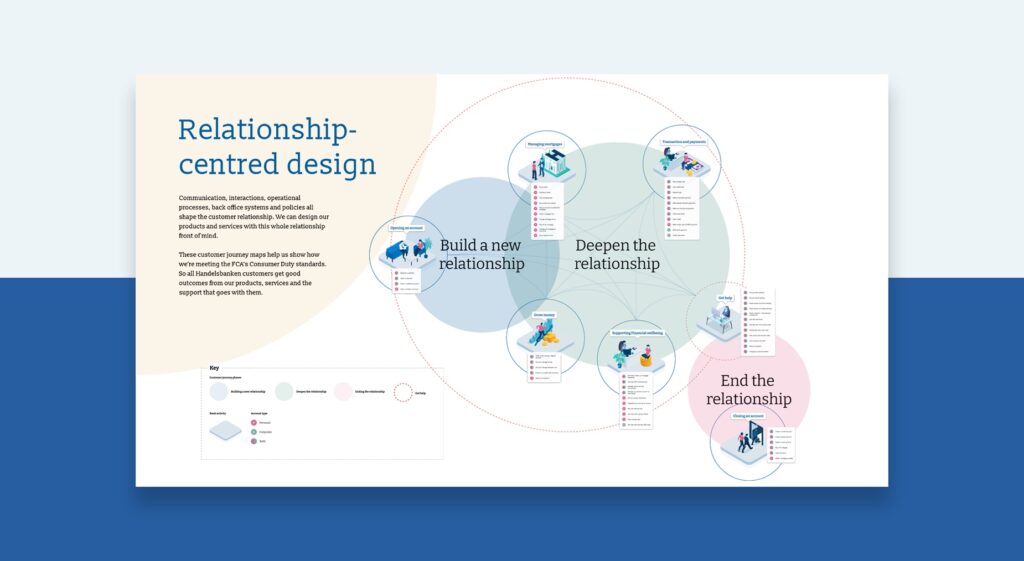
This was mapped and visualised into a structured framework that will deepen Handelsbanken’s relationship with customers from the day they come on board, right through to ending the relationship – as well as be used to evidence and ensure compliance towards the Consumer Duty.
The insights gathered throughout this process were methodically and transparently documented and collated into a detailed digital knowledge base including context and guidance, how-to guides, templates, case studies, artefacts, and much more. Providing the foundation for ongoing continuous improvement and internal work.
We worked collaboratively with people across the bank, developing a cross-bank operating methodology and providing staff training around customer-centred design. All of this helping to embed the framework and Consumer Duty compliance into Handelsbanken business-as-usual.




Case study
Somerset NHS Foundation Trust chooses Synergy as its costing solution

Summary
Somerset NHS Foundation trust (SFT) is the first trust on the English mainland to provide community, mental health and acute hospital services. We spoke to Peter Fry, Head of Costing and SLR, about the recent trust changes and how Synergy is helping them join up their costing data.
In 2017, Somerset Partnership NHS Foundation Trust and Taunton and Somerset NHS Foundation Trust formed an alliance designed to support a close working relationship between the two trusts. Later that year, the trusts moved to working from a single, joined up set of objectives that spanned across all services.
As this approach progressed and colleagues reported on the benefit gained from working in this way, they sought to go a step further and formally merge. This came to fruition in April 2020, where the trusts merged to become Somerset Foundation NHS Trust.
Prior to the merger, Peter had come from working on the mental health and community costing side at Somerset Partnership NHS Foundation trust. Since the merger he is now is working with an income and costing team of six, which works across all services (acute, mental health and community) and cover costing, service line reporting (SLR), contract and reporting.
Company size
14,000+
Industry
Healthcare
Products used
Challenge

Choosing a system
Initially, both trusts had been using different costing solutions. A decision had to be made on a sole solution to take them forward.
Peter explains: “When we merged and we were considering which solution to go with, during our search we spoke to a lot of other trusts who told us their stories around how they were using CACI’s recent developments in Synergy and the good experience and improvements they were able to make through using it”.
There were a number of factors that impacted the decision to elect CACI and Synergy as their costing solution, and flexibility with complex data, was a high priority on the list.
Solution
Peter goes on to describe the benefit, both technically and financially, for the costing team of being able to develop and build in Synergy.
“We’ve got a really good costing team in house, so we weren’t looking for a provider who would go away and do all of the work for us. In addition to the high costs involved of a provider doing it all for us, we wanted to build it ourselves so we know how it works, and when we share the data with people we know how each and every cost has been arrived at, and can communicate that effectively. So, when we sat down to review which solution to go with, it was very clear that Synergy was the logical decision and would work better with our requirements”.
Finally, Peter talks about how the outputs from Synergy will become extremely important in the coming months and so this was also a big factor when choosing a solution.
“The output is also something that’s really important, and the ability to output data into other front end analytics solutions like Power BI, means Synergy delivers even more value and cost savings to the trust – none of the other providers we were looking at could do that. This also means, as our information team already use Power BI, we’re not having to force others to use a different tool in order to look at our costs.”
Results
“My team really enjoys using Synergy. We’re still developing our costing model to reflect what we’re doing as a trust, and we’re looking forward to the outputs we want to get out of it and how we can use those going forwards”
Other aspects such as training received and the interaction with the CACI customer care team, have meant Peter’s costing team, who don’t come from a costing background, have been able to hit the ground running.





Case study
Power BI migration & implementation process & outcomes for North Bristol Trust (NBT) – part 1

Summary
When North Bristol Trust (NBT) was tasked with migrating their existing reporting tool to Power BI, CACI was their trusted partner that supported the successful production of a migration readiness package. This readiness package included a detailed report of all quantitative and qualitative findings, a newfound understanding of existing functions and capabilities, a reassessment of future requirements and definitive progression of next steps in the Trust’s migration from business case creation to sign-off.
NBT possessed over 100 reports in their pre-existing analytics platform, ranging from list-based for front line, operational workers to more backend, dashboard and analysis reports for email distribution. Once these reports needed to move from NBT’s pre-existing system to Power BI, the Trust wanted to understand and reconsider their design, particularly its contents and data structure.
Andrew Elliott, Head of Data Analytics at North Bristol Trust, has handled analytics platform outputs and has been a key player in the Trust’s Power BI migration.
Company size
13,000+
Industry
Healthcare
Products used
Power BI
Challenge

The first course of action identified for NBT was the need to improve efficiency when creating reports. This was a multi-step action, not simply addressing the speed at which reports are updated, but the efficiency and maintenance of data.
To achieve this, Andrew’s team revisited their hospital data analysis practices to ensure they would remain up-to-date, reliable and accurate.

There was also an emphasis on redesigning the data models that fed the reports to meet requirements. This required a substantial amount of analysis to understand where data was coming from and what NBT was doing with that data to display the report. Once this analysis was complete, NBT had to consider how it could be streamlined to become more efficient and recreate that logic in a new location within their data warehouse.
Solution
This process took the Trust substantial time and input from CACI, with Richard Brennan, CACI’s Principal Consultant, working on the mapping process and providing ongoing support to Andrew’s team.
Determining the best data design followed this. Andrew’s team had ambitions on what the Trust wanted to do with their data, an especially crucial factor being that through Power BI, other analysts from across the hospital could be brought on board.
In the weeks prior to going live, Andrew’s team liaised with key individuals across the Trust on upcoming reports, Power BI was displayed on the intranet’s homepage and a Power BI developer group was established for updates from Andrew’s team, their use of Power BI and best practice sharing.
Once the reports were signed off as tested, they were moved into the appropriate workspace apps for users. A soft launch took place prior to go-live to ensure comfortability of using Power BI and address any final issues. Finally, users were added to groups for immediate access and the original platform was turned off, marking the official introduction of Power BI.
The diversity of requirements and revisiting the data design were two pivotal focal points to be reprioritised over the course of the implementation.
The ambition around optimised data design was initially obfuscated due to the comparatively little data available from clinical divisions and departments across the hospital that used Excel. This prompted Andrew and his team to encourage the use of one cohesive reporting platform to ensure data sufficiency, accuracy and reliability, creating an environment that analysts would engage with and host their reporting on.
The immense size of this ambition quickly became clear to the Trust, particularly regarding the data scope, the systems it took from, the amount of available data and the data used by divisional analysts. Upon further investigation into data sources, an added layer of complexity came to be: rebuilding all the data sources into a new data model would be impossible to achieve by the stringent deadline. With CACI’s help, however, the situation took a positive turn.
“CACI provided helpful support and advice [during this time], even during times where I think our project had gone from a green to an amber stage where we were coming into the last couple of months,” Andrew shared. “CACI was incredibly supportive of the decisions that we were making, also contributing to those decisions themselves.”
Results
Richard’s Power BI configuration set up Andrew’s team for a successful first few weeks of post-go-live, with the team receiving about 600 hits on reports in the first two days post-go-live and approximately 60 support requests.
According to Andrew, Richard’s continued support in demonstrating any changes to the semantic models, identifying any issues with uploading data or explaining the environment’s functions has been particularly useful.
“We had Richard in the background with any small changes that we wanted to do with the data loads or semantic models, and that support was useful in the run-up and afterwards, because we’ve watched how to look after this system as Richard has built it, but when you’re actually live and you’ve got to look after yourself, it’s nice to have that bit of hand-holding as you learn,” he explained.

NBT has presently moved out of the post-go-live period of constant close monitoring and rapid issue resolution towards a business-as-usual position. Plans for future enhancements can now be reviewed, along with an assessment of the Trust’s future and the potential of reaching a similar outcome with NBT’s partner, UHBW, enabling both data teams to identically view data across Trusts and share it seamlessly.
The project’s success also led to Andrew and his team being nominated by NBT’s Operations leadership for their annual staff award, an internal mark of excellence and recognition for a project well-delivered.



Case study
How Virgin Media successfully met the End of Contract Notification Regulation

Summary
The Ofcom regulation launched 15 February 2020 outlining that customers must be sent an End of Contract Notification (EoCN) 10-40 days before their contract ends. These should include details of the account such as current contract deal and associated offers. The regulation is designed to raise awareness to the customer that they’re out of contract and their price may change. Virgin Media, a major provider of broadband, TV, phone and mobile services in the UK, had never previously sent out such a notification, nor were their systems ready to do so.
Company size
10,000
Industry
Retail
Services used
Products used
Challenge
Virgin Media requested support from a dedicated CACI Adobe Campaign consultant to assist with the creation and the facilitation of the end-to-end solution. CACI’s Senior Consultant, Fraser Rallison, joined the team to support Virgin Media with its EoCN campaign.

Implementation
Virgin Media faced significant challenges in implementing EoCN. Its existing systems were not equipped to produce these notifications, necessitating the creation of an end-to-end solution from scratch. Not only was this a complex task, but it had to be managed within a very tight timeline, with substantial financial implications if the deadline was missed.

Communication
Additionally, Virgin Media needed to ensure the accuracy and clarity of the notifications to avoid customer misunderstanding. In addition, they needed to identify the most appropriate and accessible way to contact customers, whether via email or special formats like audio or braille.
Solution
The EoCN approach consisted of passing data through several different data systems. The process began by selecting all eligible customers using Virgin Media’s source billing system. This data is then released to be transformed into a more customer friendly format. Once complete, the customer specific offers are appended and the data is delivered into Adobe Campaign.
Within Adobe Campaign, six individual workflows were created to release over 20 different data files. These workflows ensured that the data coming through was correct and accurate with no missing values which could cause confusion to the customer. The data is also checked to ensure all offers are correct and make sense to the consumer.
Once these steps are complete the data is reviewed to identify the most appropriate way to contact customers. This is identified by reviewing their previous email engagement, quality of email address and whether they require a notification in a special format (such as audio or braille).
Once these checks and classifications are complete a bespoke report is built from Adobe and shared with project stakeholders with a request to approve the accounts should they match the project plan. Once sign off is agreed the data passes a final two-stage quality assurance check before then being released to separate email and direct mail agencies.
Results
The level of granularity within the workflows allowed Virgin Media to better understand the offering provided to customers. The flexible and dynamic approach has also lead to a significant amount of customers communicated to since 15 February 2020 when the regulation came into force. With the support of CACI, Virgin Media has kept within the EoCN regulations and avoided substantial fines.




Case study
Creating a strategic segmentation to help TSB understand and drive money confidence

Summary
TSB is pioneering a new kind of banking for Britain, one that’s simple, straightforward and cares about people. Serving five million customers in the UK across a network of branches and operating centres, TSB offers friendly, honest and convenient banking that’s designed to meet customers’ needs, with the aim of delivering on its core purpose to equip them with money confidence. To do this, the bank wanted to better understand its customers’ behaviour, circumstances and priorities so it could be more relevant, engaging and effective.
Company size
10,000+
Industry
Financial services
Products used
Challenge

Customer segmentation
TSB already had creative-led segmentation developed by its brand agency. Yet, while this segmentation helped understand the target audience, it was ineffective for media planning and couldn’t be overlaid on the customer base.
At pitch, TSB’s new media agency, the7stars, proposed a more effective segmentation for media selection, which TSB wanted to advance further by overlaying it onto their own customer base.

Integration
In addition, the bank faced the issue of integrating these insights into its existing systems and ensuring they could be used for practical and actionable segmentation for effective media planning and customer targeting.
TSB had already been working with CACI to map Fresco financial lifestyle segments onto its customer base. So, a new joint collaboration with CACI and the7stars was initiated to address these requirements together.
Solution
Working in collaboration with TSB’s Research and Strategic Insights Team, CACI created an evolved segmentation that clearly distinguishes different customer types and provides clear segment profiles and personas.
CACI used Fresco and other external consumer demographic datasets to give TSB bespoke behavioural and lifestyle insights into its target customer base.
Justin Bell, Head of Insight, Strategy and Planning at TSB explains: “We started with a market-wide segmentation, based on all UK adults. We’ve subsequently created a version of that for our customer base.
“CACI provided a proven methodology and approach drawn from their data expertise and experience. Once we had clear segment parameters, our data team mapped them to our base.”
Results
TSB is actively using the segment insights to develop its media strategies and in campaign briefs, creating content tailored to target consumers’ profiles.
Justin continues:
“Part of the output of the segmentation was to rank the segments in order of money confidence. Working with CACI, we agreed on a weighted mix of key questions in the TGI consumer survey, to derive a money confidence score. We support people with content, products and services to help raise their money confidence and we need to be relevant to those that need that support most.

“At the heart of it is a money confidence score: we’ll measure our progress against our purpose: Money confidence for everyone everyday. We hope to see a gap opening up between the money confidence levels of our customers and that of non-customers, with a continual improvement against today’s baseline.
“We believe this segmentation will continue to pay dividends as we develop our channel and campaign marketing – we’re looking forward to tailoring products and services even more to meet customer needs.”


Case study
How CACI supported Tesco to quickly join the dots and suggest seamless approaches to problem solving

Summary
Tesco approached CACI to get support from our data specialists on a new project to connect the dots using CACI data.
Company size
10,000+
Industry
Retail
Services used
Challenge
For some years Tesco analysts have used map data from CACI to help define store delivery catchment areas. They have also used data from CACI to help them understand where the uptake of the company’s home delivery service was likely to be highest.

Digital mapping
Latterly Tesco.com, Britain’s biggest grocery home shopping retail business, has introduced a new, more advanced routing and scheduling system to plan home deliveries by its fleet of over 2,000 vans; and in the light of its established relationship with CACI, the retailer again turned to the company to supply appropriate digital map data for both the UK and Ireland.
Solution
To work on this software, CACI has supplied Tesco with premium vector street-level map data, which includes essential routing information such as one-way streets, banned turns and address ranges. The premium mapping data was also used to provide a visually pleasing map background for display and presentational purposes.
Tesco.com generally delivers to homes from 8am right through to 11pm from Monday to Friday, as well as up to 10pm at weekends, so it is vital for the company to be able to route its vehicles to take account of changing traffic speeds and flows at different times of day and at weekends.
CACI has therefore also supplied Tesco.com with Traffic Patterns, a data set that contains average traffic speed on individual road segments, calculated from past traffic flow measurements and differentiated by time of day and day of the week.
Results
Digital map data assembled, prepared and formatted by CACI is playing a key role in the continuing expansion of Tesco.com.
According to Ben Dito Smith, the Location Strategy and Analysis Manager for Tesco.com : “Efficient, timely delivery is a fundamental feature of our home shopping proposition, so it is essential for us to use the most appropriate software and data available for our delivery planning system.”
Tesco.com delivers to consumers’ homes from larger retail stores and from a small number of specially designed dotcom stores. The home shopping business on its own now turns over more than £2 billion.




Case study
Power BI migration and implementation process and outcomes for North Bristol Trust (NBT) – part 2

Summary
When North Bristol Trust (NBT) was tasked with migrating their existing reporting tool to Power BI, CACI was their trusted partner that supported the successful production of a migration readiness package. This readiness package included a detailed report of all quantitative and qualitative findings, a newfound understanding of existing functions and capabilities, a reassessment of future requirements and definitive progression of next steps in the Trust’s migration from business case creation to sign-off.
NBT possessed over 100 reports in their pre-existing analytics platform, ranging from list-based for front line, operational workers to more backend, dashboard and analysis reports for email distribution. Once these reports needed to move from NBT’s pre-existing system to Power BI, the Trust wanted to understand and reconsider their design, particularly its contents and data structure.
Company size
13,000+
Industry
Healthcare
Products used
Power BI
Challenge
Andrew Elliott, Head of Data Analytics at North Bristol Trust, has handled analytics platform outputs and has been a key player in the Trust’s Power BI migration.
The first course of action identified for NBT was the need to improve efficiency when creating reports. This was a multi-step action, not simply addressing the speed at which reports are updated, but the efficiency and maintenance of data.
To achieve this, Andrew’s team revisited their hospital data analysis practices to ensure they would remain up-to-date, reliable and accurate.

There was also an emphasis on redesigning the data models that fed the reports to meet requirements. This required a substantial amount of analysis to understand where data was coming from and what NBT was doing with that data to display the report. Once this analysis was complete, NBT had to consider how it could be streamlined to become more efficient and recreate that logic in a new location within their data warehouse.
With these needs in consideration, Andrew’s team reached a consensus on the requirement for a new reporting database, as well as a redesign of the data models that would facilitate the moving of their reporting tool.
Solution
This process took the Trust a lot of time and input from CACI to execute, as the initial input stages were focused on providing business knowledge and data understanding, with CACI possessing the technical knowledge. CACI’s Richard Brennan, Principal Consultant, worked on the mapping process and provided ongoing support to Andrew’s team.
Determining the best design for that data followed this. Andrew’s team had ambitions on what the Trust wanted to do with their data, one of which was knowing that through Power BI, other analysts from across the hospital could be brought on board. The board was an especially important and crucial factor as NBT approached the Power BI go-live date. For Andrew’s team, this included ensuring alignment on decision-making, gaining organisation-wide buy-in and keeping motivation up.
“We weren’t putting our head in the sand, we were very honest with any issues that we had and [the board was] immensely helpful in their responses, particularly around communication,” Andrew shared.
In the weeks prior to going live, Andrew’s team liaised with key individuals in the Trust across various departments and divisions on the status of upcoming reports. Power BI also began to be displayed on the intranet’s homepage of the intranet for collective awareness on Power BI going live. NBT followed an additional CACI recommendation of forming a Power BI developer group for regular meetings to take place on what Andrew’s team was doing, how they were using Power BI, encourage others to use Power BI and share best practises.
All licenses were in place and once the reports were signed off as tested, they were moved into the appropriate workspace apps for users. A soft launch using advanced functionality for several areas took place a week prior to go-live to ensure comfortability of using Power BI and iron out any final issues before eradicating their pre-existing BI tool. The final step was adding users to groups for immediate access and turning off the original platform.
By Friday afternoon, users were given access while the original platform remained available over the weekend, and by Monday morning, a blocking page prohibiting access was implemented, marking the official introduction of Power BI.
The diversity of requirements and revisiting the data design were two pivotal focal points to be reprioritised over the course of the implementation.
The ambition around optimised data design was initially obfuscated due to the comparatively little data available from various clinical divisions and departments across the hospital that used Excel. This prompted Andrew and his team to encourage the use of one cohesive reporting platform to ensure data sufficiency, accuracy and reliability, creating an environment that analysts would engage with and host their reporting on and unite users.
The immense size of this ambition quickly became clear to the Trust, particularly regarding the data scope, the systems it took from, the amount of available data and the data that was also being used by divisional analysts. The Trust also acknowledged the fixed date by which this project had to be completed. Upon further investigation into the data sources, an added layer of complexity came to be: rebuilding all the data sources into a new data model would not be possible to achieve by the stringent deadline. With CACI’s help, however, the situation took a positive turn.
“CACI provided helpful support and advice [during this time], even during times where I think our project had gone from a green to an amber stage where we were coming into the last couple of months,” Andrew shared. “CACI was incredibly supportive of the decisions that we were making, also contributing to those decisions themselves.”
Results
Richard’s Power BI configuration has set up Andrew’s team for a successful first few weeks of post-go-live, with the team receiving about 600 hits on reports in the first two days post-go-live and receiving approximately 60 support requests (mainly access requests or general functionality enquiries). While some minor accuracy issues with outpatients arose and were resolved quickly, the reporting has remained accurate and was very well received by the end users.
According to Andrew, Richard’s continued support in demonstrating any changes to the semantic models, identifying any issues with uploading data or explaining the environment’s functions has been particularly useful.
“We had Richard in the background with any small changes that we wanted to do with the data loads or semantic models, and that support was useful in the run-up and afterwards, because we’ve watched how to look after this system as Richard has built it, but when you’re actually live and you’ve got to look after yourself, it’s nice to have that bit of hand-holding as you learn,” he explained.
That brings us to present day, where NBT has moved out of the post-go-live period of constant close monitoring and rapid issue resolution towards a business-as-usual position. Plans for future enhancements to the environment and the data behind it can now be reviewed, along with an assessment of the Trust’s future and the potential of reaching a similar outcome with NBT’s partner, UHBW, enabling both data teams to have the same view of data across Trusts and share it seamlessly. The project’s success also led to Andrew and his team being nominated by NBT’s Operations leadership for their annual staff award, an internal mark of excellence and recognition for a project well delivered.





Case study
Optimised field sales team deliver double digit revenue growth

Summary
Perfetti Van Melle (PVM) is one of the world’s largest manufacturers and distributors of confectionery and chewing gum, headquartered in The Netherlands. PVM’s global brands are enjoyed in over 150 countries and include Mentos, Chupa Chups, Fruit-tella & Smint.
Company size
10,000+
Industry
Manufacturing
Products used
Challenge

Before engaging with CACI, PVM UK were manually planning their field sales territories and routes, which the management team knew was inefficient.

PVM wanted a tool to help grow their UK business, specifically in the independent channel where they had under traded in the past. Due to the unknown returns and instability in this market, they needed to drive efficiencies and savings in their current field team, rather than recruiting more headcount. Being more efficient would allow PVM to call on more stores in the independent channel.
Solution
PVM licenced InSite FieldForce, CACI’s resource planning and territory optimisation tool, to understand the utilisation of the current team, taking into consideration variables such as travel time, visit frequencies, in call times, and the additional visits to be made to the Independent channel.
The field sales territories were optimised to create workload balanced and drive time efficient territories for each field sales rep, built around their home locations.
PVM then used CallSmart, CACI’s route optimisation software, to optimise routes for their team. Planning with an algorithm gave them more control over the stores, and channels, the reps were visiting based on business strategy rather than ‘gut feel’.
Results
PVM were able to model multiple what-if scenarios prior to implementation which gave them the confidence that they could be impactful in the independent channel whilst maintaining appropriate call coverage to the multiples.
Using CACI’s tools, PVM minimised the risk associated with entering a new channel, without investing in any additional headcount. The efficiencies gained enabled PVM to make thousands of additional calls to the independent channel, resulting in a double digit increase in sales revenue across the field sales team.
CACI’s tools are used by PVM on an ongoing basis to maintain efficiencies and immediately respond to change. Optimised call schedules integrate with their retail execution solution providing reps with visibility of their calendars allowing the team to be more agile.
Learn more about FieldForce and CallSmart.





Case study
Oxford Health save time and funding through detailed data analysis

Summary
Oxford Health NHS Foundation Trust operates across a large region of the South West of England providing physical, mental health and social care.
As a valued customer of CACI, we spoke to Head of Costing, Paul Vincent about some of the challenges his team faced and the improvements they’ve made through effective use of their costing solution Synergy 4.
Company size
10,000+
Industry
Healthcare
Products used
Challenge

The teams at Oxford Health were burdened with time consuming cost calculations that could only be produced at a high level – nowhere near their requirements for team and patient level activity-based costing.
Due to the work involved, Paul describes the costing process as being too admin heavy.
“Most of the costings were produced using excel and time was spent processing the data rather than analysing the data.”
Paul Vincent, Head of Costing, Oxford Health

When CACI were appointed, a key deliverable was to implement a solution that allowed Oxford Health to focus on data analysis in order to take actions to improve apportionment and allocation of money, as well as to kick start improving activity data by identifying gaps or lack of recording.
Solution
In order to meet the core requirements of an efficient alternative to costing calculations, as well as providing opportunities to analyse the data and gain insight, CACI’s proposed solution was Synergy4.
An NHSI Healthcare Costing Standards compliant, patient level costing solution for end-to-end reporting and management.
As one of the hurdles Oxford Health was facing was that they weren’t able to report at a detailed level, Synergy would help the trust overcome this challenge by allowing activity to be costed at the lowest level and mapping to the trust’s own user defined hierarches to produce the outputs they needed.
Paul told us this aspect has proven to be key for Oxford Health.
“The amount of detail that we can cost is extremely useful, if the activity data is robust, as we can cost by different criteria e.g. Referring GP and GP Practice, Consultant, Member of Staff that carried out the consultation, age and many more.”
Paul Vincent, Head of Costing, Oxford Health
Results
Since the implementation of Synergy4 Oxford Health have seen a number of improvements. The time saved on manual processing of the data mean they are now able to focus on data analysis and turn the insights into actions within the trust that directly impact funding.
Oxford Health continue work with CACI to maximise the benefits of Synergy and generate insights that help improve outcomes for staff and patients across the trust.



Case study
Northumberland County Council used Paycheck data to inform its Local Plan

Summary
Northumberland County Council looks after a population of over 320,000, in England’s most northerly county. Northumberland is one of England’s five largest counties, with widely distributed towns and communities of varying types and populations.
Company size
10,000+
Industry
Non-profit
Products used
Challenge

The Council’s top priority is making Northumberland a stronger place, economically and socially. That means supporting economic recovery after the pandemic and tackling inequalities within its communities, so residents are healthier and happier.

Like most Local Authorities, Northumberland County Council is focused on post-Covid recovery. Determining what’s changed and where the Council can help local economies and communities demands trusted, accurate income data.
Solution
Household-level Paycheck data reveals areas of need and opportunity.
Senior Economic Analyst Julie Dowson provides data to departments across the council, from housing and planning to public health and regeneration. “Our communities have such wide differences – it’s really important to look at them at a granular level and compare them,” she said. “That’s where the Paycheck data comes in. We need current, household level information to understand exactly where people are experiencing challenges, so the council can target plans and funds to address them.”
She continued: “The cost of living is a very important topic for Northumberland’s council officials and politicians – reflecting the concerns of all who live and work in the county. One example of the way we use Paycheck data to compare incomes and cost of living across the council’s areas is in housing affordability assessments, to identify gaps and shortfalls that create inequality.”
Northumberland County Council also uses Paycheck insight to feed into its annual Economic Performance Assessment and five-year economic strategy. Julie says, “You can’t plan based on subjective assumptions – the Paycheck data provides objective evidence to support our policies, priorities and programmes. That means everyone in the Council as well as our partners and customers can see and understand why we’re focusing our resources in particular areas.”
Results
Northumberland County Council used Paycheck data to inform its Local Plan. The outputs influence Strategic Housing Market Assessments and Land Assessments, which identify potential locations for additional housing and indicate what land may be released for future housing development. This helps Northumberland County Council to plan enough affordable homes to meet residents’ needs in different housing developments across the county.





Case study
Nestle Gets Greener by Reducing Rep Miles

Summary
Nestlé’s sales operation in the Oceania region encompasses Australia, New Zealand, and the Pacific Islands. Nestlé Oceania employs more than 5,000 people in over 70 offices, factories and distribution centres strategically located across the region, promoting and distributing brands including many household names, such as Nescafé, Nesquik, Milo, Maggi, Carnation, Kit Kat, Aero, Smarties and Soothers.
Company size
10,000+
Industry
Manufacturing
Products used
Challenge

It had been many years since a comprehensive review was performed on Nestlé’s field operations, and they were keen to ensure that it was run in a more efficient manner.

Nestlé also wanted to understand what the best service model looked like through a bottom-up build of the work required to be undertaken, ensuring the right resources were delivered to the right stores at the right time. The aim was to arrive at a final strategic solution that delivered great service for Nestlé’s customers, but in a way that ensured that sales reps were given challenging, achievable workloads and also spending considerably less time stuck behind the wheel of a car. As a respected corporation, with a stated commitment to environmental sustainability, minimising the environmental impact of the salesforce was also of great importance.
Solution
Nestlé Australia, worked with the team at CACI, initially on a consultancy basis, to perform two major pieces of work.
The first was to create the ideal territories for the sales team, determined by various sets of criteria. This was not just about benefitting from the sophisticated optimisation algorithms within CACI’s headcount analysis and territory optimisation software, InSite FieldForce, but also then engaging in interactive workshops with CACI’s experienced consultants to achieve a final solution that was efficient, but also addressed the challenges of some important business considerations.
Once the territories had been identified, CACI’s routing software, CallSmart, was then utilised to develop the most efficient routes to service the stores.
Nestlé were impressed by the speed and efficacy of the CACI solutions and team of experienced analysts. Knowing that their market was always prone to change, Nestlé took a decision to license the software to ensure they could maintain the level of efficiencies gained in the initial phase.
Results
Through a combination of the software and consultancy support from CACI, during both the initial project and ongoing use of the licence, Nestlé were able to rework their territories to give field staff:
- More productive time in store
- Less unproductive time in the car
- Territories that were closer to home
Subsequently, Nestlé has been able to significantly reduce its carbon footprint, through a large reduction in the kilometres travelled by the field team. Nestlé estimate this to be around 1.7 million kilometres less per year, which equates to roughly 42 laps of the world, or 90 million party balloons less CO2 being emitted.
Find out more about FieldForce and CallSmart.




Case study
How Nationwide developed an understanding of individual members

Summary
Nationwide Building Society approached CACI to undertake a major segmentation exercise across their entire consumer database to enhance their understanding of consumers’ online and offline behaviours and its impact on the wider business.
Company size
10,000+
Industry
Financial services
Products used
Challenge

After the banking crisis, Nationwide Building Society wanted to engage with customers and underline its status as a mutual building society. Unlike the big banks, Nationwide is owned by its members and the business model is built on trust and a deep understanding of its customers. This makes it all the more important to respond to their changing needs.

In an increasingly complex financial services environment, developing a common understanding of their customers across the entire online and offline business has been recognised as key.
Solution
The Society approached CACI to undertake a major segmentation exercise across their entire consumer database. This exercise focussed on developing pen portraits of key customer segments, focussing not only on life-stage but also incorporating other dimensions that were relevant to the business, such as affluence, channel behaviour and attitudes.
CACI conducted workshops with key stakeholders across marketing, products and channel management. Models were developed which brought together both Nationwide and CACI’s own datasets (Ocean and Fresco), so that customers could be coded with both an overall life-stage score and a range of dimension scores. The data was pulled together to create a set of pen portraits covering the entire financial services marketplace and Nationwide’s customers within that.
Results
Nationwide Building Society is now able to understand their individual members at a glance, and offer them the right products, services and advice to help them with their banking needs. This new toolset helps Nationwide to understand its customers’ needs, and develop compelling, targeted products, services and marketing messages and has won Nationwide significant new business among younger members.




Case study
How InSite helped Knight Frank navigate real estate & capital investment

Summary
For over 20 years, Knight Frank has partnered with CACI to achieve a long-term vision of becoming the world’s leading independent property advisor. Knight Frank works with various industries and businesses on their property and location planning strategies. Accessibility to reliable and accurate information to successfully serve clients and the ability to build authority as a market leading commercial agent have remained at the business’ core throughout.
Despite Knight Frank’s wider recognition for its work within residential property, the business is evenly split between residential and commercial real estate. In recent years, the general climate surrounding realty has become increasingly challenging, with macroeconomic conditions weighing heavily on this industry globally, particularly in terms of capital market investments. To manoeuvre these challenges, Knight Frank has been using CACI’s GIS software, InSite, along with various CACI datasets such as Acorn, the UK’s leading geodemographic segmentation tool.
Company size
10,00+
Industry
Property
Products used
Challenge
Knight Frank’s primary challenges have been twofold:

Determine how to navigate ongoing global uncertainty in the real estate industry.

Handle volatility in capital investment markets.
Stephen Springham, Head of Retail Research at Knight Frank, elaborated on the impact that these challenges have had on the business.
”Capital market investment is key to real estate markets and obviously that is probably at the sharpest end of economic sentiment,” Stephen explained. “Investor sentiment isn’t sky high at the moment, so that is probably the biggest barrier we have to overcome, although we’re probably not radically different from most global companies in that regard.”
Solution
CACI’s InSite software has significantly supported Knight Frank’s business endeavours through both the nationwide insight from Acorn, as well as the shopper understanding from the machine-learning catchment model, Retail Footprint. “It’s a window to the world of data. A lot of those datasets are bespoke and unique to CACI,” Stephen shared.
Additionally, CACI’s business consultancy solutions and thought leadership have been supporting Knight Frank in improving their overall business functions by supplying the business with the necessary tools to effectively advise retailers and support due diligence regarding buying and selling within the capital market.
Results
According to Stephen, there has been a noticeable uptake across the business in data usage, with several transactions on shopping centres Knight Frank completed over the course of last year that were achieved thanks to the support of CACI’s data and InSite tool.
One of the business’ recent and most notable acquisitions came in 2021, with Knight Frank acting for Redical in the purchase of the Victoria Gate/Victoria Quarter Shopping Centre in Leeds. This £120-million deal was executed in part through a deep dive of data provided by CACI’s InSite tool.
While Knight Frank continues to have an open dialogue with CACI on any new developments or datasets that could continue to support the business’ initiatives, CACI’s InSite and data have created a notable foundation.




Case study
How Kirklees Council enhanced its digital service efficiency with the help of demographic insights
Summary
Kirklees Council has a population of 437,593 and covers an area of 157 square miles. It is the third largest authority in West Yorkshire and is a constituent member of the West Yorkshire Combined Authority. Like many local authorities, Kirklees Council faces a dual challenge of managing budgetary constraints while addressing increasing demand for services.
To maintain the quality of services that residents value, the council has focused on encouraging the use of lower-cost digital self-service options wherever possible. One key area identified for improvement was the handling of council tax inquiries, which significantly burdened call centre resources. Following conversations with CACI about the impact that demographic data insights could bring to alleviate this challenge, it was clear to Kirklees Council that this was the solution to the challenge.
Company size
10,000+
Industry
Non-Profit
Products used
Challenge

With over 190,000 households in the Kirklees area, the council’s call centre received a substantial volume of calls related to council tax. During the 2022/23 period, approximately 16% of these households contacted the call centre about council tax issues. A significant portion of these calls – 47% – were categorised under ‘check or query a bill,’ with 60% of these queries related to checking instalments or outstanding balances and seeking advice. Additionally, 16% of callers made payments through the call centre. Notably, 31% of accounts had repeat callers, with 5% of households calling four or more times within the year.

The Council recognised the need to delve deeper into not only understanding the reasons behind these calls, but also the demographics of the callers, particularly repeat callers. This insight was crucial in shaping the design of effective strategies that would reduce the volume of calls and promote the use of digital self-service solutions. Lacking data or insight about these callers heightened these challenges, which is where CACI’s data would prove to be essential.
Solution
To address this challenge, the Council’s project team collaborated with their Data and Insight (DI) team to analyse call centre data using CACI’s segmentation tool, Acorn. Acorn supplied a detailed demographic and socioeconomic profile of the households contacting the council. The profiling revealed that a significant proportion of both first-time and repeat callers belonged to younger and less affluent Acorn demographic segments, specifically Cash-Strapped Families, Urban Diversity and Hard-Up Households.
Acorn’s Knowledge Sheet, which includes over 800 variables from digital behaviours to channel preferences, helped illustrate that these groups should be the ones to utilise self-service capabilities instead of calling. As these groups continued to call, the Council was compelled to investigate additional factors that could bolster self-sufficiency for residents, such as their website. They quickly realised that if they were to redesign the website to better support self-service options for these target groups, the Council would have a better chance at encouraging behavioural change and telephone enquirers online, thus reducing service demand and achieving cost efficiencies.
Results
With an evidence base provided by Acorn’s detailed analysis, the Council is set to undertake several initiatives to reduce the need for phone calls by further enhancing digital self-service options, including:
- Implementing chatbots: Implementing chatbots capable of answering common queries related to council tax will provide immediate relief and reduce call volumes.
- Council tax balance checker: The Council is developing a quick and easy-to-use online tool allowing residents to check their council tax balance and instalment details without having to call the council.

These initiatives are guided by the insights gained from Acorn, which identified specific demographic segments and their preferences. By focusing on these insights, the Council can effectively target improvements that will encourage the use of digital self-service options, resulting in fewer calls. The enhanced website, combined with the introduction of chatbots and the balance checker tool, will provide residents with sufficient alternatives to calling the Council. These changes will not only improve the customer experience, but ensure the Council allocates resources more effectively to achieve further cost efficiencies.
Furthermore, the Council will be planning targeted outreach activities with landlords and tenants— identified through Acorn segments— to further reduce call volumes. This initiative aims to educate these groups on the available digital self-service options and encourage their adoption.



Case study
How CACI helped optimise utilisation of storage capacity across the MoD estate

Summary
The MoD is the UK’s second largest landowner, in possession of 1.1 million acres across the UK (2% of the country’s landmass). Land Usage and Management is crucial to the MoD’s operation and CELLA is paramount in carrying out these critical activities.
In 2020, the Warehousing and Distribution Optimisation (WDO) began a programme to better understand and manage the estate. The WDO needed a central repository that would supply a consolidated view of the wider MoD landscape to bolster planning and decision-making. The solution needed to offer evidence and operational data for the MoD’s ability to function, with a high standard of consistency, accuracy and analytical reporting. This was crucial to the WDO’s objective of increasing efficiency and using reliable evidence to manage efforts, storage capabilities and limitations.
Company size
10,000+
Industry
Defence, National Security, Transportation & Logistics
Services used
Products used
Challenge
The MoD struggled to easily understand the space it maintains and the attributes of its various storage locations. This restricted their planning and decision-making for military operations or civil requirements, particularly storing PPE reserves during the COVID-19 pandemic. Warehousing and other storage facilities were managed on an individual basis without a centralised database or management system, and data storage was often highly siloed.
The WDO decided upon a bespoke solution delivery approach, as there was no readily available commercial off-the-shelf tool that met their complex requirements. The system needed to prompt users (via email) to provide updates, with the frequency of updates having to be configurable based on need (e.g. data for short-term storage facilities should be updated more often than longer-term facilities.)
The data held on the solution needed to be comprehensive, including everything from basic facility type to state of repair and security factors.

Understanding the space available and its attributes

Restrictions on planning and decision-making
Solution
CACI worked with the WDO to optimise and classify their raw data and understand usage and users’ needs. Using Mood’s no-code software, CACI rapidly deployed an integrated solution that put relevant information at the fingertips of decision-makers.
A one-click/two-click navigation created an optimal user experience and encouraged the MoD’s goal of promoting self-sufficiency. Standardised terms and references enabled users to search the entire system, additional permissions-based access could be granted for those users who require it and automated email reminders prompted efficient action.
The Mood platform CACI delivered allows the input data to be filtered and combined in multiple ways to supply answers to operational and planning challenges, such as readiness for military or civilian emergency operations. Functional aspects such as the frequency of automated prompts is configurable to meet local conditions. Data can be exported for secondary reporting (e.g. using Power BI tools).
The frequency of email reminders can be configured on a site-by-site basis to ensure data is updated for sites where storage requirements change regularly while keeping effort low for sites used for long-term storage.
Results
Over 300 buildings are now listed within this tool and WDO users are working towards achieving comprehensive estate coverage. The WDO’s understanding of their operational assets and storage buildings has improved, helping them decide whether particular locations or sites are right for particular actions to optimise their estate. Since delivering the first phase of this programme, we have extended the CELLA capability by adding:
- Self-sufficiency: As the solution was being handed over to a central support desk, we ensured that wherever possible, users could maintain the solution themselves and not rely on CACI.
- User-specific information: Users’ home screens were updated to showcase information immediately, allowing them to focus on what needed to be done.

- Streamlined administration: Users can now access all necessary information about storage sites in one place without having to telephone individual sites and speak to multiple people. Stored items can be located and, just as importantly, storage opportunities can be identified quickly.
The CELLA Data Management Tool (CDMT) team are now working their way around the country to load further sites and hardstandings into the tool. This will give the MoD greater insight into their estate of buildings that is expanding in the face of global instability.




Case study
How Air Inform operationally supports the Royal Air Force

Summary
RAF Digital supports the Royal Air Force Air Command through the provision of operational and capability analysis. The scope of this support encompasses air missions, people, goods, reconnaissance, surveillance, air transport, refuelling and air interdiction.
In such a complex organisation that is at the heart of British Defence, some decisions made can be of national criticality. The RAF must be confident that all relevant information is available without delay to decision makers, at any location, at any time.
This intelligence is also vital in planning change. For instance, if an airframe is being considered for retirement, what impact will that have on other equipment and services, and what altered support arrangements will follow?
With this in mind, the RAF needed a Digital Twin to be able to view the connected operational landscape and make informed plans, reliably and efficiently. This is where CACI’s support came in.
Company size
10,000+
Industry
Defence / National Security
Products used
Challenge

Defining these information services and understanding their complexities was the first challenge.
Air HQ Commands a complex range of mission capabilities and activities, which are dependent upon information delivery across a large portfolio of information systems and services.

Designing a solution that would ensure the data collected would be to the right level of detail.
While all relevant intelligence was already in existence, it was in silos—geographically dispersed and in the heads of SMEs, on spreadsheets and other documents in differing formats. In many instances, the amount of detail presented a “wood for the trees” problem, and many sources were not easily understandable.
A lack of any unifying information system meant that in a typical situation, decision makers would have to telephone SMEs and others in multiple locations to gather information and make significant efforts to assimilate that information into a usable format that could inform decision making.

SMEs, along with most other personnel, move post every two years, meaning that expert knowledge is lost.
Solution
At a top level, the requirement was to help RAF Digital drive mission-focused information system transformation across all Air domain Mission Vignettes.
Core to the requirement was to deliver knowledge of what equipment is in place, and where, so that operations such as air missions can successfully proceed. This requires a single view across 25 platforms, 4500 information services and 120 mission vignettes.
RAF Digital sought a service that could assemble data in consistent formats from multiple sources, relating to a variety of equipment and services. The solution needed to:
- Be interrogatable using many filters.
- Produce reports both in tabular and highly visual styles to aid understanding.
- Be consistent in presentation of data despite inconsistent input sources.
- Maintain up-to-date information through an ongoing managed service with CACI to continue to deploy our skilled business analysts.
This is where Air Inform came to be. It is a software tool that enables a user to see how the RAF is organised in terms of information flows, modelled in terms of aircraft and operational capabilities.
Critically, it enables RAF decision-makers to understand the data exchanges required to support a mission, including pre-flight, during flight and post-flight phases, and the systems required to support these exchanges. Hence, these decisionmakers can easily answer questions such as what systems are required to support a deployment and what operational capability a system underpins and, thus, identify vulnerabilities and redundancy and inform replacement programmes.
At the heart of Air Inform is a complex operational architecture. A workshop process was key to eliciting the information, understanding connections and establishing the optimum depth of detail. During this initial phase of joint application development, both CACI analysts, SMEs and other stakeholders created an effective working partnership.
Following the architecture’s development, CACI created a system for intelligence collection and analysis and overlaid it with visual models to present actionable intelligence from multiple perspectives to end users. Key features include scenario modelling and inter-dependency visualisations by mission as well as platform and information systems (Ground, Air & Space).
Security was also important: the system can be air-gapped, and a version classified as “secret” is available.
In terms of technical capabilities, Mood software was used as an object-oriented approach for the visualisation of components to create metamodels and define the relationships between features in a solution architecture.
Results
Air Inform is now embedded within the organisation and is effectively supporting decision makers which not only saves time, but improves the quality and speed of their decisions. Several benefits have already been recognised, including:
- RAF Digital can now plan effectively for replacement of airframes.
- Interdependencies are now better understood, meaning that changes can be made without unexpected gaps in service provision that could affect the RAF’s ability to deliver its commitments.
- Financial management is now supported, helping to avoid over, or premature, spend.
- Intelligence is no longer bleeding out as people move on, thus maintaining the integrity of the knowledge base.
- New personnel can now quickly understand their working landscape.
- Security is now protected through more secure data transfers.
- Data architecture now identifies inefficiencies and drives improvements.
If Air Inform was removed, more personnel would have to be deployed back to managing and analysing data, with a less accurate and speedy outcome. Flt Lt Connor Maguire MEng RAF, elaborated on the vital role that CACI’s support has played in achieving their goals.

The architecture-based structure of the solution means that going forward, extensions to functionality can be identified and planned for with confidence. Several opportunities are now under consideration, including the ability to view and act upon equipment obsolescence or end of life data.


Case study
Data science drives EDF Energy’s ‘Generation Electric’ campaign

Summary
As the UK’s largest producer of low-carbon electricity, EDF Energy is committed to supporting electric car adoption as part of their vision of a low-carbon future. Using their expertise in energy to benefit EV drivers, EDF Energy created an Electric Vehicle (EV) proposition (vehicle leasing, an EV tariff and home chargers) to be targeted appropriately to existing customers who own an EV, and those who may buy one in future through a nurture campaign.
Company size
10,000+
Industry
Utilities
Services used
Challenge

To target customers suitable for home charge point installation and home energy plans designed for EV users, identifying customers who own an EV was required. With their move into EV car leasing, EDF Energy needed to be able to identify consumers who had a propensity to want to purchase an EV in the future.
Solution
The Segmentation
Data analysis gained from smart meters was utilised in identifying EDF Energy customers who were likely to be EV owners. Predictions were made based on consistent, regular peaks and troughs in consumption combined with demographic filters.
CACI’s demographic data was used to gain an insight into consumer characteristics and behaviours and identify EDF Energy customers who are inclined to purchase an EV.
The Customer Journeys
Data analysis informed a customer journey that was designed by CACI in accordance with customer profiles that had been created, as well as an understanding of the EV buying process. The life stages of the journey reflected a customer-centred approach, recognising the needs of the customer when making a considered purchase:
- Awareness: of EDF Energy in the EV space
- Consideration: EDF Energy in the EV market and EV in general
- Education: on the EDF Energy EV proposition
- Review: against the customer’s specific needs
The journey of the EV proposition was customised throughout, recognising the different needs and requirements of the customer. A customer’s behaviour was a key driver in ensuring the right message was delivered at the right time. The individualised journey optimised behaviours to indicate when the customer was ready to progress, entering a Nurture programme to keep the proposition front of mind when it was suggested they were still transitioning through the average two year-long sales cycle. Interactive content was designed to complement the customers quadrant and enhance the journey and life stage, creating innovate user experiences and providing a personalised journey of follow up communications tailored to the customers interaction.
Results
The campaign is still in its early stages, having recently launched and is already experiencing impressive results. The first email in the campaign’s series resulted in an open rate of 45%. This is 28% above the automotive industry standard!





Case study
Digitisation of Joint Service Manuals (JSM) for defence equipment and support
Summary
Digitisation of Joint Service Manuals (JSM) for Defence Equipment and Support Defence Equipment & Support (DE&S) are the procurement arm of the UK Ministry of Defence. They have a pivotal role in fulfilling equipment requests from across the Front-Line Commands, Executive Agencies and At Arm’s Length Bodies such as the Submarine Delivery Agency (SDA). Their remit ranges from straightforward equipment procurement to the development of new technologies and ensuring the UK Armed Forces can maintain availability and readiness for a fleet of over 400 different platforms.
DE&S summarised the overall task as “to develop the Joint Service Manual (JSM) concept and codify the Receipt, Inspection, Issue, Storage & Maintenance (RIISM) Service Category”. CACI’s main task was to digitise the JSM by bringing them into the “COMPASS for Land” digitised group of capabilities. In fact, CACI were able to go beyond digital transformation of the RIISM manual by adding 3 other important manuals.
DE&S prioritised a solution that not only digitised JSMs but also facilitated improved compliance and included interactive features to enhance suppliers’ understanding of and adherence to JSMs, making the process easier for them.
Company size
10,000+
Industry
Defence, National Security
Products used
Challenge
The commercial documentation is complex, lengthy, and sometimes didn’t keep pace with the evolution of processes over time. Because of this:

Compliance wasn’t high enough.

Interpretations of the commercial documentation sometimes resulted in incorrect actions.

DE&S needed a better way to support all actors in the procurement processes to save time, reduce individual differing interpretations, and improve compliance overall.
Solution
CACI created digitised JSMs with a flexible search facility, explanations of roles and responsibilities, and relevant dependencies involved in delivering items for DE&S.
The solution enables searching across multiple JSMs, for instance a search for “quality” can be set to bring back all quality references in all JSMs. A user can bookmark favourite sections for repeat reference and can make suggestions in the solution for future enhancements of the functionality.
CACI’s large-scale data visualisation and digital twin modelling platform Mood was employed for the document digitisation aspect of the project. From a delivery perspective, this was an example of the CACI Mood team working alongside colleagues from other suppliers and within the Defence industry in a single delivery team under the overall management of Equinox, DE&S’s private sector programme delivery partner. This type of “Rainbow Team” approach worked well. Not only is Mood easy to integrate within a wider process that uses other software tools, but bringing different suppliers together into one team with a single leadership reduces barriers in communications and speeds up delivery.
Bringing the JSMs into the overall Mood Compass for Land* solution brought extra benefits of a pre-existing sign-in apparatus, admin functions and feedback loops.
Results
Users report:
- It’s much easier to find the instructions they need.
- They have confidence that these are up to date.
- Fewer issues relating to process are arising.
- Efficiency is increasing.
- Communications between parties in an end-to-end process have been improved.
- Agreement is reached on actions faster, and with less debate.

In addition to the day-to-day operational benefits, the new digitised JSMs are supporting highly beneficial business analysis and root cause identification of areas for improvement.
CACI will continue to digitise JSMs as and when they are prioritised for action and will continue to make enhancements as required. Although this case study focuses on a Defence context, the challenges outlined in this case study will be replicated across multiple industries and operations where adherence to instructions is critical, sometimes even for the preservation of life and limb, but the quantity, complexity and changing nature of those instructions mitigate against compliance.
*Compass for Land is a Mood software solution that digitised the Common Support Model



Case study
Helping Centrica deliver a better service
Summary
Centrica PLC is a FTSE 100 multinational utility company employing over 37,000 people, with annual revenue of £26bn and 30 million customer accounts*. Centrica sources, trades, generates, processes, services, stores and supplies energy to businesses and consumers in the UK and North America.
Company size
10,000+
Industry
Utilities
Services used
Challenge
Centrica’s telephony and networks department is constantly striving to deliver the very best service to its 30 million customers. Improving IT, delivery and technology capabilities is fundamental to this, yet the internal project delivery function managing these improvements was staffed predominantly by contract resources, which created several challenges.
Contract resource wasn’t aligned with corporate strategy; they added management overheads to the business and exposed Centrica to risk with individuals possessing niche expertise leaving the company. Costs were also escalating as critical individuals became expensive to retain.
The telephony and networks department decided to introduce a single outsourced delivery service to manage these issues, while at the same time improving network and IT delivery services across its business. Centrica needed to find a supplier with a proven track record in delivering complex network and IT projects, able to continually resource demand, and mitigate risk by ensuring knowledge was retained and shared with the business.

Contract resource not aligned to corporate strategy

Sourcing a supplier with proven delivery in complex network and IT projects

Risk of employees with niche expertise leaving the business
Solution
Centrica selected CACI as their managed services delivery partner to help them deliver a number of complex network and IT projects.
Their engagements included:
Delivery management.
CACI developed requirements in-line with both the business and suppliers to agree and deliver solutions across telephony and networks. This brought together experts in firewall, architecture, information systems security and operations.
Firewall management.
Working across the entire security estate, CACI designed, documented and delivered changes to the firewall in accordance with Centrica’s standards and agreed SLAs.
Results
Company-wide room booking system: Including development, packaging, testing and deployment, this programme is expected to save Centrica £9m in catering and room booking costs over 5 years.
Video conferencing: Comprising 45 video conference end-points located across Centrica and British Gas businesses, video conferencing was migrated to a fully hosted, centralised service from Vodafone. Centrica has since cut 10% of its travel and accommodation costs in just one year.
Voice transformation: By replacing all legacy telephony systems with Cisco Unified Communications and Genesys Intelligent Network Routing, CACI was able to help Centrica consolidate technologies and rationalise suppliers and associated support contracts.
Call routing: CACI designed and deployed a British Gas Services and Business Intelligent Call Routing programme, integrating it with SAP CRM and business workflows to optimise call delivery. Call handling time has since been reduced and customer experience improved.
*Figures correct as of FYE 2024



Case study
Transforming Bupa’s customer journeys

Summary
Bupa was created in 1947 in the UK with the founding purpose to prevent, relieve and cure sickness and ill-health of every kind. The company is driven by a passion to provide high quality, affordable healthcare. Today, Bupa is an international healthcare company, providing health insurance, treatment in clinics, dental centres, hospitals and care homes.
Company size
10,000+
Industry
Healthcare
Services used
Challenge
Richard Glassborow is the Direct Distribution and Marketing Director for Bupa UK Insurance. He explains:
“Our challenge was no less than a marketing transformation. When I met with CACI a few months after taking up this role, I was looking for ways to transform our people, technology and data capabilities. Transforming our customer journeys was my top priority. We have a big customer base with many different journeys, from finding customers, bringing them into the funnel for conversion, on-boarding, renewing, retention and off-boarding, as well as managing claims. Customer expectations for personalised engagement are very high: they’re set by technology-led organisations like Amazon. In healthcare, we needed to raise our game.“

Complete marketing transformation

Improving people, technology and data capabilities
Solution
The end goal was to give Richard and his team a roadmap to transform customer journeys, alongside an assessment of current data and technology gaps.
Bupa had some challenges with lead conversion and retention, partly due to a lack of personalisation in their communications. For the transformation roadmap, CACI built a suite of private medical insurance (PMI) customer journeys for different life stages, then converted those into contact strategies which could be developed and activated through Bupa’s Adobe technology platform. They were designed to be engaging, timely and relevant.
CACI looked at the technology and data dependencies in context of Bupa’s existing and future resources, identifying the changes needed to give Bupa the customer experience capability it wanted. CACI’s consultants produced a recommended strategic solution to transform data and technology by upgrading Bupa’s IT architecture.

Results
Richard Glassborow is very pleased with the report and recommendations made by CACI, he explains:
“This work has created clarity instead of ambiguity. It has given us momentum and given our senior team the assurance to take the next step. The tactical steps we’ve identified are key to breaking down barriers to change: we now have a credible plan to address them, so everyone is confident that the transformation is feasible.”
CACI is a preferred partner to Bupa for technology and implementation. The teams are working together on several strategic projects, including the single customer view, marketing distribution technology, and this infrastructure solution.


Case study
Consistent field force solutions with industry-leading ROI for a global group

Summary
A global provider of outsourced sales and marketing solutions for retailers and consumer goods companies, Advantage Smollan helps brands and retailers win at the point of purchase. Its services include field sales, brand activation, merchandising, retail audits, data analytics and technology solutions, all of which help enhance brand visibility, drive revenue growth and optimise in-store execution. With varied working practices and technology across Europe, the group needed a consistent field force solution that could enable it to grow its customer base in-market and across borders.
Company size
10,000+
Industry
Professional Services
Products used
Challenge
To create technology support for the core service, which is consistent across all markets.

Having grown largely through acquisition, Advantage Smollan was enjoying great success with its Europe-wide model offering sales and marketing solutions to retailers and CPG brands in 12 countries.
Yet, many of these companies had brought their own ways of working and legacy technology with them when acquired by the group, complicated by the fact each client challenge varies hugely by market.

As a result, it was difficult for the Advantage Smollan’s team to achieve consistency in what they deliver and measure between markets, and to implement multi-market projects across borders.
They needed a field force solution that could provide this operational consistency and – critically – maximise ROI in the process.
Solution
Having worked with Advantage Smollan’s UK business for 15 years, CACI was well placed to work with the global team to implement its InSite FieldForce and CallSmart solutions to help optimise sales and staffing resources.
A critical requirement for the solution was that the Advantage Smollan team needed to know which stores to visit and when, plus have access to the latest data, enabling them to react quickly to support sales and promotional activity in-store.
CACI processed the data to ensure the call-file — with details of calls made by field agents helping track and optimise operations in the field — was updated overnight.
They also ensured that sales teams’ routes were optimised dynamically, to make sure the Advantage Smollan team were able to visit the stores that had the highest sales potential.
Results
At CACI, we have been able to help Advantage Smollan achieve industry-leading ROI targets regularly, enabling the team to do — and win — business with customers based on delivering enhanced performance and value, by proving that they can identify the single most efficient way to deploy field force across multiple countries — a unique proposition across the European market.
The InSite FieldForce and CallSmart solution has supported the Group with promotional compliance consistency, making efficiency improvements even on projects with 98% promotional compliance levels.
It also introduced a move towards dynamic qualifying — continuously assessing and adjusting the criteria for qualifying leads or tasks based on real-time data and changing circumstance — so that their teams can visit the right stores where their teams will make the most sales.
Advantage Smollan is so pleased with CACI’s InSite FieldForce and CallSmart solutions that it introduced CACI to its international partners. The consistency provided by the field force solution means they can use group-wide KPIs and create benchmarks that optimise their salesforce activities in emerging and developed markets.
Learn more about FieldForce and CallSmart.


Case study
How CACI’s data helped Scottish Fire and Rescue Service identify safety risks in its community

Summary
The Scottish Fire and Rescue Service (SFRS) is the world’s fourth largest fire and rescue service, committed to ensuring the safety and wellbeing of the people of Scotland. Formed from a merger of eight legacy regional services in 2013, the national SFRS organisation delivers frontline services from three strategic hubs and a network of local stations and appliances. In addition to providing fire prevention and protection services, SFRS also responds to emergency incidents including road traffic collisions, rope rescue, water rescue, hazardous materials and flooding as well as working with partner agencies to keep communities safe.
Company size
10,000
Industry
Non-Profit
Products used
Challenge
Data
Communities, infrastructure, and demographics are continually evolving. SFRS needed accurate and reliable data evidence to support continual improvement within the service.

Risk management
Improve GIS resources to help increase understanding of current and emerging community risk. Challenges like an aging population, increased wildfire risks and environmental concerns are well known at a high level. SFRS needed greater detail into how they affect communities in different areas and to organise resources better.

Insight
SFRS needed to be forward looking and showcase the value of data insight. It needed to create a demographic model of Scotland, both now and in five years, to support strategy and planning that will drive the effectiveness of services for the people of Scotland.
Solution
CACI provided SFRS with its Acorn and Household Acorn consumer segmentation tool, supported by advice on how best to use it for delivering targeted insights and outcomes.
Strategic Analyst at SFRA, Damien Griffith says: “We use a GIS approach, combining geographic information from the Ordnance Survey’s AddressBase (Gazetteer) with social and demographic data drawn from the Acorn datasets. Using the unique property reference enables us to match Acorn housing types with our own data for five years of fire incidents. We look at these together to identify patterns of risk and vulnerability.
“We feed all the information into a geodatabase and carry out a great deal of analysis. At the moment we’re working with the mathematics department of Edinburgh University to help us refine our models and algorithms, using regression and statistical modelling.
“We’re now working to build in location analysis and physical evidence. For example, locating building types such as high-rise blocks and adding environmental data for factors like flood risks.”
Results
“We now have risk metrics for every one of the 6,976 data zones in Scotland,” says Damien.
SFRS asks incident response teams to complete a record at the scene, but it’s often not possible to obtain all the information for a comprehensive report at the time. With the Acorn datasets, SFRS can identify the house type and analyse 450,000 household incidents attended in the last five years, to support the modelling and help identify future FRS community risk and associated demand.
The reporting shows the most vulnerable household types in each area. Damien adds, “Some of the risk factors are common sense, but the data analysis has revealed hidden vulnerabilities beyond the expected areas of deprivation. For example, asset rich retirees and the affluent elderly may suffer from dementia or be susceptible to trips and falls.
“With this modelling, we can predict risk both nationally and at a small area level. The granular detail in the Acorn datasets shows us at a street level where we need to target prevention, protection and response, including risk assessment by home visits.”
Learn more about Acorn and Household Acorn.