Posts A Customer Personalisation Platform to deliver change for financial services brands
A Customer Personalisation Platform to deliver change for financial services brands
Sagar Limbu
In this Article
Change within the financial services sector is complex. There are multiple stakeholders, regulatory needs, and often a base of legacy data and technology to unpick.
From our work with major brands, we know that the change is achievable and worthwhile. Investing in customer centricity will pay dividends in the long-term by reducing competitive threats, winning new customers, and ensuring retention of base customers.
To succeed in an increasingly competitive market, financial services brands need to establish change that encompasses:
A coherent data-driven strategy – where customer data is of a high quality and securely democratised to enable meaningful messaging to the individual
Establishing the right business targets and success measures – moving from short-term outcomes to long-term value for the customer and the organisation
A focus on your customers and the market context – understanding the needs and behaviours of both customers and prospects to better engage them
Maximising data and tech ROI – having the right tools to deliver the outcomes the business needs and then sweating the technology assets to deliver long-term ROI
Measure and optimise what matters – ensuring accurate reporting is fed through the business and that teams are empowered to act on those insights to optimise performance
Our challenge to leaders within financial services is to create a vision and become an agent of change. We want to work with brands who care about their customers and are making changes to show it. Therefore, our catalogue of services is developed to do amazing things with data and connect your brand with the individual.
At CACI, we can improve marketing ROI through detailed attribution modelling. Our customer demographics and bespoke segmentations provide a more accurate profile of customer needs, market size, and even financial vulnerability. Technical decisions around investment in AI, decisioning or identity resolution are made by defining clear use cases for technology and designing future technical architectures.
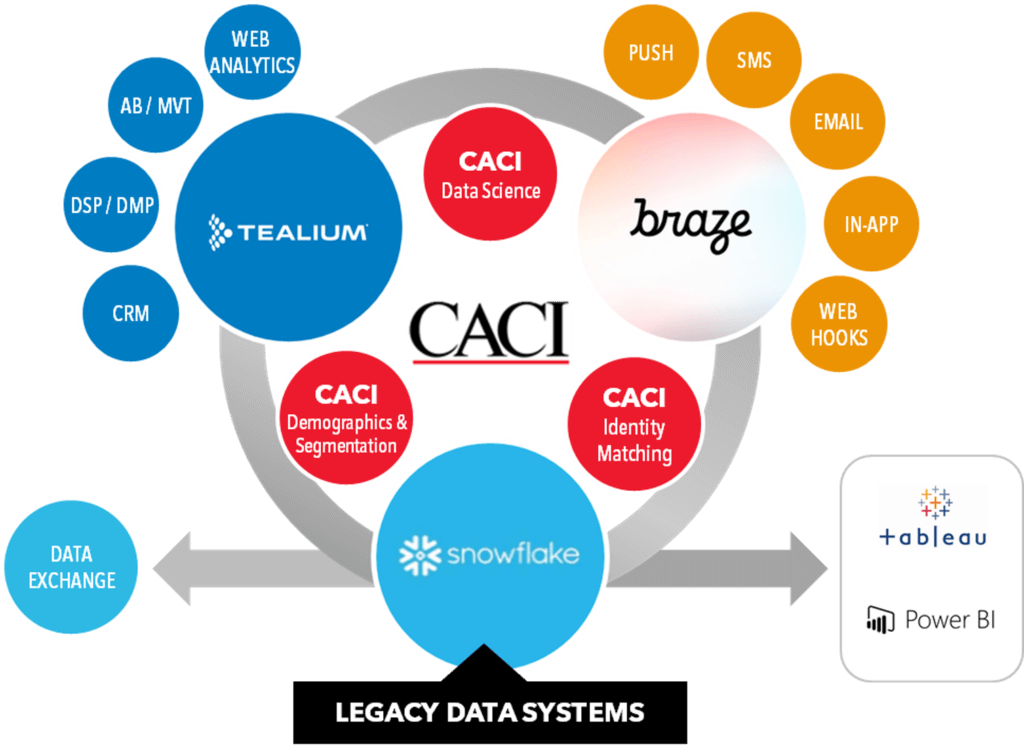
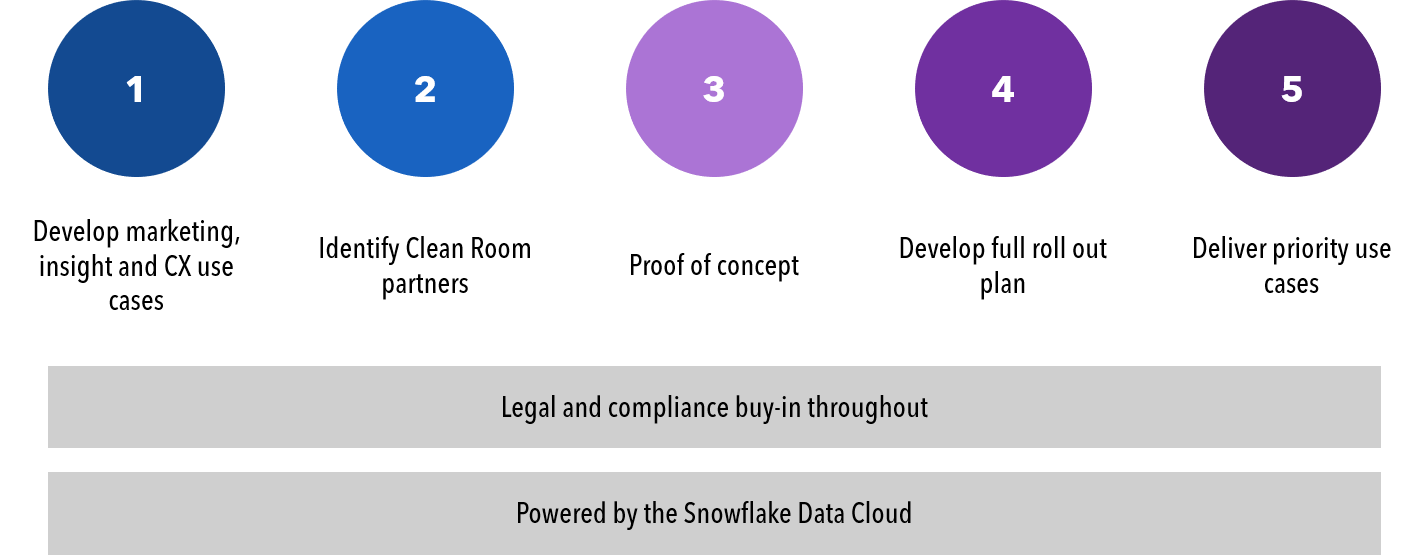
This work led to CACI developing a framework for customer personalisation at scale. Working with leading vendors Tealium, Braze and Snowflake, we created a technology blueprint that can achieve full integration between enterprise data and the omnichannel experience.
To find out more about the CACI Customer Personalisation Platform or to discuss issues related to customer transformation, please get in touch.
You may also be interested in downloading this report which uncovers a surprising disconnect between what banks think and how customers feel about the customer experience, with statistics and insight gathered from 1,500 marketing leaders and 5,000 consumers.
You can also check out the previous parts of this blog series below:
Combining data and technology to deliver effective customer journeys in the financial services industry
Sagar Limbu
For many banks and building societies, legacy systems are a barrier for real-time, personalised customer engagement. Migrating experience platforms to a scalable, cloud-based platform, coupled with well-engineered decisioning, will enable banks and building societies to establish trust with consumers and subsequently maintain it.
The need for robust and reliable customer data
Banks and building societies are bound by financial services regulations to know the identity of their customers. Proper customer identification seeks to prevent criminal behaviour such as fraud, money laundering, or tax evasion. It is also a requirement for credit checks.
Having well-managed customer data enables lenders to identify the next best action for the customer, and create a customer strategy and journey tailored to each individual customer.
Inbound and outbound digital channels should be the ideal place to deliver these messages. But the use of digital technology is hampered by unfit processes and operating models that are combined with unscalable technology and batch processing.
With the right efforts to unlock the wealth of data held, the promise of real-time personalised messages that cut through the noise is very attainable for lenders.
Covid-19: a catalyst of change
The financial services sector responded quickly and earnestly to the challenges created by Covid-19. Payment holidays were offered, and staff were quickly relocated to home working setups to continue providing a good service.
The catalyst of change we all lived with created new levels of trust and empathy. This needs to be maintained by showing customers that the financial institutions really do care about them as individuals, especially in the current climate.
Mass mailings that push irrelevant products or services will erode that relationship. It shows a lack of care for the customer and a view of them as being a source of revenue and profit.
Making technology change last
To move forward, financial services marketers need to set a vision for the type of relationship they want to have with their customers.
This vision will determine the way that data is used, it will be at the heart of all campaigns and communications, it will alter working processes so that the organisation becomes more empathetic.
Through a clear and uniting vision, marketing technology will really be able to prove its value. Not just in delivering a better campaign, but by shaping the very experience and interaction an individual has with a brand. It will be about two-way interaction.
For useful input from over 200 financial services brands, 1,500 marketing leaders in the financial services industry and 5,000 financial services consumers, on how you should be evolving your customer marketing strategy to meet the needs of a changing consumer, download this recent report from CACI and Braze.
Check out the previous parts of this blog series below:
Last mile short cuts: the value of knowing your cost to serve
Sagar Limbu
Have you been hearing a lot about cost to serve lately? At the recent Last Mile – Leaders in Logistics event, it came up in practically every conversation we had with attendees and logistics experts.
If cost to serve is top of your agenda, we’d like to share some insights into how we calculate it and what you can do with the information. If it’s a relatively new concept to you, we plan to demystify and explain it in the following paragraphs.
Cost to serve is a valuable metric because it enables logistics operators to drive efficiency and support decision-making by understanding fulfilment costs across the entire supply chain.
Logistics operators and retailers are interested in the cost to serve for a range of different reasons. Depending on your organisation’s strategic priorities and current pressures, you might apply the insights to any of the following:
Reduce fuel costs and optimise your existing fleet
Transition and selection of electric vehicle (EV) fleets – ‘what-if?’ scenarios
Site selection, weighted by cost to serve
Sales forecast modelling, balanced by cost to serve
Scenario modelling, driven by cost to serve
There’s a relatively simple sum to calculate cost to serve: distance + fuel + time + environmental impact + resource. Measuring each element individually first, we look at the distance from distribution centre (DC) to store as well as from the store or distribution point to the end customer address. Fuel is costed according to delivery vehicle type. The time a delivery takes will take into account variable traffic and route conditions as well as accessibility on the doorstep. Emissions, noise and congestion add up to the environmental impact. And lastly, there’s the resource cost – including people, vehicles and equipment.
The sum might look fairly straightforward but gathering the data and putting it into comparable formats can be challenging. You may be familiar with data for distances, fuel consumption and resource costs, but tracking and estimating time to deliver can be more difficult, particularly in the last few metres when your driver is outside the vehicle.
Environmental impact is another measure that might be new to your business, but it’s increasingly important from a financial perspective as well as being a customer concern and area of corporate social responsibility. Emissions charging, tolls and vehicle tax all add cost into logistics and it’s important that they’re visible when it comes to planning and optimising services.
You can understand and tackle the most expensive cost to serve areas and apply best practice and understanding from areas with a lower cost to serve. It can help you prioritise future investment and reveal opportunities to streamline processes or boost training.
The logistics market can change fast – the recent fossil fuel price hikes were unexpected. Consumer preferences and competitor activity can affect your operation quickly. That’s why it’s not just a strategic measure: it’s important to monitor cost to serve continuously, so you can react quickly to emerging trends and keep control of costs throughout the supply chain.
CACI’s blend of logistics expertise and customer understanding can give you the edge when it comes to adding value and differentiating your services profitably. We can line up the data so you can measure your cost to serve accurately and keep your logistics operations delivering effectively, with a clear, business-wide understanding of costs and all the factors that affect the supply chain. Get in touch today at iwheeldon@caci.co.uk
Check out the other blogs in the Last mile short cuts series:
Three ways to stand out in a crowded insurance market
Sagar Limbu
In this Article
With new guidance in the FCA’s Consumer Duty directive, the financial services industry is being asked to get to know their customer better and meet their diverse needs. In a recent report produced by Braze & CACI, providing insight for financial services brands, it was found that 42% of EMEA consumers only use one financial services brand – so how can you retain their loyalty, trust and keep them engaged?
Technology innovation
The general insurance market has always been challenged with engagement, as the frequency of communication with its policy holders is low and concentrated at the point of policy inception, claim or renewal.
However, building trust is still crucial in this market.
Every insurer is now looking for new ways to harness technology for growth and competitive advantage. The use of AI and innovative tools is becoming more prevalent in the underwriting, claims and CRM process.
Harnessing your customer data through modern decisioning tools, and leveraging third-party demographic data to build a more holistic understanding of who your customer is, enables you to interject hyper personalised communications throughout the life of the policy, via the most appropriate channels, and actively give policy holders transparency over potential changes in premium.
Building trust
Whilst insurance may be seen as a “necessary purchase”, the payments aren’t usually greeted with good sentiment or the feeling of value for money.
However, the data and insights that much of this new technology generates creates the opportunity to engage policy holders more during the life of their policy.
For example, in car insurance, the use of telematics data could be used to talk to customers regularly about how they can improve their driving whilst reducing the cost at their next renewal. It’s well understood that people feel a sense of dread when a renewal comes around, fearing a policy price increase without a clear reason. As an insurer, why not reduce this surprise and help your customers maintain or reduce their premium?
If the data used to run the underwriting model changes, meaning that the car insurance policy may go up at renewal, it is better to let the customer know this early and explain why this has happened. This would increase trust and loyalty, reducing the likelihood that they might go to an aggregator when the renewal is due.
Even better, utilise predictive analytics to warn customers early of changes, enabling them to make changes in behaviour to help keep premiums down.
Understand your competition
The insurance market is made up of large general insurers through to niche specialists. Whilst brand reputation has a role to play, the heavy use of aggregators to seek out favourable deals is commonplace.
The opportunity is there for the more established brands to innovate and use their capability to invest in and truly leverage marketing technology and data to create a more trustworthy experience. For niche players, they can utilise their positioning to clearly communicate the benefits of their USP to customers.
With restrictions on the use of incentives for new consumers, all insurers need to consider other important elements of their offering and communicate this throughout the experience.
Throughout this blog series for the financial service industry, we break down the opportunities for marketers to build trust, loyalty and a superior customer experience with data and technology.
Last mile short cuts: the latest data-driven approaches to your biggest logistics challenges
Sagar Limbu
In this Article
Logistics data + customer understanding = optimal efficiency and competitiveness for logistics operators
That’s the first short cut we’d like to share with you in our series of concise last mile insights blogs. Inspired by our recent visit to the Last Mile – Leaders in Logistics event, we want to give you the lowdown on the latest proven techniques that can help you sharpen your efficiencies and improve your margins… and maybe transform your approach to some of the tough challenges that everyone in the sector is facing at the moment.
We had some great conversations at the Last Mile event, which helped us focus even harder on the key issues for sustained success and growth in logistics. Customer understanding and routing intelligence are key to effective planning for the last mile in a fast-changing, high-demand delivery market. Everyone wanted to talk about making the most of resources to match efficiency and cost management needs. Balancing this with customer expectations and the need for speed is a complex challenge.
Logistics organisations need to manage costs by adopting the most efficient service propositions. To identify these, they need to calculate demand accurately, for return logistics as well as deliveries. They need precision route planning solutions to help optimise routes and schedules, taking a data-driven approach to help them deploy the right fleet in the best way for different schedules.
Dealing well with change and variation is key in a high-volume consumer market. Predictive modelling helps organisations anticipate changes that will affect delivery schedules and customer requirements. Customers are constantly raising the bar on expectations of their home deliveries – they want the full range of pick-up options, availability of slots, fast same day or next day delivery and greener options.
Data is your not-so-secret weapon. Keep customers up to date with clear, proactive communication based on forward visibility from realistically planned schedules. Data modelling that reveals the ease or difficulty of accessing every property can inform realistic stop times and improve efficiency. Customer insight based on behavioural and demographic data helps you to create variable delivery cost models and fulfilment options to meet different situations and customer preferences.
Source: Statista, Online deliveries and returns in the United Kingdom (UK) 2022
To succeed and grow market share, logistics operators and the brands that use them need to deliver excellent customer experiences. With good historic and predictive data, you can be ready to meet ever more challenging delivery expectations and communicate positively with end customers. This can open the way to offering more green and sustainable services in a way that benefits customers, the environment and your bottom line.
The really big question is – how can your organisation do any of this in practice, in an affordable and low-risk way? In our coming blogs, we’ll zoom in on specific issues in a straightforward way. We’ll explain how we can help your logistics organisation optimise its approach to each challenge by using intelligence, data and tools in a smart and focused way.
With CACI’s logistics consultancy, you can make the unknown known, and own the future of your business. Get in touch today at iwheeldon@caci.co.uk
Look out for the next blogs in the Last mile short cuts series:
Creating human banking experiences through data-led marketing
Sagar Limbu
Our recent report, created in partnership with Braze, found that only 53% of financial services brands use advanced techniques like event-based and attribute-based personalisation when it comes to customer communications.
Using modern customer engagement technology will help financial services brands humanise the experience with their customers – as personalising each interaction using sophisticated decisioning algorithms will make the individual feel acknowledged. Real-time customer MarTech can manage two-way dialogue with customers, engaging them with the right content at the right time.
Great experiences start from the first contact
As the market grows ever more competitive and it becomes easier than ever to switch providers, creating the right first impression for your customers is essential.
It’s often thought that successful customer onboarding requires the customer to share a lot of data, but with the right customer strategy, marketing technology and third-party demographic data you can create an onboarding process that’s right for your customer without asking for more than your customer is willing to provide. Registration processes should be simple, not prohibitive to engagement, and show clear reasons for data collection. Consider neo-banks such as Plum who gamify their onboarding journey and make it simple to become a customer.
Collecting marketing consent is an often-neglected part of the sign-up process, with a series of check boxes tucked in at the end just before the terms and conditions acceptance. Improved consent processes are geared towards signing up for specific engaging content or benefits.
Education and transparency
Even though people are visiting branches less, it is still possible to create real trust through educating customers to support their decision making via your digital channels.
Many progressive banking and building society brands are now using interaction and behavioural data to point their customers to educational posts or feature tutorials. Brands can therefore help their customers to meet their individual goals, whether it’s to stay on budget, boost their credit scores, save for a new home, or other major life purchases.
Teaching customers to make the most of the digital tools available to them, and explaining how to achieve their financial goals, will demonstrate care and support. Additionally, being connected with the customer’s long-term ambitions means that bank and consumer are together for the same reason.
Humanising the experience
With Covid-19 accelerating the use of digital channels, the online experience needs to build trust by clearly acting in the customer’s best interests, like an in-branch customer service representative would.
Humanising the experience using empathy is key to this. Creating warmth and understanding around life events, in the same way a customer service representative would, is a powerful way to build that bond with your customer.
It’s critical that the customer journey promotes the value your brand brings by using every interaction, no matter the channel, to reinforce how each individual customer can financially better themselves.
Throughout this blog series for the financial service industry, we are breaking down the opportunities for marketers to create a personalised customer experience, and build brand loyalty through central decisioning engines, marketing attribution models, data modelling, machine learning and AI-driven recommendations. Continue reading at the links below:
For recent insights on how your customers feel about the experience they receive from their financial services providers, and for guidance on how you can better understand and meet shifting customer expectations, download our recent report – Banking on the Customer Journey.
How the banking and financial services sector can lean into a changing market
Sagar Limbu
In this Article
The evidence is clear, Covid-19 accelerated the pace of consumers’ changing behaviours.
Our analysis on consumer attitudes towards returning to branches highlighted a 32% reduction in bank branch visits post-covid, with even the most resistant to channel shift turning to apps and websites to manage their finances.
This is against a backdrop of other changes in the UK’s financial services sector that are impacting marketer’s abilities to connect with customers and prospects.
Retaining your savvy savers
Rising interest rates mean that people are becoming incentivised to both start saving again, and to switch savings accounts again, with savvy savers searching for the best deals.
Our recent consumer insights have found that the younger demographic are still expecting to save in the next 12 months. And it is to be expected that your competitors will increase their efforts to attract your savers to their products. You need to be ready to retain them!
Buoyant lending with a shift to the suburbs
Across the UK we saw a shift from the cities to the suburbs, driven by the opportunity to work from home more regularly. A reduced commute and a chance for more space was an opportunity many felt could not be missed.
Coupled with the government provocation of the housing policy, using changes to the stamp duty tax threshold, there has been an incredibly active homebuyer market.
However, recent economic factors have driven up the interest rates available on new mortgages and to those coming to the end of their fixed deals. Consumers are therefore incentivised more than ever to find the best available deal. This becomes a potential flash point for marketers who need to develop trust with customers so that the retention battle can be won.
Insurers need to rethink incentives
New legislation from the FCA means that insurers must be willing to offer the same incentive to new and renewing customers. Past use of aggressive incentives to win new customers’ needs to adapt to regulatory challenges.
Like the other macro conditions, this requires marketers to engage in longer-term marketing journeys with potential consumers, to win them and retain them with value driven propositions.
The need to communicate with the individual
Whichever way you cut it, there’s a lot of change to contend with for the financial services marketer.
From CACI’s perspective, we see there being winners and losers in the market across banking, lending and insurance.
The winners will be those who utilise data and technology to serve customers as individuals. To maintain engaged relationships based on trust and demonstrate how the brand is taking care of the financial interests of the individual.
Throughout our new blog series for the financial service industry (starting with this blog), we will break down the opportunities for marketers to address these challenges through central decisioning engines, marketing attribution models, data modelling, machine learning and AI-driven recommendations. Continue reading at the links below:
For insights on consumer attitudes towards their financial services provider’s marketing and communications, download this report, created by Braze in partnership with CACI. With input from over 200 financial services brands, 1,500 marketing leaders in the financial services industry and 5,000 financial services consumers, the report uncovers a surprising disconnect between what banks think and how customers feel. It also provides guidance for brands in the financial services industry to better understand and meet shifting customer expectations.
Marketing Measurement – a quick guide to getting it right!
Sagar Limbu
In this Article
We’ve all heard the well-worn clichés about the difficulty of measuring marketing effectiveness. As tired as they are, there are valid reasons for their persistence – determining what works, why, and who for can be complex. But does it have to be?
We still find that most organisations are relying on a ‘last click’ attribution approach to Digital & CRM measurement, and with good reason – most ‘off the shelf’ software platforms default to it, it is relatively easy to establish, and it can provide results, where previously there weren’t any! That said, it’s widely accepted that this lacks sophistication and accuracy, resulting in ‘best guess’ outputs that will over or understate the true impact of channel contribution.
So, how can you more accurately track the performance of your marketing, leaving you with actionable insights that can drive improved ROI?
Our tips for enhancing your marketing measurement
Moving to multi-touch attribution, considering all digital and direct channels, is typically the first step we recommend and is an area where we have had significant impact with clients. Having evaluated multiple approaches, we currently favour Markov Chain modelling, which calculates probabilities between successive channel interactions. This attributes impact to each channel, whilst also accounting for the sequencing of contacts between different channels.
Another approach we often recommend is to use Shapley Values to work out the ‘co-operation’ that can take place between channels. This can help us to calculate transition probabilities (to determine the paths taken between channels) and the impact of channels in combinations.
Once this level of capability and insight is established, we recommend that Channel Incrementality is established to further evidence the isolated contribution of each channel. This is achieved through a controlled testing approach, with channels stopped completely for short periods. We can advise on lean approaches here to minimise the time that channels are out of action.
In addition to the Attribution approach, we also find great value in also considering the impact of ATL channels and wider econometric factors. We have seen influences such as competitor activity, economic factors (such as cost of living & employment data), weather and global events (Covid & Brexit) all have a significant and measurable impact on sales. The key is to identify data that has significant variability (e.g., things that change regularly over time as anything too static can be all but impossible to infer impact from). Our recommended approach is to combine the Media Mix Modelling with Multi Touch Attribution to provide a true 360-degree view of performance.
This MMM approach is used to infer not only the size of the effect of each channel on sales, but also, where data permits, to determine the time decay of each channel – this defines the delay between any marketing channel activity, and its knock-on effect on sales. This may often differ significantly between channels. For these we typically apply bespoke Bayesian models which incorporate business knowledge to inform probabilities for any unknown parameters.
An additional approach we have seen add significant value is to consider ‘Segmented Attribution’ – moving from a channel or ‘overall marketing’ level focus, to a view of performance at the consumer segment level. This allows us to determine not only how effective a channel is, but also who it is effective for. This enables organisations to target the channel activity at the segments that will return the optimum engagement.
Finally, once all of this capability is established, we recommend that you not only use this to explain what has happened in the past, but also to create performance forecasts for future activity. Ongoing tracking and optimisation can keep this accurate as the business evolves, so that attribution becomes a key asset informing ongoing marketing decision-making and investment planning.
First launched on 10 March 1801, the UK census is a decennial questionnaire undertaken by the Office for National Statistics (ONS), National Records of Scotland (NRS) and Northern Ireland Statistics and Research Agency (NISRA) that asks a variety of demographic questions on age, sex, marital status, health, education, and housing.
The primary purpose of the UK census is to build a detailed snapshot of society at that current point in time. Helping national, regional, and local governments understand the people and households in their constituencies. This allows these government agencies to develop current policies or create new ones, as well as plan and fund services, including education, medical facilities such as doctor’s surgeries and hospitals, and transport infrastructures such as roads and new train routes.
The census is also used for other purposes, helping organisations and companies understand the society they interact with. This includes:
Academics and Education Institutions use census statistics to support research that they are working on.
Businesses using census information to help them understand their customers more effectively, i.e., a retail chain might use census population data to help decide where to open a new store.
How often is the UK Census, and when is the data released?
The responsibility for running the UK censuses is split between ONS, NRSand NIRSA based on their geographic region. The Office for National Statistics has overall responsibility for publishing census records and statistics for the whole of the UK.
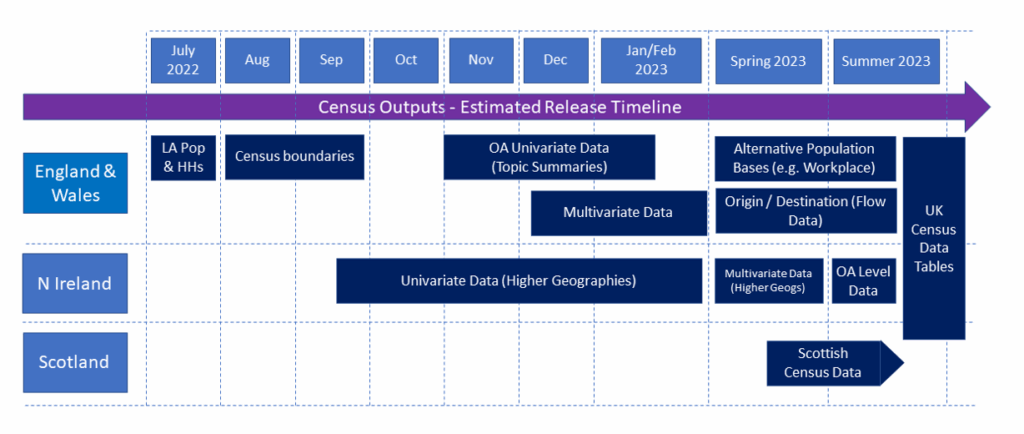
The data from the census is typically released in phases. For instance, in the first phase for England & Wales, local authority level population and household estimates were released, in June 2022. The three census offices each have their own timetable, with outputs staggered across a period of one to two years.
Because Scotland’s census took place a year after the rest of the UK, reference dates will differ. This will impact the comparability of UK census data, for this version.
Due to this, the three census offices are working closely to develop UK-wide census records, which involves consideration of how best to meet the challenges around comparability, coherence, timeliness, and accessibility of the information.
Below is an approximate timeline of the different subject releases based on the various census offices.
LA POP – Local Authority Population Data HH – Household Estimates OA – Output Area
CACI and the UK Census
The data from the UK census is used as input for many of CACI’s products, including Acorn, Ocean and Fresco. A wealth of companies uses these products, public sector bodies, charities, and not-for-profit organisations to help them understand their current customers, constituents, or beneficiaries more effectively, as well as market their products and services to like-minded individuals that fit the same demographic profile of their existing customers, saving them both expenditure and resource.
We also use the census as the baseline for CACI’s annual Up-to-Date Demographicsrelease, which providesthe latest estimates of key census variables (e.g. age, housing tenure, presence of children). These are modelled forward using various, more frequently updated data sources.
As the census is carried out only once every ten years, this provides an increasingly more reliable view of the population than the census data itself. Up-to-Date Demographics is available at census output area level.Consistent with this and for even more complex use cases, our annual Population and Household Estimates and Projections provide counts down to individual postcode levelsandproject forward for future years.
The first results of Census 2021 were published on Tuesday, 28 June 2022. These provided estimates of the number of people and households in England and Wales at local authority level. From this data, CACI was able to provide insight into the data to help:
The Ageing Population
The ageing population shown by this census follows our own predictions very closely, so it comes as no surprise. It does however throw up two significant questions.
Firstly, what does this mean for pensions? With proportionately fewer working people to retired people, will there be a greater emphasis on private pensions to cover the state shortfall?
And secondly, what does this mean for senior living facilities? We’ve recently been pushing the message that senior living needs to be looked at more rigorously in terms of its role within the wider housing stock and that all types need to be taken seriously.
The 2021 census only serves to vindicate that, and we would encourage local authorities and senior living developers or providers to engage with the data now to understand what their existing and future residents need, to ensure we have a fit-for-purpose housing mix for an ageing population.
Regional Growth and ‘Levelling Up’ –
It is great to see regions other than London taking the top spots in terms of population growth. It finds itself behind the East of England and South West, and in joint third place with the East Midlands, in terms of percentage increase.
More noticeable for their omission from the top of the charts are those regions further from London. Wales, the North East, and Yorkshire and The Humber are lagging behind quite significantly in terms of population growth, suggesting that the pull of living within reasonable commuting distance of London is still strong.
Salaries of course have a big role to play – the closer you are to London the higher both salary and disposable income tend to be. The growth we’re seeing in the census is more or less restricted to the southern part of England, so there is clearly a lot of work to be done with the ‘levelling up’ agenda, to entice people further away from the capital.
New release
On Wednesday, 2 November 2022, ONS also released their Demography and Migration Datafor England and Wales, their second release of Census 2021 data as part of their topic summaries.
This includes an update to population and household estimates for England and Wales, which now includes unrounded data by sex and single year of age, providing even more detail on individuals who were previously in age bands.
This meant that on Census Day, the size of the usual resident population in England and Wales was 59,597,542, which was the largest population ever recorded through a census in England and Wales. This meant that the population grew by more than 3.5 million (6.3%) since the last census in 2011 when it was 56,075,912.
It also contains information on household and resident characteristics, including household size, composition, deprivation status, and people’s marital and civil partnership status. Providing detailed insight into the makeup of the 24.8 million households across England and Wales. Such as although the number of households has increased to 24.8 million (up 6.1% from 23.4 million in 2011), the average household size in England and Wales in 2021 was 2.4 people per household, which is the same as in 2011.
Migration data is also included in this release providing further information on country of birth, passports held and year of arrival, helping us to understand internal and international population changes. For instance, of the 3.5 million (6.3%) increase in population from 2011 to 2021, 57.5% is positive net migration (the difference between those who immigrated into and emigrated out of England and Wales).
Understanding the impact of the cost of living in the water sector
Sagar Limbu
In this Article
The current impact of the cost of living crisis is being felt across the country. Being able to understand how these impacts are being felt across different customers groups and forecast future changes is imperative to creating a proactive customer support strategy. At CACI we have been researching and collating consumer insights and data on the cost of living to help you support your customers.
Some of the key insights we’ve seen from the research so far include:
Lower and middle affluent family groups are feeling the pressure the most
More than 2/3 of consumers have already started to change their behaviour by reducing their discretionary spend
Younger generations are more likely to turn to overdrafts and Buy Now Pay Later schemes to protect their social outgoings
Rising cost of energy bills has impacted all demographic groups, prompting high levels of concern ahead of the winter months
Economic uncertainty means 75% of consumers are worried about their own, their families, or other people’s finances
What does this mean for the water sector?
The water sector sits in a unique position with defined customer service areas that have a wide range of demographics, and a historically unengaged customer base resulting in a low awareness of support available for vulnerable customers.
CACI recently ran a roundtable to share key insights and discuss how the impact of the cost of living is being felt in the sector, and how water companies are looking to prepare for future forecasted impacts. The key outcomes from the session were:
Innovative partnerships provide new avenues – partnering with councils and landlords to identify and understand the set up for affordable housing allows support to be better directed to those that need it most.
Contact centres provide the first indication of change – whilst payment rates and direct debits currently remain strong after the summer months, the first sign of concern being seen is the increase in contact centre calls for help and support.
Clarity between water efficiency messaging and cost of living is needed – being able to identify the difference between a change in water use for environmental reasons vs to cap bills is key to ensuring the right messaging reaches the right customers.
Engaging the unengaged – is still a priority, in particular identifying those that qualify for social tariffs or support that aren’t currently using them.
Making insights actionable
Having the right data and customer understanding in place is key to enabling proactive communications, and to ensure the right support can be provided to customers. CACI’s data science team has created tools such as web-based water poverty tools, bespoke vulnerability indicators and forecasting tools to help you build proactive strategy with data driven insight.
As we continue to monitor the changing situation, sign up to our Cost of Living Podcast to get monthly updates.
Find out the full spectrum of work CACI does in the water sector from our Water Brochure.
For more detail on how CACI can support through enabling actionable insights, contact us here.
Supporting your Grocery Retail Strategies with Data Driven Intelligence
Sagar Limbu
In this Article
As with every industry Grocery Retail has had to adapt to a seismic shift in consumer attitudes and behaviour.
And those attitudes and behaviours continue to shift in response to local, national and even global events. The consumer has weathered the pandemic but is now staring down the challenges borne out of a cost of living crisis.
So, you need to make important decisions, and quickly. Flexibility is key. Having the data and tools at your disposal to make anything from adjustments that impact fine margins, right up to transformational change, is essential.
An innate understanding of your customer – their attitudes and behaviour – gives you the insight you need to attract new customers and retain existing ones. It’s also the foundation to building strong brand loyalty, even in challenging times.
CACI know more about your customers than anyone else. We combine a market leading demographic classification system with highly detailed footfall and spend data to provide you with everything you need to know about the way customers interact with your brand, your locations, and your competition.
Strategic decisions need strategic insight
CACI offer unrivalled insight into the fundamental relationship between people and place. Understanding this relationship speeds up decision-making and minimises risk from Cap Ex investment.
We are supporting grocery retailers with insight on:
The demographic profile of the catchment of each of your stores
The spend potential of the catchment in any location
The shifts in footfall and spend across times of day
The profiles of customers engaging with your competitors
Other locations similar to your best performing sites
Data driven network expansion driving the most ROI
Creating the right formats for the right locations to serve the local communities
MidCounties Co-operative
Unprecedented insight into the grocery retail market
Understanding the way customers interact with your brand, and how potential customers engage with your competition, is the first step to increasing your market share.
And with a complete view of the competitive landscape both nationally and locally, you will have the tools you need to develop strategies for success.
At a customer level you can:
Discover those that aren’t and why
Find out when they spend, how much they spend and what they spend their money on
Drive customer loyalty and win larger share of wallet
Identify highest spending customer groups and locate more of them
At a location level you can:
Benchmark locations against a national average across a range of criteria
Model catchment areas and market share catchments
Forecast how a particular location will change over time factoring demographic shift
Understand your local market share and competitor spend
Identify key growth opportunities in your store estate
Inform partnership strategy to generate greater footfall
Measure impact of your and competitor activity, e.g. marketing, store refurbs, etc
Sainsbury’s
The analysis to understand the digital / physical dynamic
The relationship between physical and digital has evolved, and demographics more inclined to visit a store are now comfortable online.
How has this affected your store network?
And how does online halo impact your performance across your physical store network?
Different demographics behave differently and will even favour different brands for different channels.
CACI can make sense of this and measure the success of each of your locations well beyond just what goes through the tills. Your best performing site might not be so obvious!
Optimising your store network with this analysis in your hands allows you to make the right decisions without negatively impacting on your multi-channel revenue lines. Future proof the business by effectively forecasting online as well as in store grocery demand.
Get in touch with us to show you how we do amazing things with data.
How wealth and asset managers should respond to the new FCA Consumer Duty
Sagar Limbu
In this Article
New plans from the Financial Conduct Authority (FCA) for increased consumer protection for financial services users, through a “fundamental shift in industry mindset” are to be confirmed by the end of July 2022.
The proposals include a new Consumer Principle that “a firm must act to deliver good outcomes for the retail consumers of its products”.
The regulator’s Consumer Duty directive is the latest in a series of measures tackling consumer needs in the financial services and wealth management sectors.
But how do the latest rules impact wealth and asset management firms? And how can a more effective use of data help firms increase customer knowledge and drive business growth, while ensuring compliance with the Consumer Duty?
How does the Consumer Duty impact wealth management firms?
Banks and building societies have moved steadily towards digitisation and customer-first policies over the past decade, but the wealth and asset management sector hasn’t moved as quickly.
While some firms have already adopted a business model that enables customer-led and technology-enabled strategy, it is only in the past 18 months that the importance of a data-led approach to wealth management has become prominent – and many firms are still playing catch-up. The Consumer Duty may well act as a catalyst for many to speed that change along.
The FCA is worried that, currently, financial services do not always work well for consumers, who are buying products and services that are not always fit for purpose, and not continuously receiving the best customer support.
Consumer Duty creates a shift towards making firms more proactive about the suitability of their products and services, to directly meet the needs of those they are sold to.
Wealth managers, along with other financial services firms, will need to improve consumer understanding, review the entire consumer lifecycle and journey, revisit how and what to include in customer marketing, and establish new ways to measure all these areas, in order to remain compliant.
“The new duty will drive a change in culture at firms. We expect firms to step up and put consumers at the heart of what they do, and we’ll be holding senior managers accountable if they do not.” warned Sheldon Mills, Executive Director of Consumer and Competition at the FCA.
Customer marketing – who are the new prospects?
Clearly, the FCA wants firms to better understand their customers. But how do wealth and asset managers do that? What steps do they need to take to make their business fit for purpose in a digital world and comply with Consumer Duty?
Regulatory pressure provides an opportunity to capture the market – collecting data and enriching it in order to tailor distribution and marketing.
Wealth managers are seeing changes in both customer behaviours and types of customers, and are moving away from the traditional investor to hunt out wealth in other areas – as they fight for market share. Meanwhile, fintech disruptors are raising the bar with innovative offerings.
Consumer insight is key. Young investors who are creating or inheriting their own wealth are increasingly important, as the older consumer market depletes. They are joined by more entry-level investors – and both personas have very strong customer service expectations.
These younger, and often more knowledgeable, investors are the customers of the future. They know they can invest quickly and easily online and they expect the same level of speed and ease of use in all their financial dealings.
A data-driven customer experience
Firms need to better understand the current and future needs of investors, those who might have a sophisticated, historic book of customers, now need to reach a broader audience – and CACI can help firms do that.
Consumer Duty firmly indicates products need to suit their customers, and firms need to be where investors can see them in order to market more broadly. Changing expectations might include more sustainable or green investments.
Those firms that recognise the need for better customer understanding are starting to bring in people with wider customer-first experience from other industries – increasing the sector’s pool of knowledge.
It is key to firms’ long-term growth that they do more with consolidated data – because if they don’t, they can be sure their competitors will. Firms will have data on customers, but many don’t know how to make the most of it.
At CACI we can help firms:
Understand their customers
Understand the market and identify opportunities
Know where potential and current customers are located, and their value
We can help brands across the wealth management, asset management and financial services space with demographic data and behavioural insights on investors.
Wealth and asset management firms looking to grow their business need to consider the importance of over- arching information and scalable transformation. Rich demographics on lifestyle, attitude and behaviours in the investment market, can empower better target distribution activity – driving revenue growth and increasing client engagement.
CACI will:
Provide detailed understanding of current investor behaviour needs and growth opportunities
Quantify the acquisition opportunity across regions to inform growth and investor engagement strategy
Enable optimisation of marketing performance across channels
Improve distribution performance through digital direct and intermediated channels
Demonstrate compliance with Consumer Duty to show that they are looking at, and understanding, customer needs
Or if you would like to find out more about how we can help, explore our services or get in touch.
Hybrid and online learning – putting perceptions in context
Sagar Limbu
For many universities, developing online technology used to be part of a three to five-year strategic plan to respond to modern learners’ needs. Students said they wanted more flexibility in how, when and where they study – virtual learning can provide this.
The pandemic forced universities to move forward quickly with these longer-term plans. The result was a rapid increase in digital resources and more collaboration with other institutions. This broke down location barriers and broadened reach.
Since the pandemic, not all universities have returned to face-to-face teaching across the board. This has sparked anger among many students, who feel they aren’t getting value for money.
For those that were able to access online learning, our study showed there was a strong sense that online tutorials and lectures could not replace the benefits of an in-person university education. Discussions were not as lively in tutor groups, lecturers were not inspiring, there was no sense of community as peers often turned off their cameras, and it was all too easy to step away from the screen. Now, looking back at their notes, students attribute gaps in their learning due to a lack of engagement.
Poor experiences in lockdown don’t mean digital learning is dead. There’s a big difference between the hastily reactive measures implemented in the pandemic and a well-informed, evidence-based, high quality hybrid learning strategy.
Universities are likely to continue delivering virtual materials as part of a hybrid delivery of education that maximises small interactive group learning and teaching in person but removes activities with less interaction, such as lectures. Our research with HEAT, Zero Gravity and students themselves suggests that – crucially – universities must take into account students’ background and experiences when designing hybrid programmes and resources.
OfS has set out guidelines and resources for learning institutions to help them set access and participation plans with commitments to address equality of opportunity. The open and free data they recommend is helpful, but we believe it’s insufficient. While IMD data is a recognised Government measure, it does not provide an up-to-date picture of deprivation. POLAR and IDACI measure attainment, but don’t explain what lies behind it.
Acorn and other commercial datasets provide vital demographic, lifestyle and behaviour insights that inform these baseline measures. It’s only by blending that universities can get the most from the OfS planning guidance to make informed decisions about how best to work with students.
Communication and consultation will be key. Students need to be convinced of the effectiveness and value of a hybrid model. They want their experiences in lockdown to be acknowledged and learned from. They want universities to share evidence that digital resources and teaching actively enhance student outcomes and are not just a way to reduce overheads or increase revenue from remote students.
In our recent paper, CACI’s University Data Team draws together student research, geodemographic data and expert opinion. It highlights priorities in the new post-pandemic world for outreach, admissions and widening participation (WP) leaders. Download the reportto find out how to build a successful WP strategy.
The bridge between Customer Experience and Brand
Sagar Limbu
It’s no surprise that customer experience has long been a priority for brands. There’s an overwhelming supply of research out there which demonstrates the importance and value of investing in CX; IBM found that businesses that prioritise CX see a 3x increase in their revenue.
However, one of the interesting differentiators between those who are really ‘winning’ in this space and those who are playing catch-up is the perception of the role of CX within brand development and communications. Whilst brand touchpoints are usually considered across ATL, TTL, BTL and POS, the reality is that brands are not just experienced within comms – they are engaged with across every touchpoint, platform or environment that a prospect or customer may find themselves in. A person should feel a seamless relationship with your brand, and with each interaction comes a wealth of information to harness and share within the business.
Where brands are losing out
Many businesses operate with marketing and customer experience departments that work independently of each other – the former focused on impressions and engagement metrics and the latter responsible for conversion optimisation and customer satisfaction. The gulf exists because these objectives are isolated, but both departments can offer invaluable information which supports the development of a cohesive customer and brand experience.
Demonstrating and measuring your values
Looking beyond customer experience ‘hygiene factors’ and conversion metrics allows you to build the right environment for your brand to flourish by having a bespoke approach to demonstrating your values. For an insurance brand, this could be the recognition and delivery of empathy and integrity when dealing with claims.
For an automotive brand this could be the sentiment of luxury and special attention that comes from purchasing an expensive new car. The whole brand falls down when these moments don’t live up to expectations, so these values should be present in all interactions, not just in communications.
Learning from the front line
Passing information back upstream is key to ensuring your brand is living up to the promise it sells. Customer reviews, call-centre recordings, satisfaction surveys, wait times and issue resolution rates are examples of information sources that would typically paint a picture of whether your brand is being perceived through the positive lens that is promised in communications.
Audiences will see straight through promises which are made but not kept to. Differentiating yourself in communications is only worthwhile if those differences are experienced when new customers (and existing ones) interact with you. If these are not present, audiences won’t stick around – they decided to give you a chance, so they can do the same for others just as quickly.
Operationally, your teams should be setup to interface and share regularly. Objectives and KPIs should straddle multiple teams and include metrics which govern your values, not just your bottom line.
Start bridging the gap
At CACI, we’re experienced in helping leading brands deliver a seamless customer experience. If you’re ready to start bridging the gap between your customer experience and brand but don’t know where to begin, our team of consultants can help you create a customer strategy and customer marketing solutions that deliver.
Responsible and sustainable practices
Sagar Limbu
In this Article
Could digitalisation save the planet?
Only if businesses can achieve sustainable cybersecurity and digital inclusion too
Digitalised businesses are onto a win-win – it’s good for corporate reputation, the planet and the environment to stop using paper and resource-consuming processes that create waste, take up storage space and hinder productivity. There are important caveats for doing all that good though: robust security for digital data and accessibility for all.
A well-understood approach to organisational corporate responsibility and sustainability is going paper-free and taking as many interactions and records as possible online. It avoids unnecessary worker travel and cuts the use of paper, postage, deliveries, physical storage and workspace, thereby reducing energy and fuel consumption.
Everyone knows the benefits of paperless offices
is “one of the most tangible examples of digitalization that has a positive impact on the environment while also providing major business performance benefits”. It estimates that even now, US businesses waste USD 8 billion on managing paper every year. It’s far more efficient and faster to transact, interact and work digitally.
Covid has accelerated adoption of these practices, as people have adapted rapidly to home-based and distanced working — which is one positive at least from the pandemic. But that means putting a lot more data online.
But hackers have an eye on the main chance. Since the pandemic, criminals have been quick to exploit security vulnerabilities created by a hasty shift to home-working and reactively moving transactional systems online. Recent headlines and share price drops show the impact of losing consumer and shareholder confidence for companies that experience data breaches and vulnerabilities.
Security by design is the gold standard for digitalisation
With so many financial transactions now executed digitally, security and trust are more important than ever to protect people’s money. Many consumers are far more aware and concerned about who is using their data and digital privacy. Building robust transactional apps, systems and data will continue to be crucial for success and reputation. Marketing compliance will need to be effective and transparent.
Security by design is the gold standard for planning, optimising and establishing cloud and digital infrastructure and systems. That means choosing and developing digital platforms and services in the specific context of cybersecurity – from thwarting hackers to back-up and recovery.
It also means that adopting new and more environmentally friendly technologies —from industrial plant equipment to electric cars, remote heating controls and contactless payments — must make digital security a top priority consideration. Hackers are not just delving into poorly password protected bank accounts for financial gain these days. They’re finding ways to hold organisations to ransom by infiltrating property, systems and infrastructure that are remotely and digitally controlled and operated.
On the surface, climate transformation has nothing to do with security. But dig a little deeper and you discover that it has profound implications indeed. The new technologies required for climate transformation will change both how businesses work and how they use technology. Security by design must be applied in order to prevent climate transformation becoming an excuse for greater vulnerability.
Smart organisations plan ahead and ask the right questions
Advanced digital mass security may not come cheap for larger organisations. It’s not just a one-off cost either: security protocols need to be maintained and measured against ISO 27001 and continually updated to mitigate the latest threats. But then there’s the potential risk and cost of neglecting security in any digitalisation solution. Smart businesses plan their budgets realistically and know that market-leading digital operations need to be underpinned by market-leading digital security.
Another important issue for ESG-aware organisations is the footprint of their digitalisation. The more data that’s online in the cloud, the more cloud storage is needed. Data warehouses have a big impact on the environment, not least because they consume so much electricity. Responsible businesses will ask questions of their cloud technology providers about their carbon offsetting and use of renewable energy sources, to maintain their integrity and reputation.
It’s not a good look to leave anyone behind
There’s another issue around digitalisation – and that’s digital inclusion. Consumers who are financially stretched typically don’t have such free access to the latest technology, devices and web access, which can lock them out of the digital environment, either partially or totally. Smartphones are increasingly the default device for managing banking and finances, but not everyone has one.
Income isn’t the only determinant of digital poverty. Location has an impact too: some rural areas struggle to access fast broadband, which can affect wealthier households. Some older citizens are digitally naïve. As well as struggling to access and use digital-only services, they may be more vulnerable to cyber-crime and scams. However good digitalisation may be for the wider environment, excluding less privileged demographics from online services and pricing generates damaging headlines and dissolves consumer loyalty and trust.
Consumer insight provides vital context for digital transformation
Savvy organisations seek insight to help them understand and avoid digital exclusion, using data like CACI’s Vulnerability Indicators. This includes detailed and granular digital vulnerability data that allows organisations to identify people who lack digital knowledge or may have little or no access to technology and the web.
Assessing and planning to enable digital inclusion must be a priority aspect of digitalisation programmes and initiatives. Responsible brands and public organisations need to understand the impact on their entire audience before assuming that the best choice is to move everything online, without exception.
Digitalisation is the right thing to do for the planet – as long as we do it right
There are huge gains to be made for our planet by embracing digitalization, cutting our consumption of the planet’s physical resources and improving efficiency and energy use in everyday life. But organisations must do this in well-considered way, taking into account the new risks and challenges that a fully digital world presents.
To maintain their integrity and reputation, businesses also need to consult and consider their customers and audiences and help them with digital adoption, as well as scrutinising and challenging the environmental practices of their own digital service providers.
If you’d like to know more about optimising processes and energy efficiency through data science or developing waste-reducing digital services and tools that meet current consumer needs, talk to the experts at CACI.
Consumer demand for more sustainable consumer transport is high and market conditions support mainstream EV adoption. What do motor brands, consumer destinations and logistics operators need to know, to make the most of this electrifying opportunity?
In our fourth blog in a regular series focusing on environmental, social and governance (ESG), our focus is on electric vehicles – an increasingly common sight on the UK’s roads.
These days it’s not just celebs and influencers who parade their green credentials with their Prius or Tesla. More choice, better charging infrastructure, longer vehicle ranges, affordable finance and fiscal incentives are persuading more and more ordinary consumers to join the EV gang.
Scenes of panic over presumed fuel shortages in autumn 2021 put the growing number of electric vehicle (EV) owners in a strong position. Suddenly, everyone wanted one – showrooms were inundated with enquiries and prospective owners joined waiting lists for test drives and for the privilege of buying new vehicles.
It feels like we’re now at the point of mass adoption, with the 2030 ban on new fossil fuel vehicle sales less than a decade away. Manufacturers, dealerships, fleet operators, drivers and infrastructure owners are all adapting fast to the changing market – what does the future hold and how can data insight help everyone thrive?
Who’s buying EVs?
Government and industry initiatives designed to accelerate EV adoption need to understand differences in consumer opinions and propensity to buy EVs. CACI’s 2021 EV survey shows that age and affluence both influence consumer behaviour – even when they have the means to buy an EV, older consumers are less keen. They tend to be concerned about range, despite typically making shorter journeys. That insight can help to explore the inhibitors and shape messaging to overcome consumer concerns.
We also identified less known benefits that could make EVs more attractive if consumers knew about them.
That suggests there’s an opportunity to tell consumers what they could save beyond the obvious cost of refuelling.
Data and insight are invaluable to manufacturers who need to know who to target, both in the way they design new vehicles and the way they promote them. New brands have risen rapidly to take advantage of the global opportunity for more sustainable consumer travel. Few UK consumers had heard of Polestar three years ago – now their cars are a common sight and the brand is well known from TV and digital advertising.
We’ve worked with Mazda to help them tailor content and produce engaging campaigns that appeal to the best audiences for their MX-30 EV. Current, accurate consumer data and granular analytics are key to the “impressive” results Mazda has achieved.
Is the infrastructure keeping pace?
Service stations, retail operators and landlords need to understand the opportunity so they can make the business case to invest in charging points. They need to drill into consumer and market data for EV adoption and understand the impact on their core users and customers.
If these organisations can’t size the demand and provide suitable charging facilities, they risk losing customers to better equipped rival sites. As well as losing revenue, that could depreciate real estate assets. In our EV survey, 55% of respondents said they would be influenced to visit a specific location if it provided an EV charging point.
Energy providers also rely on insight into consumer patterns of EV adoption, so they can plan infrastructure and provision. We’ve recently worked with EDF Energy to help them plan for demand and promote their home charging tariffs. A series of highly targeted campaigns engaged customers who already own or were at the point of purchasing an EV, to provide timely and relevant info and offers.
Have EVs lived up to their promise for early adopters?
Our survey showed that improved range in the latest EVs has supported strong owner satisfaction. As early adopters trade in and trade up, there will be more second-hand vehicles available, allowing more consumers to adopt EVs. EV ownership will be mainstream rather than a novel talking point.
There’s an opportunity for EV brands to focus on the capabilities of the latest EVs, to create a tipping point for hesitant or sceptical prospects.
How much does sustainability really matter to purchasers?
Blanket news coverage around COP-26 has increased public awareness and concern about sustainability still further. This impetus nudges more consumers to look beyond their initial perceptions of EVs, because they want to do their bit for the environment.
Consumer concern has a knock-on effect for the brands and service providers they use. Fleet and logistics operators are responding to growing awareness of the environmental damage from diesel van pollution. Consumers aren’t turning away from home deliveries, but they do want to see more sustainable approaches. Fleet and light commercial vehicles are swelling the EV market. Motor industry body the SMMT shared a recent survey that suggests fleet operators could collectively reduce CO2 emissions by almost a third through a switch to EVs.
What’s next for EV brands and related commercial and consumer sectors?
The EV market is relatively new and very fast-growing. Consumer desire, mainstream infrastructure, government legislation and attractive savings are creating a perfect storm of opportunity for EV brands. Data about customer perceptions and needs is vital for competitive advantage.
Meanwhile, many other sectors need insight into who’s driving what and where, so they can adapt facilities and propositions to make the most of the opportunity. European and global brands and businesses must seek local data, because every market is different.
Despite entreaties to use more public transport, UK consumers love the convenience of their own private vehicles. And for many, the Covid pandemic has made cars feel like a safer option. Responsible EV messaging as well as smart product development and marketing can help take carbon emissions from private and commercial vehicles off our roads and out of city centres.
We anticipate that consumers will want more and more in terms of green accountability from brands and fleet operators – such as understanding the full carbon footprint of manufacture and delivery. They’ll evolve their opinions as their own experience expands. Keeping pace with these expectations and behaviours through reliable and up-to-date consumer insight is key to commanding market share.
If you’d like to know more about acquiring consumer data that can keep your organisation ahead of EV trends and markets in the UK and beyond, talk to our sustainability insight experts at CACI.
CACI’s ESG Score can help you identify which ESG factors are most important to your customers. Download our product sheet to find out more.
Technology helps reduce waste for consumers and businesses
Sagar Limbu
In this Article
There’s a long way to go, but innovative technology is proving key to tackling waste on the global scale needed to protect our planet.
Waste doesn’t just mean physical deposits into landfill. It’s also about overconsumption and excess, from squandering energy or making unnecessary journeys to wasting water or making needless purchases, even if they are supposedly environmentally friendly. Environmental campaigners promote the mantra ‘reduce, reuse, recycle’ – if you can avoid demanding, producing and discarding an item in the first place, that means there’s less need to resort to recycling as a third best option.
The will to reduce waste is there and growing among consumers. But they need easy and affordable ways to choose low-waste lifestyles and products. Businesses, governments and service providers are stepping up to the challenge of becoming more efficient and sustainable to enable large-scale change. Everyone’s looking to technology for ground-breaking, digitally enabled approaches to waste reduction.
Convenience is key for consumers to prioritise waste reduction
Phone apps can help consumers to manage their waste. Waste processors like re3 have developed apps that provide information about recycling facilities and let people book visits to recycling centres. Local authorities have developed app-based incentives: in Nottingham, residents can earn points and prizes through the Green Rewards scheme by reducing waste with simple actions, from turning off lights to using public transport or recycling responsibly.
Capsule coffee machine owners can arrange free recycling collections for their used capsules through apps or on websites, making it easy to return rather than binning old capsules from brands including Nespresso and Dolce Gousto.
These are encouraging schemes that help avoid waste going into landfill. But there’s scope to use apps and consumer tech to prevent the creation of waste in the first place. The Scrapp app goes further, giving consumers information about the CO2 they save with each responsible recycling action and helping them reduce waste by understanding the carbon footprint of household items, so they can choose better to waste less of the planet’s resources. It also offers a reward scheme.
Apps help promote reuse as well as recycling
Using more reusable containers within a genuine circular economy, rather than recyclable ones, would cut down on production. Supermarket deliveries might arrive in sturdy bags or crates that consumers would retain until the next visit or drop off at a collection point. Applying tracker device technologies (similar to the Tile or AirTag) could make this viable, avoiding loss and theft and making sure customer deposits were refunded accurately and promptly.
The UK recycling rate for waste from households was 46.2% in 2019
Better planning and analytics help transport organisations cut fuel waste
Commercially and on a much larger scale, technology solutions are helping businesses reduce their consumption of resources, from designing products to use fewer raw materials to cutting down on the energy needed for operations and services.
CACI’s Real-Time Airport system is helping customers in the aviation sector reduce fuel usage. By optimising aircraft movements through algorithms and analytics, Heathrow airport can delay planes starting their engines and cut down on the time they spend queuing before take-off with the engines running.
This has created a massive 10% overall reduction in taxi times at Heathrow – that’s a significant benefit to the environment through reduced fuel burn as well as a better experience for air passengers.
Data modelling can make waste reduction a key factor in overall strategy
Increasingly, organisations will use advanced modelling and simulation to understand the impact of their actions on waste generation. Building in energy and carbon consumption to business models means that companies can shape their strategy and prioritise their activities to minimise waste.
Rapidly evolving artificial intelligence and machine learning capabilities can process more and more detailed and subtle information and show in depth the full range of consequences both for waste generation and wasteful use of resources. Companies can promote their low-waste approaches to customers and show the evidence behind their choices. It’s a more innovative and proactive approach to doing things very differently, rather than trying to reform old, wasteful ways of operating.
Digital convenience is key to influencing behaviour and sharing information
Apps, devices and websites use the power of digital media to raise the profile of waste-reduction and nudge consumers into making better choices. Apps like Nest provide information about heating costs and energy consumption then optimise energy usage throughout the day, cutting down on waste in gas and electricity. Utilities companies provide and connect digital smart meters, giving consumers real-time information on resource consumption so they have the power to change their habits to reduce bills and therefore usage.
Community websites and apps (such as Freecycle and Freegle) for passing on consumer goods and appliances locally give consumers a quick way to get rid of unwanted items or meet a need without buying new.
Private messaging protects privacy and means people don’t have to share their address until they’re sure the other person is genuine.
Carrie Johnson and other celebrities have raised the profile of fashion hire through platforms like My Wardrobe HQ, making it cool to rent an outfit for a smart occasion rather than buying new and discarding outfits after one or two wears. High quality digital photography and easy booking through online apps create a frictionless experience that high-end consumers are willing to embrace.
Using fuel more wisely and optimising electric vehicle transit
In travel and transport, ridesharing and public transport e-ticketing and information apps make it easier for customers to travel conveniently without needing to run their own vehicle, cutting down on private fuel usage.
Home delivery services operated on fast and efficient digital platforms cut down on individual journeys to the shops. But they have driven an explosion in courier and commercial delivery services, adding to urban congestion. Leading delivery networks already use logistics technology and data to optimise the efficiency of their delivery fleets, selecting the best routes and delivery sequences to cut down on fuel usage. As electric vehicles become more commonplace, adaptive software is key to planning routes that factor in battery life and charging times.
Reduce and re-use first and second
Recycling is good, but reducing and reusing are better, when it comes to waste reduction. Consumers and businesses are both tapping into the power of digital apps and data analytics to inform themselves and adopt new approaches that cut consumption of goods and resources.
Already, organisations can achieve substantial reductions in energy consumption and wasted materials by optimising their processes and harnessing technology to eliminate inefficiencies across their operations. Digital innovation makes it possible to combine this approach with user-friendly apps and websites, so it’s easier for customers to understand the impact of their choices and to consume and waste less.
If you’d like to know more about optimising processes and energy efficiency through data science or developing waste-reducing digital services and tools that meet current consumer needs, talk to the experts at CACI.
Understanding which ESG factors are most important to your customer is fundamental to meeting their changing needs. With our newly developed ESG Score, you can identify those customers who are most concerned about ESG issues. Download the product sheet to continue your ESG journey.
Data is key for successful businesses to take decisive action on sustainability
Sagar Limbu
In this Article
Consumer demographics insight helps brands to thrive by understanding how embedding sustainability in their policies, practices and products will influence consumer attitudes and behaviours.
In a world with an awakening environmental conscience, consumers want to know more about provenance. Company reputations will increasingly rest on ethical practices – from sourcing raw materials, reducing carbon footprint and embracing climate change agendas to employment rights and diversity and inclusion (D&I) practices. This is about the end-to-end story of how products and services are produced and brought to market. It goes beyond what goods are made of or packaged in, or how far they’ve travelled.
Sustainability is a revenue issue
Customers vote with their feet when they see organisations acting callously or making too little effort in sustainability. In most markets, they have other options if they don’t like one brand or retailer’s approach. That makes sustainability an issue for competitiveness and commercial performance as well as a matter of corporate conscience.
82% of UK consumers feel strongly about buying products that are ethically and sustainably sourced – it has started to matter to 24% only in the last year
53% of UK consumers would never buy from a brand again if it was accused of working with unethical suppliers
41% of UK consumers make a conscious effort to buy locally sourced or produced items online
We often pin the sustainability ‘trend’ on the younger generation of consumers, spearheaded by Greta Thunberg and other prominent activists and celebs. But Gen Z is just one group in a cross-generational population that’s increasingly mindful of sustainability. It’s a mainstream issue on global political agendas and in traditional and online media, both reflecting and increasing levels of concern throughout society.
Consumer action on sustainability matters in B2B just as much as in consumer purchasing, because the present and upcoming decisionmakers and stakeholders in corporates are people too. They bring their own ethics and value judgements to work with them, reflecting the concerns of their peer groups and of a wider world.
Many local and independent businesses have lately experienced an upswing, despite the constraints of the Covid pandemic. Our consumer data provides clear evidence that the many UK consumers constrained to an existence closer to home are now choosing local suppliers for goods that they might once have purchased in cities or during their work commute. There’s a feel-good factor in shopping local, on top of the sustainability benefit from both goods and customers travelling fewer miles and the positive impact of helping local employers thrive and provide fairly-paid employment in their communities.
Will consumers put their money where their mouth is?
Of course, there’s a financial tipping point in sustainable choices for many people. Customers say they want to purchase greener products and services – but how much are they prepared to pay? More sustainable sourcing, production and employment are often more expensive. And commercial organisations need to remain viable and profitable if they’re to thrive, grow and embed sustainable approaches to lead the market.
To make decisions about meaningful changes in policy and practice, businesses need more granular information about what consumers want and at what cost. It’s the only way they can be sure that doing the right thing is affordable and viable in the longer term.
Local micro-business owners tend to interact with their customers directly. It’s easy for loyal shoppers to give community businesses feedback face-to-face about what they’re doing well or badly, and how important sustainability is to them. For larger organisations with many customers and many channels of engagement, including branches or outlets and online stores, it can be harder to gauge what’s driving success… or driving customers away. Most consumers simply take their custom elsewhere if they’re unsatisfied with a brand’s approach or prices – very few raise their concerns first.
34% of consumers actively choose brands that have environmentally sustainable practices/values
28% of consumers have stopped purchasing certain brands because they had ethical or sustainability related concerns about them
7% of consumers have contacted a brand to raise an issue on their sustainability or ethical practices and values
Consumer data is vital to help organisations understand changing patterns of consumption and to plan outlets and distribution accordingly. It can help them understand how to prioritise and communicate their sustainability policies and actions with impact and integrity. It can inform product development and marketing campaigns, helping to reduce waste in both production and budgets. Crucially, it provides evidence to support investment in sustainability-driven initiatives, helping to predict potential revenues in evolving markets.
Organisations need to review this consumer data and trends regularly, particularly within their existing catchments and among target customer segments. Carrying out customer surveys and providing easy routes to give feedback can provide valuable information about existing customer priorities. But what about prevalent and emerging attitudes among prospective customers or in potential new segments and markets? Is there a difference? Are competitor approaches finding greater favour?
Customers, employees and investors are scrutinising your sustainability
There’s no question that businesses of every size need to take heed of customers’ growing attention to sustainability, in the UK and beyond. It’s already becoming a key success factor in customer recruitment and retention, for brand reputation, in attracting investment and for employee recruitment and retention.
The gold standard is granular data that connects attitudes to sustainability with the behaviour and choices of real consumers across channels and geographic areas.
To support this agenda CACI have developed an ESG score to drill into each aspect of how important environmental, social and governance issues are to individuals, enabling companies to assess both their current and potential customer base and act accordingly.
This takes the form of a series of individual level propensity models based on market research questions about consumers attitudes towards the following:
Social matters around community and social concerns and human capital
Governance issues around workplace practices such as executive pay and ethics
The product contains three propensities, one for each of the individual aspects of ESG and one unified score to summarise an individual’s affiliation to all the values encompassed by ESG. These probabilities relate to how important each of these aspects are and can be provided at individual level coded or aggregated up to postcode level.
Based on this data, leading businesses can produce consistent and reliable customer insight, using the latest analytics and modelling, to help them prioritise and accelerate their sustainability programmes.
If you’d like access to market-leading insight and evidence about consumer attitudes and responses to sustainability issues, talk to the consumer data experts at CACI.
In the first blog of our topical environmental, social and governance (ESG) series, CACI’s Matt Cooper explains why mandatory sustainability performance reporting in the world of big corporates has implications for companies of all sizes – and how we’re starting to make a difference together.
Climate risk and impact disclosure is officially on the table for large UK companies, the government announced ahead of the Glasgow COP26 conference. The government press release says, “Firms will be required to disclose climate-related financial information, ensuring they consider the risks and opportunities they face as a result of climate change.”
The new regulations come into force in April 2022. They’re based on recommendations by a task force set up in the wake of the 2017 Paris climate conference. The Task Force on Climate-related Financial Disclosures (TCFD) is focused on the challenges presented to investors, lenders and insurers by climate change. Natural disasters and environmental situations caused by climate change are creating new risks for some organisations. At the same time, initiatives and business practices designed to help reduce environmental impact could increase the value and sustainability of commercial businesses.
Commercial risk disclosure can drive positive change
Connecting climate risk and impact to financial markets and commercial investment is important, because it encourages investors and insurers to support the most sustainable organisations. This puts pressure on less sustainable businesses to change their ways, to the benefit of the environment, if they want to continue to prosper commercially. Private enterprise and industry have a major part to play in meeting national and global carbon reduction targets: the TCFD recommendations help to make this a necessary and desirable option from a business standpoint.
The Covid pandemic has shown the consequences of not considering a long-term risk. Global economic performance and the fortunes of thousands of businesses have been altered because of the virus. Some analysts and leaders (famously including Bill Gates) had previously identified this as a potential global risk. If organisations and governments had acted on these predictions, it’s possible that the pandemic could have played out differently.
In the case of climate change, forecasts and warnings are being taken seriously and publicised widely by the world’s media. Governments and powerful financial institutions are now taking tangible action, which includes regulations like these.
Customers also care about sustainable practices
But there’s a wider impact, beyond financial and underwriting markets. Deborah Brosnan, President of environmental consultancy Deborah Brosnan & Associates believes that consumers will increasingly take note of company performance on sustainability and make purchasing decisions accordingly. “Companies that are out ahead and can show how well they are managing risks and contributing to the environment and social well-being will have greater success. Those that aren’t will suffer consequences,” says Dorman, who believes that the younger generation of consumers will be particularly strongly influenced in their choices.
Quantifying the cost or value of policies and practices affecting or affected by climate change should help to eradicate the rightly maligned practice of ‘greenwashing’. Investopedia defines this as “the process of conveying a false impression or providing misleading information about how a company’s products are more environmentally sound. Companies that make unsubstantiated claims that their products are environmentally safe or provide some green benefit are involved in greenwashing.”
Clear data is the obvious basis for climate responsibility reporting
The key is the data that large organisations will now have to provide. With a framework and defining metrics for disclosure, organisations must measure their performance against agreed standards. Investors, insurers, partners and consumers can compare these, to understand relative performance and commitment. Carefully worded claims will be exposed, if the organisation can’t back them up with data evidence.
The UK regulations will apply to around 1,300 of the largest commercial firms. But we believe there’s a clear call to action for smaller businesses and organisations. Consumer appetite for accountability should be at least as great an incentive for focus as a legal compliance requirement. If you’re in a B2B organisation, the decision-makers of the companies you serve are human too – ultimately, they represent colleagues and customers of their own who share consumer and societal perspectives. There’s no getting away from the significance of a public declaration of climate risk and opportunity. Now’s the time to report clearly on what you’re doing and to be explicit about your aims to improve.
The call to action for organisations of all sizes, in the UK and globally
At CACI, and among most of our customers, we don’t need to be guilted into action. We already know that we have a responsibility to be more sustainable. We’re motivated to take action and share effective practices, so we can all contribute to decarbonisation. That means thinking differently and innovatively about our products and services as well as making practical changes to our policies.
This is our first blog in a regular series focusing on environmental, social and governance (ESG). It’s becoming a critical topic for successful and growing organisations in today’s markets. It matters to us as citizens, as an organisation and as data and technology specialists. There’s no doubt that insight and information will be key to monitoring and driving progress and understanding challenges and opportunities in a whole range of ESG areas. We’ll explore some of these in the coming weeks.
If you’d like to share your views on ESG or to talk to us about how data and tech can help your organisation report transparently and drive change, please get in touch.
Back at the end of November 2021, during a small window of lockdown restrictions easing, CACI held an event in London for clients and prospects. After 20 months of not being able to meet in person, it felt great to be reunited to share insights and experience.
Given the time that has passed, we wanted to make this event memorable for all the right reasons. To do this we organised client speakers from the RAC, Laithwaites Wines and Domino’s Pizza Group. Recognising that many of you want to hear from your peers rather than us.
“Activating data to deliver seamless customer experiences” was the title of the event we decided on. Granted it’s a mouthful to say, but we felt that the topic of activating data into the customer experience is overlooked. Often falling between the IT, data, and marketing functions. When it comes to delivering a customer experience strategy that connects across all channels and is consistent it requires all these business areas to work together.
In this blog post I want to pick out some of the important client messages from that event. You can watch all the videos here.
Takeaway 1: Need for multi-disciplinary change teams
Ian Ruffle and Jenny Cann spoke about the RAC’s implementation of Adobe Campaign and Snowflake. The project has been a big success for the RAC, delivering new use cases and positive benefits (including a reduction in inbound calls).
To successfully deliver this type of change, Jenny showed how RAC and CACI formed a core decision making team across technical and marketing disciplines. This group provided clear direction for the project and united teams around a single vision for delivery.
Domino’s Pizza Group shared the ingredients of their journey to deliver personalised messages to every customer. Hayley Pryde of Domino’s introduced how this transformation has been delivered through good technology, having the right people, developing test & learn processes, and then selecting solid agency partners.
An added ingredient was the need for new creative assets that can be personalised in every channel. This required new imagery, a variety of copy options, and strong integration between creativity and technology. Assets needed to work in multiple channels and be relevant to the recipient. For example, if a customer always orders vegetarian options, it’s less effective to use “mighty meaty” imagery in the campaign.
As Domino’s Pizza Group have discovered, having the best technology and processes will only get you so far if the creative assets are all the same. For this reason, they are working with CACI’s creative studio to produce a wide range of personalisable assets for performance and direct channels.
Through lockdown Laithwaites Wines saw a change in their customer profile. Whilst their loyal base of wine buyers continued to purchase, new customer groups came to the brand looking for great wine that could be delivered to their home.
With a growing base of customers, Laithwaites Wines worked with CACI to understand the UK market for wine buyers. Using Laithwaites’ data, CACI’s demographics and lifestyle data, and market research we created a market segmentation that could be applied to Laithwaites’ business strategy.
Personas and market plans were built from the segmentation, enabling the business to understand the differences in customer buying habits and needs. For each segment, core value propositions were drawn out and applied to communications. Importantly for Laithwaites Wines, the segments provided a way to calculate addressable headroom for each segment to set very specific targets for growth.
To listen to James and Sophie talk-through Laithwaites Wines’ approach to segmentation, click here.
What counts towards success on Black Friday 2021?
Sagar Limbu
In this Article
Will an upswing in the collective consumer conscience suppress spending? Is the force still strong with bargain hunters? We share what we’ve learned this year about your customers’ attitudes and behaviours towards physical and digital retail.
All of our inboxes are overflowing with urgent pleas from retailers to enter the seasonal frenzy of late November purchasing. But consumer champion Which? is warning shoppers to be wary of Black Friday bargains promoted by retailers online and on the high street.
How seriously should we take reported public cynicism about Black Friday? Many retailers and brands are pinning their hopes for a strong year end on UK consumers going big on November deals this year as they plan for an ultra-happy Christmas. As the Sainsbury’s ad says, “It’s been a long time coming, so let’s savour every moment of it.”
But trends for sustainability and localism could make a dent in post-Covid consumer exuberance, along with continued supply chain disruption. Impacts relating to social inequality and digital inclusion are also disquieting citizens and activists around the world.
Will oppositional social media coverage and prickling consumer consciences exert enough pressure to reverse Black Friday’s now traditional spending surge? We take a look at key trends and evidence that will influence 2021’s Black Friday outcomes for retailers and brands.
Do consumers trust the promise of Black Friday bargains?
Brands and retailers are understandably eager to cash in on consumers’ desire to get the most for their money in the run-up to Christmas. But according to Which? research released last week, up to 76% of people who bagged a Black Friday bargain in various categories in 2020 “later regretted these purchases.” Which? retail editor Ele Clark blames “the hype around the sales” for fuelling impulse buying. She raises concerns about the level of debt that some shoppers incur to fund their purchases, from home appliances and DIY kit to homeware and health and beauty.
Which? calls out retail giants including Amazon, John Lewis and ao.com for offering Black Friday prices last year that were higher than at other times before and after Black Friday.
98.5% of over 200 items scrutinised were cheaper or the same price in the six months after Black Friday 2020. The same applied to 92% in the six months before. That information could drive more suspicious shopping behaviour, with consumers taking their time to research deals carefully before hitting ‘buy’.
Sustainability is becoming a mainstream matter
The ethics of short-term promotions and pressure on consumers to make a fast decision aren’t the only controversial aspects of Black Friday.
In the aftermath of the COP26 summit, environmental concerns are becoming mainstream for more consumers. We hear that searches for “sustainable gifts” are up and more customers intend to shop mindfully. This could mean that shoppers will buy fewer gifts, purchase more locally or favour home-made or experience-based gifts that don’t generate carbon emissions through mass production or delivery.
The Make Friday Green Again collective of fashion retailers is taking a stand against what it regards as unhealthy patterns of consumer consumption. Brands that don’t want to take part in Black Friday 2021 are sharing Make Friday Green Again’s messages through a communications pack that hopes to encourage consumers to purchase more sustainably and boycott Black Friday events altogether.
Beyond the fashion sector, up to 85% of independent retailers in the UK are boycotting Black Friday with some going as far as closing down their websites for the day. Others will donate profits to charity or plant trees to help the environment. It’s partly a response to the wasteful over-consumption that Black Friday is perceived to encourage, and partly as a protest against the dominance of online retailers like Amazon.
This trend is not just for small independent retailers. Marks & Spencer and Next are two flagship UK retailers who don’t take part. IKEA too is taking a deliberately different approach, offering 20% extra on their buyback scheme for pre-loved furniture. These actions should appeal to sustainability-minded consumers and could support perceptions of social and environmental responsibility for the brand.
The reality of consumer choices and affordability
Not all your customers will think and act the same way. There are conflicting trends in socially and environmentally conscious behaviours and choices. PWC found that Londoners had the largest appetite in the UK for Black Friday deals in 2019, with more than two thirds planning to spend online. They also typically spend the most. This probably reflects higher average incomes in London. PWC’s latest Consumer Insights report also found that males typically spend more than females, and are more likely to treat themselves on Black Friday 2021 rather than looking for Christmas gifts.
Successful Black Friday retailers will develop a range of targeted messages to match different consumer preferences and intentions.
The stance taken by Which? implies that Black Friday hype can still be persuasive enough to lure unwary shoppers into debt – it’s a bad look for retailers to appear to be targeting consumers who may struggle to repay loans or credit card bills, particularly if the implied savings are not what they seem. That points to a need for nuanced, segmented customer messaging, for a socially responsible impact.
Last-minute disappointment from scarcities and shortages
The shortage of delivery and HGV drivers and shipping delays in the global supply chain have influenced some people to start shopping earlier, reflecting their fears that availability of some consumer goods will be limited.
GlobalData reports that over 40% of consumers believe this will be an issue. This could add to the feverish pressure of limited-time Black Friday promotions and ads, giving customers the sense that it’s their last chance to get their hands on desirable Christmas gifts. Online retailers with a reputation for being trustworthy and transparent about stock and delivery times will have a greater consumer pull.
Glitches and hitches switch customers off Black Friday online
46% said they would stop shopping with a retailer online altogether if their app crashes on Black Friday.
Our experience working with digital retailers bears this out: it’s high-risk to add in new functionality and offers at the last minute unless you’ve thoroughly tested them and have a robust ecommerce platform and data to build on.
Concerns about the robustness and capacity of retailer websites could drive consumers back onto the high street, where they may feel more confident about the face-to-face shopping experience. Nonetheless, John Lewis must be confident in its digital experience, expecting 70% of its Black Friday sales via online channels and just 30% in-store.
What we’ve learned… so far
Debate rages about which of the competing trends will be most influential and we look forward to seeing the commercial results for leading brands, revealing the success or otherwise of their 2021 Black Friday approach.
Our verdict for now:
Black Friday 2021 will still engage many consumers. More and more brands will consider the sustainability implications of promotions and will do what they can to reassure customers that they’re controlling waste and carbon emissions
Canny consumers will do their research before succumbing to email hyperbole and Black Friday countdowns
Retailers who offer genuine value and a consistent digital and in-store customer experience will do best from the event, not just on the day but in building lasting loyalty
Organisations who can track and review customer behaviour after the event will have valuable learnings to draw on for future promotional events and Black Fridays to come.
If you’d like to share your views on Black Friday or to talk to us about how data and tech can help your organisation deliver effective promotions and sustainable customer experiences, please get in touch.
Why organisations need to start their clean room journey now
There is a trend developing in the Data Industry which is focused on the controlled and secure sharing of data between brands and companies. More organisations are waking up to the benefits that sharing data between collaborating organisations can bring, either through improved and enhanced marketing strategy and comms, better insight, or just better co-ordinated and closer collaboration.
There are several reasons why a brand might want to collaborate with other organisations to share data. Closer collaboration through secure sharing of data can:
Enhance your understanding of your customer base
Enable you to plan and deliver better marketing
Perform joint marketing with co-operative brands
Assess the prospects of potential JVs
Data sharing allows by creating a frictionless operational process for always on collaboration.
Snowflake’s Data Clean Room
Snowflake have recently launched their Data Clean Room capabilities. The Data Clean Room is a feature that anyone running a Snowflake instance has access to. It allows for seamless and secure sharing of data, meaning that you can share your data with 3rd Party organisations whilst maintaining full control of the data.
Using cryptographic technology, you are able to decide what data you want to expose to your chosen collaborative partner. Using features within the clean room, you can decide to grant access to specific tables, procedures, views or fields.
This allows you to grant access to the data to achieve your use case. For example, you may only want to share data at a specific segment level, rather than at an encrypted individual level. This can then be refined and altered as the use cases develop.
Diagram showing how three brands can come together to create highly relevant messaging
The ability to create this secure environment and share data whilst it is in situ means that the data is immediately actionable. This has historically been a blocker with these types of environments, but with Snowflake’s Clean Room, you can directly integrate the platform into MarTech, AdTech or analytical and reporting tools.
Making it happen
As a Snowflake partner with expertise in MarTech, AdTech and Data Science, CACI is currently working with major brands to guide them on their Data Clean Room journey. We support through Use Case and Strategy planning, all the way through the set up and ongoing execution.
Beginning your Clean Room journey
We help brands by creating standardised and clean data sets, ready for sharing, and then help by creating matching logic to enable better collaboration. At this point our Data Science and Reporting experts are able to work with all data sharing parties to create models and segmentations and analyse the data for insight and collaboration potential.
Using our extensive MarTech and AdTech knowledge we can also help you activate the Clean Room generated insights into new and pre-existing technology.
For more information on Clean Rooms
If you are interested in expanding your data capabilities to include a Clean Room, get in contact with CACIto arrange a call.
The rise of EV adoption: What are the opportunities for retail operators and landlords?
Sagar Limbu
Electric Vehicle (EVs) sales in the UK increased by 180% in 2020 compared to the previous year, meaning EV’s now account for 6.6% of the overall UK car market (Autocar, 2021). The adoption of EVs has been on an upward trajectory since 2010, however, the sharp increase in sales over the past year can be attributed to three main factors:
A more environmentally conscious public. CACI’s Covid-19 national surveys have identified that consumers are thinking more ethically.
Significant investment from automotive firms into EVs and the infrastructure needed to support the transformation.
Government legislation placing a ban of sales on new petrol and diesel cars by 2030.
The combination of the three factors above means that the industry is going through a dramatic transformation. However, the implications of EVs have a further reach than just the automotive sector as, at the end of the day, people use vehicles to get to places.
CACI conducted a survey with the objective of understanding firstly, the general perception of EV’s and secondly, how the adoption of a new technology will influence the way people interact with places.
Despite significant improvements made to battery ranges, 59% of survey respondents cited limited range as the main disadvantage of driving an EV. Combining this with the fact that EV owners are now having to wait +30 mins to charge up their car, electric vehicle owners are now having to “think ahead” and plan in order to mitigate the risk of running out of battery.
This is an important factor for the property sector to consider when developing short, and long-term strategies as consumer behaviour will be influenced as a result of the automotive industry’s transformation. The data behind the survey supported this viewpoint with 55% of all respondents stating that they would visit a specific location if they provided an EV charging point.
Whilst the data suggests there is a future opportunity to capitalise on, the data also strongly supports the theory that there is a present opportunity for landlords. When looking at those who currently own an EV, those willing to change their behaviour based on the supply of charging points then increased to 91%.
This means that retailers and landlords can win over new consumers by placing charging points at their sites, allowing EV drivers the convenience of charging up whilst shopping. Furthermore, for those who benefit from an affluent catchment, this opportunity is enhanced as Affluent Achievers and Rising Prosperity Acorn groups are most likely to be to changing where they shop based on the supply of charging points.
It is also important to look at the role of service stations given that EV drivers are now going to have to wait upwards of 30 minutes to charge their car up. Consequently, service stations may need investment to accommodate for different usage patterns considering the longer dwell periods. However, in the short term there may be an opportunity for retail and shopping parks to leverage their environments and target EV drivers passing by. This goes on the principle that the environment will play a more important role if drivers are having to stop for longer periods of time to charge their car up.
However, whilst the most immediate opportunities are within retail, residential properties and offices also need to take into consideration these implications.
With the speed at which EVs are now being adopted, whereby 53% of respondents stated that they will buy an EV within the next five years, landlords need to question if their sites have the infrastructure in place to support the adoption of Electric Vehicles.
If not, they risk lower rates of return as their assets depreciate at a faster rate due to the development becoming obsolete and outdated.
For further information about Electric Vehicles and CACI’s EV survey, please get in touch.
Lessons Learned: Test, learn, repeat. Discover the backbone of digital services
But at the heart of it all lies one thing: test-and-learn. Test and learn programmes are how we work with our clients to ensure new solutions work. They’re also how we help clients innovate and push their boundaries.
There are lots of ways this can work in practice: here are four examples of how our clients used test and learn to achieve very different outcomes.
1 – Test and Learn for a Footfall App Evolution
Footfall can provide critical information for organisations. Not only does it show how peoples’ movements are changing over time, but it can also identify footfall growth which can have significant safety implications.
For one of our clients in the transport sector, an increase in footfall can indicate the need to alter floor layouts or even influence the design of future buildings.
While shift managers already recorded footfall information each day, they were using paper-based processes which were time consuming and highly inefficient – often preventing the managers from carrying out some of their other daily routines.
Working with our client’s dedicated digital innovation division, we helped to build an app that makes it quick and easy to upload footfall data and supporting documents. Through testing each version as we went and using what was learnt for the next iteration, we refined the app so that it became part of the shift managers workflows – even developing it to allow high-resolution photo evidence to be captured, giving far clearer context to the data that was being recorded.
Through this app, the data is now more easily accessible for senior executives. This means the information can be used to make more accurate decisions around public area design, while helping ensure compliance with health and safety legislation.
2 – Ongoing Consultation, the Perfect Pairing with Test and Learn
At CACI, we understand the importance ongoing consultation plays in our client relationships. Rather than working on a job-by-job basis, we prefer to partner with teams over the long term and foster deep relationships that help create greater value for our clients.
When we helped University College London Hospitals NHS Foundations Trust (UCLH) launch and develop its tuberculosis symptom screening app, that was just the first step in our relationship.
Using regular dialogues and feedback workshops to test and learn what improvements needed to be made, we now work closely to make constant iterations of the app based on direct user feedback. This makes the app more responsive to the health trust’s needs.
As a result, the NHS is gaining access to large amounts of data-driven insight – critical information to justify funding in a budget-focused organisation.
3 – Test and Learn for Ongoing Improvement
Fully managed services can help some organisations to outsource their biggest development challenges, while also gaining new skillsets in the process. They’re often the most effective way to work with an outsourced vendor.
Following a successful redesign of its website environment, dedicated CACI teams continually enhance and build new features for Mitchells & Butlers’ guest facing platform using a test and learn methodology.
For example, the team has developed new functionalities which are helping each of the company’s brands to streamline the customer experience – especially during busy periods where service can be more challenging.
These include:
Pre-order – enabling direct POS integration to help customers pre-order food and drink at busy times, for a more efficient service
Alternative venue – offering customers a suitable nearby alternative if there’s no availability at their first-choice location
Order at table – giving customers the ability to order and pay on their mobiles for food and drink at any location
This evolving website approach has proved a huge success for Mitchells & Butlers. As well as satisfying customers directly, the company’s agility is also helping it continuously improve its operational performance.
4 – Optimisation using Machine Learning
For supermarkets, perishable wastage can be a significant and avoidable drain on revenues – not to mention the negative environmental and social impact it has. One of the best ways to help avoid this is by improving stock control accuracy in a way that combines customers’ shopping pattern data with Machine Learning.
When Waitrose & Partners wanted to reduce waste, we applied Machine Learning to accurately map out when customers would most likely buy a variety of perishable products – helping to make sure the right amount of produce was delivered and on display to keep likely wastage to a minimum.
By working out the most effective times of day to reduce the price of stock approaching its “display until” date, Waitrose & Partners has not only been able to reduce its wastage, it’s also helped to eliminate any unnecessarily large discounts before they’re needed.
And because Waitrose & Partners is using Machine Learning, the process is only likely to get more accurate as its systems learn more about customers’ shopping patterns.
Test and Learn has Limitless Potential – It’s Time to Take Full Advantage
While these clients used test and learn programmes to help them optimise established projects, test and learn can be used at any scale, whatever the project. If you can test different variables based on previous results, you’ll likely see positive outcomes.
But test and learn is only part of the story. If you want the complete picture beyond test and learn programmes, stand by for my last blog in the series where I’ll talk about fully managed digital services that are proven to get results.
Driving a better understanding of Electric Vehicles
Sagar Limbu
Rapid growth in Electric Vehicle (EVs) sales in recent years (180% YoY in 2020), aided by strict government emissions targets for 2030 and substantial investment from automotive manufacturers, suggests that UK consumers are all set to go along for the electrified ride. However, even as EVs now account for 6.6%* of the overall UK car market (Autocar 2021) and, 9% of our recent survey audience already own one, the gap between the perception and the reality of owning and driving an EV will need to be bridged before they become an automatic consideration. In order to capitalise on the increasing demand for EVs, companies in the automotive sector – whether manufacturer, service or utility provider – need to be able to identify and address the unique concerns of different consumer audiences.
In our previous blog “Understanding Differing Consumer Attitudes on the path to EV adoption ”, we explored how attitudes to EVs differ amongst CACI’s Acorn classifications of the UK Population. However, going electric is more of a lifestyle change than simply buying your next car and factors such as battery size and range, where you live and, the availability of charging infrastructure are all key considerations. Our survey allows us to compare the perceptions of those who don’t yet own an EV with those who do, so how does the reality of going electric live up to the promise (or threat)?
There was little separating owners from non-owners when it came to the key advantages of driving an EV, suggesting that manufacturers and advocates have done a good job of selling the dream.
*Includes sales of battery electric vehicles only, excludes plug in hybrids.
While only 28% of owners highlighted lower servicing costs as a benefit (compared to 33% of non-owners), this was reversed when it came to fuel/charging costs, which 71% of owners see as a benefit (compared to 69%).
The biggest discrepancy in response, related to EVs producing less noise pollution. Only 41% of non-owners recognised this as a benefit, whereas 59% of owners enjoyed the quieter ride their EV gave them (and those around them).
Non-owners tended to be more sceptical of the disadvantages of owning an EV, perhaps as a result of negative press and a limited understanding of their mobility requirements. Take range anxiety, or concern that an electric battery won’t provide enough charge for drivers to get from A to B without needing to stop for an extended period to recharge. 55% of non-owners were concerned by range and when coupled with worries over the number of public charge points (62%), it all sounds very doom and gloom.
But compare that with the perceptions of owners, where only 36% worry about running out of charge and 40% about the access to public charge points and it does start to sound more manageable. Generally, today’s EVs can cover a range between 150-300 miles and the latest Zapmap figures (April 2021) show there are more than 23k public charge devices at almost 15k locations in the UK.
Whether owners or not, respondents across all Acorn categories believe the biggest advantage of an EV is the reduced air pollution. And while cost of purchase is still a concern, it should be addressed as more EVs enter the market and second-hand vehicles become available. Knowing which benefits to promote and how to ease the concerns around perceived disadvantages is critical to delivering the right messages to the right audiences.
At CACI, we’re helping our clients to drive the electric revolution
Whether using an off-the-shelf customer segmentation like Acorn, a bespoke approach based on first party data alone or a hybrid solution combining elements of both, driving engagement from your audience will depend on your content and messaging. It’s clear that individual motivations for purchasing an EV will need to be exploited, while more importantly, concerns regarding owning one, will need to be addressed head-on.
It’s widely agreed that the purchase consideration period for an EV is substantially longer than for a new petrol or diesel model. So, it’s important to be able to identify which purchase phase an individual is in – awareness, consideration, purchase – to understand what information and content they’ll need to progress through what could be a longer journey than normal. To do that, CACI creates detailed contact strategies that allow brands to nurture their audiences until they’re ready to convert.
We worked closely with EDF Energy to identify which of their customers might already own or be likely to purchase an EV. By using CACI’s Acorn data and TGI profiles, overlaid onto their customer segments, we were able to design and deploy a series of highly targeted campaigns to upsell their EV tariffs.
More recently, our Data Science team have created a ‘propensity to buy EV’ model that has enabled Mazda to target the best audiences for their new all-electric MX-30. Through our Strategic Consulting and Campaign Engagement teams, we have delivered tailored campaigns and engaging content to the best audiences.
The innovative approach taken by CACI to launch our pivotal model, particularly the impressive use of data in forming the customer journey, has led to results that speak for themselves.
James Crouch, Customer Insight/Digital Transformation Manager, Mazda
Speak to us if you have any questions or want to learn more about our survey results.