By using a Canvas in Braze, you can unlock new user journeys that will improve processes and increase the effectiveness of reaching your audience. Here I break down a few of the Canvas components that enable a truly personalised marketing journey.
Action path
An Action path in a Canvas helps you to sort users based on their actions. By using an Action path, you can customise user paths based on custom events and engagement events and hold users for a given duration to prioritise their next path based on their actions during the evaluation window.
Within the Action setting module, you can choose how long you want to keep users in the Action step by choosing the evaluation window. This is set to one day by default, but can be customised to seconds, minutes, hours, days and even weeks.
Audience path
help narrow down and target users by sending users down different paths based on specific criteria such as age groups, country and even user preferences. An Audience path allows you to intuitively filter and segment users with a strategic priority-based user-grouping.
Imagine a sorting funnel with ranking criteria: users are evaluated for each criterion in a priority order and sent down the path of the highest-ranking criteria they qualify for. An Audience path allows for up to eight audience groups, and for each group, you can assign specific filters or segments.
The true power of an Audience path comes from its ability to assign priority, enabling you to target users that fall into specific filters and segments while still targeting users that might not fit those specific criteria all in one single Canvas component.
Decision Split
A Decision Split is a ‘yes or no’ feature that creates two mutually exclusive paths for users based on either an action or a user’s attributes, enabling a personalised, real-time experience for users. Within a Decision Split, you must use a segment or filter to create a ‘yes or no’ query to evaluate users.
An example of a Decision Split could be whether a customer is push enabled – ‘yes’ or ‘no’. In the case of a yes, the user would go down the push message path, and in the case of a no, users would go down an email path.
Delay components
help achieve the desired delay in communications, ensuring the user receives a message at a specific time and date (e.g. three-day delay) or holds users for a designated time. When using a delay step, it’s important to consider that the delay step’s limit is 30 days, and that a delay component can only be connected to one next step.
Experiment paths
allow you to test multiple Canvas paths against each other and a control group at any step level. It enables the random assigning of users down different paths, ensuring you can test which path is most effective.
As an example, if you want to test results between different time delays before a message after a user completes an action, you can do so while also setting a condition that after a specific experiment evaluation window, the winning path will be used, and the other paths ignored.
Our partnership with Braze
As a trusted Braze partner, our multidisciplined team can help you get the most out of Braze and customise your marketing journey to resonate with your customers. If you’re looking to adopt Braze or are already a Braze user, contact us to find out how you can start enhancing your marketing journey by harnessing Braze’s Canvas components.
This year’s London event gathered numerous companies who are avid Braze users to share their future strategies, gauge customer engagement trends and learn how to harness the power of AI.
The morning was dedicated to thought leadership and was an amazing opportunity to chat with likeminded members of the CRM community, as well as hear from Braze’s CEO Bill Magnusson. We spent the afternoon hearing from some inspirational speakers who shared their experiences with areas like Sage AI and networking with friends and colleagues in the industry.
Key highlights of Braze City x City 2023
As Platinum sponsors, we were delighted to spend the day having brilliant conversations with multiple brands about their MarTech stack and digital maturity and run them through our Braze maturity assessment (which was a big hit!). Some of our personal highlights were seeing our colleagues Sam Obafemi, Account Director and Elena Hughes, Managing Consultant, sharing their amazing work helping MAC Cosmetics to create cut-through on Black Friday and achieve new customer experience highs, as well as hearing from Amy Clark, Head of CRM at ASOS, on the impact that this platform has had on their brand – an implementation we are proud to have supported the ASOS team with.
Challenges & themes addressed at Braze City x City 2023
While companies consistently expressed their positive sentiments about the platform, a prominent theme of the day was around the challenges in harnessing customer data. Specifically, determining how to ensure data is integrated to Braze in an optimal way to deliver campaigns and automated use cases while maintaining efficient data point consumption. This is a fundamentally critical point, as the true potential of the Braze platform can only be unlocked when your data is configured correctly.
Cloud Data Ingestion: This feature enables Braze to read data directly from Snowflake, Databricks, Google BigQuery and Amazon Redshift.
SQL Segment Extensions: Brands can create more advanced/complex segments through a new SQL Editor interface.
Data Transformations: Braze enables direct integration with other platforms that can call webhooks through building the necessary data transformations logic directly in Braze. This ensures that incoming webhook data can be directly mapped into the required data structures within Braze.
Catalogs Enhancements: With enhancements such as Shopify integration and plans for future integration with Cloud Data Ingestion, enabling brands to automatically keep data in sync with their data warehouse. [Jon Hyman, Co-founder & Chief Technology Officer of Braze, hinted at additional announcements around Catalogs features to be announced at Braze’s upcoming Forge event. We expect this will prove a significant step forward in helping clients integrate more complex data sources]
Our partnership with Braze
We’ve supported many brands on their journey with Braze, with a particular focus on ensuring optimised data integration and setup. Along with our experience in implementing the aforementioned Braze features, we’ve designed and built bespoke solutions to support clients needing additional tooling to aggregate, clean and transform data for integration with Braze.
To find out how CACI can help you get the most out of the Braze platform or understand the changes and enhancements you can make to your existing data infrastructure to ensure its seamless integration with Braze, please reach out to us.
How to avoid pitfalls & drive results in CDP implementation
Sagar Limbu
In this Article
In our previous post, we discussed how Customer Data Platforms (CDPs) are paired with Customer Experience Platforms (CEPs) to form a powerful duo in the modern marketing technology architecture. In this post, we will dive deeper into how to approach implementing a CDP as a core part of your marketing technology architecture. If you’d like to read all the blogs right away, you canregister here to access the complete series.
Approaching CDP implementation through use cases
Adopting a use case-driven approach to CDP implementation is one of the key enablers as it helps you determine what data you require in your CDP. Most organisations have amassed huge amounts of customer data, and approaching the CDP implementation using use cases helps make sense of what data is most pertinent for marketing. It also enables you to be selective about what data you integrate into the CDP, which is important as integrating all available data can be a complex and resource-intensive process.
Prioritise use cases based on value and ease of implementation
Once you have defined the use cases based on customer problems that can be solved through improved customer experiences, prioritise them based on their value and ease of implementation. Rather than an exhaustive effort to try and integrate all data in one go, this approach allows you to start seeing value from the platform by getting your priority use cases live within a short timeframe. This enables you to define and prioritise subsequent use cases, which you can then implement in a phased manner.
Another key benefit of this approach is that it enables you to identify any challenges and refine your approach before tackling more complex use cases. This reduces the risk of overloading the platform with unnecessary data and use cases, which can lead to poor performance and complexity.
Test and optimise for effective CDP implementation
It is also important to adopt a test and optimise approach. This means testing each use case and optimising it based on the results. This will help you to continuously improve the customer experience and deliver more value to your customers.
How can CACI help?
Implementing a CDP as a core part of your marketing technology architecture requires a use case-driven approach. This approach enables you to determine what data you require in your CDP and prioritise use cases based on their value and ease of implementation. It also allows you to start seeing value from the platform within a short timeframe and refine your approach before tackling more complex use cases. By adopting a test and optimise approach, you can continuously improve the customer experience and deliver more value to your business and customers.
As subject matter experts at CACI, we can tell you that a well-implemented CDP can be a game-changer for businesses of all sizes and we have hands on experience with many brands including ASOS, Kingfisher, L&G, PlayStation, Telegraph, EasyJet and DFS. If you’re interested in learning more about CDPs and how they can help your business, please don’t hesitate to reach out to one of our experts.
In our next post, we’ll explain how crucial a new operating model is for the success of a CDP. If you wish to download the full blog series now, click here.
If you’re interested in learning more about CDPs and how they can help your business, please don’t hesitate to contact us and reach out to one of our experts.
Leveraging Braze’s Winning Paths to augment Canvas performance
Sagar Limbu
In this Article
In our last article, we explored how brands can utilise Braze’s Sage AI suite to enhance their audience engagement. Now, we’ll be diving into one of Braze’s newest Experiment Path features, Winning Paths, to find out how it can help nurture audiences and enable marketers to make impactful decisions at any point along the multi-touch journey.
How does Braze’s Experiment Path work?
In the ever-evolving world of digital optimisation, the ability to leverage data-driven insights is a deal-breaker. Braze’s Experiment Path node enables testing delivery time, messaging cadence, channel combinations and much more against earlier defined conversion events by randomly assigning users to different paths (or an optional control group).
This functionality was designed to streamline testing efforts and automatically send the most engaged users through subsequent steps. While it’s especially beneficial when setting up recurring or triggered canvases, it can also be used when setting up a single-entry flow.
If the initial test results are not statistically significant and the Winning Path wasn’t determined, Braze will direct users towards the best-performing path to ensure the most relevant experience. Alternatively, marketers can choose to distribute volume and allow customers to continue further down by following percentage splits specified at the beginning of the experiment.
For single-entry canvases, Braze will automatically apply a Delay Group that will separate randomly assigned users, while the rest will follow down the experiment paths. When the test is complete, the Delay Group will be connected to the Winning Path and continue through the canvas.
How is Winning Paths implemented?
To implement Winning Paths, follow the steps below:
Add in the Experiment Path to your flow by using the drag and drop canvas builder. By default, there are two paths with 50% of eligible audiences split between each path.
Next, simply tailor distribution for up to four variants and activate Winning Path in Settings by toggling on the feature.
Lastly, define the conversion event that will determine the results and set the timeframe to define how long the experiment will run before the top performing flow is selected.
The experiment window begins when the first user enters the step, and the start can be triggered earlier than expected by users in early time zones if they’re using local time delivery. When setting up the experiment, considering time differences is imperative, as is considering the impact of setting shorter timeframes. If local delivery time is enabled, we recommend setting an experiment window of at least 24-48 hours to give all customers an equal opportunity to interact and eventually convert.
Why Winning Paths will make a difference for your brand
Winning Paths is a fantastic way to enrich your brand’s testing strategy, connect with your customers and help you better understand microtrends among audiences flowing through lifecycle or BAU journeys. This functionality will ultimately allow marketers to run multiple tests in parallel and define successful ways to build meaningful connections.
Our partnership with Braze
As a trusted Braze partner, our multidisciplined team can help you maximise your Braze experience value and help you connect with your customers like never before. If you’re looking to adopt Braze or are already a Braze user, get in touch with us to find out how you can implement Winning Paths to bolster your testing and customer engagement strategies.
If you’re interested in finding out more about Braze or if you’re a Braze user looking to maximise value, please reach out to us.
CDP and CEP: A perfect pair for a seamless customer experience
Sagar Limbu
In this Article
In our previous post, we explained the differences between a Single Customer View (SCV) and a Customer Data Platform (CDP). Now we’ll consider how the CDP integrates with another component of the modern marketing stack, the Customer Engagement Platform (CEP). If you’d like to read all the blogs right away, you canregister here to access the complete series.
What makes CDP and CEP the perfect pair in a MarTech stack?
In recent years, there has been an emergence of modern CEPs that have transformed the way companies engage with their customers. Legacy campaign management technologies enabled companies to harness their rich customer data and orchestrate outbound comms to traditional channels such as Email, SMS and Direct Mail. However, these technologies tend to be driven by batch data and had limited capabilities in digital channels.
Modern CEPs, on the other hand, are inherently real-time, allow integration of digital data (either natively or via a CDP), and offer a wealth of new ways to engage with customers in mobile apps or on websites. While these capabilities are hugely valuable to marketers, their value when combined with a CDP is further enhanced. Why? Well, the CDP helps marketers make the most of their data and provides the CEP with a richer set of attributes to drive ever-more-personalised and engaging experiences.
When a CDP is combined with a Customer Experience Platform (CEP), it creates a powerful duo that can provide even greater value to businesses. A CEP enables companies to orchestrate and deliver personalised customer experiences across multiple channels, while a CDP provides the necessary data to make those experiences relevant and impactful.
Key considerations for integrating CDP & CEP technologies
It’s important to keep in mind some key considerations when integrating these two technologies. Designing and following data usage principles between the CDP and CEP will ensure optimal value is created from these two marketing technologies.
Assessing minimum data requirements
While the CEP will want to inherit all the aggregations/derivations from a CDP as well as some customer event data – sending too much data to a CEP can hinder its effectiveness. Therefore, it’s important to carefully consider the minimum data CEP needs to accept to deliver marketing use cases.
Avoiding data overload
When taking a use case-driven approach to data requests, one will ensure that the CEP will not be flooded with data; personalised experiences will be incrementally delivered and monitored to stay relevant to each customer’s needs and preferences.
How can CACI help?
The synergy between a CDP and a CEP is undeniable. By leveraging the power of personalisation and taking a strategic approach to data integration and requests, businesses can create seamless and impactful customer experiences that drive loyalty and revenue.
As subject matter experts at CACI, we can tell you that a well-implemented CDP and CEP can be a game-changer for businesses of all sizes and we have hands on experience with many brands including ASOS, Kingfisher, L&G, PlayStation, Telegraph, EasyJet and DFS.
In our next post, we’ll explain the best approach to take when implementing a CDP. Or click here to download the full blog series now.
If you’re interested in learning more about CDPs and CEPs and how they can help your business, please don’t hesitate to contact us and reach out to one of our experts.
How to elevate your brand through the power of Braze’s Sage AI suite
Sagar Limbu
In this Article
We’re excited to kick off this blog series by delving into the remarkable Sage AI suite within Braze, a game-changing toolkit that has transformed how brands engage with their audience.
One aspect that consistently captures attention and sparks curiosity is the components that make up the Sage AI suite. The potential of generative AI, the insights available through the Predictive suite and the brilliance of the Intelligent suite have already sparked incredible innovation within the realm of Braze. Personally, I find immense joy in highlighting these remarkable features, which truly stand out in their capabilities. So, what comprises the many layers of Sage AI and how does each component work?
In this blog, we’ll explore the intricacies that each Sage AI component has to offer as we journey through its captivating landscape and find out how Generative AI, the Predictive suite and the Intelligent suite are reshaping brand strategies to create new avenues for engagement.
Intelligent Suite
Intelligent Selection:
As the epitome of efficiency and optimisation, this game-changing feature empowers marketers to conduct multivariate tests seamlessly. Picture this: the highest-performing variant automatically receives the remaining audience, streamlining the process and safeguarding customers from unproductive experiences.
Intelligent Timing:
In the world of marketing, timing is everything. Imagine the impact that delivering your message at the exact moment when your audience is most receptive would have on outcomes. With Intelligent Timing, Braze marketers can reach customers precisely when engagement potential is at its peak.
Intelligent Channel:
Crafting personalised interactions is an art, and the Intelligent Channel component adds a stroke of genius to it. By analysing customer behaviour and preferences, Braze enables marketers to select the best channel for communication, maximising open rates and engagement.
Predictive Suite
Predictive Churn:
Empowering brands with proactive insights, Predictive Churn enables Braze users to customise filters that detect potential churn. By training algorithms to assign churn likelihood scores to individual customers, brands can craft tailored communications aimed at mitigating churn risk. This personalised approach transforms challenges into opportunities for customer retention.
Predictive Events:
Unlocking users’ future behaviours is a holy grail for business growth. Enter Predictive Events, a remarkable machine learning model that unveils the likelihood of user actions, particularly purchases. As marketing teams decipher forthcoming behaviours, they can shape campaigns, vouchers and incentives for maximum ROI. This predictive prowess transforms marketing strategies from generic campaigns to customer-centric interactions, ensuring journeys resonate profoundly.
Generative AI
In the realm of innovative marketing, AI emerges as a dynamic partner, enhancing creativity and efficiency. Let’s explore three ground breaking AI-driven tools that are reshaping how brands can create, communicate and engage with users:
AI Copywriting Assistant:
A transformative approach to crafting compelling messages, the AI copywriting assistant seamlessly integrates with OpenAI’s GPT-powered copy generation tool. By simply inputting a brief product name or description, this AI marvel generates human-like marketing copy that resonates. This feature comes ready-to-use in most message composers within the Braze dashboard, revolutionising your messaging strategy.
AI Image Generator:
An OpenAI system that produces stunning images and artwork based on natural language descriptions on demand, DALL·E 2 unleashes visual creativity through AI magic Four unique variations of prompts are generated with each input request, enabling brands to generate images up to ten times daily and foster a new level of visual storytelling.
AI Content QA:
Content QA with AI, driven by ChatGPT and OpenAI, acts as a vigilant editor that ensures your messages meet impeccable standards and that your content’s quality reaches its highest potential through AI intelligence. Content QA meticulously identifies and flags elements such as spelling errors, grammar glitches, inappropriate tone and offensive language. Accessible from the Test tab during message composition, this tool reshapes content perfection within campaigns and Canvases.
Why your brand needs Sage AI
The Sage AI Suite within Braze unveils a realm of innovation that redefines brand engagement. Generative AI transforms messaging with human-like precision through the AI Copywriting Assistant and Image Generator. Meanwhile, the Prediction Suite empowers brands to anticipate customer behaviour, from averting churn with Predictive Churn to enhancing campaigns through Predictive Events. The Intelligent Suite elevates engagement by optimising selection, timing and channel choice.
This suite isn’t just technology; it’s a bridge to profound connections, resonant storytelling and empowered strategies that will shape the future of engagement. By embracing the transformative potential of Sage AI, your brand can confidently step into a new era of brand-customer relationships.
Our partnership with Braze
As a trusted Braze partner, our multidisciplined team can help you maximise your Braze experience value and help you customer engagement outcomes reach new heights. If you’re looking to adopt Braze or are already a Braze user, get in touch with us to find out how you can harness Sage AI’s new components to bolster your engagement strategy.
If you’re interested in learning more about Braze or you’re a Braze user looking to maximise value, be sure to get in touch with us to speak to one of our team.
Exploring Braze: optimising your CRM by leveraging key features
Sagar Limbu
In this Article
Braze is one of the fastest growing CRM tools on the market. It enables brands to be truly app-first and deliver enhanced and personalised real-time customer experiences without complex and bulky ETL or batch processes which often involve painful and delayed overnight data loads.
Leveraging effective marketing technology is now critical for a business’ long-term success. It allows businesses to stay ahead of the competition by understanding and adapting to everchanging consumer behaviours and tailoring experiences that best reflect their needs.
Braze is a leading platform in the CRM space, having recently been scored as ‘leader’ within The Forrester Wave™: Cross-Channel Marketing Hubs in Q1 of 2023. Its innovative approach to connecting with customers has been a gamechanger. With a particular focus on digital messaging, it has established itself as an accessible, customisable and specialised tool on a global scale.
In this blog series, my multidisciplined team will lift the lid on Braze and uncover the key features we see within the platform that are certain to deliver growth and take your use of Braze to new heights.
Our partnership with Braze
As a trusted Braze partner, we help brands get the most from the platform by supporting in all areas, from platform integration and audit to campaign management and optimisation. Our Campaign Operations team is well versed in the platform, with each member who interacts with Braze being certified in the platform. We invest in our partnership with Braze by further upskilling our team to a high standard, with multiple team members holding more than three different certifications ranging from the marketer exam to the digital strategist, enabling us to support brands in getting the most out of this amazing platform.
Our experiences and certifications have enabled our development of a set of Braze Accelerators specifically designed for CRM teams striving to achieve better results in a shorter timeframe. They have also contributed to our team being awarded Agency Partner of the Year in 2022 for our work with Domino’s in assessing their campaigns, enhancing their understanding of their customers’ behaviours and identifying personalisation opportunities that bolstered their testing capabilities and paved the way for more effective outcomes.
If you’re interested in learning more about Braze, and how CACI can help you in driving the most value from your Braze investment, be sure to get in touch with us.
CDP vs. SCV: why choosing between the two is a big mistake
Sagar Limbu
In this Article
In our previous post, we explained the role of the Customer Data Platform (CDP) in modern marketing architecture. Now, we turn our attention to another critical component of the marketing stack – the Single Customer View (SCV). If you’d like to read all the blogs right away, you canregister here to access the complete series.
What is the difference between a CDP and a SCV?
While the CDP and SCV are often confused with each other, they serve different purposes and have distinct characteristics. In this post, we will explore the benefits of having an SCV in the foundation layer and how it differs from the CDP.
Having a Single Customer View (SCV) in the foundation layer provides several benefits for businesses. Firstly, it enables businesses to build a comprehensive understanding of their customers by providing a unified and persistent view of customer data across all touchpoints. Secondly, it allows businesses to implement governance for enterprise-wide data management, ensuring data quality and consistency. Thirdly, it supplies a reliable source of customer data for analytics, reporting and decision-making. Finally, it lays the foundation for personalised experiences by providing a complete picture of the customer that can be used by marketers to deliver targeted and relevant experiences.
The SCV is where your customer data is mastered and where your business logic and definitions are applied. The output is a clean set of validated data that is presented in a useful way for your business and is ready for use in your engagement and activation layers. The SCV is where your business can address some common and critical issues with data, such as:
Validating and cleansing your data
Standardising of output and definitions
Consistent application of common business definitions and logic
Curation and presentation of data based on business application, making the data easy to use
On the other hand, the CDP is a more marketer-centric tool that empowers marketers with the ability to activate omni-channel personalised customer experiences. It is designed to make it easier for marketers to access and use customer data without relying on data engineers or IT teams. The CDP enables companies to use customer data to deliver targeted and personalised experiences across all channels.
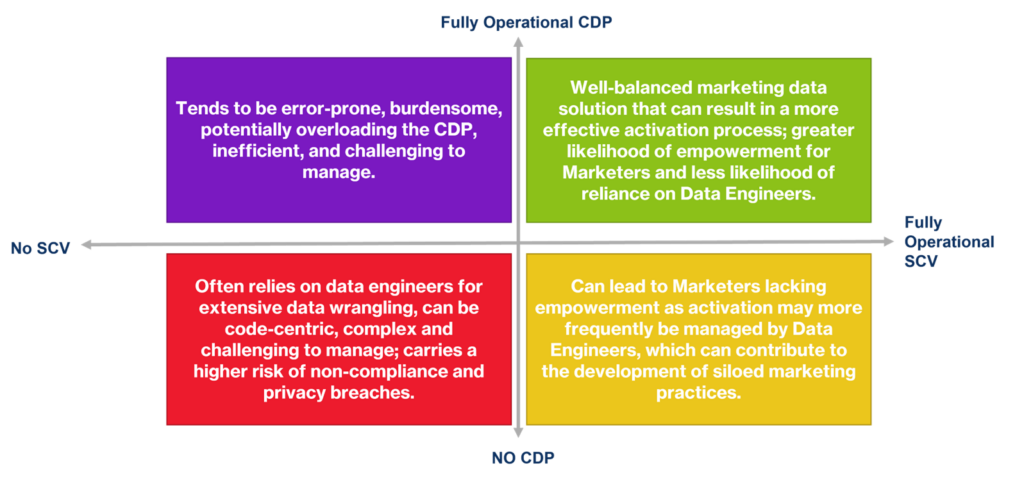
While both the SCV and CDP are valuable tools, they are not interchangeable but instead play complementary roles.
Failing to have both an SCV and a CDP can lead to significant risks and negative impacts. For example, without an SCV, companies may struggle to make sense of their customer data, leading to missed opportunities for personalisation and engagement. Without a CDP, companies may struggle to activate that data and deliver personalised experiences, leading to lower customer satisfaction and loyalty.
Ultimately, businesses that want to improve their customer experience should have both an SCV and a CDP. While the SCV provides a foundation layer of customer data, the CDP empowers marketers to activate that data and create personalised experiences.
How can CACI help?
As subject matter experts at CACI, we can tell you that a well-implemented CDP can be a game-changer for businesses of all sizes and we have hands on experience with many brands including ASOS, Kingfisher, L&G, PlayStation, Telegraph, EasyJet and DFS. If you’re interested in learning more about CDPs and how they can help your business, please don’t hesitate to reach out to one of our experts.
In the next post, we’ll consider how the CDP pairs with another key component of the modern marketing stack, the Customer Engagement Platform (CEP). Or if you’d like to download the full blog series in advance, click here to download.
Want to speak more about CDP and it can help you elevate your customer and marketing strategy? You can contact us here to speak to one of our experts.
How CACI can help housing associations navigate the Social Housing Regulation Act
Sagar Limbu
In this Article
On 20 July, the Social Housing Regulation Act received Royal Assent to become law. This places the social housing sector under increased scrutiny and introduces wide-ranging implications for how housing associations operate. The Act will:
Hold social housing providers responsible for new consumer standards, empowering tenants to provide the regulator stronger powers to hold landlords accountable.
Offer powers to the regulator to issue unlimited fines to rogue social landlords, creating a new risk for housing associations to manage customer engagement.
Enforce a closer working relationship between the ombudsman and the regulator. The ombudsman has emphasised the need for improved knowledge and information management across the sector and can enforce its recommendations more effectively through significant fines.
What transformational changes will housing associations need to consider implementing?
Housing Associations have several operational touchpoints with customers, ranging from complaints, repairs, arrears teams and beyond. This means that data and information are siloed across housing associations, prohibiting organisations from effectively engaging with customers or meeting their needs and falling foul to the new laws.
CACI can support on these key first steps for housing associations. Our work with housing associations has revealed that they are experiencing issues across the board with siloed data, gaps in customer data and complications with data foundations.
CACI can drive value for housing associations and help them become compliant with new regulations through various methods of support, including:
Assessing risks, reviewing and transformingdata management in line with Knowledge and Information Management: We provide the data foundations in line with new regulations and recommendations to reduce your data risks and conduct thorough data quality and architecture assessments to do so.
Recommending technology and data roadmaps: We offer insight into the best platforms, the processes needed to adapt to support data quality initiatives for your housing association to manage data and drive value across the organisation. This will help you achieve a single, unified view of residents in the community.
Understanding customers and assets: Our wealth of consumer and asset data supplies deeper insight into customers’ demographic, vulnerability and lifestyle variables, while asset and place-based data enhance your understanding of your homes and community.
Activatingactionable and accurate insights: Tailor your propositions and engagement by building a profile of customers according to key organisational issues such as complaints and arrears. Our trusted asset and consumer insights will help you offer the right services to the right people, reducing cost and resources while supporting your customers.
Driving value to improve customer satisfaction: An embedded data strategy that will improve outcomes for your customers by harnessing the power of analyses and spatial platforms.
What’s next?
CACI will be leading roundtables for housing associations to discuss approaches and best practices for data quality and insights. These sessions will offer a platform to share challenges and resources on meeting the new standards to ensure that housing associations deliver more value and improved outcomes for customers.
How a CDP can transform your customer experience architecture
Sagar Limbu
In this Article
This is the first post from our new series on Customer Data Platforms (CDPs). From debunking common misconceptions to exploring the power of combining CDPs with other cutting-edge technologies, we’ll be diving deep into all things CDP – and showing you how to make the most of this game-changing technology. If you’d like to read all the blogs right away, you canregister here to access the complete series.
What is a customer experience architecture?
If you’re in the world of marketing, you’ve probably heard of CDPs. But what exactly are they, and how do they fit into a modern marketing architecture?
Marketers can find CDP vendor websites confusing due to their use of language that may make CDPs sound like other components in your architecture. For example, they may claim that CDPs bring together all your customer data in one place (like an SCV) or can deliver highly personalised customer experiences (similar to other marketing platforms). However, despite this confusion, CDPs play a critical role in modern technology stacks. In this blog post, we will provide a fresh perspective on the topic to help explain the role of the CDP and its place in modern marketing architecture.
Where do CDPs fit into modern marketing architecture?
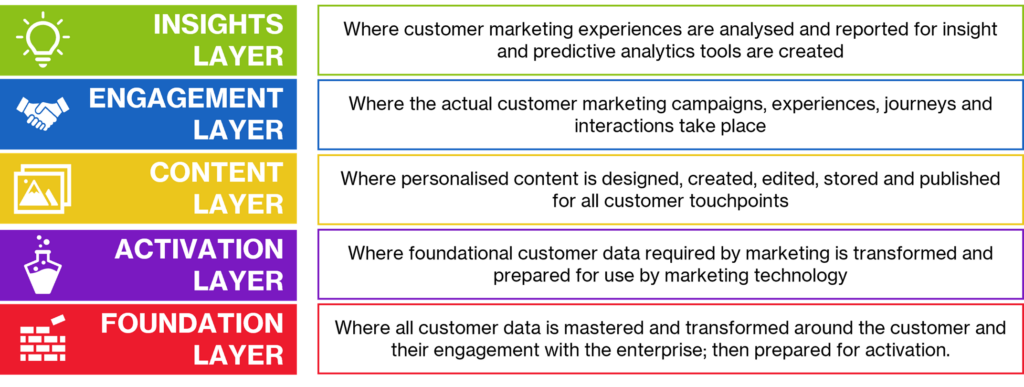
At CACI, we view modern marketing architecture as a framework with five layers:
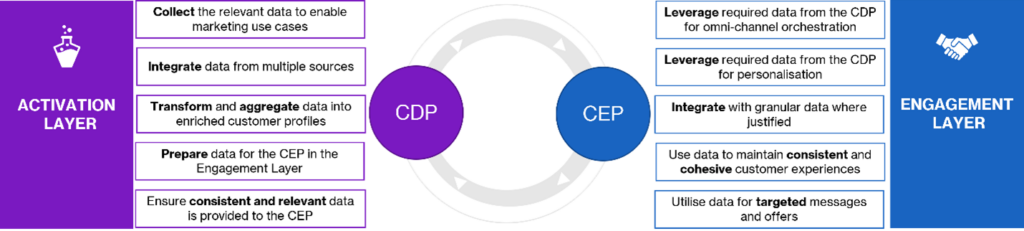
For many vendors, CDPs typically belong in the activation layer of this framework. It takes data from the foundation layer and then feeds marketing technology in the engagement layer with data in the format that marketers need to deliver highly personalised experiences.
Some CDPs may, however, offer more foundational layer capabilities whilst others can be more engagement focused. For simplicity, our framework defines the primary purpose of the CDP is to activate marketing data, which is why we put it at the heart of the activation layer.
How can a CDP enhance your customer experience architecture?
It’s important to note that a CDP should be thought of as marketing technology, rather than data technology. Its role is to empower marketers with data, removing their reliance on data engineering and allowing them to focus on strategy and campaign execution. A CDP brings a lot to the party, providing marketers with the tools they need to create effective campaigns and drive business results, such as:
A CDP can natively capture digital data, making it easier for marketers to activate audiences across a variety of MarTech and AdTech channels in real-time.
By enabling the delivery of highly personalised experiences across channels, a well-implemented CDP can help businesses improve customer engagement and increase conversions.
How can CACI help?
As subject matter experts at CACI, we can tell you that a well-implemented CDP can be a game-changer for businesses of all sizes and we have hands on experience with many brands including ASOS, Kingfisher, L&G, PlayStation, Telegraph, EasyJet and DFS. If you’re interested in learning more about CDPs and how they can help your business, please don’t hesitate to reach out to one of our experts.
In our next post, we’ll explain why businesses should not choose between a CDP and a Single Customer View (SCV). If you can’t wait until then, you canregister here to download the whitepaper which contains the full blog series.
Interested in learning more about how CDP an support your customer strategy? Contact us to speak to one of our experts today.
Understanding the meaning of geographic coverage across a business
Sagar Limbu
In this Article
When it comes to purchasing geospatial data for organisations in the Logistics sector, ensuring that you and your business have asked the right questions to secure accurate data will be key to the success of your planning, efficiency and optimisation initiatives. Our new blog series will answer the critical questions you should ask yourself when acquiring geospatial data for yourself or your organisation, from its coverage, accessibility and accuracy to legal sharing and usage.
What is the meaning of geographic coverage?
Geographic coverage is where the boundaries of the data extend to. For every piece of information that your business acquires, you must define the geographic coverage that you need it for. Without defining the boundary of the data, you could end up with far more data than you need. If you don’t define the geographic coverage, you may not receive all the data that you need. It’s important that you clearly define the geographic coverage for your data requirement.
What elements of geographic coverage through data should you consider before starting your project?
You should consider the geographic coverage that you need at the outset of your project and assess any future needs across multiple countries. Here are some example questions that may help you to ensure your geographic data requirements will be covered:
What is the difference between the United Kingdom and Great Britain?
If I buy data now for a specific country (e.g. The Netherlands), will it be available at the same detail in another country (e.g. Belgium)?
Will the maps and road networks line up across the borders?
Does the data cover the small islands around the edges of a country or small neighbouring countries such as Monaco?
Which countries offer detailed street level data in major towns and cities vs key roads in urban areas?
Stay tuned for our next post, where we’ll dive into geospatial data analysis and the attribute information that comes with it.
Our team of experts can help you navigate the intricacies of every dataset in every country across the globe. Download our whitepaper ‘Key questions to ask when buying geospatial data’ to find out more.
How digital attribution modelling improves your marketing performance
Sagar Limbu
In this Article
When allocating your marketing budget, how do you really know how much you should be spending on display? Your last-click attribution model suggests that it performs terribly, costing over £500 for every acquisition. However, it does appear to drive a lot of traffic to your website.
If this resonates with your business, you are not alone. This is a challenge faced by many brands – what is the true impact of each of your digital channels and how much do they contribute to someone becoming a customer?
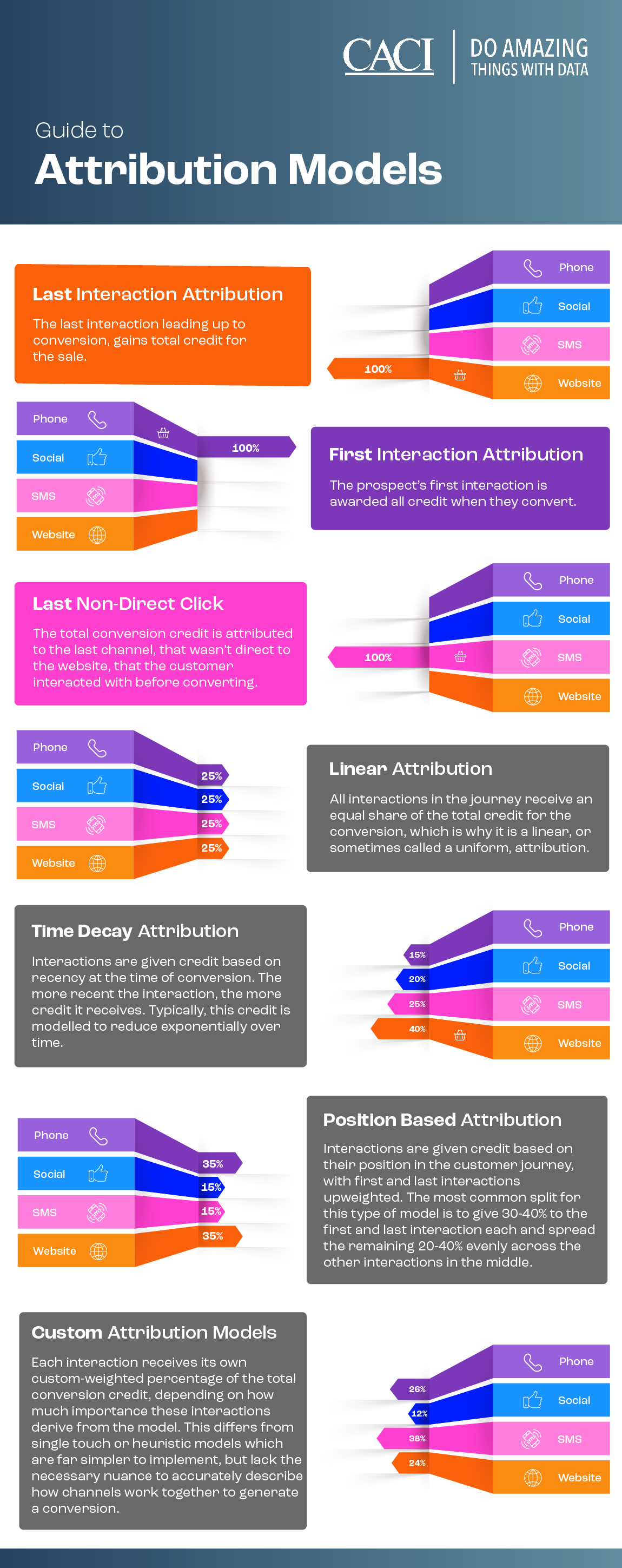
Digital attribution models are used to measure the performance of digital marketing channels, but there is a wide variety of them out there, and they can be set up in many ways. Which is the right approach for your organisation?
While there are several attribution models to choose from, choosing the model that will best suit your objectives and goals can be determined based on your business’ unique needs and your available data.
Four steps CACI take to implement a multi-touch digital attribution model, to determine the true value and performance of marketing activity
Step 1: Understanding your business goals and objectives
Building an effective and valuable multi-touch attribution (MTA) model is grounded in having a full understanding of a few key points, including:
The wider business objectives – how does this project help to achieve these?
The exact point of conversion in a consumer’s journey, often where they cease being a lead, and are acquired as a customer
Any fundamental differences in marketing activity across different regions or markets
The definition of a successful MTA project for your organisation
Step 2: Evaluation of current capability
A comprehensive review of your brands data and technology used to support digital marketing must be carried out before modelling can begin. This includes:
Evaluating your digital analytics platforms to ensure:
All necessary tracking and tagging are implemented
Relevant metrics and goals have been set up in line with best practice
Channel/sub-channel and campaign data is recorded correctly
An understanding of the past and present media activity:
Organic, paid and app
A complete understanding of a customer’s path-to-conversion
Understanding the current measurement framework and any Key Performance Indicators (KPIs) that are reported back to the business
A complete review of the technology to be used to develop and implement attribution
Upon completing an assessment of the existing digital data and technology stack, CACI will make recommendations to ensure the MTA model runs optimally and follows best practice.
By establishing what is in place, what can be optimised, and what needs to be adapted, we can identify the most suitable solution to develop.
Step 3: Building a Multi-Touch Attribution model
Preparation is key, but finally, the fun can begin! Build and validation of an MTA model includes the following steps:
Identify & collate all data for the paths a customer can take on their way to making a purchase/converting
Evaluation of the most suitable modelling method to be used (e.g. Shapley Value vs. Markov Chain)
Build, test and validate the MTA model
Integration into your technology platform for a fully automated solution
Assess model performance and produce insights tailored to your KPIs (e.g. channel share, cost per acquisition, return on investment)
Your MTA model will now deliver the insights required for you make informed decisions. Results from MTA models feed into:
Media planning: giving you confidence in budgeting and channel allocation
Optimisation: determine the most effective channels and campaigns for you to invest in
Granular insights: derive insights on your marketing activity per segment
Step 4: Evolution to best-in-class
Results from your MTA model need to be consumed on a regular basis. There needs to be a continuous closed loop of feedback into strategic decision-making and campaign planning, to improve targeting, and ultimately ensure you’re reaching your customers at the right time. As well as ongoing optimisation, CACI can support you in further enhancing your marketing through data and insights, including:
Integration of new channels
Model refreshes at optimal times
Technology selection and integration
Econometric modelling
Insight strategy
What are the major barriers affecting digital attribution modelling?
Non-digital media & in-store visits
Online results are easy to generate when businesses have a website and application analytics account. However, tracking and customising the customer journey for non-digital media and customers’ visits to physical stores becomes rather complicated. Customer engagement that can otherwise be tracked online is met with a challenge, and if any campaign efforts have been in place, a different approach such as econometrics would be required.
Third-Party Cookies
Cookies allow attribution models to function by identifying and tracking a user across their website-visiting journey. A lack of cookies translates to a lack of standards for advertisers, causing brands and businesses to question whether media planning and optimisation efforts can or will be successful.
Cookies underpin much of how digital marketers track and target individuals – small snippets of data which can demonstrate a user’s online activity over time. The third-party cookie specifically has been on its way out for some time, with Safari and Firefox already having phased these cookies out. Google initially announced to follow suit with their browser, Chrome, in 2022, but has since delayed this to 2024. This means that the functionality that has long been taken for granted in attribution and other digital analytics will change.
Marketers and analysts may have to adapt how tracking users across digital properties and devices takes place, which may make getting a cohesive picture of the user journey more difficult to deduce in attribution. Google has stated their intention to replace this with a first-party counterpart, forcing marketers to leverage walled-garden ecosystems like Google even more. The way other sectors will react to first party cookies in the future remains unclear.
Why your business would benefit from digital attribution modelling
CACI supports businesses in their delivery of optimised marketing efficiency by:
Determining the value and performance of activity through evolved multi-touch & econometric modelling
Producing results to sustain & increase growth through targeted investment & improved marketing performance
Delivering improved accuracy, consistency and availability of marketing performance insights
Enhancing capability by evolving Data, Technology & Process
Supporting the provision of ongoing Strategic & Delivery resource
Find out more about the impact that digital attribution modelling can have on your business in our whitepaper here.
How Consumer Duty compliance is changing client communications
Sagar Limbu
In this Article
How is Consumer Duty compliance affecting client communications?
Consumer Duty is rapidly changing the way Financial Services businesses communicate with clients. It is also causing consumers to re-evaluate the value of advice they receive from financial service advisers, and how financial institutions segment clients and offer relevant products and services.
On 30 April 2023, the UK adopted the new Consumer Duty obligations, and financial service providers and firms concluded their review of their existing open products. The changes that Consumer Duty brings impacts the way financial service providers interact with new and existing clients. Therefore, it is now more important than ever to ensure that you and your business are equipped with rich, actionable insights into your customers, to help you understand where to focus your Consumer Duty activities to ensure compliance.
What are the most impactful challenges currently resulting from Consumer Duty compliance?
Solidifying customer communications. You must show that the essential steps to understand customers’ needs and improve communications are being taken to remain compliant.
Identifying and supporting vulnerable customers.Vulnerability indicators change over time, therefore, without adequate customer knowledge, determining the diverse needs of your customers will be difficult.
Lack of strategy for maintaining and nurturing customer relationships over their policy, resulting from limitations of technical debt and data capabilities.
Inability to provide relevant offers or leverage existing customers to attract new customers when you do not know who your customers are.
Future proofing your business becomes compromised without the insights to initiate transformational change. Your brand will need to remain relevant for customers and adhere to their customer experience expectations.
The steps CACI takes to make a difference for your business
We support Consumer Duty compliance across several key requirements, including:
Supplying support beyond the strategy – understanding customers and improving communications.
Developing a testing process to help you understand your customers and find areas for improvement.
Accelerating Consumer Duty delivery and showing progress through an innate understanding of your customers’ diverse needs.
Providing a comprehensive view of all customer communications, assessed for suitability against Consumer Duty and amended as needed.
Scoring and evaluating your performance against key Consumer Duty metrics.
Bringing in all channels to support customers.
Our process guarantees that you will be solving Consumer Duty compliance issues as they arise to secure a successful future for your business. We break this down into four steps:
1. Audit:
We work with you to gain an understanding of your existing communications, technical capabilities and data available, for communications improvements to be made effectively.
2. Campaign strategy, testing & delivery:
We then identify initial tests to show iterative improvement and implementation of the defined methods of communication that will meet Consumer Duty standards.
3. Customer strategy:
We create robust segmentation to define where there is headroom opportunity and who your priority audiences are. We also define the customer journey to activate your segmentation and strategy accordingly.
4. Contact strategies & use cases:
Finally, we develop detailed contact strategies for the execution of your customer journey, and identify technology and data use cases that will inform your future architecture and technology roadmaps.
How CACI ensures your business meets Consumer Duty compliance: real-time example
When one business with a range of financial products that fall under Consumer Duty recognised that they did not have an established amount of internal experience, they approached CACI to ensure that Consumer Duty compliance was addressed with each of their products, tailored to the customer audiences they served.
We highlighted several opportunities that the business could leverage through our capabilities, including:
Understanding the business’ customer base and identifying headroom opportunities to drive growth.
Creating engagement strategies that would protect and support their customers throughout their relationship.
Rapidly improving insight led capability by enriching, leveraging and harnessing their potential of customer data.
Demonstrating the power that a 360° view of the business’ customers and market would have by blending their data with our own to analyse customers, identify opportunities and learn how they could serve customers more compliantly and effectively.
Why you can count on us to support your Consumer Duty compliance initiatives
Our extensive experience with Consumer Duty paired with our unique data capabilities allows us to define market opportunities and key audiences that will deliver immediate growth and engage audiences of the future. We translate rich, quantified insights into actionable strategies to deliver targeted, personalised and omnichannel programmes that will guarantee success.
Contact us today to find out how we can support you and your business ahead of the upcoming Consumer Duty deadline.
Legacy application interoperability & integration in the Police Force
Sagar Limbu
In this Article
For those watching what seems like a proliferation of Police dramas on television, you might be impressed by how easily data is shared between partner organisations: Officers tap into numerous IT systems to retrieve vital information that is key to solving their case.
Sadly, as you would probably expect, the reality is somewhat different.
Data sharing
The Digital Government report from July 2019 highlighted that data sharing is key to ensuring that digital Government can be transformative. It enables departments to work together to produce efficient public services that work for the citizen, thus improving the citizen-Government relationship.
The new National Data Strategy also recognises the importance data has to play in enhancing economic competitiveness and productivity across the UK economy, through new data enabled business models, and the adoption of data driven processes.
Data sharing has long been discussed within Policing. One of the key recommendations of the Bichard child protection inquiry in 2003 was that all forces across the UK should improve how they collect, store and share data.
In 2005 the Information Systems Strategy for the Police Service (ISS4PS) highlighted “The importance of a national approach to information sharing is now uppermost in current strategy for policing as reflected in the National Policing Plan.”
The following year the National Policing Improvement Agency (NPIA) Guidance on the management of Police Information talked of effective Policing relying on the Police Service to communicate and share information with other forces and partner agencies.
Fast forward 15 years and the National Policing Digital Strategy 2020-30 prioritises the need to deepen collaboration with public sector agencies to unlock effectiveness, by developing ‘fluid’ data and insight exchange, within appropriate ethical and legal boundaries.
Collaboration is necessity
No-one can fail to notice the masses of data that is being created today and the fact that it is growing at an unprecedented rate.
Over the last 15 years, Policing has also started to see an explosion in the data that it holds. Allied to this is a growing pressure for them to start to utilise and share this data to their advantage.
Citizens are starting to demand and expect more from the Police service. With resources more stretched than ever, Police are now having to look at new ways of working – becoming smarter in utilizing the information they have available to them and sharing it to obtain greater insight.
No-one can accurately predict how the next 15 years will unfold, but as digital trends rapidly evolve across all areas of our lives, the abundance of data and the vast array of sources from which it emanates will continue to grow.
For a long time, public sector bodies have been locked into the mentality that they need to be autonomous in their operation, harbouring their own data and with the ideas of collaboration and sharing being forced rather than instinctive.
More recently though, policing as with all public sector, has seen austerity and the ever increasing need to save money as a driver towards more collaboration and data sharing.
A by-product of this is the ability to provide a better-quality service and a more rewarding citizen experience. Agencies are provided with a more holistic view of the individuals they are dealing with and their circumstances, allowing them to make better informed decisions.
Given this win, win scenario, it seems like a no-brainer, doesn’t it?
Why’s taking too long?
If the idea of collaboration and sharing of data is clearly beneficial on a number of levels, why have we been discussing it for so long without taking any action?
The biggest obstacle to collaboration and data sharing is arguably a wealth of stand-alone, legacy applications that exist within Police estates.
“Legacy systems are invariably built on outdated architectures with high maintenance costs, inherent inflexibility, redundant features, lack of connectivity and low efficiency. Complex application and process logic is often hard-coded and undocumented.”
Gartner Oct. 2019
“Legacy systems are a significant barrier to effective Government transformation and digitisation.”
Digital Government report, July 2019
Given the autonomous mentality that previously existed, Police applications were never built with collaboration in mind.
This means that these legacy systems don’t easily provide the ability to interact and share their data with other applications – they are siloed, with the data being accessible only by the application to which it relates.
All is not lost however. There are numerous different approaches we can use to help create interoperability and integration for your legacy applications:
Rehost: redeploy the application component to other infrastructure (physical, virtual or cloud) without modifying its code, features or functions. This allows significant, short-term technology benefits without altering the application code base. Benefits of migrating to the cloud include: Improved application resilience; Disaster Recovery; Scalability; Accessibility.
Re-platform: migrate to a new runtime platform, making minimal changes to the code, but not the code structure, features or functions. This enables the application to run on modern technology framework while limiting the requirement for a major development project.
Refactor: restructure and optimize the existing code (although not its external behaviour) to enable data sharing and improve non-functional attributes. Refactoring focuses on breaking up the legacy code base into smaller manageable modules allowing consistent improvements to the application through small, iterative release cycles.
Re-architect: materially alter the code to shift it to a new application architecture and exploit new and better capabilities. This will leverage and extend the application features while introducing new integration concepts to promote data sharing and deduplication. Where appropriate an Application Programming Interface (API) would be developed to allow data sharing between application/modules over a secure HTTPS protocol.
Rebuild: redesign or rewrite the application component from scratch while preserving its scope and specifications. When deciding to rebuild an application, consideration should be taken to ensure the architecture is designed in a modular, scalable fashion promoting data sharing and future integrations using a combination of APIs and messaging architecture.
Replace: eliminate the former application component altogether and replace it, considering new requirements and needs at the same time.
To find out more about how we could help your organisation unlock integration and interoperability, take a look at our Police page.
How Transactional Spend Data transforms business operations
Sagar Limbu
In this Article
Transactional spending in UK supermarkets
When one of the UK’s largest supermarket chains needed to understand consumer shopping behaviours at a local level to enhance their relevance within existing and new stores, they quickly realised the impact that leveraging customer-centric data could have on achieving these goals.
CACI was selected as their partner to supply them with the consultancy and consumer behaviour data that they felt had been missing from their current data sources. The potential to gain a granular and cohesive perspective of customers with actionable insights to drive change was what encouraged the business to trust CACI to help reach their strategic objectives and better understand and cater to customers.
Challenges CACI was brought on to solve
The external data about customer behaviour outside their organisation which they could access was generally based on small sample surveys and was not robust enough to support their enhanced customer understanding initiatives.
Other data sources were overly aggregated, challenging the business’ ability to determine what the result of a major market change in a market might be, such as a store closing or a new store opening, or a major local marketing campaign. This also made understanding how consumer behaviours changed as a result more difficult.
Using CACI’s datasets to solve problems
CACI’s data was game-changing for this business as it was based on actual spend data, and what consumers were actually doing versus what they were saying they were doing. The huge and granular sample size in comparison was also tremendously beneficial for the business, as it was available at brand level, ultimately unlocking major potential for them.
Impact of CACI on the business
CACI’s consultancy and data was able to significantly enhance the current capabilities of the team and allow them to add a significant new dimension to a number of different projects and use cases.
Potential partner analysis
The ‘race for space’ in the early to mid 2000s, combined with the emergence of multi-channel trading and stronger discounter competition, meant that many supermarket operators have been left with stores that are too big for their catchments and, therefore, were not as efficient or profitable as they once were.
As a result, many supermarkets had to find ways to fill parts of their stores or car parks with partner retailers that would generate rental income, fill ‘baggy’ space, create a more comprehensive customer offers and help generate sales for the business by bringing in a different type of customer.
Understanding competitor performance
Through CACI’s data, they could begin to understand and benchmark performance between their brand and others in a granular way for the first time, rather than using data based on a small sample survey (Kantar) or that aggregated to market rather than retailer (IGD).
For example, before a new store opening, the performance of competing brands and what types of customers were shopping with them could be analysed in a way that has never been previously available.
They could also understand what happened once the new store opened – which brands won and lost in the market and which types of customers changed their behaviour. This understanding was key to influencing future new store opening decisions that the team could into future forecasting estimates and set expectations accordingly through data-backed evidence.
Defining missed sales opportunities
CACI’s data helped this business understand where customers were cross-shopping with their competitors on the same day as shopping with them.
One example was by analysing customers driving out of the business’ store and past their petrol station but filling up their car at an alternative fuel station on the same day. The business lost trade because the customer drove past the front of the petrol station and chose to buy petrol elsewhere.
While it did not necessarily answer ‘why’ a customer did not shop with the business, it did help generate questions and what to look out for in customers’ preferred shopping experiences so they could assess a particular store, determine which competitors were in the vicinity and what the business could do to compete– adjust the price, revisit the convenience of the store’s location and so on to drive improvements backed by data.
Another example was assessing the performance of one store in close proximity to a direct competitor’s smaller store. The business knew that they had been losing trade to this competitor for years, but they did not have the data to prove this loss.
This insight helped the business formulate strategies for marketing campaigns that would encourage shoppers to return to their store versus to their neighbouring competitor.
Format development
The business assessed quirks in catchments and emerging trends among competitors to conclude whether certain initiatives, such as creating a café space within a store, would be a success with their customers.
Ultimately, it provided the business with a different approach to the café format and its offers for customers.
Customer profiles
For this business, customer loyalty cards were paramount to building customer profiles of their own customers. However, understanding the profile of competitors’ customers and how they were behaving was out of reach. This data helped the business understand the profiles of other brands’ customers and how similar or dissimilar they were to their own customers. Most importantly, they gained insight into what their spending patterns and behaviours were and how they changed over time.
To learn more about how CACI can help you leverage data to enhance your business operations, contact us today.
How location intelligence & customer insight optimise fulfilment services
Sagar Limbu
In this Article
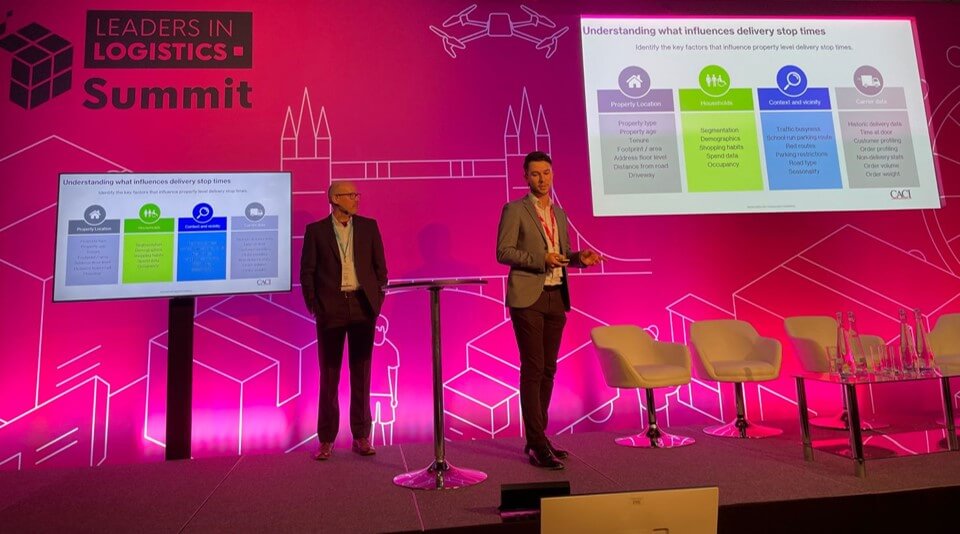
Nowadays, creating an optimal fulfilment service requires you to have access to sophisticated location intelligence data and superb knowledge of your customers. CACI’s Paul Dawsey and Dom Saunders, who work in the Logistics and Supply Chain business unit, presented the impact that location intelligence and customer insight have on optimising a distribution network and two examples of influential optimisation models at the Leaders in Logistics Summit on 28 March 2023.
Why are location intelligence & customer insight so important?
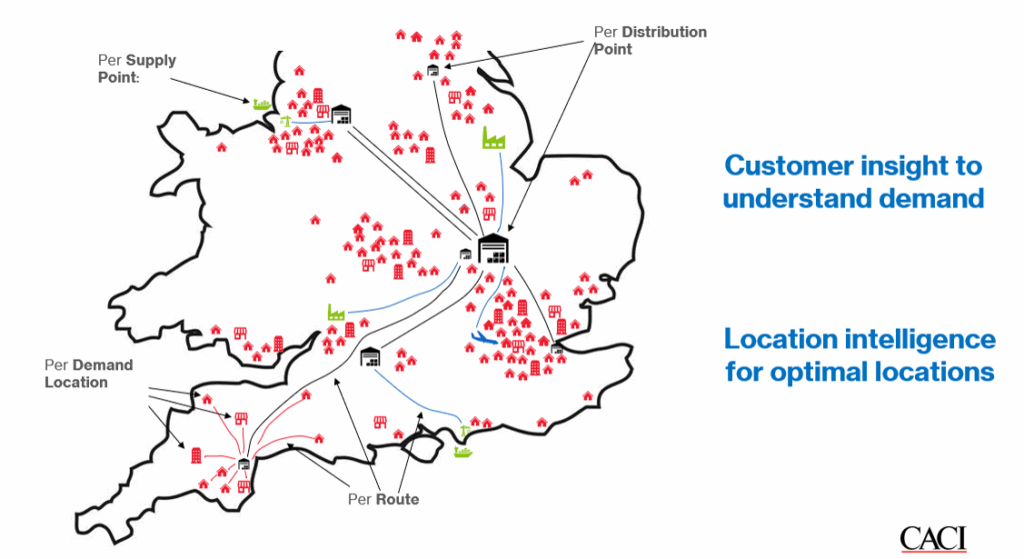
Having the right data for any type of location logistics solution is critical. Road network data, precise attributes and customer data are all critical parts of the distribution network optimisation process as they allow you to extrapolate the necessary details to ask the right questions and strategise accordingly.
There are several benefits that gaining these insights will have on your business’ operations, including:
Improving your understanding of and ability to inform store locations, and expand or contract store locations accordingly
Adhering to customers’ individual preferences for the delivery of products
Personalising fulfilment options and determining what works best for specific customer demographics
Enhancing the accuracy of your predictions for the length of time that drivers will need to spend at drop-off points, which will improve customer satisfaction and cut costs.
Example model 1: Network distribution modelling
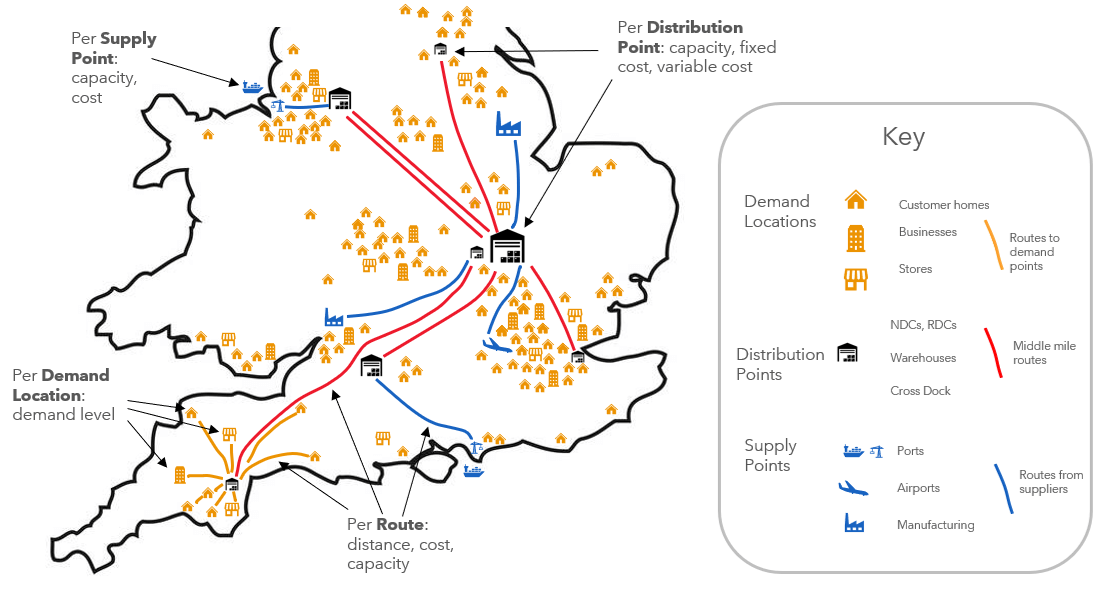
To effectively model your distribution network, especially when making expensive decisions, your thought process should be backed by data. This will help you understand your customers in a way that will allow you to quantify and locate the demand that they have for your products, their consumption of your products, their collection preferences and more.
Once you have quantified and located demand, you can determine your baseline to strategically tweak the model you are building. Depending on what happens or changes in the marketplace and your sector in the coming years, and its impact on your model, you can formulate the right questions and conclude where changes need to be made.
Different customers will also present inevitably different logistics challenges. Profiling these customers will help you gauge how to better adhere to their existing and future demands. Pairing customer insight to understand demand with location intelligence to find the best locations to effectively reach your target customers will highly support the functionality of this model.
Finally, testing a range of ‘What if?’ scenarios depending on various changes your business may experience– population growth, market trends, what your market department is focusing on or how consumers will want to shop— will help you answer questions to gain strategic insights on your business’ efficiency, optimisation, costs, bottlenecks, products and services. This enables you to make recommendations for change.
When you take these answers and insights to the board for sign-off, you will have a significant amount of evidence through this model to back up your claims.
Example model 2: Delivery stop time modelling
Understanding the key factors that influence property level delivery stop times will ensure this model is created effectively. A grasp on the intricacies of property locations, households, context and vicinity and carrier data have become standard business practice for success in more recent years.
Effectively modelling property delivery stop times begins with accessing unique data feeds via customer and property intelligence data, road network and traffic data and carrier/historical customer data. These datasets can be then used in route optimisation tools such as CACI’s Pin Routes to fine-tune optimal routes, further increasing the level of optimisation. They show how dynamic the stop time analysis can be and how to consider running costs, regulations, and other impactful factors. They can also flag high traffic volume index, Acorn type, unloading duration and more to analyse existing stop times, compare delivery times, adapt strategies and conclude the optimal routes for drivers to take.
These data feeds support the development of your solution or model to produce an output of precise stop times based on customers’ addresses, enhance stop time generation and improve customer service and insights.
How can CACI help you optimise your fulfilment services?
Implementing a digital model that will showcase exactly what needs to change and improve will be paramount to running a successful, long-term distribution network. The right model based on the right data is what will help you build in the right way—gaining efficiencies, reducing costs and improving your customer service.
To find out how you can use location intelligence & customer insights to optimise your distribution network strategy, contact our team of experts.
How CACI supports the wealth management customer journey
Sagar Limbu
In this Article
It is now crucial for wealth managers and financial service firms to better their consumer understanding. They can do so by ensuring they are well-versed in the entire consumer lifecycle and journey, understand optimal communication techniques required for effective customer marketing, collect enriching customer-centric data to tailor marketing and distribution effectively, and establish innovative ways of measuring these areas to remain compliant.
Access to insightful demographics on the lifestyles, attitudes and behaviours of investors within the market can help drive improved distribution performance, revenue growth and increased client engagement. This crucial investment market knowledge can be provided by CACI.
How does CACI support a firm’s wealth management customer journey?
Through a detailed understanding of current investor behaviour needs and growth opportunities, CACI can support businesses by quantifying acquisition opportunities across regions to inform effective growth and investor engagement strategies.
Once businesses have been equipped with the appropriate datasets to target high net worth individuals (HNWI), CACI can support the optimisation of marketing performance across channels and help businesses improve their distribution performance through digital, direct and intermediated channels to drive improved marketing return on investment, increased customer acquisition and better investment retention performance.
CACI offer a range of support for wealth managers and firms to meet customers’ needs while ensuring compliancy, including:
Support in better understanding existing investors.
Understanding the market and identifying opportunities, particularly in identifying how and where to acquire HNWI.
Determining where potential and current customers are located, as well as their value.
Receiving demographic data and behavioural insights on investors to better understand the customer landscape.
Demonstrating compliance with Consumer Duty, with meeting customers’ needs remaining at the heart of what CACI do.
How CACI use data science & analytics to support the wealth management customer journey
CACI’s data science & analytics services have three primary capacities to support the enhancement of the customer journey:
Using pre-existing information on younger investors in wealth managers and firms’ portfolios to build bespoke datasets. CACI’s multi-sector knowledge and access to unique lifestyle datasets enables the building of this bespoke consumer data insight, providing wealth managers and firms with a detailed picture of the opinions, preferences and spending potential of HNWI.
Modelling prospects for HNWI based on demographics.
Assessing firms’ historic data to determine how HNWI already in their portfolio achieved this position by tracking their movements and identifying signals and triggers, to enable modelling of future investors.
How CACI’s Fresco solution supported one business’ customer acquisition & marketing strategy
CACI’s Fresco solution was employed at one business to establish a granular understanding of existing investors. This allowed for the development of a targeting propensity score, which enabled the pinpointing of potential investors that would be most likely to join the business. CACI then identified and mapped opportunities across the UK, considering regional differences and high value areas to target. Detailed insight into prospects supported the development of a consistent marketing targeting strategy within the business, which was also rolled out across traditional and social media.
Results:
Development of a targeted audience strategy focusing on high propensity and high value audiences.
Reduction in digital marketing spend.
Increase in digital marketing ROI (return on investment).
How investor segmentation, personas & geographic data application transformed a business
CACI developed investor segmentation, detailed personas and geographic counts to support a market sizing initiative requested by one client.
The resulting data uncovered hundreds of variables at an individual level and provided rich insight into a range of traits and characteristics. This not only supported the business’ understanding of its current customers, but of the wider UK investment market. CACI developed personas to help the business gauge an in-depth view into consumer behaviour, insight into the market and the potential reach for key segments. Finally, geographic mapping helped the business understand acquisition and growth potential across catchments and regions, and cross-sell models were developed to support the immediate activation of distribution and marketing activity.
Results:
The business experienced steady and sustainable growth in its acquisition, retention and reactivation.
Increased investment values were received from both new and existing investors.
The business was equipped with actionable insights to help inform ongoing and future marketing and office location strategies.
Throughout this blog series for the wealth management industry, we break down the opportunities for businesses to attract and retain high-net-worth individuals. Continue reading at the links below:
To find out more about how CACI can support your wealth management customer journey, contact our team of data experts today.
Three reasons why wealth & asset managers need young investors
Sagar Limbu
In this Article
While wealth and asset managers may have developed a sophisticated and loyal base of investors, it is no secret that their client base is ageing and shifting. There have been noticeable changes in both the types of customers and their behaviours, whereby moving away from traditional investment styles and seeking out alternative areas of wealth to gain market share have become commonplace.
So, why would wealth and asset management firms benefit from having younger investors in their client base?
Their trajectory to wealth has high earning potential for wealth management businesses
Reaching the broader and untapped market of high-earning young investors has become critical for wealth and asset managers to continue to be successful. Supporting potential investors who are en route to wealth inheritance, who may find themselves in a position to sell off a thriving business in the near or distant future, or whose career path suggests high earning potential, are all inviting factors to drive wealth and asset management firms to acquire younger clients.
According to the Financial Conduct Authority (FCA), a High Net Worth Individual (HNWI) is someone who either earns more than £300,000 per annum or has net assets of more than £3,000,000. Firms with a client base that is more likely to pass down their wealth generationally are left to wonder the amount that might one day be re-invested into the firm, while young investors are more likely to distribute their wealth differently as a result of their current life stage and emerging alternatives, such as Crypto currencies. While the average new and younger potential investor may, for example, only bring ~£100k in assets to the table, potential exists for this investor to be on the trajectory towards becoming a high-net-worth individual.
Their financial industry knowledge is superior
They are not afraid to take their services digital
The investor arena has increasingly filled with entry-level investors who have lofty expectations for customer service, especially with digital services. They are aware of the capabilities of self-sufficient online investing; therefore, they expect the same level of speed and ease of use in all their financial affairs.
How can wealth management businesses identify and secure young investors?
Throughout this blog series for the wealth management industry, we break down the opportunities for businesses to attract and retain high-net-worth individuals. Continue reading at the links below:
Is your firm looking to attract younger investors? Get in touch with us by clicking the link below to find out how you can achieve this.
Building a world-class distribution network in the “disruptive decade”
Sagar Limbu
In this Article
Supply chains have faced massive disruptions due to unpredictable and massive global events like Brexit, Covid-19 and the ongoing war in Ukraine. The optimisation of distribution networks has been jeopardised during this “disruptive decade” as a result, reiterating the need for robust and flexible distribution network models to be implemented to help businesses thrive despite these trying times.
CACI’s Paul Dawsey and Louise Etherden, who work in the Logistics and Supply Chain and the Customer & Location Strategy areas of the business respectively, presented five necessary and innovative steps for businesses to take to build and maintain a world-class distribution network that will succeed in the “disruptive decade” at the Retail & Supply Chain Logistics conference on 1 March 2023.
What are the five recommended steps to create a world-class distribution network?
Optimising the end-to-end customer journey means developing an innate understanding of customers’ demands at every point of the supply chain. Once you understand demand, you can build an effective model based on intricate methodology to simulate your supply chain.
The five steps that will help you deliver high-quality, reliable and effective services to customers while maximising profit through a strategic distribution network are the following:
Step 1: Understand the consumer
In order to truly understand what matters, what you need to improve upon and what challenges need to be addressed, you must first focus on better understanding consumers.
Different consumers present different logistics challenges, so understanding the differences and why they present unique challenges will be integral. Paul and Louise suggest starting with generating customer profiles by channel, service and category to begin to better understand customers. Once you have gained this knowledge, obtaining additional contextual data into their lifestyle, shopping habits, location and property type, product preferences, and whether they shop with convenience or price in mind will help bring this visual to life.
Step 2: Quantify and locate demand
Understanding where your current customers are located and how they interact with your products and services to accurately gauge your business’ share of opportunity is the next recommended step to take in building a future-proofed distribution network. Paul and Louise suggest asking yourself the following questions to better understand this:
Where is the demand now?
This can be assessed through an analysis of your current customers’ engagement with different product categories, ranges and services to understand where there are other potential customers, as well as your share of the opportunity. If you have stores, determining whether there is also an online halo and what it means for the demand and your share of demand by channel will be integral.
Where is the future demand?
What population growth patterns are arising? What does the current growth of online presence mean for my business in the future? How impactful are my business’ rapid delivery solutions, and where could there be demand for new solutions in the future? What is my business’ headroom and what are our target groups?
How do customers want to shop?
What is the role of online? How does my business have to deliver to certain customers? What needs to be offered and where? Where should we trial initiatives? Answering these questions will help you understand how your business must evolve.
Step 3: Build the baseline network model
The next critical step is to build a supply chain model that will help you get to the “as is” of where products hit your supply chain to understand where the customer is located versus where your product or service needs to get to.
The model should provide a detailed idea of how much it costs to transport products from one location to the next, capacity at store locations and required capabilities to store certain types of goods in certain ways. Designing an optimised network model with this criterion in mind will help you measure against the peaks and pitfalls of your existing model and determine where you must re-focus efforts, where the headroom for growth is, and so on.
Step 4: Develop strategies through a “what if” simulation
Next, you should ask yourself the following questions that apply your methodology and use data and tools to ensure you are developing an effective simulation. These questions include:
How can we maximise efficiency?
How much will it cost, and save?
Where are the bottlenecks?
How do we ensure it is robust?
Answering these questions will help you test a wide range of potential changes backed by strategic insights. You will be able to apply these answers to various test scenarios such as change demand, new products/services, sales increases through marketing, store network changes, capacity changes and more. Your insights will help you understand the impact of any proposed change and compare it to the baseline, if it is worth implementing. This approach to modelling will facilitate data-driven decisions which will instil confidence in all stakeholders.
Step 5: Keeping it live
To maintain the effectiveness of this approach, the baseline must be kept up to date. This includes ensuring a periodic refreshment of customer understanding and working actual network changes into the model.
If you lead with the customer in mind, you will find that you are able reduce costs while offering the services that will deliver sales and growth and remain robust. Ways of effectively leading with the customer include:
Tailoring your solutions and strategies to the market and your business partners
Focusing trials and investments where there is greatest opportunity
Optimising your toolkit to support logistics operations
Dynamic planning for future demand, services and growth
Communicating with your customers about deliveries.
Get in touch with our team of experts to find out how to optimise your distribution network.
Policing’s future is in the clouds
Sagar Limbu
In this Article
What is the cloud?
For the uninitiated reading this, what is the cloud?
Well in its simplest form, the cloud refers to a remote Data Centre, commonly owned and operated by a 3rd party, that is used to host applications and store data that a Force would have previously provided via their own on-premise Data Centre facility.
The cloud is commonly accessed via the internet, meaning any device that has some form of internet connection can access the applications and data that reside there. That device could be a desktop in the station, but it could just as easily be a remote device such as a laptop, mobile or tablet being used out in the field.
Given access is via the internet it also means that it makes it far easier to share anything that’s stored in the cloud with other entities should you wish to do so. Ideal if you want to work collaboratively with other agencies and share data.
Another added benefit is that the cloud hosting provider takes on the responsibility for maintaining the infrastructure on which your data and applications are stored, as well as being responsible for the environment in which it resides.
Cloud services are typically subscription based, which shifts the commercial model from a capital one, where the Force has a large capital outlay relating to procuring and maintaining their own in-house IT provision, to a revenue-based, ‘pay as you go’ model allowing for easier budgeting with no large initial outlay.
Cloud technology also provides the ability to ramp services up and down as needed, meaning the Force only pays for what it needs, typically with a lower overall total cost of ownership.
Cloud First policy
Back in 2013 the Government introduced its “Cloud First” policy. Within it was a recommendation to all Public sector organisations that, they should prioritise the use of cloud when considering new IT solutions. The inference being the public cloud rather than a community, hybrid or private deployment model.
Key to this recommendation was that “Departments should always source a cloud provider that fits their needs, rather than selecting a provider based on recommendation.” I’ll come back to this point later.
The Government stated that, “By exploiting innovations in cloud computing we will transform the public sector ICT estate into one that is agile, cost-effective and environmentally sustainable.”
The benefits of having a cloud-based deployment were clearly evidenced in 2017 following the Manchester terrorist bombing. In the aftermath of the incident, the cloud based HOLMES2 (Home Office Large Major Enquiry System) was used to set up a Casualty Bureau, to support with missing persons, the identification of individuals and logging of evidence. Thanks to being hosted in the cloud, within two hours of the attack, 27 forces were able to utilise the casualty bureau to support one another with mutual aid.
Another cloud native system that will undoubtedly benefit all forces is the much criticised and highly controversial LEDS (Law Enforcement Data Service). LEDS is the Home Office’s new “super-database” for Police. It combines the PNC (Police National Computer) and the PND (Police National Database) into one data source. Although massively over budget and behind schedule, no one doubts the benefits it will bring to Policing. Given the amalgamation of the systems there will be reductions in running costs by supporting a single, far more efficient system.
Police will have access to a much broader set of information, which should help in speeding up the identification of persons of interest. LEDS is to be hosted on the commodity cloud service within Amazon Web Services (AWS). This will widen the scope beyond policing in terms of organisations able to obtain access, such as the DVLA, Financial Conduct Authority, Highways England, Competition and Markets Authority and the Royal Mail.
Arguably, the cloud-based technology that has had the biggest positive impact of late is Microsoft’s 365 Productivity Services suite, being rolled out to Forces as part of the National Enablement Programme. The national lockdown that was imposed in response to trying to combat the Covid 19 pandemic, added an additional level of complexity to Policing.
Whilst most things ground to a halt, criminal activity continued and so did the need to police it. By using the collaboration tools that are offered as part of the productivity suite, Forces were able to continue to operate using a virtual environment, allowing employees to come together whatever and wherever their location.
Given the exhortations of the Government and the evidential benefits of adopting cloud technology, does that mean all Forces have rushed to go ‘all-in’ pushing all their Applications and data into the cloud in haste?
The short answer is no. Despite the numerous benefits to adopting a cloud first approach, as recently as 2 years ago, reports suggested that as many as 75% of all Forces still accessed and managed their data and applications on premise. So, the big question is why?
Barriers to adoption: security concerns
Understandably, Police by the very nature of the job they do are quite anxious when it comes to re-housing their applications and data. A good percentage of the work is sensitive and needs guaranteed security. As you would imagine, most forces were initially very sceptical that the cloud could offer the same level of security as that provided in their own on-premise data centres. Surely no-one would be as concerned about the security of Police IT than the Police themselves.
When we talk about security in this instance, it usually relates to the need to ensure that everything belonging to the force is protected from a potential data security breach. When you have been responsible for security for so long it is hard to share that responsibility with someone else and have the confidence that they will look after things as well as you do. It is also unnerving when your security is no longer fully reliant on the tangible devices sitting in your data centre, that you can see and touch with a reassurance that everything is ticking along as it should be.
In a traditional on-premise solution, IT teams must manage and maintain security at every single location and for every single application. When it comes to Public Cloud, providers don’t have visibility of where or what the ultimate endpoint is, therefore all security has to be centralised and unified, able to cater for all possibilities. This unified security approach means you may end up with access to more security than you currently have employed on premise.
Let’s just for a moment take a look at cloud security:
Security is now a shared responsibility with the cloud vendor, meaning there is less of a burden on your IT teams and your finances.
Updates and patches no longer have to be resourced and scheduled in by the IT team, instead being applied in a timely fashion.
Cloud security is highly automated, meaning a reduced need for human intervention and less opportunity for errors.
As security is centralised there are less boundaries in relation to possible end points.
Cloud security may offer more specialised and robust options that would probably otherwise be unavailable due to cost.
Although public cloud involves trust of a 3rd party. They are generally experts in their field and are focussed purely on security and nothing else.
Cloud providers are now compliant with necessary regulation, meaning you can rest assured they are using best practices.
Over the last few years billions of pounds have been invested by Public cloud vendors to provide efficient data security. So much so, that cloud security arguably provides better protection than that offered by a lot of on-premise facilities.
Most of the major vendors are compliant with the Home Office’s National Police Information Risk Management Team (NPIRT) requirements, meaning cloud services can now support Police Forces across the UK who require Police-Assured Secure Facilities (PASF) to process and store their data in the cloud.
A big indicator of shifting attitudes around security, is the recent decision by the Defence Digital Service (DDS), a new group in the Ministry of Defence (MOD), to shift its data for its Readiness Reporting and Deployability Discovery (R2-D2) project to a public cloud.
Phil Jones from ISS (MOD’s Information Systems & Services) stated that Public Cloud is being used by several operations and projects within the MOD to identify how new services and capabilities can be delivered to Defence. Teams are able to access accounts to the Public Cloud offerings provided by Amazon Web Services (AWS) and Microsoft Azure – this provides teams with freedom to evolve their own Services that take advantage of industry leading capabilities.
Barriers to adoption: culture
Culture was cited as being another barrier to adoption. Historically, Forces have been quite parochial in their nature. Very much with a sense of, “This is how we’ve always done things!” or “We’ll wait and watch what everyone else does first before we decide.” This mentality has left forces lagging behind the criminals who they are trying to outwit (Who conversely, have exploited this new technology in advanced and innovative ways, making their criminal activities far more complex and difficult to untangle).
However, police culture is changing thanks to the everyday use of cloud in our personal lives. Barely a day goes by where we don’t perform some kind of interaction with cloud-based technology, passing data back and forth between applications and allowing us to do things on the move using our mobile devices, such as ordering food, making appointments and booking holidays, remember them?! We even trust the cloud to store our most precious memories in the form of photos and videos.
So, if security concerns have now been addressed and cultural views are changing, then what else is slowing mass adoption?
For those of you that read my last blog, you’ll already know the answer. However, for those that didn’t, go and read it! But in the meantime, the answer relates to the fact that a lot of forces maintain a large number of legacy applications, that were never designed for the cloud and don’t easily present themselves to being migrated on to one.
However, the aforementioned blog provides an indication as to how we at CACI can help forces overcome this obstacle.
Which cloud is the best?
If all barriers have been overcome and the decision has been made to adopt the cloud, how do you then go about deciding which cloud is best for you?
Let me try and explain by use of an analogy; when your child reaches a certain age there comes the time you want them to spread their wings and leave the family nest. Do you quickly find the first available cheap premise you can and proceed to move your loved one into it as quickly as possible? Then as each successive child reaches that same stage, find a similar property to the first and do the same again? Maybe you do!
But in all seriousness, most of us would probably seek the services of some form of an Estate or Letting Agent, someone with full knowledge of what’s available in the market that best suits your little treasure’s wants and needs. Relying on the Agent to advise and suggest viable options, before carefully choosing the best property available to them.
Well a similar approach should be applied when adopting a cloud strategy. Do you find the first cheap, hosted environment available and proceed to throw all your applications and data into it? Again, maybe you do, and I know some have to their regret.
But the smart option is to seek the services of an experienced, qualified cloud migration partner, someone who has thorough knowledge of the market and an ability to provide the best advice on the optimum solution for your organisation. A partner that will consider your differing workloads and what you need to achieve and design a strategy around a perfect hybrid of available cloud resource.
Here, now and the future
So with the many benefits the cloud brings: accessibility, affordability, removal of a maintenance burden, better levels of security, increased speed of deployment and rapid scalability, as well as the Government pushing its ‘Cloud First’ strategy, is this the end for on-premise data centres?
Gartner predicts that by 2025, 80% of enterprises will have shut down their traditional data centres, versus 10% today. But, is it as clear cut as that?
Traditionally when new applications were requested by the force, IT departments would consider how they could deploy the application using their in-house architecture. This strategy has worked well for many years, whereby the goal was to deliver the application to the Force’s own end users.
But as the workforce has now become more agile and the need for collaboration with other agencies grows, it drives the need to change the strategy and ask, ‘how can we deploy this so that we can easily access it from anywhere and share the information stored with others if we need to?’. Decisions now need to be less architecture driven and more about the needs for the services that are being delivered.
Cloud doesn’t have to be an all or nothing proposition – don’t let the one size fits all message fool you. Just because someone recommends a particular cloud service it doesn’t necessarily mean it is suitable for your particular workload.
Every Public cloud doesn’t fit every IT function. Planning around objectives and consideration of things like low latency and high bandwidth traffic needs to take place when designing a cloud migration strategy. Hence the need for an experienced, qualified partner who will provide a comprehensive, overall assessment before further engaging with your team on creation of a mobilisation and migration plan.
Cloud computing is no longer the novel concept it once was, it is a well-established, proven mainstream technology with many benefits and as operating models shift and demands increase, Policing should recognise cloud as a more effective method of delivering applications, software and data to those that need it.
It’s now highly regarded as inevitable that in time Gartner’s prediction will come to pass, but whether it is optimistic to think that it will occur within the next 4 years remains to be seen.
How to identify, attract & retain high net worth individuals
Sagar Limbu
In this Article
The distinction between attracting and retaining high-net-worth individuals (HNWI) within the existing investment landscape can feel like a blurred line for many wealth and asset management firms.
As a result, firms may now be experiencing the impact of lacking the necessary customer-centric data to effectively and compliantly deliver positive experiences and outcomes. Understanding the steps that must be taken to ensure that wealth management firms are digitally safeguarded, while adopting customer-first practices and identifying the HNWI they would like to attract, will be critical.
How do wealth & asset management businesses know who to attract?
It is through enhancing customer data that is backed by demographic, lifestage, lifestyle and attitudinal insight that will enable wealth & asset management firms to better understand, reach, and serve customers. Without having the right data available, they will risk lacking an integral understanding of who to attract.
Wealth products were historically sold by independent advisors who knew the local area and could identify the ultra-wealthy with ease, including where they were likely to be, often by word-of-mouth. This is no longer the business model for many wealth management firms looking to identify potential business at scale and deliver direct sales to new investors who expect a different type of engagement.
What major challenges do wealth & asset management businesses face in attracting & retaining high net worth individuals?
Competition for investment
The everchanging investment landscape has caused wealth and asset management firms to re-evaluate existing investor experience approaches. To keep up with the changes in client demands, firms that lack integrated insight and digital engagement capabilities will find themselves at a disadvantage against competitors, and unable to provide the tailored experiences investors now expect.
Cost of living
With no definitive end in sight for the cost of living crisis, there is increased interest in targeting affluent individuals from across sectors, many of which are mature in their data and digital capabilities. Wealth Management firms will experience increased competition and pressure for those available assets. Firms are tasked with reassessing their customers’ journey end-to-end to determine how to effectively safeguard against these unpredictable times.
What techniques should wealth & asset management businesses use to retain investors?
Effectively identifying and catering for the right customers
No two customers are the same, and firms that may have opted for a traditional approach that meets the needs of all customers will quickly realise that personalised and customised experiences for each unique customer is the best way forward. It is integral for firms to understand what their clients want and where they are seeking out financial products that meet their unique needs, to help them access the right products. This approach will allow customers to gain the most use of their tailored solution and will encourage them to remain with the firm for future support in their financial endeavours.
Utilising consolidated data to retain customers
Firms that effectively utilise consolidated data will notice long-term growth and can leverage this to outcompete their competition. Firms have client data, but without an understanding of how to enrich it, decipher it and make use of it to improve their customers’ experiences, they will not determine how to retain customers effectively. Customising solutions for clients that are built on demographic, attitudinal and behavioural insight will be paramount for this.
Acting upon customers’ short and long-term needs
Firms need to better understand the current and future needs of investors to appeal to a wider investor audience. Those that acknowledge the need for enhanced client understanding can introduce insight into their business that will drive improved customer-first experiences and outcomes.
How can CACI help?
Consumer Duty is an authoritative intention that will guarantee trust between financial institutions and consumers. Firms must innately understand their customers to adapt their products and drive messaging that effectively engages them and improves results, whilst also ensuring compliance with the directive.
CACI is uniquely positioned to support businesses through agency, consultancy, data provider and system integration capabilities, all of which work in conjunction to drive value for your business. Our services and data products work in conjunction with our strategies and values to continue to connect firms with their customers.
Throughout this blog series for the wealth management industry, we break down the opportunities for businesses to attract and retain high-net-worth individuals. Continue reading at the links below:
To find out more about how CACI can support you, contact our team of data experts today.
Understanding whether a loyalty programme is right for you
Sagar Limbu
In this Article
How do you decide when to create a loyalty programme?
All businesses will eventually face the existential question of whether they should implement a loyalty programme or not. Understanding the value in doing so is paramount— customer loyalty is a big question for a lot of brands, and few know where to begin to devise a promising loyalty scheme, with many brands lacking an understanding of the potential return on investment. It is also integral for brands to have a business case prepared prior to formulating the loyalty programme’s design, as this knowledge will sway the development entirely.
Why brands might be thinking of this now
There are several factors that may prompt the creation of a loyalty programme– increasing share of wallet, encouraging customers to buy directly from a brand versus through a third-party retailer, or enhancing direct customer relationships to drive repeat purchase behaviours. No matter what the driving forces, businesses have become increasingly aware of the impact that customer insight has on informing an effective loyalty programme and the potential cost and risk of not introducing one into your own business.
What risks are associated with creating a loyalty programme?
Improperly planned and executed loyalty programmes can result in hefty costs for businesses, plummeting bottom line profit figures and an inability for revenues to bounce back.
Additional elements you must consider when implementing a loyalty programme include:
Getting the value exchange right
If customers do not understand the point or see the value behind your business’ programme, it will not be successful. Getting the value exchange wrong can erode your brand’s impression on customers. If the programme appears worthless as opposed to rewarding, it will fail to increase customers’ sentiment or engagement with your brand.
Getting the level of innovation right
Loyalty programmes must be innovative and uniquely tailored to a diverse customer base. Your business must meet customers’ expectations in one cohesive programme versus through multiple solutions, which demonstrates the importance of value exchange– meeting the wants of customers without sacrificing your business’ value.
Getting the loyalty mechanic right
You must be mindful of what customers are looking for from a loyalty programme, but this understanding must be backed by a data-driven approach that allows you to understand the unique selling point for your customers. There are a few approaches you can take:
Points-based loyalty programme: Customers are given points with every purchase they make, and when they reach a certain number of points, the points can be used towards a discount or reward.
Subscription-based loyalty programme: Customers that sign up for subscription-based loyalty programmes will pay for their subscription upfront or in monthly or yearly instalments to receive exclusive discounts or rewards.
A lack of access to customer-centric data and an understanding of your customers’ wishes, however, will hinder a loyalty programme’s capabilities.
What should you consider before creating a loyalty programme?
If you can answer these three questions, you can conclude whether now is the time to create a loyalty programme.
How can CACI support you with implementing a loyalty programme?
CACI’s data science capabilities and Customer Engagement consulting team can determine the actual costs that your business will face in running a successful loyalty programme and support your business through an innate understanding of loyalty across enterprises.
We do this by using our own proprietary data, data science, and expertise to understand the headroom in the market and help determine KPIs, understand which of your customers want a loyalty programme and how they want it to look to inform what potential opportunity exists. Areas that we assess to inform this include demographic richness, compliance for use, permissions, and our own products to fill any gaps around customer segmentation to determine who customers are and ask the right questions.
Our teams of data scientists and consultants will scenario plan with your business to comprehend the mechanics and experiences that must served and managed to your customer groups to build the pilot. Once this business case is understood, and a feasible pilot market has been identified, we can design a sophisticated end-to-end offering to help you deploy a successful loyalty programme.
Could your business benefit from a loyalty programme? To learn more about how CACI can help you, contact us here.
Four barriers wealth managers face when attracting & retaining customers
Sagar Limbu
In this Article
Navigating everchanging expectations from customers, as well as new rules from the Financial Conduct Authority (FCA) to ensure that increased consumer protection is in place, has led wealth managers to not only find new ways to better understand their existing clients, but innovate ways to identify and attract new high net worth individuals (HNWI). This has caused many wealth management firms to scramble to increase their digitisation and customer-first policies quickly and effectively.
The ability to define these HNWI and UHNWI can be cumbersome, especially when the HMRC, FCA and individual banks and wealth managers all use varying criteria to measure this. Wealth and asset management firms looking to grow their business through the acquisition of these individuals will have to consider the importance of overarching data and scalable transformation to do so.
While you may recognise the need to better understand your clients, legacy practices and technology can often hold you back. Currently, we have noticed four major barriers in attracting and retaining customers:
1. Sparse investor data to inform decision making
Building a high-net-worth portfolio of investors requires the right financial products. Financial and consumer data products that identify people with incomes above £100k are far and few. This makes differentiating between an investor earning £100k and an individual with a £500k annual salary complicated, and identifying and targeting high-net-worth groups a challenge.
You cannot rely on your clients’ intergenerational wealth either as, once it is passed down, it is often the case that inherited wealth will be spent or not reinvested. However, if it is reinvested, it is often done with other brands, as different investor groups have different needs. This can leave you questioning how much wealth will actually remain with your client.
2. Lack of understanding of current and future investors’ needs
Once you acquire a new HNWI investor, utilising your cross-sell and upsell capabilities to extract the most benefit from their available wealth will be crucial. The ability to understand your clients is paramount, including both present and future needs in order to establish a long-term relationship.
Consumer Duty has been introduced to make firms more accountable over the suitability of their products and services, to meet the needs of those they are sold to. You will need to review the entire investor lifecycle and journey, revisit how and what to include in your marketing strategies, and establish new ways to measure all these areas to remain compliant and trusted.
Outreach to younger target investors
Younger investors are not as likely to behave as their older counterparts. For example, they may not necessarily attend the same in-person industry events, and often need to be targeted and communicated with via digital channels or social media. They will also want to manage their assets via digital platforms to be more self-serving. This means you need to work harder to intrigue and engage with younger investor audiences.
3. Maintaining GDPR (General Data Protection Regulation) compliance
By attempting to reach your target investors via additional or new channels, you must consider data protection and GDPR. Substantial penalties can come with breaches; therefore, you must ensure that any data handling is done carefully and correctly. Plus, you need to provide clarity to your audience as to where you have sourced their data from and why you are legitimately contacting them.
4. Delayed response towards technology-first approaches
The last five to 10 years have seen a significant move towards digital transformation and customer-first policies, particularly with banks and building societies. While this ongoing transformation has been relatively steady for some sectors, the wealth and asset management sector has struggled to adapt.
To appeal to investors, brands must now adopt and embrace digital practices by implementing business models that will facilitate customer-led and technology-first transformation.
How can CACI help?
CACI is already a trusted partner to leading wealth and asset management firms, supporting investor acquisition and retention through predictive analytics and data solutions.
Throughout this blog series for the wealth management industry, we break down the opportunities for businesses to attract and retain high-net-worth individuals. Continue reading at the links below:
Or to learn more about how CACI can help your firm overcome barriers in this area, explore our services or get in touch.
Last mile short cuts: the logistics for a successful returns service
Sagar Limbu
In this Article
Return logistics
Returns are a crucial aspect of consumer e-commerce. Shoppers want to be able to return easily and quickly, but for logistics and supply chain operators, the costs of doing so can mount quickly. It’s not always clear what the total cost of the return is, either to the business or within the supply chain.
Delivering a positive customer experience is paramount to retailers. Retailers nowadays understand that no matter who delivers an order to a customer’s door, the customer associates the delivery service with the brand they’ve purchased from. Therefore, whether you’re a third party logistics specialist, offering a white label service or operating logistics for your own retail organisation or brand, you must provide delivery and returns service levels that customers are promised by the originating organisation.
Organisations can’t afford to offer effortless returns at any cost. As a relatively late addition to the doorstep delivery proposition, returns are tricky to build into your business model. Customer return behaviour is unpredictable, and retailers may encourage over-purchasing with the expectation of a high volume of returns. The clothing sector is a primary example of this, where it can become difficult for logistics businesses to operate efficient end-to-end returns processes that are also profitable, and that satisfy customer and consumer needs.
Despite the challenges, there is a way to understand and refine your return logistics and processing, even in fast-changing markets. With the right data and tools to hand, you can:
Use customer segmentation and historic transactional data to understand customers’ propensity to return.
Build a predictive demand model that demonstrates where different customer types are in your delivery area.
Develop return strategies at property level, including local partner store returns and PUDO (pick-up and drop-off).
Build into your delivery planning to optimise routing and scheduling to include return pickups
You can transparently show how return costs are made up and use this to support decisions in your business, and you can manage consumer expectations clearly while dealing with outliers in the most appropriate way for your business and network.
Not all logistics businesses are capable of achieving this because it demands an specific blend of customer insight and routing intelligence. CACI have the expertise to help you gain the necessary competitive advantage to dominate the return logistics space.
CACI can supply you with the data and tools or provide full project support including consultancy and strategic, data-oriented recommendations so that you can be confident your delivery and returns proposition will work for all stakeholders. With insight like this, you can focus on your core strength: managing and delivering an excellent logistics operation. Contact us to learn more at iwheeldon@caci.co.uk
Check out the other blogs in the Last mile short cuts series:
How can the shortest distance in the logistics fulfilment process cost the most? We’re not even talking about the last mile – this is about the final metres of your delivery. Navigation and mapping will take your vehicle close to the final address, but between that point and finding the entrance and delivering the products on the doorstep, the margin of error can be large if you’re not using a data-driven approach.
Precise address data makes a significant difference in reducing logistics costs, specifically with premise addresses versus postcodes. In dense urban areas, a postcode can encompass many individual dwellings. In rural areas, it can cover large, sparsely populated areas along miles of road.
Arriving outside of the correct address for the first time and understanding its accessibility will cut delivery stop time by ensuring your driver covers the minimum possible distance from vehicle to entrance. If you factor in an average saving per drop of 30 seconds compared to a postcode-based approach with the number of deliveries each driver makes every day, it’s easy to see how companies involved in delivery fulfilment can make significant savings using this type of solution.
Organisations can further refine the accuracy of stop time by utilising additional data points (and not all of them are geographic). Enhanced property level address data provides insight on whether you’re delivering to a top floor flat or a detached home, whether the property is likely to have a driveway to park on or across, and the distance of the property from the road. These insights will ultimately enable you to factor in any additional time required to reach the front entrance and deliver the products. Using detailed data about the demographic and segmentation of households also enables you to understand the type of consumer you’re delivering to and model predictive behaviours of the customer at a specific address, helping you predict stop times more effectively and, for example, estimate the likelihood of a failed delivery because no one is in.
More accurate information enabling precise premise address level stop times can mean allowing more or less time for a delivery as opposed to using an average for all delivery stops. This may result in achieving fewer deliveries per shift or achieving more through having the data to enable improved delivery scheduling and route optimisation. Regardless, being realistic is vital to improving the accuracy of delivery time slots for customers and estimated time of arrival (ETA) calculations and ultimately, improved customer service. If you set average times to schedule delivery stops on a route, you risk hasty deliveries, speeding, poor parking or rushed and inaccurate customer communication as drivers struggle to meet their targets. This will reduce profits and affect your brand’s reputation as well as making it harder to recruit and retain delivery staff.
You can then set clear customer expectations and proactively keep customers informed while also providing drivers with the most useful information. Unrealistic estimates will create knock-on delays that affect driver productivity and morale, and ultimately disrupt more scheduled deliveries.
Finely tuned stop times allow improved optimisation for further savings as well as enhanced customer service. In order to best approach this:
Quantify factors for calculating stop times by analysing property level data, accessibility, demographics and customer segmentation along with local contextual data.
Build a stop time model and cost to serve surface, identifying addresses with a longer stop time and higher cost to serve. This can be combined with delivery product information to further refine.
Use the model to input into route planning, scheduling and e-commerce tools so you can exploit routing efficiencies, inform delivery choices and strategies.
Our smart solutions and algorithms can condense a range of place and people variables, including property type, property age, number of floors, building height, parking permitted, road type, road restrictions, distance from road, distance from school, presence of driveway, weight of traffic, postcode or household level demographics and customer segmentation data.
Could you use some help with accessing detailed data that would allow you to calculate stop times accurately and put together your models so you can deploy an accurate approach and reap the benefits quickly? Get in touch with us to learn more about the shortest route to implementation at iwheeldon@caci.co.uk
Check out the other blogs in the Last mile short cuts series: