CACI acquires Datalynx to enhance its complex data migration capability
Lauren Smithers
In this Article
New acquisition for CACI to strengthen data migration capability
CACI Limited, a leading data and technology solutions company, has acquired Datalynx Limited (“Datalynx”).
Datalynx provides specialist data and cloud migration services in mission-critical environments to government clients, including the Home Office. Tracy Weir, CEO of CACI in the UK comments:
“We’re delighted to welcome Datalynx and their exceptionally talented leadership and team to our business. Their important position in the Home Office, particularly with the Police, is a testament to both their capability and calibre. We have common core values and a shared culture – a collaborative way of working, a focus on solving real-world problems and a passion for deploying the best and most secure data solutions for our clients. Fred and his team are a perfect fit and an important addition to our Government and Public Sector business.”
Fred Keeling, Managing Director of Datalynx adds:
“Joining forces with CACI gives us more power, resources and support to provide scalable, adaptive solutions to organisations of national importance. We’re excited about the potential for growth, innovation and to deepen our reputation, under the CACI banner, of delivering industry-leading data and cloud migration services in highly secure environments that work for the safety, security and prosperity of the UK.”
About CACI Limited
CACI Ltd is a wholly owned subsidiary of CACI International Inc. Headquartered in London with offices around the UK, Europe, and India, we support government and commercial customers in transforming their businesses by bringing together the power of people, data, and technology. With over 1,600 employees, we are passionate, progressive, and welcome a challenge. Our purpose is to use our specialist skills, technology and data-driven insight to provide expert solutions that truly deliver for our customers.
Datalynx is one of the UK’s leading independent data management specialists, with a comprehensive service offer in data migration – from planning through to build, test and compliance. Originally founded by Charlie Spinks in 2002, Datalynx has established excellent processes and frameworks to provide its high profile customers with a service which is secure, efficient and consistent. As a collaborative team from a diverse range of backgrounds Datalynx keeps the values of honesty, integrity, trust and value at the heart of our delivery proposition.
Can integrated Clear and Dark Web data revolutionise intelligence investigations?
Dylan Griffiths
In this Article
The world of intelligence gathering has evolved dramatically. While infiltrating clandestine meetings in darkened rooms still has its place, today, a wealth of information resides online waiting to be unearthed and analysed. This blog post explores how investigators can leverage Clear and Dark Web data holistically together to gain critical insights and solve complex cases.
A Familiar Landscape: Clear Web Investigations
The Clear Web, the internet known to most that’s neatly indexed by standard search engines, is a treasure trove of publicly available, readily accessible information. Easy for investigators to search through, the Clear Web is a great starting point for building a comprehensive picture of a subject or situation for several critical intelligence investigation use cases:
Open Source Intelligence (OSINT) collects and analyses information from search engines, social media platforms, news sites, public records, and company websites to identify assets and connections between individuals, track movements, and establish timelines.
Social Media Analysis unlocks goldmines of personal information using social profiles, posts, photos, and connections to understand subjects’ interests, relationships, activities, and sentiment and help identify potential threats, track individuals, and understand group dynamics.
Media Monitoring helps track public sentiment and potential threats by looking at news articles, blog posts, and forum discussions to provide context and insights into events, individuals, organisations and cultural trends.
Background Checks to verify identities, uncover criminal histories, and identify financial connections using public records such as court records, property records, and business registrations for risk assessment and due diligence.
The Deep and Dark Web: the hidden depths of the Internet
This Clear Web, however, represents a tiny fraction of the Internet’s information. Over 95% of this content resides below the surface of the Clear Web, in what’s known as the Deep Web. At its most basic, anything behind a subscription, encryption or password, counts within this.
For investigators needing deeper insights for more complex investigations, a sub-section of the Deep Web, the Dark Web, is a far more valuable, albeit challenging, information landscape.
The Dark Web is a hidden part of the internet, accessible only via specialised browsers, often TOR (The Onion Router) browser, a modified, open-source version of Firefox. TOR anonymises web traffic using an encryption technique originally developed by the US Navy. It hides IP addresses and browsing activity by routing traffic through multiple nodes. This layered encryption ensures strong anonymity, protecting user privacy even if individual nodes are compromised.
Most people perceive the Dark Web to be a place synonymous with illicit activities. And it’s true that illegal marketplaces and forums for drugs, weapons, stolen data, illegal pornography, counterfeits, Malware and other criminal activities exist there –c.57% of its activities according to 2020 research.
However, the Dark Web also serves as a platform for secure communication and legal cryptocurrency trading, attracting whistleblowers, activists, and individuals seeking privacy, including those living under regimes with limited freedom of speech. The BBC, CIA and Facebook all have TOR sites on the Dark Web for this reason. Ultimately, the Dark Web’s anonymity, while exploited by criminals, makes it a valuable source of intelligence.
A complex shifting world: the challenge of Dark Web Investigations
To effectively use the Dark Web for intelligence, investigators need specialised tools, in-depth knowledge, refined techniques, and a keen awareness of ethical implications for these critical use cases.
Tracking Criminal Activity by monitoring illegal marketplaces to identify sellers, buyers, and track the flow of illegal goods. This is where effective Dark Web analysis tools are vital to help deanonymise individuals and generate intelligence to disrupt criminal networks.
Identifying Cyber Threats: Cybercriminals often discuss vulnerabilities and sell stolen data on Dark Web forums. Monitoring and carefully engaging in these forums can help investigators identify threats and prevent attacks.
Investigating Financial Crimes: Cryptocurrency transactions used in Dark Web marketplaces for legal and illegal trading – the most famous Bitcoin – can be difficult to trace. Investigators use specialised tools and techniques for blockchain data analysis to identify criminal individuals.
Uncovering Insider Threats: The Dark Web’s anonymity can embolden individuals to leak sensitive information. Investigators can monitor forums for leaked data and identify potential insider threats within organisations.
Sourcing Human Intelligence (HUMINT): While challenging, Intelligence investigators can establish contact with individuals who possess valuable information. Particularly useful for organised crime, terrorism, or other sensitive investigations.
Challenges and Ethical Considerations in Clear and Dark Web investigations
The Clear and Dark Web present both unique and shared investigation challenges requiring specialised skills, tools, and strategies:
Sheer volume of data on the Web makes it difficult to pinpoint relevant information.
Encryption of communications and transactions further complicates access to crucial evidence.
Crimes often span multiple jurisdictions, requiring national and international cooperation and collaboration.
Data fragmentation across various platforms and databases also requires extensive effort to piece together information.
Privacy laws and regulations add more complexity to obtaining data. Investigators must always operate within the bounds of the law, ensuring any intelligence collected can be used as admissible evidence in court.
The Dark Web has its own particular challenges:
Anonymity is the single most challenging factor which prevents linkages to real-world identities
Heavy encryption of transactions and communications further hinder interception and decoding of information, requiring specialist tool proficiency, cryptography and blockchain capabilities.
Human Analysis: while the sheer volume of Dark Web data necessitates using sophisticated tools to cut through the noise, careful analysis is vital to avoid false attributions.
Trends in the Evolving Investigation Landscape
The world of online intelligence gathering is constantly evolving, requiring investigators to adapt their techniques accordingly:
Artificial Intelligence (AI) and Machine Learning technologies are both a challenge and opportunity to investigators. AI deepfake imagery, voice and video, AI-generated illicit content, cryptocurrency laundering and AI-automated cyberattacks, phishing and chatbots will require investigators to constantly adapt their techniques.
Big Data Analytics tools can process and analyse the exponentially growing large volumes of data, revealing hidden connections and potential insights about complex criminal networks or individuals’ motivations that would be impossible to detect manually.
Blockchain Analysis will be an even more critical skill for investigators given the growth of new cryptocurrencies like Monero (XMR) with highly advanced cryptographic techniques that mask transactions and dynamically change IP addresses, even as Bitcoin can now be ‘cracked’. With central banks also integrating cryptocurrency into operations, it’s clear its continuing adoption and acceptance for both legitimate and illicit transactions will remain a focus.
Decentralised Web (Web3), while slower to develop than predicted, just like AI presents both opportunities and challenges for investigators. Web3’s decentralisation, blockchain technology, and token-based economics, will require new tools and techniques to effectively investigate its platforms.
Focus on Privacy and Data Protection is an increasing challenge for investigators. New regulation like the UK’s incoming Data Protection and Digital Information Bill, Brazil’s General Personal Data Protection Act (LGPD) and India’s Personal Data Protection Bill mean investigators must be mindful of the latest legal and ethical frameworks they are operating under. Investigators must always adhere to such regulation and obtain proper warrants and authorisations before accessing sensitive information.
The Integrated Approach: Combining Clear Web and Dark Web Intelligence
The Clear Web and the Dark Web are both valuable sources of intelligence for investigators. The Clear Web offers a wealth of publicly available information, the Dark Web provides access to hidden data and insights that can be crucial to solve complex cases. By effectively combining intelligence from both realms and adapting to the increasingly complex technological landscape, investigators can gain a significant advantage in their pursuit of truth and justice.
This integrated Clear, Deep and Dark Web approach provides investigators with a broader, more nuanced understanding, yet the sheer volume, fragmentation and type of data means it’s a significant technical and practical challenge to navigate. It typically requires using multiple specialist tools and robust investigator skills, set against the dynamic nature of the Web itself.
DarkBlue: a user-friendly platform for integrated Web intelligence investigations
This fundamental challenge of scale, scope and complexity was the reason behind CACI developing our DarkBlue Intelligence suite.
DarkBlue offers investigators a user-friendly, single OSINT platform to undertake holistic, complex investigations on the Clear, Deep and Dark Web efficiently, ethically and safely.
DarkBlue leverages the intelligence that CACI has been scraping from across the Web including Tor, I2P, ZeroNet, OpenBazaar and Freenet for over 10 years, amassing billion of pages of data and capturing sites long since deleted.
Included in the suite is DarkPursuit tool, which provides the user with a safe, anonymous browsing environment that obfuscates technical details that could be used for attribution or tracking. DarkPursuit integrates multiple specialist tools and allows investigators to seamlessly transition between search findings, multiple live environments and analysis.
DarkPursuit’s new CluesAI feature helps investigators deanonymise individuals and entities on the Dark Web more efficiently, helping tackle its biggest – and growing – intelligence investigation challenge.
CluesAI automatically gathers potentially identifying information like email addresses, cryptocurrency wallet details, and port scans from the Dark Web. It cross-references this information against DarkBlue’s extensive database and uses generative AI to identify connections and patterns. It then generates reports that summarise and highlight potentially deanonymising information, providing investigators with actionable leads in one click.
As the Web in all its forms grows in complexity and size – particularly with the growth of Web3 and cryptocurrency, it’s vital that investigators can stay ahead of emerging threats to help protect national security and combat criminal activity.
DarkBlue – and CACI’s OSINT as a Service offering – provides investigators with the critical tools and support from experienced intelligence experts to support your critical mission.
Contact us today to discuss how we can supercharge your investigations.
Are dashboards dead? Assessing their challenges & advantages to determine their future in businesses
Sagar Limbu
In this Article
Dashboards have been quite a topic of contention in certain circles with the recent recirculation of Taylor Brownlow’s essay ”Are Dashboards Dead?”.
While I’m of the opinion that no, dashboards are not dead, they have been undeniably overused and often misunderstood, with a disconnect between a dashboard’s actual function versus our perceived function of them.
Why is there dashboard fatigue?
Many of us have experienced dashboard fatigue, and rightfully so. As businesses, how many dashboards have we commissioned that were never fully utilised, if used at all? The answer is too many.
The reason for low engagement isn’t the fault of the humble dashboard, but rather that a dashboard was never the appropriate solution for the end user, or its design wasn’t tailored enough to the business use case.
When faced with a business problem requiring data insights, we often jump straight to dashboard creation. However, there are many other solutions that can be tailored to deliver data insights, such as concise reports and static presentations. With an increased understanding of where dashboards fail, the conversation has shifted to questioning their relevance altogether.
So, what place do dashboards still have in businesses, and how can we better understand where they excel to drive improved outcomes?
What potential challenges may arise with dashboards?
There are many instances where dashboards may be less effective or complicate matters for businesses, and other methods provide a better solution. Instances may include:
When the user needs a concise answer to a question: Dashboards require interaction and exploration, which can be time-consuming. If a stakeholder needs a straightforward answer, a tailored report is more efficient.
For business specific, niche questions: Not every level of enquiry warrants the resource-intensive creation of a dashboard. For narrow, targeted questions, simpler reporting methods suffice.
One-time insights: Dashboards are overkill for static data projects, such as measuring the success of a single transformation. In these cases, producing a well-crafted report or presentation is more resource-efficient.
If the data is exported for analysis: If users regularly export dashboard data to manipulate it elsewhere, it’s a sign that the dashboard doesn’t meet their needs or wasn’t necessary to begin with.
When might dashboards be the right solution?
Company-wide reporting platforms
Dashboards provide a unified view of performance across teams, offering consistent delivery of insights to aiding faster decision making, customisable filters for views specific to each business unit, efficiency in distributing insights without the need for manual reporting and increased data accessibility through data visualisation.
Regular cadence reporting
For tracking ongoing metrics such as daily sales, customer trends or campaign performance, and measuring progress against targets, dashboards provide updated insights without the wait.
Exploratory analysis
Whenusers want to discover patterns, relationships or unknown trends within the data, dashboards allow for interactive interrogation. These tools are especially valuable for data-savvy end users, enabling self-service exploration without requiring an analyst’s intervention.
Monitoring ongoing initiatives
Dashboards are excellent for tracking live projects or recurring business processes, offering real-time visibility into performance.
The future approach for dashboards
With the above in mind, we’re moving to a more informed approach where dashboards are no longer a tiresome, default solution, but a carefully considered tool.
The future isn’t about abandoning dashboards, but about being intentional and strategic in their creation and deployment. The key is facilitating dashboard creation in a way that adds tangible value and is thoughtfully configured to provide meaningful, actionable insights that empower decision making.
How CACI can help
At CACI, we work with you to deliver the best solutions for your analysis needs. Our extensive experience in successfully implementing dashboards across diverse industries highlights several key scenarios where dashboards have proven to be highly effective.
Whether it’s creating a bespoke, one-off report or developing a suite of comprehensive, customisable dashboards, contact us to find out more about how our user centric approach and industry expertise can help you gain meaningful analytics that will drive strategic business outcomes.
How digital forensics can scale up its mission-critical role to improve modern policing
With digital’s rapid expansion showing no signs of slowing, digital forensics – identifying, recovering, analysing, and investigating data stored electronically – is mission-critical to effective modern policing.
The (r)evolution of crime in a digital age
The 4th Industrial Revolution has blurred the lines between physical, digital, and biological spheres through technologies like AI, robotics and virtual reality, causing a seismic shift in the crime landscape. An example from earlier this year, involves Global engineering firm, Arup, who suffered a £20m loss due to a ‘deepfake’ scam using AI-generated digital clones of its Chief Financial Officer and other employees to ‘authorise’ the transfer of funds to the criminals.
While the crime was traditionally classified by Hong Kong police as ‘obtaining property by deception’, traditional forensic investigation methods such as fingerprint analysis or lifting fibres from the scene of the crime couldn’t be applied in this instance.
Often crimes like cyber-attacks, online fraud, terrorism and child exploitation, leave only a digital footprint or one that’s pivotal to solving the case. This explains why digital forensics (DF) is rapidly emerging as the cornerstone of an effective policing ecosystem.
The role digital forensics can play in modern policing
Digital forensics empowers policing professionals by enabling them to piece together narratives that shed light on the who, what, when, where, and how of criminal activities by:
Uncovering hidden evidence: deleted conversations, sophisticated, encrypted financial transactions or incriminating images on the dark web can all be uncovered using DF methods and tools.
Linking suspects and crimes: whether its tracing digital interactions across organised crime networks, social media posts placing suspects at the scene of a crime or private messages between accomplices in planning it, DF can be used to uncover evidence that builds a picture of events.
Providing timelines and corroboration: DF can use metadata attached to images and audio files to establish a clear chronology of events and corroborate – or refute – witness testimonies and alibis.
Clearly, as the digital revolution has irrevocably changed crime, a robust digital forensics capability across policing benefits not only law enforcement, but society a whole.
So, what’s the current state of play?
The scale of the digital forensics challenge
The sheer volume of digital evidence is overwhelming.
Using the headline statistic from the National Police Chiefs’ Council that 90+% of all crime has a digital element , and basing it on the ONS’ 6.7m total crime case number for 2023. Assuming just one digital device per case, that’s 6m devices per year that require investigation: an average of 140,000 devices for each of England and Wales’ 43 territorial forces.
Even if just 10% of those crimes warrant police Digital Forensic Units (DFUs) investigation, that’s 14,000 devices each. We know that the current digital forensics backlog is huge, untenable and risks damaged public trust in policing effectiveness alongside impacting case prosecution times and as society’s digitisation continues, the challenge can only increase.
Three solutions to improve policing ecosystem digital forensics capability
Building DF capability in the policing ecosystem is now a strategic, operational and reputational imperative, going beyond the application of technology, also requiring investment in people and process.
Fostering Expertise
Forces have made great strides to address the challenge with more Digital Hubs, Kiosk and Digivans and Digital Media Investigators who can play a demand-reducing triage role around device seizure at crime scenes.
But the current shortage of highly trained digital specialists working in line with Forensic Science Regulator Code of Practice statutory requirements is critical. As Europe’s only ISO/IEC 17043 accredited Digital Forensic proficiency testing provider, we can support forces in assuring digital forensics best practice in line with ISO/IEC 17025 accreditation standards. Add to this upskilling the robust resourcing and finance plans called for by Matt Parr in his HMICFRS report and you have a recipe for success.
Cutting-Edge Technology adoption
The rapid pace of technological advancement requires continuous adaption of forensic tools. DF must be capable of retrieving data securely, efficiently and lawfully wherever it resides, making Cloud forensics a vital focus area, along with Internet of Things (IOT) and blockchain capabilities. AI and machine-learning is now commonplace (unthinkable mere years ago), requiring specialist practice and – potentially – adoption in the DF process. Particularly in areas like image categorisation, though their accuracy and robustness need further validation. Partnering with organisations like CACI, DFUs can ease the burden of trying to keep pace with these advancements in technology.
Promoting Collaboration
Collaboration between police, government agencies, and private enterprises is vital for effective digital forensics at the scale it needs to be. Ironically, as criminals increasingly operate in sophisticated, structured networks with advanced technology and skills, policing is still working in silos. Sharing best practices, standards, and methods, and fostering information exchange can only strengthen the overall DF response.
Open Digital Forensics – a shared vision for the future?
A more collaborative DF policing ecosystem could go one step further, taking inspiration from the UK’s Open Banking initiative. Imagine digital forensics practitioners using standardised tools, methods, and processes, with data stored in a central national cloud repository, with AI and machine learning being used to rapidly triage the vast amounts of data, freeing up investigators to focus on relevant items. This centralised approach would also streamline the UKAS accreditation processes, reducing the burden on UKAS and individual forces.
Big thinking perhaps, but tackling the ever-growing, complex, evolving nature of crime in the digital age, requires even bigger ideas, investment and resource.
Digital forensics is a critical component of modern policing. By investing in expertise, technology, and collaboration, law enforcement can build a robust DF capability that not only meets current demands but’s also prepared for future challenges.
To find out more about CACI’s Digital Forensics Laboratory including our uniquely accredited European Digital Proficiency Testing services, just get in touch with our team of experts today.
How has CACI responded to the Forensic Science Regulator Code?
Dylan Griffiths
In this Article
With the Forensic Science Regulator Code of Practice now a statutory requirement, Digital Forensics units pursuing ISO/IEC 17025:2017 accreditation must use an ISO/IEC 17043 accredited proficiency testing provider. CACI’s Digital Forensics Lab has been assessed by UKAS and granted accreditation to BS EN ISO/IEC 17043:2023 for all our Digital Forensic Proficiency Testing schemes.
What is the Forensic Science Regulator Code of Practice?
GOV.UK states that the code “sets quality standard requirements for forensic science activities related to the investigation of crime and the criminal justice system in England and Wales” and came into force in October 2023. This being introduced will prove to be hugely impactful for forensic science and it’s importance and meets the regulator’s requirements for quality long-term.
CACI Proficiency Testing Schemes
ComputerBased Devices – Acquisition
ComputerBased Devices – Processing & Analysis
Mobile Based Phone – Acquisition, Processing & Analysis
What’s included in the scheme?
Computer Based Devices – Acquisition
Includes three to five physical devices each year.
Devices meet UKAS requirements to test the entire scope over a four-year period.
Focuses on acquisition processes and related challenges.
Includes pre-acquisition activities and more.
Computer Based Devices – Processing & Analysis
Provides forensic acquisition yearly for processing and analysis.
Meets the scope for Microsoft Windows, Apple MacOS ad Linux over a three-year period.
Includes full case background, examination strategy, and workbook.
Focuses on processing and analysis processes and related challenges.
Mobile Based Devices – Acquisition, Processing & Analysis
Includes three physical test devices and forensic acquisition yearly.
Provides full case background, examination strategy, and workbook.
Focuses on acquisition, processing, and analysis processes and related challenges.
Includes pre-acquisition activities and more.
How do CACI’s PT schemes ensure relevance to Law Enforcement DFUs?
CACI’s PT schemes are designed to closely replicate typical law enforcement digital forensics submissions. Participants receive physical devices packaged as police exhibits, along with a submission document, allowing them to test their end-to-end processes. Both Computer Acquisition and Mobile Acquisition schemes test pre-acquisition activities and more.
If you would like to book yourself on the next proficiency testing scheme, please get in touch with our team.
CACI’s Digital Forensics Lab granted ISO/IEC 17043:2023 accreditation for Proficiency Testing services
Dylan Griffiths
CACI’s new Digital Forensics Laboratory has successfully passed its initial assessment and been granted accreditation to ISO/IEC 17043:2023 by UKAS for its Digital Forensic Proficiency Test schemes. This builds on the Laboratory recently receiving ISO/IEC 17025:2017 accreditation back in February. This accreditation means that CACI are now the only accredited Digital Forensics Proficiency Testing provider in Europe.
All schemes are tailored to meet the criteria for accredited digital forensics (DF) laboratories operating in law enforcement. Participation rates during proficiency testing cycles have been consistently increasing.
CACI’s DF Laboratory’s Operations Director, Richard Cockerill, had this to say:
“CACI are delighted with the news that we have been granted ISO/IEC 17043:2023 accreditation for our digital forensic proficiency testing services. Over the past year we have successfully delivered realistic and challenging PT schemes to UK Law Enforcement related organisations. Feedback from participants has been really positive. Now that we are an accredited PT provider we look forward to expanding our support in this area for both existing and new law enforcement clients.”
*The certificate of accreditation awarded to CACI will be available from the UKAS website shortly.
If you would like to enquire to our expert team about our proficiency testing or other digital forensics services, you can get in touch here.
Environmental sustainability in business: importance and impact
Dominic Carpenter
In this Article
Key issues for countries and the businesses that operate within them to address in terms of climate change unfolded at the recent 28th UN Climate Change Conference (COP28). These issues urge immediate and significant action to be taken on fossil fuels and clean energy, national adaptation and climate finance, methane reduction, land use and more.
What does environmental sustainability in business mean?
Environmental sustainability in business is the operation of a business that does not compromise the environment. A business that has considered environmental sustainability prioritises the environment’s best interest, with society and its ecosystems coming before making a profit. It involves responsible decision-making that minimizes carbon footprint or waste while simultaneously improving the quality of life for humankind and the natural world alike.
Unfortunately, however, operating businesses as usual has had an increasingly detrimental impact on our planet. According to the latest State of the Global Climate report by the WMO, 2023 was the warmest year on record at about 1.4C,increasing pressure to shift their operations to more environmentally sustainable practices. This inevitably causes businesses to consider—where do we start? How do we begin making a difference?
What is the importance of environmental sustainability in business?
According to an article published by Maryville University, businesses that do not act responsibly will result in “the majority of many species not surviving past the 21st century”, reiterating how critical it is for businesses within every industry to take part in improving their environmental surroundings.
Although companies have a way to go before fully grasping the repercussions of ever-growing carbon footprints, those willing to tackle this challenge early on will get a head start on reshaping perspectives and realities.
Environmental sustainability in business practices
Businesses can rely on the three R’s– reduce, reuse and recycle– to begin reducing their environmental impact. However, there are several other examples of practices that businesses can incorporate into their operations amplify their reduction, including:
Re-evaluating CSR (Corporate Social Responsibility) expenses
Benefits of environmental sustainability in business
Reduces the impact of business costs
While the cost-of-living crisis is skyrocketing, improving the energy efficiency of business operations and decreasing waste will go a long a way in bracing for the impact of unexpected business costs. Using more energy efficient lighting or reusing existing resources can be quick-fix solutions for lowering costs.
Improves a business’ reputation
Environmentally sustainable businesses are viewed as a plus, and companies are eager to highlight this fact. Companies that can go “green” show that they’re serious about making a difference in the environment and are interested in more than just profitability. Businesses that can market themselves and develop their identity around their commitment to the betterment of the planet will notice incredible results in terms of their reputation.
Who is responsible for improving environmental sustainability in a business?
Businesses have been expected to pave the way towards environmental sustainability due to their notably significant contribution towards polluting the environment through waste, gas emissions and plastics generated. The responsibility does not necessarily begin with one individual within a business though– employees at every level of the business must work together to bring about change. A few examples include:
Business owners and leaders: Business owners and leaders are typically capable of leading strategic decision-making that influences the wider business. They can develop effective sustainability strategies and initiatives that have the power to change policy and induce change.
Business managers and supervisors: Managers and supervisors can supply valuable insights due to their more hands-on roles. They also typically have different perspectives and understandings as to how to improve business sustainability.
Employees: Employees can supply valuable contributions when encouraged to voice their opinions and concerns on how the business can become more sustainable.
Impact of environmental sustainability in business
The Department for Business, Energy and Industrial Strategy is striving to reach net zero carbon emissions by 2050. It’s going to take strong leadership, business-wide alignment on operations and an engaged corporate culture to successfully execute and maintain environmentally sustainable business practices. Businesses that start addressing these issues and challenge existing business processes will find themselves making a breakthrough towards becoming more environmentally sustainable while protecting the world around them.
How can CACI help you overcome these obstacles?
Our newly developed Mood Environmental Hub helps track all of your assets across multiple geographic locations and assess the environmental impact of your business.
With a single click, users can drill down from multi-site, business-level functions, to departments or even individual teams to determine asset types and locations, enabling a quick assessment of priority focus areas for improvement. It can also visualise existing data through user-friendly dashboards that show carbon impact, consumption and cost at an enterprise level.
The advanced modelling feature also outlines potential improvements, indicating ROI and carbon reduction impact. Additionally, you can easily check performance against carbon commitments such as Social Value through the initiatives tracker.
Digital forensics is a branch of forensic science that focuses on the recovery and investigation of digital devices, data and electronic evidence. With over 90% of crimes having a digital element associated with it nowadays, digital forensics plays a pivotal role in delivering justice within criminal investigations, from the scene of the crime to the courtroom.
So, what does digital forensics entail? What makes it integral for businesses, and how are digital forensics processes carried out? What skills must one possess to pursue a role in this industry?
What does digital forensics entail?
Digital forensics encompasses the identification, extraction and interpretation of electronic evidence from digital devices such as computers, laptops, smartphones, tablets and even network infrastructure.
By examining the data on these devices, digital forensics experts can supply insights and an understanding of the events that occurred, the actions taken and the individuals involved. Within an organisation, digital forensics can be used to identify and investigate cybersecurity and physical security incidents, as well as fraud, intellectual property theft, insider threats/bad leavers, sexual misconduct and embezzlement.
Why is digital forensics integral to businesses?
Digital forensics is vital for businesses as it safeguards against data security discrepancies. Since businesses typically have an influx of digital data from financial records to customer data and intellectual property, the use of digital forensics to investigate identified issues helps them avoid financial losses and reputational damage by identifying and investigating cyber enabled or dependent crimes and securing their information.
Data preservation
Digital forensics plays a crucial role in preserving and presenting evidence for legal proceedings. When crime(s) involving digital devices occur, law enforcement agencies and businesses must gather relevant evidence for legal purposes, such as criminal prosecutions or civil litigation.
Digital forensics experts follow policy and procedure documentation to ensure the integrity, preservation and authentication of electronic evidence. They create forensic copies of digital devices using validated methods, document the chain of custody and use advanced techniques to extract and analyse data without altering its original state.
This aspect is vital, especially in situations where data is regularly updated or extracted from various sources. This also ensures that the evidence collected is admissible in court and can effectively support legal actions.
Digital forensics process deep dive
During an investigation, digital forensic techniques are applied to collect, preserve, and analyse digital evidence in a manner that ensures its integrity and admissibility in a court of law. With computer type devices, this involves using forensic software and hardware tools to create a digital forensic image of the device or media being examined. This image is a bit-by-bit copy of the original data, which allows investigators to work with the evidence without altering or compromising the original source. The forensic image is then processed and analysed in a controlled environment using forensic software and techniques to search for meaningful information that can be used as evidence.
In criminal cases, the digital forensics process has succeeded in identifying, apprehending and prosecuting criminals in a wide range of offenses covering both cyber enabled and cyber dependent offences. In civil litigation, digital forensics can be used in intellectual property disputes, employee misconduct investigations, and to support or challenge contractual claims.
While the digital forensics process may be unique to specific scenarios, it typically consists of the following steps:
Step 1: Collection and recovery
The digital forensic process begins with the collection and recovery of information through advanced technological methods to extract and store data from computer systems, mobile devices and other storage mediums. Recovering such a vast scope of information can be fundamental to understanding the root cause of any digital incident, whether it’s a security breach, fraud or other cybercrime.
Step 2: Examination and analysis
Once the evidence is recovered, digital forensics experts process the data using a range of tools before thoroughly analysing the data. Some examples of techniques used during analysis include file carving, registry analysis, database analysis, timeline investigation, hash comparison, filtering and keyword searching to identify relevant information that may support or refute a hypothesis or allegation.
This can involve linking digital evidence between devices or people– with physical evidence or other forms of non-digital evidence– to create a comprehensive picture of the events under investigation. Digital forensics experts may need to work on a live or dead system— working live from a laptop or connecting via a hard drive to a lab computer– to decide which pieces of data are relevant to the investigation.
The examination will result in a report or reports produced to address the points to prove defined within the digital evidence strategy and any data of significance presented evidentially for use in criminal or civil proceedings.
Step 3: Reporting and documentation
The reporting process is tightly controlled by the Forensic Science Regulator and ISO 17025, ensuring that the status of compliance (to those standards) of work conducted is appropriately declared and the findings of the examination cannot be misinterpreted. Reporting can come in many forms, ranging from simple to complex, in line with criminal standard reporting formats.
Types of digital evidence
Communications can occur in a wide range of mediums, from traditional emails and text messages to app-based communication, in-game, encrypted and secure communication channels.
Recovered communication data can be invaluable in establishing a suspect’s intentions, activities, connections between involved parties and potential evidence of illegal activities.
Metadata relating to recovered communication data can be used during analysis to inform the investigation. Email headers, for example, can contain valuable metadata that can establish the authenticity and integrity of the communication. They can also supply information about the sender and recipient email addresses, the date and time of transmission, details of the email servers involved in the delivery process and enable investigators to define timelines and track communication flow.
Attachments within emails can also give away clues about illegal activities, which can help prove a criminal’s motive, intent or even their involvement in the event in question. App based communications often contains media, links to other content or individuals of relevance and location data.
Internet activity
Internet activity can be recovered from a wide range of browsers and is often extremely valuable in determining intent– for example, recovered ‘search terms’ entered into a search engine by an individual of relevance to the investigation. Internet records can be used alongside other activity conducted on the suspect’s device when investigating a time-period of relevance to the investigation during ‘timeline’ analysis.
Application data
Mobile devices utilise software applications, or ‘Apps’, to enable the user of the device to perform a wide range of different functions. Recovered application data if often used during investigations for evidential purposes.
Logs
Logs are automated records of computer processes, user activities or communication transactions generated by computer and mobile devices. They can be compelling evidence by being able to detail who accessed a specific system and what actions were taken
Media
Videos and images are another significant type of evidence that can be used to identify and prove the physical presence of an individual at a specific location at a given time, concluding their involvement in the event in question. Metadata recovered from media is examined during analysis.
Archives
Archives involve storing offline copies or backups of databases, files or even websites. This is a practical way of retrieving lost information, which can be crucial in a digital forensics investigation. Each of these types of evidence features their own unique characteristics and functions and contributes significantly to the realm of digital forensics, aiding experts in piecing together the digital aspects of investigations and solving cases.
What challenges commonly arise in digital forensics?
Devices, operating systems and security are constantly changing, significantly complicating the field of digital forensics. With Windows, macOS, Linux, iOS and Android being the main operating systems used across consumer computer and mobile devices, forensics experts must innately understand each operating system’s structure and functions to effectively extract and interpret digital evidence.
Encryption and password protection
Encryption is a widely used security measure that maintains data privacy and integrity. While these techniques effectively safeguard sensitive information, they can obfuscate investigations when authorities require access to relevant data. Encryption obfuscates the data format, making it decipherable only with the correct encryption key, or password. Without these credentials, accessing the encrypted data can become impossible.
Privacy concerns
Digital forensics experts must always consider privacy while performing their work. Not only is their professional credibility at stake, but also the fundamental rights of individuals, as any breaches can lead to legal complications and reputational damage. As a result, forensics investigators must exercise caution in accessing information that is specifically pertinent to the investigation in question and that any non-relevant personal data is not intruded upon.
Establishing data authenticity and reliability
Since electronic data can be easily altered or destroyed, establishing its authenticity and reliability can be compromised, resulting in complications during court proceedings. Despite forensics professionals’ best efforts, there is always a chance that the evidence could be disallowed by the court if certain legal criteria are not met.
Emerging trends in digital forensics
The integration of artificial intelligence (AI), machine learning (ML) and blockchain technologies, coupled with a rise in mobile device forensics, are transforming digital forensics as we know it. These advancements will bolster forensics experts’ capabilities in terms of visualising and interacting with complex digital crime scenes, leading to a significant enhancement in their ability to gather crucial evidence and reconstruct events accurately.
Artificial intelligence (AI) and machine learning (ML) integration
Artificial intelligence (AI) and machine learning (ML) integration will continue to revolutionise the ways in which digital forensics experts can investigate and analyse data and evidence. Through AI-powered algorithms, experts can rapidly process large volumes of data to significantly reduce the time needed to prepare for investigations.
AI and ML algorithms can also be used to identify patterns within the data that may not have been picked up during traditional, manual analysis. These algorithms can also automatically categorise and prioritise evidence to help forensics analysts assess the relevance and potential significance of collected data. Automating this process saves analysts considerable time, ensuring their focus remains on the most essential elements of the investigation.
While AI can aid the investigation process, it is important to stress that digital forensic experts must never use material identified by AI as being of potential relevance within evidential reports without first reviewing and verifying it.
Implementation of blockchain technology
Blockchain characteristics– immutability, transparency and decentralisation– make it ideal for ensuring the security and integrity of digital evidence. With digital evidence traditionally stored and managed by centralised systems or authorities, potential vulnerabilities and risks emerge, as the evidence can be tampered with or manipulated, compromising the integrity of the investigation.
By implementing blockchain technology, a decentralised and distributed ledger system that addresses these concerns is created. Blockchain acts as an immutable and tamper-proof record that stores all forensic activities, including the collection, analysis, and preservation of digital evidence, ensuring that any changes made to evidence will be easily detected, providing increased trustworthiness to the investigation process.
Rise of specialised mobile device forensics
Mobile device forensics has become increasingly prominent due to the widespread usage of mobile devices. It is a sub-branch of forensics that focuses on the recovery of data or information from mobile devices. This specialised area of digital forensics employs advanced tactics and approaches to analyse data, calling for an increased importance of this specialised forensics.
Certification and career opportunities
Digital forensics experts’ innate software understanding coupled with access to sophisticated tools and technology allows them to analyse and report on data effectively. These experts understand technology, computer systems and data structures to a degree that guarantees secure data evidence collection. Their roles are critical in corporate environments, where they may be tasked with examining malware, breaches or damages that can identify attackers to help organisations prevent incidents of this nature reoccurring.
Digital forensics professionals can pursue a range of classroom and online courses that cover a variety of aspects and specialisms of the field. While some organisations may task digital forensics experts with broader tasks and responsibilities, there will be a unanimous understanding of software to back these roles. A typical day could include:
Handling exhibits, data and materials to avoid contamination or corruption.
Disassembling and examining computers or hardware for non-volatile data storage.
Acquiring and processing data in line with defined digital forensic strategies.
Review processed data and analysing material(s) of relevance.
Creating formal reports with evidence to support investigations.
Roles within Digital Forensics Units include, but are not limited to:
Digital Forensic Technician
Digital Forensics Investigator
Senior Digital Forensics Investigator
Digital Forensics Manager
Quality Manager
Technical Manager
Quality Technician/Assistant
Consultant
How can CACI help?
CACI can supply comprehensive digital forensic services that encompass computer, mobile phone device examination and scene support for law enforcement, commercial and civil investigations.
To ensure compliance with The Forensic Science Regulators Code of Practice, and ensure quality of all Digital Forensics Investigation and proficiency Testing services, the United Kingdom Accreditation Service (UKAS) has granted CACI with accreditation for ISO/IEC 17025:2017.
UKAS Recommendation Details: Accreditation Scope: ISO/IEC 17025:2017 with compliance to ILAC G19:06/2022 and Forensic Science Regulator Code of Practice Version 1.
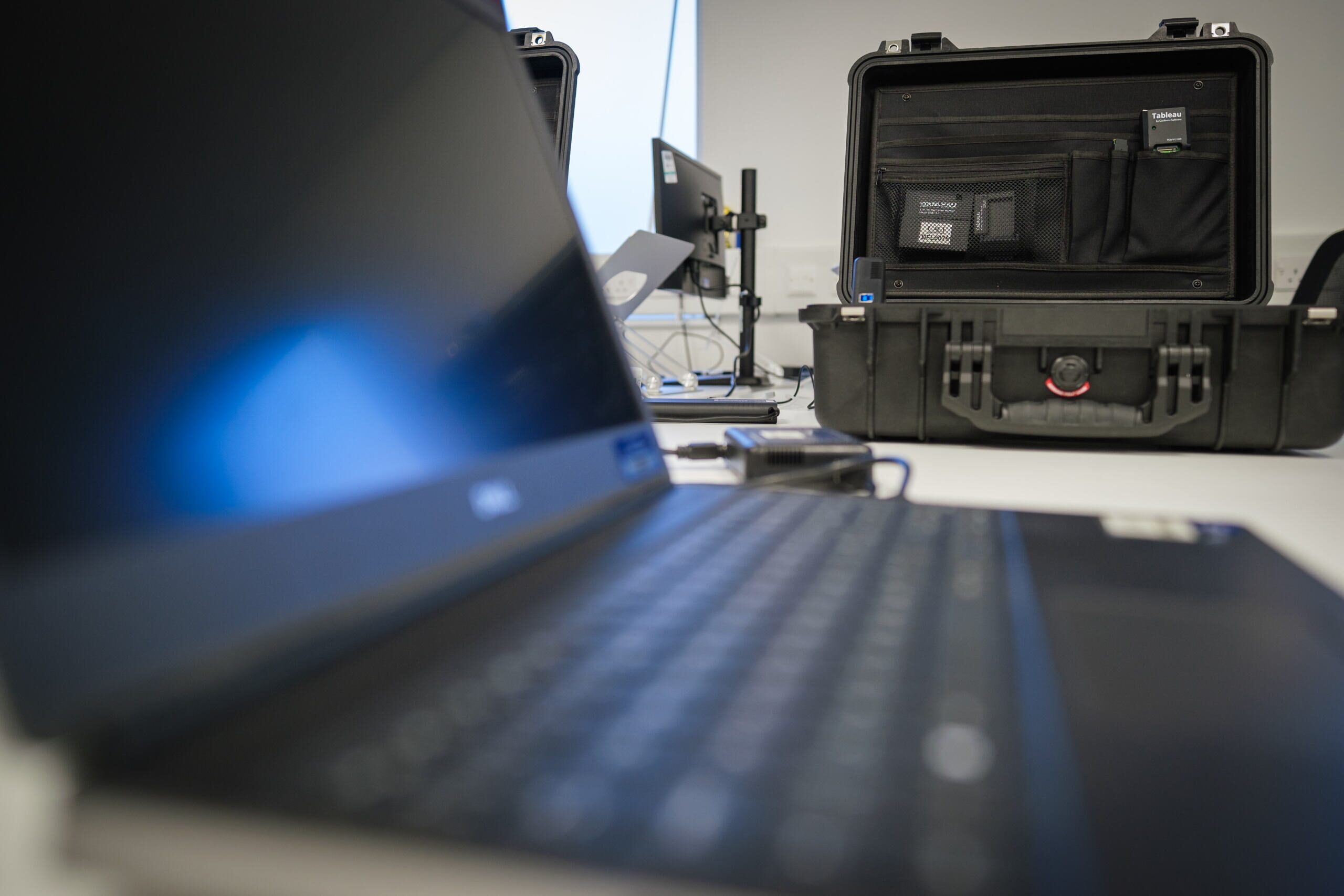
Capture and preservation of data from computers and digital storage devices HDDs, SSDs, M.2 memory devices, memory cards and USB flash devices – Using FTK Imager, EnCase Imager and Tableau T356789iu.
Capture, preservation, processing and analysis of data from Mobile Devices, SIM cards and Memory Cards – Using Cellebrite 4PC, Cellebrite Physical Analyser, MSAB XRY, MSAB XAMN and Magnet Axiom.
CACI Ltd has also been recommended for accreditation to ISO/IEC 17043:2023. This recommendation is for proficiency testing schemes relating to the acquisition, processing and analysis of computer and mobile devices.
In addition, CACI’s Digital Forensics Lab holds certification from British Standards Institute (BSI) to ISO 27001 for the provision of Digital Forensic Science Services.
To learn more about our Digital Forensic Proficiency schemes or to book a demonstration, contact us today.
CACI Earns Coveted UKAS Accreditation for ISO/IEC 17025:2017, Strengthening Commitment to UK Law Enforcement
This achievement is particularly significant in light of the Forensic Science Regulator’s Act 2021, which came into effect on 2nd October. The Act introduced a statutory requirement of compliance to the new ‘Code’ for Forensic Science Activities provided to the UK Criminal Justice System. The new ‘Code’ is crucial for ensuring the admissibility of robustness of evidence, and includes the requirement for accreditation to ISO/IEC 17025:2017 for the digital forensic science activities provided by CACI from within their laboratory.
CACI’s Digital Forensics laboratory, situated in Northallerton, North Yorkshire, has been designed to match the capabilities of law enforcement digital forensic laboratories. This enables CACI to integrate seamlessly with their clients, minimising the impact of outsourcing digital forensic investigation services and maximising the benefit for the client. The team behind the laboratory consists of highly skilled professionals with extensive experience in the digital forensics field within Law Enforcement investigations.
Richard Cockerill, Operations Director of CACI’s Digital Forensics Laboratory, expressed his team’s excitement about the accreditation, highlighting their dedication and expertise. He further emphasised CACI’s ability to deliver high-quality digital forensic investigation services to the UK criminal justice system.
“CACI looks forward to expanding its support for both existing and new law enforcement clients. This achievement highlights the dedication and expertise of our digital forensics team. With our robust capabilities and specialist expertise, CACI is well-positioned to deliver high-quality digital forensic investigation services to the UK criminal justice system and related industries. This accreditation from UKAS is a significant milestone in our development and ongoing commitment to excellence.”
Having secured ISO/IEC 17025:2017 accreditation, CACI is now actively expanding its support for both existing and new law enforcement clients.
UKAS Recommends CACI’s Digital Forensics Lab for ISO 17043 Accreditation
Dominic Carpenter
CACI’s new Digital Forensics Laboratory has successfully passed its initial assessment and been recommended for ISO 17043 by UKAS for its Digital Forensic Proficiency Test schemes. This recent recommendation from UKAS follows closely after CACI’s ISO 17025 recommendation, achieved in September, and coincides with the Forensic Science Regulator’s Statutory Code of Practice, effective since Monday 2nd October.
CACI has been recommended by UKAS for accreditation to the following scope:
ISO/IEC 17043:2023
CACI’s current schemes are as follows;
Mobile-Based Device – Acquisition, Processing and Analysis
Computer-Based devices – Acquisition
Computer- Based Devices – Processing and Analysis
All schemes are tailored to meet the criteria for accredited digital forensics (DF) laboratories operating in law enforcement. Participation rates during proficiency testing cycles have been consistently increasing.
This further evidences CACI’s commitment to supporting UK Law Enforcement with digital forensics and FSR Code compliance. The laboratory, based in Northallerton, was launched on 9th June and has been created to mirror the capabilities of law enforcement digital forensic laboratories, adhering to industry standards and employing the same tools and processes.
It took an 18-month process for the laboratory to be created, but it is now housed with industry-leading individuals with years of expertise across the digital forensics space.
The formation of the team was heavily influenced by the already-established counterpart in the United States, which has been providing exceptional service for the past decade, shown through various accomplishments and significant recognition.
CACI’s DF Laboratory’s Operations Director, Richard Cockerill, had this to say:
“We are thrilled to announce that CACI has received a recommendation from UKAS for ISO 17043 accreditation for our Digital Forensic Proficiency Test schemes. This achievement highlights the dedication and expertise of our digital forensics team. This accreditation significantly strengthens our ability to support Law Enforcement, particularly with the Forensic Science Regulator’s Statutory Code now in effect. With our robust capabilities and specialised expertise, CACI is well-positioned to deliver high-quality digital forensic investigation services to the UK criminal justice system. This recommendation from UKAS marks a significant milestone in our ongoing commitment to excellence within the UK.”
CACI are looking forward to embrace the array of opportunities expected for our digital forensics team following the confirmation of this recommendation. Furthermore, we look forward to the continued progression we’ve seen since the formation of the laboratory.
CACI Digital Forensics Laboratory recommended for ISO 17025 accreditation by UKAS
Dylan Griffiths
CACI’s new Digital Forensics Laboratory has successfully passed its initial assessment and been recommended for ISO 17025 by UKAS. This coincides with the Forensic Science Regulator’s Statutory Code of Practice which took effect on Monday 2 October.
CACI has been recommended by UKAS for accreditation to the following scope:
ISO/IEC 17025:2017 with compliance to ILAC G19:06/2022 and Forensic Science Regulator Code of Practice Version 1
Scope:
Capture and preservation of data from computers and digital storage devices – HDDs, SSDs, M.2 memory devices, memory cards and USB flash devices – Using FTK Imager, EnCase Imager and Tableau T356789iu
Capture, preservation, processing and analysis of data from Mobile Devices, SIM cards and Memory Cards – Using Cellebrite 4PC, Cellebrite Physical Analyser, MSAB XRY, MSAB XAMN and Magnet Axiom
The laboratory, based in Northallerton, was launched on 9th June and has been created to mirror the capabilities of law enforcement digital forensic laboratories, adhering to industry standards and employing the same tools and processes.
It took an 18-month process for the laboratory to be created, but it is now housed with industry-leading individuals with years of expertise across the Digital Forensics space.
The formation of the team was heavily influenced by the already-established counterpart in the United States, which has been providing exceptional service for the past decade, shown through various accomplishments and significant recognition.
The DF Laboratory’s Operations Director, Richard Cockerill, had this to say:
“This is a fantastic achievement for CACI and is testament to the hard work and experience of our Digital Forensics team over this past year. Accreditation enables CACI to increase its support Law Enforcement which is particularly important now that the Forensic Science Regulator’s Statutory Code is in effect. CACI have the capacity and expertise to provide high quality digital forensic investigation services to the UK criminal justice system, and this recommendation from UKAS is a significant milestone in our journey.”
CACI are now looking forward to the many opportunities that will open up for the Digital Forensics team following this recommendation being confirmed, as well as the continued progression we’ve seen since the formation of the laboratory.
CACI officially launches its new digital forensics laboratory in the North of England
Harsh Tandon
CACI Ltd, a leading UK data and technology company, was proud to hold the official launch of its new Northallerton based digital forensic laboratory on the 9th of June. The event was well attended throughout the day, with representation from almost all police forces covering the local North East region, as well as the local Mayor. The facility builds on the success of its parent company CACI Inc.’s* accredited facility in Virginia, United States, the laboratory will cater to UK law enforcement organisations by providing specialist digital forensics services.
Over the last 18 months, CACI’s highly skilled team of digital forensic professionals has worked diligently to establish the UK laboratory, drawing from the experience and accomplishments of its counterpart in the United States, which has been providing exceptional service for the past decade.
Richard Cockerill, Operations Director of CACI Ltd’s digital forensics laboratory, highlighted the exponential rise in the use of digital devices worldwide over the past decade. “Over 90% of crimes involve a digital component, which has resulted in unprecedented demand placed on police digital forensics units (DFUs) supporting criminal investigations,” he explained
CACI’s digital forensic laboratory has been meticulously designed to mirror the capabilities of law enforcement digital forensic laboratories, adhering to industry standards and employing the same tools and processes. This facility offers police DFUs additional resources and capacity to meet their growing operational demands.
The digital forensic team at CACI has also developed a suite of support services to assist police DFUs with ISO 17025 accreditation while ensuring compliance with the codes of practise set by the Forensic Science Regulator (FSR Codes). Since the beginning of this year, they have been providing a digital forensics proficiency testing service, with numerous accredited digital forensic laboratories having already participated and more booked in for future cycles. This service will undergo assessment by UKAS later this year, with the aim of receiving ISO/IEC 17043:2023 accreditation.
CACI’s digital forensic laboratory is fully operational and works in compliance with a quality management system designed to meet the requirements of ISO/IEC 17025:2017, FSR Codes and ILAC G19, as required for evidence used in UK criminal proceedings, with UKAS assessment scheduled in the next few months.
*CACI Inc. is a $6.2-billion American-based technology company.
Legacy application interoperability & integration in the Police Force
Sagar Limbu
In this Article
For those watching what seems like a proliferation of Police dramas on television, you might be impressed by how easily data is shared between partner organisations: Officers tap into numerous IT systems to retrieve vital information that is key to solving their case.
Sadly, as you would probably expect, the reality is somewhat different.
Data sharing
The Digital Government report from July 2019 highlighted that data sharing is key to ensuring that digital Government can be transformative. It enables departments to work together to produce efficient public services that work for the citizen, thus improving the citizen-Government relationship.
The new National Data Strategy also recognises the importance data has to play in enhancing economic competitiveness and productivity across the UK economy, through new data enabled business models, and the adoption of data driven processes.
Data sharing has long been discussed within Policing. One of the key recommendations of the Bichard child protection inquiry in 2003 was that all forces across the UK should improve how they collect, store and share data.
In 2005 the Information Systems Strategy for the Police Service (ISS4PS) highlighted “The importance of a national approach to information sharing is now uppermost in current strategy for policing as reflected in the National Policing Plan.”
The following year the National Policing Improvement Agency (NPIA) Guidance on the management of Police Information talked of effective Policing relying on the Police Service to communicate and share information with other forces and partner agencies.
Fast forward 15 years and the National Policing Digital Strategy 2020-30 prioritises the need to deepen collaboration with public sector agencies to unlock effectiveness, by developing ‘fluid’ data and insight exchange, within appropriate ethical and legal boundaries.
Collaboration is necessity
No-one can fail to notice the masses of data that is being created today and the fact that it is growing at an unprecedented rate.
Over the last 15 years, Policing has also started to see an explosion in the data that it holds. Allied to this is a growing pressure for them to start to utilise and share this data to their advantage.
Citizens are starting to demand and expect more from the Police service. With resources more stretched than ever, Police are now having to look at new ways of working – becoming smarter in utilizing the information they have available to them and sharing it to obtain greater insight.
No-one can accurately predict how the next 15 years will unfold, but as digital trends rapidly evolve across all areas of our lives, the abundance of data and the vast array of sources from which it emanates will continue to grow.
For a long time, public sector bodies have been locked into the mentality that they need to be autonomous in their operation, harbouring their own data and with the ideas of collaboration and sharing being forced rather than instinctive.
More recently though, policing as with all public sector, has seen austerity and the ever increasing need to save money as a driver towards more collaboration and data sharing.
A by-product of this is the ability to provide a better-quality service and a more rewarding citizen experience. Agencies are provided with a more holistic view of the individuals they are dealing with and their circumstances, allowing them to make better informed decisions.
Given this win, win scenario, it seems like a no-brainer, doesn’t it?
Why’s taking too long?
If the idea of collaboration and sharing of data is clearly beneficial on a number of levels, why have we been discussing it for so long without taking any action?
The biggest obstacle to collaboration and data sharing is arguably a wealth of stand-alone, legacy applications that exist within Police estates.
“Legacy systems are invariably built on outdated architectures with high maintenance costs, inherent inflexibility, redundant features, lack of connectivity and low efficiency. Complex application and process logic is often hard-coded and undocumented.”
Gartner Oct. 2019
“Legacy systems are a significant barrier to effective Government transformation and digitisation.”
Digital Government report, July 2019
Given the autonomous mentality that previously existed, Police applications were never built with collaboration in mind.
This means that these legacy systems don’t easily provide the ability to interact and share their data with other applications – they are siloed, with the data being accessible only by the application to which it relates.
All is not lost however. There are numerous different approaches we can use to help create interoperability and integration for your legacy applications:
Rehost: redeploy the application component to other infrastructure (physical, virtual or cloud) without modifying its code, features or functions. This allows significant, short-term technology benefits without altering the application code base. Benefits of migrating to the cloud include: Improved application resilience; Disaster Recovery; Scalability; Accessibility.
Re-platform: migrate to a new runtime platform, making minimal changes to the code, but not the code structure, features or functions. This enables the application to run on modern technology framework while limiting the requirement for a major development project.
Refactor: restructure and optimize the existing code (although not its external behaviour) to enable data sharing and improve non-functional attributes. Refactoring focuses on breaking up the legacy code base into smaller manageable modules allowing consistent improvements to the application through small, iterative release cycles.
Re-architect: materially alter the code to shift it to a new application architecture and exploit new and better capabilities. This will leverage and extend the application features while introducing new integration concepts to promote data sharing and deduplication. Where appropriate an Application Programming Interface (API) would be developed to allow data sharing between application/modules over a secure HTTPS protocol.
Rebuild: redesign or rewrite the application component from scratch while preserving its scope and specifications. When deciding to rebuild an application, consideration should be taken to ensure the architecture is designed in a modular, scalable fashion promoting data sharing and future integrations using a combination of APIs and messaging architecture.
Replace: eliminate the former application component altogether and replace it, considering new requirements and needs at the same time.
To find out more about how we could help your organisation unlock integration and interoperability, take a look at our Police page.
Overcoming barriers to digital transformation in the police force
Digital transformation has the potential to touch every part of the policing process, changing the way police work, harness data, exploit available technologies, collaborate with partner organisations and organise themselves. Each of these issues has wide reaching consequences, both for the industry as a whole and for individual officers. A responsible technology roadmap must therefore focus on the capabilities, processes and approaches that can maximise efficiency and learning across the whole policing system while meeting the specific needs of individual contexts.
Here we examine the key challenges faced when implementing new technology, as well as the ways forces can minimise risk and maximise ROI.
In the police force, this leads to issues such as:
Legacy technology limitations
Historically siloed procurement processes lead to a range of embedded tools that are no longer fit for purpose. Even systems that may have once been cutting-edge can be rendered unsuitable by a change in context, or rapid advances in technology. This leads to an inefficient patchwork of tools that don’t connect with one another, reducing efficiency and increasing spend, especially if locked-in to existing suppliers for long term contracts.
Clashing organisational structures
Structurally, the pace of change has raced ahead of the protocols that govern its implementation. This can be seen not only in the slow pace of procurement processes that can end up delivering outdated solutions, but also in the way those solutions are conceptualised. For example, there is still much to be decided on the appropriate use of how police forces use automation tools, such as artificial intelligence (AI), machine learning and the internet of things (IoT) in their role. In the absence of a clear path forward, it’s hard to take the next step.
Underinvestment in key areas
In an era of heavy budget scrutiny, public organisations of all kinds are wary of the risk of expenditure on systems that do not deliver value. While the public may be most interested in the number of frontline officers deployed, the less glamorous side of the policing – back-end infrastructure, data and communications – receive less attention, despite their crucial role in preventing crime.
Inconsistent understanding of data
The volume of data now available to businesses, consumers and public institutions is both huge and growing. While there have been promising results in steps towards using big data in policing, the real value can only be realised when aligned with a broader strategy that can source, structure, analyse and leverage data in a consistent way across different forces, platforms and contexts.
Creating a tailored transformation strategy
take into account that meeting these issues will not be a one-size-fits-all solution. The precise form and impact varies from force to force, depending on a range of factors. Moving forward requires a targeted approach that takes into account the unique circumstances of each force and deploys relevant strategies. A transformation plan must therefore include:
Awareness of the local challenges in policing and needs of the public
An assessment of the legacy systems in place
Plans to leverage available skills, personnel and budget
Appropriate timelines for change
A definition of success and project ROI
A key element of digital transformation for police forces will be appropriate collaboration with technology and change management providers. Given the huge range of products now available, there is scope to create unique technology stacks for individual forces that nevertheless connect to and enhance the capabilities of the wider police network.
By working with an experienced provider, you can create a transformation strategy that meets your unique challenges with a combination of relevant tools and process management. Outside advisors can also help streamline the planning and execution journey by offering a strategic view as to how operational processes can change, or be adapted, to make the most of emerging technologies.
Accelerating the digital journey
With the pace of technological change showing no signs of slowing, the challenges and opportunities that digital disruption presents to policing have the potential to become defining issues for the service.
To maintain its leading position in world policing and continue to operate as an effective public service, the police force in the UK must find a way to move past the challenges associated with digital transformation and embrace the opportunities available.
CACI has extensive experience working with large scale transformation in major industries, using agile, iterative approaches to test processes, new software and collaboration strategies to deliver tangible value quickly and cost-effectively.
Maximising efficiency in policing through digital technology
Dominic Carpenter
In this Article
Policing in the UK sits at a turning point, facing a rapidly evolving world of criminal activity that demands a new approach while also contending with tight budgets and highly scrutinised use of resources. To maintain its position as a world leader in policing, it’s essential for police forces to maximise the utility of available resources, be they financial, technological or human.
The challenge for many is that the infrastructure behind traditional policing methods has failed to keep pace with rapid advances in digital technology, driven by the private sector and enthusiastically embraced by the public, businesses and criminals alike.
In order to stay relevant, forces must be able to leverage these same capabilities, both to stay abreast of criminal activity, but also to improve efficiency and effectiveness in their own internal operations and focus resources where they can make the most difference.
In order to provide the service levels that the public expect and deserve, policing methods must be closely aligned with the challenges they are attempting to solve. In 2021, that means embracing and optimising digital systems.
Digital technology is now deeply embedded within nearly all areas of our lives, and crime is no exception. It’s estimated that more than 90% of reported crime now has a digital element, whether that’s in enabling threats, increasing their complexity or generating digital evidence through devices, applications, social media or the internet.
Alongside this evolution has come an explosion in the volume, complexity and availability of data. In 2020, people created 1.7 MB of data every second. This growth in information creates an opportunity for forces to analyse datasets to discover trends, use artificial intelligence to quickly support decision making and share data instantly. However, when it comes to data, many teams are working with outdated methods.
Risks of connecting the dots manually
indicates that a large number of forces are still relying on manual processes to manage, transfer and analyse data. 66% of respondents acknowledged that data-management was the most time-consuming aspect of the investigation process including:
Driving around to collect CCTV video from homes and businesses
Copying and burning CDs and DVDs
Not only does this increase the manpower required to manage an investigation from end to end, it also slows down the evidence-gathering process. Across the country, this leads to thousands of hours of time wasted on manual processes that could be automated, taking officers away from other, more valuable work.
The digital systems that are in place can also be a limitation in themselves. Procurement processes can be long and laborious, resulting in a patchwork of technology that is out of date by the time it’s delivered, and that doesn’t integrate with other systems. This leads again to manual processes plugging the gaps, whether by physical transfer of information or manual rekeying of data.
By prioritising connectivity and data currency, police forces can enable a more seamless information journey that acknowledges the reality of modern challenges while improving utilisation of existing resources.
An efficient model of digital policing
While forces and national programmes have already been delivering change through a number of individual programmes designed to improve specific processes and outcomes, an efficient solution must take a holistic approach.
As collaboration between police and other government services becomes more important, connection needs to be built into the infrastructure of policing. We suggest three key ways that departments can approach digital transformation to target efficiency gains and improved results.
Maximising cloud connectivity
In order to make relevant data as accurate, available and shareable as possible, it’s essential to prioritise cloud networking. By moving away from a hard-copy based system of discs and hard drives, teams can minimise officer involvement with data transfers and centralise information with tools such as a digital evidence management system (DEMS).
Forces should aim to adopt a “cloud first” principle for applications and data, where economical, interrogating proposed solutions for ease of use, connectivity and security. This must go hand in hand with network upgrades and security. Cloud connectivity increases the data demands on networks, with more information moving digitally.
This may require investing in specific skill sets for network maintenance and management in order to ensure that the move to cloud is not barred by prohibitive costs or poor connectivity.
Implement targeted automation solutions
As well as making data more available for teams and sharing, cloud migration also makes digital data accessible between applications and interfaces. This unlocks the possibility to automate many of the manual processes that reduce efficiency and increase lead time for key activities.
Not only does this save time and resources, but automation also reduces the chance for human error when it comes to lost files, corrupted data or delays. By leveraging tools such as automated data-sharing mechanisms and data analysis tools, forces can access the information they need in a streamlined and efficient manner which avoids duplication of efforts.
Bringing legacy systems into the now
Adding in new digital capabilities need not be a complete ‘rip and replace’ project, removing all existing digital infrastructure. By combining existing legacy systems with new connections, forces can drive value sooner while targeting progressive improvement.
For legacy platforms that are not directly integrated with each other, API-based connectivity layers can enable mediated transfer of information into other front-end applications or data layers. This shortens the time to ROI while also building foundations for future deeper integrations of systems.
Embracing digital efficiency
In a rapidly digitising world, police forces have an opportunity to take control of the way they approach and engage with the new data revolution. By deploying connected technologies and sharing insights and functionality directly through online channels, officers can work more efficiently to target the root causes of criminal activity and offer better support to communities.
CACI is proud to be working with police forces to help develop their vision through a step change in their implementation of key technologies. By working together both tactically and strategically, we can help pinpoint transformation opportunities, identify bottlenecks and improve performance.
You can also visit our policing page to find out more information.
Policing’s future is in the clouds
Sagar Limbu
In this Article
What is the cloud?
For the uninitiated reading this, what is the cloud?
Well in its simplest form, the cloud refers to a remote Data Centre, commonly owned and operated by a 3rd party, that is used to host applications and store data that a Force would have previously provided via their own on-premise Data Centre facility.
The cloud is commonly accessed via the internet, meaning any device that has some form of internet connection can access the applications and data that reside there. That device could be a desktop in the station, but it could just as easily be a remote device such as a laptop, mobile or tablet being used out in the field.
Given access is via the internet it also means that it makes it far easier to share anything that’s stored in the cloud with other entities should you wish to do so. Ideal if you want to work collaboratively with other agencies and share data.
Another added benefit is that the cloud hosting provider takes on the responsibility for maintaining the infrastructure on which your data and applications are stored, as well as being responsible for the environment in which it resides.
Cloud services are typically subscription based, which shifts the commercial model from a capital one, where the Force has a large capital outlay relating to procuring and maintaining their own in-house IT provision, to a revenue-based, ‘pay as you go’ model allowing for easier budgeting with no large initial outlay.
Cloud technology also provides the ability to ramp services up and down as needed, meaning the Force only pays for what it needs, typically with a lower overall total cost of ownership.
Cloud First policy
Back in 2013 the Government introduced its “Cloud First” policy. Within it was a recommendation to all Public sector organisations that, they should prioritise the use of cloud when considering new IT solutions. The inference being the public cloud rather than a community, hybrid or private deployment model.
Key to this recommendation was that “Departments should always source a cloud provider that fits their needs, rather than selecting a provider based on recommendation.” I’ll come back to this point later.
The Government stated that, “By exploiting innovations in cloud computing we will transform the public sector ICT estate into one that is agile, cost-effective and environmentally sustainable.”
The benefits of having a cloud-based deployment were clearly evidenced in 2017 following the Manchester terrorist bombing. In the aftermath of the incident, the cloud based HOLMES2 (Home Office Large Major Enquiry System) was used to set up a Casualty Bureau, to support with missing persons, the identification of individuals and logging of evidence. Thanks to being hosted in the cloud, within two hours of the attack, 27 forces were able to utilise the casualty bureau to support one another with mutual aid.
Another cloud native system that will undoubtedly benefit all forces is the much criticised and highly controversial LEDS (Law Enforcement Data Service). LEDS is the Home Office’s new “super-database” for Police. It combines the PNC (Police National Computer) and the PND (Police National Database) into one data source. Although massively over budget and behind schedule, no one doubts the benefits it will bring to Policing. Given the amalgamation of the systems there will be reductions in running costs by supporting a single, far more efficient system.
Police will have access to a much broader set of information, which should help in speeding up the identification of persons of interest. LEDS is to be hosted on the commodity cloud service within Amazon Web Services (AWS). This will widen the scope beyond policing in terms of organisations able to obtain access, such as the DVLA, Financial Conduct Authority, Highways England, Competition and Markets Authority and the Royal Mail.
Arguably, the cloud-based technology that has had the biggest positive impact of late is Microsoft’s 365 Productivity Services suite, being rolled out to Forces as part of the National Enablement Programme. The national lockdown that was imposed in response to trying to combat the Covid 19 pandemic, added an additional level of complexity to Policing.
Whilst most things ground to a halt, criminal activity continued and so did the need to police it. By using the collaboration tools that are offered as part of the productivity suite, Forces were able to continue to operate using a virtual environment, allowing employees to come together whatever and wherever their location.
Given the exhortations of the Government and the evidential benefits of adopting cloud technology, does that mean all Forces have rushed to go ‘all-in’ pushing all their Applications and data into the cloud in haste?
The short answer is no. Despite the numerous benefits to adopting a cloud first approach, as recently as 2 years ago, reports suggested that as many as 75% of all Forces still accessed and managed their data and applications on premise. So, the big question is why?
Barriers to adoption: security concerns
Understandably, Police by the very nature of the job they do are quite anxious when it comes to re-housing their applications and data. A good percentage of the work is sensitive and needs guaranteed security. As you would imagine, most forces were initially very sceptical that the cloud could offer the same level of security as that provided in their own on-premise data centres. Surely no-one would be as concerned about the security of Police IT than the Police themselves.
When we talk about security in this instance, it usually relates to the need to ensure that everything belonging to the force is protected from a potential data security breach. When you have been responsible for security for so long it is hard to share that responsibility with someone else and have the confidence that they will look after things as well as you do. It is also unnerving when your security is no longer fully reliant on the tangible devices sitting in your data centre, that you can see and touch with a reassurance that everything is ticking along as it should be.
In a traditional on-premise solution, IT teams must manage and maintain security at every single location and for every single application. When it comes to Public Cloud, providers don’t have visibility of where or what the ultimate endpoint is, therefore all security has to be centralised and unified, able to cater for all possibilities. This unified security approach means you may end up with access to more security than you currently have employed on premise.
Let’s just for a moment take a look at cloud security:
Security is now a shared responsibility with the cloud vendor, meaning there is less of a burden on your IT teams and your finances.
Updates and patches no longer have to be resourced and scheduled in by the IT team, instead being applied in a timely fashion.
Cloud security is highly automated, meaning a reduced need for human intervention and less opportunity for errors.
As security is centralised there are less boundaries in relation to possible end points.
Cloud security may offer more specialised and robust options that would probably otherwise be unavailable due to cost.
Although public cloud involves trust of a 3rd party. They are generally experts in their field and are focussed purely on security and nothing else.
Cloud providers are now compliant with necessary regulation, meaning you can rest assured they are using best practices.
Over the last few years billions of pounds have been invested by Public cloud vendors to provide efficient data security. So much so, that cloud security arguably provides better protection than that offered by a lot of on-premise facilities.
Most of the major vendors are compliant with the Home Office’s National Police Information Risk Management Team (NPIRT) requirements, meaning cloud services can now support Police Forces across the UK who require Police-Assured Secure Facilities (PASF) to process and store their data in the cloud.
A big indicator of shifting attitudes around security, is the recent decision by the Defence Digital Service (DDS), a new group in the Ministry of Defence (MOD), to shift its data for its Readiness Reporting and Deployability Discovery (R2-D2) project to a public cloud.
Phil Jones from ISS (MOD’s Information Systems & Services) stated that Public Cloud is being used by several operations and projects within the MOD to identify how new services and capabilities can be delivered to Defence. Teams are able to access accounts to the Public Cloud offerings provided by Amazon Web Services (AWS) and Microsoft Azure – this provides teams with freedom to evolve their own Services that take advantage of industry leading capabilities.
Barriers to adoption: culture
Culture was cited as being another barrier to adoption. Historically, Forces have been quite parochial in their nature. Very much with a sense of, “This is how we’ve always done things!” or “We’ll wait and watch what everyone else does first before we decide.” This mentality has left forces lagging behind the criminals who they are trying to outwit (Who conversely, have exploited this new technology in advanced and innovative ways, making their criminal activities far more complex and difficult to untangle).
However, police culture is changing thanks to the everyday use of cloud in our personal lives. Barely a day goes by where we don’t perform some kind of interaction with cloud-based technology, passing data back and forth between applications and allowing us to do things on the move using our mobile devices, such as ordering food, making appointments and booking holidays, remember them?! We even trust the cloud to store our most precious memories in the form of photos and videos.
So, if security concerns have now been addressed and cultural views are changing, then what else is slowing mass adoption?
For those of you that read my last blog, you’ll already know the answer. However, for those that didn’t, go and read it! But in the meantime, the answer relates to the fact that a lot of forces maintain a large number of legacy applications, that were never designed for the cloud and don’t easily present themselves to being migrated on to one.
However, the aforementioned blog provides an indication as to how we at CACI can help forces overcome this obstacle.
Which cloud is the best?
If all barriers have been overcome and the decision has been made to adopt the cloud, how do you then go about deciding which cloud is best for you?
Let me try and explain by use of an analogy; when your child reaches a certain age there comes the time you want them to spread their wings and leave the family nest. Do you quickly find the first available cheap premise you can and proceed to move your loved one into it as quickly as possible? Then as each successive child reaches that same stage, find a similar property to the first and do the same again? Maybe you do!
But in all seriousness, most of us would probably seek the services of some form of an Estate or Letting Agent, someone with full knowledge of what’s available in the market that best suits your little treasure’s wants and needs. Relying on the Agent to advise and suggest viable options, before carefully choosing the best property available to them.
Well a similar approach should be applied when adopting a cloud strategy. Do you find the first cheap, hosted environment available and proceed to throw all your applications and data into it? Again, maybe you do, and I know some have to their regret.
But the smart option is to seek the services of an experienced, qualified cloud migration partner, someone who has thorough knowledge of the market and an ability to provide the best advice on the optimum solution for your organisation. A partner that will consider your differing workloads and what you need to achieve and design a strategy around a perfect hybrid of available cloud resource.
Here, now and the future
So with the many benefits the cloud brings: accessibility, affordability, removal of a maintenance burden, better levels of security, increased speed of deployment and rapid scalability, as well as the Government pushing its ‘Cloud First’ strategy, is this the end for on-premise data centres?
Gartner predicts that by 2025, 80% of enterprises will have shut down their traditional data centres, versus 10% today. But, is it as clear cut as that?
Traditionally when new applications were requested by the force, IT departments would consider how they could deploy the application using their in-house architecture. This strategy has worked well for many years, whereby the goal was to deliver the application to the Force’s own end users.
But as the workforce has now become more agile and the need for collaboration with other agencies grows, it drives the need to change the strategy and ask, ‘how can we deploy this so that we can easily access it from anywhere and share the information stored with others if we need to?’. Decisions now need to be less architecture driven and more about the needs for the services that are being delivered.
Cloud doesn’t have to be an all or nothing proposition – don’t let the one size fits all message fool you. Just because someone recommends a particular cloud service it doesn’t necessarily mean it is suitable for your particular workload.
Every Public cloud doesn’t fit every IT function. Planning around objectives and consideration of things like low latency and high bandwidth traffic needs to take place when designing a cloud migration strategy. Hence the need for an experienced, qualified partner who will provide a comprehensive, overall assessment before further engaging with your team on creation of a mobilisation and migration plan.
Cloud computing is no longer the novel concept it once was, it is a well-established, proven mainstream technology with many benefits and as operating models shift and demands increase, Policing should recognise cloud as a more effective method of delivering applications, software and data to those that need it.
It’s now highly regarded as inevitable that in time Gartner’s prediction will come to pass, but whether it is optimistic to think that it will occur within the next 4 years remains to be seen.
The importance of scheduling prison officers across the UK prison system
Miles Reucroft
In this Article
Scheduling in prisons is vital across the entire infrastructure. Scheduling officers to rotas, scheduling inmates to activities and then monitoring and reporting on all activities opens a whole new level of insight. At present, much of the scheduling in the UK prison system is a box ticking exercise based on availability. But what if it could be more than that?
Assigning staff and inmates to jobs and activities is only one side of the coin. The other is data analysis and understanding. Has the best use of an officer’s skills and experience been made? Are prisoners involved in suitable activities? What are the outcomes of the decisions made?
This blog takes a closer look at the benefits of scheduling staff and prisoners across the prison system. How can having a central system, offering a bird’s eye view of the entire network, work to the benefit of the system? How can it underpin an improvement in outcomes for everyone?
Prison officers
Fundamental to the running of any prison are the staff who work there. Understanding the skills and experience of the prison officer workforce is the first step. Having a holistic view of the officers in a single prison, as well as the wider prison network, instantly provides a view of the entire workforce.
Being able to factor in the skills and experience of a prison officer instantly means that schedulers and administrative staff can assign tasks not only quickly, but more appropriately. Randomly assigning officers to tasks within a prison fails to best utilise their skills and experiences. Different prisoner profiles require different approaches. Considering an officer’s preferences when assigning them to jobs is likely to improve morale, too. If an officer has worked closely with certain profiles, e.g. offenders struggling with substance abuse, and has experienced success in that area, it makes sense to utilise those skills and that experience appropriately.
According to statistics from Statista, the number of prison officers working in England and Wales has fallen by 3,000 since 2010. This means that it is crucial that prison officers are appropriately assigned to role. Guesswork leads to mistakes and disillusionment.
It is also an issue which the Ministry of Justice is acutely aware of. In its December 2021 white paper, Prisons Strategy White Paper, the MoJ outlines its intention to boost prison officer numbers by some 5000 by the mid-2020s. Retention is another key aspect of the MoJ’s staffing intentions, to tackle a leaving rate of 11.1% in the year preceding 30 September 2021. “Enhancing professional skills: improved training, supervision and qualifications,” is central to this.
Technology can help. Not only can it instantly match skills and experience to available roles, it can also inform the training needs of the prison guards, thereby enhancing professional skills. Mandatory ongoing training is a prerequisite, but what about expanding training management efforts to open new skills and experiences to the workforce? This has the twin advantages of increasing the skills available across the prison, whilst also offering career enhancing opportunities to staff. A deeper pool of resources across your existing workforce is useful in times of strain, something we’ve seen during the Covid pandemic.
This also ties in with creating a broader understanding of the prison population. The population is transient by nature in certain prisons. Having oversight of the profile of prisoner in the facility enables better provision of resources to their needs. For example, matching prison officers with experience of dealing with and helping inmates with substance addiction.
Prison inmates
As the focus of any prison, understanding the needs of each prisoner helps to improve outcomes for them during their sentence. What makes for a good outcome? Hopefully a successful rehabilitation of the offender. Reoffending costs some £18bn.
Management and scheduling of prison activities is central to their success. The need for demand modelling is also clear. What profile of prisoner is in the prison at a given moment, and what courses and activities are required and how will spaces be allocated? The management of this can be complex. There are staffing resources, rooms and equipment to be factored in. Activities can clash, so what’s the order of priority for a prisoner? Managing waiting lists for activities is another consideration. Then there’s scheduling prisoners, where applicable, to tasks within the prison. You need to consider the jobs they need to carry out, as well as their activities.
All of this requires careful assessment and management. Prison staff resources must be allocated to the necessary background checks and assessments. Then those staff need allocating to the activities as appropriate.
Where this can be further complicated is the need to factor in a prisoner’s attendance at court. Prisoners need to attend their relevant hearings, and, in some cases, they must be escorted to and from court by prison staff. Understanding the impact of having staff off site for such visits must also be factored into the overarching prison schedule.
Prisons must also consider external visitors. From those delivering training courses to lawyers visiting inmates, all activities and their participants need to be carefully monitored and provisioned for. Each prison has its own interpretation of the rules around visits, so a degree of flexibility is required. There is also a need to communicate visiting hours with friends and relatives who wish to visit inmates.
Key ways to improve scheduling ofprison officers
Scheduling within prisons is a complex affair. There are several moving parts and resources can be strained. Having a system in place to provide a holistic view of activities, staff and prisoners can significantly help.
Understanding the skills and experience of your staff, then matching that to the needs and profile of your prisoners can help to drive improved outcomes for all parties. Leaving this to guesswork and random scheduling based solely on availability fails to make the best and most efficient use of available resources.
A central systemenables schedulers and administrative staff to instantly account for each scenario. This removes the guesswork from scheduling and auto-matches the supply of staff and their skills and experiences, to the demands of the prison population.
It also facilitates effective reporting on activities, the prison population and demand forecasting going forward. Rather than being reactive to changes and scheduling, it facilitates a proactive outlook based around supply and demand.
Automation of scheduling in certain circumstances also frees up time to focus on planning. In an environment where time is so often at a premium, this can deliver tangible benefits to the training, activities and management of a prison.
The focus, however, is always on outcomes. Improving outcomes for staff and inmates alike results in a more efficient – and more effective – prison.