

Solutions
Managed SIEM services UK
Turn fragmented security logs into reliable, searchable evidence. CACI’s managed SIEM services combine platform engineering with 24/7 security-event analysis, helping you improve detection quality and keep your SIEM healthy, governed and cost-aware across cloud, on-premises and hybrid environments.
Managed SIEM services for reliable security intelligence
CACI turns security telemetry into reliable, searchable evidence. We onboard logs from identity, cloud, endpoints, firewalls, DNS, email, operating systems and critical applications, managing connectors, APIs, timestamps, parsing and schema normalisation.
Our specialists tune correlation rules, thresholds, suppression and enrichment using threat intelligence, asset context and MITRE ATT&CK. This improves alert fidelity while preserving evidence for investigations into account compromise, privilege escalation and anomalous access.
Platform-health monitoring covers ingestion latency, parser failures, rule execution, role-based access, retention tiers and consumption. We help control events-per-second and data-volume costs without weakening agreed detection coverage.

What CACI’s managed SIEM services include

Log-source discovery and onboarding
Prioritisation and integration of security-relevant sources such as identity providers, cloud platforms, endpoints, network controls, operating systems and critical applications. Each source is documented with an owner, collection method, expected event pattern and health check.

Parsing, normalisation and enrichment
Field extraction, schema mapping, time synchronisation and contextual enrichment help turn raw events into consistent data that analysts can search and correlate across technologies.

Detection engineering and tuning
Use-case design, rule creation, threshold tuning, allow-list governance and enrichment improve alert fidelity. Detection coverage can be mapped to relevant MITRE ATT&CK techniques and reviewed as threats and environments change.

SIEM platform health and administration
Monitoring covers connector status, ingestion latency, failed parsing, rule execution, capacity and authorised configuration changes. Defined service processes keep ownership and escalation clear when data or platform issues arise.

Retention, reporting and access governance
Retention policies, role-based access, dashboards and approved reports support investigation, audit and governance needs. Requirements are agreed against risk, legal obligations and data-cost trade-offs rather than a one-size-fits-all setting.

Consumption and value optimisation
Regular reviews connect data volume and platform cost to active detections and investigation needs. Low-value or duplicated sources can be challenged; high-value gaps can be prioritised for onboarding.
SIEM platforms and integrations
CACI can manage an existing SIEM, support migration or deploy a new service architecture. Final platform scope is agreed during discovery.
Approved SIEM platforms
SIEM products CACI is contracted and accredited to manage include Microsoft Sentinel, Splunk, IBM QRadar, Elastic Security, Google Security Operations or FortiSIEM before publication.
Cloud and security telemetry
Integrate logs from Microsoft Azure, AWS, identity providers, endpoints, firewalls, DNS, email security, operating systems and critical applications through supported connectors, collectors and APIs.
Fortinet Security Fabric
CACI’s published Fortinet partnership supports integrated security, centralised visibility, automation and AI-driven threat detection across hybrid environments. Confirm the specific Fortinet SIEM products included in this service.
How CACI delivers managed SIEM services
CACI’s structured approach ensures you get maximum value from your SIEM platform.

Discover and prioritise
We agree priority threats, critical assets, log sources, investigation needs, retention and platform constraints. The output is a source catalogue, use-case backlog and measurable baseline.

Integrate, baseline and tune
We configure connectors and APIs, normalise fields, validate data quality and baseline event volumes. Detection rules, enrichment and dashboards are then tuned through controlled change.

Operate and improve
We monitor platform health, ingestion, detections, retention and consumption. Reporting highlights failed sources, coverage gaps, noisy content, cost trends and prioritised improvements.

Outcomes delivered by CACI’s managed SIEM services
- More complete coverage of agreed priority log sources
- Fewer low-value or duplicate alerts reaching analysts
- Faster investigations through consistent fields and contextual enrichment
- More predictable ingestion and retention costs
- Clearer audit evidence for platform changes, access and data retention
- A prioritised detection roadmap aligned to relevant threat techniques
Common use cases for managed SIEM services

Improving visibility across hybrid environments
Organisations use managed SIEM services to consolidate security telemetry from cloud, on-premises and SaaS environments into a single platform. Solutions such as Microsoft Sentinel, Splunk and Elastic Security can help security teams investigate activity more efficiently across complex estates.

Preparing for compliance and audit requirements
Managed SIEM services support regulatory and governance requirements through log retention, audit trails, access controls and reporting. Centralised log management can help demonstrate compliance while improving visibility of security events.

Reducing alert noise and improving detection quality
Detection engineering, correlation-rule tuning and threat-intelligence enrichment help reduce low-value alerts and improve analyst focus on genuine threats. This allows organisations to strengthen security analytics without increasing operational overhead.

Supporting teams with limited SIEM expertise
Many organisations use managed SIEM services to gain access to specialist skills for platform administration, source onboarding, detection engineering and service optimisation without expanding internal security teams.
Managed SIEM or managed SOC?
Choose managed SIEM services when your main need is to deploy, administer or optimise the SIEM platform and the security data flowing through it.
Choose managed SOC services when you need an operational team to monitor multiple security tools, triage alerts, investigate incidents, coordinate response and run security operations around the clock.
Many organisations use both, but the outcomes and accountabilities are different.

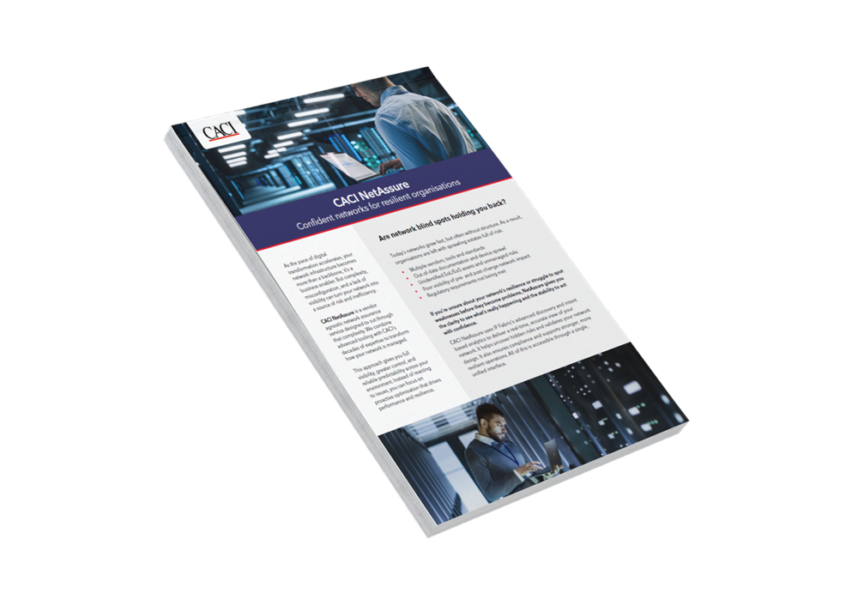
NetAssure data sheet
Gain full visibility and control of your network
What you’ll learn:
- How real‑time network discovery and visualisation uncover hidden risks, misconfigurations and End‑of‑Life assets
- How intent‑based analytics and automated compliance reporting strengthen resilience and regulatory readiness
- How proactive assurance improves change management, reduces incidents and supports future automation
Why CACI for managed SIEM services
CACI combines cyber security expertise with enterprise-grade managed services for reliable SIEM monitoring and threat detection.
Cyber security expertise
UK security specialists experienced in supporting complex and highly regulated environments.
Integrated security services
Technology-agnostic support across leading SIEM platforms, helping organisations maximise existing investments.
Governance and support
Transparent governance, reporting and service reviews that provide visibility of platform health and performance.
Managed service excellence
A focus on detection quality and security outcomes, not simply increasing log volumes.
Flexible delivery
Flexible delivery models to support existing deployments, migrations or new SIEM implementations.
Proactive approach
A continual improvement approach that aligns SIEM capability with evolving threats and business priorities.
There’s more where that came from
Related services
Managed network services
We offer outcome-focused operations and infrastructure lifecycle management, assuring regulatory adherence.
Managed SOC services
Detect and respond to cyber threats with expert managed SOC services.
SD-WAN managed services
Transform enterprise connectivity with intelligent SD-WAN managed services.
Managed Endpoint Detection and Response (EDR)
Strengthen endpoint security with expert managed endpoint detection and response.
Network security
Protect your business with proactive threat detection, compliance support and security by design. We’ll build a future-ready network that keeps you confidently one step ahead.


FAQs
Answers to common questions about managed SIEM services.
Managed SIEM services outsource the deployment, administration and continual optimisation of a Security Information and Event Management platform. The provider manages tasks such as log-source onboarding, parsing, normalisation, correlation rules, detection tuning, retention, dashboards, access and platform health. The objective is reliable security data and useful detections—not simply storing more logs.
Managed SIEM is centred on the SIEM technology and its data pipeline. Managed SOC services are centred on the people, processes and governance used to monitor, triage, investigate and coordinate response across multiple security technologies. A SOC may use a SIEM, but a SIEM alone is not a SOC.
Start with the sources needed to answer priority security and investigation questions. These commonly include identity and authentication, cloud control-plane activity, EDR, firewalls, DNS, email security, operating systems and critical applications. Source selection should reflect risk, asset criticality, detection value, retention needs and cost—not a goal of collecting everything.
Tuning adjusts logic, thresholds, time windows, suppression and contextual enrichment using known benign behaviour and incident feedback. Changes should be documented and tested so noise falls without silently removing valuable detection coverage.
Yes. CACI can design the managed SIEM engagement around your existing platform, a migration or a new deployment. Discovery confirms platform compatibility, licensing responsibilities, access, data residency, retention and transition scope before onboarding begins.
Common cost drivers include data ingestion or events per second, number and complexity of sources, retention, platform licensing, service hours, detection-engineering scope and reporting requirements. A useful proposal separates technology consumption from managed-service effort and states how growth will affect cost.
There is no universal retention period. Retention should reflect investigation needs, legal and regulatory obligations, contractual requirements, data sensitivity and cost. Many organisations use different hot, searchable and archive tiers rather than keeping every source in the most expensive tier.
Useful measures include percentage of priority sources onboarded and healthy, ingestion latency, parser failures, rule precision, duplicate-alert reduction, detection coverage, time to implement approved use cases and consumption against forecast. Metrics should include a baseline and agreed service scope.