

Solutions
Managed SOC services UK
Put a skilled security operations team behind every high-priority alert. CACI’s managed SOC services combine 24/7 monitoring, analyst-led triage, investigation, escalation, threat hunting and continual improvement across your security estate.
Managed SOC services for resilient security operations
CACI combines skilled analysts, defined processes and your security technologies. Signals from SIEM, SOAR, EDR, NDR, identity, cloud security and threat-intelligence platforms are monitored and triaged against agreed severity and business impact.
Analysts validate alerts, correlate activity, investigate affected users and systems, and hunt for tactics, techniques and procedures mapped to MITRE ATT&CK. Case enrichment, shift handovers and SOAR automation improve consistency and reduce noise.
When threats are confirmed, incident-response playbooks, escalation paths and a clear RACI define containment and communication. Governance tracks acknowledgement, investigation, escalation, SLA attainment, case quality and improvement actions.

What CACI’s managed SOC services include
CACI delivers end-to-end Managed SOC services designed to protect enterprise environments, including:

Continuous monitoring and alert triage
Analysts review signals from the technologies in scope—such as SIEM, EDR, identity, cloud and network security—validate context, remove obvious false positives and create prioritised cases using agreed severity criteria.

Investigation and incident qualification
Related evidence is gathered to establish what happened, which identities or assets are affected, how confident the finding is and what action is recommended. Investigation records preserve a clear timeline for handover and review.

Escalation and response coordination
Named contacts, response windows and communications routes are defined before go-live. Confirmed incidents are escalated with the context needed for customer responders, IT teams, crisis leadership or specialist incident-response support to act.

Threat hunting
Hypothesis-led hunts look for relevant attacker behaviours that may not have triggered an alert. Findings feed detection improvements, control recommendations and investigation priorities.

Playbooks and service governance
Scenario playbooks, severity definitions, RACI, service reporting and regular reviews make responsibilities explicit. Lessons from incidents and near misses become tracked improvement actions rather than one-off observations.

Detection and response improvement
Analyst feedback is used to refine detection content, enrichment, triage guidance and automation. Changes are prioritised by risk and reviewed for unintended loss of visibility.
SOC platforms and security integrations
CACI’s managed SOC connects the controls already protecting your organisation, creating one governed workflow for detection, investigation and escalation.
SIEM and SOAR platforms
CACI works with SIEM and SOAR platforms such as Microsoft Sentinel, Splunk, QRadar, Elastic Security, Google Security Operations, Cortex XSOAR or FortiSOAR.
EDR, XDR and endpoint security
Our approved endpoint platforms include Microsoft Defender for Endpoint, CrowdStrike Falcon, SentinelOne Singularity, Palo Alto Cortex XDR, Sophos or Fortinet.
Network, identity and cloud controls
Integrate signals from Fortinet Security Fabric and other approved network controls, identity providers, Microsoft Azure, AWS and SaaS security tools, subject to connector and licensing validation.
How we establish and run your managed SOC service
Our structured approach gives you continuous visibility and control over security operations.
1. Define the operating model
We agree service scope, coverage hours, severity, response authority, regulatory needs, dependencies and success measures, producing a documented operating model and RACI.
2. Connect, test and transition
We integrate security tools and case workflows, then test contacts, escalation routes, playbooks, out-of-hours arrangements and major-incident communications before controlled handover.
3. Operate and improve
Analysts monitor, triage, investigate and escalate. Service reviews cover SLAs, case quality, threat trends, hunt outcomes, coverage gaps and prioritised improvements.
Outcomes you expect from CACI’s managed SOC services
- Consistent analyst coverage across the agreed service window
- Faster acknowledgement and investigation of priority cases
- Clear response ownership and fewer delays caused by approval ambiguity
- Higher-quality escalations with affected assets, evidence and recommended actions
- Reduced repeat noise through analyst-led tuning feedback
- Board- and audit-ready reporting on service performance, risks and improvement actions

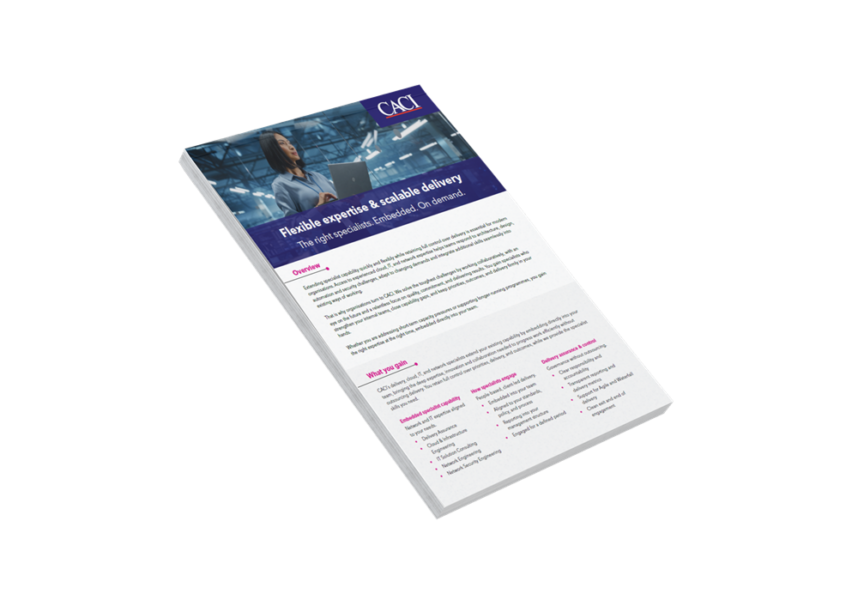
Resource augmentation
Flexible, embedded specialist expertise
What you’ll learn:
- How embedded specialists strengthen internal teams while keeping governance, priorities and outcomes in your control
- The delivery assurance model that supports Agile and Waterfall programmes with transparent reporting and clear accountability
- How flexible engagement and delivery models help you scale confidently across mission‑critical and regulated environments
Common use cases for managed SOC services

Extending security operations beyond business hours
Organisations use managed SOC services to maintain continuous monitoring and incident investigation without the cost and complexity of building a 24/7 in-house Security Operations Centre.

Improving incident response maturity
Managed SOC services help organisations establish structured incident response processes, escalation paths and security governance, enabling faster and more consistent handling of security incidents.

Supporting lean security teams
Security analysts, threat hunters and incident responders can augment existing internal capabilities, helping organisations manage increasing security demands despite skills shortages.

Strengthening detection and threat-hunting capabilities
Managed SOC teams use threat intelligence, detection engineering and frameworks such as MITRE ATT&CK to identify suspicious behaviour and improve visibility of emerging threats.

Managed SOC, managed SIEM or managed EDR?
Choose Managed SOC Services when you need people and processes to run security operations across multiple tools.
Choose managed SIEM services when the priority is engineering and optimising the central log and analytics platform.
Choose managed Endpoint Detection and Response when the priority is continuous endpoint visibility, investigation and host-level containment.
CACI can connect the services, but each solves a different operational problem.
Why organisations trust CACI for SOC services
CACI combines cyber security expertise with enterprise-grade managed services to deliver reliable and scalable SOC capabilities.
Cyber security expertise
Security operations designed around your organisation’s risk profile, assets and operational requirements.
Integrated security services
Technology-agnostic integration across existing security investments.
Reviews and improvement
Regular service reviews focused on operational maturity and measurable improvement.
Managed service excellence
Regular service reviews focused on operational maturity and measurable improvement.
Flexibility provided
Flexible service models that complement existing security teams or provide fully managed coverage.
Clarity and governance
Clear operating procedures, escalation routes and service governance from day one.
There’s more where that came from
Related services
Managed network services
We offer outcome-focused operations and infrastructure lifecycle management, assuring regulatory adherence.
SD-WAN managed services
Transform enterprise connectivity with intelligent SD-WAN managed services.
Managed Endpoint Detection and Response (EDR)
Strengthen endpoint security with expert managed endpoint detection and response.
Managed SIEM services
Strengthen cyber threat detection with expert managed SIEM services.
Network security
Protect your business with proactive threat detection, compliance support and security by design. We’ll build a future-ready network that keeps you confidently one step ahead.


FAQs
Answers to common questions about this service.
A managed Security Operations Centre monitors agreed controls, triages alerts, investigates suspicious activity, escalates confirmed incidents and improves detections and playbooks. CACI’s service scope should state the coverage window, analyst location, platforms, SLAs and which containment actions are pre-authorised.
A managed SOC provides the analysts, processes, governance and case handling needed to run security operations. Managed SIEM focuses on the log platform: source onboarding, parsing, correlation, rules, retention, dashboards and health. The SOC may depend on a SIEM, but it also uses other tools and owns the operational workflow.
The terms overlap and providers use them differently. A managed SOC usually describes the broader security operations capability. MDR normally emphasises active threat detection, investigation and response, often with defined containment authority. Buyers should compare the actual scope, service window, telemetry, response rights and SLAs rather than rely on the label.
Yes, where the tools provide supported APIs, connectors and response workflows. Discovery confirms platform versions, permissions, data quality, licensing, administration ownership and failure handling. The approved platform list on this page should match the signed service catalogue.
A useful SLA defines service hours, severity levels, acknowledgement, investigation and escalation targets, customer dependencies, communication frequency and exclusions. Do not use one vague “response time”: acknowledgement, qualification, containment and recovery are different milestones.
Typical inputs include critical assets and services, security-tool inventory, architecture, contacts, incident and escalation procedures, regulatory requirements, known risks, severity definitions, maintenance windows and approved response actions. These inputs become the operating model and playbooks.
Common drivers include number and type of telemetry sources, data volume, asset or user count, coverage hours, SLA, investigation depth, threat hunting, response authority, compliance reporting and retained tooling. Pricing should state which platform and incident-response costs are included.
Use a balanced set of measures: coverage health, acknowledgement and investigation times by severity, SLA attainment, case quality, false-positive trends, repeated incidents, threat-hunt outcomes, detection improvements and closure of agreed actions. Raw alert volume alone does not demonstrate security value.