



The next competitive battleground for analytical AI will not be the quality of the chat experience. It will be the quality of the knowledge system behind the chat, particularly the data, contextual judgement, domain expertise and controls that determine how answers are produced.
There are very few organisations that do not have some sort of technology to help them understand their consumers or find ways to better connect with them – be that through marketing activity, location planning or better service design and delivery. However, it is not so easy to work out which tools are giving you the best outcomes when faced with the multitude of natural language interface AI tools.
There are only so many large language models that underpin AI tools. As they are largely built on the same broad, non-sector specific data, they tend to have generic flavour. To that end, the challenge for any buyer is to understand what a software provider is adding on top of the conversational interaction.
It is relatively straightforward now to introduce natural language to analytical tools – but what is the additional element they are bringing that mass market models cannot?
There are many ways providers can differentiate themselves. It could be visual interpretation, sector domain specialism or even the relationship that the client has with your procurement department. However, our belief at CACI is that whilst these things are all important, the critical difference is what data the analytical tool is using and whether it knows how to use that data in the correct context.
AI is useful but data is invaluable
In social sciences it is unlikely that we will find data that is perfectly representative of every individual that it represents.
For example, census data reflects one night every 10 years whereas research data will most accurately reflect the demographic of people who are most engaged with the channel of capture.
- Public data may be easily available, but it needs correct interpretation and aggregation into something that can be used in sector-specific ways – generating new proprietary data assets.
- Years of operational ingestion of this data will ensure any quirks are understood and mitigated for ahead of proprietary aggregation. That learning is a new source of data.
- Years of application of public data, in domain-specific contexts where results have been gathered, will ensure that AI base models are given the best chance of learning how to respond to any question.
- Joining public, proprietary, client and commercial data together gives the best collective view, having both a compound effect on knowledge about customer groups but also acting as a way of validating each other.
This combination of decades of inputting, processing and applying this data alongside proven results is what gives companies with experience the edge over new entrants. In some sectors this is known as the ‘data moat’. It’s not simply a case of using AI tools. It’s the application of data behind them that drives their success or failure.
Understanding context in an AI world
Even if you have great source data, the context in which it is to be applied is critical. For example, we could see from footfall data that people are having a longer dwell time in a particular shopping centre. We can interpret that in two ways. Customer confidence is going up and people are spending more time shopping – a positive outcome. However, it could be just as easily interpreted as a negative; perhaps failing transport links, longer queuing times because of a decline in customer service or visiting multiple shops to get the best price.
The skill the analytical tools need is how to present the output in a way that either:
- Accommodates the contextual options
- Encourages the user to explore further, or
- Narrows the scope of the analysis being undertaken, without presenting findings more confidentially (without further context) than the data supports.
Mitigations for this include:
- Ensuring the natural language interface isn’t given free rein to choose whichever analytical technique and data it likes – give close step-by -step, behind the scenes boundaries.
- Giving it guidance for what a human would do with the data and analysis it has access to. Describe the particulars that would encourage a human to look for a different source of data, or frame a different question, in any given context.
- Keep feeding it new results, new human-driven articulations of context and new data sets that support those contexts.
Context can only be given by providing answers to questions that are not asked by the user, taking in perhaps unexpected data signals and incorporating them into the mix.
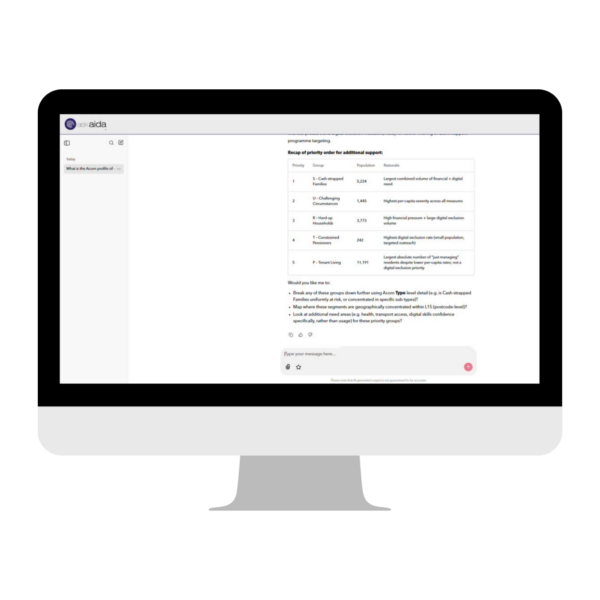
Demo
See Ask Aida in action
Discover how easy it is to turn complex data into clear, actionable insights in just a few prompts.
Why Ask Aida is different
While we wanted to embrace the power of AI in the provision of our analytical and consultancy services, we didn’t want to do so just for the sake of it. We wanted it to add to our clients’ experience in a way that makes their lives easier, but more importantly, contains all our combined consultancy experience of using the data we’ve created.
On the face of it, Ask Aida looks like a ChatGPT or Copilot natural language interface. It has all the ability to have a discussion with you that they do. However, it has been given a much more specialist scope of expertise.
- The foundation of Ask Aida remains the datasets that we have used for decades and continue to evolve and build on.
- The addition of a solutions library, a repository of human guidance for how to address specific questions, is made available to the AI agent to guide it in which technique or data to use.
- A vast suite of tools that give the ability to answer any question, but limits the chance of the AI agent going rogue, or hallucinating, in a bid to please you.
Ask Aida is your very own consultant who has been trained on CACI’s wealth of experience and data. It will continue to learn, because the one thing it can’t do is challenge the user’s question. It can only answer it as best as it is able and encourage the user to reframe the question if the answer isn’t what they expected. For example, a question like ‘what is the population of London’ can generate a multitude of answers depending on how you choose to answer it. It could be the city of London, within the M25, add up all the borough boundaries or add up all the postcodes. A human would engage in more of a conversation about what you are trying to achieve and, therefore, what the best answer would be. We still need humans in the lead and we see that very much as a feature, not a bug, of the system.
Ask Aida came from our desire to democratise our data, making it available to more than just analysts whilst maintaining the very best data operational experience. It’s not just an AI tool; it’s the data and experience behind it that makes Ask Aida uniquely positioned to answer your questions.


