




















































Case study

How Isle of Wight Council supported local housing needs

Isle of Wight Council logo

Summary

The Isle of Wight Council is a unitary authority located on the Isle of Wight near the south coast of England. It is made up of 40 councillors from 39 wards. The Council is responsible for all local government activities on the Island.

The Isle of Wight is a beautiful, interesting and relaxing place to be. While the pace of life may be slower on the Island, the Isle of Wight Council is an innovative, forward thinking and dynamic organisation. The Council has an ambitious corporate plan with a vision for the Isle of Wight to be an inspiring place in which to grow up, work, live and visit.

Company size

5,000

Industry

Non-Profit

Products used

Challenge

Danika Barber, Public Health and Strategic Analytics Lead explains: “We looked at what other councils had done to quantify affordability and knew that we needed to understand incomes across the Island in order to put house prices and rent costs in context of the local, permanent population.”

Danika and her team recognised that they needed to account for the typically more expensive second homes and holiday rentals on the Island, as well as a ‘hidden homeless’ population such as extended and overcrowded households, those in unstable tenancies and those key workers in less well-paid roles who are vital to the Island economy.

Solution

The work was commissioned by the Island Housing Conversation, a Regeneration Department project designed to inform and work with local councillors, housing providers and developers. The goal is to support stakeholders in building new homes of the right types and sizes in the right places to meet the local population’s needs.

Danika and her team used land registry square footage data to show how affordable the different sized properties are. It’s true that on the Island, unlike some other areas of the UK, more residents can afford to buy or rent a flat. However, most can’t afford to buy a three-bedroom home to accommodate a family.

Looking at the overall UK picture, while house prices appear cheaper on the island, salaries and incomes are much lower. Connecting house prices with real earnings at a granular level showed true affordability in each ward.

Results

  • The interactive tool is really powerful, making the information and data meaningful and impactful. 
  • People understood the implications immediately. When shown the interactive map for lower quartile income affordability, it raised a gasp from the audience. Residents in this group cannot afford to buy or rent anywhere. It’s vital that this is addressed for the wellbeing of the population and the health of the local economy. 
  • The data insight was very well received at the meeting and afterwards. It was successful because of the combination of relevant, granular data and the visual presentation in PowerBI. 
  • Other departments asked Danika what PowerBI could do for them – they wanted to be able to visualise data in a similar way and understand local differences and needs in the Island population. 
  • Danika’s team has also been using PowerBI to present Covid-19 data and work is underway to develop a range of other similar dashboards for other business areas. 

Case study

Detailed local population insight to inform service provision in a new Central London life sciences hub

Summary

Guy’s & St Thomas’ Foundation was previously known as the Guy’s & St Thomas’ Charity. It is an independent foundation whose mission is to invest, partner, engage and influence to come at big health challenges from all angles. The Foundation and its family of organisations collaborate with communities, partners and hospitals, using its assets to transform lives.

Impact on Urban Health is part of the Foundation, with a specific remit to make urban inner London and similar areas healthier places to live.

Company size

200

Industry

Non-Profit

Products Used

Challenge

Guy’s & St Thomas’ Foundation has created a 300,000 square foot life sciences hub with world-class lab facilities. The development is adjacent to the Guy’s Hospital campus in Southwark and will form part of a new health innovation cluster in central London.

To assess the impacts and benefits of the development for the local community, the property team asked Impact on Urban Health to help them understand more about the needs, lifestyles and characteristics of the people who live nearby.

Assess impact and benefits of the development

Understand the needs, lifestyles and characteristics of those nearby

Solution

Data Analyst Alessandra Denotti is responsible for generating insight for Impact on Urban Health projects. She used CACI’s Acorn demographic data to map profiles of the population in the immediate area around the proposed Snowsfields development.

Results

Project Director Emma Davies studied Alessandra’s insight presentation to understand the local population better, in order to design and propose relevant services within the Snowsfields development plan for local residents to use.

Family picture of grandchildren with grandparents sitting in between them, all of them are sitting on a bench.

Case study

Neighbourhood cost of living insight from Paycheck and Household Acorn data

Summary

Dumfries and Galloway is responsible for the delivery of all local authority services to nearly 149,000 people living in both urban and rural areas in the southwest of Scotland.

Company size

6,000+

Industry

Non-Profit

Challenge

Gregor Docherty is Dumfries and Galloway Council’s Economic Development Officer. He explains: “Although we have some data of our own, we don’t have the range and breadth of it to provide the information the council needs today. I was given the challenge of improving our data insight, to give us a clearer view of the areas the Council looks after and the needs of the people who live there”.

Improve data insights for a clearer view of local areas 

Understand the needs of the people living in the local areas

Solution

Dumfries and Galloway Council has access to Paycheck income data for two years. Recently, the Council decided to add the Household and Wellbeing Acorn datasets to the subscription.

The addition of Household and Wellbeing insight provides a granular picture of lifestyle, income and risk factors at a local level, that allows the team to really examine areas of need and deliver value and impact from the Council’s services and programmes.

Results

Dumfries and Galloway Council successfully applied for Borderland Inclusive Growth Deal funding, using information modelled from CACI’s data.

Gregor Docherty created a Dumfries and Galloway Datazone profile, bringing together all the available information to rank the towns in the Council’s area for funding priority. The analysis revealed the four priority towns for funding, which was approved.

Learn more about Paycheck, Household Acorn and Wellbeing Acorn.

Case study

How Crisis developed a new retail strategy with InSite’s powerful datasets

Crisis logo

Summary

Crisis approached CACI for support in identifying new charity store locations and analysing current store performance to support future decision making.

Company size

1000

Industry

Non-Profit

Products used

Challenge

Crisis wanted to learn from the performance of its existing stores in their different catchments, so it could identify success factors to inform future location choices. As well as understanding the characteristics that contribute to strong store performance, Juliet and her colleagues wanted to know about the halo effect – whether the shops’ presence made an impact on other donations, e-commerce, volunteering and lobbying in their local communities, and how they could maximise these positive outcomes in new store catchments. 

The Crisis team approached CACI because they had heard about the Acorn categories and catchment tools and saw their potential to provide the evidence needed to develop a new retail strategy. 

Analysis and learn from existing store performance

Identify success factors to inform future decision making

Understand characteristics that contribute to strong store performance

Solution

Juliet met with CACI to explain the information Crisis hoped to discover to build their retail strategy. The CACI team requested the existing store and performance metrics they needed from Crisis and proposed a list of deliverables they would generate, using Acorn demographic profiling and InSite catchment analysis overlaid on the Crisis data.

“The timings were quite tight, but the CACI consultant was quick to get back to us with a preliminary report that we could share with the senior management team to demonstrate the value of the approach. CACI followed up with a complete report and a clear explanation of the methodology used. There were spreadsheets of data and analysis by site that we could look at in granular detail. All the deliverables were well designed and easy to use – we could augment our data as more emerged, keeping the insights complete and current.”

Results

Juliet and the retail team now have the confidence to look both within and outside London for new store locations. They can work with a prioritised list that’s based on potential measured from existing store experience, catchment and customer profiling and a broader appreciation of the total opportunity for Crisis from all activities influenced by the store’s presence.

Couple looking at new mobile phones in a shop with sales assistant showing explaining to them about the products

Testimonial

“CACI were consistently good at explaining what they did with the data in a way that we could easily understand – they translated their sophisticated models and methods into up-to-date insight that we could use with confidence for retail strategy decisions, plans and actions. The CACI experts fitted well with our culture and way of working and did a brilliant job at meeting tight deadlines.”

Juliet Davies

Project Manager, Crisis

Case study

How Business Isle of Man developed a trusted demographic model and profile with CACI’s data

Business Isle of Man Logo

Summary

Business Isle of Man is an Executive Agency of the Isle of Man Government’s Department for Enterprise, acting as a key decision making and advisory body supporting the Government’s ambition for long-term economic prosperity. Its purpose is to help create an environment for key sectors to achieve sustainable growth while establishing the Island as an internationally well-regarded home for export business.

The Department has a key role to play in the achievement of the Programme for Government’s stated intention to be an Island of Enterprise and Opportunity. Supporting economic development is of strategic importance for the Island’s future growth and prosperity.

Company size

50

Industry

Non-Profit

Products used

Challenge

Business Isle of Man was approached by a property developer keen to attract larger UK multiples. These businesses were asking for a demographic report, so they could assess the commercial viability case for their brands. None of them understood the Isle of Man’s demographic.

Solution

Jonathan Platten, Economist for the Department for Enterprise:

We commissioned CACI to develop a trusted demographic database and map that showed detailed profiles of our population across the Island. CACI impressed us with their expertise and reputation in the field of socio-demographics.”

The Isle of Man can be considered alongside the UK as part of CACI’s trusted dataset and modelling, with the same granular, visual demographic detail. For the first time, investors, retailers and businesses can build reliable modelling into their business cases at postcode level.

Results

Business Development Manager, Rachel Hopkinson expresses the benefits clearly:

We have never before seen such a detailed analysis of our population across the island, including Douglas (the Island capital). Although our Island population is under 100,000, there is a big opportunity for retail and leisure businesses. Isle of Man retailers perform exceptionally well compared to the UK because we have a wealthy population and a captive audience. Now, we have the demographic data to show why this is the case.”

As well as commissioning CACI to produce the dataset and report, Business Isle of Man has entered into a collaborative ongoing relationship with CACI to help provide further, specific analysis for Island businesses and investors.

Case study

Delivering data & insights to provide Bright Horizons with a new approach to childcare

Summary

Trusted by families to look after their children for over 30 years, Bright Horizons is an award-winning nursery provider. The company operates over 300 community and workplace nurseries throughout the UK — each is individually designed to serve the needs of its community. Bright Horizons provides tailored childcare for corporate clients and for families, at home, at work and in local settings.

Company size

10,000+

Industry

Education

Products used

Challenge

Bright Horizons initially approached CACI for data to support their new site opening and acquisition insight programme.

Reliable data that was quick and easy to interpret for new site and location decision making was needed

Access to demographic data to support proposition development

Gain a better understanding of existing potential catchments

Solution

CACI provided Acorn demographics, profiling and mapping, giving insight into specific postcodes and communities. High-level demographic maps are instantly visible in InSite’s Locator tool.

Marketing Manager Eddie Thorogood explains: “The blend of data creates reliable and up-to-date information about the demand for our services, to support decision-making about how and where we can expand our operations so we can deliver high quality childcare where it’s needed. It also helps us improve our business model, so we can manage our portfolio and flex and balance our sites to meet changing needs.”

Results

Bright Horizons’ three pillars are ‘people, quality, growth’. Eddie explains, “We’re not about just growing for the sake of it. We always want to be where we are needed – where parents can find us and our services will be useful. With this data insight at local level, we can provide a clear picture of community and workplace need to our senior leadership team, so they can sign off new facilities.”

Learn more about Acorn and InSite.

Case study

How geodemographic insights have improved Bedfordshire Fire & Rescue’s understanding of community risk

Bedfordshire Fire & Rescue Service Logo

Summary

Bedfordshire Fire and Rescue wanted to improve their understanding of what risks and vulnerabilities were prominent in their communities in order to increase their preventative measures against them. They also wanted to begin tailoring their engagement to those most at risk to be able to create maximum impact and support.

Company size

1,000

Industry

Non-Profit

Products used

Challenge

Improve understanding of current and emerging community risk

Identification of households most likely to have a fire

Ensure preventative approach is risk-based and efficient

Solution

The ability to utilise the social and demographic insights accessed via CACI’s Acorn to enhance the understanding of risk and vulnerability within Bedfordshire, while also tailoring engagement to maximise the impact on those most at risk. Our data-driven methodology ensures resources are targeted effectively and efficiently.

Results

Using the data Acorn provides, Bedfordshire Fire & Rescue are now able to target those most in need of help, while making sure their approach is based on risk and also person-centred. The data provides the opportunity to understand the different needs of the communities they serves and assurance that the approach now being take is efficient, yet effective.

Case study

How Agilysis use Acorn to improve road safety interventions & outcomes

Agilisys Logo

Summary

Agilysis is a transport safety consultancy specialising in road safety. They have a wealth of experience working with road safety, and a company-wide mission of using data to inform road safety interventions and prevention strategies for casualty reduction and overall road awareness. One of their key requirements is the ability to supply insights to road safety stakeholders about individuals involved in or exposed to different types of road risk in various local communities.

Company size

50

Industry

Non-Profit

Products used

Challenge

Agilysis had been using another socio-demographic profiling tool to convey the necessary demographic profiling insights for over a decade. However, as time progressed, two critical issues arose:

The tool’s provider wouldn’t allow Agilysis to view their socio-demographic profiling model at a low enough geographic level to make it as useful as needed.

Agilysis was unable to expose all the available variables to their stakeholders due to license holder restrictions. This particularly affected their road safety stakeholders who generally work for local authorities and police forces.

Solution

Agilysis began using CACI’s geodemographic segmentation, Acorn, to enhance the calibre of their road safety intervention design and deliver precise, robust results to stakeholders.

The business dissected the available list of all the metrics, identifying those which felt most useful, easiest and relevant to understand and apply to the individual forces policing strategy. By leveraging these insights, Agilysis can better understand the likely propensity of an individual Acorn type to partake in various acts of travel, walking and cycling, a key priority of many road safety stakeholders nowadays.

Results

Acorn’s wide range of variables and its ability to let Agilysis transparently share sociodemographic metrics and results with stakeholders has helped the business make the information as useful as possible to augment the design of road safety interventions, and provide police forces, highway authorities and other stakeholders with valuable data. This intelligence leads to improved strategic and decision-making.

Additional CACI datasets are likely for Agilysis’ future, with the business having already assessed datasets that can further enhance transport safety projects. These should provide new insights into key metrics such as collision-involved drivers from outside Britain and road danger for deprived and minority communities. 

Case study

Delivering effective engagements for Age UK supporters with Demographic Data

Summary

Age UK offer free information and advice on topics as diverse as claiming benefits to finding a care home. With a growing ageing population, they play an integral part in helping many of our older generation with their struggles to live comfortably.

Company Size

1,000 – 5,000

Industry

Non-Profit

Products used

Challenge

Age UK came to us for help with the following challenges.

Icon - Magnifying glass showing a bar chart

Need to be able to track ROI against campaigns

Icon - Desktop computer with graphs and a clock

Create a dashboard that allows different departments to see the customer profiles

Solution

CACI’s suite of demographic data helps the charity build a deeper understanding of its diverse supporter and customer base; whether they be a donor to the cause, an event participant, product purchaser, or any other relationship holder.

Results

CACI’s suite of demographic data (Acorn, Fresco and Wellbeing Acorn) allows Age UK to be smarter in its communications strategy. Having a deeper understanding of its customer base, Age UK can be more considered when planning whom to contact with specific offers that are best suited to each of its customer segments.

Group of elderly seniors huddled together outside

Testimonial

CACI’s data products are key to unlocking an understanding of our supporters, service users and product purchasers, and plays a vital part in our effective engagement with them.

Age UK

Are dashboards dead? Assessing their challenges & advantages to determine their future in businesses

In this Article

Dashboards have been quite a topic of contention in certain circles with the recent recirculation of Taylor Brownlow’s essay ”Are Dashboards Dead?”.

While I’m of the opinion that no, dashboards are not dead, they have been undeniably overused and often misunderstood, with a disconnect between a dashboard’s actual function versus our perceived function of them. 

Why is there dashboard fatigue?

Many of us have experienced dashboard fatigue, and rightfully so. As businesses, how many dashboards have we commissioned that were never fully utilised, if used at all? The answer is too many.

The reason for low engagement isn’t the fault of the humble dashboard, but rather that a dashboard was never the appropriate solution for the end user, or its design wasn’t tailored enough to the business use case.  

When faced with a business problem requiring data insights, we often jump straight to dashboard creation. However, there are many other solutions that can be tailored to deliver data insights, such as concise reports and static presentations. With an increased understanding of where dashboards fail, the conversation has shifted to questioning their relevance altogether.  

So, what place do dashboards still have in businesses, and how can we better understand where they excel to drive improved outcomes? 

What potential challenges may arise with dashboards?

There are many instances where dashboards may be less effective or complicate matters for businesses, and other methods provide a better solution. Instances may include: 

  • When the user needs a concise answer to a question:
    Dashboards require interaction and exploration, which can be time-consuming. If a stakeholder needs a straightforward answer, a tailored report is more efficient.  
  • For business specific, niche questions:
    Not every level of enquiry warrants the resource-intensive creation of a dashboard. For narrow, targeted questions, simpler reporting methods suffice. 
  • One-time insights:
    Dashboards are overkill for static data projects, such as measuring the success of a single transformation. In these cases, producing a well-crafted report or presentation is more resource-efficient. 
  • If the data is exported for analysis:
    If users regularly export dashboard data to manipulate it elsewhere, it’s a sign that the dashboard doesn’t meet their needs or wasn’t necessary to begin with. 

When might dashboards be the right solution?

Company-wide reporting platforms

Dashboards provide a unified view of performance across teams, offering consistent delivery of insights to aiding faster decision making, customisable filters for views specific to each business unit, efficiency in distributing insights without the need for manual reporting and increased data accessibility through data visualisation. 

Regular cadence reporting

For tracking ongoing metrics such as daily sales, customer trends or campaign performance, and measuring progress against targets, dashboards provide updated insights without the wait. 

Exploratory analysis

Whenusers want to discover patterns, relationships or unknown trends within the data, dashboards allow for interactive interrogation. These tools are especially valuable for data-savvy end users, enabling self-service exploration without requiring an analyst’s intervention. 

Monitoring ongoing initiatives

Dashboards are excellent for tracking live projects or recurring business processes, offering real-time visibility into performance. 

The future approach for dashboards

With the above in mind, we’re moving to a more informed approach where dashboards are no longer a tiresome, default solution, but a carefully considered tool.

The future isn’t about abandoning dashboards, but about being intentional and strategic in their creation and deployment. The key is facilitating dashboard creation in a way that adds tangible value and is thoughtfully configured to provide meaningful, actionable insights that empower decision making. 

How CACI can help

At CACI, we work with you to deliver the best solutions for your analysis needs. Our extensive experience in successfully implementing dashboards across diverse industries highlights several key scenarios where dashboards have proven to be highly effective.  

Whether it’s creating a bespoke, one-off report or developing a suite of comprehensive, customisable dashboards, contact us to find out more about how our user centric approach and industry expertise can help you gain meaningful analytics that will drive strategic business outcomes. 
Refreshing Scrum with the Ball Point Game

In this Article

On a recent programme development day, Phil Ballard, one of our award-winning Scrum masters facilitated the Ball Point Game. This is an industry-known Agile game which is usually run as part of an introduction to the Agile ethos for those keen to follow the Scrum methodology. 

Despite CACI having teams that are highly experienced in Scrum, we still found this activity to be useful not only as a “going back to basics” session, but also from the several other lessons learned from our own adaptation. 

Ball Point Game: basic overview 

Teams of eight are formed, with each team collecting a bag of balls. 

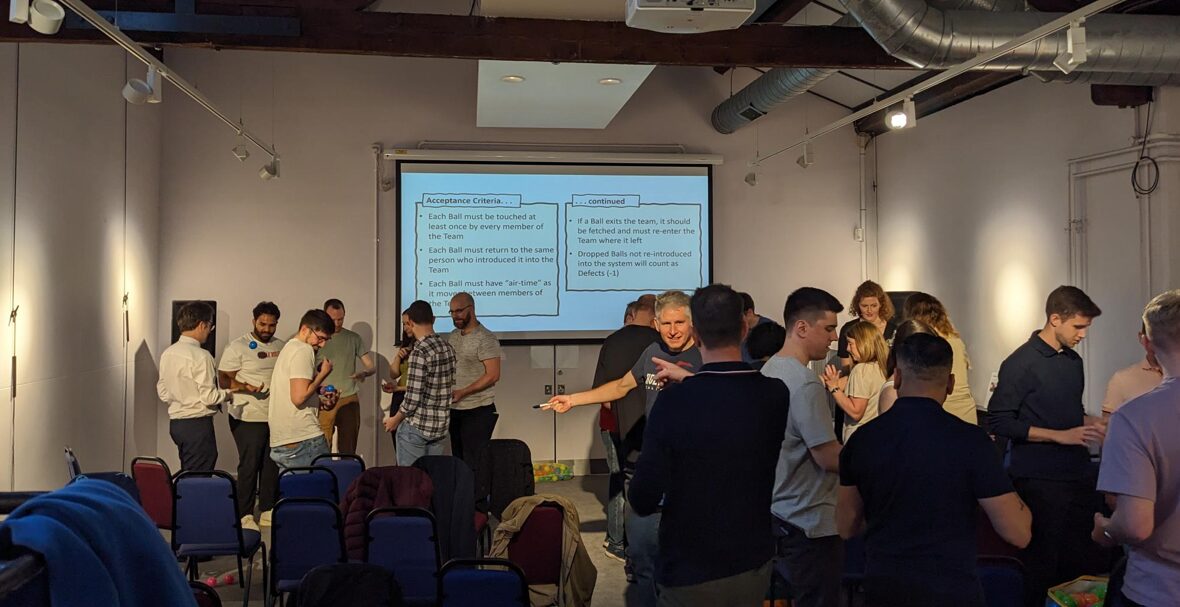
Within an Iteration (of which four take place), teams pass as many balls as possible among team members, with each ball passed scoring the team a point. Teams must adhere to the acceptance criteria of each ball being touched at least once by every member, each ball returning to the same person who introduced it into the team, each ball having “airtime” as it moves between team members, lost balls being fetched and re-entering the team where it left and dropped balls not being re-introduced into the system.

During each Iteration, teams will have one minute to talk among themselves and two minutes to perform the ‘Objective’. Prior to each Iteration, an estimate for the number of balls expected to pass through the team within the next Iteration is predicted. 

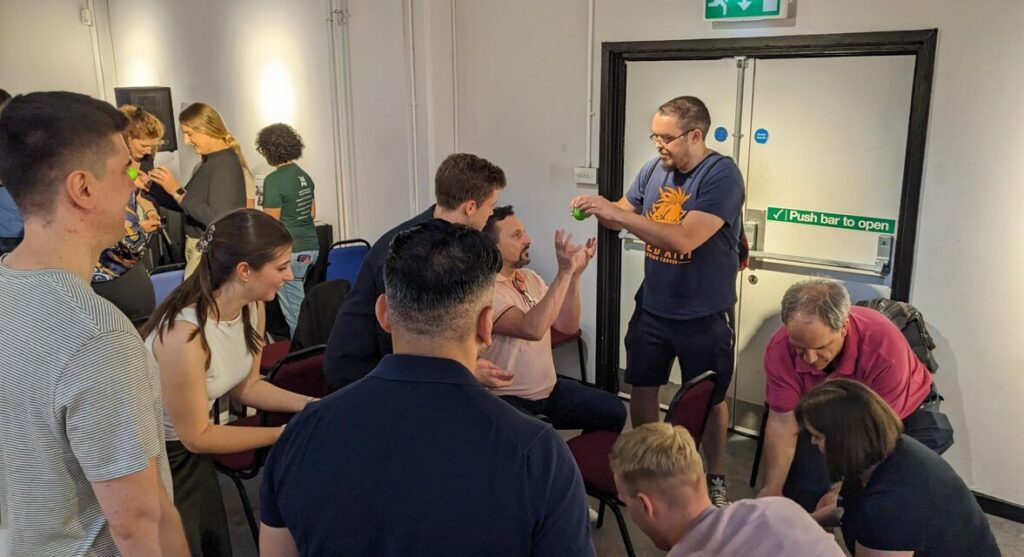
Team members taking part in the Ball Point Game, as a way to learn Agile methodology in an easy manner

CACI’s spin on the Ball Point Game 

Considering teams are already experienced in delivering in scrum, we made things more lifelike by introducing additional requirements in Iterations 3 and 4: 

  • The balls are being sold in packs of ten, with at least one of them being green. 
  • All balls must continue to gain height as they are passed through the team. 

After all, what’s software delivery without a stakeholder wanting to change their mind? The idea behind these rules was to break the established process, force change and to see what behaviours the scrum-experienced professionals would exhibit. 

Team members taking part in the Ball Point Game, as a way to learn Agile methodology in an easy manner

Ball Point Game goals

The Ball Point Game’s ultimate goal was to teach participants the value of continuous process improvement through basic agile principles using the simulation of an agile production process, including: 

  • Teamwork/shared goals 
  • Retrospectives/problem-solving 
  • Planning 
  • Estimating based on experience. 

All processes have a natural velocity. To speed things up, it is often not a case of working harder or faster, but a case of changing the process. 

Key takeaways

After all Iterations were complete, we discussed the results and asked teams to contribute their experiences with the following questions:  

  • Which Iteration felt as though it was the best/worst? 
  • How important was the retrospective between Iterations? 
  • What changes did you make? 
  • How did the team make decisions – did anybody take charge? 
  • Were all ideas heard within your teams? 
  • Was there anything notable in determining your estimates? 
  • Were improvements made by working harder or faster? 
  • Did you observe/experience anything else of interest? 

With the additional requirements added: 

  • Iterative development is also based on learning from the live product and adapting to what the customer and end user needs. 
  • Without anything being live, there is nothing to learn from and no way for the product to adapt. 
  • Sprint teams must adapt to estimating with new requirements versus estimating on a known repeatable task. 

Additional findings from the teams

  • The short timings of Iteration planning, along with the input of additional requirements, seemed to force an intensity. This, in turn, forced out several negative behaviours that we have not experienced on the programme, however, recognised within this competitive environment. 
  • Low sprint commitments despite the team feeling it was a known task. 
  • Sprint teams stopping when hitting commitment as there was an assumption that the game goal of the exercise was to have a stable velocity. 
  • Argumentative behaviours exemplified (not the usual collaborative approach we usually see). 
  • A competitive nature towards the other sprint teams, prohibiting the sharing of lessons learned. While the rules never stated they were against each other, it was inherently assumed when splitting participants into teams and asking them to perform the same task. 

On a more positive note:  

  • Many questions were asked about the requirements, with a focus on what the user/customers’ needs and problems were 
  • Looking outside of the team for improvement inspiration despite its interpretation as spying. 
  • Reflection on what we do in practice versus the theory/Agile beliefs 
  • Great discussions around the overall value of sprinting and iterative delivery. 

If you wish to find out more about the Ball Point Game or run it yourself within your programme or teams, please get in touch. 

Get ahead with CACI: Unlock the power of AI and ML in your CRM

In this Article

Setting the stage for AI and CRMs

The field of Machine learning and AI has evolved rapidly in the last few years, especially in fields where large quantities of data and quick response times to queries are crucial.

But given lots of these techniques and methods have been around for a much longer period, why has it taken so long for other industries outside of small start-ups and ambitious tech giants to leverage these methods in similar ways? 

CRM is an essential component of any company’s strategy. The ability to communicate with and understand customers is more important than ever due to the low barriers to entry in highly competitive global markets. Companies have only brief moments to convince customers that they are the right choice for shopping, spending time, or engaging. Optimising these initial and subsequent contacts is paramount to success. 

Beyond just expanding your customer base and attracting new clients, CRM is vital for any company’s retention strategy. The most advanced cutting-edge models in the world are utterly useless if we don’t know how to activate and capitalize on the value they represent. 

ML foundation for CRMs

In the CRM space our main goals are increasing consumer retention or spend, and we do this via figuring out the most effective ways to communicate with people. This can be broken down into when to speak to them, how to speak to them and why to speak to them.  

Recommendation engines lie at the core of many of these architectures, models that are designed to figure out what you want before you even know you want it. Broadly they work by looking at the kind of customer you are, then at customers like you, then finding things that they’ve bought recently that you haven’t.  

You can even simplify this down into just looking for customers who have an identical purchase history to you. Maybe a laptop you can buy on Amazon doesn’t come with a charger, so commonly when people buy this laptop their next purchase is a charger (You can often see this simple logic in the “People also bought” section of Amazon). But even these simple implementations are incredibly powerful in some ways, an educated guess is always going to be better than a random one. 

So how do these methods relate to CRM? Well, the general structure can be pulled away and applied to any subject.

When we think about how to engage with a customer, we’re going to look for ways we engaged with similar customers and how these performed. The customer who likes Sabrina Carpenter will probably need to be spoken to in a different way to the Motorhead fan. 

This is simple stuff, right? Well exactly, but it’s a method to show that the underlying AI processes in these platforms aren’t really all that complicated – there’s a lot of room for improvement especially when implementing bespoke solutions with larger data sets.  

The next (generative) step  

So, we already have ML methods that can tell us when and why to talk to people, great! But what’s the next step? 

All that’s left of our final stage is how to talk to them and what to say, stages which can and are currently being revolutionised by the advent of enterprise grade Generative AI. 

A current pipeline for devising CRM processes may involve creating template communications that are then populated with more specific information, for example customers in a certain segment defined by age and tenure are assigned one template and differing segments are shown another. 

This approach can be time consuming if it needs to be completed for each campaign, and may miss a level of personalisation that people will respond to, feeling as though each message is tailored to them rather than being an email blast they just happen to be caught up in. 

Skilled AI engineers armed with LLM’s can create a unique voice for each consumer, ensuring that quite literally all communication they will ever receive are exactly personalised to them and their engagement habits with your brand. 

Imagine attempting this even a few years ago, assigning a team of people to trawl through millions if not billions of rows of data to ensure that each customer got the perfect messaging for them would have been completely impossible. 

In practice this level of granularity in communications is probably unnecessary but it speaks to the potential these models have in this space – the sky truly is the limit. 

Even starting off small with these steps, giving a small part of a communication a generative component, allowing for large scale A/B testing and continuous model training, the effectiveness of these comms will improve over time. 

Freeing this time up from your CRM team will give them more time to tackle more involved problems that can’t be automated. 

If you need help on this journey for a better CRM, contact us here.

Environmental sustainability in business: importance and impact

In this Article

Key issues for countries and the businesses that operate within them to address in terms of climate change unfolded at the recent 28th UN Climate Change Conference (COP28). These issues urge immediate and significant action to be taken on fossil fuels and clean energy, national adaptation and climate finance, methane reduction, land use and more.

What does environmental sustainability in business mean?

Environmental sustainability in business is the operation of a business that does not compromise the environment. A business that has considered environmental sustainability prioritises the environment’s best interest, with society and its ecosystems coming before making a profit. It involves responsible decision-making that minimizes carbon footprint or waste while simultaneously improving the quality of life for humankind and the natural world alike.

Unfortunately, however, operating businesses as usual has had an increasingly detrimental impact on our planet. According to the latest State of the Global Climate report by the WMO, 2023 was the warmest year on record at about 1.4C,increasing pressure to shift their operations to more environmentally sustainable practices. This inevitably causes businesses to consider—where do we start? How do we begin making a difference?

What is the importance of environmental sustainability in business?

According to an article published by Maryville University, businesses that do not act responsibly will result in “the majority of many species not surviving past the 21st century”, reiterating how critical it is for businesses within every industry to take part in improving their environmental surroundings.

Although companies have a way to go before fully grasping the repercussions of ever-growing carbon footprints, those willing to tackle this challenge early on will get a head start on reshaping perspectives and realities.

Environmental sustainability in business practices

Businesses can rely on the three R’s– reduce, reuse and recycle– to begin reducing their environmental impact. However, there are several other examples of practices that businesses can incorporate into their operations amplify their reduction, including:

  • Life cycle assessments
  • Designing environmentally friendly products/services
  • Optimising product efficiency
  • Decreasing supply chain carbon footprint
  • Re-evaluating CSR (Corporate Social Responsibility) expenses

Benefits of environmental sustainability in business

Reduces the impact of business costs

While the cost-of-living crisis is skyrocketing, improving the energy efficiency of business operations and decreasing waste will go a long a way in bracing for the impact of unexpected business costs. Using more energy efficient lighting or reusing existing resources can be quick-fix solutions for lowering costs.

Improves a business’ reputation

Environmentally sustainable businesses are viewed as a plus, and companies are eager to highlight this fact. Companies that can go “green” show that they’re serious about making a difference in the environment and are interested in more than just profitability. Businesses that can market themselves and develop their identity around their commitment to the betterment of the planet will notice incredible results in terms of their reputation.

Group of people in front of icons representing sustainable development goals and environmental technology

Who is responsible for improving environmental sustainability in a business?

Businesses have been expected to pave the way towards environmental sustainability due to their notably significant contribution towards polluting the environment through waste, gas emissions and plastics generated. The responsibility does not necessarily begin with one individual within a business though– employees at every level of the business must work together to bring about change. A few examples include:

  • Business owners and leaders: Business owners and leaders are typically capable of leading strategic decision-making that influences the wider business. They can develop effective sustainability strategies and initiatives that have the power to change policy and induce change.
  • Business managers and supervisors: Managers and supervisors can supply valuable insights due to their more hands-on roles. They also typically have different perspectives and understandings as to how to improve business sustainability.
  • Employees: Employees can supply valuable contributions when encouraged to voice their opinions and concerns on how the business can become more sustainable.

Impact of environmental sustainability in business

The Department for Business, Energy and Industrial Strategy is striving to reach net zero carbon emissions by 2050. It’s going to take strong leadership, business-wide alignment on operations and an engaged corporate culture to successfully execute and maintain environmentally sustainable business practices. Businesses that start addressing these issues and challenge existing business processes will find themselves making a breakthrough towards becoming more environmentally sustainable while protecting the world around them.

How can CACI help you overcome these obstacles?

Our newly developed Mood Environmental Hub helps track all of your assets across multiple geographic locations and assess the environmental impact of your business.

With a single click, users can drill down from multi-site, business-level functions, to departments or even individual teams to determine asset types and locations, enabling a quick assessment of priority focus areas for improvement. It can also visualise existing data through user-friendly dashboards that show carbon impact, consumption and cost at an enterprise level.

The advanced modelling feature also outlines potential improvements, indicating ROI and carbon reduction impact. Additionally, you can easily check performance against carbon commitments such as Social Value through the initiatives tracker.

Producing carbon reduction target tracking reports or modelling for a business case is now a click away – to see how it works, you can book a demo here.