
Posts Top quick service restaurant trends for 2026: what’s shaping the future of QSR

Top quick service restaurant trends for 2026: what’s shaping the future of QSR

In this Article

The quick service restaurant (QSR) sector is entering 2026 at a pivotal moment. Consumer demand remains resilient, but the operating environment is more complex than at any point in the last decade. Inflationary pressures, labour shortages, evolving customer expectations and rapid technological change are forcing QSR leaders to make sharper, more evidence-based decisions.

While much has been written about emerging QSR trends, many articles stop short of answering the most important question: which trends will genuinely deliver sustainable growth, and which risk becoming costly distractions? 

In 2026, success will depend less on adopting every new innovation and more on prioritising the right initiatives, in the right locations, for the right customers, underpinned by strong data foundations. 

Why QSRs can’t afford to ignore these trends

Globally, the QSR market continues to grow, but that growth is increasingly uneven. According to market analysis of the UK foodservice sector, total market value is forecast to exceed £85bn by 2026, with growth driven largely by QSR and delivery-led formats. 

However, this growth masks significant pressure beneath the surface:

Against this backdrop, trends are not abstract ideas — they directly influence network planning, pricing strategy, menu development and customer experience. Brands that understand how these trends play out locally are far better positioned to protect margins and unlock sustainable growth.

Top 7 quick service restaurant trends for 2026 

1. AI as a strategic engine, not just a technology layer 

Artificial intelligence has moved well beyond experimentation in QSR. In 2026, AI is increasingly embedded across forecasting, pricing, labour scheduling and customer engagement. 

Academic and industry research shows that machine-learning-based demand forecasting can reduce forecast error by up to 52%, directly lowering waste and improving operational efficiency. 

Additional industry analysis highlights that AI-enabled forecasting can reduce food waste by up to 25%, improving both sustainability and margins. 

However, the biggest gains come when AI is treated as a strategic capability, not a bolt-on. Without high-quality customer data, location insight and behavioural context, AI risks reinforcing inefficiencies rather than resolving them.

What leading QSRs are doing differently: 

Rather than deploying AI in isolation, leading QSRs are focusing on strengthening the data foundations that sit behind it. This includes improving customer data quality, linking transactional and behavioural signals, and incorporating location-based context into forecasting models. As a result, AI is increasingly used to anticipate demand, optimise decision-making and reduce operational risk, rather than simply automate existing processes.

2. Drive-thru reinvention: speed, accuracy and experience 

Despite the growth of delivery and mobile ordering, the drive-thru remains the backbone of the QSR model. Industry analysis consistently shows that drive-thru accounts for nearly 75% of QSR sales in mature markets.

Key developments shaping 2026 include:

  • Voice AI reducing average order time by 20–30 seconds per vehicle 
  • Increased use of queue analytics to manage peak-time congestion

Crucially, hospitality research shows that order accuracy and perceived friendliness have a greater impact on repeat visits than speed alone, reinforcing the need for balanced optimisation. 

What leading QSRs are doing differently:

Top-performing QSRs are moving away from uniform drive-thru solutions and instead optimising performance at a local level. By analysing demand patterns by site, time of day and customer mix, they are better able to balance speed, accuracy and service quality. This approach helps direct investment towards the locations and peak periods where improvements deliver the greatest return.

3. Omnichannel ordering and digital transformation (with loyalty at the core)

By 2026, omnichannel is no longer a differentiator — it is an expectation. Customers move seamlessly between apps, kiosks, drive-thru and delivery platforms. 

Industry data highlights that:

The challenge lies in orchestration. Fragmented systems and disconnected data undermine both margin and experience. Leading QSRs are investing in a single customer view, unifying transaction, behavioural and location data to understand which channels genuinely drive incremental value.

What leading QSRs are doing differently: 

Rather than treating channels independently, leading QSRs are building a more integrated view of the customer journey. By connecting data across mobile, in-store, drive-thru and delivery platforms, they gain clearer visibility of true customer value and channel interaction. This enables more consistent experiences, better-targeted loyalty strategies and improved understanding of which channels drive incremental growth.

4. Value-driven strategies in a cost-conscious market

Value has re-emerged as one of the defining QSR trends of 2026. According to UK consumer research, more than half of consumers actively compare prices before choosing where to eat

Additional findings show that:

  • Bundled meals increase average order value by 8–12% 
  • Limited-time offers drive trial without permanently eroding price perception

The most effective value strategies are location-specific, using data to tailor pricing and promotions to local demographics, competition and demand patterns. 

What leading QSRs are doing differently

Instead of relying on national price promotions, leading brands are taking a more nuanced approach to value. By analysing local demographics, competitive intensity and purchasing behaviour, they are tailoring offers and bundles to specific markets. This allows them to respond to price sensitivity where it exists, while avoiding unnecessary margin erosion in locations where demand is more resilient.

5. Sustainability and packaging innovation

Sustainability is now a baseline expectation rather than a differentiator. Research indicates that over 75% of consumers expect QSR packaging to be recyclable or compostable. 

Industry data also shows:

  • Packaging redesigns can deliver 10–15% material cost savings 
  • Food waste contributes 8–10% of global greenhouse gas emissions, increasing pressure on operators to reduce waste 

What leading QSRs are doing differently: 

Leading QSRs are embedding sustainability into operational decision-making rather than treating it as a standalone initiative. By monitoring waste, packaging usage and customer response at a granular level, they are able to test changes, measure outcomes and scale successful approaches. This data-led approach helps balance environmental goals with operational efficiency and cost control.

6. Health, wellness and radical transparency

Health-led eating continues to influence QSR menus. Consumer studies show that over 40% of UK consumers actively seek healthier options when eating out.

Protein-forward and plant-based items continue to outperform category averages, while demand for clear nutritional and allergen information grows. 

What leading QSRs are doing differently: 

Rather than expanding menus uniformly, leading operators are using customer insight to understand how demand for healthier options varies by location and occasion. This allows them to introduce targeted menu changes, refine portion sizes and improve transparency without adding unnecessary complexity. The result is a more relevant offer that reflects local preferences while maintaining operational simplicity.

7. Ghost kitchens and virtual brands: a more disciplined model

Ghost kitchens remain relevant, but success depends on precision. Market analysis shows that location selection and demand modelling are the biggest determinants of virtual brand success. 

Virtual brands are increasingly used to:

  • Extend trade area coverage 
  • Test new concepts with lower capital risk 
  • Optimise delivery economics

What leading QSRs are doing differently:

Successful operators are taking a more analytical approach to virtual brands and ghost kitchens. By combining demand forecasting, delivery radius analysis and competitive mapping, they are identifying opportunities that complement existing estates rather than cannibalise them. This disciplined use of data reduces risk and improves the likelihood of sustainable performance.

How QSR leaders can act on 2026 trends today

Understanding trends is only half the challenge. The real differentiator is execution. 

To translate 2026 trends into commercial advantage, QSR leaders should focus on five practical steps: 

1. Prioritise trends by impact, not hype 

Not every trend will matter equally to every brand. Use data to assess which initiatives will:

  • Drive incremental demand 
  • Improve operational efficiency 
  • Strengthen customer loyalty 

2. Ground innovation in customer insight 

Customer expectations vary significantly by location, demographic and occasion. Advanced segmentation and behavioural analysis help ensure investment aligns with real demand. 

3. Use location intelligence to guide decisions 

From drive-thru optimisation to ghost kitchens, place matters. Understanding trade areas, cannibalisation risk and local competition reduces costly mistakes. 

4. Test, learn and scale 

Pilot new formats, offers and technologies in controlled environments. Measure results rigorously before national rollout. 

5. Build a strong data foundation 

Unified, high-quality data underpins every successful trend — from AI to personalisation to sustainability.

Future outlook: what comes next?

Looking beyond 2026, the QSR sector will continue to converge with retail and digital commerce. Automation will increase, but human service will remain critical. Data will become more central — not just for optimisation, but for resilience. 

The brands that outperform will be those that:

  • Invest in insight, not just infrastructure 
  • Optimise locally, not just nationally 
  • Align innovation with measurable commercial outcomes

In a volatile environment, clarity beats complexity — and data-led decision-making is the most reliable route to sustainable growth. 

Frequently asked questions about QSR trends for 2026

What are the top quick service restaurant trends for 2026? 

The top quick service restaurant trends for 2026 include AI-driven operations, drive-thru optimisation, omnichannel ordering, value-led pricing strategies, sustainability-focused packaging and data-driven personalisation. These trends reflect rising cost pressures, digital adoption and changing consumer expectations across the QSR sector. 

How is AI being used in quick service restaurants? 

AI is used in quick service restaurants to improve demand forecasting, labour scheduling, order accuracy and personalised marketing. By 2026, many QSRs use AI to reduce food waste, optimise staffing and deliver more relevant customer offers in real time. 

Why is value such an important trend for QSRs in 2026? 

Value is a key QSR trend in 2026 because consumers are more price-conscious due to ongoing cost-of-living pressures. Quick service restaurants are responding with targeted value meals, bundles and promotions that balance affordability with profitability. 

Are ghost kitchens still relevant in 2026? 

Yes, ghost kitchens are still relevant in 2026, but they are used more selectively. QSR brands now rely on demand modelling, delivery radius analysis and location intelligence to ensure ghost kitchens are commercially viable. 

What role does data play in QSR trends for 2026? 

Data plays a central role in QSR trends for 2026 by enabling better decision-making across pricing, site selection, customer engagement and operations. Brands that integrate customer, transaction and location data are better positioned to adapt to market changes. 

How can quick service restaurants prepare for the future beyond 2026? 

Quick service restaurants can prepare for the future by investing in strong data foundations, customer insight and flexible operating models. This allows QSRs to test new concepts, optimise locations and respond quickly to evolving consumer behaviour.


Share of Wallet: The definitive guide to customer growth

In this Article

Why Share of Wallet matters now 

Customer acquisition costs continue to rise, and the dynamic is even more pronounced in financial services, where competition for deposits, primary current accounts, and long-term savings has intensified. Research from the Harvard Business Review shows that it can cost up to five times more to acquire a new customer than to retain an existing one. Meanwhile, customer expectations have increased, switching barriers have fallen, and digital competitors are often just a click away. Within financial services, Open Banking has further accelerated switching and multi-banking behaviour, giving customers more freedom to distribute their balances across multiple institutions 

Organisations that focus only on acquisition risk spending heavily without ever realising sustainable growth. This is particularly true in financial services, where the cost of onboarding, KYC, AML checks, and compliance activities makes new customer acquisition especially expensive. As noted by Deloitte Insights, financial institutions that prioritise deepening existing customer relationships outperform those that rely heavily on acquisition-led strategies. 

Through Share of Wallet, financial institutions can also: 

  • Identify the value of balances customers hold elsewhere, giving institutions insight into hidden opportunities for deposit and investment growth. 
  • Understand which demographics, products and regions are outperforming the base, simplifying the identification of priority growth segments. 
  • Access aggregated SOW metrics and periodic reporting, enabling customer-level and portfolio-level performance tracking. 
  • Track KPIs linked to long-term strategic initiatives, connecting balance growth with broader business outcomes. 
  • Use granular data to inform personalised communications, targeting customers based on wealth indicators, behaviours and potential. 

This guide explains what share of wallet means in a financial-services context, how to calculate it using balances and asset concentration, why it matters strategically, and the practical, analytics-driven methods institutions use to increase it. Drawing on use cases across banking, savings, credit, and wealth management — including work CACI delivers — this guide shows why leading FS organisations now treat balance-based SOW as a cornerstone of sustainable growth. 

What is Share of Wallet? 

Share of Wallet (SOW) in financial services refers to the proportion of a customer’s total account balances or savings “wallet” that they hold with your institution across products such as current accounts, savings, ISAs, investments, mortgages or personal loans. 

For example, if a customer has total liquid savings of £40,000 and holds £10,000 of those balances with your bank, your SOW is 25%. 

This measurement applies across the sector: the percentage of a customer’s investable assets held with a wealth manager, the proportion of deposits concentrated with a building society, or the share of credit balances placed with one provider. 

SOW provides a more complete understanding of customer value by: 

• Revealing the total wealth picture, rather than only internal balances. 
• Highlighting how much money customers hold elsewhere, enabling accurate opportunity sizing. 
• Filling gaps in financial understanding that internal data alone cannot provide. 

Share of Wallet vs Market Share

The two metrics assess very different dynamics:

  • • Market share measures your institution’s total balances or products across the market. 
    • Share of wallet measures the proportion of each individual customer’s financial life that you hold. 

A bank may have high market share yet a low share of wallet per customer — signalling weak relationship depth. Conversely, a smaller provider might have very high wallet share among a loyal customer base. 

SOW also supports strategic decision-making by enabling: 

  • Tracking of balance growth KPIs across segments and product lines. 
  • Monitoring long-term performance such as deposit acquisition, wealth onboarding and cross-product engagement. 
  • Identifying “headroom” — the additional balances customers are likely to hold elsewhere that could be captured. 

How to calculate share of wallet 

The Basic Formula 

SOW (%) = (Balances held with your institution ÷ Customer’s total balances) × 100

Example: 
• Total savings: £60,000 
• Balances with your bank: £15,000 
• SOW = 25% 

Data Sources for Calculation

  • Internal account and balance data 
  • Open Banking and aggregation tools 
  • Customer research panels 
  • Predictive modelling and machine-learning estimation of held-away balances 

A strong SOW calculation enables institutions to: 

  • Combine customer-level balance estimates with postcode-level and product-level data for a 360° view of financial behaviour. 
  • Use CACI Retail Finance Benchmarking to understand typical wallet sizes, competitor penetration and localised patterns. 
  • Integrate wealth estimates into modelling, segmentation and pricing cohorts. 

Common Challenges

  • Hidden balances not visible to individual providers 
  • Volatile liquidity movements 
  • Categorisation differences across product types 
  • Life-stage and macroeconomic factors influencing wallet size

Why Share of Wallet Matters

Cost-Efficient Growth 

Deepening customer relationships by capturing more of their financial life is significantly more cost-effective than acquiring new customers. Increasing balance concentration boosts revenue per customer while lowering cost-to-serve. 

Customer Retention and Loyalty 

Customers who place a higher proportion of their savings or investment assets with one institution demonstrate far stronger loyalty and lower churn. 

Lifetime Value 

As wallet share increases, so does Customer Lifetime Value (CLV). Customers with deeper financial relationships are more likely to take mortgages, lending products, savings accounts and wealth services. 

Strategies to increase Share of Wallet

Segment Customers by Potential 

Not all customers have the same growth potential. SOW helps identify:

  • High potential, low share customers with substantial held-away balances 
  • High value customers to defend and deepen 
  • Lower potential segments requiring reduced investment 

CACI helps institutions uncover these opportunities using demographic, geographic and behavioural insight. 

Cross-Selling and Upselling 

Examples include: 

  • Encouraging current-account-only customers to open savings products 
  • Moving savers from low-yield accounts to higher-value fixed-term or investment products 
  • Introducing ISA or wealth solutions to customers showing investment readiness 

Next best product models identify optimal timing. 

Loyalty, Rewards and Relationship Pricing 

Mechanisms include: 

  • Preferential rates for customers consolidating savings 
  • Bundles linking savings, current accounts and credit 
  • Incentives for salary mandates or account funding 

Bundling and Value Propositions 

Product bundles and integrated financial management tools increase stickiness by offering convenience, clarity and control. 

Customer Experience 

Ease, trust and service quality materially influence wallet share. Positive digital and branch experiences translate directly into balance consolidation. 

Financial Services use case: Share of Wallet in banking 

Customer-Level Coding 

Banks assess the percentage of customer balances they hold to identify:

  • Customers with significant held-away funds 
  • Investment assets managed by competitors 
  • Opportunities to deepen primary relationships 

Savings Behaviour and Headroom 

Balance-based analysis distinguishes between:

  • Fixed savings 
  • Variable savings 
  • Investment holdings 

Customers with large variable balances but low SOW offer clear growth potential. 

Segmentation by Demographics 

Older customers often consolidate more; younger customers diversify more widely. 
CACI’s Fresco segmentation adds further behavioural and life-stage context. 

Monitoring and Tracking 

Modern analytics track: 

  • Balance concentration shifts 
  • Flow of funds in and out of held-away accounts 
  • Changes in product mix and adoption patterns 

How Institutions Use SOW

  • Identify and quantify customer-level opportunities 
  • Use CACI Retail Finance Benchmarking and location intelligence to find geographic hotspots 
  • Target segments with low share but high growth capacity 
  • Avoid unnecessary rate rises for customers already showing high SOW Provide frontline teams with estimated SOW indicators for personalised engagement 

Sector perspectives beyond Financial Services

 Retail and E-commerce  

Supermarkets compete to become the primary shopper destination. Loyalty cards, personalised coupons, and basket-building promotions all increase wallet share. E-commerce platforms use recommendation engines and premium memberships to keep customers buying within their ecosystem.  

Telecoms and Media 

Quad-play packages dramatically increase wallet share by consolidating multiple services into one bill. Customers who bundle are less likely to switch because of the perceived inconvenience of managing multiple providers.  

B2B and Professional Services  

For B2B firms, wallet share often means expanding into adjacent service areas. A consultancy may start with strategy and then cross-sell into analytics, technology, or managed services. Increasing wallet share in B2B builds long-term, multi-service relationships that are resistant to competitor approaches. 

Share of Wallet pitfalls and limitations 

Financial services face additional challenges: 

  • Over-marketing: too many rate-driven offers can reduce trust. 
  • Cannibalisation: shifting balances between products may not increase total value. 
  • Balance volatility: savings can move rapidly in response to macro-economic signals. 
  • Privacy and regulation: strict rules govern the use of customer financial data. 

Institutions should balance ambition with transparency and ethical standards. 

Advanced Share of Wallet analytics: The CACI approach 

Real differentiation comes from analytics: 

  • Predictive modelling: estimating total wallet and held-away balances. 
  • Uplift modelling: identifying which customers are likely to consolidate more funds. 
  • Controlled experimentation: validating rate changes or marketing interventions. 
  • Dashboards: tracking SOW in real time across segments and product lines. 

CACI’s data science services help banks turn SOW from a descriptive measure into a predictive, prescriptive engine for long-term balance growth. 

Share of Wallet implementation roadmap 

  • Assess: measure baseline balance concentration. 
  • Prioritise: identify customers with high potential and low current share. 
  • Design: develop targeted financial strategies — pricing, product prompts, digital journeys. 
  • Execute: deploy at the right moment with meaningful personalisation. 
  • Measure: track responses, adjust propositions, and optimise. 

Evolving Dynamics of Wallet Share 

Wallet share in FS is evolving through: 

  • AI-powered personal finance tools influencing balance allocation. 
  • Open Banking transparency enabling better competitor comparison. 
  • Cross-category mapping (e.g., savings vs investments). 
  • ESG-driven decision-making shaping where customers place their assets. 

Conclusion 

Share of Wallet is more than a KPI — it is a growth framework grounded in balance concentration and trusted financial relationships. By accurately measuring and acting on SOW, institutions can increase profitability, reduce churn, and deepen their role in customers’ financial lives. 

CACI’s expertise in data science, segmentation, and customer insight helps banks move from generic cross-sell to intelligent, targeted strategies that materially increase the proportion of savings, balances, and financial value customers hold with them. 

Share of Wallet FAQs 

1. What is share of wallet in banking? 

Share of wallet in banking refers to the proportion of a customer’s total account balances or savings that they hold with a specific financial institution. 

2. How do banks calculate share of wallet? 

Banks calculate share of wallet by dividing the balances a customer holds with them by the customer’s estimated total savings or assets, including held-away funds. 

3. Why is share of wallet important for financial institutions? 

A higher share of wallet increases customer lifetime value, improves retention, and strengthens the institution’s role as the customer’s primary financial relationship. 

4. What is a good share of wallet percentage for banks? 

A strong share of wallet typically means holding the customer’s primary current account and a significant portion (often 50% or more) of their liquid savings. 

5. How can banks increase share of wallet? 

Banks increase share of wallet by offering competitive savings rates, personalised product recommendations, relationship-based incentives, and frictionless digital experiences that encourage customers to consolidate balances. 

6. What are held-away balances in financial services? 

Held-away balances are savings or investment funds that a customer holds with other institutions, which represent potential share of wallet growth opportunities. 

7. What affects a customer’s share of wallet? 

Factors include trust, interest rates, digital experience, financial goals, risk appetite, and the convenience of managing multiple financial products in one place. 

8. How does share of wallet relate to customer loyalty? 

Customers who allocate more of their balances to one institution typically show higher loyalty, lower churn, and longer relationship tenure. 

9. What tools do banks use to measure share of wallet? 

Banks use predictive modelling, Open Banking data, demographic profiling, and internal balance analytics to estimate total wallet size and identify held-away funds. 

10. What is a share of wallet strategy in financial services? 

A share of wallet strategy focuses on increasing the proportion of a customer’s total balances, deposits, or investable assets held with the institution through targeted engagement and personalised offers. 

Share of Wallet Analysis: How to measure and unlock customer growth

In this Article

Why Share of Wallet analysis matters

Most financial institutions recognise that retaining customers is more cost-effective than acquiring new ones. Yet few have a reliable method for understanding how much of a customer’s total savings, deposits or investment balances they actually hold, or how much value sits hidden in other institutions. This is where Share of Wallet Analysis becomes indispensable. 

In financial services, Share of Wallet (SOW) reflects the proportion of a customer’s total financial holdings—savings, current account balances, fixed-term deposits, investments or unsecured lending—held with your institution. Share of wallet analysis refers to the methods, data and models used to measure, estimate and interpret a customer’s total balance wallet, including held-away funds. Done well, it uncovers hidden balance headroom, identifies consolidation opportunities, highlights attrition risk, and provides a roadmap for profitable balance growth. 

In this article, we explore what share of wallet analysis means within financial services, how it is conducted, common analytical methods, and how advanced modelling transforms SOW from a static metric into a powerful engine for deposit growth, cross-sell, retention and customer value expansion. 

👉 If you’re new to the concept of wallet share itself, start with our Definitive Guide to Share of Wallet for Financial Services and then return here for the measurement and analysis deep dive. 

What is Share of Wallet analysis? 

Share of Wallet Analysis in financial services is the process of calculating and interpreting the proportion of a customer’s total account balances held with your institution versus competitors. It goes beyond the raw SOW percentage to understand why customers distribute balances the way they do, what balance growth potential exists, where consolidation opportunities lie, and which customers present the strongest long-term value. 

In practice, SOW analysis involves: 

  • Measuring balances held with your institution 
  • Estimating total customer wallet size, including held-away savings and investments 
  • Identifying patterns across customer, product and demographic segments 
  • Using predictive analytics to model future balance consolidation and risk 

Methods of Share of Wallet analysis 

1. Survey-Based Approaches 

Historically, banks and building societies often relied on surveys asking customers where else they held savings or investments. 

Strengths: 

  • Useful for capturing attitudinal data (trust, preference, propensity to consolidate) 
  • Can identify perceived gaps in relationships 

Weaknesses: 

  • Self-reported balances are often inaccurate 
  • Customers underreport or forget held-away accounts 
  • Hard to scale reliably 

📖 Research published in the Journal of Marketing Research shows that self-reported financial behaviour often underestimates total balances. 

2. Internal Transactional and Balance Data 

Banks, building societies and wealth managers hold accurate information about the customer’s primary account balances—current accounts, savings, term deposits, ISAs, loans and investments. 

Strengths: 

  • Highly accurate, real-time data 
  • Enables granular behaviour analysis (flows in/out, volatility, deposit stability) 
  • Supports segmentation and life-stage profiling 

Weaknesses: 

  • Limited to balances held with your organisation 
  • Does not show the size of competitors’ holdings 

This is the foundation for customer-level SOW coding but requires external data or modelling to understand the full wallet.

3. Third-Party Panels and Benchmark Data 

Industry benchmarks—such as regulatory publications, anonymised credit bureau data or aggregate financial panels—help institutions estimate likely total wallet sizes across segments. 

Strengths: 

  • Offers a market-level perspective 
  • Useful for comparing your penetration against competitors 

Weaknesses:

  • Panels may not align perfectly with your customer mix 
  • Insights are directional, not customer-specific

A Deloitte report on financial services highlights that panel data supports competitive context but must be calibrated to segment differences. 

4. Predictive Modelling 

This is the most advanced and reliable approach for FS. Predictive models estimate total customer wallet size, including balances you cannot see, using behavioural indicators, demographics, product mix, income signals and external datasets. 

Techniques include: 

  • Regression models linking known balances to inferred total wealth 
  • Machine learning models using hundreds of variables to predict wallet size 
  • Uplift modelling to assess which actions drive incremental consolidation 
  • Propensity-to-save and propensity-to-move models 

At CACI, we combine internal balance data, segmentation, geography and market-level insight to produce a highly accurate picture of held-away balances, wallet potential and consolidation opportunity. 

The process of Share of Wallet analysis

Step 1: Define the Financial Category 

Define what counts as the “wallet”: 

  • Liquid savings 
  • Fixed-term deposits 
  • Current account balances 
  • Investment assets 
  • Unsecured lending exposure 
  • The category definition shapes both measurement and modelling. 

Step 2: Collect and Integrate Data 

Bring together: 

  • Internal balance data 
  • Product holdings 
  • Customer demographics 
  • External panels and benchmarks 
  • Predictive model outputs 

This is where CACI’s expertise in customer data integration and Retail Finance Benchmarking becomes essential.

Step 3: Calculate Current Wallet Share 

Apply the adapted FS formula: 

SOW (%) = (Balances held with you ÷ Estimated total customer wallet) × 100 

Step 4: Segment and Prioritise

Segment customers into actionable groups: 

  •  High wallet, low share (big consolidation opportunity) 
  • High wallet, high share (protect and retain) 
  • Low wallet, high share (profitable but low headroom) 
  • Low wallet, low share (limited upside)

Step 5: Apply Predictive Analytics 

Model: 

  • Total wallet value 
  • Likely held-away balances 
  • Customer headroom 
  • Propensity to consolidate 
  • Product-specific opportunities (savings, ISAs, term deposits, investments) 

Step 6: Translate Insight into Action 

Actions include: 

  • Targeted savings growth campaigns 
  • Relationship pricing for consolidation 
  • Fixed-term renewal strategies 
  • Investment readiness triggers 
  • Personalised engagement sequences 

Why advanced analytics makes the difference 

Basic wallet share tells you the percentage you currently hold. Advanced analytics tell you how much you could hold, how to win it, and where the risks are. 

Predictive Power 

Models forecast wallet potential for each customer, identifying those most likely to consolidate balances. 

Uplift Measurement 

Uplift modelling isolates the true incremental effect of actions—ensuring incentives are only offered where they change behaviour. 

Dashboards and Visualisation 

Dynamic dashboards allow product, marketing and risk teams to track: 

  •  Wallet share 
  • Flows in and out 
  • Consolidation patterns 
  • Segment-level performance 

Forrester research highlights that organisations adopting advanced analytics see significant improvements in customer experience outcomes. 

Sector examples of Share of Wallet analysis

Banking and Financial Services 

Banks use SOW analysis to identify: 

  • Customers with large savings held externally 
  • Deposit consolidation opportunities 
  • ISA or investment readiness 
  • Mortgage customers without savings or wealth relationships 

For example, a customer with high income and low internal savings may hold significant deposits elsewhere—representing high wallet headroom.

Retail and E-commerce (Contextual Comparison Only) 

Retailers use similar principles, but FS analysis focuses on balances, not spend. 

Telecoms and Media (Conceptual Parallel) 

Bundling logic informs FS strategies such as linking current accounts, savings and credit. 

B2B Services

Professional services firms use wallet analysis to expand into adjacent advisory domains. 

Pitfalls in Share of Wallet analysis

  • Over-reliance on surveys
  • Poor data governance or misuse of Open Banking data
  • Treating all customers as having equal wallet potential
  • Short-term incentives that erode long-term margin
  • Misinterpreting volatility in savings (seasonality, life events)

Future of Share of Wallet analysis 

The next decade will further accelerate SOW capability through: 

  • AI-driven next-best-action models 
  • Real-time balance monitoring through connected data ecosystems 
  • Cross-category household finance modelling 
  • ESG-aligned financial behaviour analysis 

Organisations using AI-led wallet prediction will outperform those relying on historical balances alone. 

Conclusion

Share of Wallet Analysis turns a simple metric into a strategic growth engine. In financial services, it reveals how much of a customer’s total savings, deposits and investments you truly hold, where your hidden opportunities lie, and what actions will maximise customer lifetime value. 

By combining advanced analytics, data integration, segmentation and customer insight, financial institutions can unlock held-away balances, increase consolidation and strengthen their role in customers’ financial lives. 

At CACI, we help institutions turn SOW analysis into measurable growth—building models, integrating data and designing targeted interventions that drive long-term, profitable balance expansion. 

What is subscription fatigue? Causes, impact & how brands can fight it

In this Article

What is subscription fatigue?

Subscription fatigue refers to consumers’ deteriorating interest in a subscription or service, resulting in their cancellation. This is often due to feeling overwhelmed by their numerous subscriptions or losing sight of the value each subscription brings. It goes hand-in-hand with churn, where uncertainty, mental exhaustion and subscription overload leads to diminished satisfaction with the subscription experience.  

What is causing subscription fatigue? 

With the ever-increasing number of subscriptions consumers have, decision overload is inevitable. Mounting costs, managing multiple accounts and the pressure to maximise each subscription all contribute to declining satisfaction. When value is unclear, questioning a subscription’s worth surfaces. 
 
Value must therefore be constantly reiterated and subscriptions models must be flexible enough to meet consumers’ unique needs. Signs of fatigue must be identified early on and actions to mitigate fatigue must be taken.  
 
CACI understands the challenge: people want convenience and personalisation, but they also want affordability and control. 

Over-subscription

Subscribing to and managing multiple subscriptions can be mentally draining. The simple fix in consumers’ minds is typically to unsubscribe, even if the service itself is not the problem.

Inability to reinforce value

If consumers feel that they are paying for a service they do not use, the feeling will quickly lead to subscription fatigue. When it comes to subscriptions, low perceived value or service underutilisation are often the driving factors behind cancellations. If value cannot be demonstrated, even your most loyal subscribers may be lost.

Lack of flexibility

When feelings of frustration or overwhelm creep up among the plethora of subscriptions a consumer has, offerings that do not feature flexibility are likely the first to go. Rigid plans will not appeal to already-fatigued consumers. If subscribers feel as though they maintain control over their subscription, they will be easier to retain and keep satisfied. Establishing tiered memberships, flexible pricing, pause options, add-ons or various payment plans can help rectify this.  

How can brands fight subscription fatigue? 

Subscription fatigue may be inevitable within an oversaturated subscription landscape, but understanding the origin of fatigue and the strategies that your organisation can implement to combat this will make a tremendous difference. Leveraging predictive modelling, customer insights and data and segmentation are among the most effective approaches.

Use predictive modelling

AI-driven predictive models forecast customer behaviours and guide the next best actions. Proactive retention and upsell strategies can therefore be developed, resources can be prioritised towards customers with the highest potential and a measurable performance uplift can be seen in metrics like LTV, conversion and engagement. 

Focus on customer insights 

By integrating transactional, behavioural, attitudinal and external data, CACI helps you attain a comprehensive view of your subscribers that will improve your decision-making across acquisition, retention and product development. 

These insights help you:

  • Build strategic confidence by grounding it in real customer behaviour  
  • Identify high value customers 
  • Understand churn drivers 
  • Uncover growth opportunities 
  • Benchmark performance against your competitors 
  • Better understand your position within the market  
  • Spot underperforming segments or categories where competitors are gaining share

Grounding strategic decisions in external evidence also improves internal storytelling and stakeholder alignment. 

Focus on acquisition through segmentation

Poor segmentation drains budget by targeting low-value audiences. Without precise targeting, campaigns miss the mark and media mix decisions lack data-driven optimisation.  

CACI’s bespoke segmentation capabilities give you intuitive, data-rich segments reflective of the diversity of your customer behaviours, values and attitudes. This enables personalised marketing and CRM journeys, enhances media targeting and campaign ROI and bolsters strategic planning by revealing which segments to grow, retain or re-engage across three core areas: 

  • Data: Curated, high-quality foundational data with diverse input lenses and no personally identifiable information (PII).  
  • Segment simulation and validation: Segment-level data layer, validation to assess predictive accuracy with guardrails in place and performance audited.  
  • Persona enhancement: Defined by segment characteristics and enriched with psychological and behavioural traits, every step is tested by experts to ensure it is structured, auditable and iterative.

Through this tailored approach, CACI equips you with segmentation that reflects your customers, leading to better decision-making, campaigns and long-term growth.

How CACI can help you overcome subscription fatigue

CACI helps subscription brands unlock growth by transforming fragmented customer data into actionable insight. Through advanced data science and AI-powered decisioning, we support acquisition, retention and personalisation at scale. 
 
We can help you:

  • Build deeper customer understanding and target the right audiences 
  • Forecast behaviour, improve retention and justify investment 
  • Turn insights into action across media and CRM 
  • Simplify data and bridge capability gaps

To find out more about how your organisation can successfully overcome subscription fatigue, get in touch with us.

Why do subscription customers churn? A data-led guide to churn reduction strategies

In this Article

What is subscription churn?

Subscription churn refers to the number of subscribers or customers that stop their subscription with your organisation within a specific period, measured against the overall customer base. Churn can be interpreted in several ways and organisations may have their own method of calculating churn depending on what suits them. However, the principle remains the same: churn shows how effectively you retain customers. 

A high churn rate means that customer retention may present difficulties, whereas a low churn rate is indicative of successful retention. 

Why is churn important in the subscription sector?

Subscriptions have embedded themselves into consumer behaviour, with 4 in 5 UK adults now signed up for at least one subscription service and nearly one-third subscribed to a subscription box delivery service. While this shows how appealing the convenience of subscriptions is, cost is a key barrier. As the cost of living rises, subscriptions are often the first thing customers look to cancel. 

In the subscription sector, churn directly affects revenue predictability, customer acquisition, lifetime value (LTV), growth and brand reputation. Even small churn rises can lead to longer-term financial instability. Understanding churn is therefore essential to uphold customer and subscriber satisfaction and retention. 

Types of customer churn

To mitigate churn, organisations must distinguish between its two types: voluntary and involuntary. Each provides a unique lens on customer behaviour and organisational performance, also requiring their own prevention and combative methods. 

Voluntary churn

Voluntary churn is when customers choose to end their relationship with a service or product. These are instances when they no longer recognise a service’s value, have opted for a competitor’s service, can no longer afford the service or other considerations.

Involuntary churn

Involuntary churn happens when customers unintentionally end their subscription with a service due to reasons beyond their control. Financial pressures are one of the most substantial driving forces behind churn, especially for discretionary spend on products that are optional rather than essential. 

Average churn rates for subscription sector

Customer churn can be expected to an extent but determining the amount of churn that your organisation can withstand and the maximum length of time in which losses can be made up will be critical for long-term growth. 
 
Churn rates also vary by customer segments. Through Acorn, our geodemographic segmentation, we found that younger Acorn groups like Tenant Living might avoid long-term subscriptions as cost is a hugely influential factor in their circumstances. Customers within Acorn’s Commuter Belt Wealth group might enjoy the convenience of subscriptions, but busy and irregular schedules can complicate commitment. We also found that subscription drop-off after discount periods is common across different segments. 
 
By recognising these behavioural differences, your subscriber retention strategies can be more effective.

Subscription churn reduction

To counter the effects of churn, organisations may turn to offering incentives that attract price-sensitive customers who churn post-offer. While this may remedy the situation to an extent, the following approaches will bolster your understanding and reduction of churn by combining proactive and reactive strategies with data. 

Bespoke segmentation

Poor segmentation leads to wasted budget on low-value audiences. Campaigns miss the mark without precise targeting and media mix decisions lack data-driven optimisation. 

CACI’s bespoke segmentation capabilities enable you to create intuitive, data-rich segments reflective of the diversity of your customer behaviours, values and attitudes. This powers personalised marketing and CRM journeys, improves media targeting and campaign ROI and supports strategic planning by revealing which segments to grow, retain or re-engage in three capacities:

  • Data: Curated, high-quality foundational data with diverse input lenses and no personally identifiable information (PII). 
  • Segment simulation and validation: Segment-level data layer, validation to assess predictive accuracy with guardrails in place and performance audited. 
  • Persona enhancement: Defined by segment characteristics and enriched with psychological and behavioural traits, every step is tested by experts to ensure it is structured, auditable and iterative.

Predictive modelling

Through predictive modelling, AI-driven models forecast customer behaviours and guide the next best actions. This enables proactive retention and upsell strategies, prioritises resources towards customers with the highest potential and drives measurable performance uplift in metrics like LTV, conversion and engagement. 

Customer insights

CACI’s data offers a holistic view of customers that helps organisations better understand churn drivers. Customer insights are divided among: 

Core demographics

  • Affluence 
  • Disposable income 
  • Age band 
  • House size 
  • Occupation 
  • Number of children

Key behaviours

  •  Price sensitivity 
  • Loyalty 
  • Motivated by premium/value 
  • Convenience 
  • Environmental attitudes

Digital behaviours

  • Posts/reads ratings & reviews 
  • Social networks 
  • Influencers 
  • Newspaper & magazines read

Brand engagement

  • Websites visited 
  • Loyalty cards 
  • TV channels 
  • Newspapers 
  • Streaming sites 
  • Magazines

An understanding of customers’ lifestyles is enriched through additional layers of their interests and hobbies, lifestyle attitudes and shopping behaviours. For subscription brands, this reveals not just who your customers are, but why they subscribe. Our insights showed that customers tend to be mindful of ethical and environmental issues and are concerned about their online security. They also tend to focus on provenance when it comes to shopping, considering where products are made/grown, the value they place on quality goods and those that make life easier. These motivations influence a subscription’s perceived value, a customer’s loyalty to a subscription and brand and what may sway their thought process in terms of staying or cancelling. 
 
Through this holistic view, you can also benchmark your organisation’s performance against competitors to gain a clear view of market position and competitive dynamics. This helps you understand where you stand in the market, who you are winning with, where you are losing and why. It identifies underperforming segments or categories where competitors are gaining share, enabling focused interventions. It also supports internal storytelling and stakeholder alignment by backing up strategic decisions with external evidence.

How CACI can help you navigate churn reduction

CACI helps retail subscription brands unlock growth by transforming fragmented customer data into actionable insight – driving acquisition, retention and personalisation at scale through advanced data science and AI-powered decisioning. 
 
We can support you in:

  • Building deeper customer understanding and targeting the right audiences 
  • Forecasting behaviour, improving retention and justifying investment 
  • Turning insights into action across media and CRM 
  • Simplifying data and bridging capability gaps

To find out more about how your organisation can successfully navigate churn reduction and strengthen customer loyalty, get in touch with us

Case study

How Money and Pensions Service (MaPS) helps people improve their financial futures through a refreshed segmentation solution

Money and Pensions Service logo

Summary

The Money and Pensions Service (MaPS) is a statutory
body sponsored by the Department for Work and
Pensions dedicated to helping people – particularly
those most in need – make well-informed decisions
about their money and pensions and improve their
Financial Wellbeing and resilience to build a more
secure future.

CACI has worked in partnership with MaPS for a
decade, delivering a range of analytical solutions
that have enhanced MaPS’ understanding of the
UK’s financial wellbeing. This work has included the
development of MaPS’ current Financial Wellbeing
segmentation solution, which supported the
understanding and underpinning of their national
strategy.

To fulfil their remit, MaPS must understand the
varying financial needs of UK consumers and the
characteristics, features and locations of consumers
with lower Financial Wellbeing. This insight is critical
for targeting the right groups of consumers and
offering them the necessary support.

Company size

0-500

Industry

Financial Services

Products used

Challenge

The UK’s economic landscape has changed since the development of the previous Financial Wellbeing solution in 2019-2020, with many households’ finances having been and continuing to be affected. As such, MaPS needed CACI to review and refresh the existing segmentation to ensure it remained fit-for-purpose in reflecting the Financial Wellbeing of the UK population and would distil a complex array of characteristics into one cohesive solution.

Solution

The UK’s economic landscape has changed since the development of the previous Financial Wellbeing solution in 2019-2020, with many households’ finances having been and continuing to be affected. As such, MaPS needed CACI to review and refresh the existing segmentation to ensure it remained fit-for-purpose in reflecting the Financial Wellbeing of the UK population and would distil a complex array of characteristics into one cohesive solution.

A blended data approach was instrumental in the innovative development of this segmentation. MaPS’ flagship Financial Wellbeing survey (known as “MoneyView” from 2025) and scoring methodology was used to inform the clustering algorithms alongside CACI’s UK-wide datasets to define the segments and add further colour and context into who these people are. Consolidating research with Fresco, CACI’s powerful individual-level financial services segmentation, and Ocean, CACI’s attribute-rich consumer database, ensured segments and sub-segments would be accurately rolled out across the UK at various geographic levels. This ranged from more granular postcode sectors to local authority area or region and can be applied to financial service providers’ customer databases. Through the range of data inputs, segments and sub-segments could be profiled across over 900 characteristics to enhance understanding and drive ongoing strategy through data-driven insight.

As a result, this refreshed solution is helping MaPS define, describe and outline a set of characteristics of those most in need, as well as who to target and reach. It will also enable the opportunity to profile service users and whether users with lower financial well-being were adequately supported.

Outcomes

MaPS’ refreshed Financial Wellbeing segmentation offers a range of new benefits, including:

  • An enhanced understanding into how consumers’ needs differ and the areas of greatest need.
  • An accurate representation of the current population’s financial situation, given changes to the market.
  • Aligning to MaPS’ Financial Wellbeing scoring for consistency with internal methodologies.
  • Ensuring reach is applicable to the whole of the UK.
  • Underpinned by Fresco, enabling its use by wider financial service organisations to bolster their understanding of Financial Wellbeing (which can be particularly helpful in the context of Consumer Duty).

The refreshed segmentation has been fundamental in aspects of MaPS’ operations, from content design to communications activity. For example:

  • Informing MaPS’ UK strategy for Financial Wellbeing.
  • Identifying the target audience for MaPS’ cost of living campaign
  • Participant recruitment in user research when developing new tools and services.
  • Understanding local regions and areas across the UK most in need of support for partnerships.
  • Understanding needs, issues and policy innovation.

To find out more about the Money and Pensions Service Financial Wellbeing strategy, click here

Solutions

Retail Finance Benchmarking

Join the UK’s leading banks, building societies and retail fintechs

Looking for more insight into retail finance markets?

Access granular data so you can size and profile the markets that matter to you.

Want to know where things are heading?

Gain a clear understanding of the latest products and consumer trends.

Need to benchmark against the market?

Get an objective, independent view of your market share and performance.

Where problems are solved

Retail Finance Benchmarking improves decision-making

Make more informed decisions

Access the market data and insights you need. Inform your decisions for product propositions, pricing, and targets for acquisition and retention.

Always have the latest market information

Receive frequent market updates to inform trading meetings. Know exactly what happened in the market the previous week with our weekly datasets.

Get a true picture of your performance

See how your products perform in the context of the wider market. Assess your market share and how successful your products are versus competitors.

Get data tailored to your specific needs

Get exactly the knowledge and information you require. Our team of data analysts can provide bespoke outputs to suit your specific requirements.

Access data and analysis any time you want

Use our secure online portal, with user-friendly, interactive dashboards. Any training you require will be supplied and is fully included in your membership.

Get personal service and attention

Get a dedicated relationship manager. Our expert team delivers top-tier service to every member — no matter their size.

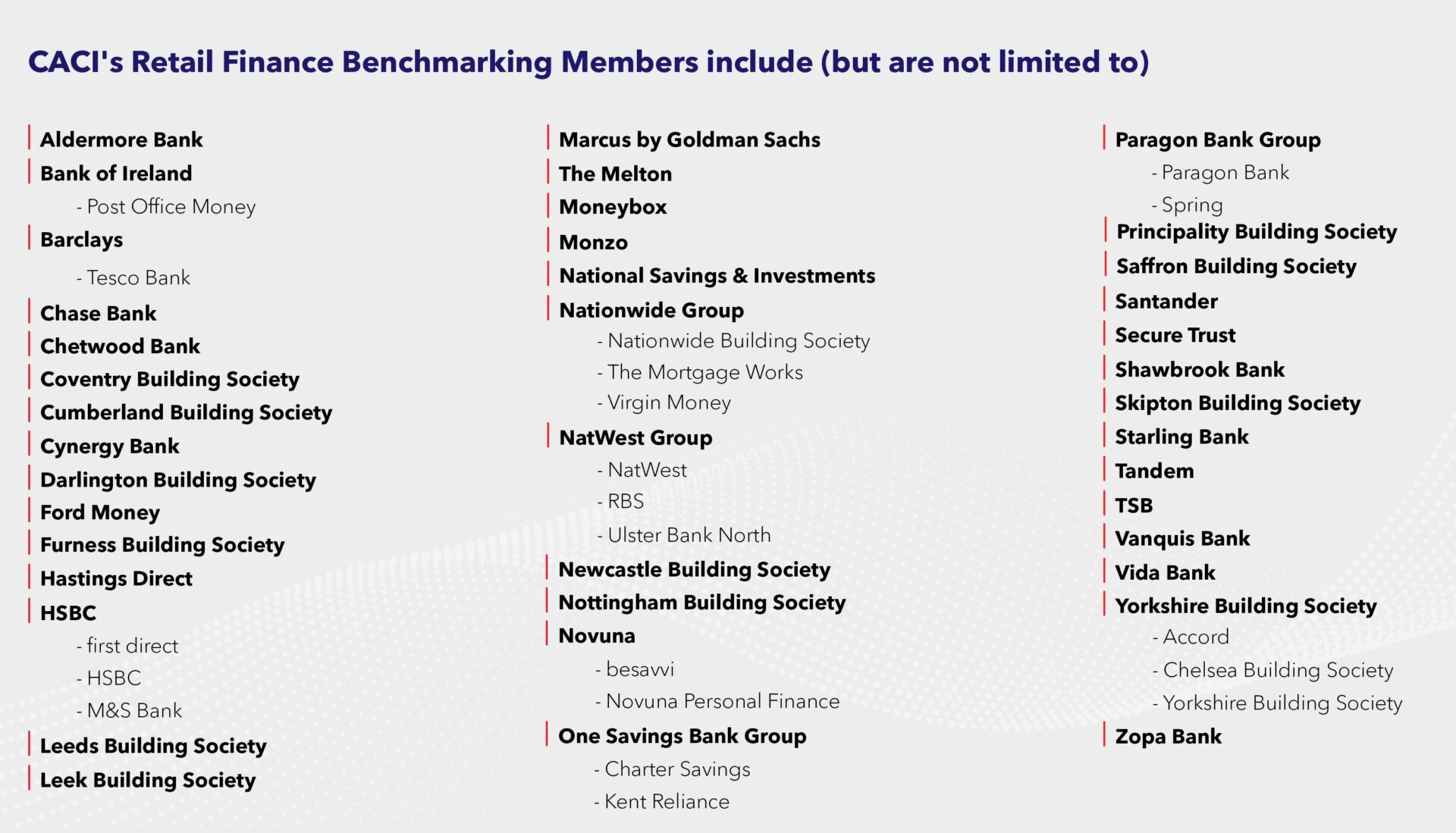
We are trusted by more than 50 of the UK’s banks, building societies and fintech providers for our market insight.

Member list for Retail Finance Benchmarking product

We bring our expertise to you

Leading companies choose Retail Finance Benchmarking for a reason

Trustworthy

Our data is reliable and objective. More than 50 of the UK’s banks, building societies and fintech providers trust our data and insights.

Timely

Our data is frequent, which makes it powerful. You can see the impact of your decisions earlier and spot shifts in retail demand sooner.

Tailored

Our data can be customised to members’ needs. Our data analysts can supply bespoke outputs. You also get personal advice and dedicated support.

Awards & accreditations

Speak to our Retail Finance Benchmarking team

Our specialist Retail Finance Benchmarking team is tried and trusted in the retail finance industry.

If you’re looking for a demo or just want to know more – we’re ready to show you how it all works and welcome you as a new member.

FAQs

Answers to common questions about retail finance benchmarking. 

Retail Finance Benchmarking is a CACI service that aims to give subscribing members a clear view of opportunities and trends in the UK’s current account, savings, mortgages and unsecured personal loans sectors.

We operate a series of exclusive, member-subscribed databases used by leading banks and building societies. Members contribute data anonymously and get insight not just into their own data, but also a pooled, anonymised view of the rest of the market.

Retail Finance Benchmarking gives you the critical information you need to make better business decisions. We also analyse and report on member performance so you can benchmark against the market.

You can access information and insight via interactive dashboards in a secure online portal, with full training provided by your dedicated relationship manager. Members are also invited to exclusive conferences and webinars.