Posts 5 lessons from the pandemic about the value of Housing Association data

5 lessons from the pandemic about the value of Housing Association data

In this Article

WHAT HOUSING ASSOCIATIONS HAVE LEARNED THAT’S ALREADY CHANGING THE FUTURE FOR THEIR COMMUNITIES

The extreme situation created by the Covid pandemic brought the value of data into the spotlight for Housing Associations, as they strove to support tenants and identify priority needs under lockdown conditions, at a time when face to face interaction was difficult or impossible.

As lockdown conditions ease, Housing Associations are considering what they’ve learned in these extremely challenging times and how it will influence their future strategy and operations.

The Covid-19 situation surfaced urgent needs and opportunities for many Housing Associations. Teams worked tirelessly to identify and support vulnerable residents and to maintain services while adhering to infection control guidelines. Planning and delivery would have been easier with clear and accessible information about the particular characteristics of properties and the needs of their inhabitants.

Working with Housing Associations throughout and beyond the pandemic, our sector experts have summarised five key factors that will influence the coming demand for housing and related services. Now’s the time to review your data strategy, to make sure your organisation has the information it needs in order to assess, monitor, and meet residents’ current needs and to model, predict and plan for ongoing and future needs in the post-pandemic landscape.

Digitalisation of services

Face-to-face and direct contact has traditionally been a core route to delivering services and providing information and engagement with Housing Association residents. In lockdown, this became very difficult. Many residents are both willing and able to engage through online media: some Housing Associations were able to offer online or mobile communication and services to replace in-person support at least temporarily. For example, holding consultations over mobile phone video-calling services like WhatsApp or Zoom, or allowing fault reporting via email or text-based services.

Building a robust and permanent digital service platform has emerged as a priority for many Housing Associations. It may have been a potential future project before: the pandemic has proved the demand and need. To offer a full range of tenant information and services online in the most efficient way, Housing Associations need complete and accurate data about the people they serve and the properties they live in. With this, they can make sure they offer the right digital support to the people who need it, providing a tailored experience for their household.

Self-help

Offering a digital service platform can improve resident experiences beyond basic fault reporting, bill paying and account information checking. If your Housing Association has accurate information about the systems and appliances installed in every property, you can go further, giving people online advice and trouble-shooting guides for common problems, for example re-igniting a boiler’s pilot light. This can be empowering and reassuring for residents who are able and willing to help themselves, removing the frustration of a long wait for support or not being able to report a problem by phone out of hours.

You can offer up-to-date online resources with advice on relevant topics like money management, community support networks and even job opportunities. In the pandemic, FAQs about coronavirus restrictions helped residents adapt to different ways of operating and understand how to access support and services.

Digital exclusion

Digital service delivery is empowering and meets expectations for many housing association residents who are digitally capable. But it cannot meet everyone’s needs. Some residents are digitally excluded, because they don’t have smartphones or other connected technology, or because they aren’t able to use it with confidence.

Knowing who cannot access digital services is crucial for a modern Housing Association. By collecting and recording this information accurately, you can make evidence-based decisions about the value and likely uptake of digital services. Most importantly, you can ensure that those who can’t use them have alternative channels of support. Face to face and paper-based communication are essential for some residents: if you know who they are, you can focus your time and resources on the people who need traditional support.

Vulnerability

With many residents confined to their homes during the lockdown, Housing Associations sought to make sure that everyone had the information and assistance they needed. With a complete data record for every household, it’s easier to identify residents who may have particular health or accessibility needs.

Beyond lockdown, this kind of information is very valuable for prioritising repairs and services to vulnerable residents. It also helps housing associations to ensure that they continue to provide accommodation with all the facilities that may be needed by a person with disabilities or particular needs.

This is sensitive data: it’s important that residents understand why you’re asking them to provide it. If you can explain clearly the benefits to them of sharing personal and health information, they are more likely to provide it accurately.

Economic hardship

In your Housing Association’s catchment, major employers can have a big impact on prosperity and hardship amongst residents. The post-pandemic economy is volatile and is likely to influence changes in employment and income for your householders. If you hold employment and financial data about your residents, you can be proactive in making sure their rents are affordable and anticipating issues that may arise from redundancy or reduced pay.

Third-party income and lifestyle data can help you identify trends in your area that may affect current and future tenants. This can also influence your recommendations to developers and housebuilders about the type and affordability of the housing stock that’s being built for the future.

All these types of data can help Housing Associations deliver better services for residents, responding more quickly and efficiently and planning for the future based on reliable evidence. The challenge is making sure you collect consistent and accurate data and that it’s shared securely within the organisation, so everyone has a clear and consistent picture for decision-making and prioritisation.

If you’d like to know more about developing a data strategy that supports your Housing Association objectives and improves residents’ experiences, download our free white paper “Insight for building flourishing communities”.

The actual experience of cloud migration for business

In this Article

LET’S TALK ABOUT THE REAL REASONS WHY ORGANISATIONS ARE MOVING TO THE CLOUD

Behind the hype, it’s solid business evidence that has convinced a critical mass of businesses of all shapes and sizes to make the leap to a cloud computing environment.

CACI Director Miguel Cardoso has worked with many of them over the past decade. He shares what’s really driven their decisions and the impact of cloud on their performance and prospects.

Security, modernisation, data governance, efficiency and cost reduction are some of the headlines that cloud computing providers use time and again to promote the adoption of platforms, applications, and services in the cloud. They’re great soundbytes, but what do they really mean for real world organisations who want to maintain their performance and drive further growth?

Cyber-security is a key reason that organisations I work with are adopting cloud – it’s a specific aspect of data security that’s becoming an ever-greater concern across all industries. The growing incidence and increasingly sophisticated nature of cyberattacks compel companies to invest in technologies and solutions that preserve one of their most important assets – data. Not all companies have teams with specialised resources in cybersecurity, so cloud computing emerges as the leading option to strengthen security and data protection.

The cyber-security resilience of a cloud computing environment come from the managed security services that leading providers offer. This means organisations without large IT and security teams can take advantage of the latest, sophisticated protective technology, and of focused, expertise that would be unaffordable internally. The cloud provider is responsible for managing and mitigating security issues, bearing the investment costs of the necessary technology and human resources as part of their core proposition. This alone is a strong reason to move to the cloud: organisations can offer their customers a vital and reassuring security message underwritten by the cloud provider.

Innovation and agility are frequently cited as cloud advantages. It’s common sense that every organisation wants these capabilities in an increasingly competitive and demanding market. So how does cloud computing help? The modern data platform it provides means that businesses can adopt the latest solutions and applications that support their business operations – from finance management and CRM to campaign delivery and customer analytics.

Cloud computing is inherently designed to connect data and systems, ensuring faster response times, greater accuracy and more informative reporting. All of these improve everyday operational performance and business management. It’s quicker, easier and more cost-effective to expand capacity, upgrade apps and add new functions, so you’re always working with the best technology tools for your business. Businesses that have moved to the cloud find they can adapt to market demands more quickly, keeping pace with customer needs while controlling profit and performance metrics.

Data storage is another key advantage that cloud adopters find compelling. The cloud has become the place of choice for data storage: when companies migrate their applications to cloud platforms they want to capitalise on the innovative applications and advanced analytics that are available. To make it happen, they need fast and systematic data organisation and accessibility. Creating a connected and complete picture of business-wise performance and customer data is much easier in the cloud. As well as enabling trusted management reporting and business governance based on current data, it supports more effective prospecting and forecasting using advanced predictive modelling tools. Cloud-based systems make these affordable and easy to use for all sizes of organisation.

Cost and efficiency come in a strong fourth place – an interesting development, since in the early days of cloud, they were its leading marketing messages. These days it’s taken for granted that cloud computing will be cheaper to run than the equivalent technological and human resources on-site. But even more important for most companies is the value they gain from more agile and modern systems, solutions and services as part of an overall digital transformation. Recent cloud adopters see significant benefits from the way cloud-optimised systems speed up and automate their processes, reducing the amount of manual rekeying and intervention. This frees up admin time so staff can focus on revenue generation and often creates extra capacity in the business to fuel growth.

These success stories are compelling. But is moving to the cloud synonymous with success? Not necessarily. Working with cloud adopters, I have observed that there are three key dependencies for organisations who achieve all the hoped-for advantages.

  1. Initial discovery and direction: you need to make an exhaustive survey of your company’s needs and define strategic goals
  2. The choice of solution: your cloud provider understand your priorities and critical success factors so they can be sure they’re providing exactly what your individual business needs
  3. Careful planning and project management: you must be thorough and rigorous, including all stakeholder and examining the impacts of change at every stage, from the selection of solutions and suppliers to the migration project and ongoing use

New clients frequently tell me that the cloud is “more complex than we expected”. Often, this is because of poor collaboration with previous suppliers. With our long experience, my team can provide an antidote. When we work on cloud transformation and migration projects we focus on:

  • Designing the right approach for the individual client company, with a strong and transparency connection to the desired commercial result
  • Using relevant specialist and industry skills to address core business issues for the company
  • Selecting and deploying the appropriate tools so they are easy to use, secure and viable in the long term to support an agile business that embraces the need to adjust and adapt in today’s demanding markets

If you’d like to talk to use about realising tangible benefits from moving your business to the cloud, please get in touch.

How tactical network automation can help banks respond to a changing financial sector

In this Article

The financial services sector has undergone seismic change – even well-established institutions are feeling the pressure from leaner margins and agile new competitors. In response, they’re hungry for new ways to drive efficiency, create revenue streams, and offer enhanced value to customers.

That dual demand – to unlock innovation and agility while cutting process costs – lands squarely at the door of IT.

A smarter, leaner finance sector needs responsive, cost-effective IT

At CACI, our specialists are used to helping financial institutions to optimise their network infrastructure. And we see every day how smart, tactical use of network automation can play a role in meeting the challenge by reducing workloads, improving quality, and meeting regulatory standards.

Automated switch checks improve visibility and accelerate ACI migration

It’s perhaps easiest to see the impact of tactical network automation in an accelerating and de-risking a major project, like network migration.

Next-generation data centre infrastructure is a key foundation for modern, data-driven banking. But achieving that transformation can often encounter unexpected and time-consuming obstacles.

For example, switching from a legacy system Cisco Application Centric Infrastructure can mean executing thousands of commands across hundreds of devices to define the migration requirements of each VLAN.

Instead of doing this manually, we built a script in Python 3, combining community-built packages to connect to each switch, translate the device output, and arrange the data into an easily manageable database.

It quickly extracted the information needed for migration planning and execution – preventing significant project delays, while eliminating the risk of human error.

MAC address checks de-risk migration in advance

Likewise, with ACI each IP address can correspond to one MAC address only. Any switches in the legacy infrastructure that exceed this limit could have a catastrophic effect. Finding them in advance of a migration is crucial – but extremely time-consuming. And missing one is a significant risk.

So on-site professionals from CACI built a solution to attach to each switch and create a report detailing which boxes have two MAC addresses or more.

Again, the automation saves potentially hundreds of engineer hours, and gives confidence that the migration can proceed without the risk of human error.

Self-service port provisioning saves hours and improves service

BAU processes can also benefit from automation – and here, the impact builds cumulatively over time.

For example, server deployment teams rely on fast, accurate port provisioning. As well as the initial configuration, each request requires extensive testing, and when completed manually the work can total dozens of engineer hours per week.

So we developed a proof of concept for a self-service system, where requests are made through a front-end web portal, but the provision and testing are automated.

As well as releasing engineer time and reducing risk, the solution prevents internal clients waiting for their request, accelerating their own work in turn. It also eliminates variations in naming and other standards, and documents each process for compliance purposes.

Bulk element configuration proves compliance without headcount

That compliance element demonstrates why automation is such a good fit for a regulated industry like finance. Because it can do more than just save time and headcount; it can provide documentation.

Each script in an institution’s library serves to document network requirements to be followed by engineers in future, and prove compliance with the relevant network engineering, security, and data sovereignty standards. And because the program is created to fit the bank’s own policies, conformity is built in.

Meanwhile, by eliminating manual configuration errors that could bring down key production environments, automation helps to avoid serious service outages that could result in sanctions from the financial conduct authority.

Quick, tactical wins with a long-term business impact

In these and dozens of other ways, we’ve deployed network automation to solve tactical issues, save financial institutions time and money, and facilitate faster, smarter working.

But the long-term cumulative effect is even more significant. The client always owns the IP in each script we’ve written and the program performs its task repeatably. That means the automation will go on saving time in future – so every solution we create makes the organisation that much more efficient and effective – ready to compete in tomorrow’s financial market.

If you’d like to discuss how we can use network automation to ease your migration, streamline your processes, or make you more efficient, please contact our Network Services experts today.

The mitigation of unwanted bias in algorithms

In this Article

Unwanted Bias is prevalent in many current Machine Learning and Artificial Intelligence algorithms utilised by small and large enterprises alike. The reason for prefixing bias with “unwanted” is because bias is too often considered to be a bad thing in AI/ML, when in fact this is not always the case. Bias itself (without the negative implication) is what these algorithms rely on to do their job, otherwise what information could they use to categorise such data? But that does not mean all bias is equal.

Dangerous Reasoning

Comment sections throughout different articles and social media posts are plagued with people justifying the racial bias within ML/AI on light reflection and saliency. This dangerous reasoning can be explained for, perhaps, a very small percentage of basic computer vision programs out there but not frequently utilised ML/AI algorithms. The datasets utilised by these are created by humans, therefore prejudice in equals prejudice out. The data in, and training, thereafter, has a major part in creating bias. The justification doesn’t explain a multitude of other negative bias within algorithms, such as age and location bias within applying for a bank loan or gender bias in similar algorithms where it is also based on imagery.

Microsoft, Zoom, Twitter, and More

Tay

In March 2016, Microsoft released its brand-new Twitter AI, Tay. Within 16 hours after the launch, Tay was shut down.

Tay was designed to tweet similarly to that of a teenage American girl, and to learn new language and terms from the users of Twitter interacting with her. Within the 16 hours it was live, Tay went from being polite and pleased to meet everyone, to a total of over 96, 000 tweets of which most were reprehensible. These tweets ranged from anti-Semitic threats, racism and general death threats. Most of these tweets weren’t the AI’s own tweets and was just using a “repeat after me” feature implemented by Microsoft, which without a strong filter led to many of these abhorrent posts. Tay did also tweet some of her own “thoughts”, which were also offensive.

Tay demonstrates the need for a set of guidelines that should be followed, or a direct line of responsibility and ownership of issues that arise from the poor implementation of an AI/ML algorithm.

Tay was live for an extensive period, during this time many people saw and influenced Tay’s dictionary. Microsoft could have quickly paused tweets from Tay as soon as the bot’s functionality was abused.

Zoom & Twitter

Twitter user Colin Madland posted a tweet regarding an issue with Zoom cropping his colleagues head when using a virtual background. Zooms virtual background detection struggles to detect black faces in comparison to the accuracy when detecting a white face or objects that are closer to what it thinks is a white face, like the globe in the background in the second image.

After sharing his discovery, he then noticed that Twitter was cropping the image on most mobile previews to show his face over his colleagues, even after flipping the image. Amongst this discovery, people started testing a multitude of different examples, mainly gender and race-based examples. Twitters preview algorithm would choose to pick males over females, and white faces over black faces.

Exam Monitoring

Recently due to Coronavirus it has become more prevalent for institutions like universities to utilise face recognition for exam software, which aims to ensure you’re not cheating. Some consider it invasive and discriminatory, and recently it has caused controversy with poor recognition for people of colour.

To ensure ExamSoft’s test monitoring software doesn’t raise red flags, people were told to sit directly in front of a light source. With many facing this issue more often due to the current Coronavirus pandemic, this is yet another common hurdle that needs to be solved immediately in the realm of ML & AI.

Wrongfully Imprisoned

On 24th June 2020, the New York Times had reported on Robert Julian-Borchak Williams, who had been wrongfully imprisoned because of an algorithm. Mr Williams had received a call from the Detroit Police Department, which he initially believed to be a prank, However, just an hour later Mr Williams was arrested.

The felony warrant was for a theft committed at an upmarket store in Detroit, which Mr. Williams and his wife had checked out when it first opened.

This issue may be one of the first known accounts of wrongful conviction from a poorly made facial recognition match, but it certainly wasn’t the last.

Trustworthy AI According to the AI HLEG

There are three key factors that attribute to a trustworthy AI according to the AI HLEG (High-Level Expert Group on Artificial Intelligence – created by the EU Commission), these are:

  1. It should be lawful, complying with all applicable laws and regulations;
  2. It should be ethical, ensuring adherence to ethical principles and values; and
  3. It should be robust, both from a technical and social perspective, since, even with good intentions, AI systems can cause unintentional harm.

These rules would need to be enforced throughout the algorithm’s lifecycle, due to different learning methods altering outputs that could potentially cause it to oppose these key factors. The timeframes where you evaluate the algorithm would ideally be deemed based on the volume of supervised and unsupervised learning the algorithm is undergoing on a specific timescale.

If you are creating a model, whether it’s to evaluate credit score or facial recognition, it’s trustworthiness should be evaluated. There are no current laws involving this maintenance and assurance – it is down to the company, or model owner, to assure lawfulness.

How Can a Company/Individual Combat This?

By following a pre-decided set of guidelines continuously and confidently, you can ensure that you, as a company/individual, are actively combatting unwanted bias. It is recommended to stay ahead of the curve in upcoming technology, whilst simultaneously thinking about potential issues with ethics and legality.

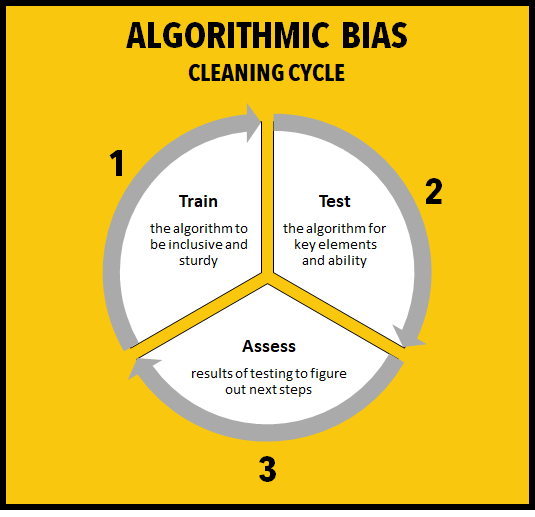
By using an algorithm with these shortfalls, you will inevitably repeat mistakes that have been already made. There are a few steps you can go through to ensure your algorithm doesn’t have the aforementioned bias’:

Assess – test results to figure out next steps that need to be done.

Train – your algorithm to the best of your ability with a reliant dataset.

Test – thoroughly to ensure there is no unwanted bias in the algorithm.

Companies that utilise algorithms, or even pioneering new tech, need to consider any potential new issues with ethics and legality, to assure no one is hurt ahead.

We can only see a short distance ahead, but we can see plenty there that needs to be done

A. Turing