Posts How to use customer insights to improve QSR loyalty programmes

How to use customer insights to improve QSR loyalty programmes

In this Article

From increased competition to navigating social media trends, understanding customers is essential to QSR loyalty programmes.

With ever-increasing competition in the QSR (quick service restaurant) space, brands are increasingly focusing on customer loyalty to maintain and grow market share. Of course, brand loyalty is nothing new across the retail sector, but there are myriad ways of achieving it in today’s increasingly convenience-led environment. From reward schemes and direct customer engagement to novel menu items and canny social media campaigns and advertising, loyalty programmes are competing on multiple fronts to capture customer loyalty. The customer experience is essential to this, with fast food operators honing in on customer insights to deliver positive experiences to drive repeat visits. 

This goes beyond just understanding what their favourite order is. Do you know who they are? Factors such as gender, age, employment and affluence inform trends such as which type of restaurant they are most likely to frequent. Do you know where they are? Understanding where they live, work and socialise, then where they are in the digital world in terms of social media platforms and apps they use. Then, crucially, do loyalty programmes know how to target them? It’s one thing gaining customer insights, another thing acting upon them effectively. 

Loyalty, in an increasingly congested market with new entrants competing for the same customer base, has never been more important to operators. Here, we’ll take a closer look at achieving customer insights and effectively acting upon them to build brand loyalty. 

Identify your customer 

Understanding the demographic data around a brand is the first step to achieving this. By diving into granular local data, it is possible to identify who lives there and who they are. This covers their profile across gender, age, affluence, spending habits, digital trends and overarching lifestyle habits. Are they likely to visit and/or order from a fast food restaurant? If so, which type and how frequently? 

In urban areas, the local demographic can change rapidly, meaning that it’s important to regularly monitor what’s happening around a QSR and be agile to any changes. What works today won’t necessarily be best tomorrow. This is why understanding customers is so crucial for loyalty programmes.

Identifying customers helps brands to build up a knowledge base that will inform their loyalty programmes. With so many marketing channels available, knowing your customer is paramount to effectively targeting them. It pays to know your customer and take advantage of marketing routes that offer them a bespoke experience. 

CACI provides demographic data across the UK to a multitude of organisations. You can read about our work with organisations, like Chopstix. They all need to understand the same thing: who lives near their services and who would benefit from them. By being able to identify customers around their sites, operators can begin to strategically plan loyalty programmes based on tangible local insights, not just overarching industry trends. By having such insights, loyalty programmes can differentiate themselves from their competitors by providing more targeted and bespoke experiences to customers. 

Know where to find them 

Brands need to know where their customers are in-person and digitally. Where do they live and work? What websites, social media and apps do they use? Combining such data with the knowledge of who they are, the personal insights become far more tangible and can be utilised to effectively target customers. 

This falls under missions, the reasons why customers visit restaurants, and meeting them where they are, at the right moment, via the right marketing channels. For example, a customer is probably unlikely to order fried chicken in the morning, but they might be tempted outside of their usual dining routine at the end of a night out. The right messaging, at the right time, can be hugely effective to influence this decision. 

This can be built upon using existing data from across a QSR’s customer base. If, for example, you have an app through which customers order, sending notifications at the right time helps, as does sending offers to customers who haven’t ordered in a while. This helps with the overarching customer experience and can be further built upon with seamless ordering, convenience and rewards. 

How can operators energise and excite customers? Reaching customers where they are is integral to this, with bespoke social media campaigns, games, promotions and in-app experiences essential to this process. If customers feel excited by a brand, this is a major step towards building brand equity and loyalty in their eyes. 

A real-world example of this is the work with Domino’s. CACI’s expertise in customer experience and transformation supported Domino’s to effectively target customers with the appropriate pizzas and offers, crucially delivered at the right time. While Domino’s defined and created the offers themselves, CACI enabled and supported the delivery of these offers to the right audiences. CACI also integrated demographic, wealth, and catchment data into its customised solutions, enabling Domino’s to understand who its customers were and how their locations related to their sites.

Understand how to target them 

Knowing how to target customers is essential. You have the info, but what do you want and need to achieve from your loyalty programme? The industry has been awash with innovation. From in-store games to product placement deals with major film releases, to reward cards and loyalty apps, there are several routes to market and several media through which to activate them. It’s all about standing out in a crowded market by offering unique and captivating experiences that drive repeat engagement.  

What works for one customer, however, won’t necessarily work for another. This is why it’s so important to gather relevant information on them, from who they are to where they are.  

It’s also vital that QSRs carefully consider what the aims of any loyalty programme are. Running them can often be expensive. For example, if it’s decided that an app is the right way to go, then the build, innovation, cost and maintenance within that infrastructure needs to be carefully considered upfront.  

Revisiting loyalty programmes frequently is equally important. In the food-to-go space, we generally see from our demographic data among Millennial and Gen Z customers that there is a desire for novelty. If your customer base widely consists of such customers, then partnerships, menu changes and competitions can be successful in building loyalty. For others, well-timed promotional offers and reward schemes may be more effective. 

CACI works with several QSR brands to regularly review their loyalty programmes. We support them in understanding what is and isn’t working, whilst considering the bigger picture of what needs to be achieved within available budgets. Do you need an app? Strategic partnerships with influencers? Social media campaigns? Traditional media campaigns? Our data and expert team help brands to cut through the noise and make informed, strategic decisions based on desired outcomes. 

Getting your QSR loyalty programme right

Loyalty isn’t a random reaction from customers it is a commercial imperative for operators in achieving long-term growth. Of course, there needs to be a baseline satisfaction with the delivery of product offerings and in-store locations and settings. If they don’t like the product, they’re unlikely to become repeat customers. Beyond that, however, there are myriad interaction points upon which brands can stand out from the crowd and offer unique experiences to customers.  

Different brands are at different stages of this journey. For brands operating a limited number of sites , building an app and investing in multi-channel marketing activities isn’t viable. For multi-site and franchise brands, the situation is very different. It comes back to understanding who the customer is, where they are and how a restaurant can offer them an experience that retains them when they consider visiting a site in future. 

Ultimately, it’s a case of activating the right insights in the right channels, at the right time. CACI’s data and expertise support loyalty programme wherever they are on the journey. Be that new entrant to the UK market interested in how your loyalty programme will succeed in a new market, revisiting a long-established loyalty programme or those looking at expanding or even starting out with a loyalty programme, we can help. 

By equipping you with unparalleled consumer insights and consultancy on loyalty activation, we can support you in your loyalty programme, in standing out from the crowd and in establishing a programme that supports your business needs.  

Discover more about driving customer loyalty in your business. Get in touch today.

Beyond the store: Unlocking the hidden value of retail’s halo effect

In this Article

The halo effect explained – and why it matters now

A consumer’s shopping experience is no longer a linear journey. They browse and research products online, visit physical stores, engage on social media and buy through a brand’s website and wholesale distributors. For landlords and retailers, this means that physical stores influence much more than just in-store sales. 

This reality is what has made measuring the ‘halo effect’ critical. But what exactly is it and how can retailers and landlords leverage it to make better location-based decisions and monetise store performance?  

Defining the retail halo effect

The ‘halo effect’ is the contribution a physical store makes to online sales in its surrounding catchment. 

A physical store plays a crucial role in brand building. If a customer is frequently reminded of your brand by passing your store while on their commute, they will be more likely to purchase from your brand online. Offering a distinctive brand experience will not only enable your physical location to drive online sales, but ensure your shelved products stand out to customers already spoiled for choice.  

Ultimately, a strong physical store presence will enhance digital performance. 

Why the halo effect is critical for retailers and landlords

Whether you are a retailer aiming to understand the true value of your stores or a landlord looking to attract the right tenants for your centre, being able to clearly measure how each store presence drives online revenue leads to better decision-making. As consumer behaviours evolve, understanding and quantifying this relationship has become crucial. 

Making sense of the halo effect in practice

Viewing all channels as interconnected is necessary in modern retailing. By measuring the halo effect, you can understand exactly how a physical store’s presence will impact digital performance and where potential opportunities lie.

For landlords

When a tenant’s stores drive strong online sales in the surrounding area, engaged and high-spending shoppers are easy to attract to the broader retail destination as a result. Quantifying this cross-channel synergy helps you:  

  • Draw a more precise picture of total revenue and brand impact 
  • Understand how your physical presence influences your online revenue  
  • Recruit the right tenant mix 
  • Set fair rent expectations

For retailers

As a retailer, understanding the online revenue tied to a physical location will show whether a store is pulling its weight. If a location seems to have low in-store sales but a robust online halo, closing it might mean losing profitable online business. Being equipped with halo effect insights affects everything from site selection and store relocations to lease renewals and marketing investments. 

The strategic impact of the halo effect

Insights from a physical store are more than just in-store interactions. They generate brand exposure that leads to online sales, which is where measuring the halo can be particularly useful in unlocking true value. 

  • Refined network strategies: Attributing online sales back to store catchments offers you insight into exactly which locations are high performing.  
  • Targeted investment: Depending on where the halo effect is seemingly strongest, you may opt for upscaling, refurbishing or increasing marketing around certain locations.  
  • Risk management: Understanding the real online revenue at stake prevents costly mistakes before closing or relocating a store and that resources are allocated to areas offering the greatest return on investment. 
  • Refined customer strategy: The online halo alone does not tell you whom to target, but reveals where your physical presence yields the biggest impact on online sales. Combining halo measurement with in-depth customer segmentation broadens strategic possibilities. 

How CACI helps you measure and monetise the halo effect

By understanding the halo effect, you can improve location-based decision-making and discover the full picture of your interconnected physical locations and digital channels. 

CACI helps retailers and landlords bring this to life. Our deep experience in shopper behaviour, demographic profiling and location analytics helps you extract meaningful insights from your halo measurements.  

Our market insights ensure landlords understand where their tenants’ customers originate, who shops at specific locations and how to attract similar shopper profiles to other areas to improve tenant mix and increase footfall.  

By layering the halo effect with demographic data, retailers can better assess where expansion or downsizing aligns with their target consumers’ shopping habits. Marketing campaigns can be tailored to amplify engagement and conversions across channels. 

From understanding consumer catchment through Retail Footprint to evaluating online sales contributions via Brand Dimensions you can redefine the future of omnichannel retail, reassess investments and granularly view your stores’ performance.  

Contact our experts today to find out more. 

What transaction trends & growth opportunities is the Food to Go sector experiencing in 2026?

In this Article

This year’s MCA Food to Go conference unveiled the key growth drivers, future trends and exciting developments shaping the sector. It highlighted everything from innovative technology and formats to trendsetting menus and marketing, ultimately exploring how successful brands are navigating market challenges.

At the conference, I showcased transaction trends and growth opportunities emerging in 2026 based on three months of data from CACI’s Brand Dimensions dataset. By tracking 30+ food to go brands from November 2025 to January 2026, I assessed the trends and opportunities fuelling growth questions this year. 

Here is what the data revealed. 

Food to Go transaction trends & growth opportunities in 2026

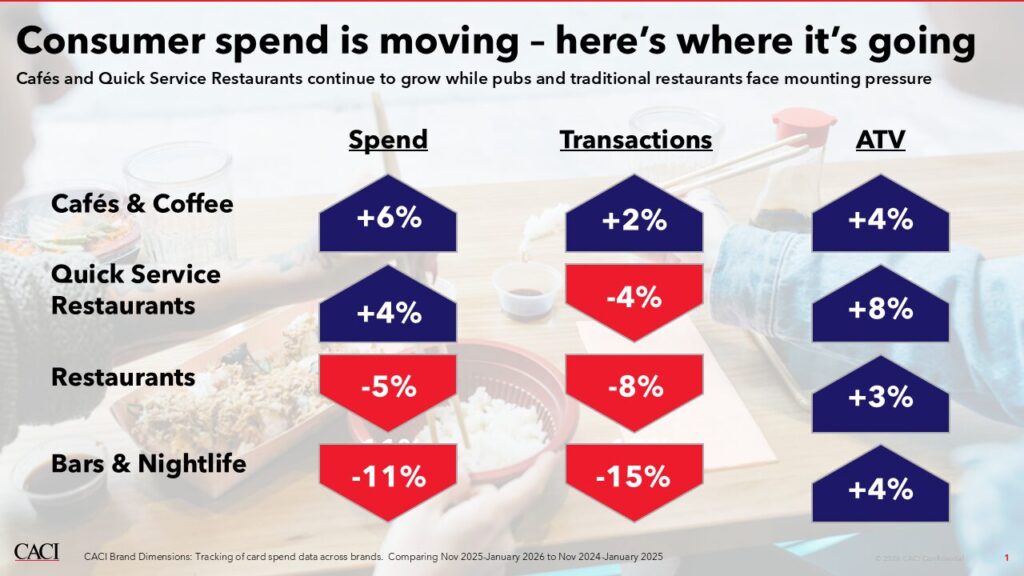
Graph showing change in consumer spend across different food industries. 'Cafes and Coffee' and 'Quick Service Restaurants' have seen the highest growth in spend

The findings showed: 

  • +6% YoY revenue growth in the Cafés & Coffee Shop market 
  • A slight decrease in Quick Service Restaurant (QSR) transactions, but a slight increase in Average Transaction Value (ATV)  
  • Transactions and revenue dropping across the wider F&B sector

Which brands are leading industry trends in 2026?

From the 30+ up-and-coming and major players in the food to go sector tracked, I identified the leading brands as those achieving YoY growth above inflation and sorted them by increase in growth percentage. 

Premium healthy lunches: Atis & Farmer J

Consumers continue to prioritise premium healthy lunches this year.  

The leading brands were Atis, growing 140%, and Farmer J, growing ~30%. Atis’ skyrocketing growth is driven by the opening of a third new space in the last year. While substantial and impressive, it is the smallest brand in CACI’s Food to Go tracker, meaning the overall GBP shift in the market is small.  

The largest share of the customer mix for these brands comes from CACI’s Acorn profiles Prosperous Professionals at 15% of spend followed by Up-and-coming Urbanites at 11%. 

For new entrants, the challenge to growth is proving value in each transaction, precise targeting and mission expansion without undermining the brand or cannibalising sales. 

Continued growth in chicken QSR: Popeyes, Wingstop & Slims

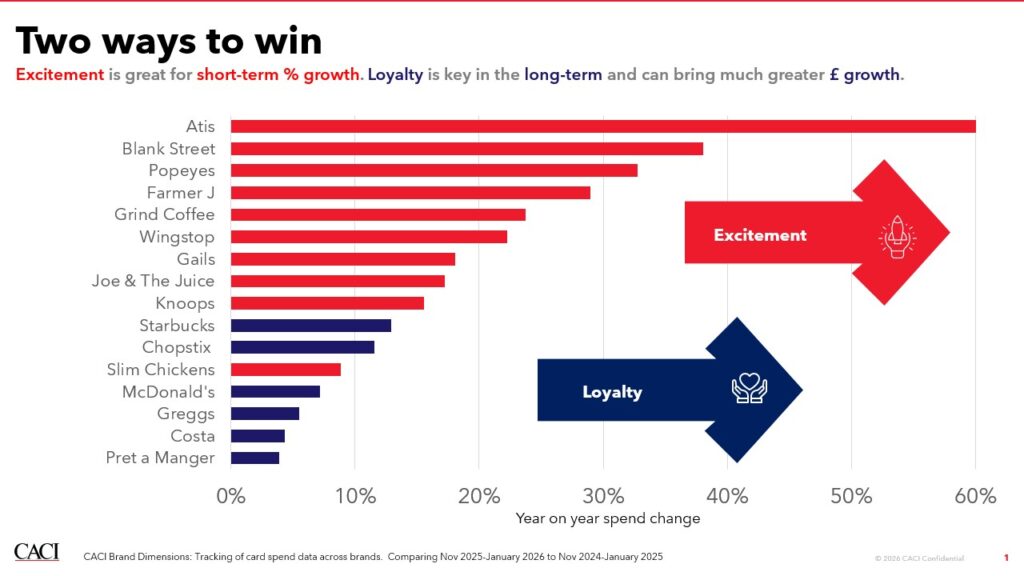
Consumers continue to seek indulgence and novelty. In the chicken QSR sector, our findings concluded Popeyes grew ~30%, Wingstop ~20% and Slims ~9% (who were +46% in the first quarter of the year). While this may counter the premium healthy lunch trend, consumers are finding ways to balance health-conscious choices with indulgent ones. 

Caffeine & matcha on the rise: Blank Street & Grind

Both Blank Street and Grind grew over 20%, indicative of the brands’ innovative products, strong social media presence and matcha-led menus. These brands have evidently appealed to younger, experience-driven consumers by creating excitement through their product innovation. 

Established brands are driving growth by harnessing loyalty 

Graph showing year on year spend change for a number of different food brands. The brands with the largest year on year spend change are Atis and Blank Street. The chart shows that while excitement is great for short term percentage growth, loyalty is key for long-term and spend growth,

The biggest takeaway is that while new entrants win on excitement, established brands win on loyalty.  

New brands have brought excitement, and with that, percentage growth, but most saw YoY growth rates slow across the year. Meanwhile, more established brands like Pret a Manger, Costa, Starbucks and McDonald’s saw stronger growth in the latest quarter. When assessing actual pounds versus percentage growth, established brands are back growing and seeing very substantial sales gains. This reiterates the impact of loyalty on long-term growth.  

The formula of the current state of the market then becomes:  

Excitement = short-term percentage growth. Loyalty = long-term monetary growth. 
 
New brands, social media influence and new cuisine are fuelling excitement. Loyalty is driven by familiarity, perceived value, brand resonance and communication. Brands that can achieve a sweet spot between both are poised for sustainable growth. However, our findings suggest tension between excitement and loyalty. This prompts brands to reflect on how to maintain excitement or build customer loyalty.  

Four strategies to drive growth in a tough climate

1) Having the right products in place 

Brands must understand how to appeal to existing customers and excite new ones. Product and menu innovation should be strategically considered to open new missions and tailor to the right locations, dayparts and missions.

2) Getting the right space

While growth can be achieved by acquiring new spaces, established brands are always optimising their spaces to reach the right people, in the right place, at the right time. This is why some brands are shifting to drive-through locations as town centres decline and why many have opted to offer FMCG products in the chilled sections of supermarkets.

3) Appealing to customers through the right message 

Tailored content sent to the right target group at the right time with the right incentive is critical to success. 

4) Delivering with the right service

Profitably staffing each location, determining which locations will best suit trialling self-service kiosks and avoiding alienating or upsetting customers who value your brand’s personal service are critical considerations.

This is often easier in the new entry “excitement” phase, but new and established entrants must constantly evaluate that they have the right mix of these factors to remain relevant in a rapidly changing market. Each of these strategies has a ‘people, place and time’ lever that can be pulled to maximise growth by leveraging customer loyalty.  

How CACI’s Brand Dimensions can help your Food to Go business thrive

With so much complexity in the food to go sector, brands need more than just internal customer data to keep on top of the mix. Supplementary market data through CACI’s Brand Dimensions can help you answer your growth questions, combining the right data with the right tools to project long-term growth through the right mix of products, services, places and messaging. 

Highly detailed, timestamped transaction data is at the heart of Brand Dimensions, indicating anonymised customers and specific outlets to infill any data gaps and gain unique performance and competitor outlet insights.

When combined with anonymised mobile activity data and demographic classifications, it creates a cohesive base to address the people, place and time levers driving growth. This can also be topped off with lifestyle attributes linked to those demographics, competitor location data and competitor sentiment data. 

Through this, businesses can better prepare for the future by understanding consumer behaviour at brand level. 

Although Brand Dimensions is typically tracked on a monthly basis, these findings have been summarised quarterly for this blog.  

If your brand could benefit from these data insights, book a Brand Dimensions demo with us.