


Consumer spending habits on cosmetic and weight-loss treatments are shifting, driven by young adults. Our blog takes a closer look.
Continuing on from our previous blog on price sensitivity among healthcare consumers, we wanted to explore the ways in which consumer spending habits are evolving. The data is again based on our H1 Voice of the Nation survey, a poll of 2000 UK-based adults.
In this blog, I want to explore the way in which consumer spending habits are changing across the cosmetic and weight-loss treatment market.
Key insights from the survey
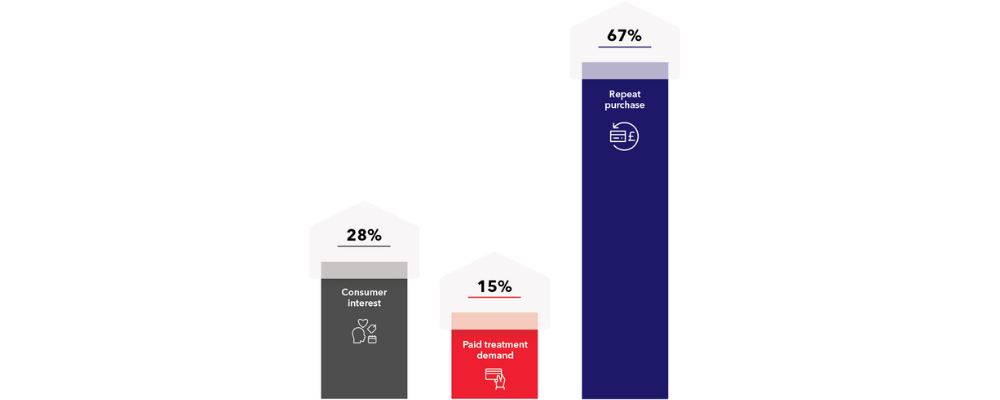
- 15% of consumers expect to pay for weight-loss treatments in 2026, up from 13% in 2025.
- Repeat usage is exceptionally high, with 67% of weight-loss treatment users planning to purchase again.
- Gen Z and Millennials are driving demand.
Gen Z and Millennials are shifting consumer behaviour
We can clearly see an upward trend in spending on weight-loss treatments as new products, notably GLP-1s, have arrived onto the market. It has risen 2% year-on-year. Spending on weight loss treatments is overtaking spending on other cosmetic treatments, with spending on those dropping 2% over the same period: 14% of respondents in 2025 expected to pay for cosmetic treatments, decreasing to 12% for 2026.
With weight-loss treatments starting to drive demand, the retention rates for such products are impressive. Two-thirds (67%) of those who paid for weight-loss treatments in 2025 also expected to do so again in 2026. This is the highest repeat spending observed in the data among different types of private treatment.
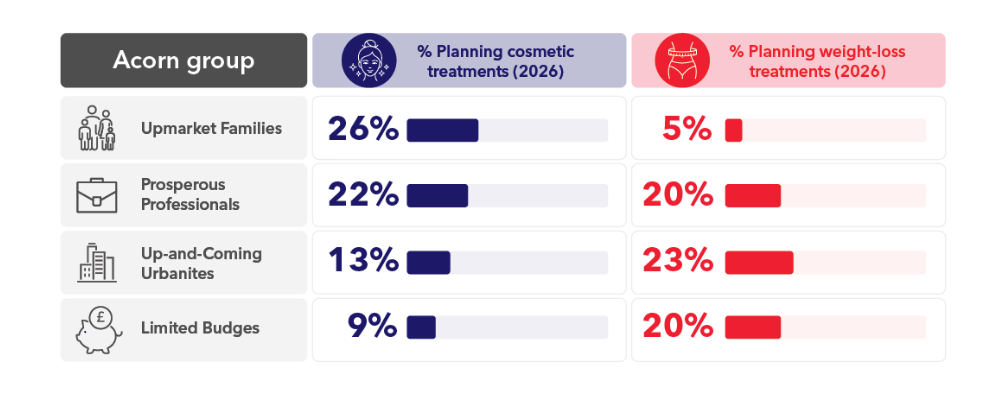
Observing the survey data through the lens of Acorn, CACI’s geodemographic segmentation of the UK population at postcode level, the anticipated take-up of cosmetic and weight-loss treatments varies wildly. The results demonstrate the extent to which age is a greater factor than affluence when it comes to spending in this area. Observing the survey results through specific Acorn groups:
- Among Upmarket Families, 26% planned to pay for cosmetic treatments, but only 5% for weight loss
- Within Prosperous Professionals, 22% would pay for cosmetic treatments and 20% for weight loss
- Up-and-Coming Urbanites exhibit the opposite behaviour, with 13% looking to pay for cosmetic treatment but 23% for weight loss
- At the lower end of the affluence spectrum, 9% of the Limited Budgets group would pay for cosmetic treatment but 20% for weight-loss treatments
It is clear that consumers are increasingly viewing healthcare as a growing concern and an ongoing service. The repeat spending on weight-loss treatments emphasises how consumers, particularly younger adults, are willing to invest in such products.
How can healthcare providers respond to this?
From the high retention rates in the weight-loss results, the most successful healthcare organisations will build continuous engagement models similar to those used by digital wellness brands. This includes the deployment of mobile apps which offer support and engagement between appointments or to track progress. When it comes to weight loss, being able to offer real-time results tracking and digital coaching can facilitate consumers realising the benefits of such products, which will help to drive retention rates.
As we explored the impact of price and affordability in our last blog, it was clear that cost is the major driver in the uptake of weight-loss treatments. Once consumers are onboard, however, there is a clear opportunity to retain them. Loyalty offers can help to make customers feel valued, whilst success stories from other customers can help them to realise the benefits of such products.
Personalised pathways powered by analytics and consumer-driven results can also help customers to navigate product offerings and work out what works best for them, with professional support on hand from the healthcare provider. This can help with things like managing dosage and side effects.
This approach is already being adopted by leading digital healthcare providers. Speaking at CACI’s Data Summit, Numan’s Director of Analytics and Data, Max Ratcliff, explained how customer insight, predictive analytics and personalised interventions are helping to improve both patient outcomes and retention within the rapidly evolving obesity care market. By combining medication with coaching, digital engagement and data-led personalisation, providers can create experiences that keep patients engaged for longer and support better health outcomes.
Key considerations
There are key technology angles for healthcare providers to consider here:
• Remote monitoring and digital coaching
• Mobile apps that support patients between appointments
• Personalised treatment pathways powered by analytics
• CRM-driven retention strategies and automated engagement
Consumers expect to interact with services digitally, so offering that service is important. Whilst it offers a valuable service to your customers, it can also help you better understand them and their behaviours. If someone is struggling to meet their weight-loss targets with your product, for example, you can create contact points to reach out to them. Even automated touchpoints provide value to your customers, helping to drive retention rates.
The world of GLP-1s is evolving, too, with the approval and arrival of such treatments in tablet form. Healthcare providers and brands will need to understand both the barriers to entry and motivations of different consumer groups to newly available treatments to best position themselves in this dynamic market.
CACI offers solutions to help healthcare providers drive enhanced user experiences to improve customer satisfaction. Our UX and digital design expertise help brands to refine digital touchpoints to create meaningful connections with their customers. We can help you put your customers first, by providing them with the service they expect.