


AI adoption continues to accelerate across industries, with more teams than ever experimenting with the technology across customer experience, operations, software development and marketing.
Yet for all the excitement, many leaders are finding that turning AI ambition into tangible business outcomes is harder than expected.
Today’s teams have access to more tools, platforms and capabilities than ever before, so the challenge becomes knowing where to focus, how to prioritise opportunities and what needs to be in place before AI can be successfully adopted at scale.
Before investing significant time, budget and resource into AI, there are five questions worth asking.
1. What business challenge are we trying to solve?
The pressure to act on AI is understandable, however there is a risk that business leaders become focused on the technology before they’ve clearly articulated the problem they’re trying to address.
The strongest AI implementations identify a business challenge that already exists and explore whether AI can help solve it.
The challenge could be employees spending too much time searching for information. It could be customer service teams overwhelmed by repetitive enquiries. Or it might be operational processes that still rely on manual effort, creating delays and inefficiencies.
These are challenges that already have a cost attached to them, whether that’s time, money, productivity or customer satisfaction.
Starting with the problem creates a much clearer basis for evaluating whether AI is the right solution. It also makes it significantly easier to determine whether the investment has been worthwhile.
2. Do we understand our starting point?
Many organisations continue to face challenges around governance, workforce readiness and risk management as they look to scale AI initiatives. These areas rarely attract the same attention as the technology itself, yet they often play a much greater role in determining whether an AI programme succeeds in the long term.
Before defining a roadmap, you should understand the reality of your current position: How accessible is your data? How mature are your governance processes? Is ownership clearly defined? Are the right skills available internally? Do teams understand how AI will be used within existing workflows?
These questions may not generate the same enthusiasm as discussing the latest AI tools, but they provide a far more reliable indicator of whether an initiative is likely to scale successfully.
3. How will we know if we have been successful?
One of the easiest ways for an AI project to lose momentum is for nobody to agree what success looks like.
It’s surprisingly common. A pilot launches, feedback is broadly positive, adoption is reasonable, but six months later stakeholders are still debating whether the initiative delivered meaningful results.
Successful transformation programmes avoid this ambiguity by defining outcomes upfront.
The exact metric will vary between teams. For some, it may be reduced handling times. For others, it might be improved productivity, lower operational costs, faster access to information or increased customer satisfaction.
What matters is establishing a clear link between the initiative and the outcome it is expected to achieve.
Those that see the greatest value from AI are rarely those chasing the latest tools. They are the ones that start with a clear business objective and a clear understanding of the outcome they want to achieve. Before any implementation begins, they know what success looks like, how it will be measured and why it matters to the business.
4. Are the right people involved?
One of the most common misconceptions surrounding AI is that it sits solely within the technology function. In reality, successful adoption depends on much broader organisational alignment.
Technology teams play a critical role in delivery, but they rarely own the business problem being solved. Operational teams understand where inefficiencies exist. Business leaders determine priorities and investment decisions. Your people ultimately decide whether a new capability becomes embedded into day-to-day ways of working.
When these groups aren’t aligned, even technically successful deployments can struggle to gain traction. A solution may work exactly as intended, but if it doesn’t fit existing processes, address a genuine business need or secure buy-in from the people expected to use it, adoption is likely to stall. That’s why the most successful AI programmes are typically owned by the business and enabled by technology, not the other way around.
5. What is the smallest step that creates momentum?
Visions of enterprise-wide transformation are compelling, but they can also create inertia. Teams become focused on designing the perfect programme rather than taking practical steps towards implementation.
A more effective approach is often to start smaller. That might mean deploying a knowledge assistant to help employees find information more quickly. It could involve automating a repetitive reporting process or supporting customer service teams with AI-powered recommendations.
Many of the most successful AI adoption stories began with focused, well-defined use cases that allowed organisations to test assumptions, understand adoption patterns and demonstrate measurable outcomes. Those early successes provide valuable evidence, helping leaders secure investment, build confidence and identify where to focus next.
Momentum is one of the most powerful assets in any transformation programme. Once teams can see a tangible outcome, larger-scale change becomes significantly easier to support.
eBook
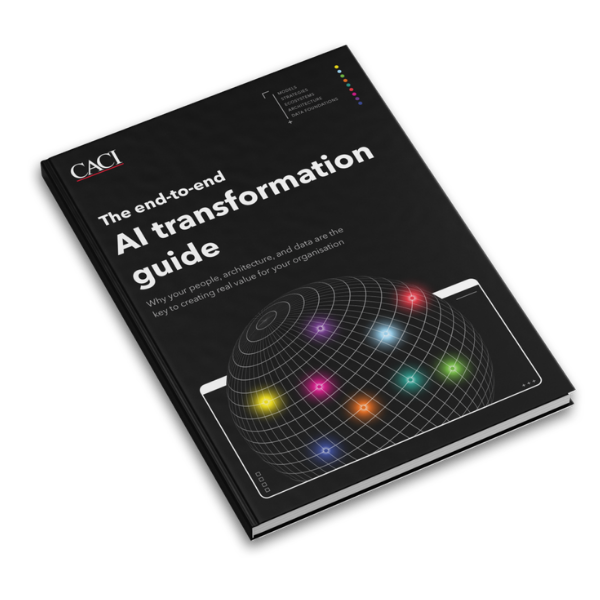
The end-to-end AI transformation guide
AI has the potential to transform how organisations operate, innovate and compete, but success relies on more than technology alone.
Looking beyond technology
As we continue to explore AI opportunities, the conversation is naturally becoming more sophisticated.
The technology itself is evolving rapidly. The harder challenge is determining how AI fits within existing business priorities, operating models and ways of working. Those seeing the greatest success aren’t necessarily those with access to the most advanced tools. They’re the ones taking a structured approach to readiness, governance, adoption and change.
Ultimately, successful AI adoption requires an understanding of leadership, operating models, data foundations, security and organisational change. The teams that get these foundations right will be better positioned to move from experimentation to enterprise-wide capability.
Build a clearer roadmap for AI transformation
In our latest guide, Architecting for AI Transformation, Ananya Sadera, draws on over 25 years of experience helping senior clients navigate complex transformation programmes, explores how leaders can assess readiness, align stakeholders and create the foundations for successful AI adoption.
Alongside Ananya’s chapter, the guide brings together insights from eight additional specialists across CACI, covering data foundations, operating models, architecture, security, governance, adoption and MLOps. Together, they provide a holistic view of what organisations need to consider as AI moves from experimentation to enterprise capability.
Download the full guide to access all nine expert perspectives and build a clearer roadmap for AI adoption. Have questions about your AI strategy, readiness or next steps? Get in touch with our specialists to discuss how your organisation can move from experimentation to scalable, business-led adoption.