
What is Marketing Mix Modelling (MMM)?

In this Article

Benefits of marketing mix modelling (MMM)

For any marketing activities to be successful, understanding consumers’ behaviours and whether a channel is oversaturated is essential. While data and analysis play undeniably important roles in this, marketing mix modelling (MMM) plays an even greater one, representing the merging point of data and analysis with the psychology of consumer understanding.  

Marketing mix modelling (MMM) is a statistical tool that enables an understanding of how each part of an organisation’s marketing activity impacts consumers’ behaviours, sales, return on investment (ROI) and more. Through MMM, an organisation’s performance can be broken down by channel and various types of data can be incorporated to evaluate the effectiveness of marketing activities and determine which are making the most substantial differences to the organisation’s overall performance. 

  • Enables organisations to quantify and measure marketing channels effectively to assess which drive the most sales and return on investment 
  • Equips organisations with long-term insights that will bolster planning through effective forecasting and marketing campaign generation based on previous performance  
  • Helps organisations allocate budgets according to the best performing channels due to measuring growth based on investments
  • Instils confidence due to its statistical reliability and being privacy-safe, both of which are particularly important in a post-cookie world
  • Offers organisations a holistic view of the impacts that various factors will have on achieving specific KPIs, ensuring marketers can make more informed decisions based on how and when marketing activities will impact KPIs. 

How do marketing mix modelling (MMM) & commercial mix modelling (CMM) work?

Marketing mix modelling (MMM)

Marketing mix modelling (MMM) is used by organisations aiming to understand how marketing activities impact KPIs being measured. Its ability to measure the impact that certain pricing choices, promotional offers, product launches or advertising campaigns may have on sales makes it a game-changer for organisations. 

In MMM, the dependent variable used to assess the relationship between sales and marketing activities is usually:  

  • Sales volume: to assess the impact of different marketing activities on sales 
  • Revenue: to track the amount of money generated by sales 
  • Competitor analysis: to understand how your organisation’s marketing activities are affecting your position in the market. 

In contrast, the independent variables in MMM are the marketing activities or factors that might drive those results, such as: 

  • Advertising spend: the amount invested in promotion across various channels. 
  • Price: to explore the impact of price adjustments on sales 
  • Promotions: discounts, coupons, or offers that could increase sales 
  • Distribution: the potential impact of product availability across various locations on sales. 

Commercial mix modelling (CMM)

Commercial mix modelling (CMM) is an analytical approach that examines a variety of commercial factors that drive an organisation’s performance. It begins with collecting data from across the organisation on pricing, promotions, distribution channels, products and more, combining the resulting data into a cohesive dataset.

The insights presented within the dataset help organisations gauge which factors contribute most to performance and where investments result in the highest returns. It also enables organisations to test various scenarios— price changes, promotional adjustments, changes within distribution channels— to assess the potential impact on performance. Through this, organisations can optimise their overall commercial mix to grow and become more profitable.  

How does commercial mix modelling (CMM) differ from marketing mix modelling (MMM)?

While both commercial mix modelling (CMM) and marketing mix modelling (MMM) are granular approaches that help organisations analyse the impact of marketing activities, their scope, methodology and applications differ.  

Scope

CMM offers a broader approach when it comes to evaluating the marketing activities that would impact an organisation’s performance, integrating various functions to optimise revenue and profitability. It encompasses external, non-marketing data sources such as weather, seasonality, competitor pricing, interest rates, etc.  

MMM, on the other hand, is more partial, purely marketing data that offers a more detailed and expansive result. As a statistical analysis method, it quantifies the impact that marketing activities— campaigns, paid advertisements, promotions, etc.— have on specific KPIs. Focusing more on media and investments rather than a wider marketing strategy, its granularity is what marks its stark contrast to CMM.  

Despite the broad scope of CMM, it is just as granular and technical as MMM. 

Methodology

CMM blends analytics, business intelligence and strategic insights, considering both internal and external factors that can affect an organisation’s growth. The approach entails: 

  • Scoping & data auditing:
    • Understanding the KPIs and defining whether the model should target revenue, acquisitions, renewals or some combination form the scoping basis. Data auditing includes tech and journey mapping to determine the stages comprising the funnel for lead gen and closing, as well as the tools and tech used at each stage. 
  • Data collation & cleaning:
    • This includes a data request to outline the full scope of what can be used in the model, with cleansing, organising and playback taken into consideration to check for completeness and broad accuracy. During this stage, data is also combined and reaggregated for ingestion into the model. 
  • Exploratory analysis & feature configuration:
    • Plotting all the raw data to understand distribution and periodicity and exploring this raw data to identify gaps and anomalies is conducted during this stage. Correlation analysis helps find feature relationships and possible collinearity, feature types are configured for use in the model and decay is applied (AdStock) to channel features to simulate the memory effect of advertising.
    • Diminishing returns to channel features simulate channel saturation and other transformations such as smoothing or feature combination.  
  • Pre-processing & feature engineering:
    • Calendar and dummy variables can be included to represent milestones and seasonality, with each variable transforming across a range of parameters to find the most realistic behaviour. 
  • Commercial mix modelling (an iterative process with pre-processing & feature engineering):
    • Once the model for the approach is scoped (e.g. logistic vs. linear, pooled, nested, hierarchical) and fit for processed features to optimise accuracy and generalising power, it is then checked against existing commercial knowledge and external priors and returned to feature processing to refine variables and tune parameters accordingly.
    • All candidate variables are imported and tested from the pre-processing stage. Finally, the model is refined continually by adjusting variables to optimise statistical measures of accuracy. 
  • Optimisation & simulations:
    • The present channel saturation is analysed, the optimal channel mix is delegated for specific budgets and results are presented from scenario simulations to understand which channels have headroom and which are oversaturated.
    • A budget guide is provided for optimising revenue and the ability to plan for different scenarios: mitigating headwinds, capitalising on opportunity and planning contingencies. 
  • Next steps & recommendations:
    • Recommendations are given based on budget optimisations and added value. 

MMM, in comparison, focuses on econometric modelling and regression analysis to determine the contributions made by various marketing channels on an organisation’s outcomes. Econometric modelling is a statistical, mathematical approach that quantifies the relationship between marketing activities and business outcomes, built with historical data. Regression analysis is a technique used within econometric modelling to measure the impact of independent variables (marketing activities) on dependent variables (sales or revenue). 

Application

Senior executives and C-suite employees may use CMM for longer-term strategic planning and decision-making, whereas MMM would be used by marketing teams to optimise spending and budget allocation towards campaigns or advertisements.  

The broader scope of CMM enables senior executives and C-suite employees to gain a complete picture of the various commercial drivers and their impact on marketing rather than isolated results. On the other hand, the granularity of MMM ensures marketing teams strategically plan and forecast how changes in spending across channels might impact sales and plan scenarios accordingly. 

How to build a marketing mix model

The first step in building a marketing mix model will be to collate and prepare your data. This will involve collecting historical data on sales and marketing spend across different channels and should go back far enough in time to effectively capture market conditions and seasonality fluctuations. 

Next, selecting the appropriate model to facilitate this will be crucial. Selecting the model can come from its robustness or flexibility, catering to your organisation’s unique needs. 

Building the model will come after this. This will include defining the relationship between marketing spend and sales or other KPIs and considering carryover effects, saturation or external factors. 

Furthermore, fitting the model will use your historical data to estimate the parameters of the MMM. Once the model is fit, the results can be analysed to precisely determine their contributions towards each marketing channel. 

Finally, the insights gleaned from these results can help you adjust marketing strategies accordingly, increase budgets within the highest-performing channels and reduce it in those underperforming. 

Examples of marketing mix modelling (MMM)

Organisations across a variety of industries can apply marketing mix modelling (MMM) to lead to improved outcomes. A few of such examples include:  

  • Consumer Packaged Goods (CPG): Gathering data on sales, advertisements, campaigns and pricing can help CPG organisations understand which channels—digital advertising, TV campaigns, etc.— drive the most overall return on investment. 
  • Retailers: From seasonal promotions to discounts and the influence of both in-store and online presence, retailers can leverage MMM to understand peak performance periods, digital sales and foot traffic to allocate budgets accordingly or reassess promotional calendars.  
  • Financial Services: Financial institutions can use MMM to evaluate their multi-channel advertising efforts and ensure they are reaching the appropriate audiences, encouraging sign-ups.  

Why businesses should choose CACI to carry out CMM 

CACI supports businesses in their delivery of optimised marketing efficiency by: 

  • Determining the value and performance of activity through evolved multi-touch and econometric modelling 
  • Producing results to sustain and increase growth through targeted investment and improved marketing performance 
  • Delivering improved accuracy, consistency and availability of marketing performance insights 
  • Enhancing capability by evolving data, technology and process 
  • Supporting the provision of ongoing strategic and delivery resource 
  • Helping businesses dig into bespoke segments and utilise in-house data products to unlock insights 
  • Offer businesses location-based insights into the effects that marketing has at various levels, from stores to regions.  

Find out more about the impact that marketing mix modelling can have on your business by contacting us today

Click here to read our short infographic to learn how CACI’s Commercial Mix Modelling can transform your business strategy.

Sources:

Case study

Creating a scalable customer journey framework, through human-centred service design

Handelsbanken

Summary

Handelsbanken are a major Swedish bank; their central proposition is they are a ‘relationship bank’ offering a truly personal service. Each branch operates as a local business, with an in-depth understanding of the local market and community; services tailored to each client’s needs.

Handelsbanken had always focused on delivering excellent experiences and services. However, when the Financial Conduct Authority (FCA) announced a new Consumer Duty was due to come into force, this was a catalyst for Handelsbanken to implement a formal, structured user and customer experience analysis and action plan.

Company size

10,000+

Industry

Finance

Services used

Challenge

The Consumer Duty requires financial firms to ensure customers receive helpful and accessible customer support, clear information, and products and services that meet their needs and offer fair value. Firms must proactively protect customers from harm and ensure customers in a vulnerable situation, such as financial difficulty or during life events like bereavement, are not disadvantaged or put at risk. Firms must also identify and tackle pain points causing customers harm.

Handelsbanken’s challenge was to ensure they could meet – and evidence – their new regulatory requirements. This requires a culture of customer research, a workforce empowered to achieve the bank’s customer-centred objectives, and toolkits and governance systems in place so stakeholders in the independent branches can work to consistent standards, creating cohesive customer experiences across all channels.

With our experience in Service Design, governance, and training, we were chosen to create a new scalable customer journey framework and embed a customer-centred approach into the existing ‘Handelsbanken Way’.

Solution

From the beginning, we worked closely with Handelsbanken’s internal teams to create a detailed working process and roadmap, using business analyst insights into operational processes in branches to inform our work.

We undertook extensive quantitative and qualitative research with a diverse range of Handelsbanken team members and customers. Due to Handelsbanken’s unique decentralised model, we needed to approach customer journey and pain point mapping from both a branch and customer perspective.

In addition to our usual definition, creation and validation of customer persona groups, to meet the Consumer Duty guidelines we also created 5 vulnerability lenses, that could overlay any customer persona and journey, to identify and trigger the appropriate support and sensitivity for a customer’s circumstances, whether in the case of ill health, fraud or financial difficulty, for example.

A critical part of our work was supporting Handelsbanken’s team with the tools and culture to deliver this new customer journey approach in practice. We developed the concept of a review panel with senior stakeholders, to create a pain point prioritisation roadmap and took outcomes into ideation and put into action quick wins ahead of the Consumer Duty July 31st 2023 deadline.

Results

We analysed the bank’s 54 services and products and identified 99 customer journeys as being in the scope of Consumer Duty. We uncovered 375 pain points for customers, of which 128 were classified as having potential to cause customer harm; running ideation sessions to establish solutions for the 128 priority areas to address.

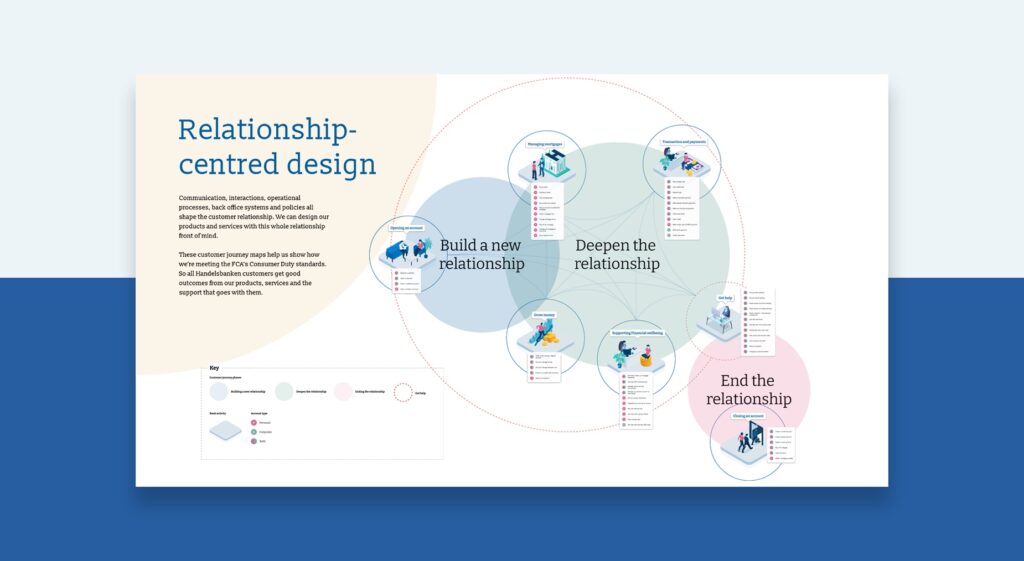
This was mapped and visualised into a structured framework that will deepen Handelsbanken’s relationship with customers from the day they come on board, right through to ending the relationship – as well as be used to evidence and ensure compliance towards the Consumer Duty.

The insights gathered throughout this process were methodically and transparently documented and collated into a detailed digital knowledge base including context and guidance, how-to guides, templates, case studies, artefacts, and much more. Providing the foundation for ongoing continuous improvement and internal work.

We worked collaboratively with people across the bank, developing a cross-bank operating methodology and providing staff training around customer-centred design. All of this helping to embed the framework and Consumer Duty compliance into Handelsbanken business-as-usual.

Diagram the presents Handelsbankens approach to human centred service design

Case study

Principality Building Society launched a new proposition to a new customer segment with Fresco

Principality Building Society

Summary

Principality Building Society developed a new highly focused proposition using Fresco’s insight on consumer behaviour and needs, aimed at the rising metropolitans segment. The targeted campaign produced triple the expected uptake of its innovative First Home Steps app.

Company size

1,000

Industry

Financial

Products used

Challenge

Principality’s portfolio and propositions teams have been working together to define and understand new target customer segments and design services and products to meet their needs. With a loyal and long-standing customer base, the team wanted to find a way to engage with younger customers nearer the start of their savings journey.

Principality has always used data to support planning and risk assessment and to measure performance. Principality has evolved the use of demographic, lifestyle and market data from CACI to further refine its customer and market insights. Using CACI’s Fresco segmentation was an obvious choice to support the project. Fresco describes individuals in terms of their financial product holdings, attitudes, life stage, affluence and digital behaviour. Principality wanted to differentiate through propositions with better customer type information.

Solution

Very often, insight is siloed within teams. Data is purchased and used for specific projects and activities. For the First Home Steps proposition, Principality shared insight across all the teams and individuals involved in planning and delivering the campaign.

CACI presented data insight to a multi-functional Principality team, showing how it could help to refine different aspects of the proposition and supporting the communication campaign. The data was used from the start, informing every aspect of proposition development. Principality combined CACI’s Fresco insight with its own research into first time buyers to produce a robust and differentiated evidence base that informed every First Home Steps decision.

The Fresco data helped build a picture of the target group and to understand their needs, in the context of how they live and work and the challenges they face in saving and planning. First Home Steps addresses the rising metropolitan segment, aiming to appeal to those looking to the future and saving to buy their first property.

The Fresco insight helped Principality’s team understand exactly how to reach the people it had identified, showing geographic areas where there was a high proportion of rising metropolitan consumer households. This supported targeting of ads and resources.

Results

The proposition team launched the First Home Steps campaign to educate and support younger adults who have reached the stage of wanting to buy a house, so they can be confident in their ability to manage their finances and buying decisions.

Promoted and supported in-branch, First Home Steps offers ‘workouts’ to get homebuying hopefuls financially and practically fit to obtain a mortgage and buy their first home. Resources include a borrowing calculator, a budget planner, house prices guide and savings tips. It’s all brought together in the First Home Steps app, a free pocket guide to the house-buying process. Principality hopes to motivate users to open a First Home Steps savings account, to save towards a mortgage deposit.

“We launched in branch and the campaign exceeded targets, especially for people downloading the app, with triple the numbers expected. From the first phase of the campaign the insight basis has given us great confidence for the next stage.”

Susan David, Propositions Manager, Principality Building Society

Sharing the data insight with colleagues from all parts of the business has not only created a stronger proposition, it has driven interest and positive support from branch colleagues who talk to branch visitors about their finances. They have been advocates for the app, able to talk knowledgeably and empathetically with branch visitors who might benefit, armed with a clear understanding of their likely needs and attitudes.

Principality has a mature approach to data, using a range of sources intelligently and collaboratively. They use their budget smartly, ensuring that they make full and focused use of the insight sources they subscribe to. CACI’s resources and services are key tools that help them retain loyal customers and to innovate. As well as delivering proposition insight, Fresco helps Principality understand branch footfall and customer profiles. Weekly flow information from CACI’s Retail Finance Benchmarking Mortgages and Savings provides the market context.

Case study

Creating a strategic segmentation to help TSB understand and drive money confidence

TSB logo

Summary

TSB is pioneering a new kind of banking for Britain, one that’s simple, straightforward and cares about people. Serving five million customers in the UK across a network of branches and operating centres, TSB offers friendly, honest and convenient banking that’s designed to meet customers’ needs, with the aim of delivering on its core purpose to equip them with money confidence. To do this, the bank wanted to better understand its customers’ behaviour, circumstances and priorities so it could be more relevant, engaging and effective.

Company size

10,000+

Industry

Financial services

Products used

Challenge

Customer segmentation

TSB already had creative-led segmentation developed by its brand agency. Yet, while this segmentation helped understand the target audience, it was ineffective for media planning and couldn’t be overlaid on the customer base.

At pitch, TSB’s new media agency, the7stars, proposed a more effective segmentation for media selection, which TSB wanted to advance further by overlaying it onto their own customer base.

Integration

In addition, the bank faced the issue of integrating these insights into its existing systems and ensuring they could be used for practical and actionable segmentation for effective media planning and customer targeting.

TSB had already been working with CACI to map Fresco financial lifestyle segments onto its customer base. So, a new joint collaboration with CACI and the7stars was initiated to address these requirements together.

Solution

Working in collaboration with TSB’s Research and Strategic Insights Team, CACI created an evolved segmentation that clearly distinguishes different customer types and provides clear segment profiles and personas.

CACI used Fresco and other external consumer demographic datasets to give TSB bespoke behavioural and lifestyle insights into its target customer base.

Justin Bell, Head of Insight, Strategy and Planning at TSB explains: “We started with a market-wide segmentation, based on all UK adults. We’ve subsequently created a version of that for our customer base.

“CACI provided a proven methodology and approach drawn from their data expertise and experience. Once we had clear segment parameters, our data team mapped them to our base.”

Results

TSB is actively using the segment insights to develop its media strategies and in campaign briefs, creating content tailored to target consumers’ profiles.

Justin continues:

“Part of the output of the segmentation was to rank the segments in order of money confidence. Working with CACI, we agreed on a weighted mix of key questions in the TGI consumer survey, to derive a money confidence score. We support people with content, products and services to help raise their money confidence and we need to be relevant to those that need that support most.

At the heart of it is a money confidence score: we’ll measure our progress against our purpose: Money confidence for everyone everyday. We hope to see a gap opening up between the money confidence levels of our customers and that of non-customers, with a continual improvement against today’s baseline.

We believe this segmentation will continue to pay dividends as we develop our channel and campaign marketing – we’re looking forward to tailoring products and services even more to meet customer needs.”

Case study

How OneFamily use data to identify demand for new products

Summary

OneFamily is an award-winning financial services company, providing products and services that help modern families thrive. The firm’s vision of “Inspiring Better Futures” means creating products to meet the needs of every generation of the modern family, from dual parents, divorced people and single parents to grandparents, junior savers and family friends.

OneFamily serves over two million UK customers, caring for over £7 billion of families’ money. With over 40 years’ experience, the OneFamily team offers a range of products including protection and lifetime mortgages, children’s and young people’s investments, including Junior ISAs and Child Trust Funds. The business has donated £3.5 million to support customers and communities since 2015 and is committed to responsible investment through climate-impact funds.

Company size

1,000

Industry

Non-profit

Products used

Challenge

Deeply committed to innovation and data-driven decision making, OneFamily faced challenges in effectively targeting their customer base.

Despite possessing the necessary in-house data science skills, they struggled due to limited resources to fully leverage their existing ‘R’ analytics software. These resource shortages therefore hindered their ability to predict market trends and make evidence-based decisions. 

As a progressive financial services company with an ethical business model, a critical challenge is to minimise waste and maximise value in all its operations. OneFamily therefore needed to refine their strategy and product development processes using advanced data analytics in order to minimise waste and enhance the precision of their targeting efforts to maximise value to its customers.

Solution

OneFamily uses Acorn and Fresco data for insight into existing customers, including its large Child Trust Fund (CTF) customer base.

Julian explains: “We are a progressive, innovative financial services organisation and we’re dedicated to developing products that meet the needs of today’s generation.”

“That’s why we’re strong advocates of data science, using it to determine strategy and product development and to help us predict market trends. Evidence-based decision making is core to our contemporary, forward-looking approach. Targeting effectively minimises waste and maximises value and relevance to our customers: these principles are important in our ethical business model.”

He adds, “Fresco is aimed at the financial services market so it’s a good match with the information we find most useful as we review and refine our products and portfolios. We can see where we index well across the UK and we can spot new opportunities to meet customer needs.”

Results

Julian was impressed by CACI’s Fresco and Acorn datasets. “They compare well with other segmentation models I’ve used in my career: we believe they’re best of breed products in our sector. They allow OneFamily to segment our family-oriented customer base and see how it’s represented across the UK population. We can zoom in to understand the preferences and needs of customers in granular detail, then locate other similar target groups.”

Data science has helped Julian and his team to identify demand for new products such as Junior ISAs, lifetime mortgages and over 50s family saving products. Fresco and Acorn data also help OneFamily prioritise recipients for cross-selling or upselling campaigns, connecting them with products that meet their current needs.

OneFamily’s insights analysts now run logistical regression models and retention models to predict customer behaviour and preferences. Julian says, “We categorise our customers and apply CACI’s variables to identify high, medium and low propensity groups for a given product or campaign.”

“CACI’s experts bridge the gap, providing specialist knowledge and so we can exploit the datasets to the max. CACI’s Head of Analytics is exceptionally knowledgeable and has steered our retention project so we can use propensity modelling on top of the lookalike datasets. That means we can focus with confidence on incentivising the top three deciles rather than expensively blanket-marketing to the entire base.”

Learn more about Acorn and Fresco.

Case study

How Nationwide developed an understanding of individual members

Summary

Nationwide Building Society approached CACI to undertake a major segmentation exercise across their entire consumer database to enhance their understanding of consumers’ online and offline behaviours and its impact on the wider business.

Company size

10,000+

Industry

Financial services

Products used

Challenge

After the banking crisis, Nationwide Building Society wanted to engage with customers and underline its status as a mutual building society. Unlike the big banks, Nationwide is owned by its members and the business model is built on trust and a deep understanding of its customers. This makes it all the more important to respond to their changing needs.

In an increasingly complex financial services environment, developing a common understanding of their customers across the entire online and offline business has been recognised as key.

Solution

The Society approached CACI to undertake a major segmentation exercise across their entire consumer database. This exercise focussed on developing pen portraits of key customer segments, focussing not only on life-stage but also incorporating other dimensions that were relevant to the business, such as affluence, channel behaviour and attitudes.

CACI conducted workshops with key stakeholders across marketing, products and channel management. Models were developed which brought together both Nationwide and CACI’s own datasets (Ocean and Fresco), so that customers could be coded with both an overall life-stage score and a range of dimension scores. The data was pulled together to create a set of pen portraits covering the entire financial services marketplace and Nationwide’s customers within that.

Results

Nationwide Building Society is now able to understand their individual members at a glance, and offer them the right products, services and advice to help them with their banking needs. This new toolset helps Nationwide to understand its customers’ needs, and develop compelling, targeted products, services and marketing messages and has won Nationwide significant new business among younger members.

Find out more about Ocean and Fresco.