










Posts Introducing Mood’s unique approach: Agile digital twins

Introducing Mood’s unique approach: Agile digital twins

In this Article

In our previous blog in this series, we uncovered the key characteristics of digital twins, their advantages and challenges and what organisations that adopt a digital twin can expect to gain from it. Today, we’ll examine Mood’s unique approach to constructing digital twins and how it can support organisations. 

What is Mood and what approach does it take with digital twins? 

Mood’s platform addresses the challenges of creating digital twins by offering a highly flexible and customisable solution that caters to specific organisational domains. Mood’s approach is centred on three key pillars:   

Agility and flexibility   

Mood enables the creation of agile digital twins that can be rapidly adapted to an organisation’s unique requirements. Whether it’s a specific industry, business model or operational process, Mood’s platform provides the tools needed to build a digital twin that accurately represents the organisation’s domain in the virtual world.   

Integrated data and consistency  

Mood’s platform integrates data from multiple sources, ensuring that the digital twin is truly reflective of the real-world state. This integration is key to maintaining clarity and consistency across the organisation, allowing for more accurate analysis and decision-making.   

Rapid deployment and optimisation 

Mood offers services that accelerate the deployment of digital twins, allowing organisations to start benefiting from their virtual models in a shorter timeframe. Its continuous monitoring and real-time analysis capabilities also enable rapid optimisation of operations, providing a significant competitive advantage.   

Common questions about digital twins 

While simulations and 3D models are static representations often used for specific scenarios or time points, a digital twin is a living, dynamic model that continuously updates based on real-time data. Digital twins provide a more comprehensive and accurate view of the current state of a system and allow for ongoing monitoring, predictive analysis and decision-making, far beyond what static models or simulations offer.  

2. Do digital twins require IoT (Internet of Things) technology?  

While IoT technology is a common and effective way to gather real-time data for digital twins, it is not strictly required. Digital twins can also be built using other data sources, such as enterprise systems, manual inputs and historical data. However, IoT devices enhance the digital twin’s ability to reflect real-time changes where physical assets are critical, making them particularly valuable in dynamic environments.  

3. Are digital twins only applicable to manufacturing and physical assets?  

No, digital twins are not limited to manufacturing or physical assets. They can be applied across a range of industries and domains, including healthcare (e.g., patient monitoring), urban planning (e.g., smart cities), logistics (e.g., supply chain management) and even service-oriented sectors. Any process or system that can benefit from real-time data integration and analysis can potentially utilise a digital twin.  

4.How difficult is it to create and maintain a digital twin?  

The difficulty of creating and maintaining a digital twin depends on the complexity of the system being modelled, the availability and quality of data and the technology stack used. While some digital twins can be complex and resource-intensive to develop, there are also more straightforward and scalable solutions available. With Mood, your digital twin can start small, returning instant value and iteratively scaled based on priority.  Maintaining a digital twin requires ongoing data integration, model updates and regular performance evaluations to ensure it remains accurate and relevant, so a single platform acting as the lynchpin can be hugely beneficial.   

How Mood can help 

and professional services offer a unique solution by providing the flexibility, integration and agility needed to develop and maintain effective digital twins. By leveraging Mood’s capabilities, organisations can achieve a new level of operational clarity and efficiency, ensuring they remain resilient and competitive in the face of ongoing challenges.  

For organisations lacking the confidence to build their own digital twin from scratch, our consultants work directly with our customers to help them, ensuring they have the skills they need moving forward. Contact Mood today to begin your journey towards an agile, data-driven future.  

 

Understanding the key characteristics & outcomes of a digital twin

In this Article

In our previous blog in this series, we examined a real-life example of where a digital twin helped drive outcomes for an organisation and the overarching importance of digital twins amidst the ever-changing technological landscape. Today, we’ll explore the characteristics comprising digital twins, including their advantages, challenges and what organisations can expect from them. 

What are the key characteristics of a digital twin? 

A digital twin, in its most basic form, is a virtual representation of a physical entity or group of entities, such as the machines and their systems on a manufacturing shop floor.

However, in the context of organisations, digital twins go beyond simply replicating physical assets. They represent the entire organisational structure, including processes, workflows, systems and even human behaviours. Some of the key characteristics of a digital twin include: 

Real-time data integration  

  • Dynamic and continuous synchronisation: A digital twin constantly updates its virtual model based on data from its physical counterpart or the processes it represents. This real-time integration allows the twin to accurately reflect the current state of the system, asset or organisation it models.   
  • Data sources: It incorporates data from various sources, including IoT sensors, enterprise systems, operational data stores and external data feeds, ensuring a comprehensive and up-to-date virtual representation.   

High fidelity and accuracy

  • Detailed and precise representation: A digital twin provides a high-fidelity model that captures the complexities and nuances of its subject. This includes both physical characteristics (e.g. dimensions and materials) and operational parameters (e.g. performance metrics and environmental conditions).   
  • Scalability: The accuracy of a digital twin can scale from a single asset (e.g. a machine) to complex systems (e.g. an entire manufacturing plant or organisational process, including its external factors).   

Two-way interaction 

  • Bidirectional communication: A digital twin supports two-way communication, allowing not only the updating of the virtual model based on physical world changes, but also enabling the virtual model to influence its real-world counterpart. For instance, adjustments made in the virtual model can be implemented in the real-world system. 
  • Predictive and prescriptive capabilities: Beyond mere replication, a digital twin can predict future states and prescribe actions based on simulations, scenario analysis or machine learning algorithms.   

Comprehensive lifecycle representation

  • Lifecycle coverage: A digital twin spans the entire lifecycle of the system, organisation or asset it represents, from design and development through to operation, maintenance and even decommissioning. This ensures that insights can be derived at any stage, supporting continuous improvement and adaptation.   
  • Change management: It adapts to changes in the physical environment, evolving over time as the real-world counterpart undergoes modifications, whether in design, operation or environment.   

Simulation and scenario analysis 

  • What-if scenarios: A digital twin enables the simulation of various scenarios and potential changes before they are implemented in the physical world. This includes testing new designs, operational strategies or responses to hypothetical events, all within a risk-free virtual environment.
  • Optimisation: By analysing different scenarios, the digital twin helps in optimising performance, reducing costs, improving efficiency and enhancing risk mitigation.   

Advanced analytics and machine learning  

  • Data-driven insights: A digital twin leverages advanced analytics, including predictive modelling, machine learning and AI to extract meaningful insights from the vast amounts of data it processes. This allows organisations to predict outcomes, prevent failures and optimise operations.     
  • Learning capability: The digital twin can “learn” from the data it receives, continuously improving its accuracy and predictive capabilities over time.   

It’s important to note, however, a digital twin can still function effectively and add value without ML and AI, instead relying on real-time data integration, simulation and rule-based systems, until enough data is generated to create ML models.   

Contextual awareness 

  • Environment and ecosystem awareness: A digital twin understands the context in which the physical asset, organisation or process operates, including its environment, external influences and interdependencies with other systems, enhancing the relevance and precision of the insights generated.  

Interoperability and integration 

  • Seamless integration: Digital twins are designed to integrate seamlessly with other digital systems, tools and platforms within an organisation. This interoperability ensures that the digital twin can act as a central hub for data and insights, interacting with various enterprise systems like ERP, CRM and PLM.   
  • Modularity and scalability: The architecture of a digital twin should allow it to be modular, enabling different components to be updated, replaced or scaled independently, which is critical for adapting to evolving organisational needs.   

Visualisation and user interaction 

  • User-friendly interface: A digital twin often includes advanced visualisation tools such as 2D & 3D models, dashboards or even augmented reality (AR) interfaces, simplifying users’ interactions and interpretations of the virtual model. The use of these depends on the need, however.   
  • Interactive decision support: Users can interact with the digital twin to perform analyses, run simulations and explore different operational strategies, all through an intuitive and accessible interface.   

Security and compliance   

  • Data security: Given that a digital twin deals with real-time and potentially sensitive data, robust security measures are a fundamental characteristic. This includes data encryption, secure communication protocols and compliance with industry standards and regulations.   
  • Governance and compliance: Digital twins must adhere to governance frameworks and compliance requirements, ensuring that the data and operations they manage meet regulatory and ethical standards.   

What are the advantages of digital twins for organisations? 

Proactive maintenance  

The system sent automatic notifications when machines required attention, whether due to routine maintenance, in response to a negative trend or as a response to an unexpected incident. This minimised downtime and ensured continuous production with a higher utilisation rate. 

Trend analysis 

The digital model tracked stats over time, allowing for trend analysis. This feature was invaluable in predicting when a machine might require more significant intervention or identifying when a production line was consistently underperforming.  

Quality assurance  

By integrating the testing processes into the digital twin, the system provided real-time feedback on the quality of the fire detectors being produced. Engineers could react quickly to any deviations, ensuring that only high-quality products left the facility.    

Enhanced decision-making

Digital twins provide a comprehensive view of organisational operations, enabling decision-makers to visualise the impact of changes before they are implemented. This leads to more informed and strategic decisions, reducing risks and improving outcomes.   

Operational efficiency 

By simulating processes and workflows, organisations can identify inefficiencies and bottlenecks in real-time, allowing for continuous optimisation and therefore improved productivity, reduced costs and agility to change.   

Predictive maintenance and risk management  

Digital twins can predict potential failures or risks by analysing data trends and patterns, minimising downtime, preventing costly disruptions and enhancing resilience.   

Scalability and flexibility 

Organisations can use digital twins to model and test new business strategies, products or services without disrupting existing operations, enabling businesses to innovate and adapt to changing market conditions with minimal risk.   

Employee and resource optimisation  

By simulating human behaviours and interactions within the organisation, digital twins can optimise resource allocation, improve workforce planning and enhance employee engagement.   

What challenges arise when creating digital twins? 

Complexity and customisation  

Developing a digital twin for an organisation is inherently complex due to the need to capture and integrate diverse data sources, processes and systems. Additionally, each organisation has unique requirements, complicating the creation of a one-size-fits-all solution.   

Data integration and quality  

A digital twin’s accuracy and effectiveness depends on the quality and integration of data. Inconsistent, incomplete or siloed data can compromise its ability to provide reliable insights, leading to suboptimal decision-making.   

Scalability of platforms    

Most existing platforms for creating digital twins are rigid and domain-specific, limiting their applicability across different industries or organisational needs and potentially hindering organisations from fully leveraging the potential of digital twins.   

High development costs and time

The process of designing, developing and deploying a digital twin is often time-consuming and expensive. This can be a significant barrier for organisations, particularly those with limited resources.  

How Mood can help 

For organisations lacking the confidence to build their own digital twin from scratch, Mood consultants work directly with customers to equip them with the necessary skills to progress towards an agile, data-driven future. Contact Mood to begin your journey. 

Stay tuned for the next blog in this three-part series, where we’ll explore the unique approach to digital twins offered by Mood and how organisations that leverage Mood’s capabilities can enhance their digital twin experience. 


How digital twins drive real-world outcomes for organisations

In this Article

Digital twins have emerged as a transformative concept that offers unprecedented opportunities for organisations to monitor, analyse and optimise their operations. However, the term “digital twin” is often misunderstood or oversimplified, leading to confusion about its true value and application. In this blog series, we will demystify the concept of digital twins, particularly in the organisational context, explore their advantages and challenges, and assess Mood’s innovative approach to creating agile digital twins that enables organisations to achieve enhanced clarity, consistency and rapid optimisation.   

Real-life example: Creating an early digital twin of a manufacturing shop floor 

Early in my career, I embarked on a project that would essentially become a digital twin of a manufacturing shop floor and associated processes. This experience was a formative one, laying the groundwork for my current understanding of how digital representations can drive efficiency, insight and optimisation in real-world operations.   

The challenge: Optimising production, maintenance & testing processes 

The manufacturing facility I worked at produced fire detectors, and the shop floor was a bustling environment where efficiency and quality were paramount. However, managing the maintenance of machines and the rigorous testing of the manufactured products presented significant manual processes and thus challenges. The facility needed a system that could not only track and manage these processes but provide insights into potential issues before they became critical.   

The solution: A digital model using Microsoft Visio, SharePoint, InfoPath & Raspberry Pis 

Visualisation with Visio

To tackle these challenges, I created a visual model of the shop floor using Microsoft Visio. This model detailed the layout of the shop floor, with the various machines and their specific roles in the manufacturing process. The visual representation served as a foundation for what would later evolve into a more sophisticated digital twin.   

Data management with SharePoint 

To bring this model to life, I used Microsoft SharePoint to create data lists that held critical information about the machines, maintenance schedules and test results. These data lists became the backbone of the system, feeding data into the Visio model, allowing it to be more than just a static diagram.   

Interactive user interfaces with InfoPath

For the maintenance and test engineers, I developed user interfaces using Microsoft InfoPath. These interfaces enabled them to input data related to maintenance schedules, findings, test results and general information. Engineers could also report incidents such as unexpected machine downtimes directly into the system. This data entry was crucial, as it provided the real-time updates necessary for the model to reflect the current state of the shop floor accurately.   

Data capture with Raspberry Pis 

To further enhance the system’s capabilities, data collected directly from the machines using Raspberry Pis, such as throughput rates, machine performance metrics and any deviations from expected operation was fed into the SharePoint lists via CSV files periodically. This integration of what was essentially an early form of IoT devices was a critical step towards creating a more responsive and accurate digital representation of the shop floor.   

The outcome: A digital twin of the shop floor processes 

What emerged from these efforts was, in essence, a digital twin of the manufacturing shop floor. This system provided near-real time dashboards that displayed the status of the machines and their key metrics. Engineers could gauge which machines were approaching tolerance levels for throughput or which production lines were close to failing quality tests.    

Reflection: Realising the concept of a digital twin 

By visualising the shop floor, integrating near-real time data and enabling interactive user interfaces, I was able to create a system that mirrored the physical world and provided actionable insights to improve efficiency, quality and maintenance in the form of what is now known to be a digital twin. This early project taught me the importance of digital representation in driving real-world outcomes and laid the foundation for my ongoing work in developing and advocating for a flexible, agile platform that can be adapted to any organisational domain and enable rapid turnaround without the need to cobble together several tools.  

How Mood can help 

For organisations lacking the confidence to build their own digital twin from scratch, Mood consultants work directly with customers to equip them with the necessary skills to progress towards an agile, data-driven future. For further insights, download our full whitepaper “Understanding Digital Twins” or Contact Mood today to find out more.

Stay tuned for the next blog in this three-part series, where we’ll dive into the characteristics of digital twins including their advantages, challenges and what organisations can expect from them. 


Exploring the benefits of security testing

In this Article

As cybersecurity threats loom large, it’s critical that organisations consider the security of their software from the outset.  

Static Application Security Testing (SAST), Dynamic Application Security Testing (DAST) and Software Composition Analysis (SCA) are three essential methodologies that can be used to identify vulnerabilities in software before it is shipped. Each plays a vital role in an organisation’s robust security strategy, offering unique benefits and complementing one another to safeguard applications throughout the development lifecycle. With this in mind, how does each tool impact software security, and how can they help your organisation bolster its security testing capabilities? 

What is SAST, DAST, and SCA?

SAST (Static Application Security Testing)

SAST involves analysing source code, bytecode or binaries without executing the programme. It is typically performed early in the Software Development Life Cycle (SDLC), helping developers catch vulnerabilities during the development phase. SAST is like reviewing a blueprint before constructing a building— it identifies flaws in the underlying structure. 

DAST (Dynamic Application Security Testing)

In contrast to SAST, DAST focuses on running applications in a live environment to find vulnerabilities in the application’s runtime behaviour. It simulates attacks to detect issues that might not be apparent in static analysis, such as input validation errors or authentication weaknesses. 

SCA (Software Composition Analysis) 

Software Composition Analysis (SCA) is a methodology and set of tools used to identify and manage open-source components within software applications. It scans the codebase to detect third-party and open-source libraries, frameworks, and packages. SCA tools analyse these components to ensure they meet security, license compliance, and quality standards. 

Benefits of SAST 

Early detection of vulnerabilities  

  • SAST identifies security flaws during the development stage, saving time and reducing the cost of fixing vulnerabilities later. 

Automated and scalable  

  • Modern SAST tools integrate seamlessly with CI/CD pipelines, providing automated scans that can scale with the development team’s needs. 

Improved code quality  

  • Beyond security, SAST also aids in improving overall code quality by identifying potential logic errors, dead code, or inefficient patterns. 

Compliance 

  • SAST helps ensure compliance with regulations and standards like PCI DSS, GDPR, and OWASP, which mandate secure coding practices. 

SAST tools CACI uses to support customers

  • SonarQube – Offers detailed code analysis (vulnerabilities, code bugs, and smells) and security vulnerabilities which integrates with various CI/CD tools. 
  • Checkmarx – Specialises in detecting vulnerabilities in source code and includes support for multiple programming languages. 
  • Fortify Static Code Analyzer – Comprehensive in identifying vulnerabilities across a wide range of programming languages. 
  • Veracode Static Analysis – Offers a cloud-based platform for static code scanning, emphasising compliance and risk assessment. 
  • SpotBugs – A successor to FindBugs, this is an open-source static code analyser which detects possible bugs in Java programmes.   
  • Potential errors are classified in four ranks: (i) scariest, (ii) scary, (iii) troubling and (iv) of concern. 

Benefits of DAST

  • DAST identifies issues such as SQL injection, cross-site scripting (XSS) and other runtime vulnerabilities that static analysis might miss. 

 Real-world simulation 

  • By emulating real-world attacks, DAST provides insight into how an application performs under adversarial conditions. 

 Technology agnostic 

  • Since it doesn’t rely on source code, DAST can test applications regardless of the underlying technology stack. 

 Post-deployment assurance 

  • DAST can verify the security of applications in production environments, ensuring that deployed applications remain secure. 

DAST tools CACI uses to support customers

  • OWASP ZAP – Open-source tool favoured for its user-friendly interface and active community support, and identifies vulnerabilities as listed in the OWASP Top 10. 
  • Burp Suite – Widely used by security professionals for its advanced penetration testing capabilities. 
  • Netsparker – Known for its automation features and ability to identify vulnerabilities with minimal false positives. 
  • AppSpider – Tailored for dynamic testing of modern web and mobile applications. 

 Benefits of SCA

Security management 

  • SCA identifies known vulnerabilities in open-source components using databases like the National Vulnerability Database (NVD) which link vulnerabilities to the Common Weakness Enumeration (CWE) system that categorises weakness in software and hardware. 

 Licence compliance 

  • Ensures associated software libraries and dependencies adherence to open-source licences (e.g., MIT, GPL, Apache) and helps avoid legal issues related to non-compliance. 

 Risk management 

  • Improves visibility into the software supply chain, ensuring third-party components are secure and compliant, and can provide detailed reporting (akin to a bill of materials) for audits and governance processes.

Popular SCA tools CACI uses to support customers

  • Snyk – Developer-centric SCA tool focusing on security vulnerabilities and licence compliance and integrates with development environments and CI/CD pipelines. 
  • Black Duck – Comprehensive SCA tool for open-source security and licence compliance management, providing policy enforcement and vulnerability scanning. 

Understanding the synergy of SAST and DAST 

While SAST and DAST offer distinct advantages, combining them creates a powerful defence against vulnerabilities. SAST addresses issues at the code level, preventing bugs from propagating into production, while DAST uncovers runtime vulnerabilities that static analysis cannot detect. Together, they provide comprehensive coverage, reducing the attack surface and ensuring a secure software ecosystem. For example: 

  • SAST might detect unvalidated user inputs during code review, while DAST confirms whether input validation issues could lead to SQL injection when the application is running. 
  • SAST can identify insecure cryptographic practices, whereas DAST tests whether those practices are exploitable in a live environment.

Benefits of implementing SAST/DAST/and SCA together

Holistic security coverage 

  • The combined approach tackles vulnerabilities from both the development and runtime perspectives. 

 Cost and time efficiency 

  • Detecting and fixing vulnerabilities at different stages prevents costly post-deployment fixes and potential breaches. 

 Increased trust and compliance 

  • Organisations gain confidence in their applications by assuring customers and stakeholders of their commitment to security. 

 Proactive security culture 

  • Incorporating all three methodologies fosters a proactive approach to cybersecurity, embedding it as a core principle of the SDLC. 

How CACI can help 

SAST, DAST and SCA are indispensable tools in a comprehensive application security strategy. By addressing vulnerabilities at different stages of the development lifecycle, they significantly reduce the risk of cyberattacks, enhance software reliability and ensure compliance with security standards. By leveraging several SAST/DAST/SCA tools, organisations can secure their applications and build a robust foundation of trust with their users. 

At CACI, we integrate SAST, DAST, and SCA into our software development and deployment workflows, creating a layered defence that keeps vulnerabilities at bay while enabling continuous delivery of secure, high-quality software. To learn more about how we can help your organisation enhance its security testing and application efforts, contact us today

Introduction to Enterprise Architecture and Process Modelling

In this Article

This blog is the first part of a two-part series exploring the roles of Enterprise Architecture and Process Modeling in ensuring compliance with security standards. You can find part two of this series here.

In today’s highly regulated business environment, organisations are increasingly required to demonstrate their adherence to strict information security standards. Compliance audits, whether for regulatory frameworks such as GDPR, HIPAA or ISO/IEC 27001, require a detailed understanding and documentation of an organisation’s processes and systems.

Enterprise Architecture (EA) and Process Modelling (PM) play pivotal roles in ensuring that organisations are well-prepared for these audits. In this blog series, the roles and key benefits of using EA and PM to streamline and enhance the process of achieving information security compliance will be uncovered, along with recommendations for organisations that are in the process of adopting and integrating them.

Information security compliance is critical for organisations to protect sensitive data, maintain customer trust and avoid legal penalties. Preparing for a compliance audit can be daunting, requiring comprehensive documentation, risk assessments and evidence of control implementations. Enterprise Architecture and Process Modelling provide systematic approaches to managing these complexities, ensuring that organisations are not only compliant, but also agile in responding to evolving security requirements.

What is Enterprise Architecture (EA)?

Enterprise Architecture (EA) is a strategic methodology aimed at defining and standardising the structure, operations and governance of an organisation. EA offers a comprehensive perspective on an organisation’s processes, information systems, technologies, and their interrelationships. This holistic view is instrumental in aligning IT strategies with business objectives, ensuring that technological initiatives support and enhance the overall goals of the organisation.

What is Process Modelling (PM)?

Process Modelling entails the creation of detailed representations of an organisation’s processes. These models are utilised to visualise, analyse, and optimise business processes, thereby facilitating the identification of inefficiencies, bottlenecks and risks. Within the realm of information security, process models are invaluable for understanding how data flows through an organisation, pinpointing potential vulnerabilities, and determining how security controls are implemented.

Conclusion

The integration of Enterprise Architecture (EA) and Process Modelling (PM) is essential for organisations looking to meet stringent information security compliance standards. As the regulatory landscape continues to evolve, these frameworks not only facilitate a thorough understanding of an organisation’s processes and systems but also enhance agility in adapting to new security requirements.

By leveraging EA and PM, organisations can streamline their compliance efforts, ensuring comprehensive documentation and effective risk management. Ultimately, this proactive approach not only safeguards sensitive data and maintains customer trust but also positions organisations to thrive in a complex regulatory environment. Embracing these methodologies will empower organisations to navigate compliance audits with confidence and resilience, paving the way for sustainable success in the digital age.

If you would like to find out about Enterprise Architecture and Process Modelling, you can do so here in my latest whitepaper. You can also reach out to our experts at moodenquiries@caci.co.uk if you would like to discuss how Mood can help your organisation’s requirements.

Key trends shaping data strategy: Insights from Big Data LDN and Snowflake DCWT 2024

In this Article

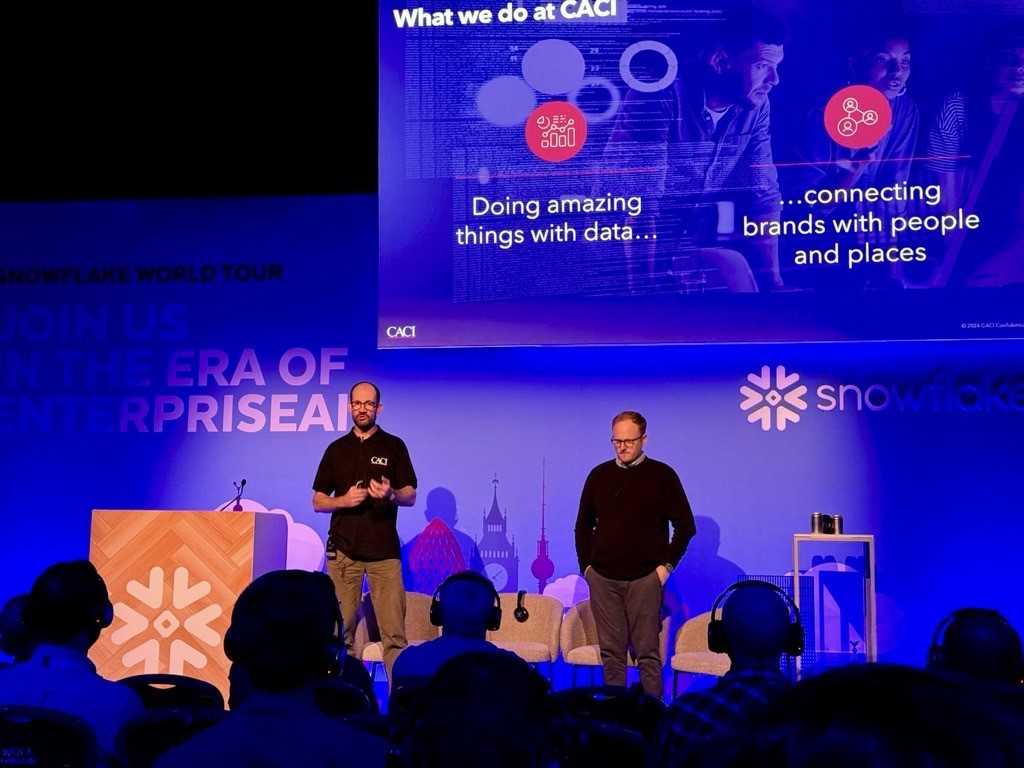
In recent months, I have had the opportunity to represent CACI at two major data conferences—Big Data London and Snowflake’s Data Cloud World Tour in London. CACI took a prominent role at both events, including serving as a Black Diamond Partner at the Snowflake tour. I spoke at both events, sharing insights from our latest projects and discussing the strategic shifts shaping the data landscape.

Both conferences were electric with activity, demonstrating the strength and vibrancy of our data community. The CACI booth saw a steady stream of professionals eager to discuss our perspectives on the future of data and technology, as well as how we’re tackling current trends and challenges across industries. These interactions highlighted three key themes resonating within the industry today.

Snowflake functionality including sharing and Container Apps

One of the questions I was asked a lot at the events was how organisations can use native data sharing functionality with Snowflake more widely. Snowflake has progressively made this easier to do, by enabling direct warehouse-to-warehouse sharing of data. Moreover, the launch of Container Apps has meant that organisations can also consolidate more processing within Snowflake, rather than handing off to processes outside of where they store this data. Increasingly, Snowflake adopters are seeking to consolidate more of their data technology and data within one common platform. This obviously increases efficiency with data processing and makes your data processing estate easier to manage.

I was inundated with questions about how we can support organisations in making more from their Snowflake estate, from supporting on enabling direct sharing and private cleanrooms, to migrating workloads to native Snowflake apps. It’s clear that this will be a core strategic push for many organisations already on Snowflake, but also a driving force behind many decisions to migrate to Snowflake.

The rise of data Self-Serve

It was quite staggering to see how many exhibitors at Big Data London were software vendors selling self service data insight platforms, many of them powered by GenAI. The desire to give non-coders access to query data held within a warehouse/lake etc is nothing new, there has forever been this requirement. Hitherto, that access has been slightly hamstrung by the capabilities of the tools aiming to give that capability, often giving a reductive or clunky user experience. However, this sector has grown momentum recently, driven by increased data volume and by the increased desire for more data by “non-technical” people.

It’s clear that GenAI, in part, has given renewed energy to this sector, and we’ll see these type of natural language tools start to really challenge the incumbent BI tools.

One of the omnipresent challenges of the data industry has been how to seamlessly give access to data, held within data platforms, and easily give access to people not proficient in writing code. It is one of the areas that has held back true democratisation of data, and limited initiatives to create thoroughbred “data-driven” organisations. If GenAI can help by removing these barriers to data accessibility, then we’ll enter a new age of data use, and organisations will really be able to start fully leveraging all the data that they have at their disposal.

Importance of Observability

In 2024, observability—essentially, next-level monitoring—is becoming indispensable. We find ourselves in a place where our data estates are becoming ever more expansive and expensive. The volume and cardinality of data that is being collected and processed is ever increasing, contributing to a degradation of transparency about what is happening on our data platforms. Moreover, the now ubiquitous consumption pricing model has meant that there is now increasingly need for better observability, to enable widespread transparency on what processes are running, their efficiency, how much compute they are using, and how much they cost.

We’ll see an increasing push to streamline data processing operations and to create better clarity on what processes are running and how much they are costing the business. Additionally, as data operations but ever more business critical, there will be additional scrutiny their performance and health.
In summary, these three trends—expanded Snowflake capabilities, the advancement of self-service data tools, and enhanced observability—reflect a broader industry shift towards greater accessibility, efficiency, and cost transparency in data management. As we continue to innovate and adapt, CACI is positioned to support organisations in navigating these changes and unlocking the full potential of their data assets. Together, these insights underscore a vibrant future where data is not only accessible but fully optimised to drive meaningful business outcomes.

Curious to explore how these trends could shape your organisation’s data strategy? Let’s start a conversation about unlocking the full potential of your data estate with CACI. Reach out today to discover more.

How a Digital Twin of an Organisation (DTO) revolutionises strategic decision-making & scenario planning

In this Article

Organisations often face challenges in strategic decision-making and scenario planning due to fragmented data, siloed operations, and a lack of real-time visibility across departments. This uncertainty complicates planning for change or responding to external disruptions, ultimately blurring the line between strategy and execution. Consequently, decision-makers may face slow responses, missed opportunities, and decisions based on outdated or incomplete information. Without clear insights into the impact of changes, disruptions, inefficiencies, or unintended consequences when implementing new strategies may seem inevitable.

So, how can decision-makers navigate these challenges and how can Mood support them?

How to bolster strategic decision-making & scenario planning

Effective strategic decision-making, scenario planning and change management require the ability to simulate different options and assess their impact on the entire organisation. By visualising dependencies and potential outcomes, businesses can plan and implement changes with greater confidence and minimal risk. 

Organisations need a unified, real-time view of their operations that integrates data from across the business. By connecting strategic goals with operational data, businesses can analyse potential scenarios, simulate outcomes and make informed decisions that align with their long-term objectives. 

Why bolstering strategic decision-making & scenario planning is critical 

Organisations that make a pointed effort to enhance their strategic decision-making will find themselves adapting quicker to everchanging industry conditions, navigating challenges or risks with ease and staying ahead of their competitors. With a comprehensive and real-time understanding of the organisation, faster and more accurate decisions can be made that will improve agility, alignment between strategy and execution and establish a stronger ability to adapt to market changes and internal demands.  

Better scenario planning and change management will also lead to more resilient organisations that can adapt quickly to market shifts or internal changes. Businesses will gain the ability to implement change smoothly, with minimal disruption and maximum impact. 

How Mood enhances strategic decision-making & scenario planning 

Creating and maintaining a DTO would ordinarily require advanced technical expertise, multiple tools, business change and substantial resources. The complexity of integrating various systems and processes into a cohesive digital model can be daunting. Mood alleviates this.  

Mood provides a non-technical, dynamic platform with everything a business needs to create and manage a Digital Twin of an Organisation. It collates data, processes and systems into a single, real-time view and supports detailed scenario planning and change impact analysis by integrating all relevant data, processes and systems into a living digital model.  

By connecting strategic objectives to live operational data, Mood enables scenario planning and simulation, empowering decision-makers to visualise impacts and align initiatives with business goals. With Mood, your organisation can make strategic decisions with confidence and agility, as well as simulate the impact of strategic initiatives, visualise dependencies and assess risks before making decisions. The integration and digitisation of the change management process can also be enabled, ensuring that changes are implemented smoothly, with full visibility into their impact across the organisation. 

Find out how Mood can transform your business by speaking to one of our experts today. 

How Mood is guiding organisational transformation

In this Article

In today’s rapidly evolving business landscape, organisations nowadays are increasingly tasked with balancing agility with strategic foresight. As digital transformation accelerates, aligning operational processes with overarching business strategies while simultaneously maintaining governance, compliance and scalability is becoming a prevalent challenge. This delicate balancing act requires not only clear visibility, but also an integrated approach that unifies process modelling, digitisation and enterprise architecture.

So, how is Mood enabling businesses to achieve this?

Mood BPMN modelling & process digitisation: bridging the gap between design & execution

At the heart of any successful transformation initiative is a clear understanding of the processes that drive the organisation. Mood offers robust BPMN (Business Process Modelling Notation) 2.0 modelling capabilities that empower business analysts and architects to map, manage, analyse, optimise and communicate business processes. Through interactive models, even the most complex workflows can be broken down into manageable stages and tailored for different stakeholders. This dynamic visualisation ensures that processes are both transparent and adaptable, leading to improved conformance, powerful collaboration, and seamless management across the enterprise.

Where our modelling capabilities ensure no gaps exist between process design and implementation, our drag-and-drop, no-code process digitisation tools take things a step further. Mood enables users across the organisation to digitise complex business processes from end to end, accelerating digital transformation programmes. This approach not only empowers non-technical users to take ownership of their workflows, but also ensures scalability and flexibility, allowing the organisation to remain agile and grow without the overhead of constant change management.

By integrating multiple data sources and enabling rich interaction with real-time insights, Mood reduces the reliance on disparate tools like spreadsheets and manual processes. Instead, data is aggregated in a shared context, enabling it to be interrogated and analysed with precision. The result is streamlined operations, significant efficiency gains, and reduced operational costs,; all while maintaining consistency and governance.

Enterprise and business architecture modelling: aligning strategy with execution

The foundation of any resilient and scalable organisation lies in its architecture. Mood offers powerful enterprise and business architecture capabilities that allow organisations to strategically align business objectives with operational processes and IT infrastructure. By providing comprehensive tools and blueprints to design and optimise current and future state architectures, Mood ensures that enterprise decisions are not only grounded in clear insights, but are also executed with precision and consistency.

Our platform supports the creation of layered, dynamic models that break down complex organisational structures into navigable and digestible components. These models empower enterprise architects, business strategists and decision-makers to visualise the impact of change initiatives, mitigate risks and maintain alignment with regulatory standards. By integrating architecture with BPMN process models and process digitisation, organisations can bridge the gap between strategic planning and operational success. This end-to-end traceability ensures that there are no gaps from vision to execution, providing a holistic view of enterprise performance that supports continuous improvement.

Businesses can adapt and evolve their architecture in tandem with market changes or organisational growth by leveraging Mood. Our platform’s comprehensive integration options, coupled with robust data management, creates a unified environment that drives optimised decision-making, reduces silos and fosters cross-functional collaboration.

Empowering stakeholders across the business through virtualisation 

In an increasingly complex business environment, organisations need more than just isolated solutions; they need a cohesive, living representation of their operations and strategy. Mood offers exactly that. By combining the strengths of BPMN modelling, process digitisation and enterprise architecture, Mood enables businesses to create a living virtualisation of their organisation, empowering stakeholders across the enterprise to access, update and interrogate data through their unique perspectives while maintaining consistency and robust governance.

Whether it’s a business analyst optimising day-to-day workflows, an enterprise architect planning for future growth or an IT leader driving digital transformation, Mood offers tailored insights and tools for each role. The platform’s integrated approach ensures that everyone, from the C-suite to the front line, is aligned around a single, consistent version of the truth. This not only fosters collaboration, but also drives better decision-making and more agile responses to change.

How Mood can safeguard the future of integrated business and enterprise modelling

As businesses face mounting pressures to stay competitive while maintaining operational excellence, the need for a fully integrated approach to process management and enterprise architecture has never been greater. Mood is uniquely positioned to deliver this by offering a comprehensive, flexible, and scalable platform that aligns strategy with execution, drives efficiency, and supports long-term growth. By enabling organisations to create a living virtualisation of their operations, Mood transforms the way businesses plan, manage, and evolve,; empowering stakeholders at every level to succeed.

To learn more about how we can help you adopt Mood to enhance your business and safeguard it for the future, contact moodenquiries@caci.co.uk  

Why consultancy is the perfect profession for problem solvers

In this Article

Those who relish the thrill of solving puzzles and the rush of competition are likely to find a perfect match in the world of consultancy.

This profession, often associated with high-stakes business decisions and strategic planning, can offer a dynamic environment where one’s passion for learning, problem-solving and helping businesses thrive can come to life.

So, how exactly does consultancy work become the ultimate puzzle, providing endless opportunities to learn, solve problems and see tangible benefits unfold? 

The endless puzzle: continuous learning in consultancy 

One of the most exhilarating aspects of consultancy is the constant influx of new challenges. Just like puzzles, each project presents a unique problem to solve, often requiring fresh knowledge and innovative thinking.

The variety in consultancy work— ranging from industries like healthcare and finance to technology and retail— ensures that there’s always something new to learn. For puzzle enthusiasts, this is akin to encountering a new, complex puzzle every day. 

Each client and project creates an opportunity to dive into new territories, understand different business models and stay updated with industry trends. This constant learning keeps minds sharp and satisfies curiosity, with every assignment more intricate and rewarding than the last. 

The competitive edge: thriving on problem-solving and strategy  

Consultancy isn’t just about applying standard solutions, it’s about crafting unique strategies that can give clients a competitive edge. This aspect will resonate deeply with those that are naturally competitive.

Just as one would approach any challenge with the goal of finding the best and most efficient solution, the aim in consultancy is to devise strategies that not only solve a client’s problem, but also position them favourably in their market. 

The thrill of this competitive element is a significant motivator. It can drive creative thinking, meticulous data analysis and team collaboration to brainstorm the best approaches. The satisfaction that comes from cracking a particularly tough problem or devising a winning strategy can be immensely rewarding, much like completing a particularly challenging puzzle. 

The reward of impact: helping businesses improve 

While the intellectual stimulation and competitive aspects of consultancy can be exciting, the real joy comes from seeing tangible impacts. There’s a unique satisfaction in knowing that recommendations and strategies can significantly improve a business’ operations, profitability or market position, as though seeing the pieces of a puzzle come together to form a clear and complete picture. 

Helping businesses in this way can provide a profound sense of accomplishment, with each success story a testament to the hard work and strategic thinking that goes into project work.

This impact-driven aspect of consultancy adds depth to the puzzle-solving experience, making it not just an intellectual exercise, but a meaningful endeavour that positively affects real businesses and people. 

Consultancy as the ultimate puzzle

Consultancy is the ultimate puzzle— one that’s ever-evolving and endlessly rewarding. For those who enjoy puzzles and competition, it offers a perfect blend of continuous learning, problem-solving and the thrill of seeing tangible results.

Consultancy is a career that challenges the mind, fosters creativity and provides an unparalleled opportunity to make a real difference to organisations and people. It not only satisfies a love for challenges, but also fuels a passion for helping others succeed.  

Find out how CACI’s expert consultants can support your unique business needs by getting in touch with us here. 

Insights from the Northumbrian Water Innovation Festival 2024

In this Article

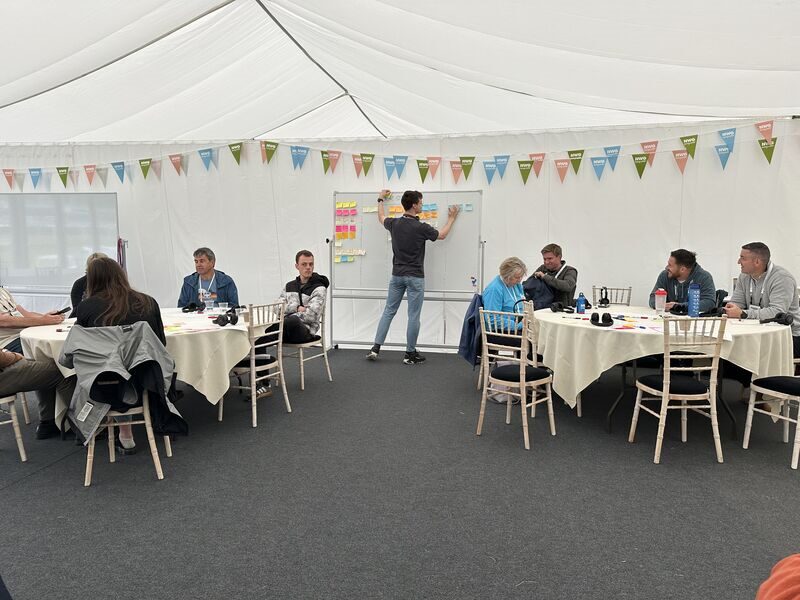
Attending the Northumbrian Water Innovation Festival last month was a very informative experience for our CACI Mood team, filled with insightful discussions and ground-breaking innovations. Held at Newcastle Racecourse, the festival brought together 3,000 people from 32 countries, creating a vibrant and diverse atmosphere. As a proud sponsor, we had the opportunity to support this great event and showcase Mood’s innovation capabilities at our exhibition stand. 

An Inspiring Setting for Innovation 

From the outset of the event, it was clear that this was not just another industry conference; it was an opportunity to break down barriers, open dialogue, and explore new ideas in a completely different context.  

The festival’s structure, which included a record 37 sprints, facilitated rapid problem-solving and idea generation. These sprints were filled with thought-provoking discussions, and we were lucky to hear insights from the likes of British Olympians Steve Cram CBE and Ellie Simmonds, who shared valuable perspectives. 

Specific Innovations and Collaborative Approaches 

One of the most striking aspects of the festival was the diversity of participants, which included suppliers like us, industry veterans, and aspiring professionals. This diversity enriched every discussion with fresh insights and novel approaches, underscoring the value of varied viewpoints in problem-solving.  

Notable innovations included solutions for improving water quality, achieving net zero emissions, and reducing pollution and leakage. A particularly impactful sprint, led by data-giant Cognizant, focused on leveraging AI technology to enhance the health of local rivers. 

Overcoming Business Challenges 

The festival also highlighted the importance of overcoming challenges through collaboration. The structured yet flexible format of the workshops, including design sprints and daily dashes, ensured that participants remained focused and productive. These sessions were expertly guided by sprint leads, facilitating a collaborative environment where participants could step out of their usual roles and approach problems from different angles. 

Personal and Professional Insights 

Engaging with a diverse group in a non-work environment allowed me to gain new perspectives on the challenges facing our water sector clients. It was refreshing to address issues in a setting where creativity was encouraged, and there were no predefined expectations about the “right” way to approach a problem. Professionally, the festival highlighted the importance of stepping outside our usual routines to generate actionable ideas. 

The Value of Participation 

Participating in the festival was more than just a productive use of time; it was an investment in the future of our water industry. The insights gained and connections made will undoubtedly contribute to more effective and innovative solutions for our clients.  

The festival demonstrated that breaking away from conventional settings and embracing a more open and creative approach can lead to endless possibilities. 

Looking Forward 

Moving forward from the festival, we hope apply elements of it to foster a more open and creative environment in our meetings and workshops. Encouraging diverse participation and thinking outside the box will continue to drive innovation in our projects and add value for our clients.

The Innovation Festival was a remarkable experience that highlighted the power of creativity, diversity, and open collaboration. I am eagerly looking forward to seeing the outcomes of this festival and am confident they will drive positive change in the water sector and beyond.

For more details on the festival, visit www.innovationfestival.org

Discover the power of Mood here.

Invention or Innovation; Evolution or Revolution?

In this Article

Our choice of language is critical in achieving effective communication, particularly in architecture-driven insight modelling. Terms like Enterprise, Business, and Solutions Architecture, and tools such as frameworks, viewpoints, models, elements, and relationships can be loaded. To some, these terms mean something specific; to others, they describe loosely understood aspects of a modelling ecosystem. 

When engaging with any enterprise in the context of architecture-driven insight modelling, it’s important to learn and use the business dialect. Learning to speak their language develops an understanding of how they think and what they want from architecture, and how to apply the modelling discipline to deliver it. 

In some instances, the rigid application of a particular modelling style, framework, notation, or language without considering why it is done that way can quickly distract from the main effort. 

Four years ago, I was part of the conception of a model to help an Enterprise understand an aspect of their world that had proven too difficult until then. This was mostly because: 

  • The data supporting the insight was dispersed across various loosely connected domains. 
  • Aspects of the data were subject to change. 
  • By the time enough information was gathered to derive insight, the data was already outdated. 

This marked the beginning of a rich and varied modelling journey, first to understand the logical representation of the Enterprise landscape in a manner that would deliver timely insights. ‘Keep it simple, start small’ was the mantra at this stage. Building a new model wasn’t an invention, as the tooling, modelling discipline, and enterprise data already existed, albeit dispersed. 

The model evolved over time, as most models do; as our thinking and understanding evolved, so did the model. Initially, changes were volatile, but they gradually stabilised as our thinking became more refined, and the model became more mature and stable. 

The greatest thing on this journey was the need to innovate. We had seen many patterns over the years, ways of describing enterprise landscapes in certain styles, or using our technology in specific ways. This model required a bespoke approach to meet an unprecedented demand for insight, which called for innovation to deliver. 

Each twist and turn in the model’s evolution demanded an innovative approach to achieve the desired outcome. I learned to describe modelling as more of an art than a science. Particularly challenging problems would occupy my mind for days, even weeks. My creative juices flowed best during the early hours, prime time for making progress. A home office setup was crucial, especially when a modeller wakes in the middle of the night with a eureka moment that must be realised quickly, or risk dissolving into a hazy dream by morning. 

Evolution is natural, invention isn’t always necessary, revolution can be a game changer, but in all of these, innovation is king. 

You can find out more on how Mood can help transform your architecture here, or get in touch with the team at moodenquiries@caci.co.uk.

Refreshing Scrum with the Ball Point Game

In this Article

On a recent programme development day, Phil Ballard, one of our award-winning Scrum masters facilitated the Ball Point Game. This is an industry-known Agile game which is usually run as part of an introduction to the Agile ethos for those keen to follow the Scrum methodology. 

Despite CACI having teams that are highly experienced in Scrum, we still found this activity to be useful not only as a “going back to basics” session, but also from the several other lessons learned from our own adaptation. 

Ball Point Game: basic overview 

Teams of eight are formed, with each team collecting a bag of balls. 

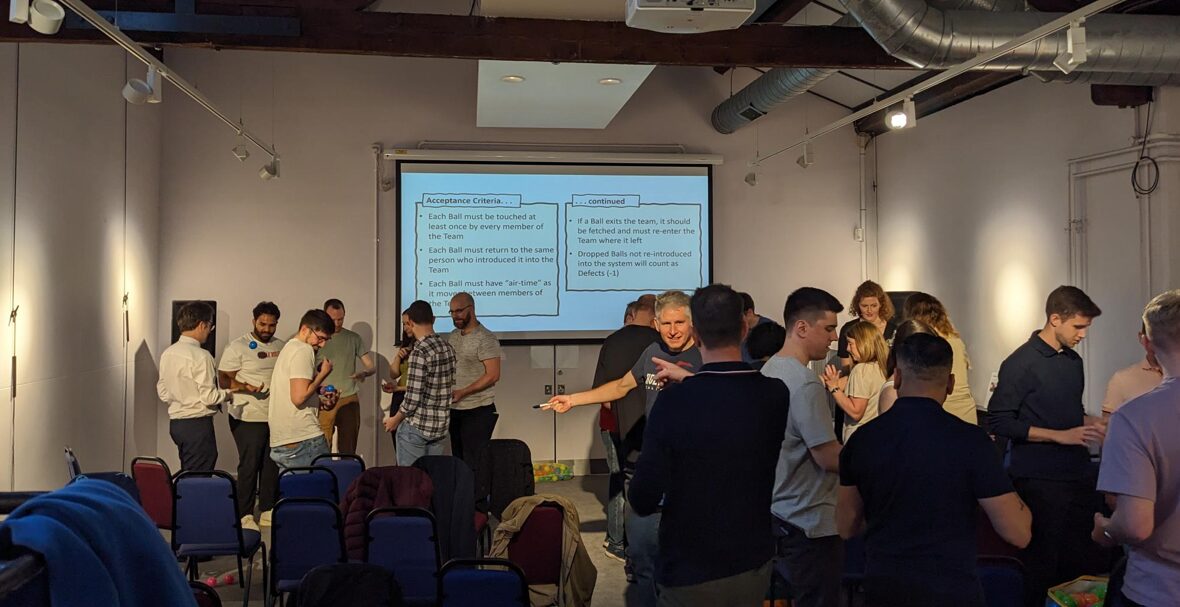
Within an Iteration (of which four take place), teams pass as many balls as possible among team members, with each ball passed scoring the team a point. Teams must adhere to the acceptance criteria of each ball being touched at least once by every member, each ball returning to the same person who introduced it into the team, each ball having “airtime” as it moves between team members, lost balls being fetched and re-entering the team where it left and dropped balls not being re-introduced into the system.

During each Iteration, teams will have one minute to talk among themselves and two minutes to perform the ‘Objective’. Prior to each Iteration, an estimate for the number of balls expected to pass through the team within the next Iteration is predicted. 

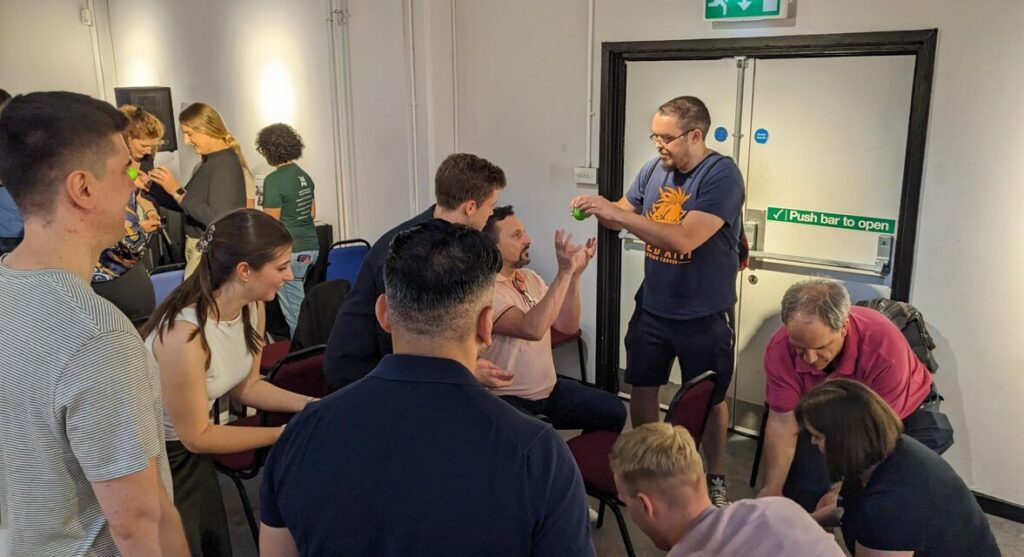
Team members taking part in the Ball Point Game, as a way to learn Agile methodology in an easy manner

CACI’s spin on the Ball Point Game 

Considering teams are already experienced in delivering in scrum, we made things more lifelike by introducing additional requirements in Iterations 3 and 4: 

  • The balls are being sold in packs of ten, with at least one of them being green. 
  • All balls must continue to gain height as they are passed through the team. 

After all, what’s software delivery without a stakeholder wanting to change their mind? The idea behind these rules was to break the established process, force change and to see what behaviours the scrum-experienced professionals would exhibit. 

Team members taking part in the Ball Point Game, as a way to learn Agile methodology in an easy manner

Ball Point Game goals

The Ball Point Game’s ultimate goal was to teach participants the value of continuous process improvement through basic agile principles using the simulation of an agile production process, including: 

  • Teamwork/shared goals 
  • Retrospectives/problem-solving 
  • Planning 
  • Estimating based on experience. 

All processes have a natural velocity. To speed things up, it is often not a case of working harder or faster, but a case of changing the process. 

Key takeaways

After all Iterations were complete, we discussed the results and asked teams to contribute their experiences with the following questions:  

  • Which Iteration felt as though it was the best/worst? 
  • How important was the retrospective between Iterations? 
  • What changes did you make? 
  • How did the team make decisions – did anybody take charge? 
  • Were all ideas heard within your teams? 
  • Was there anything notable in determining your estimates? 
  • Were improvements made by working harder or faster? 
  • Did you observe/experience anything else of interest? 

With the additional requirements added: 

  • Iterative development is also based on learning from the live product and adapting to what the customer and end user needs. 
  • Without anything being live, there is nothing to learn from and no way for the product to adapt. 
  • Sprint teams must adapt to estimating with new requirements versus estimating on a known repeatable task. 

Additional findings from the teams

  • The short timings of Iteration planning, along with the input of additional requirements, seemed to force an intensity. This, in turn, forced out several negative behaviours that we have not experienced on the programme, however, recognised within this competitive environment. 
  • Low sprint commitments despite the team feeling it was a known task. 
  • Sprint teams stopping when hitting commitment as there was an assumption that the game goal of the exercise was to have a stable velocity. 
  • Argumentative behaviours exemplified (not the usual collaborative approach we usually see). 
  • A competitive nature towards the other sprint teams, prohibiting the sharing of lessons learned. While the rules never stated they were against each other, it was inherently assumed when splitting participants into teams and asking them to perform the same task. 

On a more positive note:  

  • Many questions were asked about the requirements, with a focus on what the user/customers’ needs and problems were 
  • Looking outside of the team for improvement inspiration despite its interpretation as spying. 
  • Reflection on what we do in practice versus the theory/Agile beliefs 
  • Great discussions around the overall value of sprinting and iterative delivery. 

If you wish to find out more about the Ball Point Game or run it yourself within your programme or teams, please get in touch. 

Get ahead with CACI: Unlock the power of AI and ML in your CRM

In this Article

Setting the stage for AI and CRMs

The field of Machine learning and AI has evolved rapidly in the last few years, especially in fields where large quantities of data and quick response times to queries are crucial.

But given lots of these techniques and methods have been around for a much longer period, why has it taken so long for other industries outside of small start-ups and ambitious tech giants to leverage these methods in similar ways? 

CRM is an essential component of any company’s strategy. The ability to communicate with and understand customers is more important than ever due to the low barriers to entry in highly competitive global markets. Companies have only brief moments to convince customers that they are the right choice for shopping, spending time, or engaging. Optimising these initial and subsequent contacts is paramount to success. 

Beyond just expanding your customer base and attracting new clients, CRM is vital for any company’s retention strategy. The most advanced cutting-edge models in the world are utterly useless if we don’t know how to activate and capitalize on the value they represent. 

ML foundation for CRMs

In the CRM space our main goals are increasing consumer retention or spend, and we do this via figuring out the most effective ways to communicate with people. This can be broken down into when to speak to them, how to speak to them and why to speak to them.  

Recommendation engines lie at the core of many of these architectures, models that are designed to figure out what you want before you even know you want it. Broadly they work by looking at the kind of customer you are, then at customers like you, then finding things that they’ve bought recently that you haven’t.  

You can even simplify this down into just looking for customers who have an identical purchase history to you. Maybe a laptop you can buy on Amazon doesn’t come with a charger, so commonly when people buy this laptop their next purchase is a charger (You can often see this simple logic in the “People also bought” section of Amazon). But even these simple implementations are incredibly powerful in some ways, an educated guess is always going to be better than a random one. 

So how do these methods relate to CRM? Well, the general structure can be pulled away and applied to any subject.

When we think about how to engage with a customer, we’re going to look for ways we engaged with similar customers and how these performed. The customer who likes Sabrina Carpenter will probably need to be spoken to in a different way to the Motorhead fan. 

This is simple stuff, right? Well exactly, but it’s a method to show that the underlying AI processes in these platforms aren’t really all that complicated – there’s a lot of room for improvement especially when implementing bespoke solutions with larger data sets.  

The next (generative) step  

So, we already have ML methods that can tell us when and why to talk to people, great! But what’s the next step? 

All that’s left of our final stage is how to talk to them and what to say, stages which can and are currently being revolutionised by the advent of enterprise grade Generative AI. 

A current pipeline for devising CRM processes may involve creating template communications that are then populated with more specific information, for example customers in a certain segment defined by age and tenure are assigned one template and differing segments are shown another. 

This approach can be time consuming if it needs to be completed for each campaign, and may miss a level of personalisation that people will respond to, feeling as though each message is tailored to them rather than being an email blast they just happen to be caught up in. 

Skilled AI engineers armed with LLM’s can create a unique voice for each consumer, ensuring that quite literally all communication they will ever receive are exactly personalised to them and their engagement habits with your brand. 

Imagine attempting this even a few years ago, assigning a team of people to trawl through millions if not billions of rows of data to ensure that each customer got the perfect messaging for them would have been completely impossible. 

In practice this level of granularity in communications is probably unnecessary but it speaks to the potential these models have in this space – the sky truly is the limit. 

Even starting off small with these steps, giving a small part of a communication a generative component, allowing for large scale A/B testing and continuous model training, the effectiveness of these comms will improve over time. 

Freeing this time up from your CRM team will give them more time to tackle more involved problems that can’t be automated. 

If you need help on this journey for a better CRM, contact us here.

Insights from the London Enterprise Architecture and Business Process Management Conference 2024

In this Article

Bridging the Gap: How MooD Enhances Enterprise and Business Architecture 

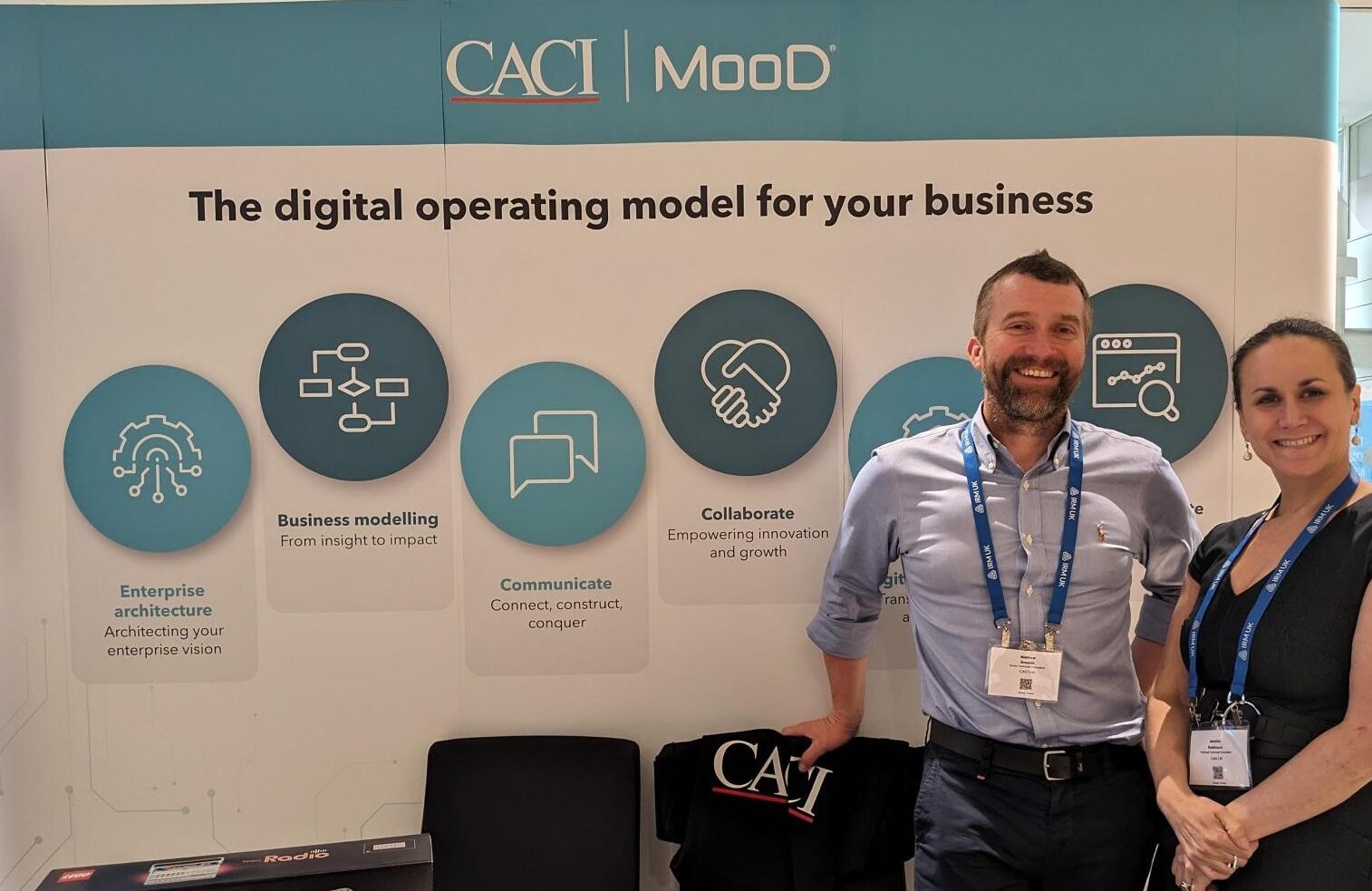
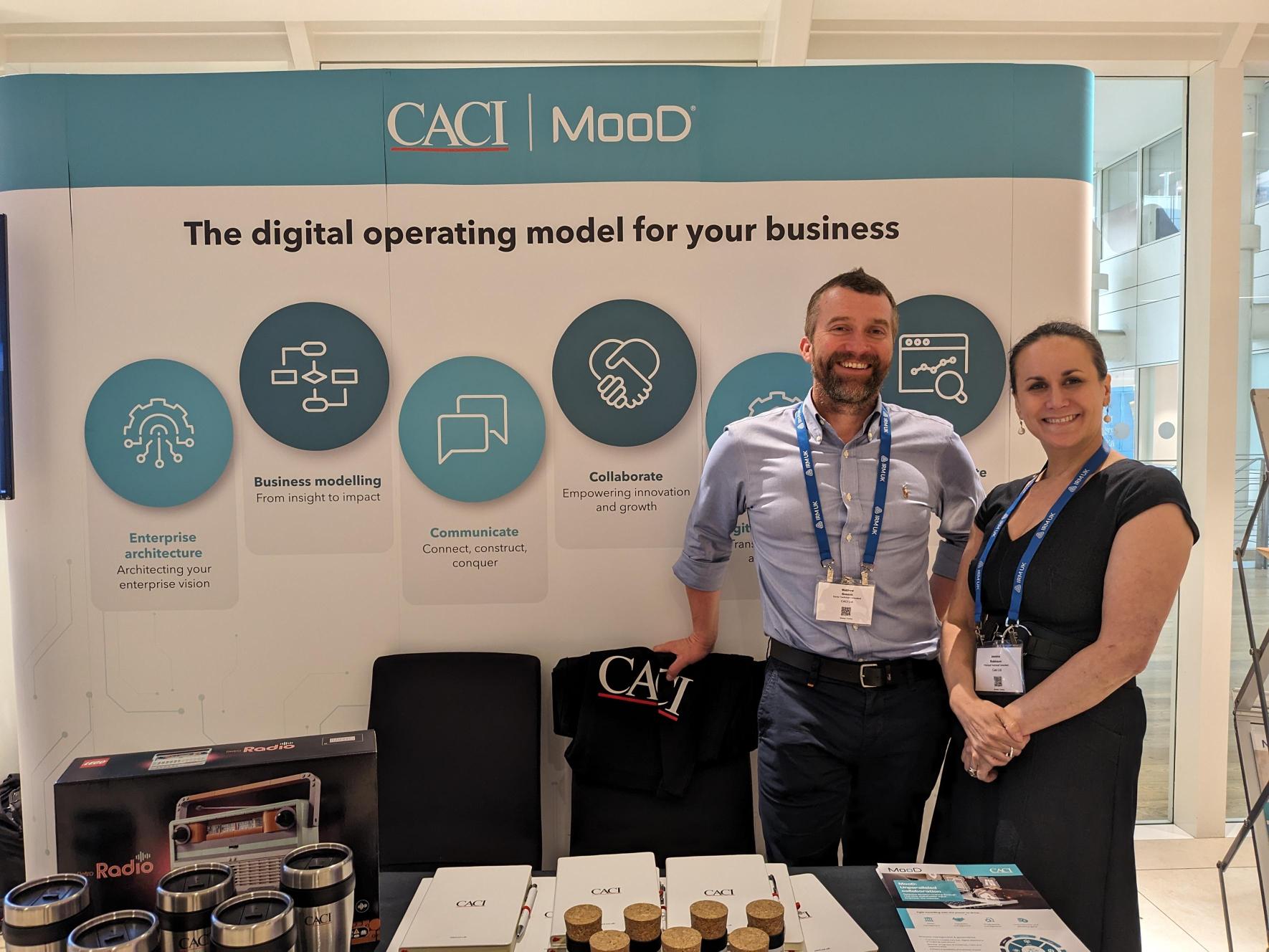
Attending the recent Enterprise Architecture and Business Process Management (EA & BPM) conference in London was a fascinating experience, full of insightful discussions and thought-provoking presentations. An overarching theme emerged from the official sessions, informal conversations at our Mood stand, and general networking: the critical importance of aligning enterprise and business architecture disciplines with broader business objectives and stakeholder engagement. 

A recurring concern highlighted at the conference was the perceived disconnect between enterprise architecture tools and their practical value to the broader business community. One speaker poignantly noted that while enterprise architecture tools are indispensable for architects, they often fail to resonate with other business stakeholders. 

This is where I wanted to jump up from my position in the audience and shout, “But we can, and that’s our edict!” Luckily, my inner filter kicked in, and I didn’t rudely interrupt the speaker. 

The challenge lies in the fact that models and architectures, no matter how sophisticated, need to be comprehensible and relevant to diverse groups of stakeholders to truly drive value. Often, this means not presenting a model at all. 

The Challenge of Stakeholder Engagement 

The conference underscored a significant issue: presenting complex models to a wide range of stakeholders often falls flat, failing to translate into actionable insights within their real-world contexts. It was also mentioned that architects should focus on presenting findings rather than making recommendations, implying that the business itself should derive the ‘to-be’ states. This perspective highlights a need for tools that not only capture and represent complex data but also facilitate understanding and collaboration across the entire organisation. 

Mood: A Unified Approach to Enterprise and Business Architecture 

This is where Mood’s capabilities truly shine. At Mood, we understand the necessity of bridging the gap between intricate architectural frameworks and practical business applications. Our platform offers an unconstrained, no-code, drag-and-drop visualisation interface, making content accessible to both technical architects and business stakeholders and making that content live, enabling input and feedback. 

  • Unified Tool and Repository: Mood provides a single tool and repository for all architectural and business models, live data, and business visualisations, establishing a single source of truth and ensuring everyone is on the same page. 
  • Flexible Meta-Modelling: Our flexible meta-modelling capability allows for the creation of meaningful taxonomies and data structures that reflect the unique needs and contexts of your organisation. This adaptability ensures that the models are not just technically accurate but also contextually relevant to the business and agile to change. 
  • True Collaboration: By enabling true collaboration throughout the lifecycle of a transformation programme and beyond, Mood ensures that all stakeholders are involved and engaged throughout. Our platform facilitates seamless communication and collaboration, breaking down silos and fostering a culture of continuous improvement and alignment. 

Conclusion 

The EA & BPM Conference in London highlighted a critical challenge in the fields of enterprise and business architecture: the need to bring the business along for the journey. Tools and models must not only be robust but also accessible and meaningful to a diverse audience. 

Mood addresses these challenges head-on, providing a platform that unifies enterprise and business architecture with its environment, enabling true collaboration and understanding. By leveraging Mood’s powerful visualisation and flexible meta-modelling capabilities, organisations can ensure that their architectural efforts translate into real-world value, driving meaningful transformation and business success. 

As we continue to innovate and enhance our platform, we remain committed to bridging the gap between architecture and business, helping organisations to navigate their transformation journeys with confidence and clarity. 

Thank you for taking the time to read about our experiences and insights from the EA & BPM Conference. We look forward to continuing the conversation and exploring how Mood can support your organisation in achieving its strategic goals. 

Upcoming Event: Northumbrian Water’s Innovation Festival 2024 

We are excited to announce that we will be exhibiting at Northumbrian Water’s Innovation Festival, taking place from 8th to 11th July 2024 at Newcastle Racecourse. The festival gathers innovators from all over the globe and is set to bring valuable opportunities for hundreds of young people from across the North East.

The festival will feature design sprints, hacks, workshops and activities focused on solving environmental and societal challenges under the theme ‘Speed and Scale’. Join us to explore how Mood can contribute to these innovative solutions and help drive meaningful transformation. For more details, visit www.innovationfestival.org

How has CACI responded to the Forensic Science Regulator Code?

In this Article

With the Forensic Science Regulator Code of Practice now a statutory requirement, Digital Forensics units pursuing ISO/IEC 17025:2017 accreditation must use an ISO/IEC 17043 accredited proficiency testing provider. CACI’s Digital Forensics Lab has been assessed by UKAS and granted accreditation to BS EN ISO/IEC 17043:2023 for all our Digital Forensic Proficiency Testing schemes.

What is the Forensic Science Regulator Code of Practice?

GOV.UK states that the code “sets quality standard requirements for forensic science activities related to the investigation of crime and the criminal justice system in England and Wales” and came into force in October 2023. This being introduced will prove to be hugely impactful for forensic science and it’s importance and meets the regulator’s requirements for quality long-term.

CACI Proficiency Testing Schemes

  • Computer Based Devices – Acquisition
  • Computer Based Devices – Processing & Analysis
  • Mobile Based Phone – Acquisition, Processing & Analysis

What’s included in the scheme?

Computer Based Devices – Acquisition

  • Includes three to five physical devices each year.
  • Devices meet UKAS requirements to test the entire scope over a four-year period.
  • Focuses on acquisition processes and related challenges.
  • Includes pre-acquisition activities and more.

Computer Based Devices – Processing & Analysis

  • Provides forensic acquisition yearly for processing and analysis.
  • Meets the scope for Microsoft Windows, Apple MacOS ad Linux over a three-year period.
  • Includes full case background, examination strategy, and workbook.
  • Focuses on processing and analysis processes and related challenges.

Mobile Based Devices – Acquisition, Processing & Analysis

  • Includes three physical test devices and forensic acquisition yearly.
  • Provides full case background, examination strategy, and workbook.
  • Focuses on acquisition, processing, and analysis processes and related challenges.
  • Includes pre-acquisition activities and more.

How do CACI’s PT schemes ensure relevance to Law Enforcement DFUs?

CACI’s PT schemes are designed to closely replicate typical law enforcement digital forensics submissions. Participants receive physical devices packaged as police exhibits, along with a submission document, allowing them to test their end-to-end processes. Both Computer Acquisition and Mobile Acquisition schemes test pre-acquisition activities and more.

If you would like to book yourself on the next proficiency testing scheme, please get in touch with our team.

Selecting the right customer engagement tool from Adobe

In this Article

At CACI, we have been working with the Adobe Experience Cloud for over 12 years, helping clients maximise the value they get from their investment in the platform, delivering award winning outcomes and producing significant revenue streams as a result. 

We’re proud to be an Adobe Gold Partner and are widely recognised as a thought leader and specialist, especially around Adobe’s campaign and journey orchestration offerings.

In this series we dive into the Adobe upgrade pathway and discover the pros and cons of each version, key upgrade considerations, and enable you to decide which one suits your needs best. 

Group of diverse coworkers collaborating and brainstorming together over a boardroom table in the office. A text below reads "what does this mean for you"

How will businesses be affected by Adobe’s latest upgrade pathway?

Following Adobe’s recent announcement that Adobe Campaign v8 (ACv8) and Adobe Journey Optimiser (AJO) represent the future of their marketing automation and journey orchestration offering, businesses currently relying on older versions of Adobe Campaign Classic and Standard are strongly encouraged to transition to either AJO or ACv8.  

For B2B clients, Marketo Engage remains Adobe’s core marketing automation solution, alongside a newly released B2B editions of the ‘Real-Time Customer Data Platform’ and ‘Adobe Journey Optimizer’ 

While both AJO and ACv8 boast robust features, the process of selecting which one is most appropriate for your needs requires careful consideration to ensure you are setup to enable long-term customer success and CRM scalability. 

With change comes opportunities for businesses to evolve their CRM programmes with the new capabilities of the Adobe Tech stack, such as utilising new channels.  

So, how can businesses decide which of these tools will be right for them? 

Face-off: Adobe Campaign v7 vs v8 

The console version of Adobe Campaign v8 is very similar to v7. Until now, the primary reason to migrate would be to take advantage of faster data processing and integrations with other Adobe products.  

The new web UI however will be attractive to lots of AC customers, offering a much more marketer-friendly interface for less technical users, and will appeal to clients currently using the web-based Adobe Campaign Standard. 

One consideration with a move to v8 is that it includes the additional layer of support provided through Adobe’s new Managed Cloud Service.

Diverse group of office workers collaborating and brainstorming together. Below is a text that reads 'How does this fit your organisation?'

Is Adobe Campaign v8 right for my business?

In our opinion, v8 is an incredibly versatile tool and is perfect for delivering complex campaigns at scale for businesses. Those who are on ACS are in for a significant upgrade given the additional capability and scope for customisation offered by the tool.  

Comparative to ACS, Adobe Campaign is a much more customisable and extensible tool and can be leveraged to meet very bespoke requirements as a result. As per ACS, at its heart is a fully relational and extendable data model. However, unlike ACS, you are not limited to a single set of rules governing sending requirements and this can be bespoke to different targeting requirements. For example, having different rules for Newsletters, automated campaigns, and other different types of marketing communications.  

Some examples of custom implementations of Adobe Campaign v8 completed by CACI include:  

Introducing Real-time journey orchestration with AJO

Adobe Campaign is built on a traditional relational database. While this fully extendable data model makes it well-suited for advanced batch segmentation and personalisation campaigns, it is not as well suited to real-time, journey-based orchestration use cases that some newer customer engagement platforms support.  

Adobe’s answer for these use cases is its Adobe Journey Optimizer (AJO) platform, built on Adobe Experience Platform. AJO offers the ability to build 1:1 journey-based, triggered experiences at scale. E.g. For anyone wanting to build seamless omni-channel personalised experiences at scale then AJO is the platform to consider 

Additionally, with support for web and mobile in-app messaging alongside DM, SMS, push and email, the platform makes for a compelling choice for clients looking to leverage these channels and respond to real-time, streaming data. AJO can also leverage the existing data in AEP to enrich the incoming event and further personalise the customer journey.

Is AJO right for my business?

We believe Adobe Journey Optimiser (AJO) stands out as an excellent real-time journey orchestration platform. It being underpinned by AEP means that it can leverage much more complex data structures than alternative customer engagement platforms, so it will no doubt appeal to clients facing more complex data needs, especially those who have not yet invested in a CDP and will therefore benefit from other products within the AEP stable.  

Many clients may still need some of the more traditional features that come from an enterprise grade campaign management platform, however, especially if they need to orchestrate complex batch campaigns (e.g. insurance renewals).

A combination of Adobe Campaign and AJO will therefore appeal to clients looking for that perfect blend of traditional batch and real-time triggered orchestrated journeys. The improved Campaign -> AEP integrations that also come with AC v8 make this combination much easier to manage.  

CACI are Gold Adobe partners and have hands on experience planning and migrating into the Adobe Experience Cloud.

Download our whitepaper series to explore the Adobe upgrade pathway and discover the pros and cons of each version, key upgrade considerations, and enable yourself to decide which one suits your needs best.

Should you need independent help when planning your Adobe Campaign upgrade, please don’t hesitate to get in contact with our experts.

CACI acquires Rowe IT to enhance its Critical National Infrastructure business

In this Article

“We’re delighted to welcome the Rowe IT team and their exceptionally rigorous software engineering and data analysis mindset. Their important position in the government space, particularly in critical national infrastructure, is a mark of both their capability and calibre. We have common core values and a shared culture – a collaborative workstyle, a focus on solving real-world problems and a passion for deploying the best and most secure technology solutions for our clients. This makes Rowe IT a perfect fit and an important addition to our business.”

Paul Rowe, co-founder and CEO of Rowe IT, adds:

“Joining CACI presents an exciting next chapter for Rowe, enabling us to continue to deliver excellence and value. We believe the complimentary and combined skills of both companies will bring the widest possible range of digital capabilities creating greater opportunities for staff and clients.”

About CACI Limited

Established in 1975, CACI employs more than 1300 staff providing data and technology solutions and systems to clients in the UK, Europe and elsewhere in the world. CACI Ltd is a wholly owned subsidiary of CACI International Inc., an IT-services company publicly traded on the NYSE and employing over 23,000 staff globally.

At CACI, we help clients digitally transform their organisations so they’re ready for today’s and tomorrow’s challenges. We provide specialist data, software, technology, consultancy and software engineering services to deliver innovative digital transformation projects for commercial and government organisations.

www.caci.co.uk

About Rowe IT

Rowe IT is a consultancy led software house, delivering brilliant solutions to the public sector by working on projects that have a societal impact. Our systems and solutions ensure that data is securely managed, stored, visualised and disseminated to those who need it, in a cost effective and easy to use way.

www.roweit.co.uk

Enterprise Architecture and BPM Conference 2024: Unveiling Mood’s role in enterprise transformation

In this Article

Introduction to EABPM and reflecting on EABPM 2023

Last year marked CACI Mood’s inaugural attendance at the IRM UK Enterprise Architecture & Business Process Modelling conference, a pivotal annual event focusing on enhancing professionals’ understanding of Enterprise Architecture and BPM.

The conference serves as a focal point for enterprise architects, BPM specialists, and industry leaders to exchange insights and experiences in applying these methodologies within real-world organisations. EABPM offers a rich educational platform, attracting influential speakers from leading organisations who provide invaluable insights into leveraging enterprise architecture and BPM to propel digital transformation and business value.

Reflecting on the workshops and discussions of the previous year, attendees explored how organisations leverage enterprise architecture to optimise business capabilities and streamline processes. The exhibition aspect of the conference provided access to solution providers showcasing their latest tools and technologies for managing enterprise architecture, modelling business processes, and facilitating automation.

Looking forward to EABPM 2024

This year, CACI Mood not only continues its participation and also takes pride in sponsoring the event alongside industry peers. Our team consists of Vickie White, Jess Robinson, and Matt Bosson will be actively involved, both at our stand and attending various workshops throughout the event. The team is excited to showcase CACI Mood’s enterprise architecture software platform and services, building upon the insights gained from last year’s event.

With an impressive line-up of speakers from diverse industries, this year’s agenda promises high-level technical sessions covering a range of topics. Attendees will gain valuable insights from representatives of large tech companies, consultancies, universities, and more.

Mood’s expertise

In a world of complex systems and evolving business challenges, Mood transforms scattered information into a living digital operating model, providing clarity and unparalleled collaboration. Mood drives strategic decision-making and ensures sustainable success by aligning strategy and operations, demonstrating impact, highlighting risks, and surfacing insights.

Mood delivers infinite value by enabling powerful analysis, rapid design, verification and validation, and appropriate presentation of complex architectures and systems, for targeted audiences.  Whether your business needs a tool for enterprise architecture, a no-code application development tool, or a full digital twin platform, Mood has you covered.

Our Defence Digital case study is a perfect example of how CACI Mood software, meets the diverse needs of Defence Digital within the Ministry of Defence (MOD). Defence Digital swiftly fulfilled various requirements, from creating architectural models to developing interactive solutions. Explore our wide range of Mood case studies for further insights.

If you will be attending EABPM 2024 and wish to explore our enterprise architecture services or simply connect with the Mood team, please drop by the CACI stand. For those interested in arranging a meeting beforehand, kindly reach out to us at moodenquiries@caci.co.uk.


How Estée Lauder harness the “beauty of data” to transform their customer experience

In this Article

At our annual Innovate & Accelerate conference, Daniel Lindsay, CRM, Data, Insights and Analytics Director at Estée Lauder, shared the business’ optimal pairing of data and magic behind beauty to enable their enterprise data transformation, taking the retailer from insight to instinct in order to personalise consumer experiences. This winning combination has contributed to the success of their brand value proposition, narrative and positioning through campaigns that struck a chord with consumers.

But how did Estée Lauder decide when the right time for data transformation was? What tools and strategies did they lean on to achieve this, and what were the results?

Why it was time for a big data transformation

Three years ago, Estée Lauder faced various evolutionary periods of marketing, from digital to connected media in terms of consumer interaction followed by the tailored messaging capabilities that came with leaning into data-led media and marketing , particularly first-party consumer data. The business was keen to ensure all their consumers were involved in their journey of change.

According to Daniel: “Our job as a leading beauty company in the UK is to evoke trust from the customer.” Consumers purchase from brands that they trust with their most personal spaces, so ensuring customers are at the root of the brand and understood as granularly as data personalisation allows for is vital. Estée Lauder quickly realised that connecting data to the personalised user experience would give them the competitive edge that they needed to remain an industry leader.

Happy woman doing routine skin care at home with beauty products. Woman sitting on bed at home and applying face cream.

Challenges experienced when working on data transformation & how they were mitigated

Three years down the line of their data transformation, Estée Lauder has faced its fair share of challenges:

  • Heavily investing in consumer data. The business quickly realised their initial consumer data investments were conducted on outdated infrastructure, which complicated their ability to locate their target customer and get a unified view of them.
  • Effectively delivering analytics or insights that would drive fast action and improve accessibility. They had also outgrown their campaign management system, sparking a new consideration of ensuring whatever was brought into the business would connect consumers across the channels.
  • Upskilling and bolstering their in-house capability. This would enable enhanced futureproofing and strategic planning while also upkeeping resources.

Implementing CDP & campaign management tools

Working with CACI enhanced the business’ understanding of how their consumers shop across their portfolio of brands. The resulting data was released into Braze, and has more recently been added into Google, Meta and TikTok to take their understanding of consumer data to a new level.

The business’ value realisation through Braze was being able to engage with consumers and make their CRM channels the fastest growing traffic channel across all their direct to consumer (D2C) channels so far. They were also able to increase their key loyalty metrics by 16% in repeat and retention rates across all brands. This was demonstrated through one brand, Aveda, that despite a complex route to market journey, proved that having the right infrastructure in place enabled the business to successfully understand and track consumer points through email or SMS, which has been transformational for the business.

Data transformation in real-time: MAC Cosmetics case studies

Creating Black Friday success for MAC Cosmetics

Elena Hughes, Customer Strategist at CACI, elaborated on CACI’s support with the design and implementation of Braze in Estée Lauder, and its impact on the business’ strategic communications plan ahead of their peak period, Black Friday. This was a commercially critical time in the business’ calendar with a predicted high revenue generation, meaning that the business’ strategy had to be airtight.

To execute this, Estée Lauder assessed the data with CACI to understand how customers behave during peak promotional periods. This resulted in the emergence of four key customer groups:

  • Gifters
  • Price-driven audience
  • Loyal
  • Lapsed (one-off)

The strategy needed to take a segmented approach to tailor the messaging to these specific audiences, which enabled newfound opportunities for creative enhancements as well. As a result, the business noticed a 23% increase in trading performance post-implementation of the strategy, proving the campaign’s effectiveness despite an obvious time crunch and key information presented for access in the most suitable way of actionable insight.

Activating a triggered lifecycle programme at MAC Cosmetics

Replenishment, automated trigger and cross-sale messaging were critical components of the business’ triggered lifecycle programme. Their Black Friday campaign success came from distilling a multitude of strategy-shaping data points.

Learning lessons towards achieving data transformation

Despite maintaining relatively stable sales around Black Friday, CACI’s Cost of Living and purchasing data proved to be crucial to Estée Lauder’s success. While the business noticed that some of the more luxury products like serums declined in sales, the resulting data showed that the “lipstick effect” prevailed and that customers still want to feel good about themselves no matter the economic circumstances, demonstrated in the purchasing of what consumers consider to be essential products.

The business is now equipped with the necessary data to enter peak shopping periods and continue developing efficiencies and creative assets that resonate with customers.

How CACI can help

If you or your business are looking to accelerate customer data or technology changes by connecting and activating your insight, please get in touch to discuss what strategies and solutions that our team of experts can help you deliver.

UKAS Recommends CACI’s Digital Forensics Lab for ISO 17043 Accreditation

CACI’s new Digital Forensics Laboratory has successfully passed its initial assessment and been recommended for ISO 17043 by UKAS for its Digital Forensic Proficiency Test schemes. This recent recommendation from UKAS follows closely after CACI’s ISO 17025 recommendation, achieved in September, and coincides with the Forensic Science Regulator’s Statutory Code of Practice, effective since Monday 2nd October.

CACI has been recommended by UKAS for accreditation to the following scope:

  • ISO/IEC 17043:2023

CACI’s current schemes are as follows;

  • Mobile-Based Device – Acquisition, Processing and Analysis
  • Computer-Based devices – Acquisition
  • Computer- Based Devices – Processing and Analysis

All schemes are tailored to meet the criteria for accredited digital forensics (DF) laboratories operating in law enforcement. Participation rates during proficiency testing cycles have been consistently increasing.

This further evidences CACI’s commitment to supporting UK Law Enforcement with digital forensics and FSR Code compliance. The laboratory, based in Northallerton, was launched on 9th June and has been created to mirror the capabilities of law enforcement digital forensic laboratories, adhering to industry standards and employing the same tools and processes.

It took an 18-month process for the laboratory to be created, but it is now housed with industry-leading individuals with years of expertise across the digital forensics space.

The formation of the team was heavily influenced by the already-established counterpart in the United States, which has been providing exceptional service for the past decade, shown through various accomplishments and significant recognition.

CACI’s DF Laboratory’s Operations Director, Richard Cockerill, had this to say:

“We are thrilled to announce that CACI has received a recommendation from UKAS for ISO 17043 accreditation for our Digital Forensic Proficiency Test schemes. This achievement highlights the dedication and expertise of our digital forensics team. This accreditation significantly strengthens our ability to support Law Enforcement, particularly with the Forensic Science Regulator’s Statutory Code now in effect. With our robust capabilities and specialised expertise, CACI is well-positioned to deliver high-quality digital forensic investigation services to the UK criminal justice system. This recommendation from UKAS marks a significant milestone in our ongoing commitment to excellence within the UK.”

CACI are looking forward to embrace the array of opportunities expected for our digital forensics team following the confirmation of this recommendation. Furthermore, we look forward to the continued progression we’ve seen since the formation of the laboratory.

CACI acquires UK digital transformation agency Cyber-Duck to enhance its Digital Solutions Business

In this Article

CACI Limited, a leading data and technology solutions company, has acquired Cyber-Duck Limited, a pioneering UK-based digital transformation agency.

Cyber-Duck has significant expertise in combining human-centred Service Design, user experience (UX) and UI design with open-source technology including Laravel, Drupal and Acquia to create transformational, next-generation experiences, services, products and systems. Its strategic design and delivery expertise has helped clients in central and local UK government as well as large enterprises digitise their operations.

Jeet Khaira, Managing Director of CACI’s Information and Management Systems Division, comments:

“We’re delighted to welcome Danny and his superbly talented team to CACI. Their significant skills and track-record of service delivery for clients makes them an excellent fit with our own Digital Solutions capability. We have common core values and a shared culture – a collaborative workstyle and a focus on solving real-world problems for clients. They are an important strategic addition to our business and bring real value-add skillsets to enhance our offerings for our clients.”

Danny Bluestone, founder and CEO of Cyber-Duck, adds:

“Joining forces with CACI gives us scale, growth, more power, resources, support and a broader portfolio of offerings, including data analytics. We’re very excited about the next stage of our journey with significant potential for growth, innovation and to deepen our reputation, under the CACI banner, of delivering innovative solutions for clients. We’re looking forward to benefitting from a new dedicated building with CACI in Kensington Village, London and growing our team together.”

About CACI Limited

Established in 1975, CACI employs more than 1300 staff providing data and technology solutions and systems to clients in the UK, Europe and elsewhere in the world. CACI Ltd is a wholly owned subsidiary of CACI International Inc., an IT-services company publicly traded on the NYSE and employing over 23,000 staff globally.

At CACI, we help clients digitally transform their organisations so they’re ready for today’s and tomorrow’s challenges. We provide specialist data, software, technology, consultancy and software engineering services to deliver innovative digital transformation projects for commercial and government organisations.

About Cyber-Duck Limited

Cyber-Duck is a leading digital transformation agency that works strategically with governments and global brands in the UK and Europe. Since 2005, its mission has been to make the web more accessible through its expertise in service design and open-source technology so organisations and their users benefit from robust, secure and easy-to-use systems, websites and applications.

Cyber-Duck is committed to doing digital better. This means hiring and fostering diverse talent: There are more than 100 people, speaking 30+ languages and based around seven countries. It also means a focus on continuous improvement of all kinds, including sustainability. Building on our long-standing ISO accreditations in UX, Web and Mobile Development with ISO 14001:2015 environmental accreditation we can ensure our clients’ digital products reduce their carbon footprint and meet their organisation’s ESG goals.

CACI Digital Forensics Laboratory recommended for ISO 17025 accreditation by UKAS

CACI’s new Digital Forensics Laboratory has successfully passed its initial assessment and been recommended for ISO 17025 by UKAS. This coincides with the Forensic Science Regulator’s Statutory Code of Practice which took effect on Monday 2 October.

CACI has been recommended by UKAS for accreditation to the following scope:

  • ISO/IEC 17025:2017 with compliance to ILAC G19:06/2022 and Forensic Science Regulator Code of Practice Version 1
  • Scope:
    •  Capture and preservation of data from computers and digital storage devices – HDDs, SSDs, M.2 memory devices, memory cards and USB flash devices – Using FTK Imager, EnCase Imager and Tableau T356789iu 
    • Capture, preservation, processing and analysis of data from Mobile Devices, SIM cards and Memory Cards – Using Cellebrite 4PC, Cellebrite Physical Analyser, MSAB XRY, MSAB XAMN and Magnet Axiom

The laboratory, based in Northallerton, was launched on 9th June and has been created to mirror the capabilities of law enforcement digital forensic laboratories, adhering to industry standards and employing the same tools and processes.

It took an 18-month process for the laboratory to be created, but it is now housed with industry-leading individuals with years of expertise across the Digital Forensics space.

The formation of the team was heavily influenced by the already-established counterpart in the United States, which has been providing exceptional service for the past decade, shown through various accomplishments and significant recognition.

The DF Laboratory’s Operations Director, Richard Cockerill, had this to say:

“This is a fantastic achievement for CACI and is testament to the hard work and experience of our Digital Forensics team over this past year. Accreditation enables CACI to increase its support Law Enforcement which is particularly important now that the Forensic Science Regulator’s Statutory Code is in effect. CACI have the capacity and expertise to provide high quality digital forensic investigation services to the UK criminal justice system, and this recommendation from UKAS is a significant milestone in our journey.”

CACI are now looking forward to the many opportunities that will open up for the Digital Forensics team following this recommendation being confirmed, as well as the continued progression we’ve seen since the formation of the laboratory.

What is green information technology (Green IT) & why should businesses follow it?

In this Article

Climate change is an ever-growing problem, and the technology sector is unfortunately playing a substantial role in this. By 2040, this sector is set to account for 14% of the world’s carbon footprint, a massive uptake from the 1.5% it occupied in 2007. Understanding how businesses operating within the technology sector can analyse and reduce their carbon footprint and leverage green information technology (also known as green IT) practices is critical. So, what exactly is green IT and how will this shape the future of this sector’s carbon footprint?

This is the first part of a 4-blog series on Green IT. In future posts, we will discuss how businesses can use green IT to reduce their carbon footprint, choose the right cloud provider, and optimise algorithms for energy efficiency.

What is green information technology (Green IT)?

Green information technology (green IT) is the practice of using environmentally sustainable computing. It aims to minimise the effects of the technology space on global emissions to combat climate change. The concept originated from the U.S. Environmental Protection Agency in 1992 through a project called “Energy Star”, which identified products that were superior in energy efficiency and helped organisations choose products that would cut costs and reduce their carbon footprint.

Why is green IT so important?

Green IT will have significant impacts in areas beyond climate change, including:

Compliance to achieve net zero carbon emissions

Recent updates made to the Green Finance Strategy from the Financial Conduct Authority (FCA) will ensure businesses continue to meet their green finance ambitions and standards. Climate change has remained a prominent consideration within this. The FCA recognises the importance of business’ resilience in collective action to achieve net zero carbon emissions, therefore, businesses are being held increasingly accountable for any climate-related actions.

Competitive advantage through ESG scores

Businesses worldwide have increasingly focused on achieving environmental, social and governance (ESG) criteria to prove they have adopted good sustainability practices. ESG criteria assess a company’s environmental risks and potential harm to the environment. ESG scores are calculated for individual businesses based on relative performance within the company’s sector (for environmental and social) and country of incorporation (for governance). Businesses that receive a positive ESG score are ultimately more attractive to customers and investors.

What can your business do to follow Green IT best practices?

While the UK is considered the second most environmentally friendly country in the world according to the 2022 Environmental Performance Index (EPI), ongoing environmental challenges call all organisations to continue to innovate and act.

Businesses may be daunted by the fact that an eco-conscious development strategy is not easy, cheap, and will not happen overnight. Technology solutions can also be highly complex, with many parts to manage and design, which can also complicate the ability to determine the impact the solution may have on climate change. Setting policies and best practices for a business to follow is a good first step, and everyone in the business must bear some level of responsibility to help drive green IT, from the CTO to the engineers and architects.

There are several key takeaways that the wider business should consider to effectively implement and follow green IT best practices, most notably:

Demand for the information and technology sector is only going to increase, making it a massive contributing factor to climate change.

Embed green methodologies and practices into the software development lifecycle to set clear goals to help mitigate carbon footprints.

Make informed decisions on what tooling and infrastructure is going to be utilised.

More research and innovation need to happen, especially in cloud computing and analytical developmental tools.

This blog is part 1 of a 2-part blog series exploring the topic of Green IT. You can read the other 2 parts by following the below links:

To learn more about green IT and how your business can adopt these best practices, contact us today.

CACI officially launches its new digital forensics laboratory in the North of England

CACI Ltd, a leading UK data and technology company, was proud to hold the official launch of its new Northallerton based digital forensic laboratory on the 9th of June. The event was well attended throughout the day, with representation from almost all police forces covering the local North East region, as well as the local Mayor. The facility builds on the success of its parent company CACI Inc.’s* accredited facility in Virginia, United States, the laboratory will cater to UK law enforcement organisations by providing specialist digital forensics services.

Over the last 18 months, CACI’s highly skilled team of digital forensic professionals has worked diligently to establish the UK laboratory, drawing from the experience and accomplishments of its counterpart in the United States, which has been providing exceptional service for the past decade.

Richard Cockerill, Operations Director of CACI Ltd’s digital forensics laboratory, highlighted the exponential rise in the use of digital devices worldwide over the past decade. “Over 90% of crimes involve a digital component, which has resulted in unprecedented demand placed on police digital forensics units (DFUs) supporting criminal investigations,” he explained

CACI’s digital forensic laboratory has been meticulously designed to mirror the capabilities of law enforcement digital forensic laboratories, adhering to industry standards and employing the same tools and processes. This facility offers police DFUs additional resources and capacity to meet their growing operational demands.

The digital forensic team at CACI has also developed a suite of support services to assist police DFUs with ISO 17025 accreditation while ensuring compliance with the codes of practise set by the Forensic Science Regulator (FSR Codes). Since the beginning of this year, they have been providing a digital forensics proficiency testing service, with numerous accredited digital forensic laboratories having already participated and more booked in for future cycles. This service will undergo assessment by UKAS later this year, with the aim of receiving ISO/IEC 17043:2023 accreditation.

CACI’s digital forensic laboratory is fully operational and works in compliance with a quality management system designed to meet the requirements of ISO/IEC 17025:2017, FSR Codes and ILAC G19, as required for evidence used in UK criminal proceedings, with UKAS assessment scheduled in the next few months.

*CACI Inc. is a $6.2-billion American-based technology company.