Posts IT Delivery Assurance – Is it needed now more than ever?

IT Delivery Assurance – Is it needed now more than ever?

With the economy now re-opening as lockdown measures are eased, there’s an acute awareness of a new normal – a heightened focus on what matters and a keener appetite to quickly disregard the things that don’t.

Increased remote working is likely here to stay so robust cyber security controls become even more important. Now, more than ever, businesses are keen to find out whether the platform they’re standing on was built from tinder wood.

To accelerate Britain’s digital maturation, the government has announced £10M funding to develop groundbreaking cyber security technologies. However, owning the tools is only a part of the solution – businesses are often in possession of good tooling but lack the skills to properly integrate, run and support these technologies. The same could be true of any kind of IT project and the failure rate of IT projects remains appalling.

The most common response to a history of failed projects is to increase project oversight, with a particular emphasis on reporting. However, more is often mistaken for better when it comes to governance.

In a Gartner study of failed IT projects, analysis revealed most complex projects had unrealistic goals, unproven teams and almost no accountability at all levels of the management and governance structure, meaning no one is responsible for failure.

What’s more, project failures led to low morale, often coupled with high attrition rates. In highly technical environments, the impact of this staff churn can dramatically affect project milestones.

This is why you should consider delivery assurance for your next major project.

To help ease this burden, we offer delivery assurance with all our technical services to ensure that the required outcomes are achieved.

We offer to take responsibility for the quality and timeliness of our consultants’ deliverables by:

·      Recruiting a high standard of consultant

·      Providing management supervision of consultants’ work

·      Ensuring resource continuity and upscaling via a pool of consultants

·      Overseeing quality of deliverables

·      Checking customer satisfaction of our consultants’ work

This offers a range of key benefits for our clients:

·      They can be confident that a programme will be delivered on time, to budget and with business benefits optimally realised.

·      They have an independent advisor to mediate and resolve any disputes you may have with a 3rd party supplier

·      Resourcing and delivery issues are taken away

·      Reduced stress about anything going wrong because they know they are covered and it will be resolved at no further cost

CACI Network Services has successfully delivered for our clients at the largest enterprise scale. Speak to us to see if you’d like to know more about our delivery assurance offering and whether we could be a good fit for your organisation.

Serverless Cloud Security Principles

Enterprise IT has evolved from on-premise, to renting space in datacentres, into the cloud and even more abstracted approaches like the current crop of serverless offerings. At CACI, we have worked with numerous customers to deliver serverless projects and each time the security considerations are always central to the design. Previous security practices and guidance have been focussed on the more traditional routes to enterprise IT, but does that guidance relate to serverless solutions?

The UK’s National Cyber Security Centre has always provided well considered and proven guidance on security practices. CACI have recently worked with them on a serverless project and used the opportunity to help review their 14 Cloud Security Principles.

So, how do they hold up?

One of the main benefits of moving to a cloud service is the delegation of responsibility for managing the physical infrastructure to a provider. All the cloud security principles that relate to the selection of that provider are still relevant and comprise of a very useful set of considerations. Those principles can be used a checklist of requirements that you should be looking for when you decide on a provider, if you look around, the main players in the market have already documented responses to the NCSCs guidance to make that easier.

A serverless solution to a problem typically has a few more moving parts than its monolithic counterparts and the some of the principles become more important as a result. Protecting your data in transit is a fundamental consideration for any project, but with greater amounts of communication between components in a serverless system, and the nature of the shared infrastructure these services are provided on, this becomes an ever more important concern. Measures such as ensuring connections to datastores, messages sent to queues and REST interfaces are all secured using TLS with a robust key policy go a long way to answering this concern, and many of the services provided by the major players come with these safeguards built in.

The principle concerning secure development practices are still very relevant and the adoption of a new style of architecting solutions with serverless components brings its own challenges. If your team do not have a good understanding of the provider’s services and the constraints that may be applied to them, for example some serverless versions of services only support certain versions of software, it is easy to leave routes open to malicious actors. Each of the major providers have partner programs where there are companies that offer a range of services from the traditional penetration test to a full architectural review of your solution. It is worth considering if the use of these external services is appropriate to you.

Ultimately, the last principle in the list is still one of the most important messages. You are responsible for the proper use of the tools you opt to use from the provider. If you don’t fully understand what each service does, the constraints around its use and the best practices for that use, you run the risk of undermining whatever protection your provider has built into the service and exposing your solution to attack from malicious or misinformed use. Some of the simplest mistakes have led to massive breaches of data, accidently checking the box to make an S3 bucket public allows anybody to download the data and numerous high-profile companies have lost control of their data this way.

The use of cloud services in general, and serverless options in particular, give you an almost unlimited opportunity to scale your solutions to solve problems at a massive scale but remember – you pay for what you use. Including some good service monitoring into your solution, and a basic understanding of the pricing models of your chosen provider, should give you the peace of mind to fully utilise the power and flexibility of the serverless architecture.

Reframing the conversation around young offenders

Getting young people out of dangerous criminal activity such as County Lines drug dealing is a monumental challenge that our police force and youth offending teams are grappling with across the country. The practice is delivering Class A drugs across the UK and fuelling violent crime which has resulted in a hardening of the public stance towards those involved. If we reframe the conversation around such offenders, however, can we begin to realise better results in rehabilitating them?


This was the topic of debate at a recent Academy for Social Justice seminar. There is a stigma attached to criminals and those who have been through the prison system which can make it difficult for them to rehabilitate back into society. Can a shift in public discourse help to deliver better outcomes?


CRIME IS ALWAYS A HOT TOPIC AND IS POLITICISED AROUND ELECTION TIME CONSISTENTLY. IT’S A SUBJECT WE LEARN ABOUT IN THE MEDIA WHEN IT GOES WRONG. THESE DISCUSSIONS ARE OFTEN OVERWHELMINGLY NEGATIVE, WHICH IMPACTS ON REHABILITATION TARGETS AND EX-OFFENDERS BEING ABLE TO SECURE BASIC FACETS OF LIFE SUCH AS EMPLOYMENT, FOLLOWING THEIR RELEASE FROM INCARCERATION.

PENELOPE GIBBS, DIRECTOR OF THE CHARITY TRANSFORM JUSTICE

This is certainly something that we can relate to with youth offending, with children who are arrested conducted activities such as County Lines often going straight back into that lifestyle, even where such drastic intervention as moving them to a new town or city has been enacted.

We are, however, starting to see a shift in the attitude towards these children. The justice system is beginning to understand them as victims, rather than criminals, recognising the reasons why they have become involved in such activities in the first place. This sort of reframing of these crimes will have benefits for those involved and, hopefully, make it easier for them to be placed on a better course.

This reframing has been brought about by understanding. It is very easy to read headlines about escalating gang violence and fear for one’s own safety, without getting to understand where and why it is happening. It is also easy to embrace a harsh position when it comes to punishment – no one wants to think about gangs of machete wielding, drug carrying kids walking their streets.

Whilst the media fuelled much of the early misunderstanding and kneejerk reaction to the problems these youths were facing and perpetrating, it has, over time, played a fundamental role in spreading understanding around County Lines and the reality that those involved face. There have been several good investigative pieces on the topic in DispatchesBBC News and Sky News, for example.

The programmes spread understanding and made it possible for the justice system to publicly acknowledge some of those involved as victims, not just as criminals.

A recent case highlights this, with the murder of 14-year-old Jaden Moodie in London in 2019 by a 21-year-old rival gang member, Ayub Majdouline. The murder itself was shocking in the most part due to the age of the victim, who had been moved from Nottingham to London to get him away from such gang related activities with which he had been involved with since he was 11.

The initial reaction is one out outrage towards Majdouline, who received a life sentence for the murder and failing to disclose the names of any of his accomplices. But that lack of disclosure hints at the cycle Majdouline himself was stuck in. The son of an alcoholic and drug dependent mother, Majdouline had been at the mercy of a string of sexually abusive stepfathers throughout his childhood. Gang membership had given him a sense of self identity and self-worth, things his life had been entirely devoid of. For someone like him, the story was always likely to end this way. None of that excuses or condones what Majdouline did, but by beginning to understand his circumstances, we can empathise with his plight, begin to understand the wider social issues at play and invest in knowledge about engaging earlier with others like him.

The seminar also touched on another interesting aspect of public perception of criminals – that they choose their lifestyle. Again, this is something that youth offending practitioners are well positioned to debunk. As with the story above, how many 11-year-olds are freely choosing to join gangs and peddle drugs and carry knives?

“There is a similar conversation around drug addiction and obesity,” said Penelope. “If we believe that criminality is indeed a rational, thought-out decision, then it feeds into the notion that we should use punishment as a deterrent. This isn’t a stance supported by any evidence, but the vast majority of people believe it. Reframing the prevalent public attitude to offending is a key battle ground in reducing offending behaviour and the rehabilitation of offenders.”

We’re seeing this reframing in youth justice. Thanks to the tireless work of youth offending teams and their dedicated specialist staff, we have built evidence from a more complete understanding of the young people involved and how they can be helped. Public perception and a reframing of them from criminals to victims is a vital step along this path.

Why it’s time for Telecoms to prioritise Master Data Management

In this Article

The year of 2020 has brought with it many challenges, not least of which is the need to stay connected. The recent reliance on digital services to keep families, friends and businesses in touch is an added pressure and opportunity for the Telco industry who are already taking on the challenges presented by the Internet of Things (IoT) and the roll out of 5G.

Along with these new challenges and opportunities comes a time for these companies to ensure one thing moves up in the list of priorities: Master Data Management (MDM).

A MDM solution not only brings systems and information together, but creates a single version of the truth. An accurate and trusted, complete view across customers, operations, supply chain, governance and more.

Here we look at some of the key uses and benefits telecoms can get from MDM.

The customer is king

It may seem obvious that we would list the importance of the customer and their data to any telco company, but what is often less obvious is just how complex customer data can get; and that without a full view of the customer, new opportunities can be easily missed and the chances of them jumping ship are substantially increased.

When we start to delve into the sources and various data held by just one customer, it can span across subscriptions, family members, tariffs, bolt-ons, bundles and more. If this information isn’t properly stored and managed, Communications Service Providers (CSPs) can quite easily make big missteps that make the customer immediately think “you don’t know me” – which in the world of tailored online marketing, creates negative brand associates overnight.

While customers might not say it out loud, the expectation is that their CSP has a complete 360-degree view of them, across from their accounts, their relationships, their history with the CSP, interactions (whether that’s by phone, email, in-store or social media) and more. Plus, to really stay on top of future opportunities the CSP also needs to be looking at the customer’s network usage and behaviours. By taking this 360-degree approach the CSP is far more likely to create the right offer at the right time, reduce customer churn and even increase products bought within their existing customer base.

Considering these facts and that it is widely accepted that customer retention and relationship building provides more potential revenue than the acquisition of a new customer, CSPs must prioritise implementation of solutions such as MDM that allow them to better understand and react to their customers and access this potential revenue.

Protecting and producing products

Managing the chain of suppliers and products is not as straightforward as it may sound, especially where CSPs are concerned. Between the contract products of various tariffs, the digital subscriptions such as video and channel content and the hardware of different suppliers, “product” suddenly sounds much bigger.

Across these products, information is stored, managed and presented in different (and sometimes multiple) ways, creating a complicated task, especially if it’s being done manually. This will often be done by various people across the business, working in different departments.

What MDM solves for products is a way to centralise all of this information, turning large volumes of data into a manageable data set that helps a CSP to better manage all of their processes.

Opening up new revenue streams

As some more traditional revenue streams dry out, the pressure is on CSPs to look to other areas of their ecosystem for opportunities and new revenue streams.

One of these opportunities may come from the growth of connected devices and the IoT. As more and more consumers connect their home appliances, CSPs can gain increased data insights from larger volumes of data than ever before.

In addition to this, as we meet the new reality of 5G rollouts, previously unthinkable volumes of data will soon become the norm. This could not only help telecoms improve efficiency, but also open up a new stream of revenue by taking a network slicing approach to enhance network monetisation.

Once telecom’s begin to go down this route the importance of MDM becomes apparent very quickly as the data volumes need to be effectively managed.

The future of MDM for CSPs

To keep the competitive edge and meet customer demands, implementation of a MDM solution is becoming increasingly crucial.

CSPs have historically invested in key systems to support these goals such as CRM, ERP and Network management systems. With those in place a solid MDM solution provides the boost the CSP environment needs to drive improvements, efficiencies and ultimately business growth.

Find out more about how CACI are supporting telco companies in master data management.

Informing SEND provision

It is easy to understand the view that putting all the educational, social and emotional support requirements of children into one check out process should be the focus of a SEND (special educational needs and disabilities) technology solution. The efficacy of this, however, should be questioned.

The SEND journey involves bringing together our burgeoning understanding of effective responses to overlapping complex needs in a specific local service context. So many children and young people cross professional service boundaries where SEND support is required. It is, therefore, paramount that disparate services are enabled to collaborate and draw on and challenge one another’s thinking to build learning and effective practice.

As things stand, individuals understand aspects of SEND and parts of a service response, but this can be insufficient to build a whole system response. A child’s presenting problems can require sound professional judgement about hidden and buried issues but these skills are in short supply. This is where we can see the pros and cons of building a rational data process infrastructure at this time to address the service problem – if you build a process solution in silos, this can shunt problems, undermine relevant perspectives, block new understandings and practice learnings that make a difference.

You can make the siloed processes more joined up and efficient and in the short term less costly, but this can result in high service costs over the longer term where the whole system is not geared to manage demand. Multi-agency collaboration and learning will be compromised and the ability to create insight and innovative responses to need in the locality will be hampered.

A backdrop to the development and understanding of SEND provisions has been the challenge and inconsistencies of cuts to public services. These have created uneven systems, recruitment and morale difficulties through the teams in this area. How can this be reconciled? How can the practitioner systems and services build capability and be aligned?

As we can see in the Richmond case (about which you can read more here), the leaders can be a long way from the coal face, often not being in a position to understand or realise the issues until the problems are identified by a case review. In this case, it wasn’t until complaints were brought against the council. The investigation revealed the points of failure from the record keeping of parents – only then could we fully comprehend what had happened in an individual case. This serves to highlight the lack of consistency and coherence that can exist in current process and practice.

This is an issue which goes beyond SEND, too. We are seeing similar issues of cooperation and coherence in situations concerning County Lines operations and efforts to thwart them. A collective multi-agency approach is crucial to these efforts, but as we are seeing, young people who are brought to the attention of the authorities are being passed from one agency to another, often with minimal interaction between those agencies.

Some of the software which these agencies are using has also conditioned practitioners to do a job, rather than their job. To a certain extent, some points of interaction and some points of the service have become box ticking exercises. An unintended consequence is that the systems do not promote consistent and reliable professionalism as fragments of information with different provenance are passed around.

It is imperative, in building effective SEND provision, that practitioners and managers have well formed, clear and relevant information at the right level on each child in the context of their developmental journey. Providing each decision-making group with timely information alongside feedback about choices and outcomes helps them greatly in their very challenging job.

Poor decisions will be made under pressure where factors precipitate risk – knowledgeable practitioners having access to reliable up-to-the-minute information relieves the pressure and helps to correct or eliminate mistakes.

Technology, systems and software are not, however, a silver bullet to the issues we have seen with Richmond. The organisation system is vulnerable to human and systemic error and is difficult to maintain good decision making for complex needs at the right organisational level.

We can collate data in systems, however, we rely on professionals to create information and turn this into knowledge to take appropriate action across multiple agencies and professional groups. This is achieved where parents/carers and professionals interact with each other, create and access information in quality sources, but this can only be achieved with a common vision of what that looks like.

It is evident at the moment that parent/carers and practitioners involved in disparate services do not have un-refracted information relevant to supporting the journeys for many children.

There are 1,318,300 SEND children in education in the UK and the identified cohort is rising year on year. That represents 14.9% of all children in the UK. Creating solutions across the whole system for this significant cohort of children is vital, and joining the practice learning, information and knowledge dots is the only way that we can achieve this.

An interview with Braze: Keeping customers engaged in 2020

In the latest instalment of our Next Digital Decade series, David Sealey interviews Gareth Ballard, Vice President of Sales at Braze. They discuss the transformational changes that have occurred in marketing over the past ten years and how CMOs can harness these changes to drive the most value for their business over the next decade. Watch the full interview below.
Gareth explores how the exponential increase in technology over the last decade has dramatically changed the way that customers can interact with brands and what this means for your organisation.

“EACH TOUCHPOINT INCREASES YOUR CUSTOMER DATA, CREATING AN OPPORTUNITY TO INTERACT WITH YOUR CUSTOMERS IN A MORE MEANINGFUL AND HIGHLY PERSONALISED WAY”


He also discusses the trends that marketers should be leaving behind and those that marketers should be taking advantage of to retain their customer base, especially AI and machine learning.


“TECHNOLOGY SHOULD BECOME A CANVAS FOR CREATIVITY; NOT A LIMITER”


Braze recently published a report on how media streaming services have experienced a sudden increase in customers throughout March due to the amount of people who are now spending more time at home. These brands are utilising AI to predict their customers choices to work towards retaining these customers by impressing them with their customer experience so that they are not lost once this period passes.
Gareth gives his advice for how marketers can drive value this decade by stepping away from old techniques like batch and blast:


“MARKETERS NEED TO PUT THE EXPERIENCE ARCHITECTURE FIRST AND FOCUS LESS ON THE CHANNEL OR CAMPAIGN”


Gareth highlights the campaign that stands out in his mind as putting customer experience first – the Burger King Whopper Detour. Watch the video of this campaign to view how Burger King brought together a marketing stack, including Braze, to create this newsworthy campaign in the US!
If you haven’t yet caught up on our Next Digital Decade series, you can find part one here, where CACI’s Faye Dinnen discusses how digital marketing has evolved in the past decade.
In part two, we were joined by CACI’s Jon Ede, where we discussed how you can make the most of your marketing technology.


Coming up in our Next Digital Decade series, David will be sitting down with our Partner in Data Strategy, Ed Sewell.

Technology, social services and SEND provision – empowering exceptional service delivery

It is easy to understand the view that putting all the educational, social and emotional support requirements of children into one check out process should be the focus of a SEND (special educational needs and disabilities) technology solution. The efficacy of this, however, should be questioned.

The SEND journey involves bringing together our burgeoning understanding of effective responses to overlapping complex needs in a specific local service context. So many children and young people cross professional service boundaries where SEND support is required. It is, therefore, paramount that disparate services are enabled to collaborate and draw on and challenge one another’s thinking to build learning and effective practice.

As things stand, individuals understand aspects of SEND and parts of a service response, but this can be insufficient to build a whole system response. A child’s presenting problems can require sound professional judgement about hidden and buried issues but these skills are in short supply. This is where we can see the pros and cons of building a rational data process infrastructure at this time to address the service problem – if you build a process solution in silos, this can shunt problems, undermine relevant perspectives, block new understandings and practice learnings that make a difference.

You can make the siloed processes more joined up and efficient and in the short term less costly, but this can result in high service costs over the longer term where the whole system is not geared to manage demand. Multi-agency collaboration and learning will be compromised and the ability to create insight and innovative responses to need in the locality will be hampered.

A backdrop to the development and understanding of SEND provisions has been the challenge and inconsistencies of cuts to public services. These have created uneven systems, recruitment and morale difficulties through the teams in this area. How can this be reconciled? How can the practitioner systems and services build capability and be aligned?

As we can see in the Richmond case (about which you can read more here), the leaders can be a long way from the coal face, often not being in a position to understand or realise the issues until the problems are identified by a case review. In this case, it wasn’t until complaints were brought against the council. The investigation revealed the points of failure from the record keeping of parents – only then could we fully comprehend what had happened in an individual case. This serves to highlight the lack of consistency and coherence that can exist in current process and practice.

This is an issue which goes beyond SEND, too. We are seeing similar issues of cooperation and coherence in situations concerning County Lines operations and efforts to thwart them. A collective multi-agency approach is crucial to these efforts, but as we are seeing, young people who are brought to the attention of the authorities are being passed from one agency to another, often with minimal interaction between those agencies.

Some of the software which these agencies are using has also conditioned practitioners to do a job, rather than their job. To a certain extent, some points of interaction and some points of the service have become box ticking exercises. An unintended consequence is that the systems do not promote consistent and reliable professionalism as fragments of information with different provenance are passed around.

It is imperative, in building effective SEND provision, that practitioners and managers have well formed, clear and relevant information at the right level on each child in the context of their developmental journey. Providing each decision-making group with timely information alongside feedback about choices and outcomes helps them greatly in their very challenging job.

Poor decisions will be made under pressure where factors precipitate risk – knowledgeable practitioners having access to reliable up-to-the-minute information relieves the pressure and helps to correct or eliminate mistakes.

Technology, systems and software are not, however, a silver bullet to the issues we have seen with Richmond. The organisation system is vulnerable to human and systemic error and is difficult to maintain good decision making for complex needs at the right organisational level.

We can collate data in systems, however, we rely on professionals to create information and turn this into knowledge to take appropriate action across multiple agencies and professional groups. This is achieved where parents/carers and professionals interact with each other, create and access information in quality sources, but this can only be achieved with a common vision of what that looks like.

It is evident at the moment that parent/carers and practitioners involved in disparate services do not have un-refracted information relevant to supporting the journeys for many children.

There are 1,318,300 SEND children in education in the UK and the identified cohort is rising year on year. That represents 14.9% of all children in the UK. Creating solutions across the whole system for this significant cohort of children is vital, and joining the practice learning, information and knowledge dots is the only way that we can achieve this.

Youth justice in 2020 – adopting a multi-agency approach

In this Article

Collaboration and cooperation

The 2019 Youth Justice Convention was an opportunity for the domain to focus on the trauma, fear and anxiety that youth violence causes, as well as the role that youth justice teams can play in adopting a multi-agency collaboration to shape and deliver effective responses and prevention.

The speakers and breakout sessions articulated strong themes about co-production, communication and engagement with young people at source. Presenters espoused the need for those involved to be trauma-aware and to work better with the available evidence and information to improve prevention and early intervention. Further insight was also offered into adolescent contextual safeguarding, research into the effects of social media and wider developments regarding trauma-informed practice developments.

This expanded upon the general themes that we saw throughout 2019. A few months ago, the Association of Directors of Children’s Services (ADCS) addressed the issue of serious youth violence, discussing similar approaches in its paper, A discussion paper on serious youth violence and knife crime by the Association of Directors of Children’s Services.

The key messaging has centred on the need for a multi-agency approach to discover new thinking and energy as regards tackling the issue of serious youth violence. There are no easy or quick fixes available, so collaboration is hugely important, a theme that was backed up across the sessions at the Youth Justice Convention.

The lack of strategic coordination at present is resulting in missed opportunities, huge inefficiencies in approach and in some cases, duplication of work across agencies.

Delivering a multi-agency approach

So, discussing multi-agency collaboration and cooperation is one thing, but how can this be delivered? Each agency involved in this sensitive area has its own work to conduct, from social workers and youth justice practitioners to the police force and those charities which aim to help, rehabilitate and prevent these issues. Taking a step back and working to fit into a bigger picture isn’t always easy.

Technology is going to play an increasingly prevalent role in the battle against these social issues. The software is available today which empowers agencies to complete their own work whilst also making it available to external agencies in order to better inform them of the important details of a young person’s journey.

If practitioners can compile data-rich life journey representations and experiences of the young people under their purview, the software is available to provide leaders with better information and analysis to inform multi-agency decision making. The principle is to use the available information and tools to easily generate improved tracking of service investments and evidence of effective practice and targeting prevention.

Each agency has so much valuable information and so many vital insights into the issues around youth violence. Opening these up to one another has been a theme of 2019 and can be a reality of 2020.

For more information on the technology that can be used to compile and share information on youth violence, please click below.

Early intervention in the county lines battle

In this Article

The benefits of fully managed hosting for youth offending teams

The issue of eliminating county lines drug operations has been perplexing police and local authority service partnerships for years now, as the criminal gangs responsible for them have evolved their enterprises to avoid detection by law enforcement. This shift in drug dealing methodology has seen criminals coercing younger and younger perpetrators to operate at the sharp end of the trade, trafficking and selling drugs up and down the country on their behalf.

The subject was covered in Channel 4’s Dispatches programme, Britain’s Child Drug Runners. The programme investigates the devastating impact county lines has on the young people involved and their families. If it’s a subject that interests and concerns you, the programme is well worth a watch.

In the programme, it says that 14-17-year olds are the most vulnerable to exploitation and that the Children’s Commissioner estimates that some 50,000 children are being exploited in county lines activities and this has been evidenced from data captured in local youth offending systems such as ChildView. Perhaps not on an entirely unrelated topic, it is also noted by the National Children’s Bureau that 49,187 children were missing education in 2016/17.

So, how can we, as a society and through our services, tackle this issue which is occurring in every town across the country? The documentary draws a familiar conclusion: early intervention.

Early intervention, largely agreed on as the panacea for county lines, is easier said than achieved. How can schools, local authorities, youth services, youth justice teams and the police align and move to recover the lives and futures of these exploited children?

Awareness will play a major role in the battle against county lines. As noted in Channel 4’s documentary by the pressured Thames Valley police, county lines are happening right under the noses of the rest of the population, down back alleys and in the homes of vulnerable drug addicts. Documentaries such as this are vital to helping people understand what is actually going on – and it’s going on everywhere.

Fortunately, experienced leaders governing multi-agency services such as Multi Agency Safeguarding Hubs (MASH) and Youth Offending Services, have shown how to build and sustain effective responses, particularly where statutory partnerships align around child-first policy, insights and information from practice systems and outcomes.

Children are falling into county lines operations as a result of being seduced by a lifestyle consisting of money, clothes, cars and respect. It offers them an identity they are otherwise struggling to find and the promise of easy money. If something looks too good to be true, however, it probably is.

Impressionable and vulnerable children, often although not exclusively from deprived backgrounds, see drug dealing as the way to make something of their lives. They get drawn in, coerced into running drug lines on behalf of their new friends and set across the country to pedal their wares out of trap houses, often living in squalor and fear of getting robbed. A glamorous and lucrative lifestyle this is not – and getting out can be all but impossible.

So, we’re back at early intervention. As one mother of a boy who was exploited says during the documentary, at first she viewed her son as a victim, then latterly as a perpetrator. The point at which these children can be helped is in those early stages. Of course, they remain as victims throughout, but getting to them before they believe they can’t back away and start recruiting other youngsters into the process is vital in turning the tide in the battle against county lines.

This is where data mapping and deeper enquiry can play such an important role. Schools, police and local children’s authorities all have observations and data on these children which can be brought into sharper focus and visualised. As we see in the documentary when one girl is arrested, the police have information on her which informs their strategy to best deal with her immediate situation. She’s known to them. The problem is, she’s already submerged in the world of drug dealing, so it’s impossible for the police and children’s services to effectively deal with her situation given the small window of time and priority that they have.

We can, however, build and use the links and insights better. Is school progress and attendance illustrating a pattern? Who knows about the young person’s peer group and family? Have the police or others been reacting to incidents? All these factors and our understanding of adolescent vulnerability can be linked and made transparent to be used for honing early intervention efforts. We can start to join the engagement dots. We can use practice-based evidence to identify the journey that exploited young people have been on to find and make sense of commonality, missed opportunities and protective factors. We can look beneath the surface.

Technology alone isn’t the silver bullet to this growing crisis. It will take insight, innovative and exceptional human effort to recover the lives concerned. Combining rich data and understanding to inform service leaders where to focus efforts across a complex system of influences will drive learning and efficiency in early intervention and optimise the limited multi agency resources available. Otherwise, as we have seen, by the time we react to escalating incidents, it can already be too late.

For more information on how our experience with technology and design can help to improve the lives of vulnerable young people, please click below.

A Cookie-less world

In this Article

Third-party cookies have been a fundamental part of the online marketing mix; an essential tool that allows brands to capture data on their audience, deliver targeted advertising and build customer profiles. In particular, cookies are at the core of programmatic advertising, which accounts for 90% of the total UK digital display ad spend of £5.81bn in 2019.

But, the cookie in its current form is not long for this world.

With the ongoing focus on customer data privacy, following the implementation of GDPR, there are growing concerns around third-party cookies and how they are collected, leading to three of the biggest web browsers on the Internet taking steps to block or phase out tracking cookies; Safari and Firefox blocked third-party cookies by default in 2019, whilst Google is planning to phase out the third-party cookie on Chrome, the most popular browser with a market share of over 60%, by 2022.

When combined with the fact that the ICO guidance explicitly states that the way many websites go about obtaining consent for third-party cookies is not compliant, it’s clear that things are going to have to change!

WHAT ARE THE ALTERNATIVES TO TRADITIONAL COOKIES FOR PROGRAMMATIC ADVERTISING?

Without the third-party cookie, the digital marketing landscape is going to need to evolve. Various methods to allow for tracking of customers and customer behaviour are already being discussed and developed as alternatives in this possible new cookie-less world.

For example, the IAB has grand plans for a standardised unique ID across the internet that would be an “improved mechanism for audience recognition and personalisation”. However, it sounds as if it will still be based on cookies and will need a lot of collaboration requiring a complex accountability system. If this proposed solution does happen, it will not be quick.

Numerous ad tech and analytics vendors are developing solutions for tracking that don’t rely on third-party cookies. Cookies have never been effective for mobiles, hence the mobile ad/device ID such as Apple’s IDFA or Google’s GAID. Whilst these systems still present privacy issues, companies like Apple and Google may be willing to work with advertisers to find a compliant method.

In addition, being able to effectively capture customer or prospect data to accurately identify, target and activate across multiple devices requires good technology. Managing campaigns across multiple marketing channels needs marketing automation, hence the rise of tools such as Customer Data Platforms (CDPs).

Digital fingerprinting – that is, using seemingly insignificant information like device used and browser plug-ins, in order to identify an individual – had emerged within the advertising industry in part to tackle cross device tracking issues which are inherent with ad IDs. However, Google, Apple and Firefox have already taken steps to implement anti-fingerprinting measures in order to deter advertisers from moving to this method in place of the cookie, making it unlikely to be a viable alternative.

WHAT’S THE RIGHT SOLUTION?

The truth is, there is no obvious alternative to the cookie just now.

It is likely the death of the cookie will benefit the large players, particularly Google and Facebook, as advertisers will be forced to use their first party data in walled gardens, meaning we could be moving to a blunter approach, returning to last click attribution.

To find out more about the impact of the loss of the third-party cookie on digital marketing and for further insights on what advertisers can do in the interim, download our guide – The End of the Third-party Cookie?

Who will be most affected by Social Distancing?

In this Article

Data & intelligence: An essential tool for the public sector in these unprecedented times

As we move into the ‘delay’ phase of the Government’s action plan to tackle the Coronavirus outbreak, those who work for organisations that have implemented appropriate business continuity plans will be working from home to keep ‘business as usual’.

This is clearly great for those who can work in this way, however what can be done to support businesses (and their employees) who operate in sectors who are directly affected by the significant changes imposed on our everyday lives? Although the Government’s plans are still evolving, the Chancellor’s package of financial support available to business during this period have been widely welcomed.

But what about low income renters or at risk and vulnerable community groups such as the over seventies, those with underlying health conditions or those who already feel socially isolated? As these groups are likely to face the biggest challenge during this difficult period, who is responsible for their wellbeing and what provisions will be made to ensure they are supported throughout?

Given that the Government has said that Councils will be fully funded for coronavirus costs, it is highly likely that local authorities alongside their colleagues in public health and the wider integrated care system will be on hand to support these community groups. But what does the public sector know about who they are, where they are and how to reach them?

The increasing role of data and intelligence in resource planning and targeting

Data and intelligence is already an essential tool for the public sector to help understand the demographic, lifestyle, behavioural and health characteristics of residents when prioritising and delivering services. Over the coming weeks and months data and intelligence will increasingly play an integral part of resource planning and targeting as the true impact of social distancing is felt by us all, particularly those who will feel the affect of social isolation more.

The use of data is also supported by the Secretary of State for Health and Social Care, Matt Hancock who tweeted “Public information: GDPR does not inhibit use of data for coronavirus response. GDPR has a clause excepting work in the overwhelming public interest. No one should constrain work on responding to coronavirus due to data protection laws.”

This is further supported by the news that US Government officials are currently in discussion with a number of tech companies, including Facebook and Google, around how data from cell phones might provide methods for combating the ongoing coronavirus pandemic.

The Government has already published guidance on social distancing for everyone in the UK, particularly older people and vulnerable adults. But what can data and intelligence really tell us about these groups and how can this be used to assist with meaningful action?

Using data to understand the impact, and the affect on services

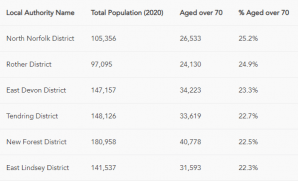
Data will allow you to understand the likely numbers involved, assess the impact of the measures so that you can see just how much this will affect services. For example, according to CACI’s current population estimates the UK population is currently just over 67 million and of that 13.7% are aged over 70. That means the Government is asking some 9 million people to self-isolate regardless of their medical conditions. In addition, analysis has shown that the largest proportion of the population aged over 70 can be found in rural authorities rather than those covering urban areas.

Top six local authorities by percentage of population over 70

If we specifically look at those who are aged seventy or over with diabetes and living alone, the health and wellbeing characteristics (Wellbeing Acorn) of these people indicate that they are three times more likely to have the biggest health challenges in the UK. They are also likely to be taking four or more prescribed medicines with many treating issues concerning cardio-vascular, gastrointestinal, the central nervous system and the endocrine system. Incidence of smoking is high with spending on tobacco at almost 70% above average resulting in higher rates of breathlessness, asthma and cancer. Their increased exposure to the health services means they are more likely to engage with multiple NHS departments. Furthermore, many of these people live in deprived neighbourhoods containing many social renting pensioners in high rise flats. They are also members of local residents or social groups and they like to talk to their neighbours.  Despite this, they are more than twice the national average not have someone who will listen nor anyone who can help in a crisis.

This intelligence is key to understanding the needs of these vulnerable and at-risk groups, assessing the demand and subsequent impact they may have on services as well as identify ways in which public services may be able to communicate and engage with them during this period of isolation.

For further information about CACI’s products and services mentioned in this blog, our work with data and intelligence across the public sector or if you have a specific data requirement now then please get in touch.

Utilising technology to improve SEND outcomes for children

In this Article

Investigation into complaints against London Borough of Richmond upon Thames (reference numbers: 18 001 501, 18 003 307 and 18 013 211)

Report by the Local Government and Social Care Ombudsman – 18 October 2019

It is clear that the setup to determine and administer support for SEND children in Richmond is not able to appropriately and effectively deliver the support packages some of these children need. The multitude of issues covers disparate systems, poor administration and concentration of knowledge into a single member of staff. Effective management of information via technology and redesign of operations would go a long way to alleviating the issues outlined by the Ombudsman.

Getting the technology right, however, is only part of the puzzle and this is not an issue isolated to Richmond. IT systems need to support and empower councils in their provisions for the children under their purview. Siloed statutory requirements, limited policy guidance and resourcing do not help councils in achieving a timely and coherent response to children’s educational needs.

As the Richmond case highlights, too, compiling and interpreting relevant historical data is incredibly challenging – aligning multiple data structures to provide a holistic view of a child or young person is, in some cases, impossible.

Even where the files exist, as we can see here, they are still at the mercy of human error when it comes to labelling, storing and indexing.

So, councils are facing a number of issues in making suitable provisions for children and this is failing SEND children on a national level. This further feeds into recent findings from the London Innovation & Improvement Alliance (LIIA) that:

  • Identification of SEND is weak
  • Outcomes for children with SEND are often poor by the age of 16

To address these underlying issues, councils need to do more work on aligning their service, practice and technology solutions to better fit the uncertainty regarding demand for the identification and support of children with SEND needs. There are, currently, some major flaws in these processes which the Richmond case serves to highlight.

Effective scheduling to effectively reduce driver fatigue

In this Article

An alarming number of drivers admit to driving whilst tired – how can operators avoid this?

Fatigue in bus drivers isn’t a common concern amongst members of the general public or, perhaps, those responsible for managing the schedules of drivers. In a service centred on delivery, considerations such as fatigue can slip down the pecking order of importance and drivers can be required to conduct more hours, at more anti-social times, than perhaps they should.

The results of this are stark: 21% of bus drivers in London say they have to fight sleepiness at the wheel two to three times per week and 36% have had a close call whilst driving a bus due to sleepiness in the past 12 months. This is according to a study conducted by Loughborough University’s Transport Safety Research Group.

These numbers are alarming, especially to someone who uses busses in London frequently, and it’s safe to assume that this isn’t a problem isolated to the capital. The causes, however, are altogether curable, cited as they are in the report as shift work and shift irregularity, sleep quantity and quality, and a disciplinarian culture giving rise to stress and mental overload.

Scheduling

The most important point is around scheduling. This is something that can be grasped immediately and have a positive impact on the problem. In a paper-based or manual environment where drivers check in at the depot to discover their shifts and routes, extra hours and unreasonable shift patterns can easily occur.

By bringing more transparency to driver scheduling, bus operators can enable their schedulers to deliver more efficient shifts to their drivers. In being able to more closely monitor shift patterns, operators can gain a far greater understanding of where fatigue is most likely to occur, leaving them in a stronger position to educate drivers and schedulers, thereby introducing a shift in culture which will reduce the risk of driver fatigue.

Technology

If this sounds straightforward, it’s because it can be. Efficient scheduling sits at the very heart of running a transport network and the tools exist to run scheduling in an online environment whereby scheduler and driver have complete oversight of their shift and shift patterns. Where schedulers can share rotas with drivers online instantly, drivers have a more efficient means of discovering their working patterns and schedulers have the means to take factors such as fatigue into consideration, offering them far greater control of the situation.

Once the scheduling element is sorted, company policy can be expanded upon to ensure fair and reasonable scheduling of those shifts which are most likely to induce fatigue, namely early morning and late-night shifts. These are the one that drivers most struggle to adapt their own sleeping patterns to, resulting in lower quantity and quality of sleep prior to and following certain shifts.

Management

Schedulers and management can also then easily identify where drivers are taking on too much work and/or have been taking insufficient breaks from their work, another red flag signposting potential driver fatigue. These breaks in driving are crucial in enabling drivers to maintain a balance in their work, whilst remaining properly hydrated and fed, thus helping to combat the onset of fatigue.

Scheduling of bus drivers is a complicated business with many factors to be considered. Delivery of a service to the public sits at the forefront of this but delivering this service in an appropriate manner is paramount. The cost of an accident can be incalculably high when all factors are considered and the risk is heightened by fatigue, yet fatigue is something that can be managed and mitigated with the correct scheduling tools and procedures.

If schedulers are properly equipped with the technology and knowledge to effectively schedule driver rotas, then the tools will be in place to begin to combat driver fatigue. Where 36% of drivers have experienced near misses in the past year as a result of fatigue, implementing the correct software to effectively and efficiently manage driver scheduling is hugely important. Is it a change that operators can afford to ignore?

School admissions made easy

In this Article

On 1 December 2018 a passenger was hit by the branch of a tree whilst leaning out of the window of a train travelling at 75mph. The accident was fatal and was later investigated by the RAIB (Rail Accident Investigation Branch) which identified a string of errors across two operating companies which contributed in their own small ways to the incident occurring, from inadequate signage and inspections, to systems failing to pick up on outstanding work. So, how can these be avoided going forward?

The train was operated by GWR (Great Western Railway) and the infrastructure by Network Rail. Both companies must carry out regular inspections in order to comply with health and safety regulations. Compliance is an issue raised by this case and the consideration of how transport operators can effectively manage and meet their compliance requirements.

Meeting the needs of children

When you then add in the complex needs of children, from children with special educational needs and disabilities, those qualifying for the pupil premium and those who are in care, to more prosaic attributes such as proximity to the school, the attendance of a sibling or those who attended a feeder school, there are myriad complications which make school admissions anything but the straightforward exercise they can appear as from the outside.

So, how can local education authorities and schools bring simplicity to what is, at times, a highly complex and challenging task?

The role of technology

Technology has been making the process of school admissions far more straightforward. By integrating with third-party mapping apps, for example, it is far quicker to determine whether or not an applicant resides within the school’s catchment area, automatically saving a lot of time in manually checking each application for such criteria.

By using an online admissions process, schools and authorities can ensure that parents are aware of the admissions criteria and can make the process a lot simpler for them, too. By logging into a parent portal, parents can complete admissions forms online and track the status at their convenience, making the whole process more engaging, more convenient and paperless – no more filling out forms and visiting the Post Office to submit applications.

Furthermore, adhering to the Department of Education rules for which parents can apply by can be formatted into a technology solution. Then aspects such as the ordering hierarchy by which children are granted admissions can be implemented to deliver further efficiency through the process. To speed up the process further, parents can upload elements such as proof of address earlier in the process, ensuring that there is transparency throughout for both parents and administrators.

Having the data securely stored in electronic formatting reduces the need for re-keying data again further down the process and enables schools to automate vast swathes of the admissions process. Just being able to automatically detect whether or not an applicant resides within the school’s catchment area saves a lot of time in having to manually check this. This is also transparent and can be easily evidenced in the case of a dispute against an admission.

Automation

Furthermore, pupils can be linked to others, making it easier to see if their sibling(s) attend the same school that is being applied for. Other categorisations can be made when in comes to the applications of special educational needs and disabilities pupils, as well as those who qualify for the pupil premium. This offers schools a far clearer picture of who is being admitted and who is not, meaning that adjustments can be made where necessary to ensure that the relevant targets are achieved. If they are not achieved, it can be evidenced exactly why not.

Utilising technology and establishing rules within a system also reduces the risk associated with human error. Putting a workflow in place around the admissions process ensures that all steps are adhered to and all information regarding an application can be automatically produced. Rather than having to manually trawl through records, they can be found instantly. This not only expediates the process but makes it far more accurate as well.

Technology is making the schools admission process easier, faster, more accurate, more transparent and fairer.

For more information on how technology could improve your admissions process, contact us today.

12 Ways to optimise your marketing opt-in process

One of the common concerns raised by direct marketers in light of GDPR, was the negative impact it would have on the contactable database. In an extreme case, one company went as far as to delete its entire customer database. Other brands attempted to re-consent their opted-in customers which saw opted-in database sizes being decimated.

Given that there was significant worry about the size of the database, I’m surprised at the lack of conversation happening about optimising opt-in rates. Opted-in customers can have a far greater lifetime value than those who have failed to give marketing consent.

Here are some ideas to begin optimising opt-in rates for marketing:

  1. Track opt-in rate as a KPI – note this isn’t the total size of the opted-in base, but the percentage of opt-ins that you could get against those who did.
  2. Also track the overall opt-in percentage of your database – this metric may move far more slowly particularly when there may be a large opted-out base of customers.
  3. A/B/n test marketing opt-in messages – testing the wording, opt-in mechanism, colour and placement.
  4. Make use of interstitial pages or modal boxes – I’ve seen modal boxes that open when a registration page is completed achieve opt-in rates of 80%.
  5. Don’t ask for all permissions in one go – consider what channel is most important and only ask for this in the first instance.
  6. Don’t ask for consent again if the customer has already given consent – for example, on prize-draw forms there’s no need to re-request marketing opt-in if the customer has already provided consent.
  7. Reconsider the opt-in proposition – what will the customer get for opting-in? What’s it in for them?
  8. Design and implement performance focussed welcome and activation customer journeys – ones that confirm your proposition and reassure the customer that it was the right idea to opt-in.
  9. Be honest and transparent – there’s no need to trick customers into providing consent, in the long-term this won’t deliver the right rewards for your business.
  10. Invest in your preference centre – enabling customers to manage down preferences or take-a-break from communications.
  11. Create really good, personalised marketing communications – make use of the data that the customer has given you and value their consent by providing the type of marketing that you’d be personally happy to receive.
  12. Focus on digital acquisition – make sure your digital acquisition efforts are focussed on acquiring new customers to registrations and opt-in.

These ideas are relatively easy to implement and shouldn’t take long to prove a positive ROI, provided that you are able to track the added value of more opted-in customers. For instance, one of my clients found that opted-in customers spent 20% more per annum.

What am I missing from this list on optimising opt-in for marketing? Are there any things you’ve tried that have worked?

Should you need any help with optimising customer acquisition and making the most of your opted-in customers, please get in touch.

How to build a business case for Adobe Campaign

In this Article

with powerful features that enable marketers to orchestrate communications and experiences across multiple channels.

Given the power of the tool when compared to other products in the market, Adobe Campaign may appear aspirational. In reality, (and having done a number of business cases for investment in Adobe Campaign) the case can be easily made. Even when moving from a low-end email service provider.

Costs to consider when building your business case:

  • Licence cost of Adobe Campaign
  • Implementation cost to configure your instance of Adobe Campaign
  • Campaign migration costs for transitioning existing campaigns to Adobe Campaign (note, this may be a good chance to improve your campaigning rather than doing a “lift-and-shift”)
  • Training of your team
  • Ongoing user support for technical and campaign users of Adobe Campaign
  • Outsourcing of the Adobe Campaign function which is an increasingly popular option allowing you the best in market tool along with an expert team of users
  • Costs for integration with further channels (SMS, Push, WhatsApp, Programmatic Display)

What’s crucial is to calculate both the CapEx and OpEx costs to get you running with Adobe Campaign. Pulling together this list can be daunting, however, CACI and Adobe can help you build a full plan with costings.

What return can I expect from Adobe Campaign?

Now comes the other side of the equation. What return do you expect to achieve from moving to Adobe Campaign? This return may be an operational cost saving by moving suppliers or, the opportunity to improve marketing performance.

Operational cost savings can come from combining existing tools into one multi-functional tool. Multiple tools that are commonly combined include ESP, SMS, campaign selection tool, customer database, and mobile app messaging. Not only is there a potential cost benefit of doing this, there is also the added power and simplicity of managing everything through Adobe Campaign. Our client, The O2 invested in Adobe Campaign and Email Studio, and have reported a reduction in campaign production timelines by 80%. Watch the customer success story.

Personally, the more exciting element of investing in Adobe Campaign is the opportunity to produce more engaging, more coordinated, cross-channel direct marketing – to actually deploy customer journeys with personalised marketing messages. Journeys that drive a significant and measurable financial return to your business.

When calculating your opportunity to improve marketing performance consider:

  • What would an improved response rate to marketing communications mean?
  • How would reduced churn or unsubscribe rates influence CLTV?
  • If customers are more engaged with my brand, what difference would this make?
  • What would the financial benefit be of reactivating lapsed customers?
  • Through personalised comms, what improvement could we see to offer conversion?
  • By improving campaign selections how much could we improve cross-sell purchases?

The perfect business case for Adobe Campaign would be composed of both an efficiency factor and an improvement in marketing response. Especially given that improved efficiency should enable the team to launch more campaigns, do more testing, and give more time to consider strategy. Combining both areas together should give you the case to invest in market leading technology that will really take your marketing efforts forward.

If you’d like help compiling your business case for Adobe Campaign, get in touch.

The 3 pillars of digital marketing strategy (Which one is failing you?)

In this Article

Whether your challenge is acquiring more leads, converting prospects or creating more value from your customer base, digital marketing success is almost impossible without the right data, technology, and people.

There are three key digital marketing pillars available to digital marketers: data, technology, and people.

By themselves, each serves a purpose, but they’re often siloed and inefficient. Combine them together, though, and you have the foundations for highly effective digital marketing strategy.

Data, tech, and people: the three digital marketing pillars

When we ask digital marketers what their greatest challenge is, it’s almost always that they want to maximise the value of their existing customer base.
And for many, this is more of a priority than attracting new customers.

Little wonder really, when on average it costs around five times more to attract a new customer than to retain an existing one. And when you consider the volumes of data brands now have at their disposal but don’t use, the potential to extract far greater insight on their customers is immense.

Truly, data is your most valuable asset by far. But without the technology, structure, and process in place to support it, that asset can easily go to waste.

Data: comes in all shapes and sizes

There’s a whole host of data available to organisations which can come from a variety of different channels and activities:

  • Demographic data – who the users are and their interests
  • Behavioural data – customer activity to date
  • Contextual data – what’s happening in real-time

Technology: the great enabler

On its own, technology won’t solve a thing. But combine it with the right data, and the talent needed to interpret it, and it can bear significant fruit. Three broad types of technology have important roles in your digital marketing stack:

  • Facilitative – external tools which are developed by third parties and are often ‘off-the-shelf’
  • Web analytics – to measure customer activity and behaviour online, including bespoke reporting
  • Internal – self-developed systems meeting your unique needs, which can’t be bought ‘off-the-shelf’

People: the human piece of the puzzle

As we know, people come in all shapes and sizes, and digital marketing is no exception. To get the most out of yours, though, you’ll need to stay on top of:

  • Team structures and skillsets – the make up of your team and who does what
  • External suppliers and agencies – the skills your team needs to outsource
  • Management levels – understand how data flows to management teams and how it will be interpreted

Combining Digital Marketing pillars for ultimate success

When you combine the forces of data, technology, and people, you create a self-populating circle of information and insight. Each one informs the other.

Without data, most tools and technology are completely useless. And just like a purchase database is useless without data, an Email Service Provider (ESP) relies completely on data to work effectively.

If the right technology can’t feed this data back to marketing and other teams in turn, it’s incredibly difficult to extract the right insight, which is critical to optimisation and marketing activity development.

And the reverse is also true, if you want to truly maximise opportunities to grow your customer base. There are scores of technologies that produce, rather than consume data. Tools like web analytics software constantly produce customer activity records which are then fed to marketers. And how this data is used is ultimately up to the people in the organisation.

But technology can also have a significant impact on the people in organisation. For a tool to succeed, it needs the right aptitudes, skills, and personnel. It can even make some roles redundant.

We tend to find that most organisations focus on one or possibly two of these elements. Some marketers have a deep opinion on which is the most important. But the truth is, without all three feeding each other, truly effective insight is almost impossible to attain.

WANT TO KNOW MORE?

Our team of digital consultants have helped many organisations from John Lewis to Heathrow Airport, if you need help with you digital marketing strategy, get in touch.

Reporting in Adobe Campaign: Three tips from the experts

In this Article

Adobe Campaign’s cross-channel engagement abilities are beyond doubt – but the tool’s reporting functionality can do more than some users realise. Here are our hints, tips and tricks for reporting using Adobe Campaign.

As I work alongside organisations to implement, integrate and use Adobe Campaign, there’s one area that I’m often asked about. Reporting.

Generally, marketers using Adobe Campaign are well aware of the tool’s data management, campaign orchestration & automation capabilities. After all, it’s the main reason they invested in the software. However, in addition to sending campaigns, they want an easy way to report on results.

More often than not, I find marketers want help in three areas:

  1. Advising on how to make the most of the out-of-the-box reports
  2. Creating custom reports and dashboards tailored to their own particular needs, data and KPIs
  3. Integrating data from Adobe Campaign into specialist reporting and analysis tools (e.g. Tableau, FastStats, PowerBI)

Adobe Campaign’s reporting capabilities are both powerful and flexible if you use them right. And in this short post, I’ll explore three ways to use Adobe Campaign reporting to help you get the information you need to track your KPIs and make smart decisions.

1. USING OUT-OF-THE-BOX REPORTS

For most operational uses, Adobe Campaign’s suite of out-of-the-box reports are great. The delivery reports in particular show a wide range of metrics, from reporting on non-deliverables and bounces through to providing a breakdown of opens by device and KPIs on all URLs clicked.

You can easily select a report showing the KPI you’re after, and all of the reports are easy to navigate. There’s no configuration required and they’re easily exportable – say as a PDF or XLS –providing a quick option when you need to share information with your colleagues.

Helpfully, you can also report on multiple deliveries at once through simply selecting them within the folder interface – the Delivery Summary report in particular is useful when comparing results across multiple campaigns.

TOP TIPS: Out-of-the-box reporting

  • Structure your campaign folders logically to help reporting on aggregate KPIs (useful when viewing reports via the dashboard)
  • Ensure opt-out and mirror page links are configured correctly so that their clicks are classified accordingly
  • Use the out-of-the box reports as a starting point for any custom reports you may want to create

2. TAKE YOUR REPORTING TO THE NEXT LEVEL WITH BESPOKE REPORTS

Once you’re comfortable with the out-of-the-box reports, you’ll want to take it to the next level and create bespoke reports.

The reporting interface within the platform allows you to create a range of reports and dashboards, with visualisations from tables through to pie charts, histograms, gauges and funnels.  You can also add your own HTML containing commentary or explanatory information.

Importantly, the platform offers complete flexibility in terms of what data is reported on, including any custom attributes and even bespoke schemas. A useful tactic can be to build custom schemas to contain aggregated data that you wish to use within your report. You can then populate this data using scheduled workflows.

We used this exact approach with a recent client who was looking to have an aggregated month-by-month sales breakdown report, populated from the underlying transactional data already integrated into their data model.

In addition to being exportable, bespoke reports can be published and made accessible from the web, either open or behind a login.

TOP TIPS: Bespoke reports

  • Create reports using schemas storing aggregate KPIs – this is a great approach when looking to report on weekly/monthly snapshots
  • Schedule prompts to send alerts to users when data in reports has been updated
  • Use bespoke filters to help you navigate to the right view quickly

3. INTERROGATE DATA THROUGH CUBES

If your license includes the Marketing Analytics Module, cubes are a great way of presenting and interrogating data.

Similar to bespoke reports, they can be built from any schema, and there’s complete flexibility around configuration of dimensions and measures – useful if you have a wide range of custom attributes.

Usefully, you can also save a list directly from a cube by simply clicking on the shopping cart button once you have selected the required cells. If your cube is using recipient data then it is straightforward to then use this list as a target in a marketing campaign.

TOP TIPS: Cubes

  • Provide access to your analysts/business intelligence teams – they will appreciate being able to quickly interrogate and compare data sets within Adobe Campaign
  • Ensure dimensions and measures are configured to cover all your key attributes (e.g. segment code, lifetime value, etc)
  • As with any reporting, ensure you set up useful metadata on your campaigns

If you want no-nonsense reporting quickly, out-of-the-box reports offer a simple and intuitive way to make sense of your data. Adobe Campaign’s custom reporting abilities enable you to take things a step further, whilst cubes are great for quick interrogation of your data.

As with any reporting however, the key is to define the KPIs and structure you need considering the business decisions your organisation needs to make. We rely on our expert colleagues within our reporting and visualisation teams to make sure we get this right for our clients at CACI.

Because a report is only worthwhile if it helps you meet your business objectives.

Getting started with audience driven marketing: A framework for success

In this Article

Talking to digital marketers at our recent London seminar on audience driven marketing, two things became abundantly clear. First, people are excited by the potential to target audiences on a granular level, with the right message in the right place at the right time. And second, few feel they have yet explored that potential to the full.

That’s perfectly understandable. An audience driven approach can give you the power to reduce marketing wastage and keep prospects fully engaged at every stage of the funnel, from initial awareness through to the sale and beyond. But the thought of integrating multiple data points from a variety of sources – while also aligning teams and resources to deliver a coherent multi-channel experience – can feel challenging, verging on impossible.

So to help, we’ve broken the approach down into a manageable framework, based on real examples that are working well for CACI clients worldwide. And we’ve come up with some hints which will – I hope – make the transition feel that bit more achievable.

Hint 1: you’ve probably started already

If you don’t know where to start with audience driven marketing, I’ve some good news. The chances are, you already have.

This approach isn’t all-or-nothing; it’s a spectrum. At the more sophisticated end, you might have multiple channel and data point integration throughout the sales funnel, but any technique that involves channel integration or data-driven targeting is a step in the right direction.

That means if you use pay-per-click search, keyword-based display advertising or paid social retargeting – among a host of other examples – your audience driven marketing journey has already begun.

From there, it’s simply a matter of layering in more data, and more channels.

Hint 2: you have access to more data than you think

All audience driven marketing is enabled and underpinned by data. Analysing the demographic information in your own database is a start, but it’s likely you have many more data points available to you, if you know where to look.

To help you take stock, we’ve devised a matrix of three data sources, and three data types.

Data type 1: demographic data – who the user is. This might be their name, location, job, income, age or other quantifiable, personal information.

Data type 2: behavioural data – what the user has done. For example, which websites they have visited, or their buying history.

Data type 3: contextual data – what the user is doing right now. Where they are, what they’re looking for, what device they’re using, and what else is happening around them.

If we plot data types on the X-axis of our grid, the Y-axis is the data’s source, or – more accurately – who owns it:

1st party data – is owned by your organisation, having been gathered directly from prospects or customers. It might include your acquisition database, transaction history or CRM.

2nd party data – is shared between partners. This might be from a joint promotion between brands, or – most commonly – between businesses within the same corporate group.

3rd party data – is bought from a data provider, having been compiled from multiple sources. It lacks some of the relevance of 1st party data, but is a rapid way to add scale.

By sorting your data into each of the nine boxes of our matrix, you’ll find it easier to track down potential sources of information, and gain the fullest possible view of who your customer is, what they’re interested in, and what they’re doing now.

Hint 3: find one data point that works, and run with it

Leaping headlong into a fully audience-driven marketing strategy would need significant investment in technology, data analysis and, potentially, restructuring. It’s easier to achieve if you test one data point at a time.

Think about your data, and your customers, and look for one way you could tailor your marketing messages to make them more relevant or less wasteful. Then layer that data into your process and – crucially – test the results.

For example, you might test the impact of adding first party demographic data – like the user’s location – to your PPC campaigns, and see if geography makes a difference to performance.

Or you might experiment with using behavioural data, like your user’s route through your site, to tailor your retargeting ads with imagery that suits their interests, or a product they’d considered.

When you find a data point that has a clear and provable impact on your figures, build it into your strategy and creative from then on. Then look for another one.

As well as being more manageable, testing with small incremental steps also allows you to build a list of solid use cases – with supporting outcome data. This makes it much easier to obtain corporate buy-in when you’re ready to take a larger step.

One data point – or one channel – at a time

At its simplest, most marketing uses one kind of data, and one channel. But finding additional data points that work for your customers, and combining them, lets you serve far more relevant and targeted messages to your audience. This can transform clickthrough and conversion rates.

Meanwhile, combining additional channels in a joined-up way allows you to keep in touch with your potential customer wherever they are in their purchasing journey.

Audience Driven Marketing is the process of moving from one data source to many, and from single channel to multichannel delivery. But the trick is to get there one data point – and one channel – at a time.

RELATED BLOG POST

To find out more about how you can optimise your online strategy, read our latest blog post on the 3 pillars of digital marketing.

Four ways to integrate the Adobe Experience Cloud

In this Article

One of the strengths of Adobe Campaign compared to other CRM solutions is the way it slots so seamlessly into the other parts of the Adobe Experience Cloud – both the core services and the other applications – many of which are already key tools for our clients.

Lining up Adobe Campaign with your other software is a powerful way to leverage your CRM data and to further enrich it – providing valuable customer insight.

Here’s a quick guide to some popular ways to get the most out of Adobe Campaign by integrating it with other Adobe Experience Cloud applications.

1. Adobe Analytics + Adobe Campaign = Better Conversion and Reporting

Using web analytics software has become standard for anyone looking to optimise their customers’ experience online. The ability to understand how your customers interact with you online is key to running a successful test-and-learn and cross-channel personalisation.

In a survey we ran in 2017, we found that at least 50% of brands using Adobe Campaign are also running Adobe Analytics. Here are three use cases that we have delivered for clients to improve conversion:

2. Adobe Target + Adobe Campaign = More Conversions

Tailor your customer’s experience to their context – say, their device and the time of day – and they’re naturally more likely to convert. Use your CRM data to add further depth to the picture, and it’s a powerful combination.

But plug in Adobe Campaign, and you can do more. Leveraging online behavioural data enables experiences to be personalised in real-time – improving relevance and therefore engagement. And the more detailed your picture of the customer, the easier marketing attribution becomes – so you know where to spend your next marketing pound for the best return.

3. Adobe Audience Manager + Adobe Campaign = Reduced CPA and Increased Retention

Integrate Adobe Campaign with the Adobe Audience Manager DMP and you’ll open up all kinds of customer acquisition opportunities – like finding much more detailed lookalike audiences and meaningful segmentation. You can also make your retargeting far more nuanced and avoid advertising to recent purchasers, dissatisfied customers and low-value opportunities.

It is also possible to use this connection to take your CRM programme into display channels and target existing customers with repeat purchase and retention campaigns. CACI has seen significant improvements in performance of CRM programmes through integration with acquisition channels.

4. Adobe Experience Manager + Adobe Campaign = Content Efficiency

With so much content being produced, it’s sometimes difficult to keep track of everything – and that means budget gets wasted. Adobe Experience Manager allows users to accelerate the creation and delivery of digital content across channels. And by combining content authoring and asset management in a single environment, everything’s under control.

Add in Adobe Campaign, and you can match the best content to the most relevant contacts – so you make more of your assets, more often.

Integration is a journey. Where would you like to go?

Our friends at Adobe tell us that adopting Adobe Marketing Cloud is a journey. As new ideas and use cases emerge, teams like web, campaigns and reporting climb out of their siloes, and are encouraged to interact, because they’re working with common data.

There are challenges with any change, but having a clear vision of the outcome you’re aiming for is an important start. And as integration becomes more natural, you’ll begin to find the seamless connection between platforms make it easier to manage each customer’s journey, from end to end.