
Posts What is website sprawl costing your organisation & how consolidation can help

What is website sprawl costing your organisation & how consolidation can help

In this Article

In our first blog of our ecosystem orchestration series, we explored why fragmented platforms may be holding your organisation back and how to navigate them through ecosystem orchestration. In this blog, we uncover the signs of website sprawl arising, how it may be affecting your organisation, the hidden costs of these signs and how consolidation can help mitigate them. 

Website estates rarely sprawl and fragment overnight. The gradual accumulation of websites is often the result of growth through business acquisitions or new sites being launched for different departments, products, campaigns or geographical regions. Each new site introduces its own hosting, security requirements, content workflows and maintenance demands.  

Over time, what may once have seemed like manageable expansion becomes a complex web of disconnected platforms, duplicated content, siloed data and rising operational overheads. The actual cost of fragmentation becomes more than technical, negatively affecting your team’s productivity and resulting in disjointed user journeys and a poor overall customer experience with limited ability to personalise and capitalise on AI.  

The impact on both B2B and B2C businesses is profound, with 20-30% of annual revenue lost due to inefficiencies caused by siloed systems and over 25% of customers defecting after just one bad experience. 

When digital expansion happens without a clear long-term governance strategy, a plethora of disconnected sites and technologies that are both difficult and expensive to maintain arise alongside fragmented user journeys and an inconsistent user experience. 

In most organisations, the website estate sits at the centre of the customer journey. When it becomes fragmented, the knock-on effects show up across the wider ecosystem, from how content is managed and how performance is measured to how CRM and customer data are used to enable personalisation. 

So, what are the warning signs that organisations should be on the lookout for when it comes to website sprawl and how might consolidation be the solution to this?

Fragmentation warning signs 

If these signs sound familiar, website sprawl may be taking effect:  

Inconsistent brand experience 

Users expect a seamless journey regardless of where and when they engage with your organisation. When different sites across your estate have different look-and-feels, inconsistent messaging or tone and navigation discrepancies, a lack of trust may arise and lead to reduced engagement.  

Duplicated content and publishing effort 

With every increase in the number of your websites, there is an increased likelihood of content duplication and discrepancies. This ultimately becomes harder to manage and makes the job of updating content across your sites a time-consuming minefield. Without strong governance or systems in place to manage this amount of content debt, conflicting and inaccurate information will continue to snowball and leave both your internal teams and users frustrated. 

Greater risk of security and compliance breaches

The more fragmented the estate, the more security vulnerabilities and increased likelihood of a malicious cyber-attack that devastates your business. This is especially true when it comes to older or forgotten websites that may not be fully patched. Similarly, as regulations tighten on key experience requirements like accessibility and data protection, the risk multiplies. Unless you have the operational bandwidth to monitor and maintain all your websites, you are opening yourself up for sanctions and fines. 

Rising maintenance costs

Each website introduces its own infrastructure requirements, costs and challenges. Managing the maintenance, hosting and support of multiple platforms is time consuming and leads to duplicated efforts.  

Hard-to-govern CMS landscape

If websites are built on different technology platforms, the operational burden grows substantially. Overhead increases when it comes to maintaining and building those sites. Integrations become more difficult and content and design changes require your team to learn multiple tools, workflows and processes.  

Poor data visibility 

Not only does a fragmented estate complicate gaining a unified customer view, but it obfuscates your websites’ analytics performance. Potential earnings are at stake because of the inability to provide users with personalised experiences and your team the ability to identify trends or insights to optimise experiences. 

These signs often indicate that your organisation needs a refreshed ecosystem orchestration and governance strategy to ensure that you can continue to scale and meet the ever-demanding needs of your users. 

The hidden costs for your organisation

The hidden costs of a website sprawl creep up in various places within an organisation. The operational drag of publishing and maintenance overhead can be felt by teams, while users grapple with inconsistent journeys that impact conversion and trust. Governance risks from compliance failures to accessibility issues and security exposure can arise and data fragmentation across platforms leads to measurement inconsistency.  

This cumulatively blocks personalisation, as relevant experiences cannot be scaled without a consistent foundation. 

What “good” consolidation looks like

Consolidation is about more than just reducing the number of websites in your ecosystem. It is about creating a coherent, manageable and scalable environment for your business to thrive digitally. When executed correctly, consolidation will unite each part of a digital estate under one governance model, ensuring consistency with content and design management. Its reusable components and shared design system, supported by a clear website and brand architecture, amplify this union.  

A composable headless CMS is central to this. It can create a single source of truth and eliminate one of the biggest causes of website sprawl: duplicate content across multiple systems. By centralising content and enabling its reuse across multiple websites, organisations can reduce reliance on fragmented legacy platforms. Separating content from presentation allows organisations to manage multiple sites from a single platform while delivering consistent user experiences across channels. This modular approach also enables legacy systems to be migrated gradually, which improves governance and reduces duplication.  

A shared measurement framework with analytics and tagging offers team comparable data and a single source of truth to work from. With accessibility built in by default, digital experiences can be enhanced and scaled confidently.  

Why consolidation is the entry point to orchestration

Website consolidation is often where fragmentation becomes most visible, but it is rarely just a website problem. True value comes when consolidation is approached as part of a wider ecosystem direction.  

Consolidation matters beyond websites because it: 

  • Reduces digital sprawl and the “surface area of complexity” 
  • Improves operational efficiency across teams and workflows 
  • Streamlines the connection between journeys, data, CRM and personalisation 
  • Creates a stronger foundation for consistent experiences, connected data and future orchestration 
  • Sets up a scalable foundation for the future of orchestration and AI-driven experiences

How CACI can help with your website & CMS consolidation

CACI’s approach to website sprawl and consolidation is grounded in practical experience, helping organisations regain control and build a foundation for sustainable innovation.  

We start by understanding your current environment, mapping out where sprawl and hidden costs are lurking. We then work with you to design governance frameworks, implement visibility tools and optimise your workloads. You gain ongoing support, regular reviews and continuous optimisation to retain your focus on what matters most: delivering meaningful experiences and fostering innovation. 

Speak to our specialists today to assess where sprawl is creating the greatest operational drag and where consolidation can help you unlock the most value. 

Download our ecosystem orchestration infographic to find out whether your platform still supports how you need to operate today. 

Next in our series, we will explore another common blocker to orchestration: how disconnected CRM and digital platforms limit personalisation, create inconsistency and what organisations can do to overcome them.

Why service design must begin with discovery

In this Article

In our first blog of this service design series, we assessed the impact of service design on end-to-end performance and why it is critical for leaders to understand its intricacies. This blog looks at the key role that discovery plays in service design.
 
Many organisations have already invested in service design: running a discovery, mapping journeys and building personas, uncovering pain points and presenting the findings. Yet despite the effort, very little remains unchanged in the day‑to‑day reality of how a service works. If that sounds uncomfortably familiar, you are not alone. Many leaders find themselves in the same position: plenty of insight, but not enough impact.
 
While service discovery is invaluable, it does not fix broken services, reduce operational costs or improve customer experience on its own. Insight is only powerful when it leads to action. This is the moment where most organisations stall and where the real work of service design begins.

What discovery will help your organisation achieve

Discovery surfaces the truth about how your service performs today, exposing friction, inconsistencies and unnecessary complexity. It reveals gaps between what users expect and what your organisation delivers through tried‑and‑tested methods:

  • Identifying pain points and experience failures.
  • Journey mapping to highlight where user effort is wasted or where support breaks down.
  • Service blueprinting to show the operational, policy and system-level issues creating that friction.

While these methods create clarity, clarity alone does not deliver change. It must be translated into decisions, prioritisation and delivery execution. Insight becomes valuable only when it moves beyond documentation and into operational improvement.

The most common point of failure in service design and transformation is not generating insight, but implementing it. This implementation gap is well recognised across large‑scale public service and organisational change, where strong discovery, policy or design intent often fails to embed into day‑to‑day delivery.

Why organisations struggle to move forward

  • No clear ownership of delivery, leaving recommendations without accountable leaders to drive them
  • Insights disconnected from a funded roadmap, so promising ideas never become prioritised work
  • Lack of governance or performance mechanisms to sustain improvements once they move into live operations
  • Misaligned teams (digital, ops, policy, technology) working on different goals, timelines and incentives
  • Operational complexity and legacy constraints that make changes difficult to implement at scale
  • Technology limitations that block even simple service improvements.

None of this is a failure of service design, but a failure of translation, from insight into action, from concept into delivery, and from isolated improvements into sustained, measurable performance gains.

What successful service transformation looks like

The organisations that unlock real value from service design treat discovery as the start, not the end. To convert insight into measurable operational improvement, they establish:

  • Clear prioritisation
  • A defined delivery roadmap
  • Alignment between digital, operational and customer teams
  • Governance and ownership
  • Measurement frameworks

How CACI helps turn discovery insights into operational changes

When it comes to service design, many organisations see the fastest wins by starting small. CACI’s quick‑start service design sprints are intentionally lightweight, low‑risk and designed to show value within weeks, not months. These are focused, time‑boxed engagements that target a single service, customer journey or operational hotspot, giving you immediate clarity on where improvements will deliver the highest return.

Because each sprint blends user insight, operational analysis and pragmatic delivery planning, you get tangible outputs fast: a prioritised set of improvements, clear owners and actions your team can implement straight away to maximise impact.

Whether you need a Rapid Service Assessment, a Blueprint Sprint or an AI‑Readiness Review, these agile engagements allow you to test the value of service design, prove ROI early and build momentum without heavy internal lift or long procurement cycles.

It is the fastest, safest way to turn insight into operational improvement with CACI supporting you every step of the way.

Discovery is essential, but value is only realised when insight leads to action and when service design is connected to delivery, governance and operational realities. For organisations that have already invested in discovery but now need to turn recommendations into measurable outcomes, this is the moment to bridge the gap.

CACI can help your organisation move from insight to implementation and from implementation to impact, translating discovery into decisions, decisions into action and action into service performance.

Contact CACI’s Service Design team to get started.

Top quick service restaurant trends for 2026: what’s shaping the future of QSR

In this Article

The quick service restaurant (QSR) sector is entering 2026 at a pivotal moment. Consumer demand remains resilient, but the operating environment is more complex than at any point in the last decade. Inflationary pressures, labour shortages, evolving customer expectations and rapid technological change are forcing QSR leaders to make sharper, more evidence-based decisions.

While much has been written about emerging QSR trends, many articles stop short of answering the most important question: which trends will genuinely deliver sustainable growth, and which risk becoming costly distractions? 

In 2026, success will depend less on adopting every new innovation and more on prioritising the right initiatives, in the right locations, for the right customers, underpinned by strong data foundations. 

Why QSRs can’t afford to ignore these trends

Globally, the QSR market continues to grow, but that growth is increasingly uneven. According to market analysis of the UK foodservice sector, total market value is forecast to exceed £85bn by 2026, with growth driven largely by QSR and delivery-led formats. 

However, this growth masks significant pressure beneath the surface:

Against this backdrop, trends are not abstract ideas — they directly influence network planning, pricing strategy, menu development and customer experience. Brands that understand how these trends play out locally are far better positioned to protect margins and unlock sustainable growth.

Top 7 quick service restaurant trends for 2026 

1. AI as a strategic engine, not just a technology layer 

    Artificial intelligence has moved well beyond experimentation in QSR. In 2026, AI is increasingly embedded across forecasting, pricing, labour scheduling and customer engagement. 

    Academic and industry research shows that machine-learning-based demand forecasting can reduce forecast error by up to 52%, directly lowering waste and improving operational efficiency. 

    Additional industry analysis highlights that AI-enabled forecasting can reduce food waste by up to 25%, improving both sustainability and margins. 

    However, the biggest gains come when AI is treated as a strategic capability, not a bolt-on. Without high-quality customer data, location insight and behavioural context, AI risks reinforcing inefficiencies rather than resolving them.

    What leading QSRs are doing differently: 

    Rather than deploying AI in isolation, leading QSRs are focusing on strengthening the data foundations that sit behind it. This includes improving customer data quality, linking transactional and behavioural signals, and incorporating location-based context into forecasting models. As a result, AI is increasingly used to anticipate demand, optimise decision-making and reduce operational risk, rather than simply automate existing processes.

    2. Drive-thru reinvention: speed, accuracy and experience 

      Despite the growth of delivery and mobile ordering, the drive-thru remains the backbone of the QSR model. Industry analysis consistently shows that drive-thru accounts for nearly 75% of QSR sales in mature markets.

      Key developments shaping 2026 include:

      • Voice AI reducing average order time by 20–30 seconds per vehicle 
      • Increased use of queue analytics to manage peak-time congestion

      Crucially, hospitality research shows that order accuracy and perceived friendliness have a greater impact on repeat visits than speed alone, reinforcing the need for balanced optimisation. 

      What leading QSRs are doing differently:

      Top-performing QSRs are moving away from uniform drive-thru solutions and instead optimising performance at a local level. By analysing demand patterns by site, time of day and customer mix, they are better able to balance speed, accuracy and service quality. This approach helps direct investment towards the locations and peak periods where improvements deliver the greatest return.

      3. Omnichannel ordering and digital transformation (with loyalty at the core)

      By 2026, omnichannel is no longer a differentiator — it is an expectation. Customers move seamlessly between apps, kiosks, drive-thru and delivery platforms. 

      Industry data highlights that:

      The challenge lies in orchestration. Fragmented systems and disconnected data undermine both margin and experience. Leading QSRs are investing in a single customer view, unifying transaction, behavioural and location data to understand which channels genuinely drive incremental value.

      What leading QSRs are doing differently: 

      Rather than treating channels independently, leading QSRs are building a more integrated view of the customer journey. By connecting data across mobile, in-store, drive-thru and delivery platforms, they gain clearer visibility of true customer value and channel interaction. This enables more consistent experiences, better-targeted loyalty strategies and improved understanding of which channels drive incremental growth.

      4. Value-driven strategies in a cost-conscious market

      Value has re-emerged as one of the defining QSR trends of 2026. According to UK consumer research, more than half of consumers actively compare prices before choosing where to eat

      Additional findings show that:

      • Bundled meals increase average order value by 8–12% 
      • Limited-time offers drive trial without permanently eroding price perception

      The most effective value strategies are location-specific, using data to tailor pricing and promotions to local demographics, competition and demand patterns. 

      What leading QSRs are doing differently

      Instead of relying on national price promotions, leading brands are taking a more nuanced approach to value. By analysing local demographics, competitive intensity and purchasing behaviour, they are tailoring offers and bundles to specific markets. This allows them to respond to price sensitivity where it exists, while avoiding unnecessary margin erosion in locations where demand is more resilient.

      5. Sustainability and packaging innovation

      Sustainability is now a baseline expectation rather than a differentiator. Research indicates that over 75% of consumers expect QSR packaging to be recyclable or compostable. 

      Industry data also shows:

      • Packaging redesigns can deliver 10–15% material cost savings 
      • Food waste contributes 8–10% of global greenhouse gas emissions, increasing pressure on operators to reduce waste 

      What leading QSRs are doing differently: 

      Leading QSRs are embedding sustainability into operational decision-making rather than treating it as a standalone initiative. By monitoring waste, packaging usage and customer response at a granular level, they are able to test changes, measure outcomes and scale successful approaches. This data-led approach helps balance environmental goals with operational efficiency and cost control.

      6. Health, wellness and radical transparency

      Health-led eating continues to influence QSR menus. Consumer studies show that over 40% of UK consumers actively seek healthier options when eating out.

      Protein-forward and plant-based items continue to outperform category averages, while demand for clear nutritional and allergen information grows. 

      What leading QSRs are doing differently: 

      Rather than expanding menus uniformly, leading operators are using customer insight to understand how demand for healthier options varies by location and occasion. This allows them to introduce targeted menu changes, refine portion sizes and improve transparency without adding unnecessary complexity. The result is a more relevant offer that reflects local preferences while maintaining operational simplicity.

      7. Ghost kitchens and virtual brands: a more disciplined model

      Ghost kitchens remain relevant, but success depends on precision. Market analysis shows that location selection and demand modelling are the biggest determinants of virtual brand success. 

      Virtual brands are increasingly used to:

      • Extend trade area coverage 
      • Test new concepts with lower capital risk 
      • Optimise delivery economics

      What leading QSRs are doing differently:

      Successful operators are taking a more analytical approach to virtual brands and ghost kitchens. By combining demand forecasting, delivery radius analysis and competitive mapping, they are identifying opportunities that complement existing estates rather than cannibalise them. This disciplined use of data reduces risk and improves the likelihood of sustainable performance.

      How QSR leaders can act on 2026 trends today

      Understanding trends is only half the challenge. The real differentiator is execution. 

      To translate 2026 trends into commercial advantage, QSR leaders should focus on five practical steps: 

      1. Prioritise trends by impact, not hype 

      Not every trend will matter equally to every brand. Use data to assess which initiatives will:

      • Drive incremental demand 
      • Improve operational efficiency 
      • Strengthen customer loyalty 

      2. Ground innovation in customer insight 

      Customer expectations vary significantly by location, demographic and occasion. Advanced segmentation and behavioural analysis help ensure investment aligns with real demand. 

      3. Use location intelligence to guide decisions 

      From drive-thru optimisation to ghost kitchens, place matters. Understanding trade areas, cannibalisation risk and local competition reduces costly mistakes. 

      4. Test, learn and scale 

      Pilot new formats, offers and technologies in controlled environments. Measure results rigorously before national rollout. 

      5. Build a strong data foundation 

      Unified, high-quality data underpins every successful trend — from AI to personalisation to sustainability.

      Future outlook: what comes next?

      Looking beyond 2026, the QSR sector will continue to converge with retail and digital commerce. Automation will increase, but human service will remain critical. Data will become more central — not just for optimisation, but for resilience. 

      The brands that outperform will be those that:

      • Invest in insight, not just infrastructure 
      • Optimise locally, not just nationally 
      • Align innovation with measurable commercial outcomes

      In a volatile environment, clarity beats complexity — and data-led decision-making is the most reliable route to sustainable growth. 

      Frequently asked questions about QSR trends for 2026

      What are the top quick service restaurant trends for 2026? 

      The top quick service restaurant trends for 2026 include AI-driven operations, drive-thru optimisation, omnichannel ordering, value-led pricing strategies, sustainability-focused packaging and data-driven personalisation. These trends reflect rising cost pressures, digital adoption and changing consumer expectations across the QSR sector. 

      How is AI being used in quick service restaurants? 

      AI is used in quick service restaurants to improve demand forecasting, labour scheduling, order accuracy and personalised marketing. By 2026, many QSRs use AI to reduce food waste, optimise staffing and deliver more relevant customer offers in real time. 

      Why is value such an important trend for QSRs in 2026? 

      Value is a key QSR trend in 2026 because consumers are more price-conscious due to ongoing cost-of-living pressures. Quick service restaurants are responding with targeted value meals, bundles and promotions that balance affordability with profitability. 

      Are ghost kitchens still relevant in 2026? 

      Yes, ghost kitchens are still relevant in 2026, but they are used more selectively. QSR brands now rely on demand modelling, delivery radius analysis and location intelligence to ensure ghost kitchens are commercially viable. 

      What role does data play in QSR trends for 2026? 

      Data plays a central role in QSR trends for 2026 by enabling better decision-making across pricing, site selection, customer engagement and operations. Brands that integrate customer, transaction and location data are better positioned to adapt to market changes. 

      How can quick service restaurants prepare for the future beyond 2026? 

      Quick service restaurants can prepare for the future by investing in strong data foundations, customer insight and flexible operating models. This allows QSRs to test new concepts, optimise locations and respond quickly to evolving consumer behaviour.

      How logistics organisations can safeguard against fuel volatility & rising prices

      In this Article

      Fuel volatility has become one of the most significant challenges facing logistics leaders. The industry is highly susceptible to variability, and with ongoing disruption in global energy markets, rising fuel prices are driving up operating costs and putting wider network performance under strain. 

      Amidst the uncertainties, one thing is clear: logistics leaders must act now to prevent losses in their networks. So, what does this fuel volatility and rising uncertainty mean for the industry and how can leaders counter these effects? 

      What fuel volatility means for logistics operations

      Three themes are emerging consistently across the sector. 

      Efficiency becomes non‑negotiable

      Tiny inefficiencies scale fast across a fleet. What was once considered a “good enough” plan that worked at £x/litre often will not survive at £y/litre.  

      As fuel costs increase, efficiency is no longer a nice-to-have. Downstream, domestic fleets are particularly impacted, as higher fuel prices amplify the cost of everyday decision-making from route choice and stop density to vehicle utilisation and realistic drive times.  

      Cost forecasts must reflect real operations

      Forecasting costs is more than just refreshing a spreadsheet. It is about grounding forecasts in what happens on the road, not what logistics leaders hope a plan will deliver.  

      While many cost models rely on planned mileage and theoretical routes, rising fuel prices expose a gap between what was planned and what happened, which becomes expensive quickly.  

      Re‑forecasting in this environment requires operational truth: understanding real mileage, real execution behaviour and where cost is genuinely being added, not assumed away. 

      Route compliance becomes the lever that matters most

      Optimisation only creates value when executed. If the plan is not followed, you are not just missing savings, but layering on cost through extra miles, minutes and exceptions.  

      Route deviations, congestion and last‑minute re-planning add unplanned miles at much higher costs per mile. Extended upstream transit times increase pressure on domestic distribution to recover service levels, often at the expense of fuel efficiency. Fleet and light commercial vehicles have been swelling the electric vehicle (EV) market, so logistics organisations in a position to adopt electric vehicles (EV) into their fleet can further reduce their fuel dependency and cut costs.  

      How can logistics leaders counter the effects?

      Logistics organisations that are coping best with fuel volatility are the ones treating efficiency as an ongoing operational discipline, not a one‑off optimisation exercise. Those prioritising the optimisation of their logistics operations via the most advanced algorithms and real-world data will stay afloat amidst uncertainty.  

      Planning optimal routes

      When fuel prices rise, every unnecessary mile becomes a direct hit to margins. Organisations can counter this by using CACI’s advanced route optimisation to continuously minimise distance travelled, time on the road and fuel consumed – without compromising service levels.  

      By dynamically calculating the most efficient routes using advanced algorithms, organisations can reduce empty miles, avoid congestion and balance workloads more effectively across fleets. 

      Focusing on operationally realistic routes

      Organisations that account for vehicle constraints, compliant roads and what drivers experience on the ground are creating the most operationally realistic routes and best placed to counter the effects of fuel volatility.  

      Closing the loop between planning & execution

      Leaders shifting from planning quality alone to execution quality can:  

      • Understand where and why deviations occur  
      • Distinguish necessary exceptions from avoidable behaviour  
      • Feed execution insight back into better planning

      These help safeguard from fuel volatility and encourage efficiencies. By embedding efficiency as a discipline, grounding forecasts in operational reality and closing the gap between route planning and execution, organisations can move from reactive cost management to predictable and resilient logistics operations, even in uncertain conditions. 

      How CACI can help

      CACI’s Logistics experts help organisations design efficient routes, re‑forecast costs using real operational data and ensure planned routes are executed. This ensures rising fuel costs do not automatically translate into rising inefficiency. 

      Pin Routes, CACI’s route optimisation software, is designed to help organisations cut costs, navigate uncertainties and increase efficiency, so that these rising costs have less of an impact. Pin Live, our delivery and collection management software, helps drivers take the correct detour and improve last-minute decision-making when changes arise on the road. Together, these tools help logistics leaders improve route compliance and maintain predictable operations despite market uncertainty. 

      To learn more about how CACI can help your organisation effectively navigate fuel volatility at cost, get in touch with us

      What is service design & how does it impact end‑to‑end performance?

      In this Article

      Service design may be a familiar term among senior leaders, but clearly articulating what it means in practice can be a challenge. While awareness of service design is high, only around 3% can define it accurately, highlighting a long‑standing understanding gap.  

      As the market currently stands, this is costly. In 2025, 70% of executives said customer expectations are evolving faster than their organisations can keep up, with 52% of consumers stopping using a brand due to a poor experience. Internal pressure is simultaneously mounting, with two‑thirds of leaders describing their organisations as overly complex and inefficient and only half feeling prepared for external shocks.  

      Clarity around service design is imperative for performance. So, how does understanding the intricacies of service design impact your organisation’s end-to-end performance? 

      What is service design?

      In commercial and operational terms, service design is the discipline of improving end‑to‑end service performance. It aligns the entire service ecosystem, people, processes, technology, data, policy and experience, ensuring services function accordingly.  

      Where a UX designer focuses on research and purely digital components like websites, a service designer will consider all touchpoints (telephony, physical spaces, technology infrastructure, etc.) for both its users and employees, discovering and fixing pain points.  

      Service design is: 

      • Understanding how a service works today (across frontstage and backstage) 
      • Identifying what users need and where the service breaks down 
      • Designing how the service should work: consistently, efficiently and at scale 
      • Aligning digital, operations and experience into a unified service model 
      • Creating a roadmap that is actionable, measurable and ready for delivery

      Service design is not: 

      • Just journey mapping 
      • An isolated discovery exercise 
      • A purely creative or theoretical activity 
      • A handover document expecting someone else to deliver it 
      • A UX‑only discipline

      At its core, service design is about making services more efficient for end-to-end customers users and the teams delivering them while enabling growth. 

      Understanding the impact of service design on end-to-end performance

      While service design has become popularised across digital transformation, customer experience, and operational change, understanding its place (whether it mirrors journey mapping or UX), where it fits within your organisation’s objectives and whether it will improve performance remain in question. 

      Many organisations invest in fragmented discovery work, generate compelling artefacts and still struggle to fix the operational issues that matter. This deduces service design to a capability, not a driver of performance. 

      Meanwhile, AI is accelerating change faster than most companies can absorb. Nearly two‑thirds of organisations yet to scale AI effectively, emphasising the need for a clear, practical and end‑to‑end approach to service design. When service design is poorly understood, opportunities are missed along with potential performance gains. When integrated from discovery through to delivery, organisations see:   

      • Modernise faster with less rework 
      • Adapt to market disruption 
      • Reduced programme risk and operational waste through meaningful change that sticks 
      • Deliver services that are easier for users and more efficient for teams 
      • Cut costs to unlock value across your entire service ecosystem. 

      Service design is more than just a way to fix broken experiences. It is a strategic lever for growth, efficiency, resilience and competitive advantage. 

      How CACI enables service design built for implementation

      At CACI, service design begins the moment insight turns into direction. Unlike traditional models where discovery and delivery sit far apart, our approach embeds service design thinking directly into the core functions that drive change. From data and analytics to digital engineering, architecture, technology delivery, operational transformation, change management and programme assurance.

      By integrating these capabilities, we remove the gaps and hand‑offs that typically slow organisations down. It means the services we design can be implemented without translation, the solutions we deliver are measurable from day one, and the insights we capture continually feed improvement. Ideas don’t get diluted as they move downstream, they gain momentum. 

      Why this matters for modern organisations 

      Leaders typically operate in environments defined by rising expectations, increasing complexity, legacy constraints and mounting pressure to deliver seamless, reliable and efficient services. 

      Service design plays a critical role in enabling this by helping organisations: 

      • Align services with strategic intent, policy goals or commercial outcomes 
      • Improve operational performance and reduce friction across journeys 
      • Deliver measurable, user‑centred improvements that stand up to scrutiny 
      • Modernise processes and technology to unlock value from existing and future platforms 
      • Strengthen accessibility, compliance, trust and resilience 
      • Enable data‑driven transformation that can scale across teams and channels

      CACI’s integrated model blends service design, research, data, engineering and delivery to translate insights into meaningful operational change. Organisations across complex, high‑stakes environments rely on CACI to redesign, modernise and optimise the services that matter most, improving experience, reducing cost‑to‑serve and accelerating performance through practical, evidence‑led transformation. 

      Organisations in complex, high‑stakes environments work with CACI to address root‑cause issues across their services, improving experience, reducing operational cost and driving performance gains that hold up in delivery.

      Contact our team to get started.

      Stay tuned for the next blog in our service design series, exploring the importance of discovery and leveraging insights for operational change. 

      What transaction trends & growth opportunities is the Food to Go sector experiencing in 2026?

      In this Article

      This year’s MCA Food to Go conference unveiled the key growth drivers, future trends and exciting developments shaping the sector. It highlighted everything from innovative technology and formats to trendsetting menus and marketing, ultimately exploring how successful brands are navigating market challenges.

      At the conference, I showcased transaction trends and growth opportunities emerging in 2026 based on three months of data from CACI’s Brand Dimensions dataset. By tracking 30+ food to go brands from November 2025 to January 2026, I assessed the trends and opportunities fuelling growth questions this year. 

      Here is what the data revealed. 

      Food to Go transaction trends & growth opportunities in 2026

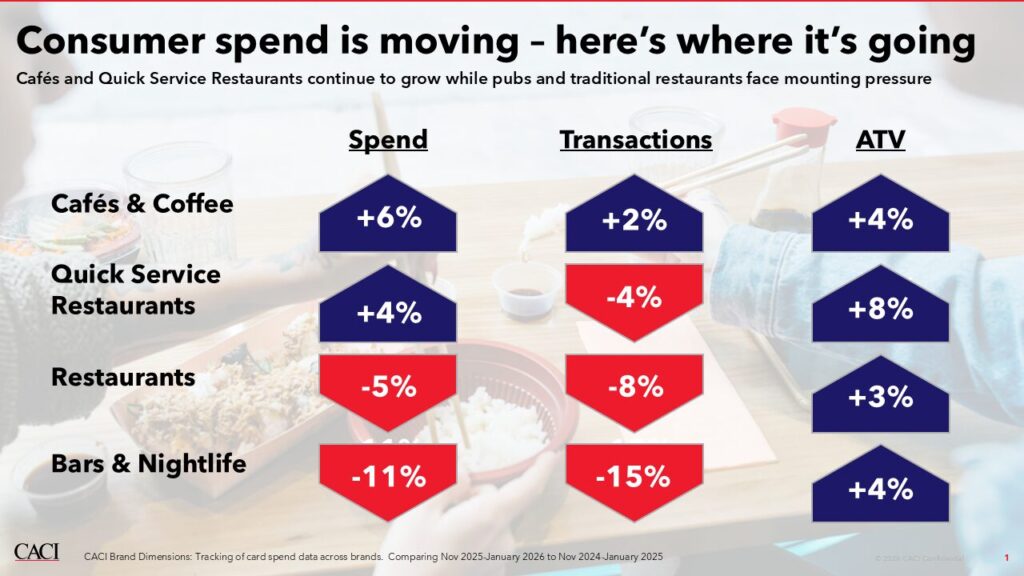
      Graph showing change in consumer spend across different food industries. 'Cafes and Coffee' and 'Quick Service Restaurants' have seen the highest growth in spend

      The findings showed: 

      • +6% YoY revenue growth in the Cafés & Coffee Shop market 
      • A slight decrease in Quick Service Restaurant (QSR) transactions, but a slight increase in Average Transaction Value (ATV)  
      • Transactions and revenue dropping across the wider F&B sector

      Which brands are leading industry trends in 2026?

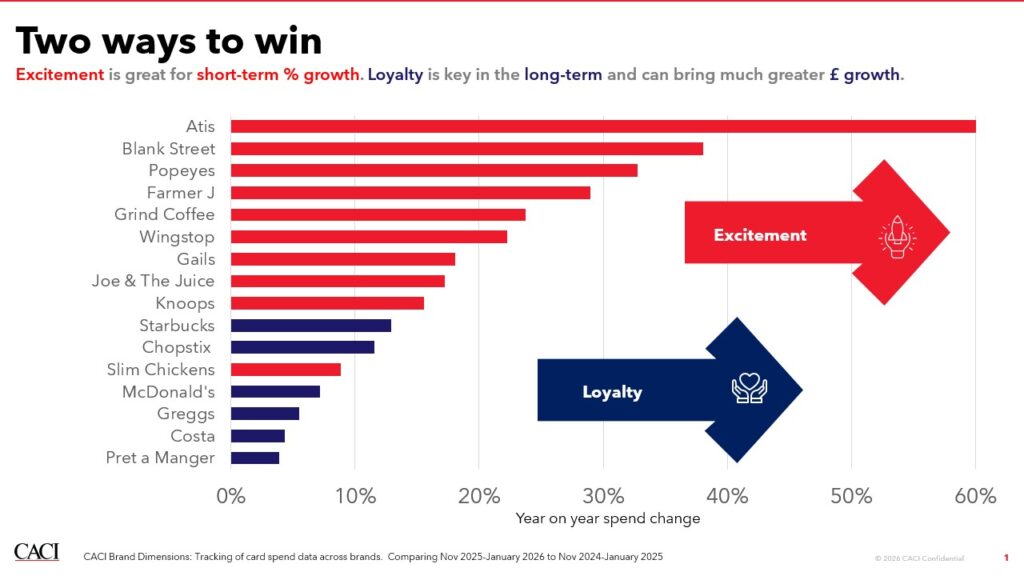
      From the 30+ up-and-coming and major players in the food to go sector tracked, I identified the leading brands as those achieving YoY growth above inflation and sorted them by increase in growth percentage. 

      Premium healthy lunches: Atis & Farmer J

      Consumers continue to prioritise premium healthy lunches this year.  

      The leading brands were Atis, growing 140%, and Farmer J, growing ~30%. Atis’ skyrocketing growth is driven by the opening of a third new space in the last year. While substantial and impressive, it is the smallest brand in CACI’s Food to Go tracker, meaning the overall GBP shift in the market is small.  

      The largest share of the customer mix for these brands comes from CACI’s Acorn profiles Prosperous Professionals at 15% of spend followed by Up-and-coming Urbanites at 11%. 

      For new entrants, the challenge to growth is proving value in each transaction, precise targeting and mission expansion without undermining the brand or cannibalising sales. 

      Continued growth in chicken QSR: Popeyes, Wingstop & Slims

      Consumers continue to seek indulgence and novelty. In the chicken QSR sector, our findings concluded Popeyes grew ~30%, Wingstop ~20% and Slims ~9% (who were +46% in the first quarter of the year). While this may counter the premium healthy lunch trend, consumers are finding ways to balance health-conscious choices with indulgent ones. 

      Caffeine & matcha on the rise: Blank Street & Grind

      Both Blank Street and Grind grew over 20%, indicative of the brands’ innovative products, strong social media presence and matcha-led menus. These brands have evidently appealed to younger, experience-driven consumers by creating excitement through their product innovation. 

      Established brands are driving growth by harnessing loyalty 

      Graph showing year on year spend change for a number of different food brands. The brands with the largest year on year spend change are Atis and Blank Street. The chart shows that while excitement is great for short term percentage growth, loyalty is key for long-term and spend growth,

      The biggest takeaway is that while new entrants win on excitement, established brands win on loyalty.  

      New brands have brought excitement, and with that, percentage growth, but most saw YoY growth rates slow across the year. Meanwhile, more established brands like Pret a Manger, Costa, Starbucks and McDonald’s saw stronger growth in the latest quarter. When assessing actual pounds versus percentage growth, established brands are back growing and seeing very substantial sales gains. This reiterates the impact of loyalty on long-term growth.  

      The formula of the current state of the market then becomes:  

      Excitement = short-term percentage growth. Loyalty = long-term monetary growth. 
       
      New brands, social media influence and new cuisine are fuelling excitement. Loyalty is driven by familiarity, perceived value, brand resonance and communication. Brands that can achieve a sweet spot between both are poised for sustainable growth. However, our findings suggest tension between excitement and loyalty. This prompts brands to reflect on how to maintain excitement or build customer loyalty.  

      Four strategies to drive growth in a tough climate

      1) Having the right products in place 

      Brands must understand how to appeal to existing customers and excite new ones. Product and menu innovation should be strategically considered to open new missions and tailor to the right locations, dayparts and missions.

      2) Getting the right space

      While growth can be achieved by acquiring new spaces, established brands are always optimising their spaces to reach the right people, in the right place, at the right time. This is why some brands are shifting to drive-through locations as town centres decline and why many have opted to offer FMCG products in the chilled sections of supermarkets.

      3) Appealing to customers through the right message 

      Tailored content sent to the right target group at the right time with the right incentive is critical to success. 

      4) Delivering with the right service

      Profitably staffing each location, determining which locations will best suit trialling self-service kiosks and avoiding alienating or upsetting customers who value your brand’s personal service are critical considerations.

      This is often easier in the new entry “excitement” phase, but new and established entrants must constantly evaluate that they have the right mix of these factors to remain relevant in a rapidly changing market. Each of these strategies has a ‘people, place and time’ lever that can be pulled to maximise growth by leveraging customer loyalty.  

      How CACI’s Brand Dimensions can help your Food to Go business thrive

      With so much complexity in the food to go sector, brands need more than just internal customer data to keep on top of the mix. Supplementary market data through CACI’s Brand Dimensions can help you answer your growth questions, combining the right data with the right tools to project long-term growth through the right mix of products, services, places and messaging. 

      Highly detailed, timestamped transaction data is at the heart of Brand Dimensions, indicating anonymised customers and specific outlets to infill any data gaps and gain unique performance and competitor outlet insights.

      When combined with anonymised mobile activity data and demographic classifications, it creates a cohesive base to address the people, place and time levers driving growth. This can also be topped off with lifestyle attributes linked to those demographics, competitor location data and competitor sentiment data. 

      Through this, businesses can better prepare for the future by understanding consumer behaviour at brand level. 

      Although Brand Dimensions is typically tracked on a monthly basis, these findings have been summarised quarterly for this blog.  

      If your brand could benefit from these data insights, book a Brand Dimensions demo with us. 

      What is subscription fatigue? Causes, impact & how brands can fight it

      In this Article

      What is subscription fatigue?

      Subscription fatigue refers to consumers’ deteriorating interest in a subscription or service, resulting in their cancellation. This is often due to feeling overwhelmed by their numerous subscriptions or losing sight of the value each subscription brings. It goes hand-in-hand with churn, where uncertainty, mental exhaustion and subscription overload leads to diminished satisfaction with the subscription experience.  

      What is causing subscription fatigue? 

      With the ever-increasing number of subscriptions consumers have, decision overload is inevitable. Mounting costs, managing multiple accounts and the pressure to maximise each subscription all contribute to declining satisfaction. When value is unclear, questioning a subscription’s worth surfaces. 
       
      Value must therefore be constantly reiterated and subscriptions models must be flexible enough to meet consumers’ unique needs. Signs of fatigue must be identified early on and actions to mitigate fatigue must be taken.  
       
      CACI understands the challenge: people want convenience and personalisation, but they also want affordability and control. 

      Over-subscription

      Subscribing to and managing multiple subscriptions can be mentally draining. The simple fix in consumers’ minds is typically to unsubscribe, even if the service itself is not the problem.

      Inability to reinforce value

      If consumers feel that they are paying for a service they do not use, the feeling will quickly lead to subscription fatigue. When it comes to subscriptions, low perceived value or service underutilisation are often the driving factors behind cancellations. If value cannot be demonstrated, even your most loyal subscribers may be lost.

      Lack of flexibility

      When feelings of frustration or overwhelm creep up among the plethora of subscriptions a consumer has, offerings that do not feature flexibility are likely the first to go. Rigid plans will not appeal to already-fatigued consumers. If subscribers feel as though they maintain control over their subscription, they will be easier to retain and keep satisfied. Establishing tiered memberships, flexible pricing, pause options, add-ons or various payment plans can help rectify this.  

      How can brands fight subscription fatigue? 

      Subscription fatigue may be inevitable within an oversaturated subscription landscape, but understanding the origin of fatigue and the strategies that your organisation can implement to combat this will make a tremendous difference. Leveraging predictive modelling, customer insights and data and segmentation are among the most effective approaches.

      Use predictive modelling

      AI-driven predictive models forecast customer behaviours and guide the next best actions. Proactive retention and upsell strategies can therefore be developed, resources can be prioritised towards customers with the highest potential and a measurable performance uplift can be seen in metrics like LTV, conversion and engagement. 

      Focus on customer insights 

      By integrating transactional, behavioural, attitudinal and external data, CACI helps you attain a comprehensive view of your subscribers that will improve your decision-making across acquisition, retention and product development. 

      These insights help you:

      • Build strategic confidence by grounding it in real customer behaviour  
      • Identify high value customers 
      • Understand churn drivers 
      • Uncover growth opportunities 
      • Benchmark performance against your competitors 
      • Better understand your position within the market  
      • Spot underperforming segments or categories where competitors are gaining share

      Grounding strategic decisions in external evidence also improves internal storytelling and stakeholder alignment. 

      Focus on acquisition through segmentation

      Poor segmentation drains budget by targeting low-value audiences. Without precise targeting, campaigns miss the mark and media mix decisions lack data-driven optimisation.  

      CACI’s bespoke segmentation capabilities give you intuitive, data-rich segments reflective of the diversity of your customer behaviours, values and attitudes. This enables personalised marketing and CRM journeys, enhances media targeting and campaign ROI and bolsters strategic planning by revealing which segments to grow, retain or re-engage across three core areas: 

      • Data: Curated, high-quality foundational data with diverse input lenses and no personally identifiable information (PII).  
      • Segment simulation and validation: Segment-level data layer, validation to assess predictive accuracy with guardrails in place and performance audited.  
      • Persona enhancement: Defined by segment characteristics and enriched with psychological and behavioural traits, every step is tested by experts to ensure it is structured, auditable and iterative.

      Through this tailored approach, CACI equips you with segmentation that reflects your customers, leading to better decision-making, campaigns and long-term growth.

      How CACI can help you overcome subscription fatigue

      CACI helps subscription brands unlock growth by transforming fragmented customer data into actionable insight. Through advanced data science and AI-powered decisioning, we support acquisition, retention and personalisation at scale. 
       
      We can help you:

      • Build deeper customer understanding and target the right audiences 
      • Forecast behaviour, improve retention and justify investment 
      • Turn insights into action across media and CRM 
      • Simplify data and bridge capability gaps

      To find out more about how your organisation can successfully overcome subscription fatigue, get in touch with us.

      Ecosystem orchestration: Why fragmented platforms hold your organisation back

      In this Article

      “Our digital transformation is failing because it is fragmenting”. This was the defining statement from a recent roundtable with C-suite leaders from global enterprise organisations, met with nods and echoes of agreement across the room.  

      Many of these leaders went through mergers and acquisitions, regional expansion and business proposition changes. The end result was the same: hundreds of disconnected tools and platforms, masses of digital sprawl, rising inefficiencies, disjointed customer experiences and a tangled web of overlapping technologies.  

      If this sounds familiar, you are not alone. Over 40% of organisations now operate four or more separate systems, and while multiple platforms can signal maturity, the lack of integration between them often introduces operational friction—slowing delivery, increasing costs, limiting personalisation and constraining AI adoption.  

      This is where ecosystem orchestration becomes strategically imperative in designing how your entire digital ecosystem works together. 

      What is ecosystem orchestration?

      Ecosystem orchestration is the discipline of designing, connecting and governing all digital platforms, experiences and data as a unified system rather than a disparate collection of isolated tools and journeys. It defines how these technologies should work together to deliver efficient operations, connected customer experiences and AI-ready foundations. 

      For most organisations, this ecosystem spans experiences, content, data and their supporting platforms. 

      Ecosystem orchestration focuses on: 

      • How data flows across your CRM, CDP, CMS, analytics and personalisation 
      • How experiences are assembled across channels, regions and brands to make them seamless 
      • How your platforms integrate, scale and evolve alongside your organisation  
      • How governance, security and performance are embedded by design. 

      What is digital fragmentation? 

      Fragmentation rarely appears as a single problem. Instead, it develops gradually as new platforms, regions and business needs are layered on existing digital estates. If one layer is weakened, it reduces the effectiveness of the entire structure and ultimately damages both your business outcomes and perceived value to your customers. This inefficiency prevents your organisation from reaching its potential.

      Fragmentation tax: The unwanted cost of disconnected systems

      When digital ecosystems grow without orchestration, the impact compounds over time. You may start to see: 

      Operational inefficiencies rise 

      When your teams jump between multiple systems, duplication and manual work skyrocket. Delivery slows and administrative load increases. 

      Maintenance outweighing innovation 

      Technology teams spend more time maintaining integrations, bug fixing and patching software than building new value-generating features. 

      Data reporting inconsistencies

      Inaccurate data creates reporting inconsistencies and data teams spend more time reconciling data than generating insights.  

      Personalisation becoming impossible

      Disconnected CMS, CRM and data platforms mean your organisation does not have a single customer view. This leads to segmentation being non-existent or superficial. 

      AI-readiness severely constrained

      AI requires unified data, modern architecture and consistent governance. Poor data hygiene and siloed insights create unstable foundations for predictive modelling and limit automation at scale. 

      Brand and experience consistency breaking down

      Multiple regions and brands lead to inconsistent UX, duplicated content and disconnected customer journeys. 

      Costs quietly increasing

      Duplicated platforms, unnecessary licences, security vulnerabilities and inefficient workflows inflate spend. 

      Leadership is struggling to make data-driven decisions

      Fragmented data erodes trust, making it harder for leaders to drive strategy or prove ROI. 

      What ecosystem orchestration will enable

      Fragmented digital estates can derail even the most ambitious digital transformation plans. Ecosystem orchestration is the solution to ensuring your business is future-ready, laying the foundation for scalable experiences, operational efficiency and AI-ready growth. 

      If the challenges described here feel familiar—from disconnected journeys to rising operational effort—it may be time to reassess how your ecosystem is designed to work together.  Speak to our team about simplifying your digital ecosystem. 

      Why do subscription customers churn? A data-led guide to churn reduction strategies

      In this Article

      What is subscription churn?

      Subscription churn refers to the number of subscribers or customers that stop their subscription with your organisation within a specific period, measured against the overall customer base. Churn can be interpreted in several ways and organisations may have their own method of calculating churn depending on what suits them. However, the principle remains the same: churn shows how effectively you retain customers. 

      A high churn rate means that customer retention may present difficulties, whereas a low churn rate is indicative of successful retention. 

      Why is churn important in the subscription sector?

      Subscriptions have embedded themselves into consumer behaviour, with 4 in 5 UK adults now signed up for at least one subscription service and nearly one-third subscribed to a subscription box delivery service. While this shows how appealing the convenience of subscriptions is, cost is a key barrier. As the cost of living rises, subscriptions are often the first thing customers look to cancel. 

      In the subscription sector, churn directly affects revenue predictability, customer acquisition, lifetime value (LTV), growth and brand reputation. Even small churn rises can lead to longer-term financial instability. Understanding churn is therefore essential to uphold customer and subscriber satisfaction and retention. 

      Types of customer churn

      To mitigate churn, organisations must distinguish between its two types: voluntary and involuntary. Each provides a unique lens on customer behaviour and organisational performance, also requiring their own prevention and combative methods. 

      Voluntary churn

      Voluntary churn is when customers choose to end their relationship with a service or product. These are instances when they no longer recognise a service’s value, have opted for a competitor’s service, can no longer afford the service or other considerations.

      Involuntary churn

      Involuntary churn happens when customers unintentionally end their subscription with a service due to reasons beyond their control. Financial pressures are one of the most substantial driving forces behind churn, especially for discretionary spend on products that are optional rather than essential. 

      Average churn rates for subscription sector

      Customer churn can be expected to an extent but determining the amount of churn that your organisation can withstand and the maximum length of time in which losses can be made up will be critical for long-term growth. 
       
      Churn rates also vary by customer segments. Through Acorn, our geodemographic segmentation, we found that younger Acorn groups like Tenant Living might avoid long-term subscriptions as cost is a hugely influential factor in their circumstances. Customers within Acorn’s Commuter Belt Wealth group might enjoy the convenience of subscriptions, but busy and irregular schedules can complicate commitment. We also found that subscription drop-off after discount periods is common across different segments. 
       
      By recognising these behavioural differences, your subscriber retention strategies can be more effective.

      Subscription churn reduction

      To counter the effects of churn, organisations may turn to offering incentives that attract price-sensitive customers who churn post-offer. While this may remedy the situation to an extent, the following approaches will bolster your understanding and reduction of churn by combining proactive and reactive strategies with data. 

      Bespoke segmentation

      Poor segmentation leads to wasted budget on low-value audiences. Campaigns miss the mark without precise targeting and media mix decisions lack data-driven optimisation. 

      CACI’s bespoke segmentation capabilities enable you to create intuitive, data-rich segments reflective of the diversity of your customer behaviours, values and attitudes. This powers personalised marketing and CRM journeys, improves media targeting and campaign ROI and supports strategic planning by revealing which segments to grow, retain or re-engage in three capacities:

      • Data: Curated, high-quality foundational data with diverse input lenses and no personally identifiable information (PII). 
      • Segment simulation and validation: Segment-level data layer, validation to assess predictive accuracy with guardrails in place and performance audited. 
      • Persona enhancement: Defined by segment characteristics and enriched with psychological and behavioural traits, every step is tested by experts to ensure it is structured, auditable and iterative.

      Predictive modelling

      Through predictive modelling, AI-driven models forecast customer behaviours and guide the next best actions. This enables proactive retention and upsell strategies, prioritises resources towards customers with the highest potential and drives measurable performance uplift in metrics like LTV, conversion and engagement. 

      Customer insights

      CACI’s data offers a holistic view of customers that helps organisations better understand churn drivers. Customer insights are divided among: 

      Core demographics

      • Affluence 
      • Disposable income 
      • Age band 
      • House size 
      • Occupation 
      • Number of children

      Key behaviours

      •  Price sensitivity 
      • Loyalty 
      • Motivated by premium/value 
      • Convenience 
      • Environmental attitudes

      Digital behaviours

      • Posts/reads ratings & reviews 
      • Social networks 
      • Influencers 
      • Newspaper & magazines read

      Brand engagement

      • Websites visited 
      • Loyalty cards 
      • TV channels 
      • Newspapers 
      • Streaming sites 
      • Magazines

      An understanding of customers’ lifestyles is enriched through additional layers of their interests and hobbies, lifestyle attitudes and shopping behaviours. For subscription brands, this reveals not just who your customers are, but why they subscribe. Our insights showed that customers tend to be mindful of ethical and environmental issues and are concerned about their online security. They also tend to focus on provenance when it comes to shopping, considering where products are made/grown, the value they place on quality goods and those that make life easier. These motivations influence a subscription’s perceived value, a customer’s loyalty to a subscription and brand and what may sway their thought process in terms of staying or cancelling. 
       
      Through this holistic view, you can also benchmark your organisation’s performance against competitors to gain a clear view of market position and competitive dynamics. This helps you understand where you stand in the market, who you are winning with, where you are losing and why. It identifies underperforming segments or categories where competitors are gaining share, enabling focused interventions. It also supports internal storytelling and stakeholder alignment by backing up strategic decisions with external evidence.

      How CACI can help you navigate churn reduction

      CACI helps retail subscription brands unlock growth by transforming fragmented customer data into actionable insight – driving acquisition, retention and personalisation at scale through advanced data science and AI-powered decisioning. 
       
      We can support you in:

      • Building deeper customer understanding and targeting the right audiences 
      • Forecasting behaviour, improving retention and justifying investment 
      • Turning insights into action across media and CRM 
      • Simplifying data and bridging capability gaps

      To find out more about how your organisation can successfully navigate churn reduction and strengthen customer loyalty, get in touch with us

      Make every network change safe: Assurance, observability & lifecycle

      In my first blog of this two-part series, I broke down the five automation metrics and principles I rely on most to help leadership demonstrate value. This second blog builds on that thinking. In my e-book, Network automation in 2026: building resilience, assurance and future-ready networks, I explained that one of the biggest challenges that network and operations leaders face today is making every change safe. 

      Automation is not just about efficiency, but maintaining control within modern networks that are dynamic, distributed and tightly-connected to cloud platforms and third-party services. While automation is essential, speed without control creates risk. By unifying the three capabilities of assurance, observability and lifecycle management, it becomes possible to execute network changes in a safe and repeatable way.

      Assurance: Validate before and after every change

      For me, assurance is the foundation. Validate every change is safe and compliant before it goes live, then confirm it behaves as intended after deployment. Continuous validation before and after every change is now expected, helping to ensure changes are safe and compliant. Streaming telemetry and service mesh architectures provide real-time visibility, making it easier to spot issues and respond quickly

      How to implement assurance:

      • Define policies as code and embed them in your pipeline. 
      • Run intent checks to catch misconfiguration and drift early. 
      • Use change windows that include automated validation and safe rollback paths.

      Outcome: Fewer failed releases and emergency fixes and better audit outcomes because evidence is generated as part of normal work. 

      Observability: Real insight from streaming telemetry

      In my first blog, I covered MTTR and MTTD with the time it takes you to detect issues and restore normal service. Observability is what drives this. Move beyond static, device-centric health checks to provide continuous visibility across paths, services and users.

      How to implement observability: 

      • Stream telemetry from network and edge assets into a common model. 
      • Use service mesh patterns where appropriate to trace requests end-to-end. 
      • Align dashboards to service objectives, not individual devices. 

      Outcome: Faster detection, clearer root cause and performance data that stakeholders can actually trust. 

      Lifecycle management: Remove tech debt as you modernise

      Teams often try to automate on top of legacy risks. Lifecycle management prevents that. You plan upgrades, renewals and retirements proactively to prevent new changes from piling risk onto legacy.

      How to implement lifecycle management: 

      • Maintain an accurate inventory and map controls to business risk. 
      • Standardise on reference designs that are easier to secure and support. 
      • Budget for renewal and decommissioning alongside new projects. 

      Outcome: Lower exposure, simpler operations and a platform that adapts as the business evolves. 

      How to implement a safe automation framework

      To bring assurance, observability and lifecycle management together for safe automation, I recommend organisations consider the following best practices:  

      1. Start with responsibility: Assign clear owners for providers and controls. Everyone should know who approves what. 
      2. Use reference designs: Build simple patterns that map known threats to specific controls, then reuse them. 
      3. Automate safely: Codify configuration and policy, prevent drift and escalate recovery with tested rollbacks. 
      4. Adopt Zero Trust: Assume breach, verify access and enforce least privilege across sites and clouds. 
      5. Strengthen monitoring: Track performance, changes, access and compliance in one place. 
      6. Keep governance practical: Set standards that teams can follow, measure them and iterate. 

      What to measure

      To make progress visible and defensible, you can refer back to the core metrics from my e-book and previous blog:  

      • Change success rate and rollback avoidance 
      • MTTR and MTTD
      • Compliance score and drift
      • Latency and packet loss against service objectives.

      These metrics will help you determine whether your automation is actually making change safer.  

      Two quick wins for the first 30 days

      If you want to quickly build momentum, I recommend: 

      • Pre-change validation on one high-traffic service: Add automated checks for policy compliance and performance impact, then track the effect on change success rate. 
      • Drift detection with weekly remediation: Choose a critical domain, enable drift alerts and close gaps to raise your compliance score. 

      Where SD-WAN and SASE fit

      At the edge, SD-WAN and SASE extend consistent policy and observability to every site. They simplify operations, support identity-led access that aligns to Zero Trust and reduce risks from technical debt and legacy systems so networks can adapt securely as business needs evolve. 

      How we can help

      In my work with clients, I see the same challenge time and again: network change needs to move faster, but it also needs to be safer and more predictable. At CACI, we help organisations bring structure, visibility and governance to complex networks so change can happen with confidence. 

      We support teams in putting practical assurance and observability in place, improving lifecycle management and reducing configuration drift, without slowing delivery. That means fewer regressions, clearer accountability and a more predictable change pipeline.
       
      If you’d like to explore how this approach could work in your environment, visit our Network Automation page to start the conversation with our specialists. 
       
      You can also download my new Network Automation in 2026 eBook for a deeper dive into how assurance and automation work together to build resilient, future-ready networks. 

      Five network automation metrics & principles every CIO should track

      In this Article

      In my new e-book ‘Network automation in 2026: building resilience, assurance and future-ready networks’, I uncover how network automation is no longer just about speed, but about reducing operational risk, strengthening compliance and stabilising services when the unexpected strikes. To meet the expectations of leadership, network automation must clearly demonstrate its ability to deliver on outcomes.  

      This first blog in a two-part series breaks down five automation metrics and principles I rely on to help advise leadership: practical, executive-friendly and aligned to how boards evaluate resilience, risk and customer experience.

      1. Change success rate and rollback avoidance 

      What it is: This is the proportion of changes that complete as planned without causing incidents or requiring rollback. 
      Why it matters: In my experience, this is one of the fastest ways to prove to leadership that automation is about increasing safety and predictability, not just throughput. 

      How to improve:  

      • I always begin with applying pre-change validation, policy gates and standardised reference designs that map controls to threats with simple, repeatable patterns. These give teams simple, repeatable patterns that map controls to threats. 
      • Instrument your pipelines to capture change outcomes automatically.
      • Assign clear ownership to execute each change and align teams.  

      What good looks like: A steady rise in successful, first-time changes and a consistent fall in rollbacks over consecutive release cycles. 

      2. Mean time to detect (MTTD) and mean time to repair (MTTR)

      What it is: The time it takes you to detect issues and restore normal service. 
      Why it matters: I find that detection and recovery are very important for leadership, especially because automation and observability deliver measurable business value. 

      How to improve:  

      • Stream all of your telemetry into a single view, then use intent checks to highlight drift or policy violations and automate first line remediation where safe.  
      • Strengthen monitoring by tracking network performance, changes, access, compliance and security events.

      What good looks like: Faster detection windows followed by runbook-driven recovery that is measured in minutes, not hours.

      3. Compliance score and configuration drift

      What it is: A combined indicator of how closely your estate aligns to policy and how far it strays from approved configurations. 
      Why it matters: Boards and auditors need confidence that controls are enforced consistently across hybrid estates. 

      How to improve:  

      • Treat policies as code and run continuous checks.  
      • Block non-compliant changes before they land.  
      • Generate audit evidence automatically to save a huge amount of time.  
      • Keep governance practical by setting clear standards, control owners and measurable policies. 

      What good looks like: A rising compliance score with drift trending down. Exceptions are documented and time-boxed. 

      4. Alert volume reduction

      What it is: A measure of how many alerts actually correlate to meaningful incidents. 
      Why it matters: High alert volume hides real risk and drains team capacity. 

      How to improve:  

      • Consolidate tooling, de-duplicate at the source, only measuring what maps to user or service objectives.  
      • Safely automate by applying Infrastructure as Code and Policy as Code to prevent drift and speed up recovery.

      What good looks like: Fewer alerts, higher signal quality and a clear link between alerts and customer impact. 

      5. Latency and packet loss against service objectives

      What it is: End-to-end performance measured against the targets that matter most for your services. 
      Why it matters: User experience is the ultimate goal. Device health means little if transactions stall. 

      How to improve:  

      • Set service-level objectives (SLOs) for your priority journeys, instrument path visibility and factor network changes into performance reviews.  
      • Adopt Zero Trust principles to assume breach, verify access and enforce least privilege.  

      What good looks like: Stable or improving latency and loss for your top services, even during high change periods. 

      How to get started 

      I recommend teams start small when adopting these metrics, but take the following into consideration: 

      1. Select two high impact metrics that you can measure today. 
      2. Automate the collection and reporting so data is timely and trusted.
      3. Share a simple scorecard with trend lines and short commentary.
      4. Only add more metrics when the first set is stable. 

      How we can help

      In my work with CIOs, one of the biggest challenges I see is turning network automation into something that’s measurable, governed and trusted. At CACI, we help organisations align automation with business goals, reduce operational risk and create real clarity around performance and compliance. 

      We bring proven architectures, practical operating models and clear measurement frameworks, so teams can track success rates, reduce configuration drift and improve incident response. We also help teams build simple, outcome focused scorecards that connect day-to-day network activity to executive priorities. 

      If you’d like support establishing a metrics baseline or shaping an automation roadmap around the principles in this blog, visit our Network Automation page to learn more or get in touch with our specialists. 

      You can also download my Network Automation in 2026 eBook for a deeper look at the frameworks and metrics that high performing organisations are using today. 

      In the next blog in this series, I’ll explore how assurance, observability and lifecycle management work together to make every network change safe. 

      CACI announced as AWS Launch Partner for European Sovereign Cloud (ESC) delivering EU-controlled data and compliance

      In this Article

      CACI Ltd is delighted to announce it has been selected by Amazon Web Services (AWS) as an official launch partner for the AWS European Sovereign Cloud (ESC), a major AWS initiative designed to help organisations meet stringent European digital sovereignty, security, and compliance requirements.

      This appointment further reinforces CACI – a global AWS Premier Tier Partner – as a trusted advisor for organisations looking to adopt sovereign cloud solutions while leveraging the scale, resilience and innovation of AWS.

      The European Sovereign Cloud is purpose-built to ensure the highest levels of governance and assurance, making it particularly suited for mission-critical and highly regulated sectors such as public services, national security, defence, financial services, healthcare, and critical infrastructure. This is also essential in supporting large commercial organisations navigate regulatory landscapes, protect sensitive data, and maintain customer trust at scale.

      Why are the AWS ESC Principles Important?

      The AWS ESC applies the principles above in the European context, giving organisations absolute confidence that their data and operations remain under tight European control, while enabling innovation without compromise.

      Key capabilities include:

      • EU-only operations: managed exclusively by EU-based personnel, ensuring governance and operational independence.
      • EU data residency: all customer data – including metadata – remains within the EU, supported by isolated service environments.
      • Independent European infrastructure: physically EU-based facilities with separate control systems including independent billing, security, and multiple Availability Zones for resilience.

      What Being an AWS ESC Launch Partner Means for CACI Clients

      CACI brings proven expertise in cloud transformation, security, and compliance. Becoming an ESC launch partner further enables CACI to:

      • Guide organisations through sovereign cloud adoption using AWS best practices.
      • Deliver secure and compliant solutions tailored to EU regulatory requirements.
      • Enable innovation without compromise, by combining sovereignty with AWS scalability and resilience.

      To prepare for this milestone, CACI has invested in advanced training for its teams on AWS Digital Sovereignty competency and principles, ensuring clients receive expert guidance in planning, migrating to, and operating sovereign cloud environments.

      Tracy Weir, Chief Executive of CACI Ltd, comments: “We’re proud to be named an AWS launch partner for the European Sovereign Cloud. This partnership reinforces our dedication to helping organisations across public and private sectors meet stringent sovereignty requirements, whilst leveraging the power of AWS. It also underlines our commitment to delivering excellence and best practice across every stage of AWS cloud adoption.”

      CACI AWS Credentials and Sovereign Cloud Expertise

      CACI pairs deep AWS expertise with secure cloud delivery experience across defence, public services, finance, healthcare, and critical infrastructure. Our powerful capabilities include:

      • First AWS Trusted Secure Enclave Vetted Partner the UK providing trusted National Security & Defence sensitive solutions
      • Other AWS Competencies including Migration, DevOps and Government Consulting
      • A partner ecosystem of 36+ strategic partners across all verticals
      • Jezero Landing Zone Accelerator: AWS validated secure cloud LZA enabling rapid deployment on AWS, and compliance with global security standards
      • 400+ AWS certifications: held by expert CACI engineers.

      AWS ESC launch timeline, locations, and investment

      AWS ESC begins its roll out from January 2026, starting with its first region in the State of Brandenburg, Germany, expanding capabilities and coverage to additional regions over time. This phased approach reflects AWS’s commitment to supporting European organisations with scalable, sovereign cloud solutions.

      AWS has also committed €7.8 billion in investment in Germany by 2040 as part of this initiative, reinforcing its long-term support for European digital sovereignty and innovation.

      With over five decades of delivering complex programmes across commercial and public sectors including highly regulated, mission-critical industries, CACI is well-positioned to help organisations adopt secure, compliant cloud solutions on the AWS European Sovereign Cloud.

      For help with ESC or any AWS or other cloud projects, get in touch today.

      Cloud innovation trends: Why optimisation must come first

      In this Article

      Cloud innovation trends: Why optimisation must come first

      In the race to modernise, many businesses make a critical mistake: innovating before optimising their cloud infrastructure. It’s an easy trap to fall into – new technologies promise speed, agility and competitive advantage. However, without a solid foundation, those promises can quickly unravel.

      So, what difference will optimisation make to cloud innovation? How do complex hybrid environments affect optimisation and what are the repercussions of innovating too soon?

      Why optimisation should come first

      Cloud optimisation isn’t just a technical exercise – it’s a strategic imperative. Before you invest in AI-driven tools, advanced analytics or multi-cloud deployments, you need to ensure your existing environment is efficient, secure and cost-effective. Otherwise, innovation becomes a gamble rather than a growth driver.

      How the complexity of hybrid environments affects optimisation

      Modern IT landscapes are rarely simple. Most organisations operate in hybrid environments, combining:

      • Cloud-native workloads
      • Semi-native applications
      • Containerised services
      • Legacy systems migrated via IaaS.

      This mix introduces complexity that can quietly erode ROI and performance. Without optimisation, you risk inefficiencies that undermine every future initiative.

      Common pitfalls of innovating too soon

      When businesses rush to innovate without first optimising, they often encounter:

      Duplicated workloads

      Hybrid setups frequently lead to duplication of environments or services, especially when containerised and legacy systems overlap with cloud-native tools. This consumes bandwidth and burdens IT and DevOps teams with managing multiple versions of the same workload.

      Latency issues

      Poor workload distribution across cloud environments increases latency, slowing response times and masking compliance or security issues. For customer-facing applications, this can directly impact user experience and brand reputation.

      Security saps

      Unoptimised containerised and legacy workloads are vulnerable to governance and compliance risks. Differences in data storage and flow between environments complicate tracking, while unresolved legacy issues can carry over post-migration.

      Mounting costs

      With up to 30% of cloud spend wasted, inefficiencies inflate monitoring and security costs, draining budgets that could fund innovation.

      Why this matters now

      Cloud strategies are under pressure to deliver more – faster, cheaper and greener. Without optimisation, businesses risk inefficiency, higher costs and vulnerabilities that stall progress. In an industry where every second counts, building on shaky ground isn’t just risky, it’s expensive.

      How to get started

      Before chasing the next big trend in cloud innovation, take time to:

      • Audit your current architecture: Maintain visibility by understand what’s running, where and why.
      • Identify duplicated workloads and inefficiencies: Determine whether any services or resources are the cause behind draining budgets.
      • Align resources with business priorities: Ensure any spending on cloud innovation drives value for the business.
      • Implement governance and security best practices: Establishing best practices early on will ensure that innovation is scaled effectively.

      This foundation ensures innovation is sustainable, not just a short-term fix.

      The CACI approach: Building a cloud that enables innovation

      Ready to build a cloud foundation that enables innovation?

      Don’t leave your cloud strategy to chance. Our specialist cloud architects and optimisation experts have helped leading organisations modernise, streamline and unlock innovation without compromise. Contact us today to start your cloud optimisation journey.

      Is your attitudinal segmentation delivering the value you need?

      In this Article

      As attitudinal segmentations are usually based on surveying a smaller sub-group and not based on data which can be easily applied to customers on your database, bridging attitudinal segmentations can be a challenge and is not always a straightforward process. However, it is a great way to provide a consistent customer experience.

      So, what is attitudinal segmentation and what considerations should an organisation have when it comes to their approach for bridging an attitudinal segmentation?

      What is attitudinal segmentation & how to bridge an attitudinal segmentation

      Attitudinal segmentations are typically created using data from quantitative surveys. They can be a powerful tool for delivering rich insights into customer and prospect mindsets and provide a valuable framework for organisations to engage customers effectively through an in-depth understanding of their needs, attitudes and motivations.

      Being able to treat customers consistently throughout the marketing funnel helps to establish a relationship with them and deliver resonating messages that will drive increased engagement. Once someone becomes a customer, they will expect to see the same messages that originally struck a chord with them reflected and developed in their ongoing journey with you.

      The economic and social disruption since the pandemic has permanently changed consumers and their expectations of brands, so ensuring your online messaging aligns with these changes is increasingly important. We consistently see organisations that are personalising messaging for their customers increasing their market share, net promoter scores, return on investment and profitability. With this in mind, being able to make your attitudinal segmentation actionable on your database should be a key part of your customer engagement strategy.

      Key questions to address the challenges of bridging an attitudinal segmentation onto your customer base

      There are no two ways about it – data is key to tackling this challenge and making it actionable. To achieve this, you should ask the following five questions to get started:

      • Where and who created the segments? Were the segments created by your organisation or a media/research partner? This is pertinent to understanding if you can get to the raw data or in understanding the level of granularity of data you can obtain.
      • What data is there? Do you have access to the responder level data or tables by segment or Pen Portraits? The data you can reach will determine the method of bridging that can be used.
      • Were questions only posed to your customer base or to the wider population? What types of questions were asked and were they personal to the organisation or more generalised? This can impact the resulting solution.
      • Are there any behavioural traits reported within the data that were part of the same survey? Wider data beyond pure attitudes can be helpful to model this back to the database.
      • Were any demographic questions asked or was postcode captured? This can help the process of creating the link between segments and customer base.

      While bridging an attitudinal segmentation can be challenging, these questions will help identify how simple or complex the solution will be.

      Key techniques for bridging attitudinal segmentation

      Depending on the granularity of the data your organisation has access to, the following techniques can be leveraged:

      • Responder level data: As this is the most granular form of data, it produces the most accurate results. Techniques here include modelling each of the segments by using a mix of the responder data and CACI’s own data to score this up against a customer database before validating this against the responder panel.
      • Tables by segment: We can compare each customer’s results to the segment averages based on a combination of multiple data points. Validation is key through profiling and sense checking the segment distribution.
      • Pen Portraits: Here we would use a rules-based approach to recreate segments based on high-level views of the segment to capture the different blend of information that you have to bridge the data. As before, the final step of validation is key to ensuring the solution’s accuracy.

      If raw data is inaccessible or unavailable, the following alternative methods can support:

      • Adding golden questions to market panels: This will provide more demographic and behaviour traits which support the bridging process.
      • Surveying the whole customer base with golden questions: Responses can often be skewed to particular segments, however, and some consumers may be more inclined to answer than others.

      Considerations at the start of an attitudinal segmentation journey

      Including key customer traits

      When beginning an attitudinal segmentation, our first recommended consideration would be to include some key customer traits. Including additional questions such as demographic markers (postcode, gender and age band) will support segmentation mapping on to the database.

      Cross-team engagement

      Cross-team engagement will be invaluable to ensure the segmentation meets goals and drives value. This will help flesh out what the segmentation will be used for now and in the future, as well as gauging what you need from the segmentation and building it accordingly. It is also pertinent in getting buy in as early as possible to ensure teams are engaged when the solution is rolled out.

      Backing segmentations with research

      Another solution would be to build the segments first and then use research to enhance them with attitudinal values. This solution can work well with one of the benefits of running focus groups to bring life to the segments rather than using the attitudes to drive the segmentation.

      Ultimately, it is about finding the right balance that works for your organisation based on wants and needs. Attitudinal segmentations can bring excellent insights but are limited in their applications across a database. Fundamentally, it is a process of ensuring that through engaging the whole organisation, your solution is optimised to meet strategic aims.

      How CACI can help

      CACI is in a unique position with a UK-wide dataset on all adults, encompassing over 800 variables that we can use to profile and create proxy variables to support the possibility of a successful bridging exercise. We help solve the challenges associated with bridging attitudinal segmentation for leading organisations many times each year.

      To learn more about getting the most out of your segmentation and how CACI can support you through this journey, get in touch and we can discuss your challenges in more detail.