Posts Exploring Braze: optimising your CRM by leveraging key features

Exploring Braze: optimising your CRM by leveraging key features

In this Article

Braze is one of the fastest growing CRM tools on the market. It enables brands to be truly app-first and deliver enhanced and personalised real-time customer experiences without complex and bulky ETL or batch processes which often involve painful and delayed overnight data loads.  

Leveraging effective marketing technology is now critical for a business’ long-term success. It allows businesses to stay ahead of the competition by understanding and adapting to everchanging consumer behaviours and tailoring experiences that best reflect their needs. 

Braze is a leading platform in the CRM space, having recently been scored as ‘leader’ within The Forrester Wave™: Cross-Channel Marketing Hubs in Q1 of 2023. Its innovative approach to connecting with customers has been a gamechanger. With a particular focus on digital messaging, it has established itself as an accessible, customisable and specialised tool on a global scale.  

In this blog series, my multidisciplined team will lift the lid on Braze and uncover the key features we see within the platform that are certain to deliver growth and take your use of Braze to new heights.

Our partnership with Braze

As a trusted Braze partner, we help brands get the most from the platform by supporting in all areas, from platform integration and audit to campaign management and optimisation. Our Campaign Operations team is well versed in the platform, with each member who interacts with Braze being certified in the platform. We invest in our partnership with Braze by further upskilling our team to a high standard, with multiple team members holding more than three different certifications ranging from the marketer exam to the digital strategist, enabling us to support brands in getting the most out of this amazing platform.

Our experiences and certifications have enabled our development of a set of Braze Accelerators specifically designed for CRM teams striving to achieve better results in a shorter timeframe. They have also contributed to our team being awarded Agency Partner of the Year in 2022 for our work with Domino’s in assessing their campaigns, enhancing their understanding of their customers’ behaviours and identifying personalisation opportunities that bolstered their testing capabilities and paved the way for more effective outcomes.

If you’re interested in learning more about Braze, and how CACI can help you in driving the most value from your Braze investment, be sure to get in touch with us.

Continue reading:

Blog 2 – How to elevate your brand through the power of Braze’s Sage AI suite

Blog 3 – Leveraging Braze’s Winning Paths to augment Canvas performance

Blog 4 – CACI’s Braze City x City 2023 takeaways

Blog 5 – How Braze’s Canvas components personalise marketing journeys

CDP vs. SCV: why choosing between the two is a big mistake

In this Article

In our previous post, we explained the role of the Customer Data Platform (CDP) in modern marketing architecture. Now, we turn our attention to another critical component of the marketing stack – the Single Customer View (SCV). If you’d like to read all the blogs right away, you can register here to access the complete series.

What is the difference between a CDP and a SCV?

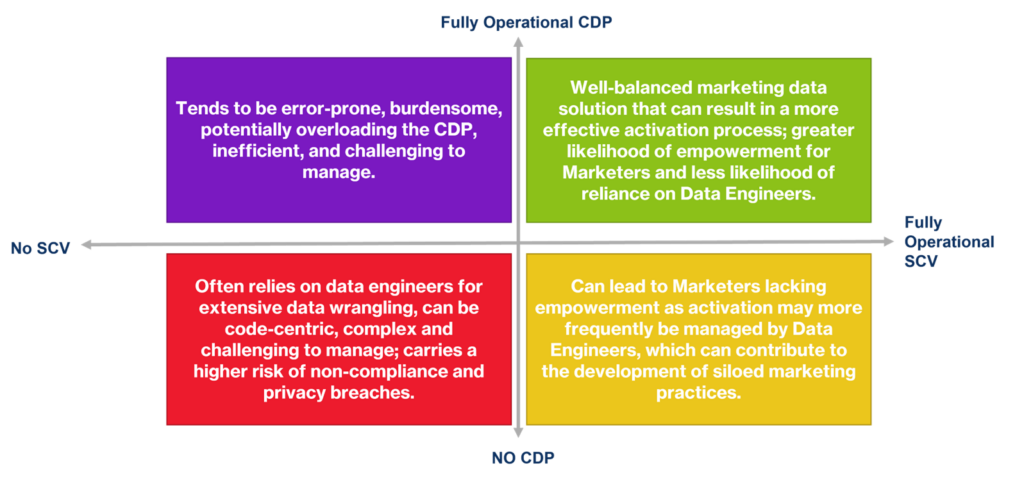
While the CDP and SCV are often confused with each other, they serve different purposes and have distinct characteristics. In this post, we will explore the benefits of having an SCV in the foundation layer and how it differs from the CDP.

Having a Single Customer View (SCV) in the foundation layer provides several benefits for businesses. Firstly, it enables businesses to build a comprehensive understanding of their customers by providing a unified and persistent view of customer data across all touchpoints. Secondly, it allows businesses to implement governance for enterprise-wide data management, ensuring data quality and consistency. Thirdly, it supplies a reliable source of customer data for analytics, reporting and decision-making. Finally, it lays the foundation for personalised experiences by providing a complete picture of the customer that can be used by marketers to deliver targeted and relevant experiences.

The SCV is where your customer data is mastered and where your business logic and definitions are applied. The output is a clean set of validated data that is presented in a useful way for your business and is ready for use in your engagement and activation layers. The SCV is where your business can address some common and critical issues with data, such as:

  • Validating and cleansing your data
  • Standardising of output and definitions
  • Consistent application of common business definitions and logic
  • Curation and presentation of data based on business application, making the data easy to use

On the other hand, the CDP is a more marketer-centric tool that empowers marketers with the ability to activate omni-channel personalised customer experiences. It is designed to make it easier for marketers to access and use customer data without relying on data engineers or IT teams. The CDP enables companies to use customer data to deliver targeted and personalised experiences across all channels.

While both the SCV and CDP are valuable tools, they are not interchangeable but instead play complementary roles.

Failing to have both an SCV and a CDP can lead to significant risks and negative impacts. For example, without an SCV, companies may struggle to make sense of their customer data, leading to missed opportunities for personalisation and engagement. Without a CDP, companies may struggle to activate that data and deliver personalised experiences, leading to lower customer satisfaction and loyalty.

Ultimately, businesses that want to improve their customer experience should have both an SCV and a CDP. While the SCV provides a foundation layer of customer data, the CDP empowers marketers to activate that data and create personalised experiences.

How can CACI help?

As subject matter experts at CACI, we can tell you that a well-implemented CDP can be a game-changer for businesses of all sizes and we have hands on experience with many brands including ASOS, Kingfisher, L&G, PlayStation, Telegraph, EasyJet and DFS.  If you’re interested in learning more about CDPs and how they can help your business, please don’t hesitate to reach out to one of our experts.

In the next post, we’ll consider how the CDP pairs with another key component of the modern marketing stack, the Customer Engagement Platform (CEP). Or if you’d like to download the full blog series in advance, click here to download.

Want to speak more about CDP and it can help you elevate your customer and marketing strategy? You can contact us here to speak to one of our experts.

Continue reading:

Blog 1 – How a CDP can transform your customer experience architecture

Blog 3 – CDP+CEP: A perfect pair for a seamless customer experience

Blog 4 – How to avoid pitfalls & drive results in CDP implementation

Blog 5 – Using CDP to design a successful business operating model

How a CDP can transform your customer experience architecture

In this Article

This is the first post from our new series on Customer Data Platforms (CDPs). From debunking common misconceptions to exploring the power of combining CDPs with other cutting-edge technologies, we’ll be diving deep into all things CDP – and showing you how to make the most of this game-changing technology. If you’d like to read all the blogs right away, you can register here to access the complete series.

What is a customer experience architecture?

If you’re in the world of marketing, you’ve probably heard of CDPs. But what exactly are they, and how do they fit into a modern marketing architecture?

Marketers can find CDP vendor websites confusing due to their use of language that may make CDPs sound like other components in your architecture. For example, they may claim that CDPs bring together all your customer data in one place (like an SCV) or can deliver highly personalised customer experiences (similar to other marketing platforms). However, despite this confusion, CDPs play a critical role in modern technology stacks. In this blog post, we will provide a fresh perspective on the topic to help explain the role of the CDP and its place in modern marketing architecture.

Where do CDPs fit into modern marketing architecture?

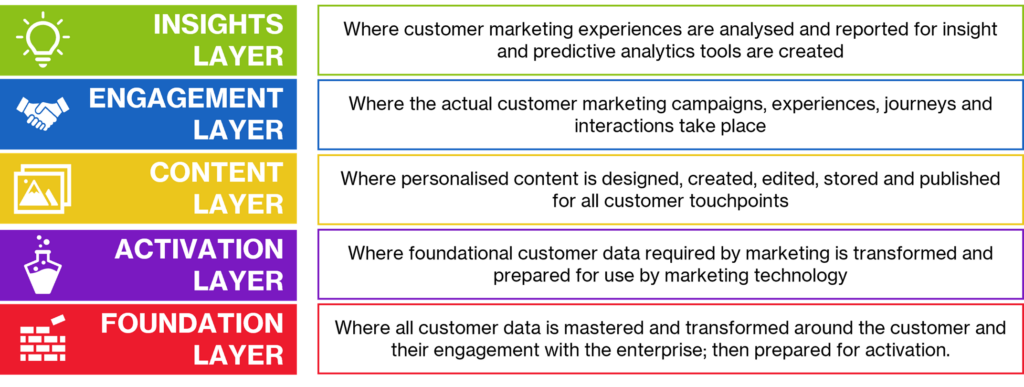
At CACI, we view modern marketing architecture as a framework with five layers:

For many vendors, CDPs typically belong in the activation layer of this framework. It takes data from the foundation layer and then feeds marketing technology in the engagement layer with data in the format that marketers need to deliver highly personalised experiences.

Some CDPs may, however, offer more foundational layer capabilities whilst others can be more engagement focused. For simplicity, our framework defines the primary purpose of the CDP is to activate marketing data, which is why we put it at the heart of the activation layer.

How can a CDP enhance your customer experience architecture?

It’s important to note that a CDP should be thought of as marketing technology, rather than data technology. Its role is to empower marketers with data, removing their reliance on data engineering and allowing them to focus on strategy and campaign execution. A CDP brings a lot to the party, providing marketers with the tools they need to create effective campaigns and drive business results, such as:

  • A CDP can natively capture digital data, making it easier for marketers to activate audiences across a variety of MarTech and AdTech channels in real-time.
  • By enabling the delivery of highly personalised experiences across channels, a well-implemented CDP can help businesses improve customer engagement and increase conversions.

How can CACI help?

As subject matter experts at CACI, we can tell you that a well-implemented CDP can be a game-changer for businesses of all sizes and we have hands on experience with many brands including ASOS, Kingfisher, L&G, PlayStation, Telegraph, EasyJet and DFS. If you’re interested in learning more about CDPs and how they can help your business, please don’t hesitate to reach out to one of our experts.

In our next post, we’ll explain why businesses should not choose between a CDP and a Single Customer View (SCV). If you can’t wait until then, you can register here to download the whitepaper which contains the full blog series.

Interested in learning more about how CDP an support your customer strategy? Contact us to speak to one of our experts today.

Continue reading:

Blog 2 – CDP vs. SCV: why choosing between the two is a big mistake

Blog 3 – CDP+CEP: A perfect pair for a seamless customer experience

Blog 4 – How to avoid pitfalls & drive results in CDP implementation

Blog 5 – Using CDP to design a successful business operating model

How learning and development can improve recruitment in transport and construction

In this Article

Learning from previous projects, mapping skills to future tasks and identifying gaps in the workforce – learning and development can inform your recruitment needs

Recruitment is a vital component of the transport and construction industries. Being able to deploy the right number of appropriately skilled personnel to any given task is essential in delivering services and projects efficiently and on time. A robust learning and development programme can help large organisations in maintaining this balance. From upskilling existing employees to demand forecasting mapped against current and future work, having oversight of core skills and competencies across your workforce is fundamental to your ability to deliver work and services. With a holistic view of your workforce you can understand where any gaps may be emerging or may exist against future work, then remedy them with accurate recruitment.

Knowing when to recruit

Mapping the existing skills and competencies of your workforce against the demand for their skills and competencies against current and future work offers insights as to what you need. If your existing workforce doesn’t cover this, then recruitment is inevitable. If there are only a few gaps, training existing employees so that they are competent for the tasks required can help to plug gaps, but where a simple case of lack of numbers is identified, bringing people in is the only solution.

So how does learning and development help? As part of your wider competency management and training efforts, the overarching learning and development umbrella is essential in gaining a complete picture of your workforce, its competencies, skills and experiences. Maintaining this central database provides insight as to the profile of employee you need to add in order to fulfil projects and tasks.

This covers every aspect of your learning and development programme. From people on the ground to fulfil the tasks required of your services, to the people who conduct assessments of your workforce and run your training programmes. During periods of growth, it will be necessary to conduct more training and more assessments in order to keep your learning and development programme on track.

Ongoing assessment work is crucial to ensure work is being conducted properly. This covers safety and the appropriate fulfilment of tasks. Having the necessary number of assessors is important to achieving this. For more information on how Transport for London (TfL) assesses its London Underground drivers, please click here.

Similarly, getting new recruits up and running is a staple of any learning and development programme. Proper inductions and any training and briefings must be conducted before they start. You can read more about how Network Rail trains its 43,000 employees here.

Maintaining a future workforce pipeline

As projects start and finish, maintaining a core workforce is essential for ongoing work. One way in which transport and construction operators can maintain a healthy pipeline of future recruits is via apprenticeships.

According to the Constructions Skills Network, an extra 225,000 construction workers will be required in the UK by 2027. Filling these roles – and in a relatively short space of time – will be essential to the efficient and timely running of construction projects, many of which will cover the UK’s transport infrastructure, too.

Working with schools and colleges is a useful way of interacting with young people who might be interested in a career in construction. Offering them hands on experience alongside their studies provides practical experience which strengthens their skills and experience in the industry.

What happens once they start their career? Career development, once people have been recruited, helps to broaden the pool of skills and competencies available to you. Offering ongoing training courses and opportunities helps your existing workforce to be upwardly mobile, helping to address skills gaps internally without the need to recruit.

Conclusion

Joined up thinking is paramount in implementing a successful recruitment policy, feeding off the competency management and training aspects of your learning and development programme. Understanding your workforce is central to this. Where are there gaps? Who can be upskilled? This feeds into your wider project management; what current and upcoming work will require what skills and competencies?

A scattergun approach to recruitment is inefficient and expensive. Utilising the knowledge that you can create about your workforce helps you to pinpoint the skills and experience you need for current and future work, whilst creating efficiencies in your processes and accurate responses to your roadmap of work.

We have recently explored the topic of learning and development, including recruitment, in our white paper Learning and development in construction and transport: how can organisations enhance their workforce efficiently, in a data led way? You can download your free copy here.

Competency management: the heartbeat of learning and development in transport and construction

Every employer conducts basic checks of their employees. Do they have the requisite qualifications, skills and experiences for the role for which they are being hired? Certificates, references and background research usually satisfy this. Then, to ensure that the person is actually appropriate for the job once they’ve started, a period of probation follows, supported by ongoing assessments at set intervals to keep tabs on their ongoing competence. In the transport and construction industries, however, competency management takes on far greater significance.

Forming part of a robust learning and development programme, competency management is essential to the smooth running of services and projects in these industries. Holding a qualification or a certain amount of experience is one thing, ongoing competence is quite another.

Take train drivers as an example. There are several assessments, exams and accompanied drives that must be completed before a driver is left to complete the task solo. That’s not the end of the process. In such a safety critical environment, with service users onboard as well, it is vital that ongoing competency management is in place. Taking Transport for London (TfL) as an example, they conduct regular assessments of their 4,500 London Underground drivers to ensure that they are fulfilling their role appropriately.

To manage this process, TfL utilises CACI’s Cygnum software. The system is used to schedule assessments, log their results and arrange any follow up activities. This helps TfL to maintain a holistic view of its London Underground drivers and their competencies, maintain service user safety and address any issues that arise.

A robust competency management framework, as part of your learning and development programme, is required to monitor, assess and train employees for their tasks. Having the technology in place to link everything together is essential, which is where systems such as Cygnum come in.

Where a large workforce is present with a vast array of skills, experiences and core competencies, staying on top of monitoring this, understanding it and carrying out regular assessments requires careful coordination.

From having an overview of your workforce, to linking projects to demand management and forecasting present and future projects, technology is assisting large organisations in keeping projects on track, creating efficiencies and managing the workforce. Competency management is a central component of this.

Aside from ensuring that people are fit for purpose, competency management can also help to unlock areas upon which to target workforce training. Regular assessments will reveal patterns; perhaps there is a common area in which assessments are failed, or raise red flags? This enables large organisations to data map their workforce and focus on areas for improvement. If certain tasks are regularly underperformed in, then this can feed into you training programme, helping to get ahead of the issue by highlighting it with the workforce and providing the necessary training to help alleviate the issue.

Competency management further feeds into recruitment. If you have a holistic view of your workforce, its skills, experience and competencies, then you can identify where there are gaps that need filling. This helps to refine the recruitment process by enabling you to focus on specific competencies required for projects and tasks. In larger infrastructure and construction projects, this can be linked to demand management and forecasting, helping you to have full oversight of the resources required in order to complete present and future projects.

Competency management is the backbone of learning and development. It feeds into every area of an organisation’s operations; assigning tasks to the right people, ensuring that the workforce is appropriately skilled for the tasks at hand, informing training programmes and guiding recruitment needs. Where workforce and service user safety and convenience are major considerations, failing to run a robust competency management framework as part of your larger learning and development programme isn’t an option.

Competency management further helps to realise efficiency gains by ensuring that the right people are in the right place at the right time; enabling schedulers and administrators to be able to pinpoint staff to specific tasks quickly and easily makes overarching project management easier and more transparent. A full depth of understanding of your workforce’s competencies is also useful in reassigning staff during times of strain, safe in the knowledge that they are appropriately competent for the tasks being asked of them to keep projects and services running.

We have explored this topic in our recently published white paper which focuses on learning and development, How can organisations enhance their workforce efficiently, in a data led way? It is available to download for free here.

Five reasons learning and development are so important in transport and construction

In this Article

The technological landscape is rapidly evolving, something being experienced across the transport and construction industries. New technologies bring about new ways of working which in turn mean that large organisations need to have robust learning and development programmes in place to keep up. Learning and development extends beyond the frontline too. Whilst there is an obvious focus on engineers and operators in the transport and construction industries, back-office staff are also realising more effective and efficient ways of working as new technology is introduced.

This blog will take a closer look at five key areas in which learning and development can be best utilised across the transport and construction industries to deliver high quality, efficient and safe services for all. For a deeper dive into this topic, our recently published white paper, How can organisations enhance their workforce efficiently, in a data led way? Is available to download for free.

1. Workforce and end user safety

From health and safety protocols to simply using equipment correctly, ensuring that your workforce is operating within defined regulatory standards and your own internal business rules is essential. Frontline workers in both industries are often performing safety critical tasks that carry some form of jeopardy to themselves, their co-workers and end service users, such as passengers on a train. Learning and development is essential in ensuring that your workforce is equipped with the necessary training, experience and knowledge to perform tasks correctly and safely.

This extends to schedulers and administrators in ensuring that tasks are correctly assigned to members of staff. New systems can help large organisations in scheduling tasks, with aspects such as auto-scheduling easing the administrative burden by matching skills, competencies and experience to tasks and reducing the element of human error in doing so.

A robust learning and development programme will help ensure that all staff are competent and trained for the tasks they are being asked to undertake.

2. Ensuring the highest quality of work and standards

In a similar vein to ensuring the safety of all staff and end users, learning and development plays a central role in ensuring that work is carried out to the highest possible standards. By continuing with learning and development programmes across your workforce, you can expose staff to the latest ways of working as well as providing ongoing opportunities to maintain and expand their professional skillset.

Having a team of highly competent, highly trained operators is a great way of meeting high standards across your projects. The better the competency of your workforce, the more likely you are to deliver projects on time and in budget, owing to a reduction in errors and repeating work. The final delivery is also likely to meet the desired outcomes of a project. In transport, it is crucial that skilled operators are performing service delivery tasks competently to ensure the safety of end users and the smooth running of timetables.

3. Keeping up with evolving technologies

Innovation has been a constant in the 21st Century and shows no sign of abating. New and improved versions of old tools and systems are constantly emerging, which poses a challenge to large organisations in not only obtaining the right tools for the job, but keeping the workforce abreast of such developments and appropriately trained to operate them. The same goes for emerging processes and practices; how can the latest technology and thinking be deployed to realise upticks in efficiency and quality of output?

Needless to say, learning and development is central to staying ahead of industry trends and technologies. Exposing your workforce to ongoing training opportunities helps them to develop their skills and experiences within your organisation, thereby helping them to enhance their careers with you.

4. Improving staff retention

Career development is crucial to staff retention. Your learning and development programme can play a significant role in staff morale. If training and career development opportunities are presented to staff, it means that they can progress within your organisation, rather than seeking new opportunities elsewhere.

This can have a knock-on effect in regard to recruitment too. Persuading staff to join your organisation is made easier if you can demonstrate career progression pathways to potential employees.

5. A more efficient workforce

A robust learning and development programme will help to ensure that your workforce is competent and appropriately trained. If you can be sure that each staff member is the right fit for their role, it makes assigning tasks far easier and enhances your chances of projects and tasks being completely properly and on time. Whilst learning and development cannot eradicate human error – mistakes are inevitable at times – it can help to minimise it and its impact.

Avoiding delays and poor workmanship means that fewer tasks need to be repeated, leading to a more efficient process overall in terms of time and cost committed to projects and tasks.

A robust learning and development programme carries myriad benefits for large organisations, notably in the transport and construction industries. With so many moving parts, having a competent and skilled workforce is essential. Failing to conduct training and to create an overview of skills, qualifications and experiences makes the task of assigning tasks incredibly complicated and wide open to error. In understanding your workforce and appropriately managing it, learning and development is essential.

How can organisations enhance their workforce efficiently, in a data led way? It is available to download for free here.

Workforce safety and the role of management

In this Article

This might seem obvious, because the role of management in overall workforce output and workforce safety is fundamental. Management decisions are at the forefront of working practices and outcomes. But when it comes to safety critical areas, it’s important to consider the way in which management structures, decision making and overall input can support, enhance and improve best practice.

It’s very easy for complacency to creep into the management of aspects such as workforce safety. Where an excellent safety record is demonstrable, aspects such as verbal and written communications can take a backseat, with a regression in their presence or simply a standing still and relying on old systems to continue working.

Railway workforce safety

This goes beyond meetings and briefings and into more serious areas such as fatigue management. There have been high profile cases of fatigue management protocols not being adhered to in the transport industry, not least when Renown Consultants was fined £450,000 with £300,000 in costs by the Office of Rail and Road following the death of two its workers in a road traffic accident following the conclusion of an unacceptably long shift.

It was a failure of management to properly implement regulations. In road transportation and haulage, drivers are restricted to how many hours they can work consecutively without a break, with further rules around taking at least 11-hours rest consecutively during a given day. Again, management of drivers is investigated where infringements occur, with fines in place for discrepancies.

One of the roles of management is to seek to improve, and safety is no different. Data from CIRAS (Confidential Incident Reporting & Analysis System), which is used by Network Rail to anonymously gather feedback from its workforce, found that in 2019/20 over 60% of respondents felt that health and safety concerns were not taken seriously by management. Furthermore, only 75% said that they had received regular safety briefings.

Those numbers paint a clear picture of the need for improvement. Whilst deaths and serious injury remain low on the UK’s railway network, they do still happen. Ticking every safety box is imperative and that starts at the top.

Why are corners cut with workforce safety?

If we accept the adage that a chain is only as strong as its weakest link, then the same is true for workforce safety. A company can put in place structures and guidelines for aspects such as safety briefings as mentioned above, but if the management levels below them are not enacting them, what can be done?

Management structures on the ground face different challenges to those in the office. Works need to be conducted in time-critical circumstances, with every minute counting. It can be tempting, with that sort of pressure, to gloss over safety briefings to a team of experienced engineers and workers. They’ve been doing the job for years without harm befalling them, why would that change now?

There is also the element of human error. People make mistakes. If people are running late, or have made a mistake, then there will be a natural compulsion to make up for that, be it by skipping a briefing or working a bit longer to make up for it.

Improving processes to improve workforce safety

Recording and understanding these errors is part of the management remit. We can see from the ORR’s 2019/20 Rail Safety Report that 41% of major injuries suffered by the rail network’s workforce was a result of a slip or trip. The role of management in these risk factors is in recording and reporting them. Gathering evidence and understanding can help to reduce the likelihood of reoccurrence.

An accident like a slip or a trip can also happen to anyone at any time. When you factor that in against 60% of respondents to CIRAS’s survey stating that they don’t feel that management take health and safety concerns seriously, with 25% not receiving regular safety briefings, it’s clear that the role of management, at least in some circumstances, can be improved.

Elements such as safety briefings are crucial for reinforcing safety best practice. Monitoring that they are happening is equally as important, to ensure that they do.

Utilising workforce management software can greatly help to achieve this. Electronic recording of sessions, via handheld devices on site, allows you to record that briefings have taken place. Where they have not been recorded against a job, workflows can automate alerts to management. Leaving a reliable and transparent evidence trail helps management in understanding why accidents have occurred and if their processes have played a part in them.

Equally, such software can help management retain proper oversight of working hours and shift patterns, ensuring that fatigue management protocols and the like are adhered to.

Whilst the intentions of management decisions are always well meaning, it is vital to underpin them with a robust framework to support decision making and to help reduce the number of accidents that occur.

You can find out more in our white paper, Improving workforce safety across the UK’s rail network, which is free to read here.

Cygnum from CACI used by Network Rail as planning & administration solution for training across its workforce

CACI is delighted to announce that its Cygnum software is now being used as Network Rail’s planning and administration solution for training its 43,000-strong workforce.

Cygnum supports all aspects of Network Rail’s training management, from automated creation of courses based on demand, intelligent allocation of staff, trainers and resources to courses, to communication of planning and optimisation of changes. Cygnum will assist Network Rail in achieving a holistic view of all its training and results, helping it to realise efficiencies across the process and ensure that all staff are appropriately trained. The attendance and results of courses are logged in Cygnum, with the system submitting course invitation and joining instructions to Network Rail staff, as well as actioning any follow-ups as required.

“We are delighted that Network Rail has chosen CACI’s Cygnum software to support and underpin its training planning and administration process,” says Ollie Watson, Group Business Development Director at CACI. “We are looking forward to supporting Network Rail in achieving a more efficient and streamlined training programme that delivers necessary and ongoing training to its workforce as optimally as possible.”

For more information on Cygnum and how it supports businesses, please visit: https://www.caci.co.uk/software/cygnum/

Have you got the right people performing the right tasks?

At its most prosaic, competency management is simply a matter of ensuring that someone is adequately qualified to perform a role in your business. Basic things such as degree certificates and driving licences, where necessary, are straightforward to validate and highlight the competency of someone for a role. In industries where ongoing qualifications and re-training are required, however, competency management can be an altogether more challenging task.

Ongoing competency assessments are common in a lot of sectors. They can be things like regular eyesight checks for transport operators such as bus and train drivers, through to ongoing checks into the abilities of inspectors across various fields. How do you keep a track of when these tests are due and when they have been fulfilled?

A lot of records are maintained online. It is possible to verify the status of someone’s driving licence with the DVLA, for example, which makes basic checks very efficient and straightforward. For obvious reasons, firms which require that someone holds a valid driving licence in order to work for them would need to check this, then make a record of the fact that they have checked this. The risks in failing to fulfil such basic competency management checks are vast.

Similarly, criminal record checks are conducted easily online, which are something some companies will run on employees, especially where they are involved in care industries – it would be crazy not to check someone’s background before hiring them as a worker in a nursery or in the education system.

That is competency management that we are all familiar with. But what else can competency management unlock for firms? Where you have a multitude of employees, collating information on their backgrounds, qualifications and career paths can help you realise efficiencies in your processes by best placing them to conduct tasks which best fit with their competencies. This can be incredibly useful in assessing your existing workforce to cover for short- and medium-term shortages in personnel.

To use transport as an example, if a bus operator is experiencing staff shortages due to illness (a pertinent point during Coronavirus times), it makes sense to explore which of the remaining drivers has experience of the routes affected. Utilising a more experienced driver to cover gaps on a route makes more sense than using an inexperienced driver who would need to familiarise themselves with the route.

This has added implications for the drivers themselves, too. We have covered previously the alarming pre-eminence of fatigue amongst bus drivers; scheduling them to familiar routes and having a thorough understanding of who is appropriately positioned to drive which routes and when can play a fundamental role in running a safe and effective service.

Similarly, with inspection bodies it’s important that appropriately qualified inspectors are conducting relevant inspections in institutions such as schools and airports. The ongoing competency of such staff also needs to be regularly tracked. If inspections are undertaken by inadequately qualified staff, there can be a lengthy knock on affect. This can be time consuming where inspections are inappropriately marked by underqualified staff and must be re-run.

By having a clear understanding of each employee and their qualifications and experiences, it can make the task of scheduling and workforce management much easier, which in turn improves efficiency and results.

Competency management can play a vital role in ensuring that you have appropriately qualified practitioners in key roles. It can also check that your workforce is being efficiently deployed to deliver your services in safe and timely fashion. With the use of the right tools, it can go beyond the basic and help inform future work patterns, keeping the right people in the right places, undertaking the right tasks.

Cygnum from CACI used by TfL as competency management solution for London Underground drivers

CACI is pleased to announce that its Cygnum solution is now being used by Transport for London (TfL) to support the competency management process for its 4,500 London Underground drivers.

Cygnum is designed to assist organisations in all aspects of their workforce management, from scheduling and competency management, through to training and recruitment, helping to keep appropriately skilled, experienced and qualified staff performing tasks. Cygnum will assist TfL in gaining a holistic view of the ongoing competencies of its London Underground drivers.

“We’re delighted that TfL has chosen our Cygnum software to underpin the ongoing competency management of its tube drivers,” says Ollie Watson, Group Business Development Director at CACI. “We’re looking forward to continuing to work closely with TfL on its Cygnum solution to help ensure that its competency management programme is run efficiently and effectively into the future.”

For more information on Cygnum and how it supports businesses, please visit https://www.caci.co.uk/software/cygnum/

Effective workforce management – training and competency management

In this Article

Ongoing training and competency management efforts are vital for organisations in maintaining effective service delivery. Keeping staff competent, via mandatory ongoing training for their role, is often a regulatory issue. Offering staff opportunities to expand upon their core competencies makes the same process beneficial to the development of your workforce.

Training management

Certain training courses are mandatory in most professional environments. For example, offices require a number of trained first aiders and fire wardens. Such training needs refreshing every three years, so having staff with those competencies in the office requires them to be trained on an ongoing basis.

In more public facing and safety critical roles, ongoing mandatory training in aspects of health and safety is required. Not fulfilling these training obligations leaves firms at risk of staff carrying out their tasks improperly.

Keeping on top of these courses is vital. A central system helps firms to set reminders and book in mandatory courses for their employees. Such a system can also help to keep track of attendance, ensuring that courses have been attended and completed.

Using the same system, organisations can also make their training courses open to their employees for them to book onto when it suits them. This makes your training management more flexible and opens up training opportunities to employees who may find them interesting. By offering the opportunity to expand on their professional interests, training management can help with staff morale and career development.

If you can train and bolster the competencies of your existing workforce, it makes life easier if you need to move staff around tasks to keep project and service delivery on track during times of strain.

Running training courses also incurs an expense. It makes sense to monitor attendances and interest in certain courses, so that you can offer tailored and more relevant courses to your workforce. Where spaces are likely to be free in arranged courses, having robust oversight of this enables you to open course registration within your organisation, or even sell spaces to other industry firms, the employees of which also need to attend such a course.

Competency management

Competency management is closely, even inextricably, linked to training management. Where it differs in the first instance is in the recruitment of new employees. If an employee says they have the necessary qualifications to fulfil the role for which you are employing them, competency management is the simple act of ensuring that they are indeed appropriately qualified.

For example, if you’re employing someone to do a driving job, it’s prudent to check that they have a driving licence. Where competency management would link with training management in such a scenario would be if you need that employee to further their driving credentials at a point in the future. So, for example, you may need to enhance their competency and send them on an advanced driving course.

Ongoing training plays a crucial role in competency management, too. As mentioned above, in many industries ongoing training is mandatory. This keeps your workforce competent for the tasks that you need it to be competent for.

Where competency management extends this is by linking to performance. If a certain employee is involved in a certain number of similar incidents, it can be a good idea to try and find out why and assign them to an appropriate training course. This means that you are taking reasonable steps to provision for both employee and customer safety, whilst also keeping your services running smoothly.

Assessing staff competencies on an ongoing basis, therefore, is crucial. In the same way that you would schedule an employee, assessors need to be scheduled to staff members and teams to periodically check their work. On the rail network, for example, such assessments take the form of an assessor conducting a ride along with a train driver to check that they are carrying out their job appropriately.

If all is well, this can be logged instantly in a central system. Similarly, if errors are detected, these can be logged instantly, with any follow-up tasks, such as another assessment or the requirement for further training, being actioned straightaway. This helps to ensure that the competencies of your staff are covered, whilst linking directly to your training management for mandatory and remedial courses.

Maintaining a central database of your workforce and its competencies fundamentally helps you to ensure that your have the right people performing the right tasks. A robust competency management framework benefits your scheduling efforts, too, since your administrative teams responsible for scheduling can assign tasks with peace of mind that those employees being rostered are appropriately qualified and/or experienced for the role to which they are being assigned.

Furthermore, a central competency management system feeds into other areas of your organisation. In being able to swiftly and accurately assess the strengths and weaknesses of your workforce, you can make informed decisions in other areas such as recruitment.

Training management and competency management for your entire organisation

The benefits of having robust training and competency management across your organisation are clear. Fulfilling mandatory ongoing training obligations whilst at the same time opening up opportunities across your workforce to expand upon their competencies is hugely beneficial.

Keeping staff competent is one thing but offering career progression boosts morale and helps to keep staff working for your organisation rather than having to seek opportunities elsewhere.

Ultimately, your workforce is your point of project and service delivery. Maintaining and understanding the array of skills and experiences drives effective and efficient delivery. Plugging this into other areas of your business, such as scheduling, enables your organisation to be agile in the face of short-term changes and responsive in remedying medium and longer term issues which are more easily identified with a bird’s eye view of your workforce.

Getting your training and competency management frameworks to dovetail will help drive understanding of your workforce, which in turn will help effective and efficient deployment to projects and services.

CACI has recently published a whitepaper, Effective workforce management to improve outcomes across your business which explores this topic in more detail. You can download your free copy here.


Fatigue management – a matter of life or death?

In this Article

Fatigue management regulations are implemented in the rail construction industry to ensure not only that workers are treated fairly, but also that they are sufficiently rested to carry out what can often be dangerous jobs which require full focus and attention. Any impairment to their work can result in expensive mistakes, injury and, in the most extreme circumstances, death.

Having components of any given job improperly carried out can be an administrative headache that sets work back days, weeks or even months, and can potentially have severe knock-on safety consequences. The chance of human error leading to this is heightened when workers are fatigued, so deploying a tired workforce makes little sense.

DEFINING FATIGUE AND ITS CONSEQUENCES

 describes the consequences of fatigue as follows:

The implications of fatigue can be vast and, like any other hazard in the workplace, fatigue needs to be properly managed.

This is something that was brought home to the rail construction industry earlier this year when Renown Consultants Limited was fined £450,000 by the Office of Rail and Road, with £300,000 in costs as well, for failures in managing its fatigue protocols which resulted in the tragic deaths of two of its workers when they crashed their van on the way home from a job.

For safety critical work, there is a requirement that there must be a minimum of 12-hours rest between booking off a turn of duty before booking onto the next. Having this requirement is one thing, actively implementing it is another.

IMPLEMENTING, ASSESSING AND MANAGING FATIGUE PROCEDURES

Many companies do not have adequate systems in place for monitoring and implementing fatigue management procedures. In the case of Renown it was noted that, “Operations and managers knew what they were supposed to do in relation to fatigue but lip service was paid to these systems. Senior operations cut corners.”

This is where technology can help firms, with procedures modelled into business systems that can plan, guide and monitor staff, ensuring fatigue is always being considered. Rosters and shifts can be planned in advance based on the work to be carried out. The systems can include rules to consider factors related to both the time of the day that the shift is occurring and the travel time involved for the staff to potentially be deployed. This helps prevent allocation of resources to jobs that contravene the 12-hour rest period because of the travel time to get to or from the job.

There also needs to be improved recording of shifts, overtime and any shift swaps that have occurred. A management system can help by allowing staff to confirm or clock actual time spent, which again may trigger a knock-on warning for future planned work from rules configured to consider fatigue. The Office of Road and Rail (ORR) have also said that companies should be far more proactive in talking to staff and finding out their own concerns on fatigue and how it is affecting them. This could be done by capturing information directly onto questionnaires within a system. When completed these can automatically be flagged for management review and any remedial action required can be instigated, with all information stored against the staff record.

Capturing all this information into a single system allows risks to be automatically flagged to planners. They will then be able to amend and adapt the rosters based on the information presented to them. Having this data to hand ensures companies can comply with their risk assessment guidelines and not plan jobs when they do not have resources to safely do so.

SAFETY FIRST

The ORR was also critical of companies accepting jobs without carrying out proper risk assessments as to whether they have the staff to carry out a job safely. Having systems that can model ‘what if’ planning scenarios to indicate whether it is safe to accept work based on all elements of a risk assessment helps this decision making.

Furthermore, if accidents do occur, having auditable systems in place demonstrates that correct risk assessments were undertaken, helping pinpoint causes quicker and helping co-operation with any third-party investigations.

The RSSB has highlighted that fatigue is a factor in some 20% of high risk accidents in the rail industry. This high percentage suggests that many firms are underestimating the seemingly intangible impact of it. Implementing robust management procedures around this will help firms to see the full scope of the problem and align their workforces correctly to mitigate it.

It makes no sense from a financial, personal or moral standpoint to facilitate fatigued workers carrying out intensive, dangerous and important work. Deploying the correct technology is a major step in the right direction.

For more information on CACI’s Cygnum software, which helps organisations to gain a holistic view of their workforce and processes, please visit: caci.co.uk/cygnum.

The importance of communication in rail safety

In this Article

A collision between a train and tractor in Kisby highlights the importance of training, briefing and communicating with all workers and operators to enhance rail safety.

Setting out safety guidelines and effectively communicating them with the workforce is paramount to creating a safe and accountable working environment.

If staff aren’t briefed on safety procedures and processes whilst conducting their work, then mistakes are likely to happen. This was brought into focus on 19 August 2021 when a freight train collided with agricultural machinery being towed by a tractor at 04:10. The incident happened at Kisby, at a user worked crossing. The train was travelling at 66mph. So, how did this happen? 

RAIB Report on the Kirby Collision Incident

According to the report released in October 2022 by RAIB (Rail Accident Investigation Branch), the accident occurred because the driver of the tractor didn’t telephone the signal operator to check that it was okay to cross. Rather, they assumed that it was safe to look at the tracks to determine whether or not a train was approaching. With the train travelling at such speed, they didn’t see it, resulting in the collision. 

Firstly, the incident could have been significantly worse. The train driver sustained minor injuries in the collision, with the driver of the tractor uninjured. From a collateral perspective, the locomotive and one wagon derailed, whilst the rail infrastructure sustained significant damage. 

The cost of repairing the infrastructure, whilst not noted in the RAIB report, will have been significant, whilst there’s also the time the section of rail will have been out of action for to take into consideration. The stretch of line of was out of action for four days whilst the train was recovered and the tracks were repaired. This will have resulted in delayed and cancelled services. 

A Class 66 locomotive, the type of locomotive involved in the accident here, has a value of around £1.5m. This is based on GBRf spending £50m on a fleet of 37 such locomotives in 2014. It’s fair to assume the repair bill won’t have been cheap.  

The short-term planning, to assign engineers at short notice to track repairs, will have taken them away from other projects on the rail, resulting in other projects being affected by this incident. This, too, will have had cost implications, as well as creating scheduling issues for engineering workers, since their rosters will have had to be re-jigged. 

It’s clear that the cost, time and resource implications of this incident were vast. That’s before taking into consideration just how much worse the incident could have been.  

In its report, RAIB notes that the driver of the tractor wasn’t aware of the requirement to phone the signal operator to check it was safe to cross. They had not been briefed. RAIB concludes that this is most likely a result of the land owner on either side of the crossing failing to brief users of the crossing in a way which resulted in its correct use. Rail staff were unaware of this until shortly before the incident. 

How can this be avoided?

So, significant upheaval, in terms of time and cost, was created because of a simple lack of communication and safety briefings. How can such a situation be avoided? 

Having the ability to evidence that training has been delivered, briefings have been given and that communication is recorded, is a major step in the right direction. The RAIB report notes that they were unable to find evidence of any call from the tractor driver to the signal operator, nor that the tractor driver had been briefed on the need to do so. Creating an evidence trail of such activities enables organisations to determine where failings have occurred and rectify them, preferably before an accident happens.  

The technology exists to underpin such processes. Keeping a robust record of training and briefings can help to ensure that incidents such as this are avoided. And they are a lot cheaper than repairing a Class 66 locomotive.  

Complete workforce management solutions

Complete workforce management solutions can support your training, competency management, recruitment and scheduling. This helps organisations to keep a complete audit trail of activities, ensuring that tasks, such as safety briefings, are conducted. Human error, however, is inevitable, so they can also assist in the short-term rescheduling of staff to emergency activities such as track repair in the wake of such incidents.  

Importance of communication for all parties

Operating the UK’s rail infrastructure is a complex process which requires the monitoring of several moving and independent parts, as this incident highlights. It involves everyone from land owners to rail operators and anyone who needs to cross the tracks. Keeping tabs on the communication with all parties is difficult. Having a system in place to record communications and aspects such as safety briefing enables operators to keep track of who needs to know what and when.  

The cost of not having such a system in place can run beyond the financial. The incident at Kisby could easily have been a fatal one. Is it acceptable that such an avoidable incident occurred through simple ignorance of the required process for safely crossing a railway track?

The process can be managed and alerts can be created to ensure that everyone receives the briefings they need to receive. The cost of not doing this can be far greater than the cost of implementing the software that helps to avoid such incidents.  

For more information on CACI’s Cygnum software, which helps organisations to gain a holistic view of their workforce and processes, please visit: caci.co.uk/cygnum

Choosing a technology provider that supports and underpins your business

In this Article

Deploying modern technology systems is vital for the growth and prosperity of any modern business. They help to drive efficiency and create transparency, underpinning business growth and operations. Making reporting easy and having a holistic view of your organisation identifies areas of strength and weakness. Deciding on a technology provider, however, is almost the easy part. What happens once the contracts are signed and the technology is implemented?

Post-implementation is the most important step in any relationship. Things change, so keeping pace with that change is vital. There will be staff turnover, new business rules, external pressures and changing targets over time. To meet this challenge, it is vital that your technology can adapt and evolve to suit your changing needs.

A technology partnership

The implementation of a technology solution into your business never really stands still. Once it is adopted, getting the most from your investment is essential. Too often technology is decided on, purchased, implemented and then just left to drift as the initial excitement cedes to apathy. The way to avoid this is to have a longer-term plan that goes beyond just getting the technology live.

How will your teams utilise the technology? What will they gain from it? This is why viewing your technology provider as a partner is so important. Considering how the partnership will play out in future should be part of your roadmap. From implementation to training to ongoing support, it’s a partnership that needs to adapt and evolve over time.

Change is inevitable in any business. Your needs and requirements will shift over time, meaning that your technology infrastructure will need to be agile to your demands. Working with a technology partner that understands your business helps to facilitate the evolution of a solution.

Interoperability

Aspects such as interoperability also need to be considered. A ring fenced or unopen software solution will be unable to work with other systems that you currently use. Perhaps more pertinently, it will be unable to work with other systems that you may wish to use in the future. By working with open architecture solutions, you can get your technology solutions to work with one another to deliver a holistic solution to your requirements.

This has the added element of creating efficiency. Where systems can interact and work together, it reduces manual efforts in aspects such as reporting, since data can be gathered seamlessly from multiple sources.

Again, making a technology provider a partner means that you can develop a future roadmap of implementations with them. They can also provide help and support in developing links between their software and others that you would like to include in your technology ecosystem.

FUSION

A clear roadmap towards success helps both parties and all individuals involved in understanding what they need to input to a project such as implementing new technology. At CACI, we developed our FUSION delivery methodology to help not only your team in successfully delivering a project, but also ours in getting to understand your bespoke needs and how we can deliver a solution tailored to them.

This helps to keeps minds focussed and provide an evidence trail of desired outcomes. Post-implementation, we understand that business needs evolve. It’s therefore vital that we provide ongoing assistance to keep your investment in our technology relevant to deliver a return on it.

Ongoing assistance scheme

As part of our partnership with you, CACI deploys an ongoing assistance scheme (OAS) to book in and guarantee time between our team and yours. This helps to support ongoing development of your deployment of our software. It is also useful for completing ad hoc tasks and can cover knowledge gaps at points such as staff turnover. Our team can step in to fulfil roles, for example setting up and establishing reports, helping to take the strain off certain tasks.

The OAS days work really well for us in our ongoing use and development of Cygnum. It guarantees us time with CACI to focus on enhancing how we utilise the system. The consistency of the support makes it very easy to plan around and our point of contact, Odette, is really knowledgeable on both Cygnum and our operational needs, so it’s something that’s really beneficial for us. Odette feels like an extension of our team within CACI – we have a great relationship and it adds value to how we use Cygnum.” Norfolk First Response, Norfolk County Council

Our OAS days are designed to be flexible in terms of delivery and scope. Being booked in advance, they are offered at a discounted rate. Block booking them upfront also means that the procurement process is negated. When you need support, our team is on hand.

Using OAS days to scope future requirements is a vital step towards our customers continuing to get the most from our technology. In effect, our team members become part of your team, understanding your bespoke requirements and mapping out how we can support them.

Not only does this deliver ongoing customer success with our technology, it also aligns our strategy to yours. With a more intimate knowledge and understanding of how your business works and what your team needs to achieve, CACI can be a proactive partner.

Modern technology sits at the heart of any business. Selecting a technology provider is one thing, understanding how they can partner with you is another. Investing in technology is an expensive process, in terms of price, but also time. Getting the most from that investment will determine the success or otherwise of it. Partnering with the right provider is fundamental to realising the objectives your business needs.

For more info on Cygnum, please visit https://www.caci.co.uk/software/cygnum/

Managing patient data to guide you in the new ICS landscape

How NHS organisations can prepare to access and contribute to a powerful pool of insight that will help them meet local needs better than ever before

When the new ICS framework rolls out, predicted for summer 2022, it should enable healthcare providers and bodies across the NHS to collaborate better than ever before, with a shared goal of providing improved patient care across the board. By moving away from fragmentation and competition, NHS services should be able to consider patient needs and pathways holistically and offer the best locally targeted overall care from a range of specialisms and organisations in a more coordinated and efficient way.

NHS leaders and healthcare teams are excited about the opportunity to smash silos and break through frustrating organisational barriers to work more effectively together in this new, collaborative culture. But they’ll need the right information and tools for shared decision-making. That means bringing together data that was formerly held separately and unleashing its full potential as part of a comprehensive system of healthcare insight.

What should NHS organisations do to make sure they’re playing their part and will have access to the data and analytics they need to deliver excellent outcomes as part of their ICS?

Trusts and healthcare bodies will need to be certain they can share data securely and effectively. They’ll need systems that can bring together disparate data in actionable formats, so it can be compared and analysed at patient and pathway level. They’ll need reporting tools and dashboards that reveal insight to underpin operational and investment decisions, as well as to track the success of initiatives. They’ll need to continuously augment data, so planning and collaboration keep pace with real-time community and service needs.

Every ICS will have its own priorities, reflecting what the local community needs in terms of NHS care across the board. Different data and analysis will be needed to plan the best collaborative service provision in every area.

TheThe overall vision is exciting, but to achieve it, organisations must identify practical steps to move from where they are today with their own data to the collaborative ICS data ecosystem. There’s an opportunity to exploit new and proven technology that manages and harnesses data to produce advanced, relevant and detailed insight.

We recommend a systematic approach to assessing where your organisation currently stands and how you can evolve your data strategy to achieve the best outcomes in an ICS. In CACI’s digital healthcare knowledge model HISC (Healthcare Insight Success Cycle), we’ve developed Discovery tools and processes that help NHS organisations do exactly that:

  •  Describe and assess your current data strategy, systems and approach
  •  Define your future data direction and destination as part of an ICS
  •  Review your data security, storage and infrastructure
  •  Build a strategy and roadmap for data insight that will improve clinical and operational delivery and performance in the ICS framework
  •  Build a business case to connect investment in insight with tangible outcomes

CEO of NHS Confederation Matthew Taylor said in March 2022 that the use of high quality, real-time population health data will help “to shift from a system that responds to demand to a system that genuinely responds to need”, and that the NHS’ implementation of Integrated Care Systems (ICS) has the potential to “help create that enabling environment” needed to leverage data effectively.

Ruth Holland, deputy chief information officer at Imperial College Healthcare NHS Trust, went even further: “ICS’ will stand and fall on their data capability in ten years’ time. I would sternly encourage digital and data leaders to look at the costings you are putting into plans [for staff and skills] that will support the ambition.”

CACI’s specialist healthcare technology team has the experience and knowledge to support your organisation with planning and delivering an ICS data transformation programme, including training and skills transfer for your staff.

If you’d like to find out more about how data helps you deliver tangible improvements in key areas of your NHS organisation’s patient care, download our brochure Spearheading your data journey to improve patient outcomes. It describes in more detail how you can take action to activate data insight to reshape health and social care. It explains how CACI’s Health Insight Success Cycle is specifically designed to drive maximum value from data for NHS organisations.

To find out more visit our website or speak to an NHS data consultant about the results we’ve helped other organisations achieve, please get in touch with our NHS client team.

Effective workforce management – recruitment

In this Article

Staff turnover is an inevitability in any business. As is, hopefully, business growth. When a business expands, new recruits are needed to fulfil an expanding list of tasks. Pinpointing the skills and experience required, however, can be a challenge. It can make recruitment difficult for any organisation. So, how can you best tackle recruitment, conducting it seamlessly for the smooth running of your services?

Understanding is the vital ingredient. It’s one thing knowing that you need to bring people in, but it’s a different challenge being able to swiftly pinpoint the skills and experience required to best serve your business needs. Having a bird’s eye view of your entire workforce can help.

Knowledge driving recruitment

If you have a central system that holds all the information on your workforce, it makes the task of understanding the skills, experience and competencies available to you straightforward. You can easily run reports and gain vital insight. In industries such as construction, transport and healthcare, core competencies are vital in delivering frontline services. For example, if you have a low or dwindling number of staff appropriately qualified to administer injections, it gives you an opportunity to react before service delivery is impacted.

Now, this can of course be done internally via training programmes as we touched upon in our previous blog. The same holistic view of training and competencies across your organisation is vital in making informed recruitment decisions, too.

Where staff cannot be upskilled internally, it makes recruitment inevitable. Using a central system can make the task easier for management teams responsible for recruitment, by being able to identify specific skills and experience that are needed across the organisation. Recruitment isn’t just a numbers game and shouldn’t be left to chance.

How long will the recruitment process take?

Another crucial aspect is understanding how long the recruitment process will take. Managers will need to take time out from their usual tasks to conduct interviews; what’s the knock-on effect of this? There’s also a cost implication in terms of not having enough staff available and in terms of the shifting of resources to the recruitment process.

Diverting resources is obviously a big undertaking, so understanding the consequences upon your resources, time and budgets is fundamental. Having a central view of your workforce will again help in this regard, helping to map out your resources and their allocation.

Post recruitment

Once the recruitment phase is completed and you have new staff signed up, what happens next? The first aspect is once again linked to your competency management efforts. If someone says they have certain qualifications, particularly in safety critical environments it is a good idea to check. Evidencing certificates and obtaining references can be completed by the new staff member, with the copies then stored against their record in your system. This means that you will have oversight of their skills, qualifications and experience for the duration of their time with you. This will help your scheduling teams in being able to appropriately assign tasks to them.

Once you’re satisfied that they are appropriately qualified, they will then need to be enrolled into your organisation and the teams with which they will be working. This process may include mandatory health and safety training for new starters. Assigning this and making sure it’s completed can be done centrally, with any result again being stored against their record. This can trigger alerts for when any refresher training might be required in future, too.

Most jobs have a probationary period, something that extends beyond safety critical work and helps to ensure that people are up to the job for which you have employed them for. Similarly, it enables employees the opportunity to leave with shorter notice if they decide the job isn’t for them.

Keeping track of this probationary period is crucial. Assessments and feedback of their work will help to make informed decisions on whether or not they have passed. Storing all of this information centrally helps to give your organisation a complete view of its workforce.

Once a new recruit is up and running, they will hopefully be in a position to fulfil their tasks in the way needed. Seeing them become a regular part of your workforce asap is beneficial to service delivery. This requires careful planning and oversight of your organisation.

What specific skills and experience does your organisation need? Who will be required to recruit? How much time will be needed? What processes are in place to get new starters up and running? All of these questions can be answered when you have a bird’s eye view of your entire workforce. By linking training and competency management, you can make more informed and accurate decisions.

CACI has recently published a whitepaper, Effective workforce management to improve outcomes across your business, which explores this topic in more detail. You can download your free copy here.

Effective workforce management – the importance of scheduling

In this Article

Your business rules, your scheduling

Everything can be completed within the boundaries of your business rules. Each organisation has its own unique ways of working, so catering for these on a case-by-case basis is vital. This can also be true of individual departments within an organisation. For example, many contracts reward staff for longer service with the provision of extra annual leave. Holidays need to be factored in, as do the rules around when a certain number of employees can be off at any given moment.

Factoring in overtime and how that’s dealt with, in terms of overrunning projects, compensation and the impact it has on future shifts, also requires careful consideration. Considering these elements in an automated fashion facilitates not only swift decision making, but also fair and consistent decision making.

External and internal regulations also need to be factored into your scheduling process. Aspects such as fatigue management can easily get overlooked when there’s pressure on to finish projects and tasks, but ignoring them can be costly.

Renown Consultants Limited was fined £450,000 with £300,000 in costs in 2020 after being convicted under the Health and Safety at Work Act. The company had failed to ensure that two of its workers were sufficiently rested to travel home after a shift in 2013. The two employees were driving from Stevenage to Doncaster after a nightshift when the driver fell asleep, resulting in a collision which was fatal to both passengers.

Travel times to and from shifts that require safety intensive work to be conducted must be factored in. Clearly, travelling from Stevenage to Doncaster is a lengthy journey – 133 miles. Again, a robust scheduling solution can help factor in aspects such as distances and potential travel times. This can help to avoid unnecessary journeys and deploy staff more intelligently based upon their location.

This also helps in plotting out schedules for staff such as district nurses. In conducting care visits, it makes sense to reduce travel times between tasks, helping to improve efficiency and complete more visits in a single shift.

Be agile in the face of change

Navigating a global pandemic has been challenging for all and sundry. With various periods of lockdown, mandatory self-isolation and people contracting Covid-19, assigning tasks and keeping services running has been a case of swimming against the tide at times.

There have been cases at airports where entire security and baggage handling teams have been taken out, and Northern Rail had to cancel services when too many staff members were forced into isolation. These have been exceptional times, but it is possible to navigate them effectively.

With a single view of the workforce, it makes it easier to manoeuvre people and keep services running. If the worst does happen, it at least facilitates swift decision making and clear communications with end users of your services. Without a central view and the help of automation, scheduling in times of stress is time intensive and manual at best; guesswork at worst.

Plug your scheduling into your wider organisation

Scheduling is vital for every company. In managing a large workforce, it is even more important, especially where vital infrastructure and healthcare services are concerned. Having robust oversight of your scheduling links closely to your efforts to deliver services and projects, recruit new staff, train existing employees and keep on top of your competency management.

It also helps in monitoring and reporting on objectives and outcomes. If projects have overrun or performed well, having a holistic view of who managed and worked on them is vital in garnering understanding that can inform future tasks.

Fundamentally, however, scheduling is central to the very core activities of any business. Leaving it to chance, guesswork and human error is a risky process. The tools exist to enhance your scheduling, by equipping your administrative teams with the tools to help them make swift, informed and effective decisions. Without the need to manually trawl through records, it leaves them free to focus on exceptions and improvements, in turn helping to move your organisation forward.

CACI has recently published a whitepaper, Effective workforce management to improve outcomes across your business, which explores this topic in more detail. You can download your free copy here.

How competency management can underpin your workforce safety efforts

In this Article

Competency management may sound like a basic construct in the world of safety-critical work. Employees are hired, they prove that they are appropriately trained and qualified for their role and off you go. Being qualified and competent at the commencement of a role is only one aspect of competency management; a robust framework is required to ensure that all staff receive ongoing support, assessments, training and guidance for their tasks. Complying with safety protocols depends upon it.

Understanding your workforce

Having a central record and database of your workforce enables you to keep track of who is competent at what. In times of strain, for example where there might be a number of absentees at short notice (something we’ve seen regularly during the Covid pandemic with people having to self-isolate), it is crucial that you can be nimble in assigning tasks across your workforce to keep services running and projects on track.

A single view of competencies required for tasks and competencies across your workforce facilitates flexible decision making. Staff can be reassigned across your organisation, safe in the knowledge that they are appropriately skilled and competent for the task at hand, whilst remaining compliant with health and safety regulations applicable to the organisation. An easily accessible record of hours staff have worked, for example, must be maintained. Fatigue is a major cause of accidents in the rail sector and can affect staff competencies to perform their tasks. Jobs should not be allocated to staff when they have not had the required amount of rest or they will exceed a safe number of hours to work.

Central record keeping is also useful for identifying skills gaps. Where such gaps are identified, this can trigger a workflow regarding training of staff in your existing workforce and can be linked to your organisation’s recruitment efforts. This further helps to ensure that your workforce has adequate competencies to fulfil the tasks across your organisation.

Safety first

In safety critical environments, competency management can be particularly important in order to comply with safety regulations. It is vital that your workforce is regularly assessed and observed, and that where ongoing training for a role is required, it is delivered, attended and passed.

For example first aider certificates last for three years, although the Health and Safety Executive (HSE) recommend that refresher training is conducted annually. Most working environments require the presence of trained first aiders, so it is important that administrators ensure that there are sufficiently competent personnel to perform the role.

In more safety intensive environments, for example trackside work on the rail network, it is vital that all members of the workforce receive appropriate safety training and briefings to understand their equipment and environment on an ongoing basis.

Ensuring that safety briefings are delivered is crucial and then, when incidents do occur, so is the recording of them, including near misses. With a log of all activities, from briefings to incidents, it makes it much easier to gain a full view of workforce safety and to understand why incidents have occurred. This can then trigger follow-up activities such as observations, assessments and the implementation of remedial training where necessary.

Upskilling your workforce’s competencies

Having a central log of information also makes life easier for your workforce to understand their training and assessment obligations, whilst also opening up and suggesting new training opportunities to them. This helps them with their career development and helps you with broadening the competencies available to you across your organisation.

Ongoing training is a prerequisite in some roles, so using a supporting competency management software tool can help you with auto-allocation of mandatory courses and sending notifications to staff members of training opportunities relevant to them.

Where potential skills gaps are identified, you can recommend relevant courses to your workforce to encourage them to broaden their competencies, making your workforce more flexible and agile in the face of unforeseen shortfalls in staff numbers. This feeds directly into responding to short-term incidents such as self-isolation arising from Covid by equipping you with the knowledge of your workforce that facilitates quick fixes where they are necessary.

A bird’s eye view

With all competencies across your workforce logged, it is much easier to allocate relevant tasks to people in a timely and even automated fashion. A bird’s eye view of your entire workforce makes decision making much easier.

The deployment of the correct technology is crucial to this. Moving away from manually intensive processes such as spreadsheets and phone calls, to having all the relevant information made available to the relevant decision makers in an automated fashion creates great efficiencies in your competency management processes, making it simple to understand who is competent at what.

This carries over benefits to your scheduling, training and, crucially, safety protocols. It’s one thing having appropriately competent staff members when they join your organisation, but updating and upskilling their core competencies keeps your entire organisation on track in a more harmonious manner.

Having a central log of all activities and incidents also makes it much easier to schedule the necessary assessments and observations of your workforce. This central log also makes it easier to identify trends and understand why incidents occur.

Ultimately, keeping your workforce appropriately trained and competent for the tasks which they are assigned to undertake carries huge benefits to your safety efforts. If staff are being assigned to tasks for which they are not appropriately competent, accidents are more likely to occur. Having a clear evidence base and bird’s eye view of your entire workforce helps to comply with safety protocols and keep your projects moving.

For a more detailed look at improving workforce safety across the UK’s rail network, please take a look at our free white paper on the topic.

The role of rostering in workforce safety

In this Article

Scheduling your workforce goes beyond simply ensuring that tasks are being performed by certain members of staff. Of course, fulfilling tasks is a minimum requirement, but having a holistic view of your workforce, its specific skills, competencies and experience can help you to drive deeper understanding. It is also critical in understanding hours worked, where further training is required and in giving management relevant information on each staff member.

Scheduling workforce safety

This links back to workforce safety, too. Simply by understanding hours worked and hours planned, makes it much easier to comply with fatigue management protocols for workers in safety critical environments. With real time information from out in the field recorded into a single system, overtime and over-running tasks can also be considered as and when they occur and dealt with accordingly. This includes communicating delays in good time and understanding the workforce implications on overlapping and future tasks.

Responding to short term changes

With a central pool of information to call upon, schedulers can begin to automate swathes of their scheduling, with a rules engine matching staff members to tasks based upon specific criteria. This allows scheduling and administrative teams time to focus on more cumbersome areas such as exceptions and reacting to short-term changes in the workforce.

Short-term changes have been brought sharply into focus by the Covid pandemic, with the need for people to self-isolate upon coming into close contact with anyone who has contracted the illness, or having to isolate upon receipt of notification from the NHS app. This has led to scenarios where entire teams have been out of action; something of a challenge in scheduling staff and meeting deadlines.

This was brought into focus for Northern Rail, which experienced a number of positive Covid tests across its workforce, with other colleagues having to isolate as a result of contact with them. The company had to issue a warning to passengers that services would be disrupted.

With a holistic view of your workforce, it’s much easier to see who is available to step into a role, based on their experience, qualifications and other tasks they are expected to perform. This helps to create a more fluid and efficient scheduling system that also enables you to put safety front and centre of the whole process.

It also helps to understand who has been in contact with whom, which can further help with workforce safety regarding Covid. If necessary, like Northern Rail, having a complete understanding of the workforce enables swift decision making as regards the need to amend timetables and cancel services. Having flexibility in such times is crucial to being able to make the right decision for the safety of the workforce and the smooth running of services.

Who can fill in where?

Competency management also has a big role to play here, in tandem with scheduling. It enables schedulers, where necessary, to consider personnel from other areas of the organisation who might be able to help with other tasks. Having the support of a system with a holistic view of your workforce also removes the element of human error in assigning tasks to other people.

This rounded view of competencies and skills can also facilitate the reintegration of staff members who have been isolating or have been off work. Where a colleague has stepped in to cover their tasks, they can be reassigned to other teams. Their return to work can be planned in, ensuring that appropriate protocols have been accounted for and that they’ve supplied things such as a negative Covid test before returning to work.

Rostering solutions to help

In these highly complex and fluid scenarios, a robust rostering solution is paramount in order to keep projects moving and to maintain workforce safety, with the need to be able to adapt at short notice and make best use of available staffing resources.

The deployment of a rostering solution facilitates the central recording and all-encompassing view of the entire workforce. With aspects such as auto-scheduling and auto-allocation of tasks, it frees up schedulers’ time to work on exceptions and deal with issues as and when they arise. As we’ve seen, it helps to be in a strong position to react to unforeseen circumstances.

CACI’s Cygnum software is designed to do all of this. We help transport operators to schedule their workforce and understand their resources, bringing scheduling, training and competency management together in one place. This helps to not only schedule and understand workforce patterns, but to implement training and move staff around to fulfil tasks as necessary.

Our white paper on improving workforce safety in the rail industry further explores the ways in which technology can help organisations to maximise workforce efficiency whilst implementing high safety standards. It is free to view here.

Effectively managing your fatigue management process

In this Article

Fatigue management protocols are commonplace in labour intensive industries which require prolonged periods of physical or mental exertion. If you’ve got engineers or drivers keeping services moving, their working hours need to be carefully monitored in order to ensure that they don’t become fatigued, thereby impairing their ability to perform to the best of their abilities. Providing appropriate rest breaks during shifts and ensuring that they get enough time to rest in between is paramount. So, how can management teams effectively manage this process and ensure that workers are getting enough rest and adhering to your company’s fatigue management protocols?

The role of management

The role of management is fundamental to ensuring that fatigue management procedures are in place, first and foremost. There are usually industry standard guidelines depending upon your sector, for example the number of hours a train driver can consecutively drive for, or be on a shift for, is closely monitored to best ensure that they are in good condition to drive.

More broadly, where safety critical work is being conducted, there is a requirement that there be a 12-hour break between one shift ending and the next one beginning.

Putting these procedures in place is one thing. Enforcing them, however, is another.

The role of technology

Technology can make the process of establishing and adhering to fatigue management protocols much easier for management teams. If your workforce can sign into and out of shifts via their mobile device, then real-time, archivable records can be kept with notifications established where infringements occur.

This enables management teams to better understand the shifts undertaken by the workforce and to take action where required.

Furthermore, by linking your fatigue management protocols to your workforce management structure, you can understand the circumstances of each worker to better combat fatigue. For example, you could link a team member’s domestic address to their shifts, better understanding their travel commitments to get to and from the location of work.

This may not sound important, but Renown Consultants were fined £450,000 by The Office of Road and Rail, with £300,000 in costs, after two of its workers were killed in a road traffic accident on the way home from a shift. Fatigue management protocols had not been adhered to and the two workers had to travel a significant enough distance home for this to prove fatal.

A holistic view

Understanding your workforce and the shift patterns of your workers is crucial to implementing an effective and robust fatigue management framework. Deploying all the information available to you and considering all the aspects will also help in implementing and maintaining your protocols.

Setting shift patterns and rosters is one thing, but then monitoring how they are conducted is another. Receiving real-time data from out in the field gives you a plethora of information.

Not only will it reveal how many hours are being worked, but it will also offer performance indicators where projects are concerned. For example, a set number of hours will be assigned to complete a given task – if this timeline is not met, understanding why is important.

Your fatigue management protocols can plug in to and interact with the rest of your processes in this way, which can help in revealing strengths and weaknesses in your processes to inform other decisions. You will also be able to identify where work is unlikely to be completed within the allocated time, in advance. All the while, you will be able to enhance the safety of your workforce.

Cutting corners with workforce safety is unacceptable and fatigue management is a central component of that. Understanding your workforce’s shift patterns and linking them to their external circumstances can play a fundamental role in ensuring that you have a robust and manageable fatigue management framework in place.


Lessons Learned: Three ways to deal with your digital innovation challenges

In this Article

While all our clients are different, they often use similar tactics to help them overcome challenges and innovate. Here’s what we’ve learned.

If the past year has taught us anything, it’s that digital transformation isn’t just nice to have. It’s essential to create innovative experiences that help you react to, and proactively anticipate, changing customer demands.

But whatever industry you’re in, digital transformation projects can be complex. And without the right ongoing, expert support, they can be difficult to execute.

Over decades helping our clients achieve their digital ambitions, we’ve discovered some key tactics that have been successful in helping them overcome their biggest challenges.

Here are the three most important – and you can start using them straightaway.

1 – Respond quickly when customer demands change

Failure to adapt to changing market conditions can potentially mean you lose out to more agile competitors, which in turn means you miss out on key revenue opportunities.

Customer demands are at the heart of most changing industry trends. Particularly in the wake of the COVID-19 pandemic, there’s never been a better time to put your customers at the centre of your digital strategy.

One way to achieve this is by introducing new and innovative digital services that help improve the customer experience.

We helped Govia Thameslink to do just that. We worked closely to design and deploy a live passenger counting system that delivers train capacity information to customers in real time – improving passenger experience and reducing station dwell times.

As well as listening to your customers, it’s important you have the ability to scale on demand to adapt to new challenges. Our major retail clients like Argos and Waitrose & Partners know this better than most.

The ability to scale digital systems quickly helped both companies navigate the seismic shift from physical stores to online during the UK’s nationwide lockdown in 2020 – coupled with unpredictable disruption following Brexit – and keep their customers satisfied across any channel.

2 – Be proactive, not reactive

Change isn’t always easy, particularly when your current strategy can appear to be working. But in reality, you could be fostering unnecessary complexity in your organisation.

Take manual processes for example.

One of our public transport clients realised that its managers, who had responsibility for its public areas, were spending so much time recording passenger footfall using pen and paper, they had little time left to carry out their basic duties.

It’s why we worked with our client to create an app that helped eliminate these manual processes. It not only made reporting far more efficient, but it also provides deep insights which now influence space and building designs – something that would have been impossible before.

By identifying a problem and taking proactive action, our client was able to unlock new efficiency gains and insights that help it better anticipate customer trends.

3 – Test and learn constantly

Due to their ability to foster innovation, test-and-learn programmes have been at the heart of many of our clients’ digital development initiatives for years. And the best part is that test-and-learn doesn’t necessarily need a huge investment in time and resources.

The truth is, an effective test-and-learn programme can begin with something as simple as an email A/B test. As long as you’re gathering data and using it to make continuous iterations, you’ll soon see the benefits.

While our work with University College London Hospitals NHS Foundations Trust (UCLH) to develop and launch its Tuberculosis symptom checker app was a significant project, the foundations for our ongoing work are simple: regular idea dialogues and feedback workshops that use direct user feedback to continually improve the platform.

Once you’re confident with test-and-learn, it’s also a good opportunity to experiment with emerging technologies such as Artificial Intelligence and Machine Learning – something our client Waitrose & Partners is using to reduce food waste and save money.

Discover opportunity in your biggest challenges

Now more than ever, it’s essential to engage with customers in more innovative, digital ways. But digital transformation projects require specialist skills – from design and build to integration, operation and improvement.

It’s why choosing the right partner to help you achieve your digital ambitions – and who understands the value of 24/7/365 support from embedded teams – is critical.

CACI is that kind of partner.

Backed by decades of experience helping major organisations such as Argos, UCLH, Waitrose & Partners and Mitchells & Butlers to deliver new digital solutions (and even legacy support services), we help you get complex, large-scale technology projects delivered on time.

We offer four core services to support successful project delivery:

  1. Specialist consulting services to scope, design and deliver digital projects
  2. Development of data-intensive software applications
  3. Secure and compliant cloud hosting solutions
  4. Ongoing management and monitoring of complex software systems

Find out more about our digital solutions and discover how we can help you manage your digital challenges.

CACI is approved on the NHS England Health System Support Framework (HSSF)

We are delighted to announce that CACI’s Cygnum workforce management software has been listed as an approved solution on the Health Systems Support Framework (HSSF). Operated by NHS England, the HSSF is a group of associated procurement frameworks to support delivery of integrated care, digitisation of the NHS and scaling of innovation by providing a marketplace of approved providers for NHS bodies to work with.

The addition of new workforce deployment service lines focus on eRostering, job planning and temporary staffing solutions. This will help the NHS become a truly modern employer by enabling evidence-based change and utilising best practice in workforce management, deployment and development of staff. The aim is that all workforce systems purchased and used by NHS organisations will meet national data and interoperability standards.

CACI’s Cygnum workforce management software is utilised by a number of public and third sector care organisations to help optimise and automate service delivery and support excellent patient care.

eRostering is core functionality in Cygnum, with the software allowing resources to be intelligently mapped to demand. Demand can be driven by patient needs, be this task-based from a patient care plan, or based on physical occupancy such as wards and rooms.

Cygnum ensures job plans are in place by recording assessments, training and competencies effectively and considering these against patient pathway demand and organisational needs.

Cygnum also meets the requirements of temporary staffing, ensuring an efficient and controlled process from first application, recording of training and competency, to staff rostering and self-management.

For more information on Cygnum, please click here.

CACI achieves ISO 20000 accreditation

As part of CACI’s ongoing efforts to enhance our service delivery to our customers, we’re delighted to announce that we have achieved the ISO 20000 service management certification. Our team has worked incredibly hard to align our practices with those outlined by ITIL, and the awarding of this certification is reward for all that hard work.

The ISO 20000 certification sits alongside our ISO 9001, 14001 and 27001 certifications and demonstrates CACI’s commitment to delivering the best possible service and ongoing support to our customers. To achieve the ISO 20000 standard, we have streamlined our processes and procedures and improved the ways we manage customer service. For example, we now use dashboards to monitor customer reviews and track feedback and internal improvement against these.

I’m delighted that we have been awarded the ISO 20000 certification,” says Matt Cooper, Senior Vice President at CACI. “It provides a further layer of assurance to our customers and inspires increased confidence in our solutions. Furthermore, it highlights the robust data security controls that we have in place, demonstrating the quality of, and ongoing commitment to, our products and services and best practices that we apply as a company.

CACI becomes a member of the RSSB

In this Article

CACI is delighted to confirm that it has been approved as a member of the RSSB (Rail Safety and Standards Board) as it seeks to strengthen its position as a 360-degree provider of products and services to the UK’s rail industry.

RSSB’s vision of a better, safer railway for everyone is shared by CACI. Via its multitude of products and services, CACI is strongly positioned to support the entire UK rail network in delivering this vision.

CACI provides products and services across the whole rail network to help deliver improvements in infrastructure management, optimise operational resilience and enhance the overall customer experience. Our portfolio of services includes understanding passenger numbers and putting in place solutions to facilitate passengers’ safe return to rail post-Covid, to understanding and driving efficiencies across the workforce employed to operate and maintain the network. CACI also supports operators through specialist consultancy, bespoke systems development and solution migration to aid operational efficiency.


We’re delighted to welcome CACI aboard as a member of RSSB.” says Chris Leech, Membership Development Manager UK + International at RSSB. “CACI’s products and services have lots to offer our vision of a better, safer railway in the UK and we’re excited to see what difference it can make to our industry. Efficiency, safety protocols and operational insight of services have been under the spotlight in recent years, so we welcome any technology provider that can help underpin improvements in our industry.

We’re delighted to have been approved a member of RSSB,” says Matt Cooper, senior vice president at CACI. “We firmly believe that our range of products and services are a great fit for the UK’s rail network. The rail industry, like everyone else, has been impacted by Covid, so there has never been a greater need to understand customer demand for rail services. Operational insight is vital, both to understand passenger journeys and to understand the challenges faced by those working on our rail network. By driving operational insight, we firmly believe that we can support the rail industry in delivering a better, safer railway for everyone.

Getting started with customer segmentation

In this Article

Segmentation in marketing isn’t a new concept. But as big data gets bigger, many marketers are only nowSegmentation in marketing isn’t a new concept. But as big data gets bigger, many marketers are only now realising the benefits of defining customer groups and developing the right engagement strategy.

At CACI, we’ve never been busier, building segmentations for clients across all kinds of sectors – retail, charity, travel, financial services, leisure, and utilities.

If you’re thinking about building or commissioning your own segmentation, there are a number of important factors to consider before going ahead.

How do I choose a segmentation model?

There are several ways segmentation can help your business. Typically, our clients use segmentation to:

  • understand their customers better;
  • increase customer engagement;
  • improve targeting and personalisation;
  • inform product development;
  • help position products or brands;
  • and size their market.

It’s worth noting that some segmentation objectives can work against others.

For example, if your primary goal is to inform product or proposition development, then a needs-based or attitudinal segmentation may be the most relevant. But this type of research-based segmentation can often be challenging to map onto a customer database, making it difficult to be used for direct targeting.

It’s why you need to be clear about exactly why you’re segmenting, including how the data will be used, by whom, and in what context.

Before starting any segmentation exercise, ask yourself these key questions:

  1. What are your objectives? Get a clear understanding of how you want the segmentation to help your business to achieve its goals. Remember that a segmentation can’t always do it all.
  2. Who will use it and how? It’s vital to recognise each way you want to use the segmentation, to inform how it’s created. For example, consider whether segments need to be coded onto your customer database, or whether your media planners will need to build segment-tailored campaigns.
  3. Is your project owner empowered to make decisions? Conflicting objectives or opinions over a segmentation’s purpose, or its application, mean it’s important to have a project owner who’s able to prioritise and make key decisions.
  4. What data is available? You can build a segmentation based on all kinds of data – attitudes to purchase, transactional history and email engagement, geography, demographics or lifestyle characteristics. The key is to choose the data that best meets your overall objectives. And remember, anything you don’t use in your segmentation build can still be used to profile your segments once they’re created – giving you a clearer picture of each group.

Begin your segmentation journey on the right foot       

Even before you start making decisions, it’s important to get the right information, and define what success will look like. For example, in our client work, we talk to key stakeholders using the four questions above. And only then do we start to design and build a segmentation.

Here are our three top tips to begin your segmentation journey:

  1. Have a core purpose – that’s clearly linked to your overall business objectives. Having a clear view of what you want to achieve is the cornerstone of a successful build.
  2. Ask whether segmentation is the best option – a reality check never hurts. We’re big fans of segmentation, but there may be another option which fits your business objectives.
  3. Think about what your users need – understanding each way your segmentation will be used. This will inform how the segmentation should be created and what data you’ll need to do it.

Customer segmentation: it’s all in the planning

The key to a truly useful customer segmentation is good planning.

The more data you have at your disposal, the more options you have. And that makes it all the more important to think clearly about what kind of segmentation you really need.

If you’d like to learn more about segmentation, or would like to talk about your own customer strategy needs, get in touch with one of our experts.