Ecosystem orchestration: Why fragmented platforms hold your organisation back

In this Article

“Our digital transformation is failing because it is fragmenting”. This was the defining statement from a recent roundtable with C-suite leaders from global enterprise organisations, met with nods and echoes of agreement across the room.  

Many of these leaders went through mergers and acquisitions, regional expansion and business proposition changes. The end result was the same: hundreds of disconnected tools and platforms, masses of digital sprawl, rising inefficiencies, disjointed customer experiences and a tangled web of overlapping technologies.  

If this sounds familiar, you are not alone. Over 40% of organisations now operate four or more separate systems, and while multiple platforms can signal maturity, the lack of integration between them often introduces operational friction—slowing delivery, increasing costs, limiting personalisation and constraining AI adoption.  

This is where ecosystem orchestration becomes strategically imperative in designing how your entire digital ecosystem works together. 

What is ecosystem orchestration?

Ecosystem orchestration is the discipline of designing, connecting and governing all digital platforms, experiences and data as a unified system rather than a disparate collection of isolated tools and journeys. It defines how these technologies should work together to deliver efficient operations, connected customer experiences and AI-ready foundations. 

For most organisations, this ecosystem spans experiences, content, data and their supporting platforms. 

Ecosystem orchestration focuses on: 

  • How data flows across your CRM, CDP, CMS, analytics and personalisation 
  • How experiences are assembled across channels, regions and brands to make them seamless 
  • How your platforms integrate, scale and evolve alongside your organisation  
  • How governance, security and performance are embedded by design. 

What is digital fragmentation? 

Fragmentation rarely appears as a single problem. Instead, it develops gradually as new platforms, regions and business needs are layered on existing digital estates. If one layer is weakened, it reduces the effectiveness of the entire structure and ultimately damages both your business outcomes and perceived value to your customers. This inefficiency prevents your organisation from reaching its potential.

Fragmentation tax: The unwanted cost of disconnected systems

When digital ecosystems grow without orchestration, the impact compounds over time. You may start to see: 

Operational inefficiencies rise 

When your teams jump between multiple systems, duplication and manual work skyrocket. Delivery slows and administrative load increases. 

Maintenance outweighing innovation 

Technology teams spend more time maintaining integrations, bug fixing and patching software than building new value-generating features. 

Data reporting inconsistencies

Inaccurate data creates reporting inconsistencies and data teams spend more time reconciling data than generating insights.  

Personalisation becoming impossible

Disconnected CMS, CRM and data platforms mean your organisation does not have a single customer view. This leads to segmentation being non-existent or superficial. 

AI-readiness severely constrained

AI requires unified data, modern architecture and consistent governance. Poor data hygiene and siloed insights create unstable foundations for predictive modelling and limit automation at scale. 

Brand and experience consistency breaking down

Multiple regions and brands lead to inconsistent UX, duplicated content and disconnected customer journeys. 

Costs quietly increasing

Duplicated platforms, unnecessary licences, security vulnerabilities and inefficient workflows inflate spend. 

Leadership is struggling to make data-driven decisions

Fragmented data erodes trust, making it harder for leaders to drive strategy or prove ROI. 

What ecosystem orchestration will enable

Fragmented digital estates can derail even the most ambitious digital transformation plans. Ecosystem orchestration is the solution to ensuring your business is future-ready, laying the foundation for scalable experiences, operational efficiency and AI-ready growth. 

If the challenges described here feel familiar—from disconnected journeys to rising operational effort—it may be time to reassess how your ecosystem is designed to work together.  Speak to our team about simplifying your digital ecosystem. 

Make every network change safe: Assurance, observability & lifecycle

In my first blog of this two-part series, I broke down the five automation metrics and principles I rely on most to help leadership demonstrate value. This second blog builds on that thinking. In my e-book, Network automation in 2026: building resilience, assurance and future-ready networks, I explained that one of the biggest challenges that network and operations leaders face today is making every change safe. 

Automation is not just about efficiency, but maintaining control within modern networks that are dynamic, distributed and tightly-connected to cloud platforms and third-party services. While automation is essential, speed without control creates risk. By unifying the three capabilities of assurance, observability and lifecycle management, it becomes possible to execute network changes in a safe and repeatable way.

Assurance: Validate before and after every change

For me, assurance is the foundation. Validate every change is safe and compliant before it goes live, then confirm it behaves as intended after deployment. Continuous validation before and after every change is now expected, helping to ensure changes are safe and compliant. Streaming telemetry and service mesh architectures provide real-time visibility, making it easier to spot issues and respond quickly

How to implement assurance:

  • Define policies as code and embed them in your pipeline. 
  • Run intent checks to catch misconfiguration and drift early. 
  • Use change windows that include automated validation and safe rollback paths.

Outcome: Fewer failed releases and emergency fixes and better audit outcomes because evidence is generated as part of normal work. 

Observability: Real insight from streaming telemetry

In my first blog, I covered MTTR and MTTD with the time it takes you to detect issues and restore normal service. Observability is what drives this. Move beyond static, device-centric health checks to provide continuous visibility across paths, services and users.

How to implement observability: 

  • Stream telemetry from network and edge assets into a common model. 
  • Use service mesh patterns where appropriate to trace requests end-to-end. 
  • Align dashboards to service objectives, not individual devices. 

Outcome: Faster detection, clearer root cause and performance data that stakeholders can actually trust. 

Lifecycle management: Remove tech debt as you modernise

Teams often try to automate on top of legacy risks. Lifecycle management prevents that. You plan upgrades, renewals and retirements proactively to prevent new changes from piling risk onto legacy.

How to implement lifecycle management: 

  • Maintain an accurate inventory and map controls to business risk. 
  • Standardise on reference designs that are easier to secure and support. 
  • Budget for renewal and decommissioning alongside new projects. 

Outcome: Lower exposure, simpler operations and a platform that adapts as the business evolves. 

How to implement a safe automation framework

To bring assurance, observability and lifecycle management together for safe automation, I recommend organisations consider the following best practices:  

  1. Start with responsibility: Assign clear owners for providers and controls. Everyone should know who approves what. 
  2. Use reference designs: Build simple patterns that map known threats to specific controls, then reuse them. 
  3. Automate safely: Codify configuration and policy, prevent drift and escalate recovery with tested rollbacks. 
  4. Adopt Zero Trust: Assume breach, verify access and enforce least privilege across sites and clouds. 
  5. Strengthen monitoring: Track performance, changes, access and compliance in one place. 
  6. Keep governance practical: Set standards that teams can follow, measure them and iterate. 

What to measure

To make progress visible and defensible, you can refer back to the core metrics from my e-book and previous blog:  

  • Change success rate and rollback avoidance 
  • MTTR and MTTD
  • Compliance score and drift
  • Latency and packet loss against service objectives.

These metrics will help you determine whether your automation is actually making change safer.  

Two quick wins for the first 30 days

If you want to quickly build momentum, I recommend: 

  • Pre-change validation on one high-traffic service: Add automated checks for policy compliance and performance impact, then track the effect on change success rate. 
  • Drift detection with weekly remediation: Choose a critical domain, enable drift alerts and close gaps to raise your compliance score. 

Where SD-WAN and SASE fit

At the edge, SD-WAN and SASE extend consistent policy and observability to every site. They simplify operations, support identity-led access that aligns to Zero Trust and reduce risks from technical debt and legacy systems so networks can adapt securely as business needs evolve. 

How we can help

In my work with clients, I see the same challenge time and again: network change needs to move faster, but it also needs to be safer and more predictable. At CACI, we help organisations bring structure, visibility and governance to complex networks so change can happen with confidence. 

We support teams in putting practical assurance and observability in place, improving lifecycle management and reducing configuration drift, without slowing delivery. That means fewer regressions, clearer accountability and a more predictable change pipeline.
 
If you’d like to explore how this approach could work in your environment, visit our Network Automation page to start the conversation with our specialists. 
 
You can also download my new Network Automation in 2026 eBook for a deeper dive into how assurance and automation work together to build resilient, future-ready networks. 

Five network automation metrics & principles every CIO should track

In this Article

In my new e-book ‘Network automation in 2026: building resilience, assurance and future-ready networks’, I uncover how network automation is no longer just about speed, but about reducing operational risk, strengthening compliance and stabilising services when the unexpected strikes. To meet the expectations of leadership, network automation must clearly demonstrate its ability to deliver on outcomes.  

This first blog in a two-part series breaks down five automation metrics and principles I rely on to help advise leadership: practical, executive-friendly and aligned to how boards evaluate resilience, risk and customer experience.

1. Change success rate and rollback avoidance 

What it is: This is the proportion of changes that complete as planned without causing incidents or requiring rollback. 
Why it matters: In my experience, this is one of the fastest ways to prove to leadership that automation is about increasing safety and predictability, not just throughput. 

How to improve:  

  • I always begin with applying pre-change validation, policy gates and standardised reference designs that map controls to threats with simple, repeatable patterns. These give teams simple, repeatable patterns that map controls to threats. 
  • Instrument your pipelines to capture change outcomes automatically.
  • Assign clear ownership to execute each change and align teams.  

What good looks like: A steady rise in successful, first-time changes and a consistent fall in rollbacks over consecutive release cycles. 

2. Mean time to detect (MTTD) and mean time to repair (MTTR)

What it is: The time it takes you to detect issues and restore normal service. 
Why it matters: I find that detection and recovery are very important for leadership, especially because automation and observability deliver measurable business value. 

How to improve:  

  • Stream all of your telemetry into a single view, then use intent checks to highlight drift or policy violations and automate first line remediation where safe.  
  • Strengthen monitoring by tracking network performance, changes, access, compliance and security events.

What good looks like: Faster detection windows followed by runbook-driven recovery that is measured in minutes, not hours.

3. Compliance score and configuration drift

What it is: A combined indicator of how closely your estate aligns to policy and how far it strays from approved configurations. 
Why it matters: Boards and auditors need confidence that controls are enforced consistently across hybrid estates. 

How to improve:  

  • Treat policies as code and run continuous checks.  
  • Block non-compliant changes before they land.  
  • Generate audit evidence automatically to save a huge amount of time.  
  • Keep governance practical by setting clear standards, control owners and measurable policies. 

What good looks like: A rising compliance score with drift trending down. Exceptions are documented and time-boxed. 

4. Alert volume reduction

What it is: A measure of how many alerts actually correlate to meaningful incidents. 
Why it matters: High alert volume hides real risk and drains team capacity. 

How to improve:  

  • Consolidate tooling, de-duplicate at the source, only measuring what maps to user or service objectives.  
  • Safely automate by applying Infrastructure as Code and Policy as Code to prevent drift and speed up recovery.

What good looks like: Fewer alerts, higher signal quality and a clear link between alerts and customer impact. 

5. Latency and packet loss against service objectives

What it is: End-to-end performance measured against the targets that matter most for your services. 
Why it matters: User experience is the ultimate goal. Device health means little if transactions stall. 

How to improve:  

  • Set service-level objectives (SLOs) for your priority journeys, instrument path visibility and factor network changes into performance reviews.  
  • Adopt Zero Trust principles to assume breach, verify access and enforce least privilege.  

What good looks like: Stable or improving latency and loss for your top services, even during high change periods. 

How to get started 

I recommend teams start small when adopting these metrics, but take the following into consideration: 

  1. Select two high impact metrics that you can measure today. 
  2. Automate the collection and reporting so data is timely and trusted.
  3. Share a simple scorecard with trend lines and short commentary.
  4. Only add more metrics when the first set is stable. 

How we can help

In my work with CIOs, one of the biggest challenges I see is turning network automation into something that’s measurable, governed and trusted. At CACI, we help organisations align automation with business goals, reduce operational risk and create real clarity around performance and compliance. 

We bring proven architectures, practical operating models and clear measurement frameworks, so teams can track success rates, reduce configuration drift and improve incident response. We also help teams build simple, outcome focused scorecards that connect day-to-day network activity to executive priorities. 

If you’d like support establishing a metrics baseline or shaping an automation roadmap around the principles in this blog, visit our Network Automation page to learn more or get in touch with our specialists. 

You can also download my Network Automation in 2026 eBook for a deeper look at the frameworks and metrics that high performing organisations are using today. 

In the next blog in this series, I’ll explore how assurance, observability and lifecycle management work together to make every network change safe. 

Case study

How CACI and Adobe helped Skipton Building Society transform their marketing platform

Summary

In today’s hyper-connected, data-driven world, marketing teams are under more pressure than ever to deliver personalised, timely and measurable campaigns. Legacy systems, fragmented data and unsupported platforms can quickly become roadblocks to innovation, however.


For Skipton Building Society, a long-standing client of CACI, the need to upgrade their Adobe Campaign platform was not just about compliance, but unlocking the full potential of their marketing strategy. With Adobe sunsetting support for their existing platform, Skipton seized the opportunity to reimagine their marketing infrastructure for the future.

Company size

2,500+

Industry

Financial services

Partners used

Challenge

Skipton Building Society faced a number of common challenges that we are seeing across the market: 

Icon - Magnifying glass with upward line

A legacy data model that restricted campaign agility 

Icon - Young boy outline in the middle of cupped hands

A data solution that did not enable Skipton to be customer-centric

Icon - Head with a microchip

Missed data during daily processing, impacting decision-making

Icon - Watch with time at 3

A looming deadline with Adobe’s end of support

Icon - Three people outlines with arrow going upwards

The need to coordinate across multiple stakeholders and systems.

Solution

The timing of this project was critical, and strategic. 

  • Adobe product sunsetting: With Adobe confirming that support for Skipton’s existing Campaign platform would end after 2024, the risk of operational disruption and compliance issues was growing. 
  • Rising customer expectations: Customers now expect seamless, personalised experiences. Skipton’s legacy data model was limiting their ability to deliver on this, and competitors were already moving ahead. 
  • Data as a differentiator: In a world where data drives marketing performance, Skipton needed a platform that could process, transform and activate data in real time. 
  • Cloud momentum: The broader shift to cloud-based marketing platforms is accelerating. By acting now, Skipton avoided the pitfalls of rushed migrations and positioned themselves ahead of the curve. 

This was not just a technical upgrade, it was a strategic transformation, taken at exactly the right moment. 

This transformation was not delivered in isolation. It was the result of a close, collaborative partnership between CACI, Adobe and Skipton, each bringing unique strengths to the table. From the outset, the project was shaped by a shared vision and a deep commitment to joint success. 

CACI led the programme of work, particularly in the design and architecture of the solution, by creating a design that delivered Skipton’s requirements and providing the personnel that could deliver that plan. Adobe played a central role as a strategic partner, offering platform expertise, innovation and direct support throughout the journey. Skipton brought critical insight, ambition and a clear understanding of their organisational needs and goals. 

Together, this tri-party team operated as a single, integrated unit. Our four-phase approach was co-developed and co-delivered, ensuring the transformation was not only smooth and secure, but designed to scale and evolve with the organisation’s needs. 

Icon - Desktop computer with graphs and a clock

1. Discovery

In-depth analysis of Skipton’s SQL Server and Adobe Campaign setup

Icon - Illustrative workflow

2. Design

A reimagined architecture tailored to modern marketing needs

Icon - Young boy outline in the middle of cupped hands

3. Implementation

Rebuild of the data platform to create a customer centric solution, enabling better personalisation

Icon - Illustrative workflow

4. Migration

Seamless transition of workflows and data to the cloud

Icon - Three people outlines with arrow going upwards

5. Testing & handover

Rigorous Q&A and collaborative enablement.

Outcomes

  • Full re-implementation of Adobe Campaign v8 on Adobe Cloud Managed Services 
  • Legacy components eliminated, streamlining operations 
  • New data staging and transformation processes to overcome Helix migration issues 
  • Helix is Skipton Building Society’s cloud-based data platform designed to centralise, govern and orchestrate marketing and customer data across the organisation. It plays a foundational role in enabling the migration to Adobe Campaign v8 in the Cloud and supports the broader digital transformation strategy. 
  • Delivered on time and within budget, a rare feat in complex migrations. 

With their new platform, Skipton is now positioned to: 

Icon - Outline of a person in a target circle

Launch campaigns faster and with greater precision

Icon - Target with an arrow in the middle and arrows coming from the bottom

Leverage real-time data for personalisation

Icon - Lines coming from the outline of a person

Scale marketing operations without infrastructure or data constraints

Icon - Illustrative graph

Have a future-proof solution designed for future business needs

Icon - Magnifying glass showing a warning symbol

Stay ahead of compliance and vendor support timelines.

CACI announced as AWS Launch Partner for European Sovereign Cloud (ESC) delivering EU-controlled data and compliance

In this Article

CACI Ltd is delighted to announce it has been selected by Amazon Web Services (AWS) as an official launch partner for the AWS European Sovereign Cloud (ESC), a major AWS initiative designed to help organisations meet stringent European digital sovereignty, security, and compliance requirements.

This appointment further reinforces CACI – a global AWS Premier Tier Partner – as a trusted advisor for organisations looking to adopt sovereign cloud solutions while leveraging the scale, resilience and innovation of AWS.

The European Sovereign Cloud is purpose-built to ensure the highest levels of governance and assurance, making it particularly suited for mission-critical and highly regulated sectors such as public services, national security, defence, financial services, healthcare, and critical infrastructure. This is also essential in supporting large commercial organisations navigate regulatory landscapes, protect sensitive data, and maintain customer trust at scale.

Why are the AWS ESC Principles Important?

The AWS ESC applies the principles above in the European context, giving organisations absolute confidence that their data and operations remain under tight European control, while enabling innovation without compromise.

Key capabilities include:

  • EU-only operations: managed exclusively by EU-based personnel, ensuring governance and operational independence.
  • EU data residency: all customer data – including metadata – remains within the EU, supported by isolated service environments.
  • Independent European infrastructure: physically EU-based facilities with separate control systems including independent billing, security, and multiple Availability Zones for resilience.

What Being an AWS ESC Launch Partner Means for CACI Clients

CACI brings proven expertise in cloud transformation, security, and compliance. Becoming an ESC launch partner further enables CACI to:

  • Guide organisations through sovereign cloud adoption using AWS best practices.
  • Deliver secure and compliant solutions tailored to EU regulatory requirements.
  • Enable innovation without compromise, by combining sovereignty with AWS scalability and resilience.

To prepare for this milestone, CACI has invested in advanced training for its teams on AWS Digital Sovereignty competency and principles, ensuring clients receive expert guidance in planning, migrating to, and operating sovereign cloud environments.

Tracy Weir, Chief Executive of CACI Ltd, comments: “We’re proud to be named an AWS launch partner for the European Sovereign Cloud. This partnership reinforces our dedication to helping organisations across public and private sectors meet stringent sovereignty requirements, whilst leveraging the power of AWS. It also underlines our commitment to delivering excellence and best practice across every stage of AWS cloud adoption.”

CACI AWS Credentials and Sovereign Cloud Expertise

CACI pairs deep AWS expertise with secure cloud delivery experience across defence, public services, finance, healthcare, and critical infrastructure. Our powerful capabilities include:

  • First AWS Trusted Secure Enclave Vetted Partner the UK providing trusted National Security & Defence sensitive solutions
  • Other AWS Competencies including Migration, DevOps and Government Consulting
  • A partner ecosystem of 36+ strategic partners across all verticals
  • Jezero Landing Zone Accelerator: AWS validated secure cloud LZA enabling rapid deployment on AWS, and compliance with global security standards
  • 400+ AWS certifications: held by expert CACI engineers.

AWS ESC launch timeline, locations, and investment

AWS ESC begins its roll out from January 2026, starting with its first region in the State of Brandenburg, Germany, expanding capabilities and coverage to additional regions over time. This phased approach reflects AWS’s commitment to supporting European organisations with scalable, sovereign cloud solutions.

AWS has also committed €7.8 billion in investment in Germany by 2040 as part of this initiative, reinforcing its long-term support for European digital sovereignty and innovation.

With over five decades of delivering complex programmes across commercial and public sectors including highly regulated, mission-critical industries, CACI is well-positioned to help organisations adopt secure, compliant cloud solutions on the AWS European Sovereign Cloud.

For help with ESC or any AWS or other cloud projects, get in touch today.

Case study

How Money and Pensions Service (MaPS) helps people improve their financial futures through a refreshed segmentation solution

Money and Pensions Service logo

Summary

The Money and Pensions Service (MaPS) is a statutory
body sponsored by the Department for Work and
Pensions dedicated to helping people – particularly
those most in need – make well-informed decisions
about their money and pensions and improve their
Financial Wellbeing and resilience to build a more
secure future.

CACI has worked in partnership with MaPS for a
decade, delivering a range of analytical solutions
that have enhanced MaPS’ understanding of the
UK’s financial wellbeing. This work has included the
development of MaPS’ current Financial Wellbeing
segmentation solution, which supported the
understanding and underpinning of their national
strategy.

To fulfil their remit, MaPS must understand the
varying financial needs of UK consumers and the
characteristics, features and locations of consumers
with lower Financial Wellbeing. This insight is critical
for targeting the right groups of consumers and
offering them the necessary support.

Company size

0-500

Industry

Financial Services

Products used

Challenge

The UK’s economic landscape has changed since the development of the previous Financial Wellbeing solution in 2019-2020, with many households’ finances having been and continuing to be affected. As such, MaPS needed CACI to review and refresh the existing segmentation to ensure it remained fit-for-purpose in reflecting the Financial Wellbeing of the UK population and would distil a complex array of characteristics into one cohesive solution.

Solution

The UK’s economic landscape has changed since the development of the previous Financial Wellbeing solution in 2019-2020, with many households’ finances having been and continuing to be affected. As such, MaPS needed CACI to review and refresh the existing segmentation to ensure it remained fit-for-purpose in reflecting the Financial Wellbeing of the UK population and would distil a complex array of characteristics into one cohesive solution.

A blended data approach was instrumental in the innovative development of this segmentation. MaPS’ flagship Financial Wellbeing survey (known as “MoneyView” from 2025) and scoring methodology was used to inform the clustering algorithms alongside CACI’s UK-wide datasets to define the segments and add further colour and context into who these people are. Consolidating research with Fresco, CACI’s powerful individual-level financial services segmentation, and Ocean, CACI’s attribute-rich consumer database, ensured segments and sub-segments would be accurately rolled out across the UK at various geographic levels. This ranged from more granular postcode sectors to local authority area or region and can be applied to financial service providers’ customer databases. Through the range of data inputs, segments and sub-segments could be profiled across over 900 characteristics to enhance understanding and drive ongoing strategy through data-driven insight.

As a result, this refreshed solution is helping MaPS define, describe and outline a set of characteristics of those most in need, as well as who to target and reach. It will also enable the opportunity to profile service users and whether users with lower financial well-being were adequately supported.

Outcomes

MaPS’ refreshed Financial Wellbeing segmentation offers a range of new benefits, including:

  • An enhanced understanding into how consumers’ needs differ and the areas of greatest need.
  • An accurate representation of the current population’s financial situation, given changes to the market.
  • Aligning to MaPS’ Financial Wellbeing scoring for consistency with internal methodologies.
  • Ensuring reach is applicable to the whole of the UK.
  • Underpinned by Fresco, enabling its use by wider financial service organisations to bolster their understanding of Financial Wellbeing (which can be particularly helpful in the context of Consumer Duty).

The refreshed segmentation has been fundamental in aspects of MaPS’ operations, from content design to communications activity. For example:

  • Informing MaPS’ UK strategy for Financial Wellbeing.
  • Identifying the target audience for MaPS’ cost of living campaign
  • Participant recruitment in user research when developing new tools and services.
  • Understanding local regions and areas across the UK most in need of support for partnerships.
  • Understanding needs, issues and policy innovation.

To find out more about the Money and Pensions Service Financial Wellbeing strategy, click here

How to strengthen your network security posture

In this Article

When it comes to strengthening your network security posture, doing so is no longer a nice-to-have, but a strategic necessity. The notion of strengthening your network may sound time-intensive and lengthy, however, there are some immediate changes that can lead to quick wins. In this blog, we uncover four key steps IT leaders can take to strengthen network security posture and immediate quick wins that can be achieved upon doing so.  

Four steps to strengthen your network security posture

Security is no longer optional. These four foundational actions will help you reduce risk and build resilience: 

1. Adopt zero trust principles

Zero trust means “never trust, always verify.” Every user and device inside or outside the network must be authenticated and authorised. This approach limits the impact of breaches and is now recommended by the NCSC and leading global providers.  

  • Implement strong authentication for all users and devices.  
  • Segment networks to limit lateral movement.  
  • Continuously monitor for unusual behaviour.  

2. Automate detection and response

Manual processes cannot keep pace with modern threats. Automation can reduce response times by up to 40%, demonstrating its ability to help defenders stay ahead. 

  • Use AI-driven tools for threat detection and alert triage.  
  • Automate patching, backup, and incident response workflows.
  • Regularly test and updated automated playbooks.

3. Operational load

With many IT teams stretched thin, managed network services allow organisations to focus on strategy while experts handle day-to-day operations, monitoring and compliance. 

  • Consider managed firewall, detection and response and vulnerability management services.  
  • Ensure providers offer transparent reporting and clear SLAs.

4. Secure hybrid work

With two-thirds of UK employees working remotely at least part-time, endpoint protection and secure remote access are essential.  

  • Enforce multi-factor authentication for all remote access.  
  • Protect endpoints with up-to-date security software and policies.
  • Educate staff on secure working practices. 

Quick wins: Immediate actions UK IT leaders should take 

Not every improvement requires a major investment or a long-term project. The following actions can quickly reduce risk and strengthen your security posture:  

Enable multi-factor authentication (MFA) 

Multi-factor authentication (MFA) is one of the most effective ways to prevent account compromise, blocking the majority of phishing and credential stuffing attacks.  

  • Enforce MFA for all users, not just administrators.  
  • Use app-based or hardware tokens for stronger protection. 
  • Regularly review and test MFA coverage.  

Read NCSC guidance on MFA  

Patch the basics consistently and quickly

Most breaches exploit known vulnerabilities. Even delays in patching of a few days can be costly.  

  • Maintain an up-to-date inventory of all assets, including cloud workloads and remote endpoints. 
  • Apply critical patches within 14 days, as recommended by the NCSC.  
  •  Automate patch deployment and monitor for failures.  

Back up critical data securely and test your restores

Ransomware is only effective if you cannot recover your data. Secure, tested backups are essential.  

  • Use immutable, offsite or cloud-based backups.  
  • Regularly test restores to ensure data integrity.  
  • Protect backup credentials with MFA and restrict access.

Review firewall rules and access controls

Firewall policies can become cluttered over time with unused or overly permissive rules, creating hidden vulnerabilities.  

  • Schedule regular firewall reviews to remove unused or risky rules.  
  • Align policies with current business needs.  
  • Use automated tools to analyse policies for overlaps and compliance gaps.   

Run a tabletop incident response exercise 

Plans are only effective if teams can execute them under pressure. Tabletop exercises simulate real-world incidents, allowing teams to rehearse roles and identify gaps.  

  • Involve both technical and business stakeholders.  
  • Use realistic scenarios tailored to your organisation.
  • Capture lessons learned and update your incident response plan.  

See NCSC’s guidance on incident response exercises 

How CACI can help enhance your network security

CACI has helped UK businesses protect their networks for decades. From network security to data centre solutions and IT consulting, our expertise delivers secure-by-design architectures, automation, and incident readiness for robust network security.  

Download our 2026 Network Security Survival Guide today to learn more about how your organisation can set its network environments up for success. 

The 9 biggest challenges in cloud security

In this Article

The demand for cloud-based offerings and cloud adoption has accelerated, with the importance of flexibility and agility now being realised. Without adapting, businesses risk being left behind. What are the benefits, however, and how do you know if it’s the right solution for you? 

We shared the key advantages of cloud adoption in our previous blog. This time around, we identify the biggest challenges of cloud security. 

Cloud adoption has become increasingly important in recent years, with 64% of all enterprises now regarding cloud security as a pressing security discipline. Despite its integral role, more than half of all enterprises find securing cloud environments to be more complex than securing on-premises venues. 

As cybercriminals increasingly target cloud environments, the pressure is on for IT leaders to protect their businesses. Here, we explore the most pressing threats to cloud security you should take note of. 

Limited visibility

The traditionally used tools for gaining complete network visibility are ineffective for cloud environments as cloud-based resources are located outside the corporate network and run on infrastructure the company doesn’t own. Furthermore, most organisations lack a complete view of their cloud footprint. You can’t protect what you can’t see, so having a handle on the entirety of your cloud estate is crucial. 

Lack of cloud security architecture and strategy

The rush to migrate data and systems to the cloud meant that organisations were operational before thoroughly assessing and mitigating the new threats they’d been exposed to. The result is that robust security systems and strategies are not in place to protect infrastructure. 

Unclear accountability

Pre-cloud, security was firmly in the hands of security teams. In public and hybrid cloud settings, however, responsibility for cloud security is split between cloud service providers and users, with responsibility for security tasks differing depending on the cloud service model and provider. Without a standard shared responsibility model, addressing vulnerabilities effectively is challenging as businesses struggle to grapple with their responsibilities. This not only obfuscates incident response, but increases the likelihood of risks and misconfigurations. 

Misconfigured cloud services

Misconfiguration of cloud services can cause data to be publicly exposed, manipulated or even deleted. It occurs when a user or admin fails to set up a cloud platform’s security setting properly. For example, keeping default security and access management settings for sensitive data, giving unauthorised individuals access or leaving confidential data accessible without authorisation are all common misconfigurations. Human error is always a risk, but it can be easily mitigated with the right processes. 

Data loss

Data loss is one of the most complex risks to predict, so taking steps to protect against it is vital. The most common types of data loss are: 

  • Data alteration – when data is changed and cannot be reverted to the previous state. 
  • Storage outage – access to data is lost due to issues with your cloud service provider. 
  • Loss of authorisation – when information is inaccessible due to a lack of encryption keys or other credentials. 
  • Data deletion – data is accidentally or purposefully erased, and no backups are available to restore information. 

While regular back-ups will help avoid data loss, backing up large amounts of company data can be costly and complicated. Nonetheless, ransomware attacks swelled by 126% earlier this year, reiterating the necessity for businesses to conduct regular data backups.  

Malware

Malware can take many forms, including DoS (denial of service) attacks, hyperjacking, hypervisor infections and exploiting live migration. Left undetected, malware can rapidly spread through your system and open doors to even more serious threats. That’s why multiple security layers are required to protect your environment. 

Insider threats

While images of disgruntled employees may spring to mind, malicious intent is not the most common cause of insider threat security incidents. Worryingly, the frequency of insider-led incidents is on the rise. According to a report published this year, nearly half of the organisations surveyed noticed an increase in the frequency of their insider threats. The financial repercussions of this increase have led to costs increasing by 109% between 2018 to 2024, posing serious financial risks to affected organisations. 

Compliance concerns

While some industries are more regulated, you’ll likely need to know where your data is stored, who has access to it, how it’s being processed and what you’re doing to protect it. This can become more complicated in the cloud. Furthermore, your cloud provider may be required to hold specific compliance credentials. 

Failure to follow the regulations can result in substantial legal, financial and reputational repercussions. Therefore, it’s critical to handle your regulatory requirements, ensure good governance is in place and keep your business compliant. 

API vulnerabilities

Cloud applications typically interact via APIs (application programming interfaces). However, insecure external APIs can provide a gateway, allowing threat actors to launch DoS attacks and code injections to access company data. 

In 2020, Gartner predicted API attacks would become the most frequent attack vector by 2022. With over half of all enterprises reporting an increase in direct attacks to compromise infrastructure as of 2025, this prediction has become a reality. Addressing API vulnerabilities will therefore be a chief priority for IT leaders in 2025 and beyond. 

Check out our comprehensive guide to cloud security for more insights on overcoming these challenges and safeguarding your business against evolving threats.

Cloud innovation trends: Why optimisation must come first

In this Article

Cloud innovation trends: Why optimisation must come first

In the race to modernise, many businesses make a critical mistake: innovating before optimising their cloud infrastructure. It’s an easy trap to fall into – new technologies promise speed, agility and competitive advantage. However, without a solid foundation, those promises can quickly unravel.

So, what difference will optimisation make to cloud innovation? How do complex hybrid environments affect optimisation and what are the repercussions of innovating too soon?

Why optimisation should come first

Cloud optimisation isn’t just a technical exercise – it’s a strategic imperative. Before you invest in AI-driven tools, advanced analytics or multi-cloud deployments, you need to ensure your existing environment is efficient, secure and cost-effective. Otherwise, innovation becomes a gamble rather than a growth driver.

How the complexity of hybrid environments affects optimisation

Modern IT landscapes are rarely simple. Most organisations operate in hybrid environments, combining:

  • Cloud-native workloads
  • Semi-native applications
  • Containerised services
  • Legacy systems migrated via IaaS.

This mix introduces complexity that can quietly erode ROI and performance. Without optimisation, you risk inefficiencies that undermine every future initiative.

Common pitfalls of innovating too soon

When businesses rush to innovate without first optimising, they often encounter:

Duplicated workloads

Hybrid setups frequently lead to duplication of environments or services, especially when containerised and legacy systems overlap with cloud-native tools. This consumes bandwidth and burdens IT and DevOps teams with managing multiple versions of the same workload.

Latency issues

Poor workload distribution across cloud environments increases latency, slowing response times and masking compliance or security issues. For customer-facing applications, this can directly impact user experience and brand reputation.

Security saps

Unoptimised containerised and legacy workloads are vulnerable to governance and compliance risks. Differences in data storage and flow between environments complicate tracking, while unresolved legacy issues can carry over post-migration.

Mounting costs

With up to 30% of cloud spend wasted, inefficiencies inflate monitoring and security costs, draining budgets that could fund innovation.

Why this matters now

Cloud strategies are under pressure to deliver more – faster, cheaper and greener. Without optimisation, businesses risk inefficiency, higher costs and vulnerabilities that stall progress. In an industry where every second counts, building on shaky ground isn’t just risky, it’s expensive.

How to get started

Before chasing the next big trend in cloud innovation, take time to:

  • Audit your current architecture: Maintain visibility by understand what’s running, where and why.
  • Identify duplicated workloads and inefficiencies: Determine whether any services or resources are the cause behind draining budgets.
  • Align resources with business priorities: Ensure any spending on cloud innovation drives value for the business.
  • Implement governance and security best practices: Establishing best practices early on will ensure that innovation is scaled effectively.

This foundation ensures innovation is sustainable, not just a short-term fix.

The CACI approach: Building a cloud that enables innovation

Ready to build a cloud foundation that enables innovation?

Don’t leave your cloud strategy to chance. Our specialist cloud architects and optimisation experts have helped leading organisations modernise, streamline and unlock innovation without compromise. Contact us today to start your cloud optimisation journey.

Is your attitudinal segmentation delivering the value you need?

In this Article

As attitudinal segmentations are usually based on surveying a smaller sub-group and not based on data which can be easily applied to customers on your database, bridging attitudinal segmentations can be a challenge and is not always a straightforward process. However, it is a great way to provide a consistent customer experience.

So, what is attitudinal segmentation and what considerations should an organisation have when it comes to their approach for bridging an attitudinal segmentation?

What is attitudinal segmentation & how to bridge an attitudinal segmentation

Attitudinal segmentations are typically created using data from quantitative surveys. They can be a powerful tool for delivering rich insights into customer and prospect mindsets and provide a valuable framework for organisations to engage customers effectively through an in-depth understanding of their needs, attitudes and motivations.

Being able to treat customers consistently throughout the marketing funnel helps to establish a relationship with them and deliver resonating messages that will drive increased engagement. Once someone becomes a customer, they will expect to see the same messages that originally struck a chord with them reflected and developed in their ongoing journey with you.

The economic and social disruption since the pandemic has permanently changed consumers and their expectations of brands, so ensuring your online messaging aligns with these changes is increasingly important. We consistently see organisations that are personalising messaging for their customers increasing their market share, net promoter scores, return on investment and profitability. With this in mind, being able to make your attitudinal segmentation actionable on your database should be a key part of your customer engagement strategy.

Key questions to address the challenges of bridging an attitudinal segmentation onto your customer base

There are no two ways about it – data is key to tackling this challenge and making it actionable. To achieve this, you should ask the following five questions to get started:

  • Where and who created the segments? Were the segments created by your organisation or a media/research partner? This is pertinent to understanding if you can get to the raw data or in understanding the level of granularity of data you can obtain.
  • What data is there? Do you have access to the responder level data or tables by segment or Pen Portraits? The data you can reach will determine the method of bridging that can be used.
  • Were questions only posed to your customer base or to the wider population? What types of questions were asked and were they personal to the organisation or more generalised? This can impact the resulting solution.
  • Are there any behavioural traits reported within the data that were part of the same survey? Wider data beyond pure attitudes can be helpful to model this back to the database.
  • Were any demographic questions asked or was postcode captured? This can help the process of creating the link between segments and customer base.

While bridging an attitudinal segmentation can be challenging, these questions will help identify how simple or complex the solution will be.

Key techniques for bridging attitudinal segmentation

Depending on the granularity of the data your organisation has access to, the following techniques can be leveraged:

  • Responder level data: As this is the most granular form of data, it produces the most accurate results. Techniques here include modelling each of the segments by using a mix of the responder data and CACI’s own data to score this up against a customer database before validating this against the responder panel.
  • Tables by segment: We can compare each customer’s results to the segment averages based on a combination of multiple data points. Validation is key through profiling and sense checking the segment distribution.
  • Pen Portraits: Here we would use a rules-based approach to recreate segments based on high-level views of the segment to capture the different blend of information that you have to bridge the data. As before, the final step of validation is key to ensuring the solution’s accuracy.

If raw data is inaccessible or unavailable, the following alternative methods can support:

  • Adding golden questions to market panels: This will provide more demographic and behaviour traits which support the bridging process.
  • Surveying the whole customer base with golden questions: Responses can often be skewed to particular segments, however, and some consumers may be more inclined to answer than others.

Considerations at the start of an attitudinal segmentation journey

Including key customer traits

When beginning an attitudinal segmentation, our first recommended consideration would be to include some key customer traits. Including additional questions such as demographic markers (postcode, gender and age band) will support segmentation mapping on to the database.

Cross-team engagement

Cross-team engagement will be invaluable to ensure the segmentation meets goals and drives value. This will help flesh out what the segmentation will be used for now and in the future, as well as gauging what you need from the segmentation and building it accordingly. It is also pertinent in getting buy in as early as possible to ensure teams are engaged when the solution is rolled out.

Backing segmentations with research

Another solution would be to build the segments first and then use research to enhance them with attitudinal values. This solution can work well with one of the benefits of running focus groups to bring life to the segments rather than using the attitudes to drive the segmentation.

Ultimately, it is about finding the right balance that works for your organisation based on wants and needs. Attitudinal segmentations can bring excellent insights but are limited in their applications across a database. Fundamentally, it is a process of ensuring that through engaging the whole organisation, your solution is optimised to meet strategic aims.

How CACI can help

CACI is in a unique position with a UK-wide dataset on all adults, encompassing over 800 variables that we can use to profile and create proxy variables to support the possibility of a successful bridging exercise. We help solve the challenges associated with bridging attitudinal segmentation for leading organisations many times each year.

To learn more about getting the most out of your segmentation and how CACI can support you through this journey, get in touch and we can discuss your challenges in more detail.

The top 6 business benefits of cloud adoption

In this Article

Cloud adoption is no longer seen as a means for storage, but a foundation for intelligent business capabilities. Businesses that have adopted the cloud are able to reap benefits far beyond cost savings, enhancing operational flexibility, enabling faster disaster recovery and much more. In the first blog of our cloud security series, we explore the key advantages of cloud adoption. 

Flexibility

Cloud infrastructure is the key to operational agility, allowing you to scale up or down to suit your bandwidth needs. The pay-as-you-go model offered by most cloud service providers (CSPs) also means that you pay for usage rather than a set monthly fee, making IT spending a more manageable operational expense. The ability to scale resources according to demand also ensures performance will be optimal during peak times and eliminate waste during downtime. 

Reduced cost

Kind to your cash flow, cloud computing cuts out the high hardware cost. The availability of the aforementioned pay-as-you-go models can significantly cut costs. Not to mention the cost-savings of reduced resources, lower energy consumption and fewer delays.  

Disaster recovery

From natural disasters to power outages and software bugs, if your data is backed up in the cloud, it is at a reduced risk of system failure as the servers are typically far from your office locations. You can recover data anywhere to minimise downtime by logging into the internet’s cloud storage portal. 

Accessibility

We’ve all heard that the office is dead. Workers want the ability to work anytime, anywhere. With cloud (and an internet connection), they can. The cloud enables workforces to be distributed through secure access to data and applications from any location, which is critical in today’s hybrid working world. 

Greater collaboration

Cloud infrastructure makes collaboration a simple process, changing the parameters of how and where teams can work. The cloud can drastically improve workplace productivity, from online video calls to sharing files and co-authoring documents in real-time. It offers a centralised, secure and real-time working environment that bolsters communication and helps streamline workflows. These cloud-native applications are designed to make our lives more efficient through greater collaboration.  

Strategic value

Ultimately, businesses that have adopted the cloud typically experience greater cost efficiencies, faster speed to market and enhanced service levels. Adopting the cloud not only reimagines business models and builds resilience but also enables organisations to be agile and innovative. For example, adopting DevOps methodologies can be an essential element for businesses looking to get ahead of their competitors. 

But what about security? Earlier this year, a reported 61% of organisations felt security and compliance were their primary barriers to cloud adoption. Rushed application and the resulting lacklustre security have only intensified security concerns as cybercriminals increasingly target cloud environments. 

Download our comprehensive guide to cloud security and start securing your cloud today.

What is Marketing Mix Modelling (MMM)?

In this Article

Benefits of marketing mix modelling (MMM)

For any marketing activities to be successful, understanding consumers’ behaviours and whether a channel is oversaturated is essential. While data and analysis play undeniably important roles in this, marketing mix modelling (MMM) plays an even greater one, representing the merging point of data and analysis with the psychology of consumer understanding.  

Marketing mix modelling (MMM) is a statistical tool that enables an understanding of how each part of an organisation’s marketing activity impacts consumers’ behaviours, sales, return on investment (ROI) and more. Through MMM, an organisation’s performance can be broken down by channel and various types of data can be incorporated to evaluate the effectiveness of marketing activities and determine which are making the most substantial differences to the organisation’s overall performance. 

  • Enables organisations to quantify and measure marketing channels effectively to assess which drive the most sales and return on investment 
  • Equips organisations with long-term insights that will bolster planning through effective forecasting and marketing campaign generation based on previous performance  
  • Helps organisations allocate budgets according to the best performing channels due to measuring growth based on investments
  • Instils confidence due to its statistical reliability and being privacy-safe, both of which are particularly important in a post-cookie world
  • Offers organisations a holistic view of the impacts that various factors will have on achieving specific KPIs, ensuring marketers can make more informed decisions based on how and when marketing activities will impact KPIs. 

How do marketing mix modelling (MMM) & commercial mix modelling (CMM) work?

Marketing mix modelling (MMM)

Marketing mix modelling (MMM) is used by organisations aiming to understand how marketing activities impact KPIs being measured. Its ability to measure the impact that certain pricing choices, promotional offers, product launches or advertising campaigns may have on sales makes it a game-changer for organisations. 

In MMM, the dependent variable used to assess the relationship between sales and marketing activities is usually:  

  • Sales volume: to assess the impact of different marketing activities on sales 
  • Revenue: to track the amount of money generated by sales 
  • Competitor analysis: to understand how your organisation’s marketing activities are affecting your position in the market. 

In contrast, the independent variables in MMM are the marketing activities or factors that might drive those results, such as: 

  • Advertising spend: the amount invested in promotion across various channels. 
  • Price: to explore the impact of price adjustments on sales 
  • Promotions: discounts, coupons, or offers that could increase sales 
  • Distribution: the potential impact of product availability across various locations on sales. 

Commercial mix modelling (CMM)

Commercial mix modelling (CMM) is an analytical approach that examines a variety of commercial factors that drive an organisation’s performance. It begins with collecting data from across the organisation on pricing, promotions, distribution channels, products and more, combining the resulting data into a cohesive dataset.

The insights presented within the dataset help organisations gauge which factors contribute most to performance and where investments result in the highest returns. It also enables organisations to test various scenarios— price changes, promotional adjustments, changes within distribution channels— to assess the potential impact on performance. Through this, organisations can optimise their overall commercial mix to grow and become more profitable.  

How does commercial mix modelling (CMM) differ from marketing mix modelling (MMM)?

While both commercial mix modelling (CMM) and marketing mix modelling (MMM) are granular approaches that help organisations analyse the impact of marketing activities, their scope, methodology and applications differ.  

Scope

CMM offers a broader approach when it comes to evaluating the marketing activities that would impact an organisation’s performance, integrating various functions to optimise revenue and profitability. It encompasses external, non-marketing data sources such as weather, seasonality, competitor pricing, interest rates, etc.  

MMM, on the other hand, is more partial, purely marketing data that offers a more detailed and expansive result. As a statistical analysis method, it quantifies the impact that marketing activities— campaigns, paid advertisements, promotions, etc.— have on specific KPIs. Focusing more on media and investments rather than a wider marketing strategy, its granularity is what marks its stark contrast to CMM.  

Despite the broad scope of CMM, it is just as granular and technical as MMM. 

Methodology

CMM blends analytics, business intelligence and strategic insights, considering both internal and external factors that can affect an organisation’s growth. The approach entails: 

  • Scoping & data auditing:
    • Understanding the KPIs and defining whether the model should target revenue, acquisitions, renewals or some combination form the scoping basis. Data auditing includes tech and journey mapping to determine the stages comprising the funnel for lead gen and closing, as well as the tools and tech used at each stage. 
  • Data collation & cleaning:
    • This includes a data request to outline the full scope of what can be used in the model, with cleansing, organising and playback taken into consideration to check for completeness and broad accuracy. During this stage, data is also combined and reaggregated for ingestion into the model. 
  • Exploratory analysis & feature configuration:
    • Plotting all the raw data to understand distribution and periodicity and exploring this raw data to identify gaps and anomalies is conducted during this stage. Correlation analysis helps find feature relationships and possible collinearity, feature types are configured for use in the model and decay is applied (AdStock) to channel features to simulate the memory effect of advertising.
    • Diminishing returns to channel features simulate channel saturation and other transformations such as smoothing or feature combination.  
  • Pre-processing & feature engineering:
    • Calendar and dummy variables can be included to represent milestones and seasonality, with each variable transforming across a range of parameters to find the most realistic behaviour. 
  • Commercial mix modelling (an iterative process with pre-processing & feature engineering):
    • Once the model for the approach is scoped (e.g. logistic vs. linear, pooled, nested, hierarchical) and fit for processed features to optimise accuracy and generalising power, it is then checked against existing commercial knowledge and external priors and returned to feature processing to refine variables and tune parameters accordingly.
    • All candidate variables are imported and tested from the pre-processing stage. Finally, the model is refined continually by adjusting variables to optimise statistical measures of accuracy. 
  • Optimisation & simulations:
    • The present channel saturation is analysed, the optimal channel mix is delegated for specific budgets and results are presented from scenario simulations to understand which channels have headroom and which are oversaturated.
    • A budget guide is provided for optimising revenue and the ability to plan for different scenarios: mitigating headwinds, capitalising on opportunity and planning contingencies. 
  • Next steps & recommendations:
    • Recommendations are given based on budget optimisations and added value. 

MMM, in comparison, focuses on econometric modelling and regression analysis to determine the contributions made by various marketing channels on an organisation’s outcomes. Econometric modelling is a statistical, mathematical approach that quantifies the relationship between marketing activities and business outcomes, built with historical data. Regression analysis is a technique used within econometric modelling to measure the impact of independent variables (marketing activities) on dependent variables (sales or revenue). 

Application

Senior executives and C-suite employees may use CMM for longer-term strategic planning and decision-making, whereas MMM would be used by marketing teams to optimise spending and budget allocation towards campaigns or advertisements.  

The broader scope of CMM enables senior executives and C-suite employees to gain a complete picture of the various commercial drivers and their impact on marketing rather than isolated results. On the other hand, the granularity of MMM ensures marketing teams strategically plan and forecast how changes in spending across channels might impact sales and plan scenarios accordingly. 

How to build a marketing mix model

The first step in building a marketing mix model will be to collate and prepare your data. This will involve collecting historical data on sales and marketing spend across different channels and should go back far enough in time to effectively capture market conditions and seasonality fluctuations. 

Next, selecting the appropriate model to facilitate this will be crucial. Selecting the model can come from its robustness or flexibility, catering to your organisation’s unique needs. 

Building the model will come after this. This will include defining the relationship between marketing spend and sales or other KPIs and considering carryover effects, saturation or external factors. 

Furthermore, fitting the model will use your historical data to estimate the parameters of the MMM. Once the model is fit, the results can be analysed to precisely determine their contributions towards each marketing channel. 

Finally, the insights gleaned from these results can help you adjust marketing strategies accordingly, increase budgets within the highest-performing channels and reduce it in those underperforming. 

Examples of marketing mix modelling (MMM)

Organisations across a variety of industries can apply marketing mix modelling (MMM) to lead to improved outcomes. A few of such examples include:  

  • Consumer Packaged Goods (CPG): Gathering data on sales, advertisements, campaigns and pricing can help CPG organisations understand which channels—digital advertising, TV campaigns, etc.— drive the most overall return on investment. 
  • Retailers: From seasonal promotions to discounts and the influence of both in-store and online presence, retailers can leverage MMM to understand peak performance periods, digital sales and foot traffic to allocate budgets accordingly or reassess promotional calendars.  
  • Financial Services: Financial institutions can use MMM to evaluate their multi-channel advertising efforts and ensure they are reaching the appropriate audiences, encouraging sign-ups.  

Why businesses should choose CACI to carry out CMM 

CACI supports businesses in their delivery of optimised marketing efficiency by: 

  • Determining the value and performance of activity through evolved multi-touch and econometric modelling 
  • Producing results to sustain and increase growth through targeted investment and improved marketing performance 
  • Delivering improved accuracy, consistency and availability of marketing performance insights 
  • Enhancing capability by evolving data, technology and process 
  • Supporting the provision of ongoing strategic and delivery resource 
  • Helping businesses dig into bespoke segments and utilise in-house data products to unlock insights 
  • Offer businesses location-based insights into the effects that marketing has at various levels, from stores to regions.  

Find out more about the impact that marketing mix modelling can have on your business by contacting us today

Click here to read our short infographic to learn how CACI’s Commercial Mix Modelling can transform your business strategy.

Sources:

Case study

Creating a scalable customer journey framework, through human-centred service design

Handelsbanken

Summary

Handelsbanken are a major Swedish bank; their central proposition is they are a ‘relationship bank’ offering a truly personal service. Each branch operates as a local business, with an in-depth understanding of the local market and community; services tailored to each client’s needs.

Handelsbanken had always focused on delivering excellent experiences and services. However, when the Financial Conduct Authority (FCA) announced a new Consumer Duty was due to come into force, this was a catalyst for Handelsbanken to implement a formal, structured user and customer experience analysis and action plan.

Company size

10,000+

Industry

Finance

Services used

Challenge

The Consumer Duty requires financial firms to ensure customers receive helpful and accessible customer support, clear information, and products and services that meet their needs and offer fair value. Firms must proactively protect customers from harm and ensure customers in a vulnerable situation, such as financial difficulty or during life events like bereavement, are not disadvantaged or put at risk. Firms must also identify and tackle pain points causing customers harm.

Handelsbanken’s challenge was to ensure they could meet – and evidence – their new regulatory requirements. This requires a culture of customer research, a workforce empowered to achieve the bank’s customer-centred objectives, and toolkits and governance systems in place so stakeholders in the independent branches can work to consistent standards, creating cohesive customer experiences across all channels.

With our experience in Service Design, governance, and training, we were chosen to create a new scalable customer journey framework and embed a customer-centred approach into the existing ‘Handelsbanken Way’.

Solution

From the beginning, we worked closely with Handelsbanken’s internal teams to create a detailed working process and roadmap, using business analyst insights into operational processes in branches to inform our work.

We undertook extensive quantitative and qualitative research with a diverse range of Handelsbanken team members and customers. Due to Handelsbanken’s unique decentralised model, we needed to approach customer journey and pain point mapping from both a branch and customer perspective.

In addition to our usual definition, creation and validation of customer persona groups, to meet the Consumer Duty guidelines we also created 5 vulnerability lenses, that could overlay any customer persona and journey, to identify and trigger the appropriate support and sensitivity for a customer’s circumstances, whether in the case of ill health, fraud or financial difficulty, for example.

A critical part of our work was supporting Handelsbanken’s team with the tools and culture to deliver this new customer journey approach in practice. We developed the concept of a review panel with senior stakeholders, to create a pain point prioritisation roadmap and took outcomes into ideation and put into action quick wins ahead of the Consumer Duty July 31st 2023 deadline.

Results

We analysed the bank’s 54 services and products and identified 99 customer journeys as being in the scope of Consumer Duty. We uncovered 375 pain points for customers, of which 128 were classified as having potential to cause customer harm; running ideation sessions to establish solutions for the 128 priority areas to address.

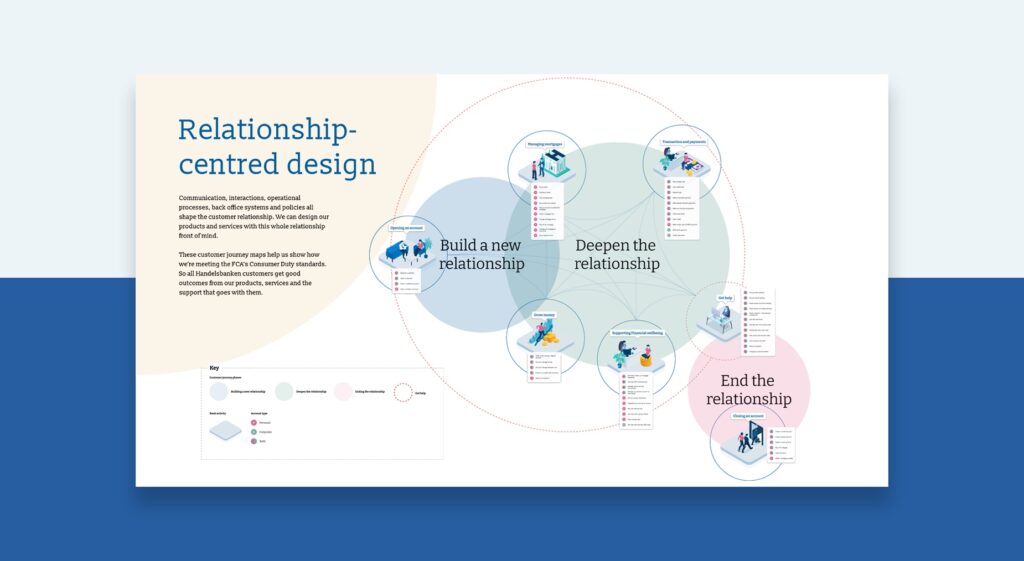
This was mapped and visualised into a structured framework that will deepen Handelsbanken’s relationship with customers from the day they come on board, right through to ending the relationship – as well as be used to evidence and ensure compliance towards the Consumer Duty.

The insights gathered throughout this process were methodically and transparently documented and collated into a detailed digital knowledge base including context and guidance, how-to guides, templates, case studies, artefacts, and much more. Providing the foundation for ongoing continuous improvement and internal work.

We worked collaboratively with people across the bank, developing a cross-bank operating methodology and providing staff training around customer-centred design. All of this helping to embed the framework and Consumer Duty compliance into Handelsbanken business-as-usual.

Diagram the presents Handelsbankens approach to human centred service design

Case study

Principality Building Society launched a new proposition to a new customer segment with Fresco

Principality Building Society

Summary

Principality Building Society developed a new highly focused proposition using Fresco’s insight on consumer behaviour and needs, aimed at the rising metropolitans segment. The targeted campaign produced triple the expected uptake of its innovative First Home Steps app.

Company size

1,000

Industry

Financial

Products used

Challenge

Principality’s portfolio and propositions teams have been working together to define and understand new target customer segments and design services and products to meet their needs. With a loyal and long-standing customer base, the team wanted to find a way to engage with younger customers nearer the start of their savings journey.

Principality has always used data to support planning and risk assessment and to measure performance. Principality has evolved the use of demographic, lifestyle and market data from CACI to further refine its customer and market insights. Using CACI’s Fresco segmentation was an obvious choice to support the project. Fresco describes individuals in terms of their financial product holdings, attitudes, life stage, affluence and digital behaviour. Principality wanted to differentiate through propositions with better customer type information.

Solution

Very often, insight is siloed within teams. Data is purchased and used for specific projects and activities. For the First Home Steps proposition, Principality shared insight across all the teams and individuals involved in planning and delivering the campaign.

CACI presented data insight to a multi-functional Principality team, showing how it could help to refine different aspects of the proposition and supporting the communication campaign. The data was used from the start, informing every aspect of proposition development. Principality combined CACI’s Fresco insight with its own research into first time buyers to produce a robust and differentiated evidence base that informed every First Home Steps decision.

The Fresco data helped build a picture of the target group and to understand their needs, in the context of how they live and work and the challenges they face in saving and planning. First Home Steps addresses the rising metropolitan segment, aiming to appeal to those looking to the future and saving to buy their first property.

The Fresco insight helped Principality’s team understand exactly how to reach the people it had identified, showing geographic areas where there was a high proportion of rising metropolitan consumer households. This supported targeting of ads and resources.

Results

The proposition team launched the First Home Steps campaign to educate and support younger adults who have reached the stage of wanting to buy a house, so they can be confident in their ability to manage their finances and buying decisions.

Promoted and supported in-branch, First Home Steps offers ‘workouts’ to get homebuying hopefuls financially and practically fit to obtain a mortgage and buy their first home. Resources include a borrowing calculator, a budget planner, house prices guide and savings tips. It’s all brought together in the First Home Steps app, a free pocket guide to the house-buying process. Principality hopes to motivate users to open a First Home Steps savings account, to save towards a mortgage deposit.

“We launched in branch and the campaign exceeded targets, especially for people downloading the app, with triple the numbers expected. From the first phase of the campaign the insight basis has given us great confidence for the next stage.”

Susan David, Propositions Manager, Principality Building Society

Sharing the data insight with colleagues from all parts of the business has not only created a stronger proposition, it has driven interest and positive support from branch colleagues who talk to branch visitors about their finances. They have been advocates for the app, able to talk knowledgeably and empathetically with branch visitors who might benefit, armed with a clear understanding of their likely needs and attitudes.

Principality has a mature approach to data, using a range of sources intelligently and collaboratively. They use their budget smartly, ensuring that they make full and focused use of the insight sources they subscribe to. CACI’s resources and services are key tools that help them retain loyal customers and to innovate. As well as delivering proposition insight, Fresco helps Principality understand branch footfall and customer profiles. Weekly flow information from CACI’s Retail Finance Benchmarking Mortgages and Savings provides the market context.

Case study

Creating a strategic segmentation to help TSB understand and drive money confidence

TSB logo

Summary

TSB is pioneering a new kind of banking for Britain, one that’s simple, straightforward and cares about people. Serving five million customers in the UK across a network of branches and operating centres, TSB offers friendly, honest and convenient banking that’s designed to meet customers’ needs, with the aim of delivering on its core purpose to equip them with money confidence. To do this, the bank wanted to better understand its customers’ behaviour, circumstances and priorities so it could be more relevant, engaging and effective.

Company size

10,000+

Industry

Financial services

Products used

Challenge

Customer segmentation

TSB already had creative-led segmentation developed by its brand agency. Yet, while this segmentation helped understand the target audience, it was ineffective for media planning and couldn’t be overlaid on the customer base.

At pitch, TSB’s new media agency, the7stars, proposed a more effective segmentation for media selection, which TSB wanted to advance further by overlaying it onto their own customer base.

Integration

In addition, the bank faced the issue of integrating these insights into its existing systems and ensuring they could be used for practical and actionable segmentation for effective media planning and customer targeting.

TSB had already been working with CACI to map Fresco financial lifestyle segments onto its customer base. So, a new joint collaboration with CACI and the7stars was initiated to address these requirements together.

Solution

Working in collaboration with TSB’s Research and Strategic Insights Team, CACI created an evolved segmentation that clearly distinguishes different customer types and provides clear segment profiles and personas.

CACI used Fresco and other external consumer demographic datasets to give TSB bespoke behavioural and lifestyle insights into its target customer base.

Justin Bell, Head of Insight, Strategy and Planning at TSB explains: “We started with a market-wide segmentation, based on all UK adults. We’ve subsequently created a version of that for our customer base.

“CACI provided a proven methodology and approach drawn from their data expertise and experience. Once we had clear segment parameters, our data team mapped them to our base.”

Results

TSB is actively using the segment insights to develop its media strategies and in campaign briefs, creating content tailored to target consumers’ profiles.

Justin continues:

“Part of the output of the segmentation was to rank the segments in order of money confidence. Working with CACI, we agreed on a weighted mix of key questions in the TGI consumer survey, to derive a money confidence score. We support people with content, products and services to help raise their money confidence and we need to be relevant to those that need that support most.

At the heart of it is a money confidence score: we’ll measure our progress against our purpose: Money confidence for everyone everyday. We hope to see a gap opening up between the money confidence levels of our customers and that of non-customers, with a continual improvement against today’s baseline.

We believe this segmentation will continue to pay dividends as we develop our channel and campaign marketing – we’re looking forward to tailoring products and services even more to meet customer needs.”

Case study

How OneFamily use data to identify demand for new products

Summary

OneFamily is an award-winning financial services company, providing products and services that help modern families thrive. The firm’s vision of “Inspiring Better Futures” means creating products to meet the needs of every generation of the modern family, from dual parents, divorced people and single parents to grandparents, junior savers and family friends.

OneFamily serves over two million UK customers, caring for over £7 billion of families’ money. With over 40 years’ experience, the OneFamily team offers a range of products including protection and lifetime mortgages, children’s and young people’s investments, including Junior ISAs and Child Trust Funds. The business has donated £3.5 million to support customers and communities since 2015 and is committed to responsible investment through climate-impact funds.

Company size

1,000

Industry

Non-profit

Products used

Challenge

Deeply committed to innovation and data-driven decision making, OneFamily faced challenges in effectively targeting their customer base.

Despite possessing the necessary in-house data science skills, they struggled due to limited resources to fully leverage their existing ‘R’ analytics software. These resource shortages therefore hindered their ability to predict market trends and make evidence-based decisions. 

As a progressive financial services company with an ethical business model, a critical challenge is to minimise waste and maximise value in all its operations. OneFamily therefore needed to refine their strategy and product development processes using advanced data analytics in order to minimise waste and enhance the precision of their targeting efforts to maximise value to its customers.

Solution

OneFamily uses Acorn and Fresco data for insight into existing customers, including its large Child Trust Fund (CTF) customer base.

Julian explains: “We are a progressive, innovative financial services organisation and we’re dedicated to developing products that meet the needs of today’s generation.”

“That’s why we’re strong advocates of data science, using it to determine strategy and product development and to help us predict market trends. Evidence-based decision making is core to our contemporary, forward-looking approach. Targeting effectively minimises waste and maximises value and relevance to our customers: these principles are important in our ethical business model.”

He adds, “Fresco is aimed at the financial services market so it’s a good match with the information we find most useful as we review and refine our products and portfolios. We can see where we index well across the UK and we can spot new opportunities to meet customer needs.”

Results

Julian was impressed by CACI’s Fresco and Acorn datasets. “They compare well with other segmentation models I’ve used in my career: we believe they’re best of breed products in our sector. They allow OneFamily to segment our family-oriented customer base and see how it’s represented across the UK population. We can zoom in to understand the preferences and needs of customers in granular detail, then locate other similar target groups.”

Data science has helped Julian and his team to identify demand for new products such as Junior ISAs, lifetime mortgages and over 50s family saving products. Fresco and Acorn data also help OneFamily prioritise recipients for cross-selling or upselling campaigns, connecting them with products that meet their current needs.

OneFamily’s insights analysts now run logistical regression models and retention models to predict customer behaviour and preferences. Julian says, “We categorise our customers and apply CACI’s variables to identify high, medium and low propensity groups for a given product or campaign.”

“CACI’s experts bridge the gap, providing specialist knowledge and so we can exploit the datasets to the max. CACI’s Head of Analytics is exceptionally knowledgeable and has steered our retention project so we can use propensity modelling on top of the lookalike datasets. That means we can focus with confidence on incentivising the top three deciles rather than expensively blanket-marketing to the entire base.”

Learn more about Acorn and Fresco.