
Posts Are dashboards dead? Assessing their challenges & advantages to determine their future in businesses

Are dashboards dead? Assessing their challenges & advantages to determine their future in businesses

In this Article

Dashboards have been quite a topic of contention in certain circles with the recent recirculation of Taylor Brownlow’s essay ”Are Dashboards Dead?”.

While I’m of the opinion that no, dashboards are not dead, they have been undeniably overused and often misunderstood, with a disconnect between a dashboard’s actual function versus our perceived function of them. 

Why is there dashboard fatigue?

Many of us have experienced dashboard fatigue, and rightfully so. As businesses, how many dashboards have we commissioned that were never fully utilised, if used at all? The answer is too many.

The reason for low engagement isn’t the fault of the humble dashboard, but rather that a dashboard was never the appropriate solution for the end user, or its design wasn’t tailored enough to the business use case.  

When faced with a business problem requiring data insights, we often jump straight to dashboard creation. However, there are many other solutions that can be tailored to deliver data insights, such as concise reports and static presentations. With an increased understanding of where dashboards fail, the conversation has shifted to questioning their relevance altogether.  

So, what place do dashboards still have in businesses, and how can we better understand where they excel to drive improved outcomes? 

What potential challenges may arise with dashboards?

There are many instances where dashboards may be less effective or complicate matters for businesses, and other methods provide a better solution. Instances may include: 

  • When the user needs a concise answer to a question:
    Dashboards require interaction and exploration, which can be time-consuming. If a stakeholder needs a straightforward answer, a tailored report is more efficient.  
  • For business specific, niche questions:
    Not every level of enquiry warrants the resource-intensive creation of a dashboard. For narrow, targeted questions, simpler reporting methods suffice. 
  • One-time insights:
    Dashboards are overkill for static data projects, such as measuring the success of a single transformation. In these cases, producing a well-crafted report or presentation is more resource-efficient. 
  • If the data is exported for analysis:
    If users regularly export dashboard data to manipulate it elsewhere, it’s a sign that the dashboard doesn’t meet their needs or wasn’t necessary to begin with. 

When might dashboards be the right solution?

Company-wide reporting platforms

Dashboards provide a unified view of performance across teams, offering consistent delivery of insights to aiding faster decision making, customisable filters for views specific to each business unit, efficiency in distributing insights without the need for manual reporting and increased data accessibility through data visualisation. 

Regular cadence reporting

For tracking ongoing metrics such as daily sales, customer trends or campaign performance, and measuring progress against targets, dashboards provide updated insights without the wait. 

Exploratory analysis

Whenusers want to discover patterns, relationships or unknown trends within the data, dashboards allow for interactive interrogation. These tools are especially valuable for data-savvy end users, enabling self-service exploration without requiring an analyst’s intervention. 

Monitoring ongoing initiatives

Dashboards are excellent for tracking live projects or recurring business processes, offering real-time visibility into performance. 

The future approach for dashboards

With the above in mind, we’re moving to a more informed approach where dashboards are no longer a tiresome, default solution, but a carefully considered tool.

The future isn’t about abandoning dashboards, but about being intentional and strategic in their creation and deployment. The key is facilitating dashboard creation in a way that adds tangible value and is thoughtfully configured to provide meaningful, actionable insights that empower decision making. 

How CACI can help

At CACI, we work with you to deliver the best solutions for your analysis needs. Our extensive experience in successfully implementing dashboards across diverse industries highlights several key scenarios where dashboards have proven to be highly effective.  

Whether it’s creating a bespoke, one-off report or developing a suite of comprehensive, customisable dashboards, contact us to find out more about how our user centric approach and industry expertise can help you gain meaningful analytics that will drive strategic business outcomes. 

Refreshing Scrum with the Ball Point Game

In this Article

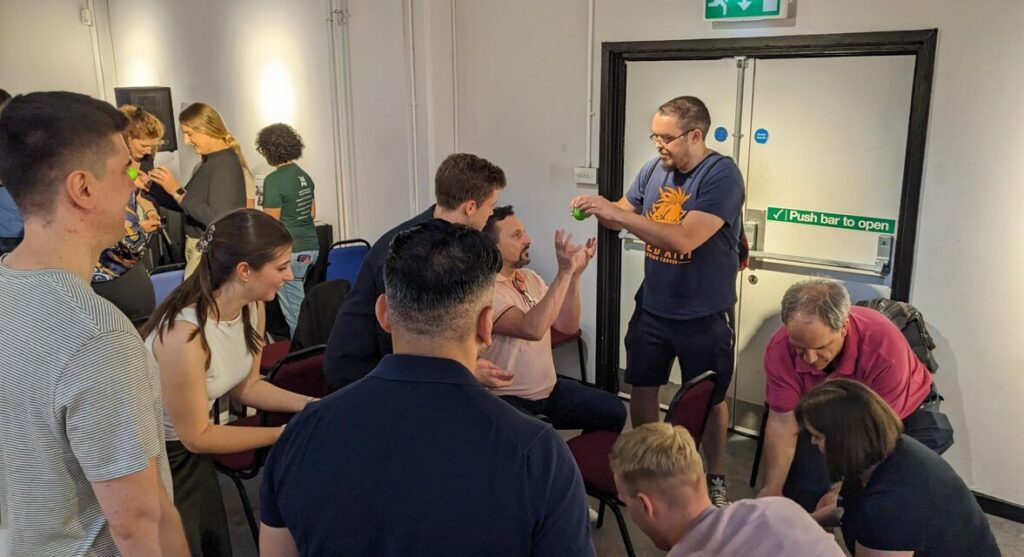
On a recent programme development day, Phil Ballard, one of our award-winning Scrum masters facilitated the Ball Point Game. This is an industry-known Agile game which is usually run as part of an introduction to the Agile ethos for those keen to follow the Scrum methodology. 

Despite CACI having teams that are highly experienced in Scrum, we still found this activity to be useful not only as a “going back to basics” session, but also from the several other lessons learned from our own adaptation. 

Ball Point Game: basic overview 

Teams of eight are formed, with each team collecting a bag of balls. 

Within an Iteration (of which four take place), teams pass as many balls as possible among team members, with each ball passed scoring the team a point. Teams must adhere to the acceptance criteria of each ball being touched at least once by every member, each ball returning to the same person who introduced it into the team, each ball having “airtime” as it moves between team members, lost balls being fetched and re-entering the team where it left and dropped balls not being re-introduced into the system.

During each Iteration, teams will have one minute to talk among themselves and two minutes to perform the ‘Objective’. Prior to each Iteration, an estimate for the number of balls expected to pass through the team within the next Iteration is predicted. 

Team members taking part in the Ball Point Game, as a way to learn Agile methodology in an easy manner

CACI’s spin on the Ball Point Game 

Considering teams are already experienced in delivering in scrum, we made things more lifelike by introducing additional requirements in Iterations 3 and 4: 

  • The balls are being sold in packs of ten, with at least one of them being green. 
  • All balls must continue to gain height as they are passed through the team. 

After all, what’s software delivery without a stakeholder wanting to change their mind? The idea behind these rules was to break the established process, force change and to see what behaviours the scrum-experienced professionals would exhibit. 

Team members taking part in the Ball Point Game, as a way to learn Agile methodology in an easy manner

Ball Point Game goals

The Ball Point Game’s ultimate goal was to teach participants the value of continuous process improvement through basic agile principles using the simulation of an agile production process, including: 

  • Teamwork/shared goals 
  • Retrospectives/problem-solving 
  • Planning 
  • Estimating based on experience. 

All processes have a natural velocity. To speed things up, it is often not a case of working harder or faster, but a case of changing the process. 

Key takeaways

After all Iterations were complete, we discussed the results and asked teams to contribute their experiences with the following questions:  

  • Which Iteration felt as though it was the best/worst? 
  • How important was the retrospective between Iterations? 
  • What changes did you make? 
  • How did the team make decisions – did anybody take charge? 
  • Were all ideas heard within your teams? 
  • Was there anything notable in determining your estimates? 
  • Were improvements made by working harder or faster? 
  • Did you observe/experience anything else of interest? 

With the additional requirements added: 

  • Iterative development is also based on learning from the live product and adapting to what the customer and end user needs. 
  • Without anything being live, there is nothing to learn from and no way for the product to adapt. 
  • Sprint teams must adapt to estimating with new requirements versus estimating on a known repeatable task. 

Additional findings from the teams

  • The short timings of Iteration planning, along with the input of additional requirements, seemed to force an intensity. This, in turn, forced out several negative behaviours that we have not experienced on the programme, however, recognised within this competitive environment. 
  • Low sprint commitments despite the team feeling it was a known task. 
  • Sprint teams stopping when hitting commitment as there was an assumption that the game goal of the exercise was to have a stable velocity. 
  • Argumentative behaviours exemplified (not the usual collaborative approach we usually see). 
  • A competitive nature towards the other sprint teams, prohibiting the sharing of lessons learned. While the rules never stated they were against each other, it was inherently assumed when splitting participants into teams and asking them to perform the same task. 

On a more positive note:  

  • Many questions were asked about the requirements, with a focus on what the user/customers’ needs and problems were 
  • Looking outside of the team for improvement inspiration despite its interpretation as spying. 
  • Reflection on what we do in practice versus the theory/Agile beliefs 
  • Great discussions around the overall value of sprinting and iterative delivery. 

If you wish to find out more about the Ball Point Game or run it yourself within your programme or teams, please get in touch. 

Get ahead with CACI: Unlock the power of AI and ML in your CRM

In this Article

Setting the stage for AI and CRMs

The field of Machine learning and AI has evolved rapidly in the last few years, especially in fields where large quantities of data and quick response times to queries are crucial.

But given lots of these techniques and methods have been around for a much longer period, why has it taken so long for other industries outside of small start-ups and ambitious tech giants to leverage these methods in similar ways? 

CRM is an essential component of any company’s strategy. The ability to communicate with and understand customers is more important than ever due to the low barriers to entry in highly competitive global markets. Companies have only brief moments to convince customers that they are the right choice for shopping, spending time, or engaging. Optimising these initial and subsequent contacts is paramount to success. 

Beyond just expanding your customer base and attracting new clients, CRM is vital for any company’s retention strategy. The most advanced cutting-edge models in the world are utterly useless if we don’t know how to activate and capitalize on the value they represent. 

ML foundation for CRMs

In the CRM space our main goals are increasing consumer retention or spend, and we do this via figuring out the most effective ways to communicate with people. This can be broken down into when to speak to them, how to speak to them and why to speak to them.  

Recommendation engines lie at the core of many of these architectures, models that are designed to figure out what you want before you even know you want it. Broadly they work by looking at the kind of customer you are, then at customers like you, then finding things that they’ve bought recently that you haven’t.  

You can even simplify this down into just looking for customers who have an identical purchase history to you. Maybe a laptop you can buy on Amazon doesn’t come with a charger, so commonly when people buy this laptop their next purchase is a charger (You can often see this simple logic in the “People also bought” section of Amazon). But even these simple implementations are incredibly powerful in some ways, an educated guess is always going to be better than a random one. 

So how do these methods relate to CRM? Well, the general structure can be pulled away and applied to any subject.

When we think about how to engage with a customer, we’re going to look for ways we engaged with similar customers and how these performed. The customer who likes Sabrina Carpenter will probably need to be spoken to in a different way to the Motorhead fan. 

This is simple stuff, right? Well exactly, but it’s a method to show that the underlying AI processes in these platforms aren’t really all that complicated – there’s a lot of room for improvement especially when implementing bespoke solutions with larger data sets.  

The next (generative) step  

So, we already have ML methods that can tell us when and why to talk to people, great! But what’s the next step? 

All that’s left of our final stage is how to talk to them and what to say, stages which can and are currently being revolutionised by the advent of enterprise grade Generative AI. 

A current pipeline for devising CRM processes may involve creating template communications that are then populated with more specific information, for example customers in a certain segment defined by age and tenure are assigned one template and differing segments are shown another. 

This approach can be time consuming if it needs to be completed for each campaign, and may miss a level of personalisation that people will respond to, feeling as though each message is tailored to them rather than being an email blast they just happen to be caught up in. 

Skilled AI engineers armed with LLM’s can create a unique voice for each consumer, ensuring that quite literally all communication they will ever receive are exactly personalised to them and their engagement habits with your brand. 

Imagine attempting this even a few years ago, assigning a team of people to trawl through millions if not billions of rows of data to ensure that each customer got the perfect messaging for them would have been completely impossible. 

In practice this level of granularity in communications is probably unnecessary but it speaks to the potential these models have in this space – the sky truly is the limit. 

Even starting off small with these steps, giving a small part of a communication a generative component, allowing for large scale A/B testing and continuous model training, the effectiveness of these comms will improve over time. 

Freeing this time up from your CRM team will give them more time to tackle more involved problems that can’t be automated. 

If you need help on this journey for a better CRM, contact us here.

Environmental sustainability in business: importance and impact

In this Article

Key issues for countries and the businesses that operate within them to address in terms of climate change unfolded at the recent 28th UN Climate Change Conference (COP28). These issues urge immediate and significant action to be taken on fossil fuels and clean energy, national adaptation and climate finance, methane reduction, land use and more.

What does environmental sustainability in business mean?

Environmental sustainability in business is the operation of a business that does not compromise the environment. A business that has considered environmental sustainability prioritises the environment’s best interest, with society and its ecosystems coming before making a profit. It involves responsible decision-making that minimizes carbon footprint or waste while simultaneously improving the quality of life for humankind and the natural world alike.

Unfortunately, however, operating businesses as usual has had an increasingly detrimental impact on our planet. According to the latest State of the Global Climate report by the WMO, 2023 was the warmest year on record at about 1.4C,increasing pressure to shift their operations to more environmentally sustainable practices. This inevitably causes businesses to consider—where do we start? How do we begin making a difference?

What is the importance of environmental sustainability in business?

According to an article published by Maryville University, businesses that do not act responsibly will result in “the majority of many species not surviving past the 21st century”, reiterating how critical it is for businesses within every industry to take part in improving their environmental surroundings.

Although companies have a way to go before fully grasping the repercussions of ever-growing carbon footprints, those willing to tackle this challenge early on will get a head start on reshaping perspectives and realities.

Environmental sustainability in business practices

Businesses can rely on the three R’s– reduce, reuse and recycle– to begin reducing their environmental impact. However, there are several other examples of practices that businesses can incorporate into their operations amplify their reduction, including:

  • Life cycle assessments
  • Designing environmentally friendly products/services
  • Optimising product efficiency
  • Decreasing supply chain carbon footprint
  • Re-evaluating CSR (Corporate Social Responsibility) expenses

Benefits of environmental sustainability in business

Reduces the impact of business costs

While the cost-of-living crisis is skyrocketing, improving the energy efficiency of business operations and decreasing waste will go a long a way in bracing for the impact of unexpected business costs. Using more energy efficient lighting or reusing existing resources can be quick-fix solutions for lowering costs.

Improves a business’ reputation

Environmentally sustainable businesses are viewed as a plus, and companies are eager to highlight this fact. Companies that can go “green” show that they’re serious about making a difference in the environment and are interested in more than just profitability. Businesses that can market themselves and develop their identity around their commitment to the betterment of the planet will notice incredible results in terms of their reputation.

Group of people in front of icons representing sustainable development goals and environmental technology

Who is responsible for improving environmental sustainability in a business?

Businesses have been expected to pave the way towards environmental sustainability due to their notably significant contribution towards polluting the environment through waste, gas emissions and plastics generated. The responsibility does not necessarily begin with one individual within a business though– employees at every level of the business must work together to bring about change. A few examples include:

  • Business owners and leaders: Business owners and leaders are typically capable of leading strategic decision-making that influences the wider business. They can develop effective sustainability strategies and initiatives that have the power to change policy and induce change.
  • Business managers and supervisors: Managers and supervisors can supply valuable insights due to their more hands-on roles. They also typically have different perspectives and understandings as to how to improve business sustainability.
  • Employees: Employees can supply valuable contributions when encouraged to voice their opinions and concerns on how the business can become more sustainable.

Impact of environmental sustainability in business

The Department for Business, Energy and Industrial Strategy is striving to reach net zero carbon emissions by 2050. It’s going to take strong leadership, business-wide alignment on operations and an engaged corporate culture to successfully execute and maintain environmentally sustainable business practices. Businesses that start addressing these issues and challenge existing business processes will find themselves making a breakthrough towards becoming more environmentally sustainable while protecting the world around them.

How can CACI help you overcome these obstacles?

Our newly developed Mood Environmental Hub helps track all of your assets across multiple geographic locations and assess the environmental impact of your business.

With a single click, users can drill down from multi-site, business-level functions, to departments or even individual teams to determine asset types and locations, enabling a quick assessment of priority focus areas for improvement. It can also visualise existing data through user-friendly dashboards that show carbon impact, consumption and cost at an enterprise level.

The advanced modelling feature also outlines potential improvements, indicating ROI and carbon reduction impact. Additionally, you can easily check performance against carbon commitments such as Social Value through the initiatives tracker.

Producing carbon reduction target tracking reports or modelling for a business case is now a click away – to see how it works, you can book a demo here.


Tangible actions organisations can take to combat climate change

In this Article

Benchmarking against a new global stocktake 

At the 28th UN Climate Change Conference (COP28) towards the end of 2023, the first ever global stocktake concluded as a benchmarking process for countries and stakeholders to measure against. With a rapidly closing window of opportunity to make environmentally conscious change, this stocktake encourages a reassessment of where countries and stakeholders stand in terms of climate action and support, identify any gaps and strategise on solutions to accelerate action. This stocktake will also hold countries and stakeholders accountable for their policies and commitments towards genuine climate change.

In support of this stocktake, High Level Champions and the Marrakech Partnership created the 2030 Climate Solutions: an Implementation Roadmap, a comprehensive framework which businesses can reference to set and achieve their climate change goals by 2030.

Climate change is the issue of our time, and we all know that we must do our bit. But nailing down what bit we are supposed to be doing can be harder than expected. If you’re manufacturing goods, it’s a bit easier – but the vast majority of organisations are run online with little physical input or output. As businesses especially are expected, and indeed want, to reduce their carbon footprint, they may find themselves wondering… where do we start?

How to identify tangible actions for business-wide change

To meaningfully reduce carbon emissions and create sustainable business models, businesses must be able to identify specific tangible actions that are realistic for initiating change. The granular details can add up to a substantial difference, and what makes sense to one organisation may not to another. Nonetheless, what remains clear is the necessity of change.

Access to comprehensive carbon emissions data

The time has long passed where organisations can afford to stumble around in the dark when it comes to their environmental impact. In fact, by 2030, greenhouse gas emissions must be reduced by 43% and global heating limited to 1.5°C.

What businesses really need is comprehensive, transparent and insight-led data on their carbon emissions. This data is critical in decision-making, anticipating future demand and analysing the marketing campaigns’ success. So, why wouldn’t we expect it of our impact on the environment? Leveraging technology to take control of their data to make it understandable and actionable is a crucial and essential step forward.

How CACI’s Environmental Hub can help create sustainable businesses

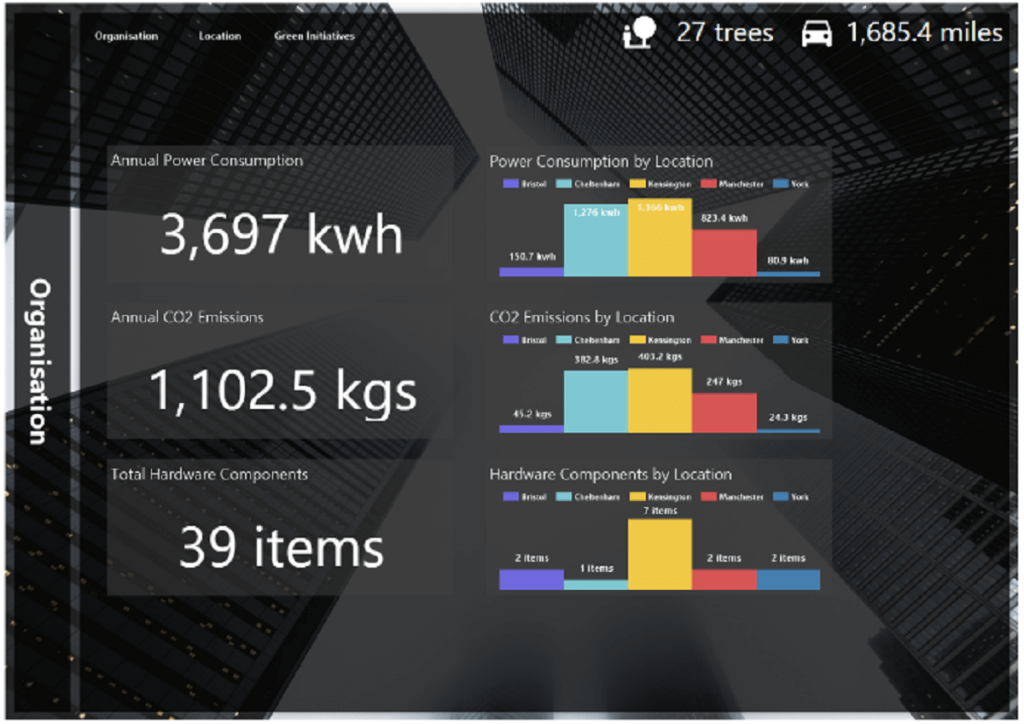
Using CACI’s highly reputable Mood data visualisation platform to distill each component of your business and connecting disparate data, the Environmental Hub generates informative and actionable insights that drive effective decision making.

But understanding your current position isn’t necessarily very helpful without data on how to make improvements. From the top 5 power consumers, you can view a selection of Green Alternatives – i.e., more low-energy efficient alternatives to your current components. Selecting one allows modelling of what difference that choice would make. There’s also info on energy suppliers, including cost savings and whether they are providing green energy.

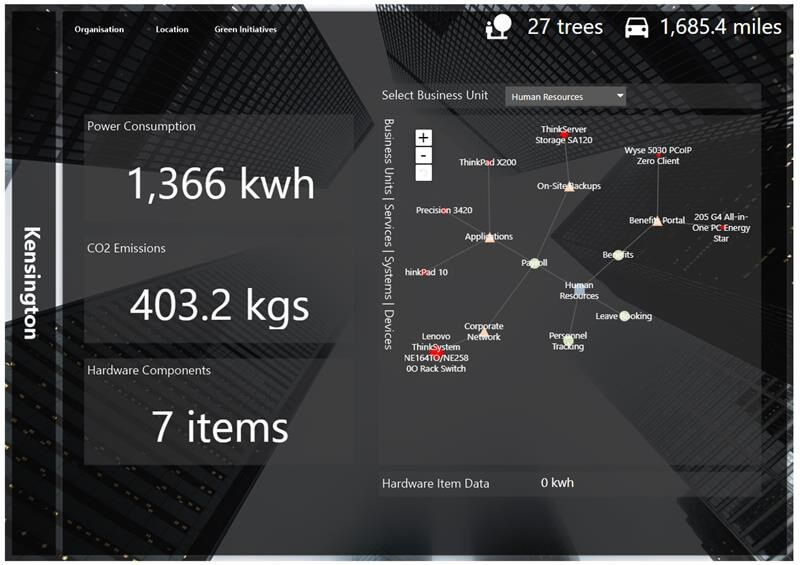
This begins with a top-down view showing power use across an organisation split by location, which is then benchmarked against equivalent miles driven and trees needed to offset. From there, users can browse locations, investigate connected infrastructure from hardware linking into applications and determine which applications support services in each department.

At this stage, any item’s power usage can be viewed in just one click, alongside a comparison of other items. It’s here that you can see where your carbon footprint is really coming from – and start to make changes.

From the top five power consumers, you can view a selection of Green Alternatives (i.e. more low-energy efficient alternatives to your current components). Selecting one allows modelling of what difference that choice would make. There’s also information on energy suppliers including cost savings and whether they supply green energy.

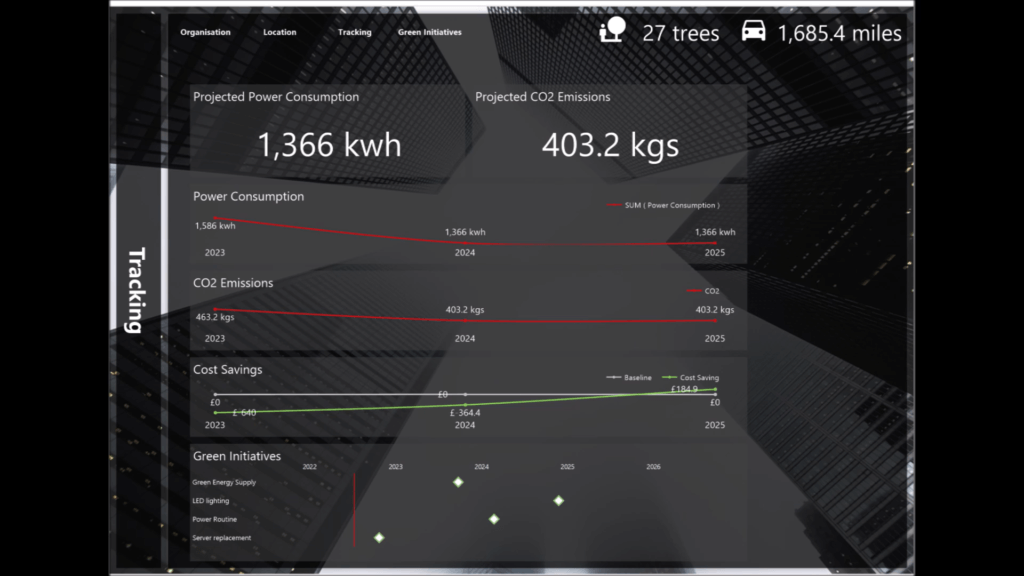
Once you’ve begun to make changes, however, you must be able to see what kind of progress you’re achieving. The Tracking view shows detailed data over time and is logged against Green Initiatives to highlight the where and when impacts were made. Over time, organisations can build a truly holistic and well-informed picture of their carbon emissions.

Book a demo for CACI’s Environmental Hub here and find out how it could help your organisation reduce its carbon footprint.

Free NetDevOps training to learn network automation with Cisco U

In this Article

Cisco have recently complemented their various Training and Learning Platforms (including Cisco Digital Learning, Cisco Learning Network and Cisco Live) with a new user-friendly offering: Cisco U. While some of the content is pricy, we’ve found some completely free-of-charge network automation courses that we think you should know about. 

What are the Cisco U pricing plans?

Unlike other Cisco training platforms, no special user account is required– just use the same Cisco Connection Online (CCO) account you currently use as a NetEng to login to the main Cisco Portal for activities such as Cisco Certification Tracker, Cisco Software Downloads and Cisco TAC Case Manager

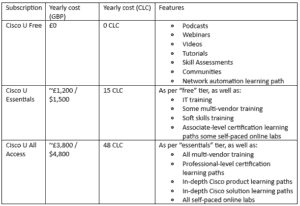
Cisco U currently has three Pricing Plans

  1. Cisco U Free – £0 per year 
  2. Cisco U Essentials – ~£1,200 per year (or 15 Cisco Learning Credits
  3. Cisco U All Access – ~£3,800 per year (or 48 Cisco Learning Credits

Generally, the difference between the subscription levels is around the specialism of content available. For more interactive and live tutorial content, higher subscription levels are required. As a summary of the differences: 

Note: Cisco Learning Credits (CLC) are prepaid vouchers that you may already have an allowance of if you act as a Cisco VAR (value-added reseller) or have a large enough Cisco contract. 

What free content is available? 

Although some of those prices may seem a little steep for individuals, there is a great deal of free content available within the network automation realm, especially for those looking to learn about topics such as: 

  • Practices: NetDevOps, pipelines, pull requests, version control, CI/CD 
  • Data Structures: YANG, YAML, JSON, XML 
  • Coding: Python, PIP, PyPI, Netmiko, pyATS, Genie, EXPRESSO, Bash 
  • Tooling: Ansible, Terraform, Cisco NSO, Vim, Linux, API 
  • Protocols: gNMI, RESTCONF, NETCONF, REST API 

Here’s a curated summary of some of our favourite and completely free of charge courses: 


What does the future of Cisco Learning look like? 

This looks like a promising step in consolidating all the disparate Cisco Learning platforms, systems and content into one centralised, easily-searchable and visually-appealing place. Sure, the pricing may seem steep at present – and as an individual general network engineering learner, you’d get better bang for your buck going via CBT Nuggets, INE, Pluralsight or Udemy – but for free network automation-specific content, Cisco U is a surefire winner for anyone wanting to break into the world of NetDevOps. 

How CACI can supplement your network automation efforts

In the midst of a network automation initiative and struggling to get the right NetDevOps-qualified professionals to help drive your latest automation, dashboard or observability project forward?

Let us help and see how your business can fully utilise our talented NetDevOps NRE, SRE, developer, automation and coding experts to cut through your engineering backlogs. 

Using Cisco CE credits to recertify your CCNP or CCNA

In this Article

Following the recent announcement of Cisco creating its own Continuing Professional Development (CPD) scheme, the Cisco Continuing Education Program, it is now possible to recertify your CCNP or CCNA certification using an exam-free approach. With some studying and time applied, this can even be done free of charge! So, what are the credits you can earn for recertification and how do you go about earning them? 

What is a CE credit? 

Cisco Continuing Education Credits (CE Credits) is a programme that offers Cisco certification holders flexible options to recertify by completing a variety of eligible Continuing Education (CE) items. The programme is designed to help professionals stay up to date with the latest technologies and trends in the industry, including Python, network automation, NetDevOps and beyond. CE credits are similar in form to CPD points seen in other fields, and can be earned through the following means: 

How can you earn CE credits? 

The amount of CE credits earned will depend on the type of activity and its duration. For example, you can earn 12 CE credits for a 14-hour Cisco course delivered via the Cisco Digital Learning platform or earn a generous 40-65 credits for attending a five-day Cisco instructor-led training course offered by authorised Cisco Learning Training Partners. You can also earn small amounts of “top up” credit here and there through ad-hoc, time-bound initiatives. 

How points contribute towards certificate renewals 

The CE Credit process has some legwork to it, as CE Credit issuance isn’t automatic. The process roughly looks as follows: 

  1. Attend the training session, course or webinar for its full duration.
  2. Note down the official course name, date when you began and date when you finished. 
  3. For online courses, you should expect to receive a completion certificate at the end, which is a PDF document with a certificate number in it. You’ll need this certificate validation code later on.  
  4. Log in to the Cisco CE Credit User Portal with your Cisco.com CCO account and click “Submit Items” in the top right side to enter the details of the training course, webinar or online learning you have completed. 
  5. Ensure you have the course name, start date, end date and certificate validation code and PDF version of the Completion Certificate to hand to submit.
  6. Wait a few days for the credit status to change from “Pending” to “Earned” on the Cisco CE User Dashboard

Within 24-48 hours, your CE Credits will then also show against your Cisco CertMetrics under Certifications -> Cert Status -> Pick your CCNP/CCNA Certificate -> View More. This shows the progress these points make towards the recertification, where the following table is handy to know: 

Certification 

Renewal Period 

Renewal (CE Credit-only) 

Renewal (Exam + CE Credit) 

Associate (i.e. CCNA) 

3 years 

Earn 30 CE credits 


Specialist 

3 years 

Earn 40 CE credits 


Professional (i.e. CCNP) 

3 years 

Earn 80 CE credits 

Earn 40 CE credits + Pass 1 Professional exam 

Expert (i.e. CCIE, CCDE) 

3 years 

Earn 120 CE credits 

Earn 40 CE Credits + Pass 1 Technology exam(OR)Earn 40 CE Credits + Pass 2 Professional exams(OR)Earn 80 CE Credits + Pass 1 Professional exam 

Activity 

Type 

Credits 

Expiration Date 

Cost 

Rev Up to Recert: Python 

Online Videos 

15 CE Credits 

April 20 2023 

£free 

Cisco DevNet Associate Fundamentals 

Online Course 

48 CE Credits 

April 30 2023 

£99 

How CACI can support your recertification process

If you need qualified Cisco professionals to help your business thrive, why not get in touch to see how we can help you fully utilise our talented CCNA, CCNP, CCIE and other vendor expertise for your business network. 

What is the difference between Cisco IOS and Nokia SR Linux?

In this Article

Cisco IOS and Nokia SR Linux are two popular operating systems used in networking. While both have their strengths, they differ in several ways– SR Linux is chiefly a microservices-led, containerised network operating system (NOS), while Cisco IOS is a monolithic NOS, with Cisco having made enhancements to their approach in the NOS under IOS-XR, IOS-XE and NX-OS. So, what are the main differences between these two operating systems, and how do you know which one is right for you and your business? 

Breaking down the differences between Cisco IOS and Nokia SR Linux

Architecture

One of the main differences between Cisco IOS and Nokia SR Linux is their architecture. Cisco IOS is a monolithic operating system, meaning that all features are integrated into a single image. This can make it difficult to upgrade or modify specific features without affecting the entire system. In contrast, Nokia SR Linux is a modular operating system, which allows for more flexibility in upgrading or modifying specific features without affecting the entire system. 

Command-line interface (CLI) 

Another difference between the two operating systems is their command-line interface (CLI). Cisco IOS uses a proprietary CLI that can be difficult to learn and use for those who are not familiar with it. On the other hand, Nokia SR Linux uses a standard Linux CLI that is more familiar to many users. 

Security features & capabilities 

In terms of security, both operating systems have strong security features. However, Cisco IOS has been around longer and has had more time to develop its security features. Additionally, Cisco has a larger market share than Nokia in the networking industry, making it a bigger target for hackers. 

Support and documentation 

Another difference between the two operating systems is their support and documentation. Cisco has an extensive support network and documentation library due to its large market share. In contrast, Nokia’s support network and documentation library may not be as extensive due to its smaller market share. 

Containerlab.io and SR Linux 

Containerlab.io is an open-source tool that supplies a CLI for orchestrating and managing container-based networking labs. It allows users to create virtual network topologies using Docker containers, making it easy to test and experiment with different network configurations.  

One of the main benefits of Containerlab is its ease of use. It provides a simple command-line interface that allows users to quickly create and manage container-based networking labs. Users can specify the number of containers they want to create, the type of network topology they want to use and other configuration options. 

The open-source project is backed by Nokia SR Linux and has a great deal of flexibility in supporting a wide range of containerised routers, including FRRouting, Quagga, Bird, Juniper and others. It enables network engineers to experiment with different routing protocols and configurations as well as virtual wiring, VNETs, VXLAN and other topologies. Not to mention, it’s easy to integrate with network automation tools such as Ansible and Terraform. 

How can CACI help you choose between the two? 

Both Cisco IOS and Nokia SR Linux have their strengths and weaknesses, and they differ in several ways– their architecture, CLI, security features and support/documentation. Ultimately, choosing between the two will depend on individual needs and preferences. 

Why not get in touch to see how we can help your business fully utilise data centre network operating systems (NOS) such as Cisco IOS, IOS-XE, IOS-XR, Nokia SR Linux and others. 

Leveraging Braze’s Winning Paths to augment Canvas performance

In this Article

In our last article, we explored how brands can utilise Braze’s Sage AI suite to enhance their audience engagement. Now, we’ll be diving into one of Braze’s newest Experiment Path features, Winning Paths, to find out how it can help nurture audiences and enable marketers to make impactful decisions at any point along the multi-touch journey.

How does Braze’s Experiment Path work?

In the ever-evolving world of digital optimisation, the ability to leverage data-driven insights is a deal-breaker. Braze’s Experiment Path node enables testing delivery time, messaging cadence, channel combinations and much more against earlier defined conversion events by randomly assigning users to different paths (or an optional control group).  

This functionality was designed to streamline testing efforts and automatically send the most engaged users through subsequent steps. While it’s especially beneficial when setting up recurring or triggered canvases, it can also be used when setting up a single-entry flow.  

If the initial test results are not statistically significant and the Winning Path wasn’t determined, Braze will direct users towards the best-performing path to ensure the most relevant experience. Alternatively, marketers can choose to distribute volume and allow customers to continue further down by following percentage splits specified at the beginning of the experiment. 

For single-entry canvases, Braze will automatically apply a Delay Group that will separate randomly assigned users, while the rest will follow down the experiment paths. When the test is complete, the Delay Group will be connected to the Winning Path and continue through the canvas. 

How is Winning Paths implemented?

To implement Winning Paths, follow the steps below:

  1. Add in the Experiment Path to your flow by using the drag and drop canvas builder. By default, there are two paths with 50% of eligible audiences split between each path.
  2. Next, simply tailor distribution for up to four variants and activate Winning Path in Settings by toggling on the feature.
  3. Lastly, define the conversion event that will determine the results and set the timeframe to define how long the experiment will run before the top performing flow is selected.  

The experiment window begins when the first user enters the step, and the start can be triggered earlier than expected by users in early time zones if they’re using local time delivery. When setting up the experiment, considering time differences is imperative, as is considering the impact of setting shorter timeframes. If local delivery time is enabled, we recommend setting an experiment window of at least 24-48 hours to give all customers an equal opportunity to interact and eventually convert.

Why Winning Paths will make a difference for your brand

Winning Paths is a fantastic way to enrich your brand’s testing strategy, connect with your customers and help you better understand microtrends among audiences flowing through lifecycle or BAU journeys. This functionality will ultimately allow marketers to run multiple tests in parallel and define successful ways to build meaningful connections.

Our partnership with Braze

As a trusted Braze partner, our multidisciplined team can help you maximise your Braze experience value and help you connect with your customers like never before. If you’re looking to adopt Braze or are already a Braze user, get in touch with us to find out how you can implement Winning Paths to bolster your testing and customer engagement strategies.

If you’re interested in finding out more about Braze or if you’re a Braze user looking to maximise value, please reach out to us.

Continue reading:

Blog 1 – Exploring Braze: optimising your CRM by leveraging key features

Blog 2 – How to elevate your brand through the power of Braze’s Sage AI suite

Blog 4 – CACI’s Braze City x City 2023 takeaways

Blog 5 – How Braze’s Canvas components personalise marketing journeys

Requirement discovery – paving the way to project success

In this Article

Focussing on outcomes is essential to the success of any project. What does the project need to achieve? It sounds like an obvious question, but time and again we see vague notions of what the outcomes are.

Procuring a technology system isn’t the end of the process. It needs to be designed, structured, implemented and have a plan put in place for its ongoing success post go-live.

How will the people using the new system be trained? What, ultimately, will success look like? A robust requirement discovery phase of the project helps both parties to understand one another and outline the objectives of the project.

At CACI, we utilise our proprietary FUSION project delivery methodology with all of our customers and for our internal projects. This helps us to keep work on track, whilst further enabling us to continually learn from project implementation to continuously improve our own processes.

Spending that time early in the lifecycle of the project to fully understand what it is you need to achieve enables us to set clear goals and create a point of reference for the remainder of the project.

Here we can establish what success will look like, creating a baseline of requirements and their acceptance criteria for sign off.

Requirement discovery building knowledge and insight

The success of any project is underpinned by the people involved. Getting both teams together so that they can build knowledge and insight of how each other works is invaluable in putting in place the groundwork for a successful project.

The definition of success and acceptance criteria created during the requirement discovery phase of the project acts as a reference point for the rest of the project. The requirements laid out at this stage are designed to establish what you need from the project, not describe the solution. It is important, therefore, to prioritise your requirements, understand what you want to achieve and set out your acceptance criteria at this stage. Who needs to do what, by when? What will tick your boxes in order to advance the project?

The involvement of key roles such as the project sponsor are vital in ensuring buy-in from key personnel and following up on your requirements to ensure that they are appropriately managed.

This isn’t just about managing the change in technology that you’re experiencing, there’s the human element to consider, too. We covered this in our previous blog about change management, but it’s worth reiterating since the requirement discovery phase further enables discussion around the tangible impact to the people who are affected by the change. Getting buy-in from everyone early in the project is good practice and the discovery phase is vital in building that knowledge and insight that will facilitate a smoother change management process when the (agreed upon) time is right.

The importance of epics in requirement discovery

Epics are an important way of breaking down a larger body of work, such as a software implementation, into user stories that work towards the intended outcome of the overarching project. This helps both teams to break their work down whilst continually working towards the bigger picture.

CACI helps customers in creating these, since they enable us to focus on your outcomes, putting them front and centre of the project. We’re providing the solution, but your required outcomes are bespoke to you. Creating epics enables us to focus on this during the process of delivering your solution.

The creation of epics also enables us to come back to your requirements and how we intend to achieve them. With the overarching project broken down into smaller sprints of work, it enables us to focus on the delivery of key requirements across the project.

How CACI can help you deliver the outcomes you need

The purpose of the discovery phase is to build insight and understanding between our team and yours. Reading requirements on a tender is one thing, but how will they look in reality? We aim to embed our team within yours, which is why discovery is so important. This enables us to tailor the solution to your needs, with your required outcomes at the forefront of the project implementation.

We’ve seen all manner of projects in our time. Most have gone well, but we’ve also been involved in projects where shortcuts have been taken and the project has been executed without the involvement of those who will be most impacted by the project: that is to say, those who will be using the solution day in, day out.

Discovery is such an important step in the project. It enables us to create an agreed path forwards against set deliverables, acting as a point of reference as the project advances. The project lifecycle can be difficult to manage, but by breaking it down and understanding what you need the solution to deliver, it makes it easier to pinpoint where things are veering off course.

Our team of project managers have seen it all before, across a multitude of industries. Selecting a technology provider and their solution is one thing, but what happens next is so important to the solution being successful for you. We always strive to place your outcomes first, to ensure that the solution and the project work to deliver what you need.

What is green information technology (Green IT) & why should businesses follow it?

In this Article

Climate change is an ever-growing problem, and the technology sector is unfortunately playing a substantial role in this. By 2040, this sector is set to account for 14% of the world’s carbon footprint, a massive uptake from the 1.5% it occupied in 2007. Understanding how businesses operating within the technology sector can analyse and reduce their carbon footprint and leverage green information technology (also known as green IT) practices is critical. So, what exactly is green IT and how will this shape the future of this sector’s carbon footprint?

This is the first part of a 4-blog series on Green IT. In future posts, we will discuss how businesses can use green IT to reduce their carbon footprint, choose the right cloud provider, and optimise algorithms for energy efficiency.

What is green information technology (Green IT)?

Green information technology (green IT) is the practice of using environmentally sustainable computing. It aims to minimise the effects of the technology space on global emissions to combat climate change. The concept originated from the U.S. Environmental Protection Agency in 1992 through a project called “Energy Star”, which identified products that were superior in energy efficiency and helped organisations choose products that would cut costs and reduce their carbon footprint.

Why is green IT so important?

Green IT will have significant impacts in areas beyond climate change, including:

Compliance to achieve net zero carbon emissions

Recent updates made to the Green Finance Strategy from the Financial Conduct Authority (FCA) will ensure businesses continue to meet their green finance ambitions and standards. Climate change has remained a prominent consideration within this. The FCA recognises the importance of business’ resilience in collective action to achieve net zero carbon emissions, therefore, businesses are being held increasingly accountable for any climate-related actions.

Competitive advantage through ESG scores

Businesses worldwide have increasingly focused on achieving environmental, social and governance (ESG) criteria to prove they have adopted good sustainability practices. ESG criteria assess a company’s environmental risks and potential harm to the environment. ESG scores are calculated for individual businesses based on relative performance within the company’s sector (for environmental and social) and country of incorporation (for governance). Businesses that receive a positive ESG score are ultimately more attractive to customers and investors.

What can your business do to follow Green IT best practices?

While the UK is considered the second most environmentally friendly country in the world according to the 2022 Environmental Performance Index (EPI), ongoing environmental challenges call all organisations to continue to innovate and act.

Businesses may be daunted by the fact that an eco-conscious development strategy is not easy, cheap, and will not happen overnight. Technology solutions can also be highly complex, with many parts to manage and design, which can also complicate the ability to determine the impact the solution may have on climate change. Setting policies and best practices for a business to follow is a good first step, and everyone in the business must bear some level of responsibility to help drive green IT, from the CTO to the engineers and architects.

There are several key takeaways that the wider business should consider to effectively implement and follow green IT best practices, most notably:

Demand for the information and technology sector is only going to increase, making it a massive contributing factor to climate change.

Embed green methodologies and practices into the software development lifecycle to set clear goals to help mitigate carbon footprints.

Make informed decisions on what tooling and infrastructure is going to be utilised.

More research and innovation need to happen, especially in cloud computing and analytical developmental tools.

This blog is part 1 of a 2-part blog series exploring the topic of Green IT. You can read the other 2 parts by following the below links:

To learn more about green IT and how your business can adopt these best practices, contact us today.

How do you start implementing Zero Trust Network Architecture?

In this Article

The Zero Trust Network Architecture deployment cycle

Below is a typical deployment cycle as created by the U.S. National Institute of Standards and Technology. Before you bring ZNTA to your company, you need to first assess your system and user inventory and then perform a business process review to understand the current state of your operations.

After creating the initial inventory, you should put in place a regular cycle of maintenance and updating as well as continuing to evaluate your business processes to progressively improve your architecture.

Zero trust security concept, Businessman holding zero trust icon on virtual screen for business information security network.

The Zero Trust Maturity Model

As I said in my previous blogs, Zero Trust is a transformative journey and you must invest considerable time and resources to build a mature Zero Trust Network Architecture. The model below shows you a gradient of Zero Trust implementation across five distinct pillars, where minor advancements can be made over time towards optimisation. It can be described using three stages, with increasing levels of protection, detail and complexity of adoption.

All these descriptions are used to identify maturity for each Zero Trust technology pillar and to provide consistency across the maturity model:

  • Traditional – Manual configurations and assignment of attributes; static security policies; pillar-level solutions with coarse dependencies on external systems; least-function established at provisioning; proprietary and inflexible pillars of policy enforcement; manual incident response and mitigation deployment.
  • Advanced – Some cross-pillar coordination; centralised visibility; centralised identity control; policy enforcement based on cross-pillar inputs and outputs; some incident responses to predefined mitigations; increased detail in dependencies with external systems and some least-privilege changes based on posture assessments.
  • Optimal – Fully automated assigning of attributes to assets and resources; dynamic policies based on automated/observed triggers; assets have self-enumerating dependencies for dynamic least-privilege access (within thresholds); alignment with open standards for cross-pillar interoperability; centralised visibility with historian functionality for point-in-time recollection of state.

Unlike other technologies which are ‘all or nothing’ capabilities, Zero Trust is an extendable spectrum of capability. I know some companies may find it hard to reach the ‘Optimal’ stage because they must invest far more resources than they are comfortable with. Even though their technological capability may be mature enough, their IT team also needs to be upgraded and end-users educated in parallel. Technology and company culture are interdependent.

How CACI can help

CACI has cybersecurity experts who can improve the protection levels of your business. Capabilities include Zero Trust Network Architecture, Threat Analytics, Systems Hardening, Network Analytics and Next Generation Firewalls. We can perform a risk assessment to advise you on what cybersecurity you need.

Together, we can rethink your cybersecurity strategy in this cloud-first world – have you incorporated Zero Trust Model as part of your plan? To build the future of trust from ‘zero’, have a read of our Zero Trust Model whitepaper where we cover everything in this blog series.

Notes:

The Benefits & Challenges of Zero Trust Network Architecture

In this Article

In my last blog, I explained the reasons for transforming to a Zero Trust Model. In this next blog of CACI’s Zero Trust series, I’ll explore some of the benefits and challenges to implementing Zero Trust Network Architecture (ZTNA) in your business.

Benefits of implementing Zero Trust Network Architecture

ZTNA not only improves your network security, but also enhances your business processes and protects your end-users. A few of the ways in which you and your business can benefit from Zero Trust include:

Your Network

Traditional on-premises architecture cannot support remote access at scale. ZTNA allows more remote users to securely connect to your company network via multi-factor authentication (MFA).

Secure cloud adoption
ZTNA enables the classification of access rights on the cloud so that only authorised users can access your selected assets

Overall Security

You can secure confidential data by implementing least-privileged access control and strict user authentication. This minimises the blast radius in any data leakage incident. – Protection against threats Any configuration changes are automatically triggered and analysed for suspicious activities in ZTNA, keeping down the overall risk exposure.

User Enablement

ZTNA sets up your network infrastructure so that global employees and business contractors can access your company network safely via a Virtual Protected Network (VPN). – Optimised customer experience ZTNA allows your customers to securely access any confidential data and to complete transactions anywhere by verifying their identities.

Challenges to implementation

Transforming to modern technology is always easier said than done. There are a few common hurdles to overcome in order to complete the Zero Trust journey:

‘Implicit trust’ in the legacy system

A few of my clients’ legacy systems still rely on ‘implicit trust’, which conflicts with the core principles of ZTNA. Some of their upper-layer applications are built from older protocols or conventions from when the public internet was a trustworthy space. These dated applications have been bolted onto security and data encryption layers since the evolution of technology.

You’ll need an appetite for bold change and significant investment to transform to ZTNA, and it won’t be built in one day! Most companies operate in a hybrid Zero Trust or perimeter-based mode while they make the transition.

No standardised frameworks for component creation

There are no standardised frameworks for creating commoditised Zero Trust components. Different frameworks are suggested by governments or experienced IT consulting companies based on their knowledge and experience. For instance, there are many competing products for user authentication, such as Microsoft Active Directory, Okta, Azure AD and OneTrust.

Insufficient workforce support

I’ve spoken to some companies that have admittedly not invested enough in their networking and security. This led to a lack of leadership support and security experts to drive their transformation to Zero Trust.

If this is the case in your business, you can partner with an IT outsourcing provider that will advise you on the best fit Zero Trust framework and equip you with a team of security experts to help you get there. We have some top tips on how to find the right IT outsourcing partner which you might find useful.

How CACI can help

CACI’s team of cybersecurity experts can help you improve the protection levels of your business, from Zero Trust Network Architecture, Threat Analytics, Systems Hardening, Network Analytics and Next Generation Firewalls. We perform a risk assessment to advise you on the comprehensive cybersecurity you need.

We also have experts in Cloud Network on-ramp Connectivity, such as Microsoft ExpressRoute, AWS Direct Connect, GCP Cloud Dedicated Connect and SASE/SdP/VPN technologies like Zscaler and Tailscale.

Stay tuned for my final blog, where I’ll be sharing some efficient ways to implement ZTNA. If you’d like the whole story, take a look at our Zero Trust Model whitepaper where we cover everything in these blogs.

Why do you need a Zero Trust Model?

In this Article

Traditional cybersecurity paradigms focus on network-based security strategies like firewalls and other tools to monitor user activities on the network. However, digital transformation and social environment factors have driven new cybersecurity strategies to focus on protecting end-users, assets and resources. This is the prototype of the ‘Zero Trust Model’.

In this new blog series, I’ll explain the reasons for transforming to a Zero Trust Model as well as the benefits and challenges of implementing Zero Trust Network Architecture. I’ll also cover how you might efficiently implement it.

What is a Zero Trust Model?

But first things first, what exactly do we mean by ‘Zero Trust’? Well, Zero Trust is not a technology, it’s a security model with a set of guiding principles for workflow, system design and operations that can be used to improve the security posture of any classification or sensitivity level.

Zero Trust is a transformative journey rather than a complete replacement of technology. Ideally you should evaluate the security risks in your business model to before you start shifting to Zero Trust. Yet, during the COVID-19 pandemic, many companies were forced to quickly change their central-breakout remote access VPN to a Zero Trust using cloud-based equivalents such as Netskope, Zscaler or Tailscale. They then had to progressively apply Zero Trust principles, process changes and technology solutions that protect their data assets and business functions as they went along.

Now, they are often left having to operate in a hybrid Zero Trust/ perimeter-based mode while continuing to invest in IT modernisation initiatives and improve business processes – not ideal.

Why do we need a Zero Trust Model?

In the new working environment that we find ourselves, we need to look at a Zero Trust Model for a number of reasons:

Remote work and BYOD policy for employees

In the post-COVID era, remote working and a BYOD (Bring Your Own Device) policy have become the new normal. The “castle-and-moat” network security model in fixed office locations and employer-owned devices cannot cater for every employee’s needs. More staff are working out of the office using their own devices and Wi-Fi networks which are less secure in a remote working environment than in an office. You need to take a micro-level approach to authenticate and approve every access request in your network to make sure it’s secure.

Digital transformation of customer experience

The customer journey is not limited to retail shops and customers are rapidly shifting their buying behaviour to the internet and mobile applications. Thousands of personal computers and devices across the globe connect to company networks to complete transactions. This means that identity verification is critical for customers before they access their confidential data.

The high complexity of network architecture

In response to the high demand for rapid and secure access to data, anytime and anywhere, your company may operate several internal and external networks. These can include on-premises systems and cloud environments. Perimeter-based network security is then insufficient once attackers breach it whereas Zero Trust Network Architecture adds additional security layers to identity verification, such as a least-privilege access control, multi-factor authentication and endpoint verification for improved security.

Zero Trust forms a strong defence line against cyberattacks

With all these social and network environment changes, the opportunity for your network to be attacked is much greater. The median cost of cyberattacks in the UK rose 29% in 2022 with an average attack costing a business nearly £25,000.

Legacy systems, regulations and compliance practices are no longer sufficient amid increasingly sophisticated threats. Cloud environments are attractive targets for cybercriminals aiming to destroy and steal confidential business data. Amongst these different types of cyberattacks, ransomware tactics have evolved and become the most significant threat.

The Zero Trust Model is another approach to combat the emerging threat landscape which legacy security systems and perimeter approaches can no longer adequately mitigate.

How CACI can help

CACI has cybersecurity experts who can improve the protection levels of your business. Capabilities include Zero Trust Network Architecture, Threat Analytics, Systems Hardening, Network Analytics and Next Generation Firewalls. We perform risk assessment to advise clients on what comprehensive cybersecurity they need.

We also have experts in Cloud Network on-ramp Connectivity such as Microsoft ExpressRoute, AWS DirectConnect, GCP Cloud Dedicated Connect) and SASE/SdP/VPN technologies such as Zscaler and Tailscale.

In my next blog, I will be discussing the benefits and the challenges of implementing Zero Trust Network Architecture. However, if you want the whole story, have a read of our Zero Trust Model whitepaper where we cover everything in these blogs and more. Download your copy now.


Notes:

CACI awarded Adobe’s Digital Experience Emerging Partner of the Year 2023

In this Article

CACI is proud to announce that we have been awarded Adobe’s Digital Experience Emerging Partner of the Year 2023. Adobe’s Digital Experience partner awards acknowledge companies that have made significant contributions to Adobe’s business and have had a significant impact on customer success.

To secure this award, the team at CACI has demonstrated a strong level of investment and engagement in the Adobe partnership. This is measured through solution licensing, services, and the number of certifications and specializations held. We have also worked closely with Adobe to ensure that our relationship is of the highest quality and that we are working together to drive value for our clients.

We are thrilled to have received this recognition, and it highlights our commitment to providing exceptional services to our clients. The award was announced at Adobe Summit in Las Vegas, and we are excited to share this news with our clients and partners. CACI will be present at Adobe Summit UK this June and we look forward to seeing you there. Please feel free to get in touch with us if you’d like to meet at the event.

David Sealey, Director of Strategy and Growth at CACI, said,

“Adobe’s solutions to deliver enhanced customer experiences are an essential part of our market offering. I’m delighted that this award recognizes the hard work of CACI’s commercial and delivery team as they implement, optimize, and support brands with Adobe. It’s also important to acknowledge the importance of our clients who have the vision and determination to deliver better experiences to their customers.”

CACI’s expertise with Adobe extends across Adobe Campaign, Adobe Analytics, Adobe Target, and the Adobe Experience Platform. Our focus for 2023 and 2024 is to help organizations evolve their Adobe stack in pursuit of greater performance, reliability, and the ability to launch new use cases.

Should you wish to find out more about CACI’s services for Adobe products, please feel free to get in touch.

Technology helps reduce waste for consumers and businesses

In this Article

There’s a long way to go, but innovative technology is proving key to tackling waste on the global scale needed to protect our planet.

Waste doesn’t just mean physical deposits into landfill. It’s also about overconsumption and excess, from squandering energy or making unnecessary journeys to wasting water or making needless purchases, even if they are supposedly environmentally friendly. Environmental campaigners promote the mantra ‘reduce, reuse, recycle’ – if you can avoid demanding, producing and discarding an item in the first place, that means there’s less need to resort to recycling as a third best option.

The will to reduce waste is there and growing among consumers. But they need easy and affordable ways to choose low-waste lifestyles and products. Businesses, governments and service providers are stepping up to the challenge of becoming more efficient and sustainable to enable large-scale change. Everyone’s looking to technology for ground-breaking, digitally enabled approaches to waste reduction.

Convenience is key for consumers to prioritise waste reduction

Phone apps can help consumers to manage their waste. Waste processors like re3 have developed apps that provide information about recycling facilities and let people book visits to recycling centres. Local authorities have developed app-based incentives: in Nottingham, residents can earn points and prizes through the Green Rewards scheme by reducing waste with simple actions, from turning off lights to using public transport or recycling responsibly.

Capsule coffee machine owners can arrange free recycling collections for their used capsules through apps or on websites, making it easy to return rather than binning old capsules from brands including Nespresso and Dolce Gousto.

These are encouraging schemes that help avoid waste going into landfill. But there’s scope to use apps and consumer tech to prevent the creation of waste in the first place. The Scrapp app goes further, giving consumers information about the CO2 they save with each responsible recycling action and helping them reduce waste by understanding the carbon footprint of household items, so they can choose better to waste less of the planet’s resources. It also offers a reward scheme.

Apps help promote reuse as well as recycling

Using more reusable containers within a genuine circular economy, rather than recyclable ones, would cut down on production. Supermarket deliveries might arrive in sturdy bags or crates that consumers would retain until the next visit or drop off at a collection point. Applying tracker device technologies (similar to the Tile or AirTag) could make this viable, avoiding loss and theft and making sure customer deposits were refunded accurately and promptly.

This technology can also work for grocery goods bought in-store in reusable containers. Tesco and Loop have been trialling reusable containers for groceries through an app that manages deposits and refunds.

The UK recycling rate for waste from households was 46.2% in 2019

Better planning and analytics help transport organisations cut fuel waste

Commercially and on a much larger scale, technology solutions are helping businesses reduce their consumption of resources, from designing products to use fewer raw materials to cutting down on the energy needed for operations and services.

CACI’s Real-Time Airport system is helping customers in the aviation sector reduce fuel usage. By optimising aircraft movements through algorithms and analytics, Heathrow airport can delay planes starting their engines and cut down on the time they spend queuing before take-off with the engines running.

This has created a massive 10% overall reduction in taxi times at Heathrow – that’s a significant benefit to the environment through reduced fuel burn as well as a better experience for air passengers.

Data modelling can make waste reduction a key factor in overall strategy

Increasingly, organisations will use advanced modelling and simulation to understand the impact of their actions on waste generation. Building in energy and carbon consumption to business models means that companies can shape their strategy and prioritise their activities to minimise waste.

Rapidly evolving artificial intelligence and machine learning capabilities can process more and more detailed and subtle information and show in depth the full range of consequences both for waste generation and wasteful use of resources. Companies can promote their low-waste approaches to customers and show the evidence behind their choices. It’s a more innovative and proactive approach to doing things very differently, rather than trying to reform old, wasteful ways of operating.

Digital convenience is key to influencing behaviour and sharing information

Apps, devices and websites use the power of digital media to raise the profile of waste-reduction and nudge consumers into making better choices. Apps like Nest provide information about heating costs and energy consumption then optimise energy usage throughout the day, cutting down on waste in gas and electricity. Utilities companies provide and connect digital smart meters, giving consumers real-time information on resource consumption so they have the power to change their habits to reduce bills and therefore usage.

Community websites and apps (such as Freecycle and Freegle) for passing on consumer goods and appliances locally give consumers a quick way to get rid of unwanted items or meet a need without buying new.

Private messaging protects privacy and means people don’t have to share their address until they’re sure the other person is genuine.

Carrie Johnson and other celebrities have raised the profile of fashion hire through platforms like My Wardrobe HQ, making it cool to rent an outfit for a smart occasion rather than buying new and discarding outfits after one or two wears. High quality digital photography and easy booking through online apps create a frictionless experience that high-end consumers are willing to embrace.

Using fuel more wisely and optimising electric vehicle transit

In travel and transport, ridesharing and public transport e-ticketing and information apps make it easier for customers to travel conveniently without needing to run their own vehicle, cutting down on private fuel usage.

Home delivery services operated on fast and efficient digital platforms cut down on individual journeys to the shops. But they have driven an explosion in courier and commercial delivery services, adding to urban congestion. Leading delivery networks already use logistics technology and data to optimise the efficiency of their delivery fleets, selecting the best routes and delivery sequences to cut down on fuel usage. As electric vehicles become more commonplace, adaptive software is key to planning routes that factor in battery life and charging times.

Reduce and re-use first and second

Recycling is good, but reducing and reusing are better, when it comes to waste reduction. Consumers and businesses are both tapping into the power of digital apps and data analytics to inform themselves and adopt new approaches that cut consumption of goods and resources.

Already, organisations can achieve substantial reductions in energy consumption and wasted materials by optimising their processes and harnessing technology to eliminate inefficiencies across their operations. Digital innovation makes it possible to combine this approach with user-friendly apps and websites, so it’s easier for customers to understand the impact of their choices and to consume and waste less.

If you’d like to know more about optimising processes and energy efficiency through data science or developing waste-reducing digital services and tools that meet current consumer needs, talk to the experts at CACI.

Want to read more from our ESG blog series?

Understanding which ESG factors are most important to your customer is fundamental to meeting their changing needs. With our newly developed ESG Score, you can identify those customers who are most concerned about ESG issues. Download the product sheet to continue your ESG journey.

The five hallmarks of a great Life Cycle Management (LCM) strategy in Financial Services

In this Article

As more organisations take advantage of AI, machine learning, and the internet of things (IoT) technology, ensuring network devices and infrastructure are supported, maintained, secured and up to date will be critical. Not least in financial services, where in 2019, US regulators fined Capital One $80 million for a breach of its data.

A well-structured and achievable life cycle management strategy is essential for all organisations so choosing the right LCM partner can make a huge difference to your operations and free your IT teams to focus on more impactful and innovative activities.

Based on our experience of running multiple large scale LCM programmes within enterprise clients, we have put together 5 core competencies which you should look for when choosing your LCM partner.

Hallmark #1 – They’re quick to react and can deliver at scale

Large infrastructure refresh projects are, by their very nature, time consuming. But while it’s important to do a good job, this shouldn’t come at the expense of project schedules or budgets.

That’s why it’s important to look for an LCM partner that doesn’t just have the right skills, but can also effectively communicate at any level and demonstrate sound planning with outcome-based objectives. In addition, they should also show a proven track record of successful project delivery – at scale, and in a way that adapts to changing requirements.

With the right resources and management, it’s possible to deliver both speed and scale.

Hallmark #2 – They take complete process ownership

Fast-paced, dynamic environments need strong leadership and experienced people to take control. Without them, projects can quickly run over time and budget, and even create more problems than they set out to address.

Your supplier should have the confidence to liaise with not just you, but other suppliers along the chain. They should always be looking at things from a holistic perspective and looking towards creative, collaborative, progressive solutions rather than playing the blame game if there are delays.

An LCM vendor that’s willing to take complete control of your process is usually easy to spot, as they’ll have a track record of going above and beyond their basic requirements. It’s something any trustworthy vendor will be keen to demonstrate from the off.

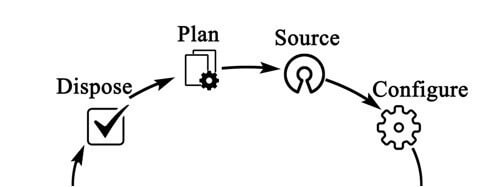
Diagram showing the Life Cycle Management Process, with 'Dispose', 'Plan', 'Source' and 'Configure' stages of the process shown as relevant icons and arrows showing the correct direction of each stage.

Hallmark #3 – They work in partnership to achieve a shared goal

Rather than a transactional customer-supplier relationship, the best LCM vendors take a collaborative approach that considers the entire project lifecycle. This way, your vendor can better spot time and cost-saving opportunities, and identify and mitigate risks before they impact your operations.

By treating an environment as an end-to-end ecosystem – including working effectively with all your relevant suppliers – your LCM vendor can decide on the best way to replace your infrastructure, while causing the least disruption.

It’s an approach that’s paid dividends for one of our Investment Banking clients. By providing a bridge between the bank’s IT engineers and its physical infrastructure suppliers, we were able to save them £100,000 just by swapping out a single component type.

Hallmark #4 – They focus on communication (but know when to take the initiative)

The biggest roadblock to effective project management is poor vendor communication with you and your suppliers, which can lead to longer project cycles and wasted resources.

It’s a simple concept, but one that far too many LCM vendors get wrong – especially in the Enterprise arena.

By choosing an LCM partner that focuses on multi-stakeholder communication, you can be safe in the knowledge that critical project decisions are being made based on accurate data and facts – supported by previous experience – and communicated to you in a way that keeps you in complete control.

On the flip side, your time is precious, and you don’t always want to be consulted at every stage. So, it’s also important that you trust that your partner has the skills, experience and confidence to make decisions on your behalf where appropriate, and only come to you when necessary.

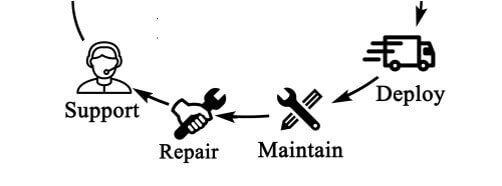
Diagram showing the stages of the Lifecycle Management Process, with the 'Deploy', 'Maintain', 'Repair' and 'Support' stages shown as relevant icons and arrows indicating the direction of each stage in the lifecycle process

Hallmark #5 – They have significant, demonstrable experience

The key attributes of a great LCM partner are nothing without the right experience. An experienced vendor will be familiar with your goals and able to see your project from a different perspective – offering valuable advice based on their past client successes.

Simply, experience is the driver that can save you time and money, and even help give your devices and infrastructure the longevity to stay reliable and secure well into the future.

LCM should be a partnership, not just a vendor relationship

Technical failure in financial services organisations is simply out of the question. So for many, it can be all too tempting to throw money and resources at a solution.

But the truth is, LCM requires a more nuanced approach, supported by open communication, end-to-end project management, and skilled IT engineers capable of making the right decisions – no matter the size or scope of the project.

At CACI, we pride ourselves on having the agility to help our clients react quickly, supported by the scale to reliably complete projects on time and within budget.

What’s more, our skilled project managers and engineers have decades of experience delivering LCM for some of the world’s biggest financial institutions, so you can be safe in the knowledge your needs are being taken care of.

To find out more about our collaborative approach to life cycle management, take a look at our network services capabilities.