Posts Ecosystem orchestration: Why fragmented platforms hold your organisation back

Ecosystem orchestration: Why fragmented platforms hold your organisation back

In this Article

“Our digital transformation is failing because it is fragmenting”. This was the defining statement from a recent roundtable with C-suite leaders from global enterprise organisations, met with nods and echoes of agreement across the room.  

Many of these leaders went through mergers and acquisitions, regional expansion and business proposition changes. The end result was the same: hundreds of disconnected tools and platforms, masses of digital sprawl, rising inefficiencies, disjointed customer experiences and a tangled web of overlapping technologies.  

If this sounds familiar, you are not alone. Over 40% of organisations now operate four or more separate systems, and while multiple platforms can signal maturity, the lack of integration between them often introduces operational friction—slowing delivery, increasing costs, limiting personalisation and constraining AI adoption.  

This is where ecosystem orchestration becomes strategically imperative in designing how your entire digital ecosystem works together. 

What is ecosystem orchestration?

Ecosystem orchestration is the discipline of designing, connecting and governing all digital platforms, experiences and data as a unified system rather than a disparate collection of isolated tools and journeys. It defines how these technologies should work together to deliver efficient operations, connected customer experiences and AI-ready foundations. 

For most organisations, this ecosystem spans experiences, content, data and their supporting platforms. 

Ecosystem orchestration focuses on: 

  • How data flows across your CRM, CDP, CMS, analytics and personalisation 
  • How experiences are assembled across channels, regions and brands to make them seamless 
  • How your platforms integrate, scale and evolve alongside your organisation  
  • How governance, security and performance are embedded by design. 

What is digital fragmentation? 

Fragmentation rarely appears as a single problem. Instead, it develops gradually as new platforms, regions and business needs are layered on existing digital estates. If one layer is weakened, it reduces the effectiveness of the entire structure and ultimately damages both your business outcomes and perceived value to your customers. This inefficiency prevents your organisation from reaching its potential.

Fragmentation tax: The unwanted cost of disconnected systems

When digital ecosystems grow without orchestration, the impact compounds over time. You may start to see: 

Operational inefficiencies rise 

When your teams jump between multiple systems, duplication and manual work skyrocket. Delivery slows and administrative load increases. 

Maintenance outweighing innovation 

Technology teams spend more time maintaining integrations, bug fixing and patching software than building new value-generating features. 

Data reporting inconsistencies

Inaccurate data creates reporting inconsistencies and data teams spend more time reconciling data than generating insights.  

Personalisation becoming impossible

Disconnected CMS, CRM and data platforms mean your organisation does not have a single customer view. This leads to segmentation being non-existent or superficial. 

AI-readiness severely constrained

AI requires unified data, modern architecture and consistent governance. Poor data hygiene and siloed insights create unstable foundations for predictive modelling and limit automation at scale. 

Brand and experience consistency breaking down

Multiple regions and brands lead to inconsistent UX, duplicated content and disconnected customer journeys. 

Costs quietly increasing

Duplicated platforms, unnecessary licences, security vulnerabilities and inefficient workflows inflate spend. 

Leadership is struggling to make data-driven decisions

Fragmented data erodes trust, making it harder for leaders to drive strategy or prove ROI. 

What ecosystem orchestration will enable

Fragmented digital estates can derail even the most ambitious digital transformation plans. Ecosystem orchestration is the solution to ensuring your business is future-ready, laying the foundation for scalable experiences, operational efficiency and AI-ready growth. 

If the challenges described here feel familiar—from disconnected journeys to rising operational effort—it may be time to reassess how your ecosystem is designed to work together.  Speak to our team about simplifying your digital ecosystem. 

Is your marketing platform still fit for purpose?

In this Article

Dissatisfaction with a marketing platform rarely arrives suddenly. It tends to build gradually through small frustrations, workarounds and compromises that feel manageable on their own, but increasingly costly when they accumulate. 

Enterprise marketing platforms have not necessarily become weaker. In many cases, they are more powerful than ever. What has changed is how you are expected to operate as a marketing leader:  the speed at which you must respond, the need for technology to directly translate into measurable outcomes and the pressure to do more with less. 

This shift has prompted many senior leaders to ask a different question. Instead of “Is our platform capable?” it has become “Is it still fit for how we need to operate today?”  

In this blog, we uncover the driving factors to that question, from cost and operational complexity to real-time capability and drag, and why many organisations are revisiting their platform architecture.

Why enterprise marketing platforms are being re-evaluated now

Several pressures are converging at once: customer expectations continue to rise, particularly around relevance, timing and the consistency of communications across channels. At the same time, teams are being asked to move faster, demonstrate clearer value and operate with leaner resources. Against this backdrop, platforms designed for a previous era of marketing are being stretched in new ways, particularly as you try to support real-time journeys, unified customer data and faster campaign development. Data ingestion is increasingly event- and profile-based, enabling real-time digital conversations. 

These tensions are most obviously felt during moments of operational change: renewal cycles, organisational shifts or attempts to introduce new real-time use cases. What may once have been accepted as the cost of scale can start to feel like complexity rather than capability. 

When cost becomes a strategic question

Rising costs are rarely the starting problem. The pressure tends to surface around licence renewals, expanding data volumes or the addition of new modules that promise incremental capability. Over time, the cost of operating and maintaining the platform can begin to grow faster than the value it delivers.  

Many enterprise marketing platforms were originally adopted on the promise of breadth, future-proofing and long-term stability. Licensing models expanded over time, new modules were introduced and capabilities were layered in to support growth. That made sense when scale and consolidation were the priority. Today, however, operations are expected to have faster cycles and leaner teams, where value is judged less by the number of features available and more by how quickly features translate into outcomes. You may still be using the platform extensively, but usage alone is no longer enough. 

The harder question is whether that usage is translating into impactful outcomes: faster speed to market, more relevant experiences and the ability to respond while customer intent is still live. When incremental gains demand disproportionate effort or when specialist skills and parallel tools are required to unlock value, cost pressure becomes a strategic signal rather than a purely financial one.

The hidden weight of operational complexity 

As platforms grow in scope, complexity often follows. What may have started as a powerful central system can become a heavyweight environment that requires specialist expertise to operate effectively. While advanced querying, scripting and complex journey logic offer flexibility, they can also introduce dependency and bottlenecks, particularly if your teams are expected to move quickly. 

This operational overhead rarely appears in executive reporting, but it is felt day to day. Longer lead times, reliance on a small group of experts and limited ability for marketers to test and iterate independently all begin to slow momentum. Over time, the platform can feel like something your teams work around rather than something that actively enables them. 

When ‘fast enough’ is no longer fast enough

Speed has always mattered in marketing, but the threshold for what is considered acceptable has changed. 

In an environment shaped by real-time signals and event-driven interactions, delays of hours or even minutes can mean missed opportunities. Despite this, many marketing environments still rely heavily on batch processing, scheduled workflows and manual handovers between systems. 

When insight takes too long to become action, you are pushed into more reactive ways of working. Campaigns must be planned further in advance, personalisation lags behind behaviour and responsiveness becomes constrained by technology rather than strategy. 

Data fragmentation and orchestration limits

As your digital estate expands, data rarely lives in one place. Transactional systems, analytics platforms and engagement tools all play a role, but unifying them cleanly remains challenging. 

Many marketing platforms were never designed to act as the primary data layer. As a result, you may rely on connectors, middleware or separate data foundations to bridge the gaps. While workable, these approaches often introduce latency, instability and added complexity, particularly at scale. 

The impact is most visible in orchestration. When data is fragmented, journeys tend to become channel-led rather than customer-led, limiting your ability to deliver coherent experiences across touchpoints.

When friction becomes systemic 

Individually, none of these challenges are unusual. What matters is when they coexist. 

Cost pressure, operational complexity, slow execution and fragmented data tend to reinforce one another. As environments become harder to manage, extracting value becomes more difficult. As value becomes harder to demonstrate, scrutiny increases. Over time, you may find your teams becoming less able and less willing to push the platform in new directions. 

This is often the point at which conversations shift from optimisation to re-evaluation. 

A changing view of platform architecture

In response, many organisations are reassessing the role their marketing platform plays within the wider ecosystem. Rather than expecting a single system to do everything, there is growing interest in more modular, composable approaches that separate data, decisioning, orchestration and activation. 

This shift is not about chasing trends. It reflects a desire to align technology more closely with how you currently operate and how you expect to evolve over time. 

How CACI can help you optimise your marketing platform

The most productive platform conversations do not start with vendors or features. They start with clarity. 

If you are questioning whether your current platform still supports how your teams work, it may be time for a more structured conversation about fit, value and operational friction. 

To support this, we have created a short Marketing Platform Health Check to help you sense-check whether your current setup still fits how you operate today. It highlights common friction points and provides a structured way to assess where further investigation may be valuable.

What is Model Based Systems Engineering (MBSE)? A practical explainer for modern engineering

What is Model Based Systems Engineering (MBSE)? A practical explainer for modern engineering 

Engineering domains like defence, automotive, manufacturing and critical infrastructure have always dealt with complexity. But today that reality is compounded by volatility. One seemingly small change can ripple across an entire architecture: a single component going end of life forces updates to requirements, interfaces and test plans or single regulatory change means revisiting assumptions and evidence across multiple teams.  

Traditional, document heavy engineering methods simply weren’t designed for this pace, scale and level of interdependence. Big static specifications, linear stage gated processes and manual drafting and review cycles are slow, siloed and paperwork driven; they just can’t keep up with environments that depend on fast iteration, shared data, and real-time collaboration. 

Model Based Systems Engineering (MBSE) offers a more coherent way forward. It makes models, rather than documents, the primary way of understanding how a system is put together and how it behaves under change. And while it’s often discussed in abstract terms, its value is practical: clearer decisions, fewer surprises and systems that can evolve with the world around them. 

Understanding Model Based Systems Engineering 

Traditional systems engineering spreads knowledge across separate artefacts: requirements lists, design specifications, interface control documents, test plans and more. Each serves a real purpose, but together they create a fragmented picture that engineers must mentally stitch together. 

MBSE brings this information into a single system model. Instead of navigating isolated, and typically manual, documents, engineers work with a visual, traceable representation of requirements, behaviours, structures and constraints across the system’s lifecycle: from concept and design through to operation and decommissioning. 

This connected view enables teams to: 

  • Simulate and validate designs before physical implementation 
  • Understand the implications of a change across the whole system or system-of-systems 
  • Maintain traceability between requirements, design and testing as the system evolves 
  • Accommodate iterative and Agile delivery without losing architectural coherence 
  • Establish a strong foundation for digital twins and digital continuity 

In short, MBSE replaces a fragmented understanding with a coherent one. By shifting the focus from assembling information to analysing the system as a dynamic whole, it makes decisions clearer and enables swifter action. 

MBSE vs. Enterprise Architecture – what’s the difference? 

As an approach, MBSE is often mentioned alongside or confused with Enterprise Architecture (EA) because both use models to bring structure to a changing, interconnected world. They sit on a continuum, but they don’t do the same job. 

Enterprise Architecture works at the organisational level, the so-called ‘30,000ft view’. It defines the capabilities the business needs, the processes that support them, the information that flows between them and the technology principles that keep everything aligned. EA sets the strategic intent and the architectural constraints within which engineered systems must operate. 

Model Based Systems Engineering works at the system level and, critically, does so visually. It uses graphical models to capture requirements, behaviour, structure and constraints so engineers can see how a system works, how its parts interact and how changes flow across the architecture. MBSE can represent a single engineered system or a “system of systems”, depending on the scale of the environment.  

In plain engineering terms: 

  • EA defines the environment: capabilities, context, constraints.
  • MBSE defines the system: behaviour, architecture, verification.

EA sets the intent; MBSE delivers the model‑based technical design that realises that intent. So, even when a “system of systems” MBSE model approaches EA in scope, it’s still serving a different purpose. Both disciplines tackle the same operational pressures but address them from different vantage points. 

Model Based Systems Engineering in practice 

In practice, MBSE means working from a dynamic system model that brings together the elements that matter most in complex engineering environments. Typically visualised in a dashboard, it provides a traceable, queryable representation of the system as a single point of truth, containing: 

  • Requirements
  • Behaviours and interactions
  • System structure and architecture
  • Constraints and dependencies
  • Lifecycle considerations from concept to decommissioning

The shift from documents to models isn’t cosmetic. Documents age; models evolve. Documents sit in silos; models connect disciplines. Documents tell you what the system was; models show you what the system is — and what it could be as it adapts to new constraints, technologies or missions. 

Most organisations use modelling languages such as SysML and tools like Cameo, Rhapsody or Enterprise Architect. SysML remains the most widely used, giving teams a standardised way to express structure, behaviour and constraints across complex systems. But the tools are only the enablers. The real value lies in the clarity, consistency and shared understanding that modelling brings. 

The operational benefits – why MBSE matters in modern engineering

 MBSE gives teams a coherent view of how a system behaves and how change in one area affects others and, fundamentally, a more honest representation of how systems behave in the real world. That shift enables: 

  • Earlier validation and simulation
  • Clearer communication across disciplines
  • Faster impact analysis
  • Stronger traceability between requirements, design and testing
  • Enhanced collaboration across teams and suppliers
  • Scalability for managing large, multicomponent or “system of systems” architectures

This is why MBSE has become particularly relevant in sectors where systems are large, long-lived and safety or mission critical.  

In defence and aerospace, it supports mission level traceability, interoperability across suppliers and stronger evidence for certification. In automotive, it helps integrate mechanical, electrical and software design in increasingly software defined vehicles. And in digital and critical infrastructure, it provides a way to map dependencies, model resilience and design for long-term adaptability. The common theme being MBSE provides the clarity needed to make confident decisions. 

What good MBSE delivery looks like in practice 

Successful MBSE programmes have less to do with tools and more to do with delivery behaviours. The organisations that get the most value tend to share a few consistent patterns: 

  • Models are treated as living artefacts. They evolve as understanding deepens, rather than being produced once and filed away. 
  • Iteration is normal. Teams model early, test assumptions quickly and refine as they learn, instead of waiting for a single ‘big reveal’. 
  • Commercial and governance frameworks allow change. MBSE only works when contracts, schedules and decision gates accept that things will evolve. 
  • Practitioners lead the work. Systems engineers, architects and domain specialists shape the model, ensuring it reflects real world behaviour rather than abstract theory. 
  • Collaboration is built in. Modelling becomes a shared activity across disciplines, not something done in isolation by a single specialist. 

These principles also shape how CACI deliver MBSE.  

Our teams work iteratively, use models to drive shared understanding and keep architectures traceable as requirements evolve. We focus on the behaviours that make MBSE effective, clarity, adaptability and practitioner led modelling – because these consistently help programmes navigate complexity and make better decisions. 

Why MBSE is becoming essential 

 Recent research finds the number and intensity of system level dependencies is rising across every major engineering domain, increasing the likelihood that local failures propagate far beyond their point of origin. The PanIberian blackout in April 2025 made this clear: the energy disturbance cascaded across two national grids, disrupting transport, healthcare and communications within minutes.  

In this context, MBSE becomes a core competency rather than a niche specialism. But its value depends on how it is delivered, and by who.  

A strong MBSE approach provides clarity, traceability and better decisions. It reduces risk. It helps engineering systems evolve with the environment. And in sectors where the stakes are high like defence, automotive, aerospace and critical infrastructure, that combination is not optional, it’s foundational — and increasingly essential if organisations are to stay ahead of the rising fragility built into the systems they depend on. 

To find out how CACI can help your organisation build the resilience needed to operate effectively in an increasingly volatile, interconnected engineering environment, get in touch with our experts today. 

FAQs about Model Based Systems Engineering (MBSE)

What does “model-based” actually mean in Model Based Systems Engineering (MBSE)?

In Model Based Systems Engineering (MBSE), “model-based” means that system information is stored in a structured, machine-readable model rather than free-text documents. This allows relationships, dependencies and constraints to be queried, analysed and validated automatically instead of being inferred manually.

Is Model Based Systems Engineering only suitable for large or complex systems?

No. While MBSE is most visible in large, complex programmes, it can also be valuable for smaller systems where change is frequent or assurance requirements are high. Even lightweight models can reduce ambiguity, improve communication and prevent rework as designs evolve.

How does MBSE support verification and validation activities?

MBSE enables verification and validation by explicitly linking system behaviours and constraints to verification criteria within the model. This allows teams to assess test coverage, identify gaps early and maintain alignment between design intent and evidence as the system changes.

What skills are required to work effectively with Model Based Systems Engineering?

Effective MBSE requires a combination of systems thinking, domain expertise and modelling literacy. While familiarity with languages such as SysML is useful, the most important skills are the ability to reason about system behaviour, understand trade-offs and communicate across disciplines using models as a shared reference.

How does Model Based Systems Engineering improve decision-making?

MBSE improves decision-making by making assumptions, dependencies and impacts explicit. Engineers and stakeholders can explore “what-if” scenarios, assess trade-offs and understand consequences before changes are committed, reducing the risk of late-stage surprises.

Can Model Based Systems Engineering be applied to legacy systems?

Yes. MBSE can be introduced incrementally to legacy environments by modelling critical parts of an existing system rather than attempting a full re-engineering effort. This approach helps organisations gain insight into dependencies, constraints and risks without disrupting ongoing operations.

How does MBSE fit with safety, regulatory and assurance frameworks?

MBSE supports safety and regulatory assurance by providing a structured way to demonstrate traceability from requirements through design to verification evidence. This can simplify audits, improve confidence in compliance claims and reduce the effort required to respond to regulatory change.

What are common misconceptions about Model Based Systems Engineering?

A common misconception is that MBSE is primarily a tooling or documentation exercise. In practice, its effectiveness depends on how models are used to support collaboration, learning and decision-making — not on the level of detail or the sophistication of the tools alone. 

How to strengthen your network security posture

In this Article

When it comes to strengthening your network security posture, doing so is no longer a nice-to-have, but a strategic necessity. The notion of strengthening your network may sound time-intensive and lengthy, however, there are some immediate changes that can lead to quick wins. In this blog, we uncover four key steps IT leaders can take to strengthen network security posture and immediate quick wins that can be achieved upon doing so.  

Four steps to strengthen your network security posture

Security is no longer optional. These four foundational actions will help you reduce risk and build resilience: 

1. Adopt zero trust principles

Zero trust means “never trust, always verify.” Every user and device inside or outside the network must be authenticated and authorised. This approach limits the impact of breaches and is now recommended by the NCSC and leading global providers.  

  • Implement strong authentication for all users and devices.  
  • Segment networks to limit lateral movement.  
  • Continuously monitor for unusual behaviour.  

2. Automate detection and response

Manual processes cannot keep pace with modern threats. Automation can reduce response times by up to 40%, demonstrating its ability to help defenders stay ahead. 

  • Use AI-driven tools for threat detection and alert triage.  
  • Automate patching, backup, and incident response workflows.

  • Regularly test and updated automated playbooks.

3. Operational load

With many IT teams stretched thin, managed network services allow organisations to focus on strategy while experts handle day-to-day operations, monitoring and compliance. 

  • Consider managed firewall, detection and response and vulnerability management services.  
  • Ensure providers offer transparent reporting and clear SLAs.

4. Secure hybrid work

With two-thirds of UK employees working remotely at least part-time, endpoint protection and secure remote access are essential.  

  • Enforce multi-factor authentication for all remote access.  
  • Protect endpoints with up-to-date security software and policies.
  • Educate staff on secure working practices. 

Quick wins: Immediate actions UK IT leaders should take 

Not every improvement requires a major investment or a long-term project. The following actions can quickly reduce risk and strengthen your security posture:  

Enable multi-factor authentication (MFA) 

Multi-factor authentication (MFA) is one of the most effective ways to prevent account compromise, blocking the majority of phishing and credential stuffing attacks.  

  • Enforce MFA for all users, not just administrators.  
  • Use app-based or hardware tokens for stronger protection. 
  • Regularly review and test MFA coverage.  

Read NCSC guidance on MFA  

Patch the basics consistently and quickly

Most breaches exploit known vulnerabilities. Even delays in patching of a few days can be costly.  

  • Maintain an up-to-date inventory of all assets, including cloud workloads and remote endpoints. 
  • Apply critical patches within 14 days, as recommended by the NCSC.  
  •  Automate patch deployment and monitor for failures.  

Back up critical data securely and test your restores

Ransomware is only effective if you cannot recover your data. Secure, tested backups are essential.  

  • Use immutable, offsite or cloud-based backups.  
  • Regularly test restores to ensure data integrity.  
  • Protect backup credentials with MFA and restrict access.

Review firewall rules and access controls

Firewall policies can become cluttered over time with unused or overly permissive rules, creating hidden vulnerabilities.  

  • Schedule regular firewall reviews to remove unused or risky rules.  
  • Align policies with current business needs.  
  • Use automated tools to analyse policies for overlaps and compliance gaps.   

Run a tabletop incident response exercise 

Plans are only effective if teams can execute them under pressure. Tabletop exercises simulate real-world incidents, allowing teams to rehearse roles and identify gaps.  

  • Involve both technical and business stakeholders.  
  • Use realistic scenarios tailored to your organisation.
  • Capture lessons learned and update your incident response plan.  

See NCSC’s guidance on incident response exercises 

How CACI can help enhance your network security

CACI has helped UK businesses protect their networks for decades. From network security to data centre solutions and IT consulting, our expertise delivers secure-by-design architectures, automation, and incident readiness for robust network security.  

Download our 2026 Network Security Survival Guide today to learn more about how your organisation can set its network environments up for success. 

From Static Predictions to Intelligent Automation: An MLOps Transformation by CACI and Snowflake

A leading media company* operating multiple radio brands had successfully deployed Machine Learning (ML) models to optimise ad selection and predict customer churn. Run on scheduled batch processes producing static outputs, the LM models were manually monitored and maintained. As the models became more business-critical, the client wanted to move from time-intensive manual oversight to a more automated, scalable approach for managing and retraining them.

Leveraging the client’s existing use of the data platform Snowflake, CACI designed a Machine Learning Ops (MLOps) architecture that enables continuous ML improvement through automated testing, version control, and human-gated deployment workflows. Delivered as a scalable blueprint, the solution is being trialled on the ad optimisation model as a proof of concept, with the potential to be applied across the client’s wider ML estate.

Industry

Media & publishing

Partner

Snowflake

Challenge

While the client’s ML models delivered value initially, scaling, reliably maintaining and improving them became increasingly complex. The in-house team had the technical capability but not the operational headroom to design a solution and faced issues that collectively slowed innovation, increased operational costs, exposed the business to risk and limited the company’s ability to respond to fast-changing business needs.

Icon - Stop sign

Lack of observability

No real-time visibility into model performance or data quality, meant the team couldn’t detect issues early and struggled to answer fundamental questions like “Is our model still working correctly?” or “Has our data changed significantly?”, creating uncertainty.

Icon - Illustrative charts and graphs

Infrastructure scalability constraints

On-premises virtual machines struggled under growing workloads, causing regular failures and downtime. The team required reliable, scalable hosting infrastructure that could provide them with autonomy over its deployment.

Icon - Left and right arrows intertwined

Manual deployment risks

Data scientists developed improved model versions but deploying them to production was high-risk in the absence of systematic testing or comparison frameworks. Each update felt like a leap of faith.

Icon - Cog with person outline and upwards arrow

Inflexible batch processing

Scheduled batch jobs could not meet urgent business needs, such as real-time campaign optimisation or reacting to breaking news events.

Icon - Folders with a magnifying glass

No testing framework

Without automated quality assurance, silent data drift and undetected model degradation posed serious risks to business outcomes.

Solution

To address this, the client engaged CACI to design a MLOps (Machine Learning Operations) architectural blueprint – a structured framework of practices and tools to automate and streamline ML workflows – and support a proof-of-concept (POC).

Working closely with the in-house data science team, CACI mapped operational requirements, tested theories and validated approaches. The result: a robust MLOps architecture built on four core pillars:

  • Observation – Four-tier monitoring for data quality, performance, drift, and infrastructure health. Threshold-based alerts linked to business KPIs trigger proactive responses like investigation, enhanced monitoring, or retraining.
  • Reproducibility – Full version control across datasets, features, models, and configurations. Each model traceable to its training data and transformations, enabling fast troubleshooting and clear audit trails.
  • Automation with oversight – CI/CD pipelines standardise testing, deployment, and model serving. Quality gates enforce performance thresholds, APIs enable real-time predictions, and monitoring informs retraining – while humans make the final call.
  • Continuity – Challenger model versions run in parallel using shadow scoring, A/B testing, or seasonal rotation. A centralised serving layer manages selection, logging, and complexity, allowing better models to be adopted without disrupting stability.

Designed on the client’s Snowflake data platform, the blueprint leverages our strategic dataTech and cloud partnership. It powers data ingestion, feature engineering, versioning, model serving, and observability.

A central metadata store governs configurations and guardrails, with automated checks at every stage. Models are validated and served on-demand or scheduled, with outputs logged to downstream systems. Snowflake’s native monitoring tracks freshness, validity, and custom rules – establishing a pathway to scalable, governed automation.

Results

The client is now using the MLOps blueprint to implement the proof of concept on their ad-serving model, with the intention to scale the approach across their wider ML estate. Early feedback shows the in-house team confident the design will reduce manual effort, improve reliability, and accelerate innovation.

The blueprint provides a clear automation framework to move from reactive model maintenance to proactive, evidence-based improvement – allowing them to test and deploy improved models with faster-time to value, greater confidence and less risk.

Real-time model serving – previously out of reach due to infrastructure and process constraints – is now within reach. The challenger model framework enabling safe experimentation, while the metadata-driven design ensures flexibility as business needs evolve: all with improved auditability and compliance via full traceability.

Crucially, the architecture supports trust-building: alerts and retraining triggers are reviewed by humans before any automated action is taken. Over time, as confidence grows, the client can choose to enable full automation on their own terms.

The blueprint not just enables a powerful technical upgrade from a mostly manual ML implementation, but also the strategic and operational step change needed to move from: “Is our model working?” to “How can we make our models work even better?” A mindset shift laying the foundation for scalable, future-ready ML deployment can deliver business value over time.

*This case study describes a proof-of-concept architecture design and implementation support engagement. The client organisation is not identified to maintain confidentiality.

Cloud innovation trends: Why optimisation must come first

In this Article

Cloud innovation trends: Why optimisation must come first

In the race to modernise, many businesses make a critical mistake: innovating before optimising their cloud infrastructure. It’s an easy trap to fall into – new technologies promise speed, agility and competitive advantage. However, without a solid foundation, those promises can quickly unravel.

So, what difference will optimisation make to cloud innovation? How do complex hybrid environments affect optimisation and what are the repercussions of innovating too soon?

Why optimisation should come first

Cloud optimisation isn’t just a technical exercise – it’s a strategic imperative. Before you invest in AI-driven tools, advanced analytics or multi-cloud deployments, you need to ensure your existing environment is efficient, secure and cost-effective. Otherwise, innovation becomes a gamble rather than a growth driver.

How the complexity of hybrid environments affects optimisation

Modern IT landscapes are rarely simple. Most organisations operate in hybrid environments, combining:

  • Cloud-native workloads
  • Semi-native applications
  • Containerised services
  • Legacy systems migrated via IaaS.

This mix introduces complexity that can quietly erode ROI and performance. Without optimisation, you risk inefficiencies that undermine every future initiative.

Common pitfalls of innovating too soon

When businesses rush to innovate without first optimising, they often encounter:

Duplicated workloads

Hybrid setups frequently lead to duplication of environments or services, especially when containerised and legacy systems overlap with cloud-native tools. This consumes bandwidth and burdens IT and DevOps teams with managing multiple versions of the same workload.

Latency issues

Poor workload distribution across cloud environments increases latency, slowing response times and masking compliance or security issues. For customer-facing applications, this can directly impact user experience and brand reputation.

Security saps

Unoptimised containerised and legacy workloads are vulnerable to governance and compliance risks. Differences in data storage and flow between environments complicate tracking, while unresolved legacy issues can carry over post-migration.

Mounting costs

With up to 30% of cloud spend wasted, inefficiencies inflate monitoring and security costs, draining budgets that could fund innovation.

Why this matters now

Cloud strategies are under pressure to deliver more – faster, cheaper and greener. Without optimisation, businesses risk inefficiency, higher costs and vulnerabilities that stall progress. In an industry where every second counts, building on shaky ground isn’t just risky, it’s expensive.

How to get started

Before chasing the next big trend in cloud innovation, take time to:

  • Audit your current architecture: Maintain visibility by understand what’s running, where and why.
  • Identify duplicated workloads and inefficiencies: Determine whether any services or resources are the cause behind draining budgets.
  • Align resources with business priorities: Ensure any spending on cloud innovation drives value for the business.
  • Implement governance and security best practices: Establishing best practices early on will ensure that innovation is scaled effectively.

This foundation ensures innovation is sustainable, not just a short-term fix.

The CACI approach: Building a cloud that enables innovation

Ready to build a cloud foundation that enables innovation?

Don’t leave your cloud strategy to chance. Our specialist cloud architects and optimisation experts have helped leading organisations modernise, streamline and unlock innovation without compromise. Contact us today to start your cloud optimisation journey.

Case study

How CACI helped Network Rail develop & manage an open data service

Summary

National Rail Open Data (NROD) provides the public with access to a large number of operational data feeds to encourage both greater interest in rail and the development of innovative products that are of use to passengers and the rail industry. CACI processes and manages the NROD platform with the aim of providing continual and easy access to users.

Company size

42,000

Industry

Transport

Products used

Challenge

Network Rail provides a variety of data in different formats from XML, JSON and rail proprietary data structures. These are received with varying levels of frequency from static data to real-time data updated at up to 100 messages per second during peak hours. Our instruction from Network Rail was for the data to be made available with no obfuscation or filtering applied to make it as accessible and easy to use as possible.

Icon - Magnifying glass showing a warning symbol

Varied data formats

Icon - Illustrative workflow

Inconsistent frequency

Icon - Hands holding a heart

Need accessibility

Solution

To achieve this, we offered options for users by providing some conversions (such as to JSON) and enriching data with metadata. We also used AWS infrastructure and highly available components like AWS ECS (Elastic Compute Service) and S3 (Simple Storage Service) to improve access and availability.

Users were provided a portal for account management, allowing them to change details such as their username and password and access links to documentation and endpoint information for the data to aid their use and interpretation. A separate portal manages access for industry clients invited by Network Rail, allowing them to connect to a more stable platform for use in industry applications.

Results

NROD is now used by an engaged, passionate community of over 600 registered users who apply the data in a variety of ways. Since the data was first made available, a range of websites and apps have been created, including Open Train Times, which provides real-time arrival and departure information for each train company and helps passengers plan their journeys, along with Recent Train Times, demonstrating individual trains’ performance and helping users assess the punctuality of different train services to plan their journeys accordingly.

CACI has been collaborating with industry clients and representatives of the broader public client community in a working group to give updates and receive feedback on how best the community can be served. We also discuss enhancements and how to collaborate to address users’ needs at quarterly meetings.

A Grafana dashboard has been developed to keep users informed on the system’s status, including message rates, message latency of the main feeds and an update field showing system downtime updates.

To ensure NROD is accessible to as many audiences as possible, we have worked with Network Rail to provide the same data within the Rail Data Marketplace (RDM), adding to the 100+ other rail data products now available on this platform.

Case study

HMCTS Court Store and Bench Moves to AWS

Summary

The HMCTS Court Store and Bench applications have historically been hosted on the UKCloud’s elevated platform, managed and supported by CACI. In 2021 however, the decision was taken to move the hosting of these projects onto the
AWS platform, with ongoing support in the new environment. CACI was tasked with ensuring the move was achieved in as short a time frame as possible whilst observing the highest level of security.

Company size

18,500

Industry

Government

Challenge

Due to the complexity of the UKCloud solution and application software stack, we decided to migrate the solution in its existing state from UKCloud to AWS. The environments consisted of four AWS accounts and eight Virtual Private Cloud environments. The approach was to split the project into two stages.

In view of the tight timescales, the order of this migration was to first focus on production, with the pre-production environment to be established after go-live. This order was acknowledged by all parties that whilst being far from ideal, there was no alternative. One of the biggest challenges was the volume of data to be migrated from one cloud provider to the other: in excess of 20Tb.

Icon - A hand holding a cog

Stage one environments

Production, sandbox and performance

Icon - Illustrative cog

Stage two environments

Pre-production

Solution

The migration project consisted of several phases:

  • Provisioning a base AWS Infrastructure and protective monitoring setup
  • Export of Virtual Machines in UKCloud and import into AWS as AMIs
  • Provisioning/cloning of AMIs
  • Re-configuration of the application stack, on-VM protective monitoring/backups and internal operability testing
  • Intersystem Connectivity and Operation, Connectivity Testing
  • Configuration of G-Suite and novation of domain from MoJ to CACI
  • End-user testing
  • IT Health Check
  • Operational Readiness Testing
  • Data Migration

CACI’s role was as follows:

  • Solution design
  • Migration plan
  • Infrastructure and protective monitoring
  • Import of Virtual Machine images and data transfer
  • Testing: OAT, ITHC
  • Cutover
  • Overall project management, including other parties: SopraSteria, HMCTS and other MoJ departments

Results

HMCTS can now continue to run its Court Store and Bench operations in the knowledge there is little likelihood of a breakdown in service.

Based on CACI’s experience of migrating similar workloads, this move to AWS also achieved other improvements such as:

  • Use of infrastructure as code: better change management, less human error, increase of delivery quality and reduction in build time
  • Use of AWS security services to increase view of security posture and simplify implementation of some security controls (e.g. encryption, identity and access management)

Other highlights:

  • Completed the project two months ahead of time
  • Ongoing data storage cost savings are in the region of 65%
Two colleagues working together with a bright blue cloud representing the digital cloud in front of them

From chaos to clarity: how to fix poorly organised data and unlock insight

In this Article

In today’s digital-first world, organisations are sitting on mountains of data — but what happens when that data is poorly organised? 

Across industries, we regularly see brands struggling with data that is fragmented, duplicated, inconsistent or stored in disconnected silos. Instead of unlocking valuable insights, teams find themselves lost in a maze of spreadsheets, dashboards and conflicting reports.

The result? A dataset that’s hard to use, impossible to interpret and offers little value to the business. 

The challenge: data without direction 

One of the most common challenges we uncover in our Digital Analytics work is disorganised data. Whether it stems from legacy systems, ungoverned tracking implementations, or unclear data ownership, the impact is always the same: 

  • Time wasted trying to piece together insights 
  • Poor decision-making based on unreliable or incomplete data 
  • Low confidence across teams in the outputs of digital reporting 
  • Missed opportunities to personalise experiences and optimise performance 

The irony is that most brands already have access to the data they need — they just can’t make sense of it. 

Build a data foundation that drives growth 

Modern marketing ecosystems generate data across dozens of platforms — web analytics, CRM, media, social, app, customer service and more. Without a clear data strategy and strong governance, it’s easy for chaos to take root. 

What starts as a few inconsistent naming conventions in your analytics platform quickly evolves into larger problems: 

  • Metrics that don’t align across teams 
  • Broken tracking disrupting customer journey analysis 
  • Difficulties with attribution and ROI measurement 
  • Paralysis when trying to prioritise digital investments 

The truth is, data disorder doesn’t just affect your analysts — it affects leadership decision-making, marketing effectiveness, and ultimately, the customer experience. 

How CACI brings clarity to digital data 

At CACI, we specialise in bringing structure, clarity and control to digital data ecosystems. Our Digital Analytics consultants work with brands to audit their current set-up, streamline tracking implementation, and align measurement frameworks to real business goals. 

Our proven approach: 

  • Uncovers data issues at source, not just the symptoms 
  • Builds a trusted foundation for consistent, accurate insight 
  • Enables cross-channel visibility with a single source of truth 
  • Empowers teams with dashboards and tools they can trust and use 

We go beyond just fixing the data — we design ecosystems that scale with your business, support smarter decisions, and create a foundation for advanced analytics, personalisation and experimentation. 

Take control of your digital data 

If your organisation is struggling with messy, misaligned or underperforming data, it’s time to take back control. Poorly organised data isn’t just a technical issue — it’s a barrier to growth. 

Let’s turn your data into a strategic asset. 

Use our Digital Analytics Self-Assessment Checklist to evaluate your current capabilities and uncover opportunities for growth. It’s a practical first step toward unlocking the full potential of your digital strategy.

How CACI equipped a luxury vehicle manufacturer with bespoke CRM solutions via Microsoft Dynamics

In this Article

As a trusted partner for organisations seeking to implement and evolve complex, bespoke CRM solutions using Microsoft Dynamics, CACI’s work with a luxury vehicle manufacturer conglomerate over the past decade has exemplified our ability to deliver high-impact, continuously evolving platforms that support critical functions.

In this blog, we’ll uncover the challenges that this manufacturer faced in the absence of a bespoke CRM solution and the benefits they’ve been able to realise once integrating this new solution with CACI’s support.  

Understanding the power of CRM solutions

The luxury vehicle manufacturer’s Key Account Management team is responsible for managing fleet sales, accounting for approximately 40% of their global vehicle sales, equating to billions of euros annually. Fleet sales involve a highly complex and customisable product (vehicles) sold under constantly shifting market conditions, regulatory environments and customer-specific pricing structures. With this in mind, the manufacturer needed a CRM solution that could: 

  • Handle intricate pricing logic and discount structures 
  • Integrate with multiple internal and external data sources 
  • Adapt rapidly to changes in product offerings, market conditions and geographies 
  • Scale across brands and European markets 
  • Provide a single source of truth for pricing and account management. 

The difference CRM solutions would make 

To achieve this, CACI built and continues to maintain a bespoke pricing and account management tool on Microsoft Dynamics Customer Experience (CE). This solution includes: 

  • Custom APIs and integrations with the manufacturer’s internal systems and external data feeds 
  • Bespoke code to support complex pricing logic and real-time quote generation 
  • Advanced data management to consolidate and process information from diverse sources 
  • Continuous customisation and improvement, ensuring the platform evolves with the manufacturer’s needs 
  • Migration to Microsoft Azure, modernising the infrastructure for scalability and performance. 

In doing so, the manufacturer has enhanced: 

  • Speed and accuracy: The tool enables the generation of accurate, real-time pricing for complex fleet deals, reducing turnaround time and improving customer satisfaction 
  • Revenue protection: By ensuring pricing precision and agility, they maintain a competitive edge against industry rivals 
  • Scalability: The platform has been successfully rolled out across multiple European markets and adapted for use with other brands 
  • Strategic partnership: CACI’s decade-long collaboration with this manufacturer reflects a deep understanding of their business and a shared commitment to innovation. 

Why this matters to other organisations & how CACI can help 

CACI’s Microsoft Dynamics capability is ideally suited for organisations that: 

  • Sell complex, customisable products (e.g. in automotive, logistics, FMCG or retail) 
  • Operate in dynamic markets with evolving pricing, regulatory or customer requirements 
  • Require deep integration with existing systems and data sources 
  • Need a continuously evolving CRM platform rather than a static, off-the-shelf solution. 

While CACI’s expertise is strongest in the Customer Experience module, we also support other Dynamics modules (excluding Finance, which typically requires accounting SMEs). Our strength lies in delivering bespoke, high-performance solutions that go far beyond basic configuration, leveraging our back-end development expertise in .NET, Java, and Azure to build platforms that drive real business value. 

If your organisation is grappling with complex sales processes, diverse customer needs or fragmented data systems, CACI’s approach to Microsoft Dynamics could be the transformative solution you need. Our work with this luxury vehicle manufacturer demonstrates how a tailored, continuously evolving CRM platform can become a strategic asset, driving revenue, efficiency and competitive advantage. 

Get in touch with our expert team at CACI to explore how a bespoke solution can drive efficiency, scalability and competitive advantage for your organisation.

Multi-touch attribution (MTA) vs marketing mix modelling (MMM)

In this Article

What is Marketing Mix Modelling (MMM)?

Marketing mix modelling (MMM) is a statistical tool that helps organisations understand and quantify the impact of marketing activities on consumers’ behaviours, sales, return on investment (ROI) and more. It breaks down an organisation’s performance by channel, incorporating various types of data to evaluate effectiveness and determine which marketing activities are most heavily influencing the organisation’s business outcomes, which we explore further in our blog on marketing mix modelling.  

Based on a series of steps, MMM begins with data collection of marketing variables, followed by an analysis of the data collected to identify relationships or patterns and building a customised model to showcase actions and results. Finally, scenario testing can be conducted to gauge possible outcomes, leveraging the results to optimise marketing strategies and bolster decision-making. 

What is multi-touch attribution (MTA)?

Multi-touch attribution values each customer touchpoint leading to conversion, with its goal being to decipher the marketing channels or campaigns that should be credited with the conversion. The intention of this is to measure the effectiveness of each channel or touchpoint so that marketers are aware of where they should focus efforts and resources and allocate future spend in the most effective ways possible to enhance customer acquisition efforts.  

Through multi-touch attribution, a more comprehensive view into customer journeys can be gained, enabling organisations to create better strategies or optimise their ad spend in line with market shifts. The ability to see how each touchpoint impacts a sale is what allows organisations to dissect customer journeys and allocate budgets accordingly.

What are the differences between multi-touch attribution (MTA) vs marketing mix modelling (MMM)?

Aggregated versus disaggregated data

Aggregated data is statistical data used in MMM that is grouped into channels, regions or times to assess trends in terms of how channels contribute to sales. Disaggregated data, on the other hand, is behavioural data that is used in MTA to gain the most detailed insights possible at user or individual level.  

Organisations require aggregate information for visibility into external trends that may be affecting marketing efforts and conversions. In comparison, the precise level of detail available through disaggregated data is critical in MTA as it is required for assigning multiple touchpoints within a customer journey.

Objective and impact assessment

MTA uses trackable customer interactions to understand the importance of each touchpoint. As a result, one of the most substantial differences between these two is their objective. MTA focuses on the impact of specific, individual touch points and their sale or conversions impact, whereas MMM focuses on the overall impact of your marketing mix and how that combination influences sales or other outcomes.

Choosing the right approach for your company

MMM’s main goal is to help organisations deduce overall business outcomes and MTA helps organisations understand the contributions of individual touchpoints to conversions or actions. MMM includes both online and offline channels, whereas MTA only includes digital channels that track individual user behaviours. 

While MTA may not be easy to implement due to ever-changing customer journeys paired with uniting all touchpoints across various devices, channels and platforms, it does enable flexibility and offers a more granular understanding of what does and does not work within marketing initiatives. This flexibility and granularity equips organisations with insights that allow for informed, data-driven decision-making for digital marketing campaigns.

When to use multi-touch attribution modelling (MTA)

Multi-touch attribution has become a staple for organisations requiring tactical insights and are focused on short-term optimisation by measuring and quantifying the impact that their digital marketing campaigns are having. The visibility that multi-touch attribution modelling provides into the success of touchpoints across a customer’s journey is unparalleled. #

This insight is critical for organisations to consider amidst consumers’ increasing wariness of marketing messaging. Through this, the right audiences and their respective marketing preferences can be identified across channels, enabling customised messaging to be created and the right consumers on the right channels at the right times to be reached. 

Maximising ROI can also be made possible through multi-attribution modelling by engaging with consumers in fewer though more frequent and impactful marketing messages that ultimately shorten sales cycles. 

When to use marketing mix modelling (MMM)

Marketing mix modelling should be used when needing to understand the combined impact of advertising spending, promotions, pricing and distribution channels. It can be particularly impactful for organisations that are well-established and have a plethora of data over the course of many years to work with.

From media activities to external variables including macroeconomic factors and competitors’ activities and internal variables like product distribution, product changes and price changes, countless categories can be monitored for organisations to analyse data and understand the relationship between sales and these elements. Its [immunity to the everchanging privacy landscape] is also a key advantage.

How to use both approaches together

Both MTA and marketing mix modelling MMM are key approaches in the realm of marketing analytics. When used together, MMM can offer macro-level views into marketing impact on revenue, while MTA can supply granular insights into the effectiveness of specific marketing channels. Organisations that understand when and how to use both approaches will find themselves transforming their marketing strategies and maximising their ROI.  

Combining these two approaches when building an attribution strategy is often recommended. However, MMM will ultimately be most effective for gaining long-term, strategic insights that can bolster planning and financial outcomes, whereas MTA is best suited for short-term, tactical insights that can enhance day-to-day optimisation, campaigns and decision-making. 

How CACI can help

CACI supports businesses in their delivery of optimised marketing efficiency by:  

  • Determining the value and performance of activity through evolved multi-touch & econometric modelling
  • Producing results to sustain & increase growth through targeted investment & improved marketing performance
  • Delivering improved accuracy, consistency and availability of marketing performance insights
  • Enhancing capability by evolving data, technology & process
  • Supporting the provision of ongoing strategic & delivery resource.

Find out more about the impact that digital attribution modelling can have on your business by contacting us today

Watch a session from our recently event on how to optimise marketing performance through Commercial Mix Modelling.

Sources:

How to transform your website into a growth engine with Drupal

In this Article

Your website holds something quietly powerful within the realm of fleeting attention spans and constant digital noise: insight. Not just numbers in a dashboard, but real signals about what your audience cares about, how they behave and what they need next. 

For many teams, however, that insight feels just out of reach. You know the data exists, but the tools are clunky, the dashboards are overwhelming and the time to act on it is always in short supply. The result? A platform that feels like it’s underperforming, even when your team is working overtime. 

At CACI, we help teams turn that quiet potential into confident action. We bring clarity to complexity, unlocking the value already sitting in Drupal platforms so that websites become a source of momentum, not maintenance.  

The following are five trends that we’re seeing increasingly more from our clients and how we approach each one as a leading UK Drupal agency. 

Building a modern, AI-ready communications platform

For many organisations, the day-to-day reality of communications can feel more frustrating than inspiring. Content workflows are slow, developer dependencies are high and CRM integrations are patchy at best. These aren’t just technical issues, they’re blockers to growth. 

We tackle this head-on by streamlining Drupal workflows. Through optimised content types, reusable components and design systems, we empower marketing and content teams to self-serve. Our SiteGuardian module helps monitor patches and security, and we look forward to Drupal 11’s roadmap that will include automatic core updates, freeing up your developers’ time to focus on innovation, not firefighting. 

Take our work with Sanctuary, for example, where we connected Drupal Webforms to Salesforce Marketing and Service Cloud. The result? Seamless data flow, reduced manual effort and a platform that supports strategic growth. 

Empowering content teams 

If your website feels like it’s standing still, it probably is. When it comes to today’s digital landscape, that’s not just a missed opportunity, it’s a risk. 

Even for organisations that have already moved on from Drupal 7, the pace of change hasn’t slowed. The expectations of modern users – faster performance, seamless personalisation and inclusive design – are only growing. Platforms that were cutting-edge a few years ago can now feel sluggish, disconnected or difficult to scale. 

Drupal 10, and soon Drupal 11, offer more than just technical upgrades. They represent a shift in mindset from maintenance to momentum. With smart defaults, accessibility built in and a no-code interface, the new Drupal CMS is designed to empower content teams and reduce reliance on developers. For many teams, this isn’t about catching up. It’s about staying ahead and building a platform that’s not only modern and AI-ready, but flexible enough to evolve with your organisation’s needs. 

When digital experience is often the first impression made, standing still isn’t safe, it’s falling behind. This is where leveraging the latest and greatest innovation coming from Drupal will make all the difference. 

Driving real growth 

Your website shouldn’t just be something you maintain, but something that moves you forward. It should help your team work more efficiently, connect more meaningfully and adapt more confidently to what your audience needs next. 

Whether you’re trying to reach new users, simplify how content is created or tailor experiences to different audiences, your platform should be working with you, not against you. Drupal CMS and Drupal AI are designed to do just that. They help you cut through complexity, reduce repetitive tasks and focus on what really matters: creating experiences that feel personal, purposeful and easy to manage. 

We’re preparing for the evolution of Layout Builder into Experience Builder, which will bring in-browser theming and greater intuitiveness. This means faster campaign launches, more creative freedom and an end to the “everything looks the same” problem. 

Along with AI-powered editorial tools, we’re helping teams automate tagging, metadata and translation workflows, scaling content creation without scaling headcount. Default Drupal marketing tools often fall short in today’s fast-paced, multi-channel world. That’s why we partner with Acquia to bring in a full ecosystem of personalisation and MarTech modules, along with custom analytics that enable agile, lead-gen focused marketing. 

The impact? Campaigns that launch faster, reach the right audiences and deliver measurable ROI. 

Delivering personal, meaningful experiences 

In the age of AI overviews and accessibility-first design, traditional SEO isn’t enough. Your content needs to be structured, searchable and inclusive by design. 

At CACI, we optimise Drupal sites for AI-generated summaries, implement structured data and ensure WCAG-compliant accessibility from the ground up. But we don’t stop there. 

When it comes to your on-site search engine, we’re building deep expertise in integrating Typesense with Drupal core, enabling natural language queries and dramatically improving on-site search and filtering. This means users can find what they need faster, with search that understands intent not just keywords. 

Discoverability and accessibility aren’t just technical checkboxes, however: they’re design principles. That’s why we advocate for robust, tokenised design systems that act as a single source of truth across teams and platforms. These systems bring consistency to UI components, streamline development and ensure accessibility is embedded, not retrofitted. 

As CACI puts it, design systems are how you “deliver on critical requirements like accessibility, all while keeping your brand and your teams’ sanity intact”. They connect the work of designers, developers and content teams, enabling you to scale experiences without sacrificing quality or compliance. The result? Better search visibility, more inclusive user journeys and a platform that’s not only easier to manage, but easier to trust. 

Let’s talk 

You don’t need another tool, you need a partner who understands what you’re trying to build and why. At CACI, we work alongside you to unlock the full potential of your Drupal platform. Whether you’re reimagining your site, migrating from Drupal 7, exploring headless solutions or simply trying to make things work better for your team, we’re here to help you move forward with clarity, creativity and confidence. 

Reach out for a quick chat. Through a quick audit, we can take a closer look at your content structure, SEO performance and integration setup, so you can see where you are now and where you could go next. 

Let’s talk about what’s possible. 

Data harmonisation: speak the same language across teams and systems

In this Article

Unifying Your Data Story: Speak the Same Language Across Teams and Systems

In the world of digital analytics, there’s a silent struggle happening behind the dashboards: inconsistency. Different teams. Different tools. Different definitions. And the result? A fragmented data story that no one can confidently act on.

This is where data harmonisation comes in. It’s the process of aligning data from disparate sources into a consistent structure, using shared definitions, taxonomies, and metrics. By harmonising data, businesses can eliminate confusion, reduce duplication, and ensure that insights are accurate and actionable across the organisation.

At CACI, we work with brands to bring order, clarity, and alignment to their data foundations—because without consistent taxonomy and standardised metrics, even the most advanced analytics can mislead rather than inform.

The Hidden Cost of Inconsistent Taxonomy & Metrics

When marketing, digital, product, and analytics teams define success differently, it creates confusion. What counts as a “conversion”? How is “engagement” measured? Is “bounce rate” the same across platforms?

Without a common language:When marketing, digital, product, and analytics teams define success differently, it creates confusion. What counts as a “conversion”? How is “engagement” measured? Is “bounce rate” the same across platforms?

Without a common language:

  • Reports contradict each other
  • Decisions are delayed
  • Cross-channel comparison becomes unreliable
  • Teams lose trust in the data

In an era where fast, data-led decisions drive competitive advantage, this kind of friction is a blocker to growth.

CACI’s Approach: Building a Solid Analytical Foundation

Our approach simplifies  complexity and align on the fundamentals. Here’s how:

  • Taxonomy Harmonisation – Through collaboration with stakeholders, we design and implement a unified taxonomy that reflects your brand’s goals, customer journey stages, and platform specifics.
  • Metric Standardisation – Consistency in metric definitions ensures everyone speaks the same data language. We bring consistency to how key metrics are defined, calculated, and reported—so that insights are trusted, comparisons are accurate, and decisions are aligned across the organisation.
  • Governance Frameworks – We help embed processes, guardrails, and tools that ensure ongoing data integrity, even as teams scale and evolve.
  • Enablement & Training – A good taxonomy isn’t just a document—it’s a mindset. We deliver practical enablement to ensure adoption and understanding across your organisation.

Why It Matters

When taxonomy and metrics are consistent, analytics becomes a true strategic asset. Brands can compare performance across campaigns, channels, and regions. They can move faster, with confidence. And perhaps most importantly—they can trust the story their data is telling.

Case study

Enhancing Compare the Market’s mortgage comparison product through User Centred Design (UCD) and iterative UX

Compare the Market logo

Summary

Compare the Market is a leading UK price comparison service and one of its most well-known brands. They wanted to improve their mortgage comparison service’s user experience and product to improve its performance and reduce the rate of users dropping off without completing the process. Collaborating with CACI, the joint team initiated a series of design sprints to address specific user, web technology and data-driven challenges. The initial project’s success led to a comprehensive redesign of their digital mortgage proposition, resulting in significant improvements in user engagement and completion rates. 

Company size

1,000+

Industry

Financial Services

Challenge

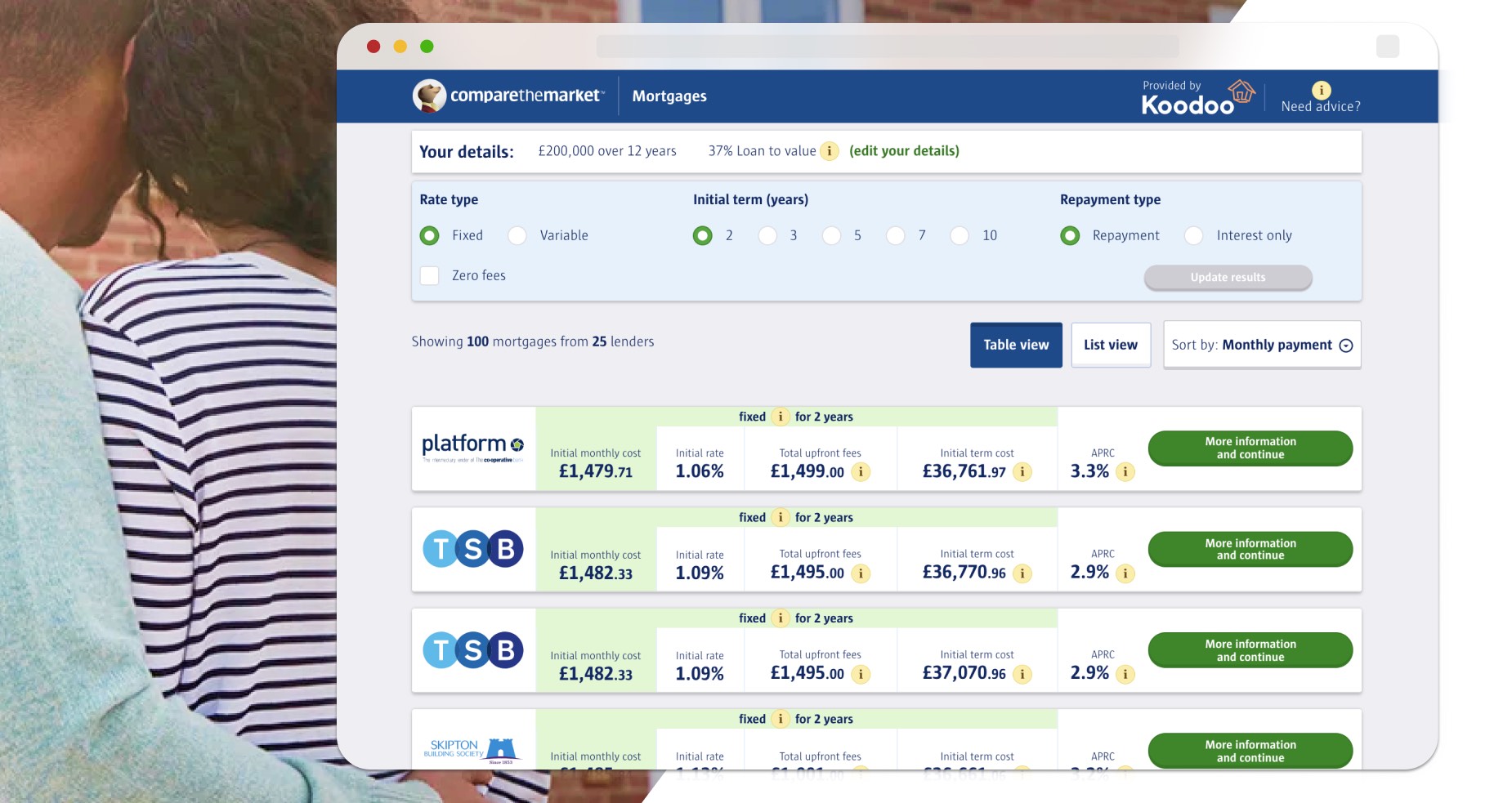
Compare The Market’s had launched an end-to-end mortgage comparison service on their website which saw customer provide their financial information, review mortgage options from different lenders and then ideally apply for a mortgage via the site. However, results were below expectations with a 50% user drop-off rate before completion. 

Icon - Magnifying glass with upward line

We needed to understand and identify measurable improvements to different user journeys including first-time buyer, remortgage, buy-to-let and mover to make the necessary UX recommendations that would enable the Compare The Market in-house team and senior stakeholders to understand and implement the changes needed. 

Icon - Magnifying glass showing a warning symbol

As the service was already ‘live’, there was a need for an Agile and iterative UX design approach, supported by effective product management and backed by user research and usability testing, that could deliver the service changes without disruption and to work within Compare The Market’s existing design system. 

Icon - Lightbulb with a tick

In addition, as Compare the Market was implementing a wider UX-driven digital transformation, it was crucial for us to share our knowledge, UX processes and best practice to support Compare The Market’s wider long-term aspirations around user research and testing. 

Solution

CACI commenced with an intensive discovery sprint, collaborating closely with Compare the Market’s team to identify and address key user experience issues. By analysing user data and feedback, we pinpointed areas causing friction in the mortgage comparison journey.   

We then followed with a collaborative design discovery and ideation workshop, grouping customers by behaviour and need types, and conducted a UX audit on the service’s existing interfaces. 

From this, we crafted proto-personas and empathy maps, backed up with customer research including 60 hours of user interviews that identified the reasons behind the high drop-off rate: apprehension and form fatigue. We then prototyped, developed and user tested a more streamlined, intuitive, and user-friendly journey, implementing iterative design improvements based on real user interactions ensuring enhancements effectively addressed the identified challenges.  

The partnership evolved into a long-term collaboration, supporting the continuous refinement of the mortgage proposition to better serve users’ needs. Documenting UX processes and best practice in a digital playbook, covering everything from how to create research study guides, recruiting participants and managing consent; to conducting ethical research in-line with MRS’ code of conduct.  

Results

Through our 200+ hours of qualitative service and user research and UX design approach, we reduced the number of user facing questions by 70% and users presented with actionable results much earlier in the process.  

After further optimising the user experience over 10 design sprints, the improvement comparison tool now had 80% of users completing their remortgage calculator submissions, surpassing our initial target of 65%. 

In terms of Compare The Market’s objectives around UX transformation in the business, when surveyed, the client rated our communication and knowledge sharing at 100%. The playbook and support enabling them to scale their design and user research practice. 

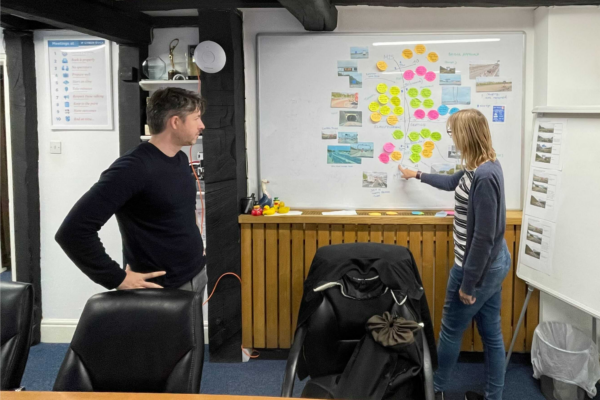
Photos showing design sprint with a design discovery and ideation workshop for Compare the Market

Case study

Transforming National Highway’s Dart Charge with user-centred design, service design and agile methodologies

National Highways logo

Summary

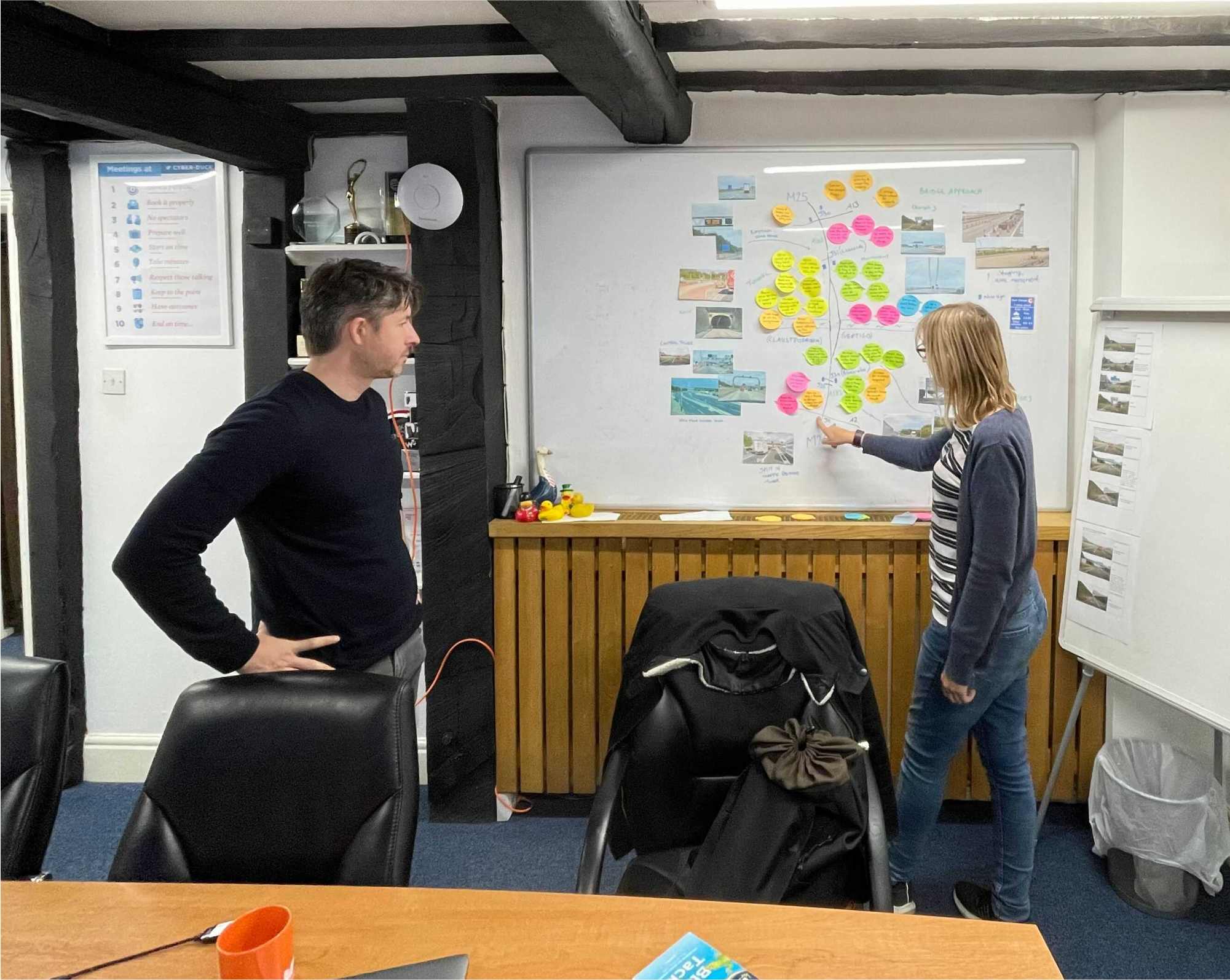
National Highways is the government organisation which builds, maintains and operates Britain’s motorways and major roads. They are responsible for the Dart Charge, a congestion charging system on the Dartford Crossing – the bridge and tunnels that crucially connect the M25 between Essex and Kent. 

As a public service, National Highways needed to update and improve the Dart Charge service to reduce penalty charge notices (PCNs) and improve user experience. As the Dart Charge service had previously failed to meet UK Government Digital Service (GDS) standards, National Highways and the programme needed assurance and support from a team with in-depth knowledge and experience of working to GDS standards, as well as Service Design and UX, which is where CACI came in. 

Company size

5,000+

Industry

Government

Challenge

Icon - Clipboard with check boxes and a magnifying glass showing a tick

The project plan and requirements stated that National Highways wanted the service to meet GOV.UK standards and pass its Alpha assessment, but there were no details on how this would be achieved by the contracted suppliers. CACI needed to help ensure a coherent, smooth, end-to-end user-centred project in this Alpha phase and guide the multi-faceted team to ensure the new digital Dart Charge met GDS standards for the first time. 

Icon - Cursor clicking

We had to understand the existing end-to-end service and legacy platform to identify where it failed to meet diverse user needs and contributed to high PCN rates. These insights were needed to highlight UX/CX gaps, skills shortages—particularly around accessibility – and support procurement of the right people and services to build a successful multi-disciplinary team. 

Icon - Lightbulb with a tick

A final objective was to embed Service Design and user-centred design principles and working practices and oversee prototypes for the new service using the GOV.UK prototyping toolkit – refined through iteration and user testing- that Dart Charge service owners could use to meet user needs and resolve the pain points we identified. 

Solution

CACI initiated a comprehensive service design strategy, beginning with in-depth user research encompassing various user personas, including neurodiverse individuals and those with limited digital access. This research informed the creation of detailed ‘as-is’ and ‘to-be’ service blueprints, highlighting areas for improvement. 

To meet the GDS Service Standard meant educating and collaborating with multiple stakeholders and suppliers was a vital part of the work. CACI engaged with multiple government technology vendors and suppliers and introduced Agile methodologies, user-centred design practices and gave guidance on governance, operations, and day-to-day activities, all fostering a new culture of iterative development and continuous feedback.

We also provided practical guidance to the team on passing the Alpha service assessment, creating a working plan to meet – and evidence – all 14 aspects of the GDS Service Standards. Drilling down further to a structured methodology with 100+ practical steps needed to meet them, suppliers then providing the CACI team with evidence of how they are taking these steps, tracking their progress against the required criteria. 

Accessibility was a core focus, with designs and prototypes tested against WCAG guidelines to ensure inclusivity. The team also addressed operational challenges, identifying skill gaps and recommending the integration of accessibility and service design experts.  

Results

Meeting GDS Service Standards can often be thought of as a tick box exercise, but we wanted to steer this towards being a brilliant service. Our hands-on, empathetic, highly user-centred approach was a key contributor to National Highways’ success in the Dart Charge moving through the Alpha service assessment successfully, the first time in 7 years it had done so.

National Highways are now using this project as an internal case study for learning how to deal with future programs involving other crossings. The National Highways team are also using this project as a learning tool on what it means to go through – a meet – a GOV.UK service assessment process.  

Various views that drivers see on the road when approaching the Dartford Crossing, with signs to remind them that the crossing is coming up.