


































Solutions

Digital twinning

Enhance operational efficiency and strategic decision-making.

Transform your operations with digital twins that offer real-time, actionable insights, enhancing decision-making and efficiency. 

Struggling with cost efficiency? 

It’s challenging to manage the efficiency, costs and lifecycle of equipment and facilities. 

Want to optimise your supply chain? 

Navigate supply chain challenges and maintain just-in-time production with enhanced data analytics. 

Need better resource management? 

You need to anticipate issues, guarantee resource availability and reduce downtime. 

Did you know?

30%

Digital twins can reduce maintenance costs by up to 30%.

Source: Twinview

50%

Digital twins can reduce development times by up to 50% and accellerate innovation cycle times.

Source: McKinsey

The benefits of digital twinning 

Adopt digital twinning with Mood software 

Be agile and flexible

Create adaptable digital twins that mirror your unique operational needs, improving agility across all levels of your business.

Consistent data integration 

Integrate data from sources into a consistent digital twin, for accurate real-world reflections. 

Rapid deployment 

Deploy digital twins quickly with Mood and continuously optimise operations through real-time analysis.

Access professional support 

Our experts work alongside your team so you harness the full potential of digital twins, from integration to scaling and staff training. 

Enhance predictive maintenance 

Predict when equipment or systems are likely to fail, allowing for pre-emptive maintenance that minimises downtime and extends asset life.

Dynamic scenario planning 

Simulate various operational scenarios and their potential impacts in a risk-free virtual environment. 

Testimonial

The CELLA team have secured multiple storage successes, which will see savings to the MoD of several million pounds over the next few years. As CELLA continues to mature understanding of its potential, these figures will undoubtedly continue to rise.

Wg Cdr Duncan Serjeant

Ministry of Defence (MoD), Joint Support 

Experts in digital twinning 

Leading companies choose us for a reason 

Scalability 

Easily scale your digital twin as your business grows, accommodating more complex systems and larger datasets. 

Flexibility

Tailor Mood to fit various industry requirements, ensuring that your digital twin is always aligned with specific business needs. 

Adaptability 

Mood’s platform adjusts quickly to changes, whether they’re in your operational environment or broader industry trends. 

Read more about it

Harness the potential of digital twin for your Business

Discover how Digital Twin can transform operations by creating accurate virtual models of your assets. Learn about the benefits, challenges, and real-life applications, and see how CACI’s unique approach can drive value for your organisation.

Awards & Accreditations

Speak to one of our digital twinning experts

We’re tried and trusted in this industry and have been involved in digital twinning for decades. At CACI, we want to support you in transforming your business.

If you want to book a consultation, we’re ready to help you cut the complexity out of digital twins. 

FAQs

Answers to common questions about digital twinning. 

Adopting digital twin technology offers numerous benefits, including improved agility, consistent data integration, and rapid deployment. Digital twins create adaptable models that mirror unique operational needs, enhancing agility across all business levels. They integrate data from various sources into a consistent digital twin, providing accurate real-world reflections. Moreover, digital twins can be deployed quickly, continuously optimising operations through real-time analysis.

The key features of a digital twin include real-time data integration, predictive analytics, and dynamic simulation capabilities. Digital twins integrate data from multiple sources to provide a comprehensive view of the physical asset or process.

Predictive analytics help identify potential issues before they occur, allowing for proactive maintenance and optimisation.

Dynamic simulation capabilities enable businesses to test various scenarios and their impacts in a virtual environment, reducing risks and improving decision-making.

Digital twin technology enhances operational efficiency by providing real-time, actionable insights into the performance and health of physical assets. This technology enables predictive maintenance, reducing downtime and extending the lifespan of equipment.

Additionally, digital twins facilitate dynamic scenario planning, allowing businesses to simulate various operational scenarios and their potential impacts in a risk-free virtual environment.

Solutions

Solutions architecture

Maximise the value of your technology investment.

Navigating complex, multi-technology implementations can be challenging. Our solution architecture services help businesses maximise their investment by designing and implementing the right technology solutions to meet goals, ensuring value at every stage 

Struggling to deliver a complex tech project?

You need to accurately define architecture strategies for multi-technology environments. 

Lacking clarity on your tech strategy? 

It’s key to understand what technology you need and how to get the most from your investments. 

Concerned about scalability? 

You need to tap into expertise to make sure your tech is adaptable to future needs. 

Did you know?

45%

of IT projects fail to meet their objectives or face significant delays, with poor architectural planning often cited as a leading cause.

Source: Project Management Institute – The High Cost of Low Performance

50%

of CEOs surveyed said that rapid investments in AI technology had led to fragmented systems, making it difficult to integrate data effectively.

Source: IBM

The benefits of solutions architecture

Achieve what you need, faster 

System integration 

We help businesses integrate disparate systems and technologies into a cohesive solution. By streamlining communication between your software, hardware, and platforms, we ensure smooth data flow and eliminate inefficiencies, enhancing productivity and system reliability.

Cloud architecture

Our cloud architecture services optimise your cloud infrastructure to support your business growth. From migration to multi-cloud strategies, we design solutions that balance scalability, performance, and cost, while ensuring robust security and compliance standards are met. 

Security architecture 

Security is a top priority in every aspect of modern technology. We design security architectures that safeguard your data, networks, and applications against evolving threats, while maintaining compliance with industry standards. From encryption to identity management, we ensure your systems are secure and resilient. 

Data architecture

Our data architecture solutions ensure your data is organised, accessible, and ready for analysis. We design and implement data models, storage strategies, and governance frameworks that help you leverage data as a strategic asset, driving informed decision-making and business intelligence. 

Application architecture

We help design and optimise your applications to ensure they are reliable, scalable, and aligned with business goals. By focusing on modular design and efficient code structure, we ensure that your applications can handle growing user demands, reduce downtime, and evolve with your business needs.

Enterprise architecture

We help you create a unified blueprint for your entire IT ecosystem. We align technology infrastructure with business objectives, ensuring that every system, process, and technology component is working towards a common goal, improving overall efficiency and driving long-term success.

Experts in solutions architecture

Leading companies choose us for a reason 

De-risk implementation 

Make sure your technology projects have a clear strategy, reducing the risk of delays and budget overruns. 

The right solutions 

We help you identify the right technology stack to meet your specific use cases and business requirements. 

Accelerated technical ROI 

Our architecture leadership ensures that your technology delivers measurable business value and supports future growth. 

Awards & accreditations

Speak to one of our solutions architecture consulting experts

We are a trusted end-to-end digital transformation partner, focused on driving early value realisation through data-driven strategies and seamless execution. If you’re looking for a demo, want to book a consultation, or both – we’re ready to help you cut the complexity out of digital transformation. 

FAQs

Answers to common questions about solutions architecture.

Solutions architecture is crucial for businesses because it ensures that technology solutions are aligned with business goals, scalable, and adaptable to future needs. By leveraging solutions architecture, businesses can maximise the value of their technology investments, reduce implementation risks, and achieve faster time-to-value. This approach helps in driving measurable business value and ensuring successful project delivery.

Solutions architecture reduces implementation risks by providing a clear and detailed roadmap for technology projects. This roadmap includes well-defined strategies, timelines, and milestones, ensuring that all aspects of the project are thoroughly planned and executed. Additionally, ongoing guidance from experienced architects helps to identify and mitigate potential risks, ensuring successful project delivery and minimising the chances of delays and budget overruns. 

Solutions architecture ensures seamless integration by providing a comprehensive strategy for integrating new systems with existing ones. This involves detailed planning and coordination to ensure smooth transitions and minimal disruptions. With expertise in data, cloud, and integration strategies, solutions architecture helps businesses achieve a cohesive and efficient technology environment.

Solutions

Platform solutions

Eliminate complexity and find the right technology for your needs.

We help you navigate the evolving technology landscape, aligning business objectives with the right platform selection strategy. 

Struggling to choose the right platform? 

We simplify the process by combining business strategy with technology expertise, ensuring that your platform aligns with your operational goals. 

A complex technology landscape creating confusion? 

We clarify the available options, helping you understand how different platforms meet your functional and non-functional requirements.

Concerned about risk? 

We help mitigate risks by guiding you through a structured selection process, ensuring scalability, flexibility and compatibility with your existing infrastructure.

Did you know?

70%

of businesses struggle to define platform requirements effectively, leading to costly misalignment.

Source: Gartner 

50%

Companies that choose the right technology from the outset see a 50% reduction in long-term migration costs.

Source: McKinsey 

The benefits of expert platform selection 

Make the right choice for the future 

Current State (AS-IS) & Future Vision (TO-BE) Analysis 

We map out your current state (AS-IS) processes and systems to understand where inefficiencies or gaps exist, then collaborate with you to define the desired future state (TO-BE). This allows us to identify the right platform features Selecting the right platforms enables you to drive digital transformation forward and benefit from features such as automation, real-time data processing, or AI integration.

Business Requirements Discovery

Through collaborative workshops and stakeholder interviews, we dive deep into your business processes to uncover functional and non-functional requirements based on the user, customer and stakeholder experience. We also review performance expectations, security mandates, compliance needs (e.g., GDPR), and uptime requirements, ensuring the platform can meet these critical demands from the outset. 

Vendor Assessment & Platform Evaluation

We conduct an in-depth vendor assessment to evaluate potential solutions based on their technical compatibility, scalability, and ability to integrate with existing infrastructure. We consider factors like front-end interfaces, API capabilities, data security features, and support for microservices architectures to ensure the selected platform aligns with both current and future business needs.

Scalability & Cloud Architecture Fit

We ensure the selected platform is capable of scaling seamlessly as your business grows. Whether opting for a public, private, or hybrid cloud model, we assess cloud components like load balancing, containerisation (e.g., Kubernetes), and serverless architectures to ensure the solution will scale efficiently and maintain high availability.

Compatibility with Existing Systems

We evaluate how the platform integrates with your current systems, ensuring smooth interoperability with tools like CRM, ERP, or other enterprise software. This includes assessing data exchange mechanisms (APIs, ETL processes), authentication protocols, and middleware solutions to minimise disruption and maintain operational continuity.

Alignment with People & Processes

We ensure the platform aligns with your team’s capabilities and your organisation’s workflows. If there are gaps, we identify necessary changes—such as retraining employees, redefining workflows and help ensure the platform integrates seamlessly with your business processes and supports your team in driving productivity and growth.

Experts in platform selection 

Leading companies choose us for a reason 

Future-focused approach 

We define your business objectives first, ensuring that platform selection is driven by clear operational needs and underpinned by user, customer and stakeholder requirements. 

Proven experience 

With years of experience in platform evaluation and technology consulting, we streamline the selection process with confidence and validate the platform selection with data and insights. 

Tech-agnostic 

We offer impartial recommendations, ensuring you get the best-fit solution without vendor bias. 

Awards & accreditations

Speak to one of our platform selection experts

We are a trusted end-to-end technology partner, focused on driving early value realisation through data-driven strategies and seamless execution. If you’re looking for a demo, want to book a consultation, or both – we’re ready to help you cut the complexity out of digital transformation.

FAQs

Answers to common questions about platform selection. 

Platform selection is crucial for your business because the right platform can significantly impact your operational efficiency, customer experience, and overall success. A well-chosen platform ensures that your business processes are streamlined, scalable, and adaptable to future needs. It also helps avoid costly mistakes and ensures that your technology investments deliver maximum value. 

Consultants ensure a successful platform selection process by clearly defining your business requirements and objectives. They conduct a thorough evaluation of potential platforms, considering factors such as functionality, scalability, and cost. Consultants involve key stakeholders in the decision-making process and provide expert input. Finally, they plan for a smooth implementation and provide adequate training and support to users. 
  

Common challenges in platform selection include identifying the right criteria, managing stakeholder expectations, and balancing short-term and long-term needs. The fast-changing tech landscape can also be tough to keep up with. Consultants help by doing thorough research, providing expert advice, and involving key stakeholders to ensure the chosen platform meets your business needs now and in the future.

Solutions

Consulting and tech services

Transforming technology into business success 

We guide businesses in selecting the right technologies, web, app, martech, or cloud and design custom solution architectures, including AI and digital twinning, to drive efficiency and innovation. Our approach ensures your business is poised for growth, enhanced performance, and a competitive edge. 

Did you know?

70%

By 2026, 70% of enterprises will fail to deliver on their digital transformation initiatives due to poor platform and technology selection.

63%

63% of business leaders cite “lack of expertise” as a major barrier to successful technology adoption and digital transformation.

Speak to one of our consulting and tech services experts

We are a trusted end-to-end technology partner, focused on driving early value realisation through data-driven strategies and seamless execution. If you’re looking for a demo, want to book a consultation, or both, we’re ready to help you cut the complexity out of digital transformation.

Environmental sustainability in business: importance and impact

In this Article

Key issues for countries and the businesses that operate within them to address in terms of climate change unfolded at the recent 28th UN Climate Change Conference (COP28). These issues urge immediate and significant action to be taken on fossil fuels and clean energy, national adaptation and climate finance, methane reduction, land use and more.

What does environmental sustainability in business mean?

Environmental sustainability in business is the operation of a business that does not compromise the environment. A business that has considered environmental sustainability prioritises the environment’s best interest, with society and its ecosystems coming before making a profit. It involves responsible decision-making that minimizes carbon footprint or waste while simultaneously improving the quality of life for humankind and the natural world alike.

Unfortunately, however, operating businesses as usual has had an increasingly detrimental impact on our planet. According to the latest State of the Global Climate report by the WMO, 2023 was the warmest year on record at about 1.4C,increasing pressure to shift their operations to more environmentally sustainable practices. This inevitably causes businesses to consider—where do we start? How do we begin making a difference?

What is the importance of environmental sustainability in business?

According to an article published by Maryville University, businesses that do not act responsibly will result in “the majority of many species not surviving past the 21st century”, reiterating how critical it is for businesses within every industry to take part in improving their environmental surroundings.

Although companies have a way to go before fully grasping the repercussions of ever-growing carbon footprints, those willing to tackle this challenge early on will get a head start on reshaping perspectives and realities.

Environmental sustainability in business practices

Businesses can rely on the three R’s– reduce, reuse and recycle– to begin reducing their environmental impact. However, there are several other examples of practices that businesses can incorporate into their operations amplify their reduction, including:

  • Life cycle assessments
  • Designing environmentally friendly products/services
  • Optimising product efficiency
  • Decreasing supply chain carbon footprint
  • Re-evaluating CSR (Corporate Social Responsibility) expenses

Benefits of environmental sustainability in business

Reduces the impact of business costs

While the cost-of-living crisis is skyrocketing, improving the energy efficiency of business operations and decreasing waste will go a long a way in bracing for the impact of unexpected business costs. Using more energy efficient lighting or reusing existing resources can be quick-fix solutions for lowering costs.

Improves a business’ reputation

Environmentally sustainable businesses are viewed as a plus, and companies are eager to highlight this fact. Companies that can go “green” show that they’re serious about making a difference in the environment and are interested in more than just profitability. Businesses that can market themselves and develop their identity around their commitment to the betterment of the planet will notice incredible results in terms of their reputation.

Group of people in front of icons representing sustainable development goals and environmental technology

Who is responsible for improving environmental sustainability in a business?

Businesses have been expected to pave the way towards environmental sustainability due to their notably significant contribution towards polluting the environment through waste, gas emissions and plastics generated. The responsibility does not necessarily begin with one individual within a business though– employees at every level of the business must work together to bring about change. A few examples include:

  • Business owners and leaders: Business owners and leaders are typically capable of leading strategic decision-making that influences the wider business. They can develop effective sustainability strategies and initiatives that have the power to change policy and induce change.
  • Business managers and supervisors: Managers and supervisors can supply valuable insights due to their more hands-on roles. They also typically have different perspectives and understandings as to how to improve business sustainability.
  • Employees: Employees can supply valuable contributions when encouraged to voice their opinions and concerns on how the business can become more sustainable.

Impact of environmental sustainability in business

The Department for Business, Energy and Industrial Strategy is striving to reach net zero carbon emissions by 2050. It’s going to take strong leadership, business-wide alignment on operations and an engaged corporate culture to successfully execute and maintain environmentally sustainable business practices. Businesses that start addressing these issues and challenge existing business processes will find themselves making a breakthrough towards becoming more environmentally sustainable while protecting the world around them.

How can CACI help you overcome these obstacles?

Our newly developed Mood Environmental Hub helps track all of your assets across multiple geographic locations and assess the environmental impact of your business.

With a single click, users can drill down from multi-site, business-level functions, to departments or even individual teams to determine asset types and locations, enabling a quick assessment of priority focus areas for improvement. It can also visualise existing data through user-friendly dashboards that show carbon impact, consumption and cost at an enterprise level.

The advanced modelling feature also outlines potential improvements, indicating ROI and carbon reduction impact. Additionally, you can easily check performance against carbon commitments such as Social Value through the initiatives tracker.

Producing carbon reduction target tracking reports or modelling for a business case is now a click away – to see how it works, you can book a demo here.

 

SurfaceNet: An Observational Data Platform Improved by Cloud

In this Article

Met Office are responsible for collecting and processing observation data, used to analyse the country’s weather and climate, at weather stations around the world and coast. The observations are valuable to several different consumers, from meteorologists forecasting the weather to climate scientists trying to predict global trends resulting from global warming.

Met Office and CACI’s SurfaceNet

Met Office have been looking to build a replacement observations platform that is more efficient and appropriate for their current needs. CACI have been working with Met Office for the last two years to deliver the next generation system: ‘SurfaceNet’, with the primary requirements being that it is cost effective and scalable.

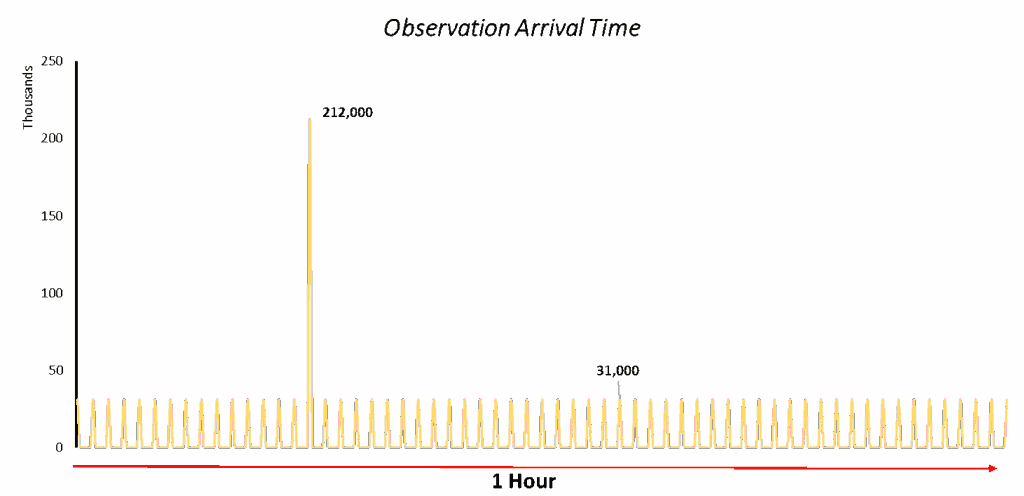
Given Met Office’s ethos of adopting a ‘Cloud First’ approach, and its partnership with AWS, it was an obvious choice to build the system in AWS’ Cloud.  The first important decision was to select what would be our main compute resource. The observation data would be arriving once a minute and, given this spiky arrival time, Lambda proved to be the most cost-effective solution, allowing us to only pay for small periods where compute was required. The platform processes several observations from roughly 400 stations every minute – equating to 15 billion observations per month – so any marginal improvements on compute cost would soon add up.

Choosing Lambda complemented our desire to have a largely serverless system to minimise maintenance costs, using other serverless AWS resources such as S3, Aurora Serverless, DynamoDB and SQS. This approach avoided the need to provision and manage servers and the associated costs involved with this. Serverless resources are highly available by design; Aurora Serverless mandates at least two Availability Zones that the database is deployed into, while DynamoDB and S3 resources have their data intrinsically spread over multiple data centres.

Most of the data ingest occurs by remote data loggers communicating via MQTT with the platform; AWS IoT Core was the ideal resource for managing this. Using API gateway, we developed a simple API on top of IoT Core allowing those administering the system to onboard new loggers, manage their certificates and monitor their statuses. The Simple Email Service (SES) allows ingestion of data from marine buoys and ships that transmit their data via Iridium Satellite. Both IoT Core and SES are fully managed by AWS, supplying an easy method of handling data from a range of protocols with minimal operational management.

From a development perspective, the stand-out benefit of working in the cloud has been having the ability to deploy fully representative environments to test against. Our infrastructure is defined using CloudFormation, enabling each developer to stand up their own copy of the system when adding a new feature.

Eliminating the classic ‘works on my machine’ problems that plague local development allowed for rapid iteration cycles and far fewer bugs during testing. The process means constantly exercising the ability to deploy the system from scratch, which will come in handy when an unforeseen problem occurs in the future.

Whilst this suggests a flawless venture into the Cloud sector, the journey hasn’t been without problems. CloudFormation has been incredibly useful, but given the scale and the number of resources, it has become cumbersome. Despite our best mitigation efforts there is still a large amount of repetition, and the cumulative lines of YAML we have committed is on par with the number of lines of python. We would consider using the newer AWS CDK if we were to approach the project again.

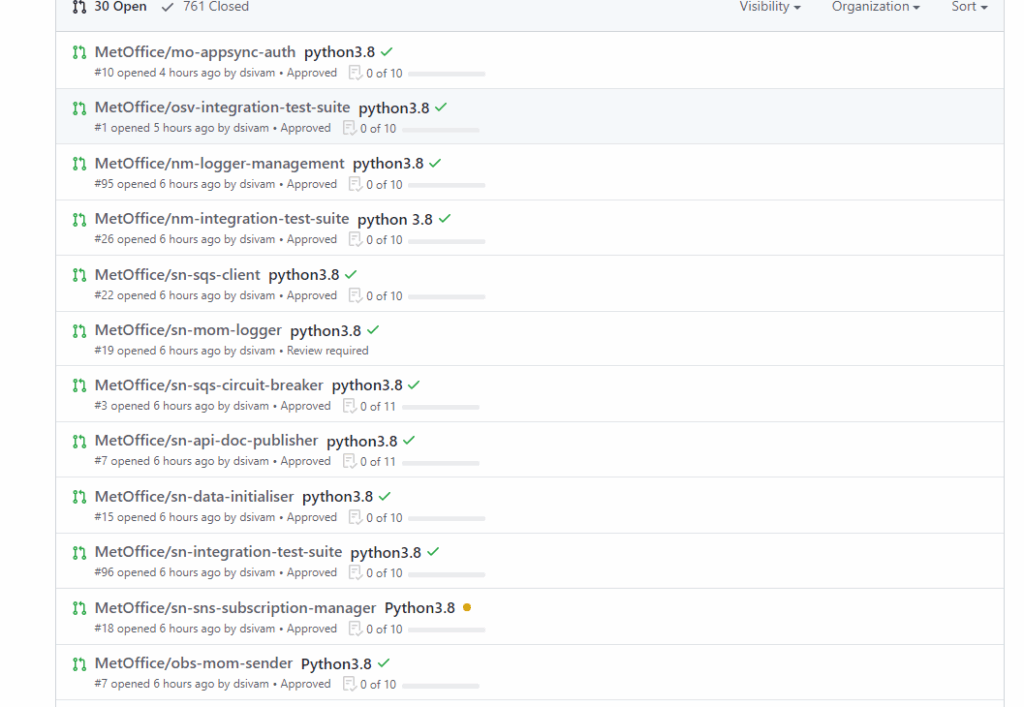
Additionally, we started off making new repositories for each new Lambda, but this has ended up limiting our ability to share code effectively across components, not to mention having to update ~40 repositories when we want to update buildspecs to use a new version of python.

It has been a fascinating couple of years and a main takeaway has been that large organisations such as Met Office, with large-scale bespoke data problems, see the cloud as a desired environment for building solutions.

The maturity of the AWS platform has shown the cloud to be both robust and cheap enough to satisfy the requirements of complex systems, such as SurfaceNet, and will certainly play a big part in the future of both CACI and the Met Office.