Posts Covid and the Future of Population Forecasts

Covid and the Future of Population Forecasts

In this Article

It’s hard to know the current population, let alone predict populations accurately for 2050 and beyond.  Yet that’s what many of our clients are required to do for long-term planning.

As we flagged in our recent round-table on the challenges of population forecasting, the government are currently using two different estimates of the ‘current’ population to present the latest Covid vaccination rates. This explains why the English national rate is higher than any of the regions – a mathematically impossibility raised in a recent edition of Radio 4’s “More or Less” podcast.

This is why it’s important to start from a consistent and robust estimate of the current year population by age and gender that users can rely on, at a local level.  Something that CACI achieve using a proven methodology respected by JICPOPS, the Joint Industry Committee for Population Standards, at Postcode Sector level.

We then model it right down to the unit postcode level needed by our many clients that rely on us for an accurate understanding, not just of population numbers, but also their demographic and lifestyle characteristics.

Building on this solid base we project forward nationally as far as 2069 using a consistent set of inputs at a granular geographic level to give credible and affordable ready-made local forecasts. Inevitably the uncertainty of forecasts increases as we look further forward in the crystal ball and we offer custom solutions to our clients seeking to tackle forecasting in areas of greater uncertainty using bespoke inputs.

An uncertain future

But, despite increasing computer power and open data access, it is getting harder to forecast over long-term horizons.  The following are just a few of the challenges faced building forecasts based on today’s uncertainty.

It’s been 10 years since the last Census gave us a solid population base, and many don’t realise we have a long wait until the 2021 Census can feed the latest forecasts. And whilst the ONS reports a great response rate, there may be local nuances resulting from capturing the data during a pandemic.

The jury is still out on where Brexit will level out on the nation’s migration patterns and even climate change could start to impact where people can, or want, to live within current planning horizons – potentially reshaping local populations from a complex mix of local and international movements.

This is before we even think about the unknows from potential changes in planning policies that have moved up the agenda only this week following the Chesham and Amersham by-election.

And then there is the uncertainty from Covid.  This week it was widely reported that UK deaths exceeded births for the first time in 40 years and sadly we know that death rates in specific age and demographic groups have far exceeded long-term patterns, making trend-based forecasting harder.

But will Covid also cause long-term change in local populations in other ways?

Will university cities become a thing of the past, now that lectures have moved online?  Will families seek to support their older relatives closer to home after the challenges seen in the care sector?  Is the ‘race for space’ out of our cities here for the long-term or will people have to return to work in the office despite our survey revealing that most want to return less than 3 days a week.

In short, there’s a lot of uncertainty.  And you can be certain that any of these trends will vary locally and by demographic group.

Our use of mobile data and surveys during Covid has revealed clear insights into the behaviours of consumers during the different stages of the pandemic that can support decision-making into the uncertain future.

I’d love to discuss how we can support you in creating future scenario models using our data. Please get in touch and we can discuss your challenges in more detail.

Paul Langston Associate Partner | Communities & Government plangston@caci.co.uk

Understanding Differing Consumer Attitudes on the path to EV adoption

The market for Electric Vehicles is growing consistently – of that there can be no doubt. But market statistics only tell one part of the story.  While we are clearly on a path towards mass EV adoption there are still many different opinions about electrification – some see advantages, while others perceive disadvantages – and consumers will weigh up these views differently as they make their decision about whether to purchase an Electric Vehicle.


Our survey suggested that many consumers are thinking positively about Electric Vehicles.  42% of respondents said that it was likely that their next car would be an EV, with 64% of those suggesting this purchase would happen within the next 2 years.  But this level of engagement is not consistent across all consumer groups.  In order to bring more consumers on board it is necessary to understand more about the attitudes and concerns of certain groups in order to realise the potential within them.  Because it is when we overlay the survey results with Acorn (CACI’s powerful classification of UK consumers) that we see some fascinating results.

For instance, the survey identified that Affluent Achievers (the wealthiest household group) who perhaps would have been considered a core market for EV’s are only marginally more likely to say they will buy an EV as their next car (48%). This is because when we drill-down into this category we find that affluence is not the only issue – age plays a significant part too.  The older, affluent groups within this category (specifically the Group called Mature Money) are far less likely to say they will purchase an EV next (42%) than the slightly younger “Executive Wealth” (51%).

Ask why, and it appears that Mature Money still consider battery range a key obstacle, despite their being more likely to make shorter trips. Importantly, unlike other Acorn Categories, both Executive Wealth and Mature Money are not particularly concerned about the provision of public charging points – probably due to the likelihood of living in a detached house where they could place a private charging point. But it is definitively range anxiety that is most pressing for the older more affluent groups.

This is a prime example of how the market can accelerate the adoption of EV’s among these consumers, allaying their concerns about range and amplifying the convenience factor (and reassurance) of charging at home.  Furthermore, these consumers are financially savvy, the survey shows they recognise the long-term savings on cost-of-ownership that EVs bring so these factors need to be amplified with these groups to get them on board.

With EVs it’s clear that the car buyers of the future may not be the same as the car-buyers of the past.  Rising Prosperity (younger professionals, often living in metropolitan environments) show the greatest inclination to purchase an EV (12% above the average). Interestingly, these consumers have not previously shown much interest in car ownership, preferring instead to use other mobility solutions (e.g. public transport or taxis).

One factor that has been identified through CACI’s wider research is how the spread of Covid-19 has resulted in these consumers looking towards private mobility solutions in the attempt to avoid public transport. As a result, they seek the benefits of private vehicle ownership without compromising their concerns for the environment.

However, despite being engaged in the idea of owning an EV, they appear unwilling to commit as they are more likely to wait 2 years or more before purchasing an EV. Price-point is clearly a big issue for this group, with higher living costs and relatively low disposable income, they are more likely than any other Acorn Category to admit that price is their main barrier to entry. Moreover, this group are likely to be living in urban high-rise flats or terraced accommodation so may not have the luxury of private charging points. This is identified in the survey as they are most likely to suggest that a lack of public charge points as the main barrier. In all areas of life convenience is key for this Acorn Category, so while they may be less phased about issues to do with range, they are put off by the perceived inconveniences of lack of access to a charge point (private or public). As a result, the market needs to do more than just offer an affordable range of EV’s.  Investment in public charging infrastructure, ensuring it is accessible and convenient (encouraging further investment where development is still lagging) will be crucial for getting these groups on board.

The final Acorn Category we focus on here is Comfortable Communities – characterised mainly by middle-affluent households. If EV ownership is to hit the “mainstream”, then surely these are Groups where adoption needs to increase the most.  The survey indicates many variations in attitudes across this Category, although price is a common theme in their perceived disadvantages and barriers.  Particularly interesting is the observation that respondents coming from the Groups that are characterised by rural populations are still reluctant to view EVs as a viable mobility solution.

Only 36% say it is likely that their next car will be an EV and 67% specifically quote range as a disadvantage.  While these rural Groups do acknowledge the economic advantages of ownership and recognise the convenience of private charging, they also see a lack public charge points as a significant barrier to ownership.  Furthermore, it is within this Category you will find the highest likelihood of consumers stating that it is the lack of an established second-hand market for EVs that is putting them off.  Therefore, while there are undoubtedly challenges in attracting these consumers to EV usage in the short-to-medium-term, the long-term prognosis looks good, particularly once the second-hand market for EVs becomes more established.

These results of this survey are fascinating and show that public perceptions of EV ownership are driven by consumers’ age, lifestage, affluence and where in the country they live.  Government and industry initiatives to accelerate the rate of EV adoption need to be aware of the nuances and differences in consumer opinions and ensure that each concern is addressed appropriately as the industry looks to make the next big leap in EV adoption.

Please get in touch with us if you have any questions or want to learn more about our survey results.

Data Science in the water sector – How to create behavioural change

In this Article

Engaging customers in an industry without direct competition can be a difficult conundrum – how do you effectively engage your customers in your services, and drive behaviour change to meet water efficiency goals?

Recently, CACI held a roundtable for the water sector to dive into the approaches that have been taken to understand customers, personalise communications and ultimately drive the behaviour change needed to keep down demand.

CACI Data and the Benefit for Customer Insight – Penny Walton, United Utilities

United Utilities has been on a journey to better understand its customers and to ensure that when interacting with them, this communication is through the right channels with the right messages.

In order to achieve this, CACI has created a bespoke segmentation that uses CACI’s household level demographic data in combination with United Utilities’ transactional data to segment the United Utilities customers into one of eight segments. The primary focus of this was to meet customer requirements, improve communications, and focus resources through considering ‘how do we want customers to feel and behave when we interact with them’.

The segmentation has been used throughout the business to drive improvements in communication with customers, ensuring that these are delivered through the channels that the customers prefer, and creating a better quality of communication. This has been used effectively across billing, priority services, metering, switching to digital, and water efficiency.

Having this approach in place during Covid has been vital as it’s ensured targeted communications to reach the right customers through the right channels and fundamentally it has given United Utilities the ability to reach out to customers with lower affordability with bespoke messaging that is designed to resonate with the different segments.

The customer segmentation now frames every aspect that is looked at when considering communicating with customers.

Driving behavioural change with actionable insight – Ed Sewell, Data Strategy Partner at CACI

When considering an example outside of the water sector, Change4Life is an excellent example of creating behavioural change through actionable insight. It has been incredibly successful at driving behaviour change in hard to reach groups and has now been running for 11 years.

Through creating highly engaging and personalised messages, the government was able to reach high risk groups and, all-importantly, to keep them engaged overtime to really reach the key goals of the programme.

There were a number of different campaigns that came out of the programme, some of which have been highly memorable such as ‘Couch to 5k’, and all of which were based from segmentation and underlying data that drove the personalisation and engagement.

Whilst this is an example of a highly effective government led behaviour change strategy, these techniques and approach can be applied to the water sector to increase customer engagement and drive behaviour change around water efficiency and responsibility.

Key Takeaways

The most resounding point shared during the discussion was the power of adding data and data science to customer insights and understanding, as it supports creating more effective communication, drives down costs, and creates better outcomes.

Here are some of the key insights and takeaways that were shared:

  • Significant uptakes have been seen in affordability programmes due to reaching the right customers
  • Blending customer transactional data, complaints data, and demographic data is key to creating actionable insights
  • Being able to focus on those that are interested in engaging with water efficiency and being able to amend messaging for the different types of customers (whether they are more interested in environment, cost, savings, etc.) makes a big difference in driving change
  • It’s about getting the right messages to the right people
  • This approach supports driving down operational costs as majority of customers move digital
  • Ultimately, more personalised content drives better outcomes
  • Interest in the environment and concern around climate change is at the highest yet so now is a key time to increase focus on water efficiency
  • Ensuring that there are no ethical issues in the build of the segmentation or the resulting communications

What’s Next

Look out for our next roundtable in the series which will be focussed on the power of population projections for the water sector.

Please do not hesitate to get in touch should you want to hear more!

Is your digital marketing team structured for success?

In this Article

To create real marketing magic, you need an extraordinary alchemy of people, process and technology

Agility, flexibility, responsiveness… you’re building them all into your digital marketing strategy right now. Everyone knows how important it is to be ready to react to coming trends and sudden consumer and competitor movements in this unpredictable, digital-first marketplace.

Devising the strategy and maintaining continuous oversight of performance metrics so you know when you need to change, is one thing. Delivering real-time optimisation of your campaigns to fulfil the strategy and respond to trends is quite another.

Your resources aren’t as fickle as your consumers

To get the job done, you depend on your talented people and capable systems. These resources are substantial, not ephemeral. You can’t just ditch and switch them in an instant. Unless you have unlimited budget, you can’t keep adding more people to your team with the exact digital or creative skills you need for a campaign moment. You can’t retrain your people in a snap to meet a sudden spike in demand for certain tasks.

There’s less of an ethical issue with hiring and firing your inanimate technology solutions, but it still costs money to make changes and there’s risk inherent in messing with established connections and procedures. You need to keep your campaigns and customer intelligence current and scaling with demand, but you don’t want to break anything, nor find your campaign delivery capability is compromised during upgrades or development projects.

Outsourcing is not such a dirty word these days

This is why outsourcing has come back into favour as a means of powering the digital marketing function in leading consumer organisations. Before, it was seen as a strength to have all your resources in-house, from IT and systems hardware to expert staff. That way you could be sure of guarding talented people and technology know-how for competitive advantage. But now, the pace of innovation in marketing technology and the accelerated digital-first consumer market together make using on-demand, specialist resources a very attractive solution.

It’s the same argument that’s driving the mass adoption of cloud technology and digital services, as opposed to on-premises hardware and wholly-owned software solutions. By paying for what you need when you need it and dispensing with the burden of long-term ownership, you create freedom to adapt and focus on what you can uniquely deliver for your customers.

But let’s get back to digital customer engagement. Structuring your marketing team, processes, data and technology to meet demand is now the biggest differentiator for digital consumer marketeers. Agility comes from having the specialist expertise you need on tap. Maintain a talented team in-house, with strong core delivery, management and strategic skills. Then supplement them with third party digital marketing experts who have experience and best practice knowledge from across the market. Then you have that magical combination of stability and agility you need to support your campaign delivery.

The dream team and the dream tech are what we call co-managed services

If you choose the right partner, you’ll get to exploit learning from their cross-sector experience. You’ll get leading-edge technology advice and the ability to implant project teams to develop, augment, connect and replace crucial elements of your data and insight ecosystem and martech stack. You’ll get insights into the latest smart approaches to customer insight, customer experience optimisation and creative execution.

You can pull in account managers, marketing and database specialists, SCV optimisers, data planners and campaign managers to step in and deliver whatever you need… and step out when they’re done, with no ongoing overhead. They can upweight your core resources to handle essential management and operations or tackle a specific requirement or project that’s outside the day-to-day.

What’s the downside? You might create a management headache in trying to co-ordinate a myriad of individual or niche contributors to deliver all this specialist input. That’s why we advocate choosing a single, trusted, expert partner with a strong and proven talent bench of experts right across the board, and an obsession with the latest developments in global digital marketing. With a range of clients on board, such a partner can afford to nurture specialist talent in every area and make them immediately available as needed.

Co-managed services for digital customer engagement could be the alchemy you need to deliver exceptional, powerful, customer marketing magic. In a very fast changing environment, it’s a model that works, if you can find the perfect partner.

Of course, you can see where we’re going with this. We’re big believers in co-managed services for digital marketing. And we’ve set ourselves up to offer a unique breadth of vendor-agnostic expertise, from a talented team of leading digital marketers. If you’d like to explore how the CACI team could augment your people, process and digital resource in one or more areas through managed services, please get in touch.

Level up your digital marketing

In this Article

How exactly should you innovate, be super-creative AND maintain quality and consistency, to meet surging consumer expectations?

Orchestrating multi-channel digital campaigns is an intense business. To keep up with consumer expectations for personalisation, you’ll no doubt be working with a range of customer personas across many customer journeys, aiming to deliver the most engaging experiences across all the channels you command.

In practice, that means a very large – and ever-growing – volume of content hitting down every day, landing in inboxes, on social platforms and on websites, through chat and media services. Your campaign deliverables are being viewed, shared and discussed. Consumers are seeing your propositions across multiple channels and pursuing their journeys from one campaign to another.

Creativity and constraint are uneasy bedfellows

With all this activity going on, you need to keep consumers’ attention and interest, but you also need to portray one brand across multiple channels. There’s a fine balance to achieve between creative expression and brand consistency. The same content works differently in different media: optimisation is key to make sure your customers and prospects have a friction-free experience, with no glitches or rough edges that could undermine your brand values.

Our creative optimisation team knows all about staying agile and alert to all the pitfalls and challenges of high-volume, multi-channel, multi-brand campaign design and execution. Achieving flawless delivery for our clients demands a systematic approach, as well as a finger on the pulse of the latest creative trends and smart design. Here’s an example of the details they consider for every variant of every email campaign before it goes out:

  • Is it mobile-first?
  • Are the fonts optimised?
  • Are images formatted in the right resolution?
  • Are the images sized to display immediately, without a lag?
  • Will the headers avoid spam labelling?
  • Is the pre-text correctly formatted?
  • Is the call to action in the first screen?
  • Does the branding comply with corporate guidelines?
  • Is the recipient greeting correctly personalised?
  • Are all the legally mandated elements present?

You have to automate for control when there’s so much going on

There’s nothing magical about these criteria – they’re well-known best practice for campaign execution. The challenge here is applying them consistently, across every single item that goes out. Our template management platform, Email Studio, is a crucial tool to make this happen: you need the power of automation for quality control when you’re dealing with such high volumes. Email Studio spots and flags any inconsistencies, missing elements or poorly rendered content so they can be corrected before anything goes out.

Blink and you’ll miss it – the rules and formats keep on changing

When they’re designing individual campaign items from scratch, your formidable creative team will always come up with the goods. Issues tend to creep in when you seek to drive the most value from the content by using it across multiple channels and formats.

It’s just not as simple as sharing a TV ad on YouTube and posting the link on Instagram. Video and sound formats need to be checked and re-optimised for different platforms. Character counts and post formats vary. Distorted images and inappropriately cropped thumbnails are quickly called out by digital audiences used to high standards.

And of course, new channels are constantly emerging to form part of your customers’ journeys. You need to disseminate your content into them quickly – with a whole host of new parameters and conventions to apply. You need to know what will work best in each medium, how audiences are engaging with the latest content and what cumulative effect you’re creating from your multi-channel presentation.

Can you supply matching luggage for every single journey?

We often talk about matching luggage – you need strong, consistent branding and intelligent optimisation of your creative content across every item, however differently it might be sized, shaped or used. The goal is that whatever combination of luggage your consumers pick up for their journey, they’ll have a great experience with their own coherent set.

Keeping on top of all this change and variety is intense. You need to be plugged in to rapidly evolving trends and tech. You need to be able to update your campaign templates and executions fast. You need to keep ahead of competitors who are striving just as hard to deliver compelling customer journeys to the same target audience.

You can do it… but you’ll need to be thorough, eagle-eyed and ever vigilant. That’s why many clients choose to use specialist customer engagement campaign automation tools, resources and consultants to support, build, maintain and continuously improve their creative campaign execution operation. At CACI, we’re dedicated digital marketing campaign experts, working every day with leading marketing organisations. It’s our business to know the latest best practices, consumer trends and emerging technologies… and to share them with you. Get in touch if we can help.

Your moment of digital marketing truth

In this Article

It’s time to cast a critical eye over your activities in four key strategy areas, to make sure you’re set up for sustainable success.

Hands up if you’ve heard the phrase “the world has changed” too many times lately for it to mean anything any more. Yep, same. The world is always changing. It’s not the change itself that’s remarkable, it’s the speed of change lately that’s shaken everything up. Consumers have formed and moved on from one preference to another, acquiring skills and forming opinions super-rapidly in challenging times. Innovative technology, apps and platforms have been hurled into the uncharted waters of this urgent demand. As marketers, we’ve all acted and reacted to deliver the best digital experiences we could lay our hands on.

But with the best will in the world, not every decision has been a good or sustainable one. Chances are, your digital marketing has taken some big leaps forward to meet short-term opportunities, but there will have been some misses as well as hits. As consumers begin to resume more recognisably normal lives, now’s the time to regroup.

We’re now working with many clients to take stock of current reality and to help them sense-check and develop their marketing and customer experience strategy for what lies ahead. If you’re ready to do the same, here are the four key strategy areas we recommend you focus on, to maintain and grow your market share by providing valued customer experiences that capture the zeitgeist.

KPIs

Take a good look at your KPIs and consider how you’re identifying success in your channels and marketing mix. Is everything connected or are people creating campaigns in silos, to meet conflicting or separate targets? You need a coherent strategy that embraces all your channels and customer requirements.

Messaging

How much is your messaging driven by a direct understanding of customer needs, as revealed by behavioural, demographic and research data? If you’ve been heavy on batch and push messaging to cover all the bases in a volatile market, it’s time to make a change to a more targeted, responsive and segmented approach.

Customer journeys

From acquisition and engagement to lapsed customers and off-boarding, you need journeys that address every life stage for your brand. We recommend developing a roadmap for each customer journey, working from identified customer requirements to define the technology, data structures and skills you need to create and deliver the right experiences.

Contact strategy

Take a look at how you’re using channels and your range of content. Make sure you’re engaging with customers at each stage of their journeys on key dates and at key points, providing relevant, personalised experiences, across all channels they engage with, when they engage with them.

Resetting your strategy now is vital: just look around at what competitors are doing. Everyone’s sharpening up their act, but budgets are tighter for most brands and businesses. Taking risks is not high on the boardroom agenda in a period of economic uncertainty. But ROI and growth are still top of the agenda, as markets emerge from survival mode and leaders adopt a competitive approach to recovery.

Digital marketers need to use assets and resources as effectively as they can. There’s a great opportunity in a more digital-first consumer market, but everyone is chasing their share of it. Trying to get back on track by resuming your pre-2020 plans won’t work. That’s why a strategy review is key – to make sure your next tranche of digital marketing campaigns and tactics are well-conceived and executed, to meet current customer needs in these interesting times.

If you’d like to move quickly and decisively with a strategy review and update, our customer engagement strategy and consulting team is here to help. We have 25+ years’ experience working with leading consumer marketing brands. We know the markets, the data, the tools and the tech – we can help you recalibrate with confidence and make changes rapidly and effectively to level up your customer experiences.


Lessons learned: three ways we help our clients pre-empt their challenges to be more proactive 

In this Article

In any competitive market, being proactive can make all the difference. For example, developing new application features that make your processes more efficient can save time and free your team to focus on more challenging tasks.

Change isn’t easy if you’re going it alone. You need the right processes and skills in place from the off. While this isn’t impossible to achieve, it doesn’t happen overnight. Even for the best organisations, it can take time, effort, and significant resources.

There is another way: working with the right partner with the right expertise to help you drive meaningful change.

At CACI, we’ve spent decades helping clients navigate and pre-empt shifting markets. Here are three ways we’ve helped them to be more proactive.

1 – Eliminating Complexity and Manual Data Entry

While it can be tempting to stick with the old ways of doing things, this will almost certainly breed unnecessary complexity and manual processes.

Take a crowded public place for example. One of our clients is required by health and safety law to monitor and record footfall. It’s a critical part of the company’s understanding of congestion at its sites – and how it can make changes to reduce it.

But when the standard method of recording this information was pen and paper, submitted periodically, our client found that its staff were spending so much time filling out paperwork that they struggled to carry out their other daily routines.

Our solution was simple: a digital app that replaced paper forms and allowed staff to upload a variety of supporting documents – removing tedious, manual data entry, and freeing valuable people to focus on other tasks.

2 – Using Technology to Solve Critical Problems

In healthcare, preventative treatment can catch potential issues before they become bigger problems, helping people live healthier lives. What’s more, a healthier population means less pressure on the NHS and more evenly distributed budgets.

University College London Hospitals NHS Foundations Trust (UCLH) identified that without appropriate screening, some of the most vulnerable groups in the UK were at risk of contracting TB – a disease which can be a significant challenge to treat if not discovered in its early stages.

So we worked closely with UCLH to develop its internet tele-radiology information and communication system (ITRICS), which helps to identify, manage, support, and treat patients while they wait (a particular advantage for those without fixed addresses who are hard to track down).

By identifying cases more quickly and with greater accuracy, UCLH is now able to provide effective treatment on the spot. This reduces the pressure on its outreach teams and helping them serve more people when they need it most.

Bringing new applications to market quickly is not just helpful in healthcare. It’s also helped Waitrose & Partners deliver a more seamless customer shopping experience.

We worked together to consolidate the retailer’s multi-device ecosystem – including providing comprehensive ongoing device support – and now it’s easy for Waitrose to develop a wide range of applications for any customer mobile device.

3 – Anticipating Issues to Help Mitigate their Impact

Understanding upcoming changes that could impact your operations – and taking proactive action to mitigate those effects in advance – can help you avoid potential problems and stay ahead of the competition.

In the retail sector, a sudden change to something seemingly straightforward, like the VAT rate, could have huge legal implications, literally overnight. And we helped Waitrose & Partners to prepare for exactly this.

Changing product prices to reflect a tax change sounds simple in theory, but the reality is hundreds of thousands of products that each need updating at once – with no room for error.

That’s where batch processing comes in. By making these price changes in sensibly sized batches (usually overnight to limit point-of-sale disruption), our client avoided painful database errors that could have risked non-compliance and customer dissatisfaction.

We also helped Waitrose & Partners to prepare for the food import challenges posed by Brexit. By using stock smoothing techniques where the locations of the most buying were analysed and supplied accordingly, the retailer has been able to reduce the impact of perishable food disruption – and it now uses the same technique to deal with adverse weather events that threaten suppliers both at home and abroad.

Proactive Changes, Countless Benefits

Often, change is out of our control. But what we can do is be proactive about how we prepare for it – so we’re ready when it happens.

What’s more, being proactive can also help you be more innovative and responsive to your customers’ needs – opening critical revenue-generating opportunities for you.

If you haven’t already, read the first entry in this blog series – How three major organisations used challenges to drive digital change.

Lessons learned: how three major organisations used challenges to drive digital change

In this Article

According to research by BCG, 70% of digital transformation programmes fall short of their objectives. One reason for this is that organisations often see technology as a ‘silver bullet’ – and end up creating more problems than they set out to solve.

That’s why it’s essential to know exactly what factors should help you drive change. And who better to learn from than some of the UK’s top brands?

We took the opportunity to look at some of our clients’ most successful digital transformation challenges. And we found three key strategies that have helped shape their success over the past year.

1 – Listen to your Customers, they Usually have the Answers

Customer demands are one of the biggest driving forces behind changing industry trends.

Responding to those demands effectively is critical. Failing to meet them can reduce customer satisfaction, and you risk losing customers to competitors who are offering what they want.

At the very least, you might miss out on new revenue opportunities that, if executed correctly, could accelerate your organisation’s growth and brand reputation.

Our relationship with UK hospitality giant Mitchells & Butlers has always centred around meeting changing customer demands. We helped them to introduce innovative new applications to serve their customers better.

For example, we worked closely with the client’s own team to develop an order-at-table app that delivered both real-time item availability and flexibility for their customers at each stage of ordering. It is a simple, straightforward solution putting customers in control.

2 – Take a Proactive Approach but be Prepared to React

Understanding your customers – and market trends – goes a long way to helping you take a more proactive approach.

For a long time, we have been helping Waitrose & Partners to adapt to more of its business moving online, and to deliver the exceptional experiences its loyal customers expect across a wider range of channels.

But when the COVID-19 pandemic hit, few could have predicted the knock-on effects of a nationwide lockdown on customer habits. When retailers were hit with sudden panic buying, they had to react fast.

For Waitrose & Partners, this meant putting controls in place to ensure its customers could still buy the wide range of products they expect, while also limiting the nationwide impact on supermarket essentials.

Together, we applied product capping techniques to limit bulk buying. By using volume testing to introduce sensible limits on key products, and stopping promotions in line with trading standards law (while starting new ones on uncapped products), the retailer ensured its customers could get what they needed, still safe in the knowledge there were offers to be had.

Once we were confident panic buying was under control, we made changes to stock control systems to help spread the supply of in-demand products across all sites.

Meanwhile, we were also working with the retailer on its Brexit planning contingencies – helping to ensure perishable product disruption is kept to a minimum by adapting sources to within the UK or unaffected countries.

You can find out more about our proactive client work in the second blog in this series.

3 – Be Prepared to Scale at a Moment’s Notice

The number of online orders retailers receive is increasing year on year. So, being able to scale as and when you need to is critical. While some peak trading periods – such as Easter, Black Friday, and Christmas – can be plotted on a calendar and are relatively easy to plan for, what happens when the retail landscape changes overnight?

This was the problem faced by Argos when the COVID-19 pandemic hit. While nationwide lockdown restrictions forced its physical stores to close, its online and click-and-collect orders surged to around 90% of its total sales – putting huge pressure on its digital infrastructure.

We’ve been working with Argos for decades, so both teams knew what was required to help the company adapt. Our programme of works took shape in two phases. The first was at store level, where we shifted the focus to optimising stock and picking systems for home delivery and enabling items to be ready for click and collect. This allowed Argos to keep stock disruption to a minimum.

We then worked with the company’s development team to streamline its nationwide distribution network and accelerate system testing – helping Argos to sustainably manage stock around its sites in the long term.

Take a Challenge-Led Approach to Digital Change

These examples show how with the right approach – and the right partner – you can unlock new levels of digital change to improve your customer experience and foster further innovation in turn.

By taking a consultative approach that strikes the right balance between making proactive changes and reacting to customer demands, you can make better decisions that will help you maintain a competitive edge.

If you’d like to explore the topic of proactivity a little further, you’re in luck. Read the next blog in the series to discover three ways our clients turned their biggest challenges into their biggest proactive opportunities.

How to compile the data-based SRS evidence you need for funding applications

Complete, consistent and detailed data across 48+ metrics is becoming the norm for Housing Association funding applications

Bromford and Clarion Housing Group both recently made headlines with their ground-breaking, large-scale funding wins supported by their evidence of meeting Environmental, Social and Governance (ESG) standards in social housing.

Bromford’s £75m deal with SMBC Bank International links the sustainable loan to a governance metric: by reducing its gender pay gap, Bromford will benefit from a lower interest rate. Clarion has raised £300m in a heavily subscribed sustainable bond issue, ascribing its popularity to the housing association’s commitment to ESG principles.

The Sustainability Reporting Standard for Social Housing (SRS) was launched in November 2020 by the ESG Social Housing Working Group – a collaboration of banks and investors, housing associations, service providers and impact investing organisations.

The SRS is a voluntary reporting framework, setting out 48 ESG criteria such as zero carbon targets, affordability and safety standards. It enables housing providers to report on their ESG performance in a consistent and comparable way, so lenders and investors can assess performance, identify risks and pursue opportunities to create positive social and environmental outcomes.

With more and more major funding organisations using the SRS to guide their investment strategy, UK housing associations are considering how they can evidence their performance against the framework. Gathering and retaining accurate and accessible data across the organisation to inform the 48 SRS metrics is key.

For housing associations whose data is distributed around the organisation or is not recorded frequently or regularly, pulling together an evidence-based SRS report on ESG criteria to support a major funding application is a huge headache. Managers and administrators have to find, validate and manually collate the information. It places massive demands on resources, taking staff away from essential day to day activities supporting residents. In some cases, the data may not be available. It’s a real issue, because without this evidence, Housing Associations may lose the chance to compete for transformative funding.

The 48 metrics in the SRS are just the start. For individual funds and grants, further criteria may apply and additional, specific evidence may also be required. Housing Associations that can pull together data efficiently and reliably have a clear advantage in bidding for these very substantial funds.

If their data strategy and practices are not well established, housing associations will need to assemble data reactively for every application. It’s possible, if the data exists somewhere within the organisation. But this reactive approach is not just time-consuming; it also fails to support SRS monitoring and improvement.

If you have reporting and data collection set up to run continuously, you will be able to look at the metrics at any time and view trends and improvement opportunities. This benefits housing association employees and communities by improving the sustainability and inclusivity of service delivery across the organisation.

SRS reporting isn’t just a box-ticking exercise – the standards have been carefully designed to help Housing Associations achieve positive growth and work in environmentally and socially responsible ways. As this is very much a part of housing association operating culture, the standards are in principle welcomed by responsible social housing providers.

Keeping SRS and related metrics under constant review and using them to identify areas for improvement is a double win. Housing organisations gain better insight into current strengths and weaknesses and potential to develop, so they can prioritise improvement initiatives. This strengthens their ESG performance for the benefit of their communities and catchment. At the same time, they’ll be better positioned to compete for funding against the SRS criteria with clear and trusted data to present and trend information that shows how the organisation is evolving.

It’s not an easy task for most housing associations to marshal and monitor this SRS data. They need a data strategy that helps them identify the data they need to collect, where it exists already, how to obtain and sustain it where it doesn’t. The data strategy will provide a roadmap to the comprehensive and constructive data approach that the housing association needs to meet today’s ESG criteria for grants and funding as well as tracking its performance against organisational goals.

The data strategy doesn’t need to involve a major IT investment. It can audit and draw together existing resources. Once the housing association knows what data is has and what it needs to measure, it can develop efficient processes to track progress and to create reports that achieve the best funding outcomes for the community.

If you’d like to know more about developing a data strategy that reveals your Housing Association’s ESG performance metrics and supports SRS-related funding applications, download our free white paper “Insight for building flourishing communities”.

5 lessons from the pandemic about the value of Housing Association data

In this Article

WHAT HOUSING ASSOCIATIONS HAVE LEARNED THAT’S ALREADY CHANGING THE FUTURE FOR THEIR COMMUNITIES

The extreme situation created by the Covid pandemic brought the value of data into the spotlight for Housing Associations, as they strove to support tenants and identify priority needs under lockdown conditions, at a time when face to face interaction was difficult or impossible.

As lockdown conditions ease, Housing Associations are considering what they’ve learned in these extremely challenging times and how it will influence their future strategy and operations.

The Covid-19 situation surfaced urgent needs and opportunities for many Housing Associations. Teams worked tirelessly to identify and support vulnerable residents and to maintain services while adhering to infection control guidelines. Planning and delivery would have been easier with clear and accessible information about the particular characteristics of properties and the needs of their inhabitants.

Working with Housing Associations throughout and beyond the pandemic, our sector experts have summarised five key factors that will influence the coming demand for housing and related services. Now’s the time to review your data strategy, to make sure your organisation has the information it needs in order to assess, monitor, and meet residents’ current needs and to model, predict and plan for ongoing and future needs in the post-pandemic landscape.

Digitalisation of services

Face-to-face and direct contact has traditionally been a core route to delivering services and providing information and engagement with Housing Association residents. In lockdown, this became very difficult. Many residents are both willing and able to engage through online media: some Housing Associations were able to offer online or mobile communication and services to replace in-person support at least temporarily. For example, holding consultations over mobile phone video-calling services like WhatsApp or Zoom, or allowing fault reporting via email or text-based services.

Building a robust and permanent digital service platform has emerged as a priority for many Housing Associations. It may have been a potential future project before: the pandemic has proved the demand and need. To offer a full range of tenant information and services online in the most efficient way, Housing Associations need complete and accurate data about the people they serve and the properties they live in. With this, they can make sure they offer the right digital support to the people who need it, providing a tailored experience for their household.

Self-help

Offering a digital service platform can improve resident experiences beyond basic fault reporting, bill paying and account information checking. If your Housing Association has accurate information about the systems and appliances installed in every property, you can go further, giving people online advice and trouble-shooting guides for common problems, for example re-igniting a boiler’s pilot light. This can be empowering and reassuring for residents who are able and willing to help themselves, removing the frustration of a long wait for support or not being able to report a problem by phone out of hours.

You can offer up-to-date online resources with advice on relevant topics like money management, community support networks and even job opportunities. In the pandemic, FAQs about coronavirus restrictions helped residents adapt to different ways of operating and understand how to access support and services.

Digital exclusion

Digital service delivery is empowering and meets expectations for many housing association residents who are digitally capable. But it cannot meet everyone’s needs. Some residents are digitally excluded, because they don’t have smartphones or other connected technology, or because they aren’t able to use it with confidence.

Knowing who cannot access digital services is crucial for a modern Housing Association. By collecting and recording this information accurately, you can make evidence-based decisions about the value and likely uptake of digital services. Most importantly, you can ensure that those who can’t use them have alternative channels of support. Face to face and paper-based communication are essential for some residents: if you know who they are, you can focus your time and resources on the people who need traditional support.

Vulnerability

With many residents confined to their homes during the lockdown, Housing Associations sought to make sure that everyone had the information and assistance they needed. With a complete data record for every household, it’s easier to identify residents who may have particular health or accessibility needs.

Beyond lockdown, this kind of information is very valuable for prioritising repairs and services to vulnerable residents. It also helps housing associations to ensure that they continue to provide accommodation with all the facilities that may be needed by a person with disabilities or particular needs.

This is sensitive data: it’s important that residents understand why you’re asking them to provide it. If you can explain clearly the benefits to them of sharing personal and health information, they are more likely to provide it accurately.

Economic hardship

In your Housing Association’s catchment, major employers can have a big impact on prosperity and hardship amongst residents. The post-pandemic economy is volatile and is likely to influence changes in employment and income for your householders. If you hold employment and financial data about your residents, you can be proactive in making sure their rents are affordable and anticipating issues that may arise from redundancy or reduced pay.

Third-party income and lifestyle data can help you identify trends in your area that may affect current and future tenants. This can also influence your recommendations to developers and housebuilders about the type and affordability of the housing stock that’s being built for the future.

All these types of data can help Housing Associations deliver better services for residents, responding more quickly and efficiently and planning for the future based on reliable evidence. The challenge is making sure you collect consistent and accurate data and that it’s shared securely within the organisation, so everyone has a clear and consistent picture for decision-making and prioritisation.

If you’d like to know more about developing a data strategy that supports your Housing Association objectives and improves residents’ experiences, download our free white paper “Insight for building flourishing communities”.

The Challenges of Same Day Delivery Routing

In this Article

JUST LIKE NEXT DAY SERVICE WITH THE PROCESS SPEEDED UP? THINK AGAIN!

The demand for fast response in urban deliveries has never been higher. Under the restrictions of Covid-19 lockdown, consumers have had to find new ways to access products they need fast.

Retailers are keen to meet this latent demand – to maintain sales, show their agility and to retain and acquire customers and advocates. But there are significant barriers to entry for retailers and distributors keen to seize the immediate and longer-term market opportunities.

Amazon’s consumer and business shoppers may have the impression that same day doorstep delivery is old hat – it has been available on selected Amazon products in densely populated UK areas since 2015.

CAN ANYONE KEEP UP WITH AMAZON?

With Amazon’s vast network of distribution centres, blanket national coverage and sheer number of delivery journeys, coupled with a huge volume of data and processing power, the firm is uniquely equipped for same day fulfilment.

Most retailers and distributors – even major multiples – have nothing approaching these resources or scale.

Courier and haulage firms can provide same day delivery because they have flexible capacity to make vehicles or bikes available. They can meet demand profitably by charging a premium rate. Other UK retailers have recognised growing customer demand for same day delivery and launched limited services. For example, Ocado, Sainsbury’s and Tesco can deliver same-day within certain urban catchments.

THE PROBLEM OF COST AND ROI FOR SAME-DAY DELIVERY

If national same day delivery was easy to provide profitably, many more retailers would be offering it to consumers. But a big investment in technology, warehousing and stockholding is needed to operate a same day delivery process economically. This currently makes the cost prohibitive in most cases, particularly with a relatively high risk inherent in launching a complex process with many unpredictable variables.

Here’s why. Let’s say a company has a warehouse and drivers and vehicles ready, and a website to take orders. They receive a steady flow of online orders throughout the day. The service manager need to make a judgement about when to send the order to be picked – do they collate them every half hour? Or send each one immediately? They must maintain the warehouse picking team’s efficiency to keep costs down and prevent adverse impact on the fulfilment of other less urgent orders.

Having picked a number of orders, at what point does the company collate and load them onto a delivery vehicles? If most of the orders can be delivered using a relatively efficient route, how long can the service manager hold back an outlying order that would require a long detour, in anticipation of other local orders coming in that would create a viable delivery route?

IT’S HARD TO BE EFFICIENT WHEN YOU’RE MAKING COMPLEX DECISIONS AGAINST THE CLOCK. NEXT DAY DELIVERY IS FAR EASIER TO OPTIMISE

It’s hard to assess with any degree of certainty when you have met the economic criteria, working in real-time. You don’t know the route beforehand – you are creating routes on the fly. You have to decide how full each vehicle should be before it sets out. The clock is ticking from the moment the order was received: you may have to break protocols to meet a one, two or four hour window. It’s an extremely dynamic and sensitive process.

This is completely different from operating a next day delivery service, where you can cut off orders at a certain time then work with a complete picture of the day’s orders to allocate orders and plan efficient delivery routes throughout the following day. When you are planning to meet a four hour (or less) delivery window, all you ever have to work with is a rolling snapshot of orders. You can only optimise within this, so there’s far less scope for efficiency.

IS THE INVESTMENT IN SAME-DAY DELIVERY EVER WORTH IT?

For some retailers, same day delivery may be a competitive differentiator that makes it worth running at a loss or compromising efficiency. But how much can you afford to compromise? How do you measure the overall business gain? Efficiency may be less important than meeting customer requirements in some cases, but companies need to have enough orders coming in to make the operation worthwhile.

Based on experience to date, it’s our view that to make same-day delivery economically viable, firms need high and consistent volumes of daily orders in the catchment of their distribution hub. This could mean hundreds or thousands – there are many variables in terms of the type of goods, the value of orders and the ease of delivery.

THERE IS HOPE: NEW TECHNOLOGIES AND APPROACHES ARE ON THEIR WAY

The type of delivery vehicles available will also influence the efficiency and viability of same day deliveries. Cargobikes and short range electric vehicles could improve efficiency and lower costs. Local hub consolidation could also help, using a last mile delivery service to optimise efficiency. But for most retailers, all these are untried or experimental approaches: few have the confidence to invest heavily without better evidence of value and profitability.

There’s no getting away from the fact that customer expectations continue to mount in the area of same day deliveries. At the moment, to meet the need and desire for rapid fulfilment, many consumers and businesses turn to Amazon. Other retailers and distributors are hungry for solutions that will enable them to reclaim market share profitably.

The good news is that solutions are beginning to emerge. We are currently evaluating a promising same day delivery scheduling and routing tool that could be a game-changer for retailers seeking a competitive edge. Watch this space for more news.

If you’d like to be notified when we have more information about viable same-day routing technologies, please get in touch with one of our logistics consultants.

How we helped complete a fast, efficient and secure migration to new IT infrastructure

In this Article

When the insurance business of a company splits off from it’s parent, it marks the beginning of a new era.


But before the company could begin operating independently, it had a major technical hurdle to overcome – establishing its own IT estate. This meant migrating critical data & services from the infrastructure it previously shared with it’s parent company.


“A migration of this scope represents some serious risks.”

To make matters even more complex, the company was tasked with doing this all against the clock. Following the separation, the business was given a finite time to migrate from the shared infrastructure – after which point, it would be charged significantly for its use.

AGAINST THE CLOCK: MIGRATING QUICKLY, SECURELY AND COST-EFFECTIVELY

Major network migrations are rarely simple. But when you’re a financial services company with primarily digital operations, a migration of this scope represents some serious risks.

Firstly, the migration had to be executed in an extremely secure way, so that data and services remained as secure as possible in transit. Secondly, there had to be a secure new environment waiting for the company’s data and services. Finally, the whole process had to be completed with minimal disruption, as each minute of downtime could potentially cost hundreds of thousands of pounds in lost revenue.

On top of those challenges, the migration also had to lay the foundation for future success. From start to finish, the process had to be cost-effective and fast – but a simple quick fix wasn’t an option. This was the beginning of a new era for DLG and the technology foundation it established would play a huge role in determining how successful that era was going to be.

TOTAL NETWORK SUPPORT

To help meet the immediate need, the CACI Network Services team built a team of 8 highly skilled Network Engineers, Consultants and Service Delivery Managers to help the company complete its ambitious migration strategy.

The underlying technologies would be Routing and Switching, Security and Load Balancing across Cisco, Fortinet and F5.

After the new infrastructure was implemented, the CACI team supported the seamless migration of users and services into the new environment. Our service team then remained within the company to resolve any potential issues with the network infrastructure and provide all the specialist network skills needed to succeed.

THE OUTCOME: A FAST, SECURE MIGRATION – AND A LASTING RELATIONSHIP

The result was total success. The migration was carried out in the desired time frame and the new infrastructure and migration process met the company’s demands. Most importantly, downtime was kept to an absolute minimum.

It laid the foundation for a faster, smarter future. It also started a valuable ongoing relationship between the company and CACI. Our experts remain inside the company providing direct support and helping to manage the organisation’s infrastructure.

What’s more, we have engaged with other business units within it, delivering exciting new projects and helping the insurance provider do and achieve more.

NEED HELP MIGRATING OR MANAGING YOUR NETWORK?

Networking isn’t just about innovative transformation projects using the latest technology – sometimes you just need to lay the foundations for reliable, secure, and predictable digital operations. At CACI, we have all the skills you need to execute any networking project – from major cloud initiatives, to routine migrations and the management of core networking technology.

Find out how we could support your next project and become a trusted, reliable extension of your core IT team.

5 practical tips to get the best value from your campaign migration project

Minimise risks and maximise ROI with our best practice round-up

Campaign delivery is critical to your organisation’s competitiveness and growth. In challenging and volatile market conditions, being able to monitor and adapt campaigns in real time to meet changing customer wants and needs is a core skill for successful marketing.

It’s no surprise that many businesses are looking to invest in improved campaign management platforms. Technology has evolved rapidly in the past few years: exploiting new and sophisticated multi-channel, high volume solutions for customer retention, development and acquisition is a priority for marketing and customer experience leaders.

Choosing a campaigning platform with the features and headroom your organisation needs is just the start. The ROI and competitive advantage you stand to gain will only be as good as the migration process.

Many organisations find campaign migration more challenging than they expect. Our expert team has five top tips to help you avoid common pitfalls and tackle your platform migration project with the same rigour as your platform selection business case:

  1. Include the migration project in your business case to ensure that you can afford to deploy effectively and rapidly. A great campaign platform can make all the difference to customer experience, engagement and ultimately the sales bottom line. It’s a big investment and you’ll have looked carefully to find the best fit for your needs and to calculate ROI. But migrating to a new platform is not just as simple as turning off campaigns in one platform and turning them on in the new one.
  2. You’ll need strong methodology and project management to define the order of campaigns that need to be migrated and prioritise those that are business critical before moving on to the others. You’re dealing with high volumes of campaigns and data, and you need to build in IP warming and parallel running of old and new platforms during this phase. Planning ahead is crucial.
  3. Review existing campaigns being sent out and evaluate whether they could be improved and optimised. It clearly makes sense to do this as part of the migration, rather than doing a direct lift and shift. Many organisations struggle to do it in practice because of resource constraints. Your team needs to maintain business as usual during the migration. If you can access additional resources or third-party support, your team can provide focused input to campaign improvement work through workshops, while the migration project team manages and delivers the actions.
  4. Training is key to ensure a smooth transition and quick adoption of a new platform. Your team may need to adopt new processes and learn new skills. It’s important that they are confident using all the features and capabilities of the new solution if you’re to achieve maximum impact and hit your ROI goals. Build user confidence and avoid stress by providing formal training and making responsive, expert support available to answer questions and resolve issues once the platform is live.
  5. Access specialist and dedicated resource to make it happen as quickly as possible and without interruption. In most organisations, everyone’s working to capacity, so finding extra time and resource to manage a major migration project is difficult. It’s not realistic to expect your team to handle it on top of business as usual. Exploit the experience of platform migration specialists: their proven methodology and expertise is worth paying for to avoid the risk of delays or campaign interruptions undermining the value and impact of your campaign platform investment.

If you’d like to keep your campaigns flowing and hit the ground running with your new campaign platform, get your free copy of The CACI three-step guide to successful campaign migration. In it, our specialist Campaign Operations team shares insights from our proven process, to help you plan an effective transition.

With long experience supporting leading organisations through efficient and low-risk campaign migration projects, we can shoulder the burden of planning and managing an optimised transition to your new platform, to achieve rapid value from your investment. Talk to us if you’d like to find out how we can help.

The five hallmarks of a great Life Cycle Management (LCM) strategy in Financial Services

In this Article

As more organisations take advantage of AI, machine learning, and the internet of things (IoT) technology, ensuring network devices and infrastructure are supported, maintained, secured and up to date will be critical. Not least in financial services, where in 2019, US regulators fined Capital One $80 million for a breach of its data.

A well-structured and achievable life cycle management strategy is essential for all organisations so choosing the right LCM partner can make a huge difference to your operations and free your IT teams to focus on more impactful and innovative activities.

Based on our experience of running multiple large scale LCM programmes within enterprise clients, we have put together 5 core competencies which you should look for when choosing your LCM partner.

Hallmark #1 – They’re quick to react and can deliver at scale

Large infrastructure refresh projects are, by their very nature, time consuming. But while it’s important to do a good job, this shouldn’t come at the expense of project schedules or budgets.

That’s why it’s important to look for an LCM partner that doesn’t just have the right skills, but can also effectively communicate at any level and demonstrate sound planning with outcome-based objectives. In addition, they should also show a proven track record of successful project delivery – at scale, and in a way that adapts to changing requirements.

With the right resources and management, it’s possible to deliver both speed and scale.

Hallmark #2 – They take complete process ownership

Fast-paced, dynamic environments need strong leadership and experienced people to take control. Without them, projects can quickly run over time and budget, and even create more problems than they set out to address.

Your supplier should have the confidence to liaise with not just you, but other suppliers along the chain. They should always be looking at things from a holistic perspective and looking towards creative, collaborative, progressive solutions rather than playing the blame game if there are delays.

An LCM vendor that’s willing to take complete control of your process is usually easy to spot, as they’ll have a track record of going above and beyond their basic requirements. It’s something any trustworthy vendor will be keen to demonstrate from the off.

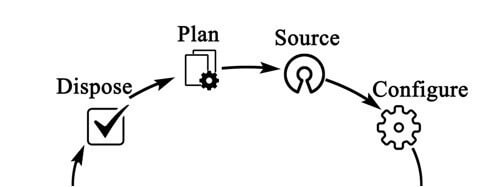
Diagram showing the Life Cycle Management Process, with 'Dispose', 'Plan', 'Source' and 'Configure' stages of the process shown as relevant icons and arrows showing the correct direction of each stage.

Hallmark #3 – They work in partnership to achieve a shared goal

Rather than a transactional customer-supplier relationship, the best LCM vendors take a collaborative approach that considers the entire project lifecycle. This way, your vendor can better spot time and cost-saving opportunities, and identify and mitigate risks before they impact your operations.

By treating an environment as an end-to-end ecosystem – including working effectively with all your relevant suppliers – your LCM vendor can decide on the best way to replace your infrastructure, while causing the least disruption.

It’s an approach that’s paid dividends for one of our Investment Banking clients. By providing a bridge between the bank’s IT engineers and its physical infrastructure suppliers, we were able to save them £100,000 just by swapping out a single component type.

Hallmark #4 – They focus on communication (but know when to take the initiative)

The biggest roadblock to effective project management is poor vendor communication with you and your suppliers, which can lead to longer project cycles and wasted resources.

It’s a simple concept, but one that far too many LCM vendors get wrong – especially in the Enterprise arena.

By choosing an LCM partner that focuses on multi-stakeholder communication, you can be safe in the knowledge that critical project decisions are being made based on accurate data and facts – supported by previous experience – and communicated to you in a way that keeps you in complete control.

On the flip side, your time is precious, and you don’t always want to be consulted at every stage. So, it’s also important that you trust that your partner has the skills, experience and confidence to make decisions on your behalf where appropriate, and only come to you when necessary.

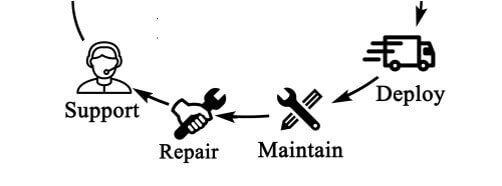
Diagram showing the stages of the Lifecycle Management Process, with the 'Deploy', 'Maintain', 'Repair' and 'Support' stages shown as relevant icons and arrows indicating the direction of each stage in the lifecycle process

Hallmark #5 – They have significant, demonstrable experience

The key attributes of a great LCM partner are nothing without the right experience. An experienced vendor will be familiar with your goals and able to see your project from a different perspective – offering valuable advice based on their past client successes.

Simply, experience is the driver that can save you time and money, and even help give your devices and infrastructure the longevity to stay reliable and secure well into the future.

LCM should be a partnership, not just a vendor relationship

Technical failure in financial services organisations is simply out of the question. So for many, it can be all too tempting to throw money and resources at a solution.

But the truth is, LCM requires a more nuanced approach, supported by open communication, end-to-end project management, and skilled IT engineers capable of making the right decisions – no matter the size or scope of the project.

At CACI, we pride ourselves on having the agility to help our clients react quickly, supported by the scale to reliably complete projects on time and within budget.

What’s more, our skilled project managers and engineers have decades of experience delivering LCM for some of the world’s biggest financial institutions, so you can be safe in the knowledge your needs are being taken care of.

To find out more about our collaborative approach to life cycle management, take a look at our network services capabilities.


Four crucial questions ask about your single customer view

In this Article

Discover whether you have a source of insight you can rely on for business decision-making or if you need to address inaccuracies in your data sources with an identity resolution project

An error-free, up-to-date and de-duplicated Single Customer View is the holy grail to deliver exceptional, personalised customer experiences. It’s also vital so you can analyse customer behaviour and campaign performance continually, evolving and adapting them to sustain performance.

Of course, it’s not a simple aspiration for a modern, competitive and fast-growing business. With multiple data sources in a range of systems and repositories, real-time data flowing in and out and an array of customer channels, you have your work cut out.

The rewards of getting the Single Customer View right are compelling – truly personalised marketing, exceptional customer engagement and loyalty that deliver great campaign ROI, revenues and profits. With a deep understanding of what your customers want and need, driven by highly relevant engagement and analysis of customer behaviour and propensities, you’ll have the insight to design and deliver what your customers want ahead of your competitors.

Without an accurate Single Customer View, it’s impossible to achieve that level of sustained performance. Errors in data create a lack of trust, both within the business and with your customers and audiences who are on the receiving end of poorly targeted campaigns. Campaign planning becomes subjective rather than data-led, while customers turn to competitors who can deliver the experiences and information they want in a timely and relevant way.

FOUR CRUCIAL QUESTIONS

You need a positive answer to all four of these questions about your Single Customer View, if you want it to be a reliable and effective source of decision-making insight:

  1. Does it hold unique, real-time customer records?
  2. Is all the data clean, reliable and standardised, with matched addresses?
  3. Does it bring together customer data from every online and offline source in your organisation?
  4. Is it scalable for future needs?

Not many organisations can answer all four questions with a resounding yes. If you have any doubt about the integrity of your Single Customer View, or if you don’t have one that you can rely on, you need to take action quickly.

To make it easier and quicker to fix or establish your Single Customer View, CACI’s specialist data team has developed the ResolvID application. It’s a powerful tool to create a trustworthy source of customer data for reliable analysis. It resolves data from disparate sources – including your CRM, e-commerce and finance systems as well as offline data and mobile apps. You can use the accurate and unified outputs with confidence for analytics and data science, campaign activation, BI and reporting.

If you’d like to find out more about how ResolvID can help you clean up your Single Customer View so you can deliver high performance campaigns and analytics that are trusted by everyone in the business, get in touch with our team.

Taking the challenge to challenging behaviour in our education system

“In 2011 I was asked to head an EBD (emotional and behavioural difficulties) school and quickly realised that the skills I’d acquired over more than 20 years as a teacher didn’t work – I needed to re-skill and re-skill quickly.” Rich Berry has over 32 years’ experience as a teacher but decided to focus upon improving outcomes for children whose behaviour sits outside of the acceptable ‘norm’, having come to garner a better understanding of why difficult children are difficult.

The school he led was judged to be failing. “I realised that we needed a fresh approach,” explains Rich. “So, I built a team with experience in working with young people who had experienced trauma and we started to investigate neuroscience and the impact that trauma has on brain development in children. Trauma can manifest itself in so many different ways, but we commonly see the emotional struggle emerge in the form of challenging behaviour – this is the only way children have of communicating their struggle; it is not the conscious deliberate act that many assume.

“Through implementing a therapeutic curriculum at the school, our Ofsted judgments began to head in the right direction. The emphasis moved away from a traditional school discipline model and I personally played a more prevalent role in the education process, as an emotionally available adult, always interacting with the students and looking at how we could improve their outcomes.”

After nine years as head of two schools, Rich took early retirement in 2019 to establish his consultancy, Rich Berry Educational Consultancy. He is also co-chair of the charity, Engage in Their Future, which specialises in providing support to teachers and schools for children with SEMH (social, emotional and mental health) challenges. His work covers the UK, with Engage in Their Future working across more than 90 specialist schools and children’s homes.

“I also qualified as a mental health first aid trainer,” explains Rich. “Identifying and preventing mental health issues is a key challenge in helping the children I work with. Early prevention is always the best route, so being able to spot the signs and help them to get the help that they need can be hugely beneficial. I used the mantra with my staff that we were agents for social change. By helping young people overcome trauma they are less likely to suffer with mental health problems in later life.

“In all settings young people’s ability to learn and develop resilience depends on the approaches taken by their teachers, parents, sports coaches and youth workers. It’s a responsibility I put at the centre of everything I do.”

CACI is delighted to be partnering with Rich to provide his consultancy services to local authorities and associated youth justice and education workers. As part of this, and to promote trauma-informed practice and challenge preconceptions around children displaying disruptive behaviour, CACI will be arranging sessions for customers and as part of our tender process.

“Much of my work, whether with parents, teachers or school communities, focuses on challenging behaviour policies,” says Rich of the consultancy he provides. “Teachers feel disarmed if you take away their ability to sanction pupils in a punitive way. What I challenge them to do is to look at poor behaviour not as a deliberate act of defiance, but as a communication. The fact that we struggle to read that communication should not mean that we go ahead and punish. A punitive system tends to do one of two things; either the child’s behaviour continues and deteriorates further, or the child complies and their message is missed, which can lead to a mental health issue in later life. Stats tell us that 50% of adult mental health issues are embedded by 14 and 75% by 17 years of age.

“You can’t argue with neuroscience. There has been a massive increase in our understanding of brain growth as scanning techniques have developed. I use this understanding to develop everyone else’s understanding that trauma causes the emotional (limbic) brain to be underdeveloped. I develop peoples’ understanding of trauma. I then help them to understand that the body’s natural fear systems kick in and what we very often see as challenging behaviour, is just a fear response.”

Please contact us if you require more information.

What can the water sector learn from other sectors to improve customer experience?

In this Article

Identity Resolution, customer segmentation, and real-time multi-channel communication tools have the ability to surprise and delight water customers in the UK. What can be learnt from the success of other sectors?

The dreaded “Beast from the East” of February and March 2018 left over 200,000 consumers in England and Wales with little or no water and resulted in OFWAT releasing their “Out in the Cold” report – measures and requirements to prevent something like this from ever happening again.

Then, Covid hit. When whispers of a distant virus first circulated in the UK, I don’t think anyone truly anticipated just how serious it would be. Over a year into it, everyone is still trying to make sense of the changing consumer habits and how household and non-household consumption will change moving forward. Regardless of anyone’s opinions on how the future might look, one thing is clear – demand is high.

If you’re not familiar with the nuances of demand forecasting or operations for the water sector, you may be thinking “well of course demand is high, everyone is at home”. However, the consequences of this are much more far reaching – from consumers completely changing peak usage as a result of later waking times due to mass non-commuting, to children not being at school during an unseasonably hot Spring in 2020, causing paddling pools to be filled across the nation. This caused a big headache for many departments within the water sector – such as diverting water supplies to meet demand for those at the extremes of reservoir distance, adjusting pressure times for household consumption, and massive concerns about the size of pipes being too small to deliver the demand of water at peak times.

One thing was clear, water companies needed to ask consumers to consider how much water they were using. Nothing as extreme as a hose pipe ban was required (yet)…but considering not filling up your paddling pool every day, not having a bath every evening because you’re in lockdown or reconsidering whether the car needs to be washed every. single. day.

CACI is in the fortuitous position where we work across multiple sectors with the sole focus of enabling organisations to “do amazing things with data”. So, what can the water sector learn from other sectors to enhance their communication with their own customers – not only improving engagement, but ensuring consumers are contacted in channels that appeal to them.

If I was the Director of Customer Engagement at a water company, what would I do?

By following the four below points you’ll be enabling your organisation to trust that you’re speaking to the right customer, with messages that resonate with them, via the right channel.

MAKE SURE MY CUSTOMER DATA IS IN ORDER

If I look at myself, I have multiple email addresses, my surname is frequently misspelt (thanks Rob Brydon), I have two mobile phones with different numbers, even my postal address frequently appears incorrect on certain address look-up providers, which means I’m sometimes on edge as to which of the three incorrect addresses my parcel will be sent to (thank god I live in a little village with a local postie)! Data can get messy. With customer data stored in disparate databases, customer engagement/customer services are often the teams that get the brunt of customer frustration.

Typically, you’ll find a customer who’s disgruntled needing to phone a call centre to complain, to then be asked for their non-sensical account number (which often needs to be found on a letter or via an online account – a whole other kettle of fish trying to log in there), to then be directed to a different team, to then be put on hold. It’s a sure way to reduce C-SAT scores and irritate your customers – probably escalating that complaint and making it harder to resolve.

Now, imagine a world where you can link all customer data and ensure that it’s correct. So, if a customer phones into a call centre with a complaint you’re able to quickly and effectively go to one customer record, with all their contact history. That would improve their experience immediately!

The ability to connect online and offline data in real-time already exists. So, this problem could be a distant memory. Read all about it here.

BE PREPARED IN AN EMERGENCY

If the past has shown anything, having the ability to communicate to customers in real-time across channels is vitally important. The great news? There is already tonnes of technology out there to enable you to do this. Imagine the water supply is being cut off in an area due to a burst main. Well how about if you could:

  • Immediately send out a text or email to all residents affected
  • Provide them an update once the issue has been resolved and direct them to an information hub if they need any further details
  • Send them a letter/email 7 days later apologising for the disruption and informing them of customer service information should there be any further problems.

That’s just in an emergency, imagine if you could set up customer journeys for all sorts of other reasons, e.g planned engineering works, hose pipe bans etc – rather than the typical letter consumers receive.

All this technology exists in the market already and is used very successfully for marketing campaigns. The utilities sector is pretty unique in the requirement to contact customers in these situations – why not take advantage of this powerful technology?

MAKE SURE YOU HAVE THE TOOLS TO COMMUNICATE THROUGH CHANNELS THAT APPEAL TO THEM

Emergency communication is one thing, but consumers are expecting you to provide them with interesting content. We’re already working with lots of water companies to understand financially vulnerable customers and providing the tools to inform them of social eligibility tariffs, for example, but a key area is understanding what channels a consumer is going to respond to, and having the campaign tools in house to deliver this content.

Customer journeys are used widely within sectors such as auto, retail and leisure – there is no reason why the water sector shouldn’t also embrace this to drive engagement (and increase the C-MEX and C-SAT scores).

David Sealey from CACI, interviewed Gareth Ballard from Braze in April last year, and it’s definitely worth a watch if you’re looking to form human connections with your customers.

MAKE SURE I REALLY UNDERSTAND MY CUSTOMERS AND THEIR NEEDS

We talk about this all the time at CACI – segmentation is our bread and butter. I can’t re-iterate enough – understanding your customers is so important. How would you feel if you received a letter asking you to stop watering your garden so much in a lockdown when you’re in the top floor flat in 30 degrees with no access to outside space? Not great.

Trying to encourage behavioural change can be supported further when we add attitudinal information to a rich demographic segmentation. Lessons can be learnt from EDF’s Smart Meter Roll Out programme, where CACI built out attitudes to understand the drivers for people to get a smart meter, and then built an integrated communication journey to encourage change.

How could this work for the water sector? Well, perhaps something like the below:

  • Creative One (Environmental Families): Content around family activities to encourage water saving.
  • Creative Two (Frugal Flat Owners): Content around the money individuals can save around the home by engaging with their water provider, e.g free toilet flushing water savers + a water meter
  • Creative Three (Nosey Neighbours): Use demand metrics to say how much water a neighbourhood is using vs another within the area – or simply provide a number of free water saving equipment delivered within the area to encourage uptake.

Does any of this resonate? I’m very happy to talk you through any of the above as part of an Art of the Possible session and bring in Subject Matter Experts to really drive forward your customer experience. Just get in touch and I can set up a 45-minute session with you today.


Identity resolution robust compliance

In this Article

Get your PII data under control to help mitigate the risk of reputational damage and financial penalties.

Organisations need to be able to demonstrate that they know where all the Personally Identifiable Information (PII) they hold is located and how it’s linked to specific individuals. If you work in a highly regulated sector, the demands and penalties here will be particularly stringent. Obligations may vary by territory, and even between US states. In the UK and Europe, GDPR regulations apply to any data controller.

Identity resolution is a key discipline for responsible organisations who collect data from more than one source about individuals who engage with them or provide personal information of any kind. It means being able to gather all PII data from across a range of systems about an individual. A consistent identity resolution process is the only way you can be sure that you are delivering marketing experiences and engagement in a responsible and compliant manner.

YOU NEED A FULL REVIEW OF DATA IN YOUR DIVERSE SYSTEMS, SOFTWARE AND TOOLS

Compliance is made harder because even if you use the latest digital campaign delivery platforms, you’ll likely have a number of legacy systems, a diverse estate of software and some cloud-based tools in the mix. Somehow, you have to resolve identities across all of these.

The first step is to assess the risk – you need to examine all the data you hold across the organisation and make sense of it. This is a challenge, because your data will be fragmented and the quality will vary. You’ll need a thorough and systematic approach that takes in finance, CRM and e-commerce systems, to address:

  • Accurate data capture and storage
  • Duplication of data and customer records
  • Data validity and standardisation
  • Maintenance of data and recency of updates
  • Data understanding

With a complete and accurate assessment of the quality and completeness of your data, you can look to improve your data collection, storage and identity resolution processes to avoid non-compliance in the future.

Tackling identity resolution for data compliance across your organisation is a daunting task. CACI’s experts have developed the ResolvID application to help customers with complex data and system estates to manage identity resolution reliably.

ResolvID can bring together data from multiple sources, standardise and cleanse it then report on it to reveal issues that need tackling. It’s ideal for managing compliance risk and mitigating against fines and reputational damage. It also provides the consistent, unified customer data you need to deliver successful personalisation and differentiated customer experiences, for revenue and customer growth.

If you’d like to find out more about harnessing ResolvID to assess and tackle your compliance issues, get in touch with our specialist data team.

Identifying the unique customer in data lakes and data warehouses

In this Article

HOW IDENTITY RESOLUTION ENABLES ADVANCED PERSONALISATION IN BIG DATA ENVIRONMENTS

Most organisations have plenty of data. The issue is not how much you have, it’s what you can do with it. You may be sitting on a goldmine of data insight, but you can’t use it to refine personalised communications and marketing unless you can connect it with the digital platforms and tools that will deliver the personalisation.

Tackling this challenge is key to success in a world where consumers are increasingly intolerant of content and approaches that aren’t directly relevant to them. You need to use all the information you have to create unified identities that can inform personalised customer experiences, if you want to compete effectively.

The problem becomes more acute if you are using a data lake as the primary store of customer data. The concept and architecture of data lakes do not lend themselves to the enforced structure, maintenance and standardised logging that good identity resolution requires. At the opposite end of the spectrum, more traditional data warehouses can lack the structure or ability to capture and use large quantities of digital data which can form the backbone of modern identity resolution. These platforms may also be difficult to integrate with other MarTech and AdTech.

TACKLING IDENTITY RESOLUTION IN DATA LAKES

If you work in a big data environment, you may struggle to identify unique customers. It can be risky to rely on insights developed from data lakes, because they have no enforced structure at the point of data capture. This makes it challenging to define a customer view in a consistent manner, with all data points incorporated.

CACI’s identity resolution application ResolvID has a smart way of tackling this problem. It takes in all potentially identifiable information as it’s loaded into the data lake and continues to iterate and develop the customer picture over time. It adds up small quantities of data from sources including transactions, ClickStream data and geolocation to build the identity of a customer. The structure of the customer is defined within the platform: ResolvId makes its keys available for use within any and all resources.

TACKLING IDENTITY RESOLUTION IN DATA WAREHOUSES

If your organisation uses enterprise or operational data warehouses, it can be difficult to connect the finance, CRM and order data held within them directly with digital customer data platforms (CDPs) that serve web, automated marketing and mobile app content.

CDPs maintain digital identifiers, but they need a single customer identifier to truly connect the business with digital channels. Because of the complex nature of data held in the data warehouse, it can be challenging to resolve to an individual’s identity.

Using ResolvID as a middle layer, you can create a unified identity and identity graph that can work in both environments. It connects the systems to enable rapid deployment, unlocking value in your data for personalised campaigns. You’ll achieve a single view of the customer and can report crucial unified measures such as lifetime value.

Read the previous blog to find out factors to consider in delivering personalised content and marketing that fuel sales and retention in competitive consumer markets. Get in touch if you’d like to discuss identity resolution in your big data environment with one of our campaign data experts.

Impact Mentoring – improving outcomes for vulnerable young people and families

One thing that has come under the spotlight in the UK during the Covid pandemic has been ensuring fair access to education for all children. The school environment is often a hugely positive one for many children, offering structure as well as education and, in some cases, meals.

Impact Mentoring was founded by Wayne Cockram to mentor and support children who were struggling with their education and circumstances, inside and outside of schools. “By providing one-to-one mentoring, which so many children need, it develops a trusting, supportive relationship and helps to raise aspirations. Once a young person knows what they want to be, they better understand the importance of education and see school as an important part of their journey, ultimately improving their outcomes,” he explains.

“School is such an important welfare support system for kids. Impact Mentoring is largely funded by the schools, to help us go in and work their students, but when the school holidays come around, that funding stops. To address this gap, we set up the charitable arm of Impact Mentoring, Ignite Life, enabling us to further help kids who simply become isolated during the holidays. We realised that we needed to stop this from happening as a lot of good work was being undone during the school holidays.”

The charity has covered some impressive ground, delivering tangible benefits to young people who needed them most. “We realised that three hours of mentoring wasn’t enough for some of these kids, they needed specialist support,” explains Wayne. “Trauma in early life is a key factor in why some children find learning almost impossible. Specialist therapeutic help such as counselling can repair these issues, but often the wait can be 18 months or more. Going private isn’t an option to most families either, as the costs can be out of reach.”

Ignite Life has provided counselling sessions for young people that are free to schools, parents and the local authority, with an eight-day turnaround from referral, giving these young people the help they need, when they need it.

With the onset of Covid and the subsequent lockdowns and closures of schools, Wayne and his team identified another area of need. “The food vouchers are a great idea in theory, if you can get to the supermarket, do your shopping and get it all home,” he says. “My colleague Tom Gould decided that he would reach out to the some of families around us to see if they needed help with getting food. A lot of families have, for example, children with disabilities, and it makes getting to the shops, doing your shopping and then getting home incredibly difficult under normal circumstances.

“So, Tom started helping out with a few families. We thought, initially, that we might have 20-25 families to support in this way, but we now have over 150. We’re helping to feed over 500 people in our community each week.”

Another challenge posed to these families, and particularly the children, is accessing education during Covid. Many do not have access to the internet, so continuing their education away from the school environment is nigh on impossible.

“We’ve set up an environment here at Impact Mentoring where these kids can come and use our laptops and access the internet,” explains Wayne. “We always have a team of our mentors onsite to help them. This is helpful in many ways; it enables them to continue their educational journey, it gets them out of the house and into a safe space and we can offer them help with their homework and school tasks. Many come from families where such access and support are impossible. We’ve set up a really vibrant, aspirational environment for them here, somewhere where they actively want to come and spend time.”

Impact Mentoring also assists some of the children by giving them laptops that they can take home with them. “This enables us to deliver mobile sessions to some of the children, particularly those who can’t come to our site to use them,” adds Wayne. “This helps to increase the capacity of our services and help more children.”

You can find our more about Impact Mentoring and the important work it does here. And learn more about Ignite Life here. CACI is proud to be supporting Impact Mentoring by donating laptops to the centre.

The actual experience of cloud migration for business

In this Article

LET’S TALK ABOUT THE REAL REASONS WHY ORGANISATIONS ARE MOVING TO THE CLOUD

Behind the hype, it’s solid business evidence that has convinced a critical mass of businesses of all shapes and sizes to make the leap to a cloud computing environment.

CACI Director Miguel Cardoso has worked with many of them over the past decade. He shares what’s really driven their decisions and the impact of cloud on their performance and prospects.

Security, modernisation, data governance, efficiency and cost reduction are some of the headlines that cloud computing providers use time and again to promote the adoption of platforms, applications, and services in the cloud. They’re great soundbytes, but what do they really mean for real world organisations who want to maintain their performance and drive further growth?

Cyber-security is a key reason that organisations I work with are adopting cloud – it’s a specific aspect of data security that’s becoming an ever-greater concern across all industries. The growing incidence and increasingly sophisticated nature of cyberattacks compel companies to invest in technologies and solutions that preserve one of their most important assets – data. Not all companies have teams with specialised resources in cybersecurity, so cloud computing emerges as the leading option to strengthen security and data protection.

The cyber-security resilience of a cloud computing environment come from the managed security services that leading providers offer. This means organisations without large IT and security teams can take advantage of the latest, sophisticated protective technology, and of focused, expertise that would be unaffordable internally. The cloud provider is responsible for managing and mitigating security issues, bearing the investment costs of the necessary technology and human resources as part of their core proposition. This alone is a strong reason to move to the cloud: organisations can offer their customers a vital and reassuring security message underwritten by the cloud provider.

Innovation and agility are frequently cited as cloud advantages. It’s common sense that every organisation wants these capabilities in an increasingly competitive and demanding market. So how does cloud computing help? The modern data platform it provides means that businesses can adopt the latest solutions and applications that support their business operations – from finance management and CRM to campaign delivery and customer analytics.

Cloud computing is inherently designed to connect data and systems, ensuring faster response times, greater accuracy and more informative reporting. All of these improve everyday operational performance and business management. It’s quicker, easier and more cost-effective to expand capacity, upgrade apps and add new functions, so you’re always working with the best technology tools for your business. Businesses that have moved to the cloud find they can adapt to market demands more quickly, keeping pace with customer needs while controlling profit and performance metrics.

Data storage is another key advantage that cloud adopters find compelling. The cloud has become the place of choice for data storage: when companies migrate their applications to cloud platforms they want to capitalise on the innovative applications and advanced analytics that are available. To make it happen, they need fast and systematic data organisation and accessibility. Creating a connected and complete picture of business-wise performance and customer data is much easier in the cloud. As well as enabling trusted management reporting and business governance based on current data, it supports more effective prospecting and forecasting using advanced predictive modelling tools. Cloud-based systems make these affordable and easy to use for all sizes of organisation.

Cost and efficiency come in a strong fourth place – an interesting development, since in the early days of cloud, they were its leading marketing messages. These days it’s taken for granted that cloud computing will be cheaper to run than the equivalent technological and human resources on-site. But even more important for most companies is the value they gain from more agile and modern systems, solutions and services as part of an overall digital transformation. Recent cloud adopters see significant benefits from the way cloud-optimised systems speed up and automate their processes, reducing the amount of manual rekeying and intervention. This frees up admin time so staff can focus on revenue generation and often creates extra capacity in the business to fuel growth.

These success stories are compelling. But is moving to the cloud synonymous with success? Not necessarily. Working with cloud adopters, I have observed that there are three key dependencies for organisations who achieve all the hoped-for advantages.

  1. Initial discovery and direction: you need to make an exhaustive survey of your company’s needs and define strategic goals
  2. The choice of solution: your cloud provider understand your priorities and critical success factors so they can be sure they’re providing exactly what your individual business needs
  3. Careful planning and project management: you must be thorough and rigorous, including all stakeholder and examining the impacts of change at every stage, from the selection of solutions and suppliers to the migration project and ongoing use

New clients frequently tell me that the cloud is “more complex than we expected”. Often, this is because of poor collaboration with previous suppliers. With our long experience, my team can provide an antidote. When we work on cloud transformation and migration projects we focus on:

  • Designing the right approach for the individual client company, with a strong and transparency connection to the desired commercial result
  • Using relevant specialist and industry skills to address core business issues for the company
  • Selecting and deploying the appropriate tools so they are easy to use, secure and viable in the long term to support an agile business that embraces the need to adjust and adapt in today’s demanding markets

If you’d like to talk to use about realising tangible benefits from moving your business to the cloud, please get in touch.

Tackling today’s complex challenges for identity resolution

In this Article

Your customers and prospects want and expect you to communicate with them as individuals. It’s a very natural human desire – no-one wants to feel like they’re just a data point.

Today’s sophisticated data management and campaign delivery technology makes this possible in theory. But effective personalised communication has become more complex in recent times because of the challenges of identity resolution.

Identity resolution has always been important. It means matching identities across different touchpoints to create a unified profile for every customer. The advent of GDPR intensified the need to use identity resolution to manage data preferences robustly across channels and media, to comply with data protection laws.

But legal compliance is only one reason for the extreme complexity of the identity resolution challenge today. For marketing personalisation and for analytics, you need an accurate view of an individual, so you can always communicate with them in context of who they are and what matters to them.

We need to be able to resolve identities better, faster and more efficiently across a much greater amount of data to keep pace with competitive pressures and market demands.

CONSUMERS ARE UNFORGIVING

Your customers are ever more demanding – they want and expect to know about the right products and services at the right time and to be served content that’s relevant to their current preferences. 63% of customers say they will stop using companies who deliver poor individual marketing, according to data cited by the Forbes CMO network.

DIGITAL BEHAVIOUR IS CONSTANTLY EVOLVING

There’s an ever-growing number of channels enabling consumer engagement with brands. Consumers also have more devices. They use them to graze across a range of channels and media – frequently their interactions are superficial and transient. They no longer adopt a consistent pattern of behaviour, nor do they always log in or identify themselves directly when they view content.

YOU CAN’T RELY ON THIRD PARTY COOKIES

The third-party cookie is on its way out. That makes it harder to connect interactions through online advertising on third party sites. First party data is becoming more important, and it must be accurately resolved with other sources.

SOPHISTICATED TECH CAN OVERREACH YOUR CAPABILITIES

Technology is at hand to help and many vendors are pushing their solutions. These are based on complex data science and may include visualisations, digital reporting platforms and next best action platforms. Many are excellent tools, but you need to bring your data together in a consistent, de-duplicated way before you can obtain value from them.

THERE ARE SHADES OF GREY IN DIGITAL IDENTITIES

In the previous digital era, identity resolution was relatively simple – you either knew or did not know who a person was. But it’s no longer black and white. You can also personalise and understand preferences without knowing exactly who the individual is, learning about them through behaviour and touchpoints.

These factors all create obstacles to delivering the personalised content and marketing that fuel sales and retention in competitive consumer markets.

Organisations need to upweight their data science and marketing analytics expertise to deal with the ever-evolving challenges of identity resolution and get the best value and differentiation from their digital marketing campaign tools and tech.

Increasingly, clients are asking CACI to step in as an expert third party resource to tackle these challenges, using the purpose-build ResolvID solution.

CACI is a frontrunner in identity resolution and has pioneered innovative ways to consolidate customer data since the issue first arose. We started with matching services based on name, surname, address. Today, we have built far beyond that expertise to create ResolvID, a real time API-driven product that learns as it resolves a wide range of different data sets. It can also address digital applications where there may be no first party identifiers, instead using IP addresses and device IDs.

Our next blog will be to find out exactly how identity resolution supports advanced personalisation, compliance and accurate analytics, and why this is crucial for your success in today’s digital marketplace. Or get in touch if you’d like to discuss how we can help you tackle the challenges of identity resolution in your customer data.

Maximising profit in the e-commerce boom

In this Article

THE TURNSTILES ARE OPEN: IT’S TIME FOR INTEGRATED CONSUMER DATA INSIGHT TO LEAP JUMP ON BOARD THE RETAIL LOGISTICS MERRY-GO-ROUND, IN SUPPORT OF EVERY FUNCTION

The explosion of e-commerce in the last nine months is putting fulfilment networks under huge strain. The Covid pandemic has accelerated consumer behaviour by five years in just a few months.

Retail and logistics thinking needs to speed up to the same pace. That’s a tall order for systems, processes and strategies that have evolved gradually over a long period in separate business functions.

Because the pressure for change comes from consumers, the key is to apply historic and predictive consumer data to B2B systems. At the moment, that doesn’t happen consistently throughout the retail fulfilment cycle. Until now, comprehensive, integrated consumer and commercial data analytics have not been available for cross-functional use.

WHO OWNS CONSUMER DATA INSIGHT IN YOUR ORGANISATION?

Today, consumer data tends to reside within the retail and marketing team. It isn’t shared with decision-makers in logistics, supply chain and location planning. They plan their provision and services based on historic performance and their own forecasting models.

Traditionally, consumer data is used at the front end of the retail supply chain. Brands and stores analyse consumer needs and channel preferences to determine their ranges, product specification, pricing, channel mix, positioning and advertising messages. Customer data is readily available from epos and e-commerce tracking to inform procurement, product design and marketing.

Most successful retailers have a strong and established capability to use their own data, supplemented with external market research, to predict and meet consumer demand and trends. this means they can consistently source, stock and market the right goods in their physical and virtual shopfronts throughout the year.

That’s a big tick in the box for the retail, marketing, digital and store operations teams. But what happens next? The process of getting the goods to the customer is handled by the logistics and supply chain team. Do they have the same foresight into customer demand in terms of fulfilment, so the whole process is completed seamlessly for customers?

PROFIT IS A COLLECTIVE RESPONSIBILITY

Customer data staying in the retail silo has an impact on profitability. Procurement mark-up netted against retail operations costs may hit the profit target for products, categories and ranges. But fulfilment and logistics can cancel that out if stockholding isn’t optimised in the right locations or the pricing of universal consumer delivery methods is out of kilter with the real cost of supply.

The logistics team is also crucial in delivering an excellent end-to-end customer experience. Their work is often longer-term, because changing warehouse locations and bringing physical stores online is usually slower than specifying and sourcing a new consumer product.

This is an area where costs and efficiency are often harder to measure and understand as they build up across the operation. There’s a big opportunity to save money and improve performance with end-to-end analysis.

Defining consumer demand in different regions and types of logistics catchment is key for location planners to optimise the use of their existing sites and networks and to determine new store and depot locations.

The final mile has long been recognised as the most expensive part of the fulfilment process. But in fact, the final metre is even more critical. Understanding the exact nature of the address you’re delivering to makes a big impact on costs. The difference between a semi-detached house with easy parking on the driveway and a top floor flat on a red route can be ten minutes or more in courier time and efficiency.

UNDERSTANDING REGIONAL DIFFERENCES SUPPORTS FULFILMENT PROFIT AND EFFICIENCY

The same insights should influence the choices of delivery method that retailers offer to e-commerce consumers. Flat fees for postal or courier delivery may be profitable for sending a small item via the Royal Mail, first class. The same fee doesn’t necessarily cover the cost of transporting a bulky item from a warehouse on the southern coast of England to a domestic address in the Scottish Highlands, using a lorry to move it between depots and an overnight courier for the final leg of the journey.

Logistics managers need to understand likely consumer demand at the same time as retail buyers, in order to feed in accurate costs and make provision for responsive fulfilment. And they need to understand it regionally as well as nationally. It’s this information that allows logistics providers and clients alike to manage and measure the effectiveness of their third party logistics (3PL) activity. As client, you can use this data insight to challenge or work with your 3PL to improve efficiency, for everyone’s benefit.

Profitability is everyone’s responsibility in the retail supply process, from marketing right through to end user fulfilment, whether that’s at store or on the doorstep. Strategic and tactical decisions in all these functions need to be informed by the same consumer data insight. It’s a continuous loop of demand and supply that needs data to flow consistently around, reflecting real-time change so that every department can work to the same demand patterns.

THE MERRY-GO-ROUND IS SPINNING: WE CAN HELP YOU JUMP ABOARD

How do you intervene, given the perpetual motion of this carousel of demand and supply? It’s spinning ever faster with the twin pressures of fast-changing consumer habits and fiercer competition. Where can you jump on to the merry-go-round to set the data flow in motion throughout your retail supply process?

At CACI, we have a unique capability to help you jump aboard and infuse consumer data insight into every function in the retail supply continuum. understanding customer behaviour and preferences is crucial at every stage. 

By aggregating small gains throughout the fulfilment process, you stand to make big savings.

We can help you drive value out of data and insight across every business area. From store network strategy to digital channel management, from warehouse optimisation to route planning, we can empower your retail business to deliver goods to consumers rapidly, profitably and competitively across the UK and globally.

We can help make your entire network more efficient and responsive – from stock availability to final metre delivery. Talk to us about driving competitive advantage and supporting sustainable retail growth in the fast-changing world of 2021 and beyond.

Marketing through Covid restrictions and recovery

In this Article

Why marketing attribution analysis is the most important weapon in B2C’s armoury this year.

Everyone’s talking about which changes will stick and what the future holds for consumer brands, as global and national economies and commerce reform and recover from the impact of Covid and successive lockdowns.

With tight margins and budgets the reality for most, and caution the watchword even for the most stable and successful organisations, prioritising and justifying marketing spending is key in an unpredictable and fast-changing world.

Improving overall marketing ROI will deliver most value

It’s ironic that cost reduction pressures are also what stands in the way of designating team resources or recruiting specialists to scope and deliver the comprehensive, reliable and granular information that would enable you to dramatically improve marketing ROI.

Most organisations are focused on value, ROI and prioritised spending right now. Marketing Directors need to spend less and get more bang for their buck – and they need to prove they’re doing it effectively. That means making changes and making cuts. But where?

As one marketing director says, “My marketing budget is under serious pressure so I’m scrutinising every activity and channel for signs of underperformance. Any hint of weakness and I pull the campaign. What more can I do?”

You need more insight to cut costs with minimal risk

The problem is that arbitrarily scaling back marketing activities because they feel expensive or look disproportionate on the P&L can have unforeseen consequences for other related activities. You won’t know the hidden impact of these campaigns until too late, when it begins to reveal itself in bottom line sales figures.

These are challenging times for all organisations. Budgets are tight. New channels are developing faster than ever. Consumer trends are volatile. You need to be agile in rapidly changing markets. Rich, reliable and actionable insight is more important than ever before.

  • How do I sell more with a reduced budget?
  • What marketing actions should I take when things change?
  • What impact does each channel have on others?
  • How do I convince the business that marketing is working?

You need advanced capability in data integration, modelling and measurement

You need to model for growth and changes in your customer and channel mix. You need to know exactly what’s working to engage different customers and where you’re getting strong ROI. You need to measure and model your entire portfolio of marketing and communication activity more rigorously and rapidly than ever before. You can’t afford any bias – for example, relying on analysis from media owners or channels whose interest is best served by more investment from you.

Moreover, adjustments to targeting and positioning can make a dramatic difference to campaign effectiveness. With the right information, you can understand where it’s beneficial to tweak a campaign to optimise it to get more from the marketing investment, and where a campaign is at its maximum potential.

There’s a clear business case for marketing attribution in the post-pandemic world

B2C organisations need access to sophisticated marketing analytics at a time when there’s no slack in the budget for investment in unproven technologies. Happily, marketing attribution analysis is a proven solution. It tangibly improves ROI from marketing activities – and we can help you make the business case based on clear evidence.

At CACI, we’ve developed our marketing attribution approach based on experience gained working with leading global clients that command vast amounts of data and a complex range of marketing campaigns, media and channels. We’re channel, campaign and media agnostic. We can show you the results of optimisation driven by this powerful data insight and share best practice that’s powering the success of leading organisations.

Our short paper 8 key questions you can answer with marketing attribution analysis explains exactly why you need this game-changing insight to fuel your marketing success in your post-pandemic consumer market. Read it now and get in touch if you’d like to discuss how you can put marketing attribution to work for your organisation.

It’s a big question: is your marketing working?

In this Article

Marketing attribution analytics could help you get some clear answers. But many organisations are frustrated by a lack of objective expertise and resources to deliver it. Our marketing data expert Ed Sewell recommends an accessible route.

What’s really working in your business to drive performance from your marketing spend?

Marketing, Finance and Commercial leaders need a dependable, evidence-based answer. But that’s hard to come by in an increasingly complex channel, media and consumer environment.

Your marketing harnesses a vast array of digital and traditional channels. And you’ll already have a range of measures and evaluations in place for many of them. But to prioritise effectively, you need to put it all together to see the contribution and interdependence of all your marketing activities.

Robust, joined up marketing attribution analysis is the only way you can get to the bottom of it.

WHAT’S SPECIAL ABOUT MARKETING ATTRIBUTION?

Marketing attribution can help you answer key questions that shape your marketing priorities and tactics and directly influence sales performance. For example:

  • How do I attract and keep the right customer segments?
  • How well is each marketing channel performing?
  • What impact do external factors have on my marketing results?
  • What channels and content should I invest in next?
  • How do I improve results with reduced budgets?

Detailed, accurate and actionable answers to these questions provide decision-making evidence that you can apply across your organisation and use to formulate a competitive and profitable marketing strategy, ultimately improving results.

The crucial characteristic of marketing attribution analysis is its completeness. It’s an integrated, reliable set of insights that shows exactly what’s delivering ROI and how your activities across all channels inter-relate. The information is current and updates continually, so you can see trends and take action based on real-time market and consumer factors.

WHAT’S THE BEST WAY TO HARNESS VALUE FROM MARKETING ATTRIBUTION?

Marketing attribution is a long way from manually updated spreadsheets or the kind of two-dimensional marketing metrics that are typically used to measure the effectiveness of individual campaigns and channels. It demands specialist expertise and powerful technology, to produce meaningful and clear reporting.

That’s why at CACI we’ve been working on developing a third-party proposition that all organisations can exploit to get rapid results and impact. Based on our experience of marketing analytics across every industry, channel and campaign type, we’ve built an objective and fully integrated marketing intelligence solution that can handle the vast volumes of data that provide a complete picture of marketing effectiveness.

CACI’s marketing attribution analysis is a unique, specialist proposition that we’re able to deliver because of our deep and wide-ranging data insight expertise. It provides complete and continual oversight of all your campaigns and channels, in context of the customer segments you’re addressing and external market factors.

THE ROI OF MARKETING ATTRIBUTION INSIGHT: GET ANSWERS TO EIGHT CRITICAL QUESTIONS

If you’d like to know more about how CACI Marketing Attribution could help you deliver excellent ROI from your activities, read our short paper “Is your marketing working? 8 key questions you can answer with marketing attribution analysis.”