

Posts Getting the message: the art of communicating content that will connect with your audience

Getting the message: the art of communicating content that will connect with your audience

In this Article

More than ever customers expect brands to speak to them, not just literally, but with content that they relate to. It’s not enough to have a phenomenal product, a killer marketing strategy and an arsenal of digital tools – if the messaging is off, it could all be for nothing. Your content is the most direct route to connecting with your audience on an individual level, so using techniques including emotion and narrative, as well as making sure the message fits the channel, is vital to maximising every valuable opportunity.

Sorry, do I know you?

The key to on-target messaging is knowing your audience, and it all starts with the data. Once you’ve collected profile data and created meaningful segments through Tealium and CACI’s consumer segmentation tool, Acorn, you will have a deeper level understanding of who you’re talking to. You can personalise content effectively, far beyond first names, using their last interaction or other details to bring a conversation to life, effectively mimicking one-on-one communication. Knowing a customer inside out means you can signal the values that align with theirs or share their vision for a better life. And the more data captured, the more sophisticated and creative the personal touch can become.

Once upon a time…

Once you have an idea of your audience, how can you effectively capture and hold their attention? Evolved over thousands of years, storytelling is the most powerful tool you can use to compel the brain. It has the ability to communicate so much, including, by using the brand as the personality at the centre of the story, who the brand is. Good storytelling uses the power of language and, where possible, causes you to pause and reflect, making it more likely to stick in the memory.

But storytelling doesn’t need words, visual narratives are equally effective and better suited to social media. Videos can prompt a stronger emotional response and are more likely to be shared, whilst imagery can solidify feel and focus. User-generated content can help tell stories whilst having the added benefit of generating trust in the brand. Storytelling in this way isn’t a hard sell. It takes the approach of content marketing, that is, nudging behaviour through being thoughtful, relevant and engaging.

Once more with feeling

Humans are fuelled by emotion – we feel first and think second. Using language that triggers emotions we are hard-wired to respond to can be very effective. Love, fear, anger and guilt are all primitive drivers of behaviour. By knowing your audience, you can speak directly to their individual joys, fears and pain points, and ultimately inspire them to take action. For example, a car’s anti-lock braking system may help you have more control whilst driving, but if you say it helps keep your family safe, it taps into a desire to protect your loved ones and is more likely to resonate.

After the turmoil of Covid, most people feel the need for connection more than ever. The global pandemic has reminded us that we all crave the very human experience of bonding.

Using emotion to cultivate a sense of belonging can establish a connection which is more impactful and longer lasting. It goes beyond selling, it’s a way of bringing authenticity to a brand’s identity and helps the reader buy into the brand values and ethos.

Mixed messages – making the message work for the channel

Increasingly consumers take different pathways to making a purchase, having different touchpoints along the way. Whilst it’s important messaging is consistent, it doesn’t have to be adhered to rigidly. With an awareness of which audience uses each channel, the message can be creatively tailored using a tool such as Spirable to have the most impact on the target audience.

For example, Instagram is more likely to be used by Millennials or Generation Z, so messaging needs to align with their interests and needs, and the tone will be more assertive and dynamic. Email marketing provides an opportunity to pique interest through weaving more narrative, focusing on messaging that resonates with the demographic, whilst push notifications can use real-time content to engage and visuals to bring a message to life.

There’s no one quick fix to creating a message that connects with your audience. But a combination of personalisation, focus on tapping into an emotion and telling a story are more likely to make your reader sit up and take notice, and make sure your message doesn’t get lost in the noise.

Accelerating value realisation with CACI and Braze

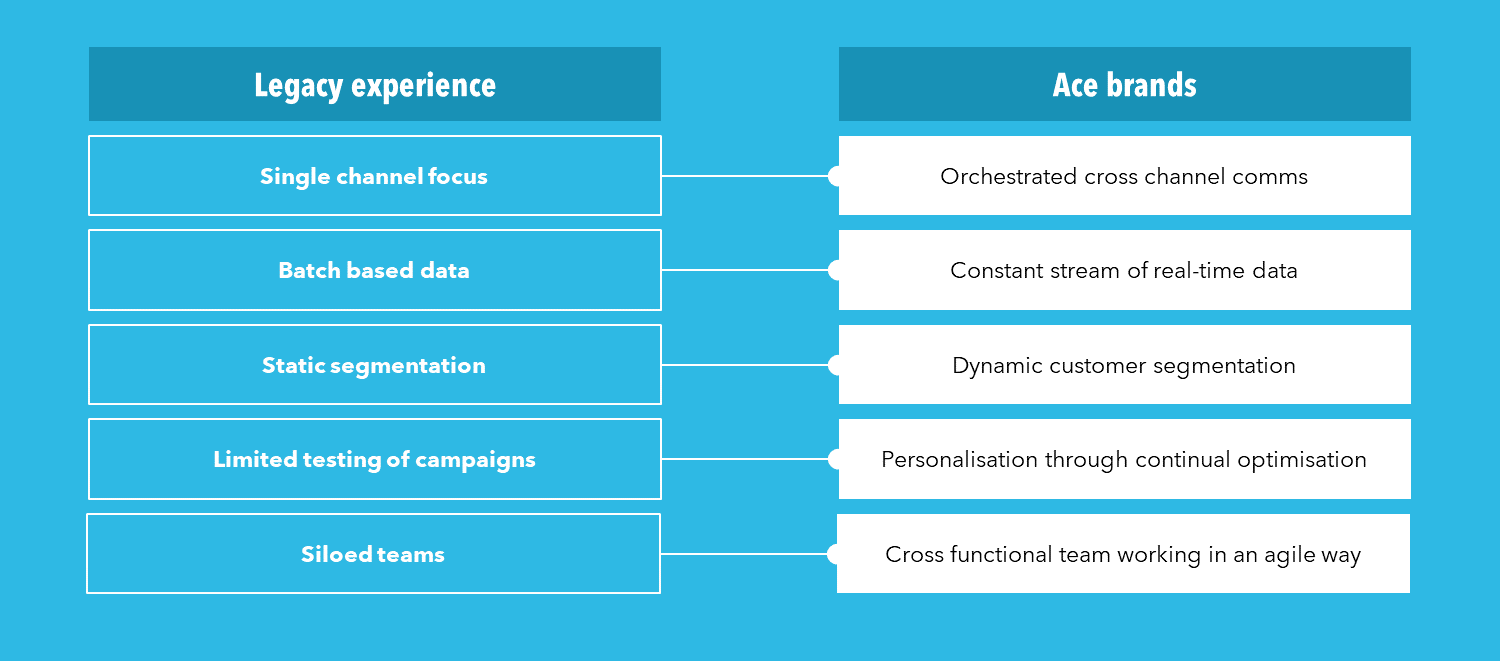
Braze’s recently published 2021 Global Customer Engagement Review is a report worth reading for customer-oriented marketers. Through research and in-depth analysis of customer experience data, Braze has gleaned vital insights into what separates brands that deliver a poor experience with those that excel (Braze titles these the “Ace” brands).

One stat that particularly caught my eye was that Ace brands are 56% more likely to exceed their revenue targets. And this is across all areas of customer activation, conversion, monetization and retention. They are leveraging all the features of Braze’s real-time customer engagement platform to improve the customer’s experience which in turn leads to more customers spending with the brand.

Set out below are the differences between brands delivering legacy customer experiences, and how Braze’s Ace brands are performing. It’s clear that Braze is enabling customer focussed organisations to create experiences and communications that resonate and connect with the recipient.

At CACI we’re helping brands to get the most from Braze. We’re a trusted partner at implementing, optimising, integrating and running Braze for our mutual clients. The work we’re doing with brands who want to be classed as Ace has highlighted five areas where value realisation can be accelerated:

  • High quality implementation of Braze – without this there may be challenges accessing or relying on the data that Braze holds
  • Real-time data integration – to deliver meaningful in the moment experiences, Braze requires fresh data
  • Optimisation not migration – when migrating campaigns from your old platform, take the time to optimise them based on Braze’s capabilities
  • Accelerate personalisation and optimisation – change business practices to enable more continual improvements to your campaigns and comms
  • Have the right model of expert support – whether it’s for creative assets or execution of CRM activity; you need the right type of agency relationship

CACI has now developed a set of Braze Accelerators designed for CRM teams who need to achieve greater results in a reduced timeframe.

If you’d like to find out more about how we could enable your brand to achieve more with Braze, get in touch and I will send you a copy of the presentation on our accelerators.

Democratising student access and experiences

As we have seen with the recent news around exams results, democratising student access to higher education is an important theme in the British educational landscape. With a skewwhiff government algorithm seemingly penalising students from disadvantaged backgrounds, a reworking of A-level results is underway to ensure a fairer grading process is implemented. Granting students fair access to education is one thing, but what happens to those students who are finishing their degrees and looking for work? What can higher education facilities do to democratise the employment prospects of students once they have completed their courses?

A survey by Prospects in May 2020 found that more than half of final year students have lost jobs or internships due to the ongoing COVID-19 pandemic. Colleges and universities often work closely alongside prospective employers to deliver internship and employment opportunities, but could this process be opened up further to improve the employment outlook of students going forward?

As we’ve seen during the pandemic, technology is playing an increasingly central role in how we work and communicate. Where work calls are taking place on platforms such as Zoom, so are university lectures and seminars as institutions have scrambled to deliver their core services to their students.

The upshot of this is that the door to innovation within higher and further education facilities has well and truly been opened, with what seemed like an alien concept until very recently now the ‘new normal’. Furthermore, it is showing that the technology and innovation works, with students completing their studies online across the UK.

At the heart of this is the crucial focus on improving student outcomes. This is an emphasis that sits across the educational spectrum, from 0-25 years, to deliver the best possible education to everyone. Technology is playing a central role in this, helping schools, colleges and universities to link external factors and circumstances to each student’s journey in order to make the best possible provisions for them.

The SEND (special educational needs and disabilities) experience is a good example of this, with records being established early and shared across the student’s educational facilities. This information can be shared with further and higher education institutions as well, to assist them in appropriately catering for and focussing on that student’s outcomes.

The increasingly widespread use of technology is also making education more accessible for all. With courses, lectures and seminars available online, it removes some of the financial burden of having to live in a different city or even of having to pay for transport to and from college or university. This delivers a transparent and comparable student experience to all.

Crucial to the success of remote learning is communication. Students need to be able to access their tutors and course information easily and flexibly. With the student experience moving online, such access also needs to be available virtually, too, in order to establish regular contact and touchpoints to deliver an individual service to each student.

Having access to a student app is an increasingly popular way of opening up two-way communication between education facilities and their students. Creating a central hub for the student enables them to view things such as timetables and course registrations, as well as get in contact with their tutors.

By extending this functionality to prospective employers, further and higher education facilities can help generate awareness of employment opportunities for their students, too. This further helps colleges and universities to communicate with and provide an enhanced service to their students.

There is an opportunity to encourage collaboration and engagement between students, education facilities and employers that focusses on improving student outcomes. We’re seeing the potential that technology is unlocking in democratising the student experience, so it makes sense to extend this to employment opportunities, too.

For more information on how implementing a student app across your educational facility can help empower your students and their outcomes, please click here.

How is COVID impacting student finances?

In this Article

Student finances have been something of a hot topic in the higher education industry ever since student tuition fees were raised in 2010. The cost of going to university has really been placed under the microscope, with universities themselves under added pressure to provide value for money to an increasingly expectant population of students. A paradigm shift in attitudes has occurred where there is more focus now than ever before on what students are getting for their money, not least from the students themselves.

The COVID pandemic has ratcheted up the pressure on universities still further. There have been no material reductions in fees as the cost of providing the courses hasn’t drastically altered, with many lectures and seminars having moved to an online environment to mitigate the risks of the virus spreading whilst also providing students with a learning outlet. This has posed challenges to students and their tutors.

Do students feel they are getting value for money?

We recently conducted a survey of 300 UK-based students to assess how they are feeling about returning to university in these COVID times. Among the questions we sought to gain an understanding as to how students felt their finances and overall value for money from their courses were being affected.

View the Survey

In isolation, that might not sound like anything new, with the stereotype of students scraping together enough pennies towards the end of term for another night out. Attitudes in that regard, however, have shifted, with average student debt from a three-year course now standing at around £50,000. That’s a significant debt burden to be saddled with, so getting the most from their education is paramount and appropriate budgeting is central to that in order to cover course necessities.

Paying off that debt is also brought into view for students, with 55% of respondents stating that they are concerned about finding work upon completion of their studies. With the labour market being hit by COVID this is a very real concern for students. The ultimate aim of obtaining a degree is to improve employment prospects, but with that becoming an area of concern, there is likely to be a knock-on effect for some as regards attending university in the first place. At this moment, however, only 12% of students feel that COVID makes it less likely that they will complete their course.

Overall, 47% of students feel that they are not getting value for money from their education. 29% of respondents feel that they are getting value for money, with 24% not having an opinion either way.

Changing Perceptions

What can universities do address this perception amongst students? Value for money is something of an intangible and can only really be quantified by the individual, but by improving the student experience, universities can begin to address this issue.

65% of students are concerned about their lectures and seminars being affected, but universities have been very quick in embracing online solutions to deliver their learning programmes. This is something that is actively being used to combat such fears amongst universities, yet the fears remain.

The most effective way for universities to combat such negative perceptions is via clearer communication. COVID has heralded a period of great change across society, with universities no exception. Office workers are working from home now and students are studying from home. Joining the dots between fears over the impact of COVID to their studying, and the reality of the options available, is crucial for universities in managing student expectations and offering value for money to them.

Deploying an all-encompassing student information management system enables universities to keep a track of their students, the disruptions that they are facing at an individual level and to be able to more effectively communicate with them around any short, medium- and long-term changes that are occurring. This connects universities, students and their courses more closely, providing greater clarity and a greater sense of value for money.

For more information on how OSIRIS can help your university, please click here.

COVID, campus and communication – student survey reveals concerns over universities’ handling of pandemic

Managing the Covid pandemic and its potential spread through university freshers’ week was a difficult challenge for universities. Perhaps most prominently, Glasgow University was forced into an early lockdown in its halls of residence as positive tests for Covid spiked shortly after the new intake of students arrived in the city. This presented a significant challenge to the university in communicating with its students and managing the situation.

CACI recently conducted a survey of 300 students around returning to university, their studying and their overall student lifestyle in the face of Covid. Unsurprisingly, 95% of students expressed concern about the impact of Covid upon their lifestyle. This isn’t a concern restricted to students, either, with lockdown rules and government guidance being enforced to try and restrict the spread of the virus across the whole of society.

When it comes to the student experience, 59% of students are concerned about socialising and 55% are concerned about returning to a physical location in order to continue their studies.

View the Survey Here

The challenge for universities is in providing a seamless student experience that can incorporate the learning and socialising outcomes that most expect from attending university. There is, after all, a reason why these students have chosen to attend university rather than complete an online course.

71% of students view the university campus as integral to their student experience, yet 45% believe that it is unlikely that they will return to study on campus again. There is an element of managing a transition into the unknown for universities here.

Universities have been carefully implementing Covid secure environments to smooth the passage of safe return for students. One-way systems, mandatory face coverings in buildings and socially distanced lecture halls and libraries are all designed to protect students, staff and the wider society in which the university is situated.

Whilst such measures undoubtedly impact on the anticipated student experience, they do help universities to manage student concerns. But what of those students forced into self-isolation by an escalating situation around them?

Whilst 59% of students are concerned about socialising, 41% are not. This inherent contradiction is impossible for universities to manage. What universities can – and have – managed is the fear of the 55% who are concerned about returning to a physical location.

Communication plays a vital role in this. Clear guidance has been given by universities to their students about acceptable behaviour during Covid, with household bubbles and a restriction on mass gatherings put in place. Beyond that, universities are reliant upon the social conscience of their student population to abide by the measures put in place.

The measures put in place by universities show that they can manage the contradiction between their students viewing campus as integral, yet also a cause for concern. Effectively demonstrating this to their students, and communicating clear policy and guidelines, can help to assuage anxieties in the student population about returning to campus.

Technology can play a fundamental role in the new student experience, too. Lectures and seminars are increasingly, although not exclusively, moving to online platforms. With Covid guidelines an evolving and ongoing concern, universities need to be able to respond to the challenges and communicate their policies to their students quickly.

Student information management systems can help universities to meet these changing demands. Via a system such as OSIRIS, for example, students can download a white labelled university app, through which the university can send instant communications, present timetables and course options, as well as putting students in touch with their tutors.

Centrally managing the ongoing response to Covid will help universities to stay on top of the problem, implement effective responses and keep their students informed, safe and up to date.

For more information on OSIRIS, please click here.

Can real-time detection and site inspections help to reduce railway trespass?

In this Article

Trespassing on railway tracks has always been, and to some extent always will be, an issue for train operating companies, British Transport Police and Network Rail. Recent data from British Transport Police and Network Rail shows a five-year high in trespassing incidents in 2020, with September seeing 1,239 incidents reported – the worst month over that period. Furthermore, trespass costs the railway network £50m every year, with the overall cost to the UK economy standing at £800m per year. What can TOCs and Network Rail do to address the situation?

Network Rail and British Transport Police have really ramped up awareness of the dangers of trespassing over the past couple of years, with social media campaigns targeted at a younger audience which have included aspects such as football club Twitter accounts promoting awareness of the issue in order to help reach a younger audience. Increases in trespassing incidents usually coincide with school holidays, so reaching school children with the messaging has been the main priority.

It’s not just children, however, who are trespassing on the lines. Trespassing on the tracks became a national story in October when a couple in Whitby were caught having their wedding photos taken on railway tracks.

The cost of trespassing to the rail industry is vast, running into the hundreds of millions of pounds every year. Where trespassers are spotted, trains must stop or run at reduced speeds, causing knock-on effects to the smooth running of the network. Then there’s the cost to the public of any police enforcement that requires conducting to end incidents. This can then result in the added cost of administering fines and court appearances and, in some severe cases, jail terms.

A Data Driven Approach

There’s only so much TOCs, Network Rail and British Transport Police can do to stop trespassing. Data suggests that their social media campaigns have had a largely positive impact, with incidents involving children decreasing. British Transport Police report that taking a short cut is the primary motivation for trespass, followed by thrill seeking. Such temptations will always remain.

CACI can help. Utilising Internet of Things (IoT), sensors and smart video cameras mounted inside the train’s driving cabs, CACI‘s real-time trespass solution is capable of capturing foreign objects on the rail network and enabling real-time video playback of an incident to Operational Control Centres. This enables TOC staff to quickly assess the problem and alert Network Rail and British Transport Police to rapidly deploy staff to site.

Not only does this help to pinpoint the location of a live incident, and help to reduce the impact and the delays each incident causes, but it also provides intelligence on trespass locations to help determine trespass hotspots across the network.

Regular inspections of these hotspots can make a difference, but it’s impossible to police every inch of the railway network. This is where data gathering enables efficient targeting of hot spots in the battle to reduce incidents.

With key areas identified, it then makes the task of trying to decrease trespassing incidents a bit easier. Using a robust data framework, sites can be inspected regularly to ensure that everything is in place to deter trespassers, from ensuring that trackside fencing is repaired to putting up clear signage that highlights the dangers of trespassing.

Inspectors can be scheduled to ensure that sites are visited on a regular basis, with the inspectors using real-time reporting mechanisms to report back with any defects they spot onsite immediately. This can then automatically trigger a workflow to ensure that appropriate remedial work is scheduled and conducted in a timely fashion.

By automating sections of the administrative process involved in scheduling, recording and actioning work, it saves rail companies time in carrying out inspections and ensures that they are conducted with appropriate regularity. This gives you peace of mind that hotspots are being regularly checked, in real time, and that appropriate signage is in place to help prevent and deter trespassing at identified hot spots.

A Safer Rail Network

Such technology can be used beyond trespassing, too, to ensure that appropriate safety precautions, such as up to date signage, are in place across the rail network, both onboard and outside train carriages, to help reduce the number of incidents. With real-time information being recorded by inspectors out in the field, follow-up work can also be auto scheduled to ensure that the right steps have been taken and that no jobs get missed.

This frees up the time of administrators to work on identifying areas for improvement across the network, helping to run a safer rail network.

Find out how Cygnum can support your scheduling, inspections, data recording and workforce management.

Find out how Radar can help you gather real-time information on the status of your network.

Disaster recovery, downtime and high availability – how is your organisation effected?

In this Article

System downtimes and outages are very costly for businesses of all sizes. Of course, the bigger companies suffer eyewatering costs when they experience system outages: in 2019 a 14-hour system outage cost Facebook $90m and in 2016 a five-hour system outage cost Delta Airlines $150m with 2,000 flights cancelled. With the business costs of system outages potentially being so high, it is worth carefully considering the impact that any system outage may cause you.

How does your organisation organise its IT infrastructure? Some outages are seen as inevitable, for example where your system and software need upgrading, but with careful planning the impact of such downtime can be minimised. Planned downtime will be made clear in your service level agreement with your hardware or software provider. Non-planned outages are mitigated via the disaster recovery plans for the respective system.

Minimise Disruption

Business continuity (BC) ensures that aspects such as backups are in place, that data is backed up at regular, logical points and even that backup, physical locations are designed in such a way to mirror the current working environment. Disaster recovery (DR) is scoped to cover unforeseen scenarios ranging from loss of power (at the level of a single server to a complete datacentre), hardware damage or loss through fire or theft, to prolonged system failure. Every organisation has such disaster recovery scenarios covered via its business continuity planning.

Aligning your software solution(s) to your BCDR (business continuity and disaster recovery) plan minimises disruption by ensuring minimal changes to your existing tried and tested disaster recovery processes.

This is where recovery point objectives (RPOs) and recovery time objectives (RTOs) are factored into the BCDR and high availability equations.

RTO is the acceptable time limit after an incident in which your system can be recovered and restored. This interlinks with the RPO, which defines the maximum time period it is tolerable for data to be lost. For example, if your system, with an RTO of three hours goes down, this means that the maximum period of time your organisation should expect to be down is three hours. If the RPO is also three hours, then when the system is back up the maximum amount of data that could be unavailable is three hours prior to the incident occurring.

Keeping Your Business Running

The shorter the time frames for RTOs and RPOs, the higher the associated costs. Having an RTO and RPO close to zero (i.e. no down time and zero data loss) would require, effectively, ‘real-time backup’ with transactions replicated to an offsite system.

The same is true of high availability. Organisations require high availability in order that system outages are kept to an absolute minimum. For certain public bodies, organisations and institutions, such as those in the public sector including transport operators, healthcare, care service providers and hospitals, as well as private enterprise companies specialising in data, high availability is imperative. The higher the availability, however, the higher the cost, so it is important to consider all factors when implementing such measures.

Availability is measured in nines, from one nine, or 90%, to nine nines, or 99.9999999%. One nine equates to 35.53 days of downtime per year; nine nines equates to 31.56 milliseconds. What sort of availability your organisation requires is based upon what is tolerable to your organisation in terms of downtime, and the impact of this down time to your operations. With the possibility of conducting planned and scheduled upgrade works over weekends, many firms can accept a lower level of availability in return for reduced costs, keeping any disruption away from most of the workforce.

Therefore, it is important for software and service providers to engage with your overall BCDR strategy. For example, for companies that we supply our Cygnum software to, we understand that we’re only one component of their overall BCDR equation. It is, therefore, vital that we engage with the customer to understand their BCDR processes so that we can dovetail our solution and service level agreements to align with this. If their BCDR processes are not aligned across their technology solutions, then in the event where disaster recovery is required, inconsistent RPOs and RTOs will result in an inconsistent resumption of business as usual.

What’s Right for your Business?

We have seen an increase in demand across our customer base for highly available solutions recently. Those operating in care and transport, for example, require higher availability than those operating in less sensitive areas. Cygnum 2020 can now be installed with real-time site-to-site transaction processing implemented to give a true highly available solution.

It’s all about striking a balance and finding what is required in your business. Would losing an hour’s worth of data be acceptable? Would losing three? Or five? Similarly, does your system need to be fully functional all the time, or can you work around planned and scheduled downtime?

Working with you we can propose the best solution as regards implementing, maintaining and upgrading Cygnum in line with your technology stack, your BCDR processes and how you run your business. As our high availability and hosting solutions have evolved in line with client demand, our solutions have become more adaptable and scalable, meaning that higher availability solutions are more readily and affordably available than they have been in the past.

Depending on your needs, we can work with you to ensure that our service level agreement fits your requirements and budget.

For more information on Cygnum, please click here.